Tag Archives: Creation

Alpha And Omega

Alpha Omega Bible

I am Alpha and Omega, the beginning and the ending, saith the Lord, which is, and which was, and which is to come, the Almighty.  (Revelation 1:8)

These words recorded by the Apostle John, the one “whom Jesus loved” (John 13:23; 20:2; 21:7, 20), introduce the One who would “reveal” the details of the final events of world history. At this time, John was an old man probably in his nineties, exiled on the island of Patmos “for the word of God, and for the testimony of Jesus Christ” (Revelation 1:9). It was Sunday, “the Lord’s Day,” and John was “in the Spirit” (Revelation 1:10).  John does not say, but I imagine that he was reading and meditating on Daniel’s prophecy and praying. John earned the nickname “Camel Knees” (so I am told) for the calluses he developed from hours on his knees in prayer. While in that posture, “a great voice, as of a trumpet” interrupted his meditation, and the resurrected Lord introduced Himself as “Alpha and Omega, the first and the last” (Revelation 1:10-11).

John recognized Him, although he had never seen Him like this before – “clothed with a garment down to the foot, and girt about the paps with a golden girdle. His head and his hairs were white like wool, as white as snow; and his eyes were as a flame of fire; And his feet like unto fine brass, as if they burned in a furnace; and his voice as the sound of many waters” (Revelation 1:13-15). John, in the company of Peter and James, witnessed Jesus transfigured on the mountain (Luke 9:28-36) in the days of Jesus’ short ministry on earth. That experience left the disciples awestruck, but it was nothing compared to this appearance.

Alpha, the first letter in the Greek alphabet, represents the beginning of the Word. In his Gospel, John wrote, “In the beginning was the Word, and the Word was with God, and the Word was God. The same was in the beginning with God. All things were made by him; and without him was not any thing made that was made” (John 1:1-3, emphasis mine). The Word of God, the Holy Bible, opens with the same phrase: “In the beginning God created the heaven and the earth” (Genesis 1:1, emphasis mine). God, the “uni-plural” Elohim, created the universe – all things – through His spoken Word: “And God said, Let there be light: and there was light. And God saw the light, that it was good: and God divided the light from the darkness” (Genesis 1:3-4, emphasis mine). John says, “In him [the Word] was life; and the life was the light of men. And the light shineth in darkness; and the darkness comprehended it not” (John 1:4-5, emphasis mine).

The Alpha of the Bible goes on to describe the six-day creation acts of God. On the sixth day, the Elohim created all the land-dwelling animals, and at last, He created man. “And God said, Let us make man in our image, after our likeness: and let them have dominion over the fish of the sea, and over the fowl of the air, and over the cattle, and over all the earth, and over every creeping thing that creepeth upon the earth. So God created man in his own image, in the image of God created he him; male and female created he them” (Genesis 1:26-27, emphasis mine). The switch between the plural (us/our) and the singular (his/he) provides the first insight (in English) to the triune nature of God, which is developed later in Scripture. However, in the original language of Hebrew, that insight appears in the very first verse. God (Elohim) is the plural form of the noun for god (el); however, the verb “created” (bara) appears in the singular form, which under other circumstances would be a grammatical booboo in Hebrew.

So, God creates man in His own image, which among other things, implies that man too is triune in nature. One aspect of that triune nature involves the physical form that animates and transports “the soul” of man. “And the LORD God formed man of the dust of the ground, and breathed into his nostrils the breath of life; and man became a living soul” (Genesis 2:7, emphasis mine). What physical shape would reflect “the image of God”? The Hebrew word translated “formed,” yâtsar, describes the work of a potter molding and shaping a lump of clay into a useful vessel. The Word, by whom “all things were made,” molded and shaped the kind of body He would one day inhabit. “And the Word was made flesh, and dwelt among us, (and we beheld his glory, the glory as of the only begotten of the Father,) full of grace and truth” (John 1:14, emphasis mine).

God took His image bearer “And the LORD God planted a garden eastward in Eden; and there he put the man whom he had formed” (Genesis 2:8). There God provided for man’s every need. The Garden of Eden provided an abundance of food and water (Genesis 2:9-10) with a perfect climate (Genesis 2:5-6). Best of all, sickness and death did not exist. God gave His stamp of approval on His perfect creation. “And God saw every thing that he had made, and, behold, it was very good. And the evening and the morning were the sixth day” (Genesis 1:31, emphasis mine). Death could not exist in a “very good” creation because the Bible says that death is “the last enemy” (1 Corinthians 15:26).

God and His image enjoyed intimate fellowship as God walked “in the garden in the cool of the day” (Genesis 3:8). However, love coerced is not love. Love must be a willful choice, and God allowed for the choice. “And the LORD God commanded the man, saying, Of every tree of the garden thou mayest freely eat: But of the tree of the knowledge of good and evil, thou shalt not eat of it: for in the day that thou eatest thereof [dying] thou shalt surely die” (Genesis 2:16-17, emphasis mine). Death did not exist in the Garden of Eden, but the potential did exist. Man had the choice, and man made the wrong choice. “And when the woman saw that the tree was good for food, and that it was pleasant to the eyes, and a tree to be desired to make one wise, she took of the fruit thereof, and did eat, and gave also unto her husband with her; and he did eat” (Genesis 3:6, emphasis mine). Man made the choice, and death entered God’s perfect creation.

The remainder of the Bible tells the story of God’s work in restoring fellowship with His fallen and dying creation. Only the blood of a perfect and innocent victim could make amends or reparation for the perpetual infraction. “For the life of the flesh is in the blood: and I have given it to you upon the altar to make an atonement for your souls: for it is the blood that maketh an atonement for the soul” (Leviticus 17:11, emphasis mine). The blood of animals fell short of the requirement because it was man, not animals, that sinned. “For it is not possible that the blood of bulls and of goats should take away sins” (Hebrews 10:4). The atoning blood-sacrifice must be that of a perfect, innocent man; nothing less would do. However, no man fit the bill, for “As it is written, There is none righteous, no, not one” (Romans 3:10). No human solution could be found. Therefore, “the Word was made flesh, and dwelt among us” (John 1:14, emphasis mine). “But [the Word] made himself of no reputation, and took upon him the form of a servant, and was made in the likeness of men: And being found in fashion as a man, he humbled himself, and became obedient unto death, even the death of the cross” (Philippians 2:7-8, emphasis mine). “But this man [the Word], after he had offered one sacrifice for sins for ever, sat down on the right hand of God” (Hebrews 10:12, emphasis mine). The debt is paid in full, and God offers the pardon as a gift to whoever will accept it. A choice must still be made – accept the gift or reject it. Love is not coerced.

Omega is the final letter in the Greek alphabet. Just as Alpha opens the book with God’s perfect image bearers in the pristine Garden of Eden, Omega closes the final book in a new heaven and new earth (Revelation 21:1) – Eden restored. There, the fellowship between Creator and creature is renewed (Revelation 21:3). Death and the grave no longer exist (Revelation 20:14), neither do tears, sorrow or pain (Revelation 21:4). The Tree of Life is there (Revelation 22:2), but not the Tree of the Knowledge of Good and Evil. The residents of the new heaven and new earth chose God’s free pardon during their time on earth. They chose to love God of their own volition; therefore there is no longer any curse, nor the option to choose evil (Revelation 22:3), “and they shall see His face” (Revelation 22 4) – the One who started it all. “I am Alpha and Omega, the beginning and the end, the first and the last” (Revelation 22:13).
2 Comments

Filed under Bible, Christianity, Creation, End Times, Evangelism, Gospel, Heaven, Origins, Religion, Salvation, Theology

Natural Selection

Animals

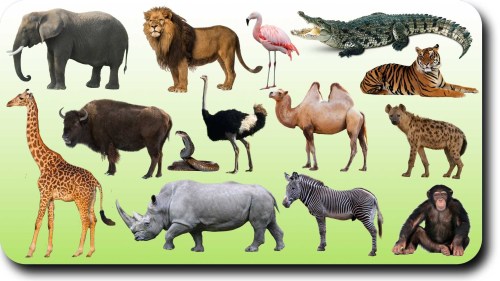
And God said, Let the earth bring forth the living creature after his kind, cattle, and creeping thing, and beast of the earth after his kind: and it was so. And God made the beast of the earth after his kind, and cattle after their kind, and every thing that creepeth upon the earth after his kind: and God saw that it was good. (Genesis 1:24-25)

Natural selection is the means by which Charles Darwin proposed all life on earth sprang from a common source. From where or how that common source first appeared he did not explain nor can his modern devotees.

According to Dictionary.Com, natural selection is “the process by which forms of life having traits that better enable them to adapt to specific environmental pressures, as predators, changes in climate, or competition for food or mates, will tend to survive and reproduce in greater numbers than others of their kind, thus ensuring the perpetuation of those favorable traits in succeeding generations” (emphasis mine). That is a very reasonable definition of what we observe in nature. (For purposes of this discussion, I will limit “life” to those creatures that have “breath” and “blood” in keeping with the biblical definition of life.) All living things possess traits that enable them to survive and thrive in their unique environments. A population achieves stasis when the dominant traits pass on to succeeding generations. Weaker elements of the population are eliminated either through infanticide (mothers kill their own young when they detect abnormalities) or through genetic deficiencies that prevent certain individuals from surviving in their environment. This “process” assures a healthy population.

Not long ago, my wife and I visited a raptor rescue organization in Sitka, Alaska dedicated to restoring to health bald eagles and other predatory birds found wounded in one fashion or another. Once the birds are healthy, they are returned to the wild. At the shelter, they had a female bald eagle that they kept for public education purposes. She was beautiful except that her upper and lower beak overlapped – crossed over each other – in a way that would prevent her survival in the wild. With her distorted beak, she would not be able kill and eat her prey. She could survive in the shelter only because she was handfed small portions of food that she could manage. The staff at the shelter neutered her so that she could not reproduce and pass on the defective trait to her progeny. However, in the wild, the process of natural selection would ensure that her defect would not propagate because she would likely starve to death before procreating. That is what natural selection accomplishes; it prevents perpetuation of unfavorable traits in succeeding generations.

Darwinian evolutionists acknowledge this attribute of natural selection but further attribute an additional process whereby minor changes in the traits over long periods enhance a creature’s ability to adapt to its environment. They suggest that minor beneficial mutations over time improve the creature’s chances of adapting to changing environments. Never mind that such beneficial mutations have never been observed or that such a notion violates the Second Law of Thermodynamics, i.e. entropy. Things in nature tend to degenerate; they do not improve. That is why natural selection is important to maintain stasis in a species.  Without it entropy takes over, and a species degenerates to the point of extinction.

Evolutionists “believe it is totally rational to explain that life’s complexity results from the ever-upward pressure of natural selection’s ability to see and save traits, though it, itself, is undirected and absolutely blind to any goal. [They] must use words like ‘undirected’ and ‘blind’ to reinforce that natural selection, not God, creates nature’s design.”[1] “Genetic alterations called mutations can profoundly affect expression. Evolutionists believe a major source of new genetic material is mutation. The vital need, however, is some type of management—a substitute designer that ‘sees,’ ‘selects,’ ‘saves,’ and ‘builds’ with mutations. ‘Natural selection’ is intended to fill this role.”[2]

So, unwittingly, evolutionists attribute to nature intelligence and discernment to select traits suited for the creature as dictated by their environment. Nature and natural selection effectively take the place of God as Designer and Creator.

The absurdity of the evolutionists’ notion of natural selection presents several problems besides the obvious. Nature is just what is. It does not possess the ability to think, to choose, or to select. Nature is simply what exists around us – our environment. It is the air around us, the earth beneath us, and the creatures that share our planet. That is all nature is. That aside, for nature to produce the diversity that we see in life, it would have to overcome the hurdle of irreducible complexity, i.e. everything needed for life and for reproduction must be present all at once in order for the creature to survive. Even the simplest single-cell life form is so complex that it cannot survive if a single protein is missing in its makeup. Not only that, but if nature could manage to create the first single-cell creature from which all other life would spring, it must accomplish this feat not only once, but multiple millions of times simultaneously to ensure survival of the prototype. Nature must then overcome or reverse the effects of entropy to allow minor beneficial mutations to change the creature into other forms without losing the original prototype. Variations at first reproduce asexually, but as they become increasingly complex over millions of years, sexual reproduction becomes necessary. Here nature must jump another huge hurdle. Nature now must create male and female simultaneously. If nature creates a male and no female, or vice versa, the new species dies – no evolution. The more we ponder this belief, the more the problems exacerbate. One wonders how such a notion qualifies as “science.” Of those who religiously hold to this fantasy, the Bible says, “Professing themselves to be wise, they became fools” (Romans 1:22).

God built into His creation a system by which stasis can be achieved and maintained. This system might be called natural selection or it might be called survival of the fittest, but in either case, the purpose is to maintain the health – the good traits – in a population. In nature, there exists a food chain where predator lives off prey, but if the predator exhausts its food supply, the predator will starve and die out as well. When the jackrabbit population explodes, the coyotes feast, until the jackrabbit population diminishes. Then the coyote population begins to die off. Only the strongest of the population survive. Meanwhile, with the diminishing coyote population, the jackrabbits multiply and there is resurgence. Eventually the coyote population comes back due to the abundance of food, and the cycle starts over. This is by God’s design and it has nothing to do with evolution. Following the Global Flood recorded in Genesis 6-9 God promised, “While the earth remaineth, seedtime and harvest, and cold and heat, and summer and winter, and day and night shall not cease” (Genesis 8:22). This is exactly what we see in nature. When God created sea creatures and creatures of the air on Day Five (Genesis 1:20-23), He determined that they would reproduce “after their kind.” He created them all complete and perfectly suited to their environments, and He declared His creation “good” (Genesis 1:21). When God created the land animals on Day Six (Genesis 1:24-25), He determined that they would reproduce “after their kind.” He created them all complete and perfectly suited to their environments. The Bible makes no allowance for evolution. Natural selection, as a system designed by the Creator, serves to maintain the health of a population, but its design does not promote evolution of one “kind” into another. God does not need “nature” to help Him create. He created nature, and all the systems needed to run this wonderfully complex world in which we live. Nature does not “select.” God creates!

Notes:


[1]  Randy Guliuzza, P.E., M.D., “Natural Selection Is Not ‘Nature’s Intelligence’” http://www.icr.org/article/natural-selection-not-natures-intelligence/

[2]  Randy Guliuzza, P.E., M.D., “Darwin’s Sacred Imposter: How Natural Selection Is Given Credit for Design in Nature” http://www.icr.org/article/darwins-sacred-imposter-how-natural/

2 Comments

Filed under Apologetics, Christianity, Creation, Evolution, Origins, Religion, Science, Theology

The True Moral Fallacy of #justiceforHarambe – Fall on Grace Fall on Grace

And surely your blood of your lives will I require; at the hand of every beast will I require it, and at the hand of man; at the hand of every man’s brother will I require the life of man. Whoso sheddeth man’s blood, by man shall his blood be shed: for in the image of God made he man. (Genesis 9:5-6)

Equating animals to humans is the logical result of evolutionary thinking. If we all evolved from the same source, then all creatures are equally amoral, and there should be no outrage over a human killing an ape to save a human. But there is outrage, and the humans are held to a higher standard. Why? As you point out so clearly, it is because humans are created in God’s image, and we have His innate moral standard, but the ape does not. Furthermore, God’s moral standard does hold human life as more valuable than animal life. (See Genesis 9:5-6 above) Human life is to be preserved above all others. By the way, that would include “unborn” human life.

Source: The True Moral Fallacy of #justiceforHarambe – Fall on Grace Fall on Grace

Comments Off on The True Moral Fallacy of #justiceforHarambe – Fall on Grace Fall on Grace

Filed under Apologetics, Christianity, Creation, Current Events, Evolution, Origins, Pro-life, Theology

No Accident


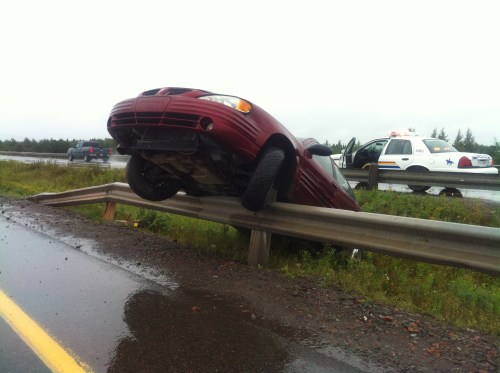
CAUSE: Hydroplaning. EFFECT: Wreck. No Accident!

CAUSE: Hydroplaning. EFFECT: Wreck. No Accident!

All things were made by him; and without him was not any thing made that was made. (John 1:3)

Commuting to work on the rain-drenched LBJ Freeway in Dallas, Texas this past week, I was at once amused and terrified at the maneuvers made by some crazy drivers obviously unaware of the hazardous road conditions. It reminded me of something that my old Driver’s Ed teacher repeated often a hundred years ago, “Accidents don’t happen; they are caused.” Apparently the crazies on LBJ never took driving lessons from my old Driver’s Ed teacher.

The truth of the adage obeys the very basic law of physics, that of cause and effect. Simply stated, everything that happens, i.e. every “effect,” has a cause. On the highway, this basic law expresses itself through Newton’s three Laws of Motion: (1) Inertia – an object in motion tends to stay in motion unless some external force acts upon it, (2) Acceleration – when a force acts on a mass (object) to produce motion, and (3) Reaction – for every action, there is an equal and opposite reaction. These three laws are expressions of the primary law of cause and effect. There is a series of cause-and-effect scenarios that propel a vehicle down the road at high rates of speed. Friction is a stabilizing force acting upon the tires of a car to counter the inertia that would maintain the car’s high rate of speed. However, on a wet, rainy day, friction yields to a phenomenon known as hydroplaning. This “cause” creates a thin barrier of water between the surface of the road and the tires, which effectively negates the force of friction on the tires. The tires lose contact with the road surface and now skim along on a slippery sheet of water. Inertia now controls the forward motion of the vehicle, and the incognizant operator unwittingly presumes he is in full control until he has to make a quick lane change or a sudden stop. It takes little imagination to visualize the “effects” that may result. The frequent “mishaps” witnessed on the highway are “incidents” not “accidents.” The majority of the time, the main cause of these incidents is the loose nut behind the wheel. Lesson: be aware of road conditions!

Forgive the defensive driving lesson, but the point was to illustrate the law of cause and effect. Nothing that exists just happens. There are no accidents. This simple and common fact is overlooked or ignored by naturalists/evolutionists/atheists when dealing with the matter of origins. What caused the universe? The Big Bang they say. What caused the Big Bang? They say that an infinitesimal “singularity” rapidly expanded and produced all that there is. Even though no one existed to witness or record this great event, they (the “theoretical” physicists) can tell us what happened one second after the Big Bang, one minute after, five minutes after, and so on. So, from where did this singularity come? What caused the singularity? What made it expand? “We don’t know,” they admit, “but we are still working on it.” This is what is passed off as science today.

Everything must have a cause, but cause-and-effect can only be taken back so far. Eventually, we must arrive at the cause that caused all other causes, and this cause cannot itself be caused. “Science” has no explanation for this, therefore hypotheses abound. In desperation, absurdities, like the “multiverse” hypothesis, arise to account for what cannot be proven in this universe. Since it cannot be proven in this universe, it must be true in another. The problem is that this universe is the only universe to which we have access to do science. There remains this nagging requirement for science called observation, and we cannot observe other universes, if indeed they do exist. Ours is the only universe we can observe. Our science is limited to what we can observe in this universe.

That brings us back to question of origins. How did our universe come to be? If nothing else, the Big Bang asserts that our universe must have had a beginning. But what caused it all? Reason demands that the original cause cannot itself have a cause. Our universe is no accident.

Where science fails us, the Bible provides a reasonable answer. Naturalists automatically reject this notion; however they offer nothing in its place that makes more sense. “In the beginning God …” (Genesis 1:1). Time, “the beginning,” was caused by God. The reader will note that nothing is presented before God, the Cause. God is the “uncaused Cause,” and the Scripture’s presentation of nothing prior to God expresses His eternal nature, His infiniteness. His eternal existence is the only reasonable and logical response to an infinite series of causes and effects. God is no accident. He is and always has been and ever will be. He is the eternal “I AM THAT I AM” (Exodus 3:14). John identifies Jesus as the eternal Creator (John 1:1-3), and later records the Lord’s self-identification as the Eternal One: “I am Alpha and Omega, the beginning and the end” (Revelation 1:18; 21:6), “I am Alpha and Omega, the first and the last” (Revelation 1:11), “I am Alpha and Omega, the beginning and the end, the first and the last” (Revelation 22:13). He is the One, the initial Cause that started it all. Before Him nothing else existed.

Our universe is no accident; it had a cause – God the Creator. Our world, our earth, is no accident; it had a cause – God the Creator. You and I are no accidents. We have a Creator that fashioned us in His own image (Genesis 1:27), and loved us enough to give us the choice to accept or reject Him. Either choice produces eternal effects. If we choose to reject Him, that decision is eternal. If we choose to accept Him, that decision is eternal. The choice is no accident.

2 Comments

Filed under Apologetics, Atheism, Bible, Christianity, Creation, Evangelism, Evolution, Gospel, Origins, Philosophy, Religion, Science, Theology

Work

Work-needed

But Jesus answered them, My Father worketh hitherto, and I work. (John 5:17)

According to the U.S. Bureau of Labor and Statistics, the current unemployment rate as of this writing is 5.0%. On the surface, that looks pretty good, but when one considers that the unemployment rate rose to over 10% in late 2008 and remained there for almost four years before starting to drop; and that many that lost jobs then, and since then, remain unemployed and off the unemployment rolls, the current report is deceptive. The current statistic draws from a smaller pool of workers. With fewer jobs to go around, companies maintain minimum staffing simply to survive. Not to mention, Obama Care encourages employment of part-time help rather than hiring full-time employees to avoid paying health benefits. As a result, fewer workers are being laid off, so the unemployment number looks better than the actual unemployment. Sources differ, but the actual unemployment rate is somewhere between 40% and 60% meaning that at least half of the country is out of work.

The scarcity of work not only serves to stagnate the economy, but it potentially promotes an increase in crime and civil unrest. Having been created in the image of God (Genesis 1:26-27), humans need to work. Jesus made the point in John 5:17 (above) that God works, and He (Jesus) works. It follows, then that we, His creatures, must work; it comes with being created in the image of God.

So, what happens when we don’t work? A line in an old song says, “busy hands are happy hands; hands that can’t go wrong.” An old saying says, “An idle mind is the devil’s workshop.” God set the pattern for work in six days of Creation. “And on the seventh day God ended his work which he had made; and he rested on the seventh day from all his work which he had made” (Genesis 2:2). Later He would codify that pattern into law. “Six days shalt thou labour, and do all thy work: But the seventh day is the sabbath of the LORD thy God: in it thou shalt not do any work … For in six days the LORD made heaven and earth, the sea, and all that in them is, and rested the seventh day: wherefore the LORD blessed the sabbath day, and hallowed it” (Exodus 20:9-11). The command was repeated again: “Six days may work be done; but in the seventh is the sabbath of rest, holy to the LORD” (Exodus 31:15), and again: “Six days thou shalt labour, and do all thy work: But the seventh day is the sabbath of the LORD thy God: in it thou shalt not do any work” (Deuteronomy 5:13-14). The pattern was established from the beginning. The place where God placed man in the beginning was not a place of leisure. “And the LORD God took the man, and put him into the garden of Eden to dress it and to keep it” (Genesis 2:15).

Work is something God created for man’s benefit. God could have called the entire creation into existence in a nanosecond, but He “worked” in six days to set the pattern for us. Have you ever wondered why the 7-day week is ubiquitous in all the earth? Nowhere on earth is there a four-day week or a ten-day week. All across the earth, the world observes a seven-day week.

Work is God’s gift to us. Yes, work can become “laborious” because of the Fall (Genesis 3:17-19), but it remains in us to work because of the image of God which we carry. The psalmist, Moses, said, “Let thy work appear unto thy servants, and thy glory unto their children. And let the beauty of the LORD our God be upon us: and establish thou the work of our hands upon us; yea, the work of our hands establish thou it” (Psalm 90:16-17). We reflect the image of God through our work. Knowing that should encourage us to do our work with excellence. Modernizing Paul’s words he exhorts us: “[Employees], obey in all things your [employers] according to the flesh; not [only when they are watching you], as [flatterers]; but in singleness of heart, fearing God: And whatsoever ye do, do it heartily, as to the Lord, and not unto men; Knowing that of the Lord ye shall receive the reward of the inheritance: for ye serve the Lord Christ (Colossians 3:22-24).

Since work is something that God does which He imparted to His image bearers, is it any wonder there is so much unrest when there is no work to be had? It would be good, if our policy makers understood that.

1 Comment

Filed under Christianity, Creation, Current Events, Religion, Theology