
Category Archives: Gospel

Doggie Heaven

Peeper

Are not five sparrows sold for two farthings, and not one of them is forgotten before God(Luke 12:6)

Tina, our fourteen and a half-year old Chorkie (half Chihuahua, half Yorkie) is coming to the end of her life, and the prospect of her demise is breaking our hearts. We got Tina when she was not quite three months old from my sister. She was so tiny that she fit in the palm of my hand, and she looked rather ugly with thin, grayish, wiry hair that stuck out in all directions. In the evenings when June, my wife, would come home from the hospital where she worked as a labor and delivery nurse, she would take Tina and put her in the side pocket of her scrubs, and Tina was perfectly happy to go along for the ride. She didn’t stay that small though. She grew to a whopping seven pounds, and our local vet cautioned us that she was getting too fat. Well, she didn’t get any bigger than that, but what she lacked in size, she made up in heart. Tina loves people and tolerates other dogs as long as they know that she’s the boss. She knows no fear and she won’t back down from a fight, even when the aggressor outweighs her by twenty pounds. That’s how she lost her left eye, and how she got her nickname, “Peeper.”

We have many fond memories of the time God has blessed us with our little girl. I can’t believe that I was once ready to get rid of her because she refused to be housebroken. She was almost a year old and she just wasn’t getting it. I told her, “If you don’t stop doing your business inside the house by the end of the week, you’re out of here!” I don’t know if she understood, but from that day on, we had no more problems. When I think of what we would have missed out on had I followed through on my threat, I just thank God that she got the message.

As I ponder what lies ahead for us – will she pass quietly in her sleep? – will we have to watch her waste away slowly because she refuses to eat? – will we have to put her down and hold her as her life leaves her tiny body? – I wonder, why does God allow us to love these little creatures so deeply that our hearts ache when we lose them? I think, “They are just animals.” But are they just animals? Anyone who has ever loved a dog knows that each one has their own personality. They can’t talk to us in human language, but they do communicate. We know what they are thinking and what they want, and they know how to get what they want from us. And when we talk to them, they listen, and it is almost as if they understand. When we are happy, they are happy. When we are down, they seem to know, and they will wrap themselves up next to us, or crawl up on our laps to comfort us. Remember the story of Lazarus and the rich man in Luke 16:19-31? The rich man had no concern for the plight of the poor beggar camped outside his gates. Jesus noted that the dogs had more compassion for this poor wretch and “came and licked his sores” (v. 21). Dogs are like that.

I hope that God has a special place for dogs in heaven. I know that the Bible doesn’t talk about such things. Isaiah speaks of animals in the Millennial Kingdom: “The wolf also shall dwell with the lamb, and the leopard shall lie down with the kid; and the calf and the young lion and the fatling together; and a little child shall lead them. And the cow and the bear shall feed; their young ones shall lie down together: and the lion shall eat straw like the ox. And the sucking child shall play on the hole of the asp, and the weaned child shall put his hand on the cockatrice’ [crocodile’s] den. They shall not hurt nor destroy in all my holy mountain: for the earth shall be full of the knowledge of the LORD, as the waters cover the sea” (Isaiah 11:7-9). Since the wolf is of the “dog kind,” surely domestic dogs will be included there too. The Millennial Kingdom, although it will be wonderful, is not quite heaven. There is yet a New Heaven and a New Earth to be created (Revelation 21:1). There is no mention of animals in the New Heaven and the New Earth, but it is safe to guess that since God created animals before man in His first creation, then He probably will have animals in the New Heaven and New Earth. But do dogs go to heaven?

In the beginning when God created, there was no death. Animals did not die and man did not die. It stands to reason, therefore, that animals too were created to live forever. But that ended when man sinned in the Garden (Genesis 3), and death entered into the world because of man’s sin (Romans 5:12). Man’s sin brought death upon all of God’s creation so “that the whole creation groaneth and travaileth in pain together until now” (Romans 8:22). Animals suffer death innocently because of our sin, but Jesus did not come to die for dogs. “This is a faithful saying, and worthy of all acceptation, that Christ Jesus came into the world to save sinners; of whom I am chief” (1 Timothy 1:15). In redeeming mankind, Christ will redeem His creation. “And God shall wipe away all tears from their eyes; and there shall be no more death, neither sorrow, nor crying, neither shall there be any more pain: for the former things are passed away” (Revelation 21:4).

No, the Bible doesn’t say what happens to doggies when they die. That does not mean that God does not care about them. Our beginning verse reminds us that even seemingly insignificant sparrows do not fall without their Creator taking notice of them. So, as I pray for my little four-footed friend, I ask that God will take note of her. Remember what a faithful little companion she has been. Remember that the curse of death is not her fault; it’s mine. So, if there is a doggie heaven, then please, Lord, make a place for our little Tina.

5 Comments

Filed under Apologetics, Christianity, Creation, Current Events, Dogs, End Times, Gospel, Religion, Salvation, Theology

Willful Blindness

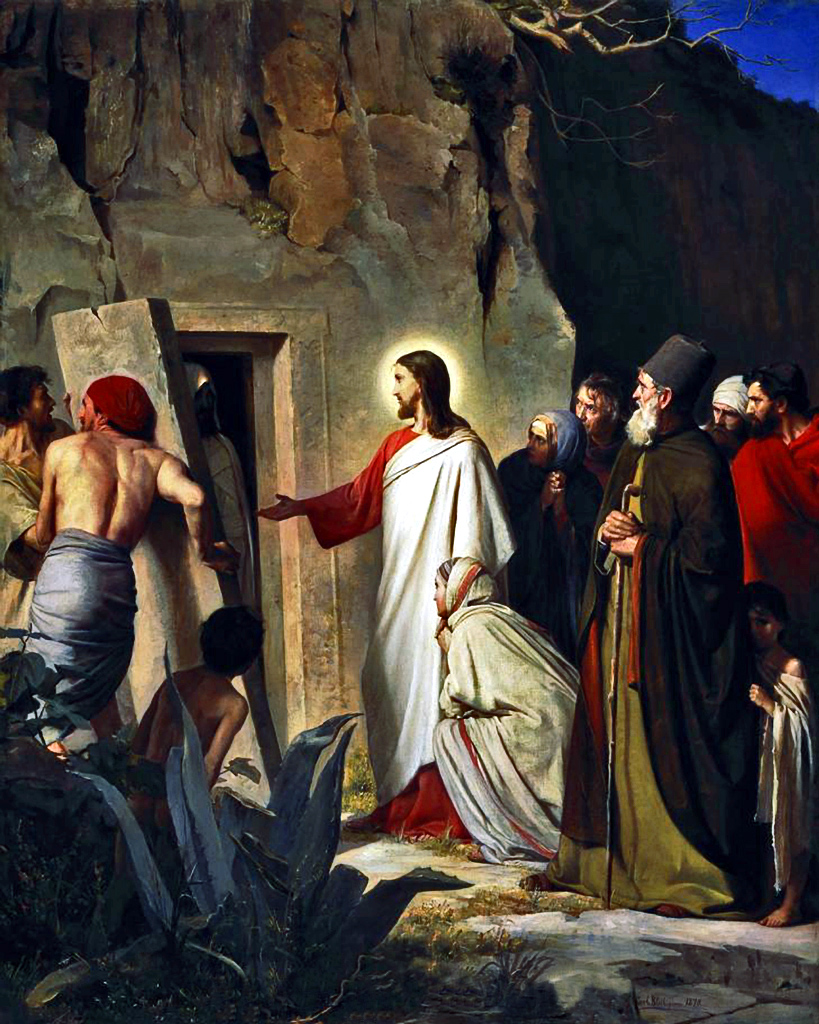
John11_1_Raising_Lazarus_Bloch

But the chief priests consulted that they might put Laz’-a-rus also to death; Because that by reason of him many of the Jews went away, and believed on Jesus. (John 12:10-11)

Jesus was entering His final week before the cross.  Just days before He had raised Lazarus from the dead (John 11:43-44), and now He was enjoying a meal with His friends and His apostles.  Lazarus was among the invited guests, and many curious spectators “came not for Jesus’ sake only, but that they might see Laz’-a-rus also, whom he had raised from the dead” (John 12:9).  Others came with ulterior motives.  After Jesus raised Lazarus, “many of the Jews which came to Mary, and had seen the things which Jesus did, believed on him.  But some of them went their ways to the Pharisees, and told them what things Jesus had done.  Then gathered the chief priests and Pharisees a council, and said, What do we? For this man doeth many miracles … Then from that day forth they took counsel together for to put him to death” (John 11:45-47, 53).  Now, not only did they want to put Jesus to death, but they wanted to destroy the evidence to His miracle by killing Lazarus too.

The reprobate mind is willfully blind.  “They profess that they know God; but in works they deny him, being abominable, and disobedient, and unto every good work reprobate” (Titus 1:16).  “Reprobate” is the Greek word adókimos meaning unapproved, rejected, or by implication, worthless.  There is no fix to a reprobate mind; once a heart is hardened against God, He can do nothing less than give them over to a reprobate mind (Romans 1:28).  For the reprobate mind, there is no amount of evidence that will turn their heart toward God.  “If they hear not Moses and the prophets, neither will they be persuaded, though one rose from the dead” (Luke 16:31).  This was proven true twice during Jesus’ final weeks: first Lazarus, then Jesus Himself.  But instead of believing the evidence, they continued in their unbelief, “knowing the judgment of God, that they which commit such things are worthy of death, not only do the same, but have pleasure in them that do them” (Romans 1:32).

Of course, as believers, we are not in the position to make such a judgment, for only God “knoweth the secrets of the heart” (Psalm 44:21).  Our responsibility is to be His witnesses (Matthew 28:18-20; Acts 1:8), for God truly is “not willing that any should perish, but that all should come to repentance” (2 Peter 3:9).  Sadly though, because of willful blindness, we may be giving “that which is holy unto dogs” and casting our “pearls before swine” (Matthew 7:6) no matter what evidence we provide, even though “One rose from the dead.”

Comments Off on Willful Blindness

Filed under Apologetics, Christianity, Gospel, Religion, Salvation, Theology

Good Soldiers

soldiers_in_war_2-normal

No man that warreth entangleth himself with the affairs of this life; that he may please him who hath chosen him to be a soldier. (2 Timothy 2:4)

A battle is a time of intense focus and concentration.  A soldier can ill afford to be distracted from the task at hand.  He must be well trained and proficient in the use of the weapons at his disposal.  His equipment must be well maintained at all times and ready for use at a moment’s notice.   His mind cannot wander to the loved ones who wait for him back home.  He cannot think about the possibility of being wounded or killed.  The only thing that matters is the battle at hand.

A good soldier knows his enemy.  He knows the weapons the enemy will use against him.  He knows the enemy’s tactics and he knows how to counter the enemy’s attacks.  A good soldier knows the battlefield.  He knows the best places to ambush or to avoid being ambushed.  He knows the places with the best vantage points and the places where he is most vulnerable.  A good soldier is prepared always for the battle.

As soldiers of Christ, we are in a battle, “though we walk in the flesh, we do not war after the flesh … Casting down imaginations, and every high thing that exalteth itself against the knowledge of God, and bringing into captivity every thought to the obedience of Christ” (2 Corinthians 10:3,5).  The armament of a soldier of Christ is spiritual: “For the weapons of our warfare are not carnal, but mighty through God to the pulling down of strongholds” (2 Corinthians 10:4).  As good soldiers of Christ, we must maintain our weapons in battle-ready condition:  truth, righteousness, the preparation of the gospel of peace, faith, salvation and the Word of God (Ephesians 6:13-17), and the greatest weapon of all – prayer (Ephesians 6:18).  These are not merely defensive weapons, they are offensive.  Our weapons are designed to charge the gates of hell, “and the gates of hell shall not prevail against it” (Matthew 16:18).

As good soldiers of Christ we cannot afford to allow the cares of this life to entangle us.  “Take therefore no thought for the morrow: for the morrow shall take thought for the things of itself.  Sufficient unto the day is the evil thereof” (Matthew 6:34).  “But seek ye first the kingdom of God, and his righteousness; and all these things shall be added unto you” (Matthew 6:33).  “Thou therefore endure hardness, as a good soldier of Jesus Christ” (2 Timothy 2:3).

Comments Off on Good Soldiers

Filed under Apologetics, Christianity, Gospel, Religion

Understanding Listeners

Bereshit

And Ezra the priest brought the law before the congregation both of men and women, and all that could hear with understanding, upon the first day of the seventh month. (Nehemiah 8:2)

At the time of the rebuilding of Jerusalem’s walls, evidently there were, besides the Jews, other people living there from the surrounding nations.  “On that day they read in the book of Moses in the audience of the people; and therein was found written, that the Ammonite and the Moabite should not come into the congregation of God for ever … Now it came to pass, when they had heard the law, that they separated from Israel all the mixed multitude” (Nehemiah 13:1, 3).  So, it is interesting that when “all the people gathered themselves together as one man into the street that was before the water gate; and they spake unto Ezra the scribe to bring the book of the law of Moses, which the Lord had commanded to Israel” (Nehemiah 8:1), those that gathered there were “all that could hear with understanding” (v.2).

The word translated “understanding” is the Hebrew word biyn which means to “separate mentally” or to “distinguish.”  These who gathered here were those who could understand the language of the text.  And for those times when the language was “rusty,” “the Levites, caused the people to understand the law … So they read in the book in the law of God distinctly, and gave the sense, and caused them to understand the reading” (vv. 7-8).  The congregation was composed of those with a common language, a basic knowledge of the Mosaic law, and a common desire to attend to the Word of God.  This meeting was not intended for outsiders.

One of the fallacies of the seeker-sensitive movement is that worship services are designed to attract outsiders into the congregation.  In doing so, the “insiders” are fed a diluted spiritual meal and the outsiders do not benefit from it either because they lack understanding.  When the church body gathers for worship, the service should serve, in the first place, to worship God, and secondly to edify the believer – the understanding listener.  Ravi Zacharias in his latest book, Why Jesus?: Rediscovering His Truth in an Age of Mass Marketed Spirituality, says that worship “is the submission of our will, heart and purpose to the sovereign will and the person of God who created us and loves us. Worship is a relationship from which all inspiration flows and the relationship through which all of our needs are met” (173). An unbeliever does not have that relationship and therefore cannot truly experience worship. I am not suggesting that we should not invite unbelievers to our worship services, but our worship services should not be modified solely to cater to their “sensitivities.” That sort of manipulation is profitable for neither the unbeliever nor the believer.  If a true seeker enters into the congregation, the Holy Spirit will deal with him/her (John 16:7-14) without any modifications to the worship service. In this way “all that hear with understanding” will benefit.

3 Comments

Filed under Apologetics, Christianity, Gospel, Religion

Room For All

Crowd

… God our Saviour; Who will have all men to be saved, and come to the knowledge of the truth. (1 Timothy 2:3-4)

In this day of rampant relativistic humanism, there is “the truth.”  It is not based on the on the fickle whims of men, but on the immutable Word of God.  “The truth of the LORD endureth for ever” (Psalm 117:2).  “Thy word is true from the beginning: and every one of thy righteous judgments endureth for ever” (Psalm 119:160).  “ For all flesh is as grass, and all the glory of man as the flower of grass. The grass withereth, and the flower thereof falleth away:  But the word of the Lord endureth for ever” (1 Peter 1:24-25).

Man’s “truth” is mutable.  What is “true” in one century is proven false in the next.  It was once true that the sun circled the earth; now we know that the earth circles the sun.  The “science” of man is ultimately flawed because man has limited knowledge and understanding and because it originates from a faulty source – man himself.  Jesus says, “Heaven and earth shall pass away, but my words shall not pass away” (Matthew 24:35).  That is an incredible assertion to make, if the claimant is incapable of validating it.  Anyone making such a claim in the world of science and academia today would be laughed to scorn, and yet Jesus makes such a claim without hesitation because He can, and did, validate it with His own death and resurrection.

Our verse contains one of the greatest, if not the greatest, truths: that God “will have all men to be saved,” and thereby “come to the knowledge of truth.”  God is “not willing that any should perish, but that all should come to repentance” (1 Peter 2:9).  “This is a [“truthful” or “trustworthy”] saying, and worthy of all acceptation, that Christ Jesus came into the world to save sinners; of whom I am chief” (1 Timothy 1:15).  The “truth” is that in God’s plan of salvation, there is room for ALL.  The companion truth is that not all will make it.  Jesus said, “Enter ye in at the strait gate: for wide is the gate, and broad is the way, that leadeth to destruction, and many there be which go in thereat: Because strait is the gate, and narrow is the way, which leadeth unto life, and few there be that find it” (Matthew 7:13-14).  There IS room for all, but not all will find room.

1 Comment

Filed under Christianity, Gospel, Religion, Salvation