Category Archives: Gospel

Heavenly Minded

Colossians 3_1-2


If ye then be risen with Christ, seek those things which are above, where Christ sitteth on the right hand of God.  Set your affection on things above, not on things on the earth. (Colossians 3:1-2)

Back in the seventies there was a saying going around in Christian circles exhorting Christians: “Don’t be so heavenly minded that you are no earthly good.”  So effective was that campaign that today it appears that the saying was taken to the extreme so that we are now producing Christians that are “so earthly minded that they are no heavenly good.”

It is sad to see so many formerly strong fundamental churches pandering to the whims of an increasing populace with an insatiable need for entertainment.  They call this being “seeker sensitive.”  This is an oxymoron because the Bible says that “there is none that seeketh after God” (Romans 3:11).  Many churches have lowered their standards in attempt to win those who have no standards and end up neither pleasing God nor pleasing man.  Jesus came “to seek and to save that which was lost” (Luke 19:10); He did not come to be sought.  Jesus was not a panderer.  When the rich young ruler came to Jesus seeking eternal life (Matthew 19:16-22), Jesus did not offer him the easy way out, nor did He go after him when “he went away from him sorrowful” because he had great possessions.

The standard for the Christian is the heavenly standard:  “But seek ye first the kingdom of God and his righteousness; and all these things shall be added unto you” (Matthew 6:33).  “And be not conformed to this world: but be ye transformed by the renewing of your mind, that ye may prove what is that good, and acceptable, and perfect, will of God” (Romans 12:2).  We are to “seek those things which are above” (Colossians 3:1), and to set our “affection on things above, not on things on earth” (v. 2).  We need to understand that “the world passeth away, and the lust thereof: but he that doeth the will of God abideth for ever” (1 John 2:17).  Our love for the lost should never exceed our affection for the things above.  We must “be ready always to give an answer to every man that asketh you a reason of the hope that is in you with meekness and fear” (1 Peter 3:15), but never at the cost of compromise.

2 Comments

Filed under Christianity, Gospel, Religion, Theology

The Immutable Christ

Jesus Christ the same yesterday, and to day, and for ever. (Hebrews 13:8)

It is not uncommon for the world to discount the message of the Bible as archaic and irrelevant to our modern evolutionary state.  Our science has moved us so far beyond the society that produced the Bible more than two thousand years ago; but just an informal observation of the world’s societies will readily reveal that no matter how scientifically advanced a society is, they have not advanced beyond the level of sin described in the pages of the Bible.  That being the case, it becomes easier to disregard the message of the Bible and act as if it does not apply.

Adopting that kind of attitude is like cutting the moorings of your ship and setting it adrift on a stormy sea.  The anchorage is gone, and one is “tossed to and fro, and carried about with every wind of doctrine, by sleight of men, and cunning craftiness, whereby they lie in wait to deceive” (Ephesians 4:14).

It is comforting to know that Jesus never changes.  His power never diminishes: “All power is given unto me in heaven and in earth” (Matthew 28:18).  His Word never changes:  “Heaven and earth shall pass away, by my words shall not pass away” (Matthew 24:35).  His love never changes: “Who can separate us from the love of Christ? … For I am persuaded, that neither death, nor life, nor angels, nor principalities, nor powers, nor things present, nor things to come, nor height, nor depth, nor any other creature, shall be able to separate us from the love of God, which is in Christ Jesus our Lord” (Romans 8:35-39).

In this tempestuous world, it is good to know that in our immutable Christ, we have a solid rock upon which to anchor our lives.  In the words of the old hymn:

I’ve anchored my soul in the Haven of Rest,
I’ll sail the wide seas no more;
The tempest may sweep over wild, stormy, deep,
In Jesus, I’m safe evermore.
 

Thank God for our immutable Christ!

Comments Off on The Immutable Christ

Filed under Christianity, Evolution, Gospel, Religion, Theology

Encouragement to Move Forward


Wherefore seeing we also are compassed about with so great a cloud of witnesses, let us lay aside every weight, and the sin which doth so easily beset us, and let us run with patience the race that is set before us. (Hebrews 12:1)

This passage conjures up a vision of the saints in a heavenly stadium peering over the edge of billowy clouds cheering us on in the contest of life.  While there may be some truth in that, the verse refers to us having more than saintly cheerleaders urging us forward.  The Greek verb translated “compassed about”—(echontes perikemenon) means “to hold around,” and it is present, active, nominative meaning that the subject is performing the action.  In other words, “we are holding around us” this great cloud of witnesses.

But who or what is this “great cloud of witnesses?”  In the Greek, “cloud” is singular as it is translated in English, but this singular cloud contains multiple witnesses.  “Witnesses” is the translation of the Greek martúron, which can be translated as martyr, witness or “record.”  Considering that our verse begins with “wherefore” [therefore], we need to look back to what has been said previously and apply it to the current statement.  Chapter 11 of Hebrews is the “record” of the heroes of the faith.  The emphasis of the record is not on the heroes themselves, but on their faith.  “But without faith, it is impossible to please [God], for he that cometh to God must believe that he is, and that he is a rewarder of them that diligently seek him” (Hebrews 11:6).

“We hold around us” this great “record” of the faith and of the faithful.  This “record” informs us of how God rewarded the faith of those who have gone on before, and likewise He promises to reward those who demonstrate faith in Him today and who “diligently seek Him.”  We also have the record of how God has provided for us in our own past.  So, since we hold God’s great track record, we need to “lay aside every weight;” “For our light affliction, which is but for a moment, worketh for us a far more exceeding and eternal weight of glory; While we look not at the things which are seen, but at the things which are not seen: for the things that are seen are temporal; but the things which are not seen are eternal” (2 Corinthians 4:17-18).  With all this in mind, “let us run with patience the race that is set before us.”  God is faithful!

Comments Off on Encouragement to Move Forward

Filed under Christianity, Gospel, Religion

Four Gospels, One Jesus


… by the name of Jesus Christ of Nazareth… for there is none other name under heaven given among men, whereby we must be saved. (Acts 4:10,12)

There are some that question the veracity of the Bible due to the apparent discrepancies or inconsistencies in the Four Gospel accounts of Jesus.  However, the fact that we have four different gospels, from four different writers with four different perspectives of Jesus is actually beneficial.  A good illustration of this is the scene of an automobile accident.  Rarely is a police officer around when the accident takes place, so when he arrives, he will solicit input from as many witnesses as are willing to testify.  Let us assume that an accident takes place at an intersection at sunset.  A westbound car makes a left turn and collides with a car going the opposite direction.  Witness “A” was behind the car making the left turn.  “A” says that the left turn arrow was green when he saw it, and he was prepared to follow the car turning left.  Witness “B” was in the car next to Witness “A” in a straight-ahead lane.  “B” says he is not sure that the left turn arrow was green, but the cars in front of him had stopped for the red light in their lanes.  “I couldn’t see the light clearly because the sun was in my eyes,” he reports.  Witness “C” was eastbound behind the car that got hit.  Witness “C” says the light had just turned green when the car in front of her shot out across the intersection and got wiped out by the car making the left turn.  Witness “D” was stopped at the light facing south.  He was busy checking his cell phone messages while he waited his turn to go.  All of a sudden he heard the sound of squealing tires followed by a loud crash.  When he looked up, all he saw were glass and car parts flying everywhere.

Each of these witnesses saw the same accident from four different points of view.  The police officer must then try to compile all these differing reports to come up with an accurate picture of what happened.

Another illustration that comes to mind that is a little more personal.  I am known by many different people, and if they were all to write something about me, they would probably all have something different to say.  I sing in the church choir, so someone may write about my love for music.  I also teach Sunday school, so someone else might write about my love for studying and teaching the Bible.  I taught elementary school, and my students thought I was the best teacher ever!  My teacher friends could write about my dedication to my students and the hard work I put into teaching my kids.  My wife could write things about me that no one else has seen.  But with all these different points of view, I am still the same person, and no one point of view tells the whole story.

The same is true for the story of Jesus.  The four gospel writers provide four different perspectives from four individual points of view.  Matthew was a disciple that had been called away from a lucrative career as a tax collector (Mark 2:14).  As a tax collector, he was hated by his fellow Jews and seen as a traitor to his people. “The publicans were also regarded as traitors and apostates, defiled by their frequent contacts with the heathen and being willing tools of the oppressor.”[i] Understanding the mentality of the Jewish people, oppressed under the heel of Rome, and having witnessed the resurrected Christ, Matthew was able to perceive the authority of Jesus, so he writes his gospel to show Christ as the promised Messiah destined to reign from the throne of David.

John Mark wrote the Gospel of Mark.  He was not one of the twelve, but he seems to have been “around” to witness some of the acts of Jesus.  In fact, it is thought that John Mark described himself as the “young man” present at the time of Jesus’ arrest that “fled from them naked” (Mark 14:51-52).  Tradition has it that Mark wrote most of his gospel as related to him by Peter.  Being a “young man” and probably used to serving around the house, his perspective of Jesus was that of a servant dedicated to the mission assigned to Him by His Father; so his gospel is written with that sense of urgency.

Luke was a Greek, not a Jew.  He was also a medical doctor – a scientist, if you will.  Luke is very interested in facts and details and he points out many things that the other gospel writers do not even notice.  Luke addresses his Gospel to an official by the name of Theophilus (translated “Lover of God).  Luke is trying to make a case for Jesus being the “Son of Man” rejected by Israel and now preached to the Gentiles.  Jesus is for all mankind and not for just a select group.

Finally, John was the “disciple whom Jesus loved.”  The relationship is not very clear, but it is thought that he was a close cousin of Jesus.  From the cross, Jesus entrusted the care of His mother to this disciple (John 19:27).  From this close relationship, John was able to discern the deity of Christ, so his gospel is filled with examples that make this point clear.

From all of these gospels, we conclude that Jesus was the promised Messiah, the Anointed One of Israel, the Son of God.  He was God in the flesh, the Son of Man.  He came to serve and to do His Father’s will by dying for the sins of man and for our redemption.  He is the Eternal Word.  He is God.  He is the Creator (John 1:1-3).  He is love personified.  “God is Love” (1 John 4:8, 16).  “For God so loved the world that he gave his only begotten Son, that whosoever believeth in him should not perish, but have everlasting life” (John 3:16).  We could not have so clear a picture of Jesus without the different perspectives of the four Gospel writers.


[i] Unger, Merrill F. and R. K. Harrisson, The New Unger’s Bible Dictionary (Chicago, Moody Press, 1988), Listing for “Publican.”


Comments Off on Four Gospels, One Jesus

Filed under Apologetics, Christianity, Gospel, Religion

Eternal Sacrifice

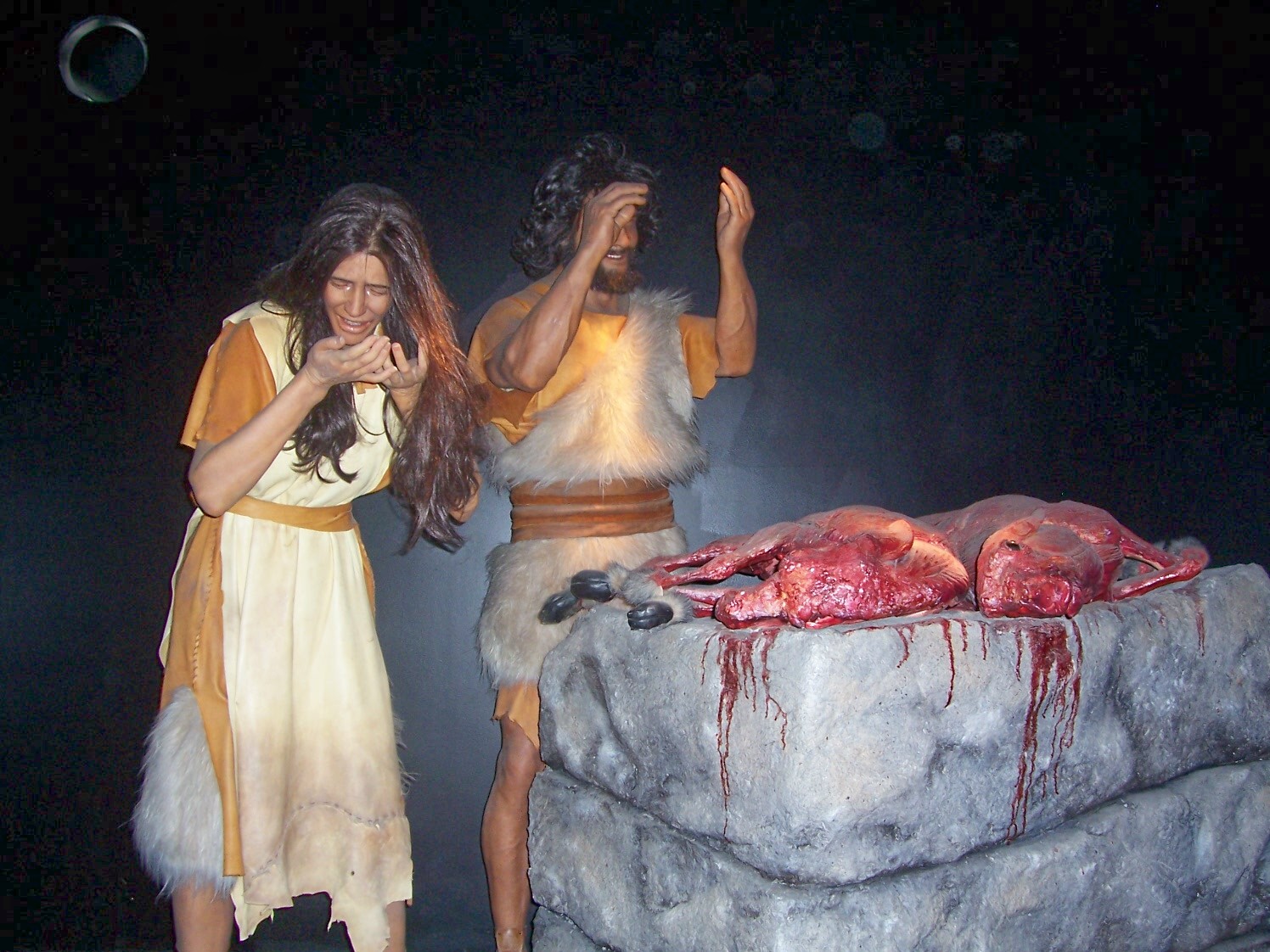
For Adam and Eve, this was the first time the first couple witnessed death. Innocent blood spilled to cover the consequence of their sin. (Romans 6:23)

And almost all things are by the law purged with blood; and without shedding of blood is no remission.  (Hebrews 9:22)

 Christianity has often been characterized as a “bloody religion” due to the many references to blood.  Blood is in many of the songs we sing with lyrics like: “What can wash away my sins? Nothing but the blood of Jesus;” or “Alas and did my Savior bleed and did my Sovereign die;” or “Have you been to Jesus for the cleansing power?  Are you washed in the blood of the Lamb?” and many others.  Unlike pagan religions that required multiple human sacrifices to keep at bay the multitude of insatiable demonic gods, Christianity offers only one human sacrifice that suffices for all and for all eternity.

From the fall of man, blood has been shed for the covering or the atonement of sin.  “Unto Adam also and to his wife did the LORD make coats of skins, and clothed them” (Genesis 3:21).  Those coats of skins required the shedding of blood on the part of some innocent animal.  Abel understood the concept of blood sacrifice when he made his offering to God, “And the LORD had respect unto Abel and to his offering” (Genesis 4:4).  In gratitude for God’s salvation, Noah shed the blood of several animals as a burnt offering to God, “And the LORD smelled a sweet savor; and the LORD said in his heart, I will not again curse the ground any more for man’s sake” (Genesis 9:21).

Blood represents life, and life has great value to the Creator who created it.  God prohibited the consuming of blood:  “But flesh with the life thereof, which is the blood thereof, shall ye not eat” (Genesis 9:4).  He placed an even higher value on human life: “and surely your blood of your lives will I require; at the hand of every beast will I require it, and at the hand of man … Whoso sheddeth man’s blood, by man shall his blood be shed: for in the image of God made he man” (Genesis 9:5-6).

The Israelites were instructed on the proper methods of animal sacrifice for the forgiveness of sins.  All of these were perpetual offerings that foreshadowed the sacrifice Christ would make on the cross once and for all.  This was necessary because “Neither by the blood of goats and calves, but by his own blood he entered into the holy place, having obtained eternal redemption for us” (Hebrews 9:12).  Christ “offered himself without spot to God” (Hebrews 9:14) “For it is not possible that the blood of bulls and of goats should take away sins” (Hebrews 10:4).  “We are sanctified through the offering of the body of Jesus Christ once for all” (Hebrews 10:10) and forevermore.

1 Comment

Filed under Christianity, Gospel, Religion, Salvation