Category Archives: Religion

Articles that deal with religions other than orthodox Christianity.

Mourn for the Nation

And it came to pass, when I heard these words, that I sat down and wept, and mourned certain days, and fasted, and prayed before the Lord.  (Nehemiah 1:4)

Nehemiah was chief steward, butler or “cupbearer” for the Persian king Artaxerxes (Nehemiah 1:11).  His position was one of great confidence before the king.  One of his main functions was to taste the king’s food and drink before serving it to him to ensure that it was not poisoned (Nehemiah 2:1).  Nehemiah would be comparable to the secret service agents that surround our President today and are willing take a bullet for him.

One can imagine that with a position of such great responsibility, Nehemiah was well compensated and had not a care in the world as far as material possessions are concerned.  His job was secure, and he probably enjoyed all the finer things in life.  Materially speaking, Nehemiah had nothing for which to be sad (Nehemiah 2:1).  But news from Judah wounded his spirit deeply so that he “wept and mourned” for several days.  The people of Judah were “afflicted” and defenseless (Nehemiah 1:3), and while Nehemiah was far removed from problem, he could identify with and relate to the problem of what he considered to be his nation.

Nehemiah was deeply grieved for his nation and his people, but he did more than weep and mourn over the situation.  He “fasted and prayed before the Lord.”  He interceded “for the children of Israel.”  He confessed “the sins of the children of Israel” and acknowledged “we [all of Israel] have sinned against thee: both I and my father’s house” (Nehemiah 1:6) – he did not exclude himself.  He reminded God of His promise to “scatter you abroad among the nations: But if ye turn unto me … I will gather them from thence …” (Nehemiah 1:8-9).  Nehemiah did not stop there.  He committed himself to be used of God personally to affect change in his nation: “prosper, I pray thee, thy servant this day, and grant him mercy in the sight of this man [Artaxerxes]” (Nehemiah 1:11).

At the time of this writing, a heavy, dark cloud looms over our beloved nation.  Like the children of Israel, we have been so richly blessed by God.  Now, after more than 236 years, we have cast God aside and have forgotten Him.  As a result, we are reaping what we have sown as a nation.  Yet, while life remains, there is hope.  As children of God, it is up to us not merely to weep and mourn the erosion of our liberty, but like Nehemiah, we must fast and pray acknowledging our sin in confession.  Then, when we have fasted and prayed for several days, we must assume personal responsibility and take action to rebuild the walls and the gates that have crumbled by the decay of neglect.  The America of our Founders Fathers no longer exists, and we may never again see the America of only 50 or 60 years ago, but as Christians, we are citizens of “a city which hath foundations, whose builder and maker is God” (Hebrews 11:10) and we “desire a better country, that is, an heavenly [country] … for [God] hath prepared for us a city” (Hebrews 11:16).   The current state of that city here on earth is in dire need of repair, and whereas we may not be able to affect that state of our nation, we can still rebuild the crumbling walls of our faith.  We need to pray for and work toward revival in our nation, regardless of the powers that be.

1 Comment

Filed under Christianity, Current Events, End Times, Religion

Who or What Are Witnesses?

But ye shall receive power, after that the Holy Ghost is come upon you: and ye shall be witnesses unto me both in Jerusalem, and in all Judaea, and in Samaria, and unto the uttermost part of the earth.  (Acts 1:8)

Acts 1:8 and Hebrews 12:1 both translate the Greek word mártus as “witnesses.”  In Acts 1:8 the sense is that of someone who bears witness to an event, while in Hebrews 12:1 the sense seems to be that of spectators observing an event.  Taking the apparent sense of Acts 1:8, a witness is someone who would testifies before a court trial and provides an eyewitness account, or some other form of evidence used to substantiate the facts of an event.  However, in Hebrews 12:1, the sense seems to be that of a crowd observing a sports event and cheering on their favorite team.  Considering that “witnesses” is translating the same Greek word in both Acts 1:8 and Hebrews 12:1, how do we reconcile the apparent discrepancy?

The word “witness” or “witnesses” is used extensively throughout the N.T. and also in the O.T.  The word “witness” or “witnesses” appears 184 times in the King James Bible (KJV):  87 times in the O.T. and 97 times in the N.T.  Seventy-one times in the O.T. the KJV translates the Hebrew (Strong’s OT 5707) `ed; contracted from OT: 5749 concretely, a witness; abstractly, testimony; specifically, a recorder, i.e. prince:  KJV – witness.[1]  Isaiah 33:8 translates `ed as “the cities”:  “The highways lie waste, the wayfaring man ceaseth: he hath broken the covenant, he hath despised the cities, he regardeth no man” (emphasis added).  Here, it is “the cities” that are “the record” or “the witness” to a broken covenant, but in every other appearance the word is simply translated “witness” or “witnesses.”  Four times the KJV translates the Hebrew(Strong’s OT 5749) `uwd (ood); a primitive root; to duplicate or repeat; by implication, to protest, testify (as by reiteration); intensively, to encompass, restore (as a sort of reduplication):  KJV – admonish, charge, earnestly, lift up, protest, call (take) to record, relieve, rob, solemnly, stand upright, testify, give warning, (bear, call to, give, take to) witness.  This word appears 44 times in the O.T. and is translated in several different ways, but always with the sense of bearing witness to something.

In the N.T., mártus appears 35 times: three times it is translated as “martyr” (Acts 22:20; Revelation 2:13; 17:6) and twice it is translated as “record” (2 Corinthians 1:23; Philippians 1:8).  Otherwise it is simply translated as “witness.”  Strong’s defines mártus [Strong’s NT 3144]:  of uncertain affinity; a witness (literally [judicially] or figuratively [genitive case]); by analogy, a “martyr”:  KJV – martyr, record, witness.  The verb form of the word, marturéo [Strong’s NT 3140], means:  to be witness, i.e. testify (literally or figuratively):  KJV – charge, give [evidence], bear record, have (obtain, of) good (honest) report, be well reported of, testify, give (have) testimony, (be, bear, give, obtain) witness.

Both the O.T. and the N.T. favor the sense that a witness is someone or something that gives testimony or evidence to a fact.  In Acts 1:8 Jesus said: “ye shall be witnesses unto me both in Jerusalem …”  In other words, “go bear testimony of Me.  If someone asks you about Me, give them the factual record of Me.  You may even have to die for your testimony.”

Hebrews 12:1 seems to present a different picture:  “Wherefore seeing we also are compassed about with so great a cloud of witnesses.”  From the English construction, it appears that the witnesses are spectators to an event.  Indeed, Robertson says: “An old word (Latin: nubes), here only in the New Testament, for vast mass of clouds.  Nefelee is a single cloud. The metaphor refers to the great amphitheater with the arena for the runners and the tiers upon tiers of seats rising up like a cloud.”[2]  However, he elaborates:  “The martures  here are not mere (emphasis mine) spectators [theatai ), but testifiers (witnesses) who testify from their own experience (Heb 11:2,4-5,33,39) to God’s fulfilling his promises as shown in Heb 11.”[3]  But is Hebrews 12:1 referring to the “witnesses” or to their “witness,” i.e., their “testimony”?  The USB New Testament Handbook seems to agree with Roberson: “The thought is that the Old Testament heroes are watching how the writer of Hebrews and his readers ‘run their race’ in the Christian life, since their own salvation is linked with that of Christians (Heb 11:40). This large crowd of witnesses consists of the heroes of faith recorded in chapter 11.”[4]  Wuest offers an alternative view: “Rather than seeing the witnesses as spectators looking at this earthly scene from heaven, it would seem nearer the correct interpretation here to think of these first century readers running their Christian race, not having in mind the witnesses of 11:4-40 as spectators, but rather their testimony as examples urging them on to faith in Messiah as High Priest.”[5]

The “Wherefore” (therefore) that begins this verse alerts the reader that what follows must be taken in context with what came before, i.e., “The Faith Hall of Fame.”  Because of these examples of faith – these “witnesses,” these “testimonies” – we are to “run with patience the race that is set before us.”  The examples are an enormous cloud on which we can lay hold.  “Are compassed about” translates the Greek échontes perikemeínon.  The first word, échontes, is a present, active, participle meaning to “have, hold, wear, be able or consider.”  The active voice indicates that the subject (we) is performing the action.  This indicates that we “have” or we “hold” this “great cloud of witnesses.”  The second word, perikemeínon, is a present, middle, participle meaning to “be around, surround or wear.”  The middle voice suggests that the subject acts in relation to himself.  Together the translation could be rendered: “We hold around ourselves so great a cloud of witnesses.”  Since it is impractical to think that we are holding on to saints that have gone on before, it makes more sense that we hold around ourselves their testimonies of faith.  These are the witnesses of Hebrews 12:1!  “The noun witness, even where it has the idea of looking on, anticipates bearing witness later to what had been seen earlier.  The heroes of Hebrews [11] attest to the fact that faith brings approval from God.  Believers are surrounded by this O.T. host of witnesses.  Because this is true, Christians are to run their race with endurance.”[6]

Who or what are witnesses?  The answer is both.  Witnesses are those who testify or give witness to an event, and they are the testimonies or those things which bear witness to an event.  In Acts 1:8 Jesus told His disciples, “ye shall be My witnesses” (note that there is no choice in the matter).  In Hebrews 12:1 we are encouraged to persist in our witness as we lay hold of the great testimonies of those who have gone before us.  This would not only include Bible saints, but the saints that are enduring the race along with us.  Let us also remember that God has provided substantial “witnesses” in our own lives by the way He has guided us and provided for us individually in the past.


[1] Strong’s translations are copied from the Biblesoft’s New Exhaustive Strong’s Numbers and Concordance with Expanded Greek-Hebrew Dictionary, (Copyright © 1994, 2003, 2006 Biblesoft, Inc. and International Bible Translators, Inc.).

[2]  From Robertson’s Word Pictures in the New Testament, (Electronic Database Copyright © 1997, 2003, 2005, 2006 by Biblesoft, Inc., Robertson’s Word Pictures in the New Testament, Copyright © 1985 by Broadman Press).

[3]  Ibid.

[4]  From the UBS New Testament Handbook Series, (Copyright © 1961-1997, by United Bible Societies).

[5]  From Wuest’s Word Studies from the Greek New Testament, (Copyright 1940-55 by Wm. B. Eerdmans Publishing Co., Copyrights © renewed 1968-73 by Jeannette I. Wuest).

[6]  Toussaint, Stanley D., The Epistle to the Hebrews, class notes, Revised, Spring 2008, p. 32.

Comments Off on Who or What Are Witnesses?

Filed under Apologetics, Christianity, Religion

The Immutable Christ

Jesus Christ the same yesterday, and to day, and for ever. (Hebrews 13:8)

It is not uncommon for the world to discount the message of the Bible as archaic and irrelevant to our modern evolutionary state.  Our science has moved us so far beyond the society that produced the Bible more than two thousand years ago; but just an informal observation of the world’s societies will readily reveal that no matter how scientifically advanced a society is, they have not advanced beyond the level of sin described in the pages of the Bible.  That being the case, it becomes easier to disregard the message of the Bible and act as if it does not apply.

Adopting that kind of attitude is like cutting the moorings of your ship and setting it adrift on a stormy sea.  The anchorage is gone, and one is “tossed to and fro, and carried about with every wind of doctrine, by sleight of men, and cunning craftiness, whereby they lie in wait to deceive” (Ephesians 4:14).

It is comforting to know that Jesus never changes.  His power never diminishes: “All power is given unto me in heaven and in earth” (Matthew 28:18).  His Word never changes:  “Heaven and earth shall pass away, by my words shall not pass away” (Matthew 24:35).  His love never changes: “Who can separate us from the love of Christ? … For I am persuaded, that neither death, nor life, nor angels, nor principalities, nor powers, nor things present, nor things to come, nor height, nor depth, nor any other creature, shall be able to separate us from the love of God, which is in Christ Jesus our Lord” (Romans 8:35-39).

In this tempestuous world, it is good to know that in our immutable Christ, we have a solid rock upon which to anchor our lives.  In the words of the old hymn:

I’ve anchored my soul in the Haven of Rest,
I’ll sail the wide seas no more;
The tempest may sweep over wild, stormy, deep,
In Jesus, I’m safe evermore.
 

Thank God for our immutable Christ!

Comments Off on The Immutable Christ

Filed under Christianity, Evolution, Gospel, Religion, Theology

Encouragement to Move Forward


Wherefore seeing we also are compassed about with so great a cloud of witnesses, let us lay aside every weight, and the sin which doth so easily beset us, and let us run with patience the race that is set before us. (Hebrews 12:1)

This passage conjures up a vision of the saints in a heavenly stadium peering over the edge of billowy clouds cheering us on in the contest of life.  While there may be some truth in that, the verse refers to us having more than saintly cheerleaders urging us forward.  The Greek verb translated “compassed about”—(echontes perikemenon) means “to hold around,” and it is present, active, nominative meaning that the subject is performing the action.  In other words, “we are holding around us” this great cloud of witnesses.

But who or what is this “great cloud of witnesses?”  In the Greek, “cloud” is singular as it is translated in English, but this singular cloud contains multiple witnesses.  “Witnesses” is the translation of the Greek martúron, which can be translated as martyr, witness or “record.”  Considering that our verse begins with “wherefore” [therefore], we need to look back to what has been said previously and apply it to the current statement.  Chapter 11 of Hebrews is the “record” of the heroes of the faith.  The emphasis of the record is not on the heroes themselves, but on their faith.  “But without faith, it is impossible to please [God], for he that cometh to God must believe that he is, and that he is a rewarder of them that diligently seek him” (Hebrews 11:6).

“We hold around us” this great “record” of the faith and of the faithful.  This “record” informs us of how God rewarded the faith of those who have gone on before, and likewise He promises to reward those who demonstrate faith in Him today and who “diligently seek Him.”  We also have the record of how God has provided for us in our own past.  So, since we hold God’s great track record, we need to “lay aside every weight;” “For our light affliction, which is but for a moment, worketh for us a far more exceeding and eternal weight of glory; While we look not at the things which are seen, but at the things which are not seen: for the things that are seen are temporal; but the things which are not seen are eternal” (2 Corinthians 4:17-18).  With all this in mind, “let us run with patience the race that is set before us.”  God is faithful!

Comments Off on Encouragement to Move Forward

Filed under Christianity, Gospel, Religion

Four Gospels, One Jesus


… by the name of Jesus Christ of Nazareth… for there is none other name under heaven given among men, whereby we must be saved. (Acts 4:10,12)

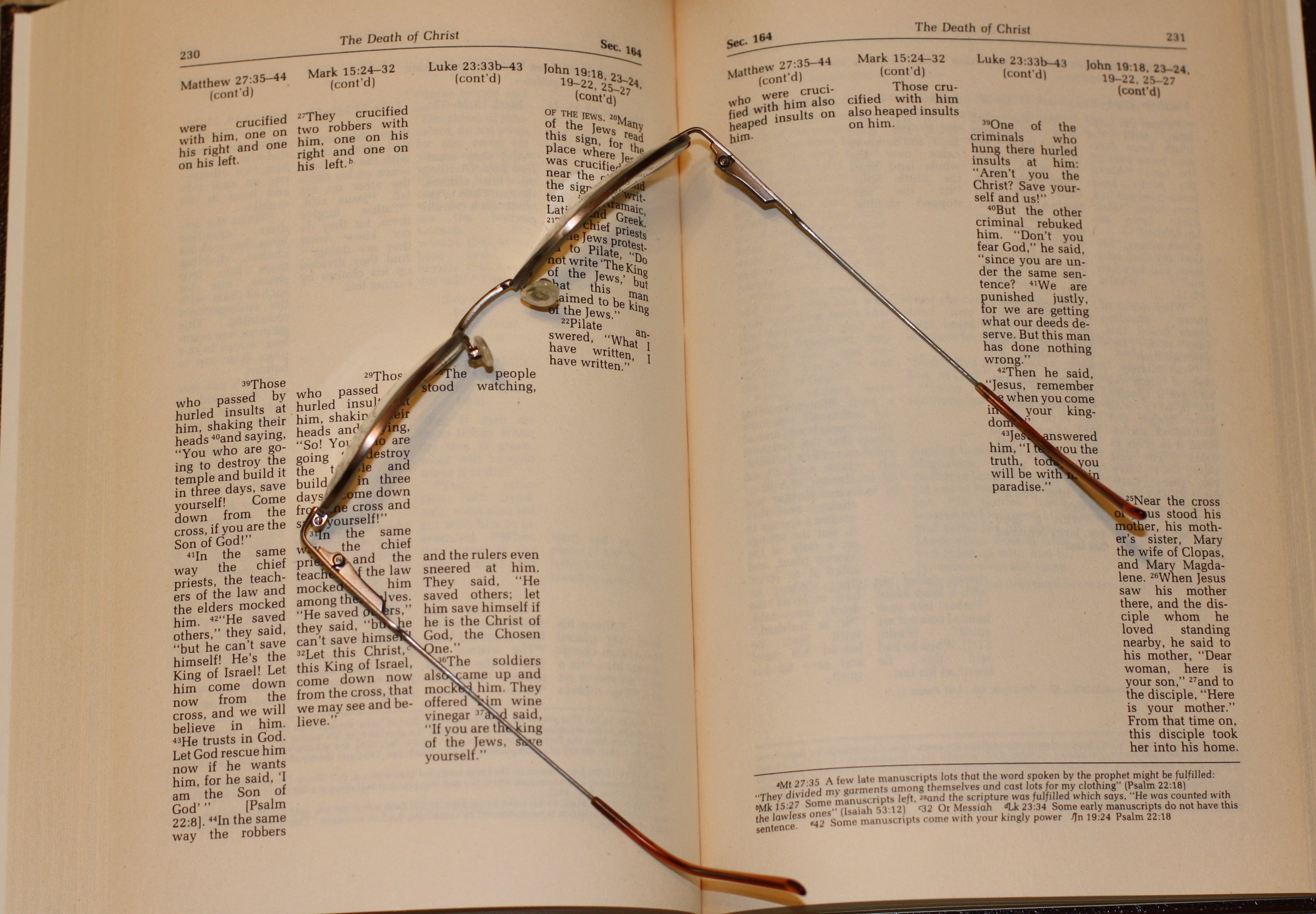
There are some that question the veracity of the Bible due to the apparent discrepancies or inconsistencies in the Four Gospel accounts of Jesus.  However, the fact that we have four different gospels, from four different writers with four different perspectives of Jesus is actually beneficial.  A good illustration of this is the scene of an automobile accident.  Rarely is a police officer around when the accident takes place, so when he arrives, he will solicit input from as many witnesses as are willing to testify.  Let us assume that an accident takes place at an intersection at sunset.  A westbound car makes a left turn and collides with a car going the opposite direction.  Witness “A” was behind the car making the left turn.  “A” says that the left turn arrow was green when he saw it, and he was prepared to follow the car turning left.  Witness “B” was in the car next to Witness “A” in a straight-ahead lane.  “B” says he is not sure that the left turn arrow was green, but the cars in front of him had stopped for the red light in their lanes.  “I couldn’t see the light clearly because the sun was in my eyes,” he reports.  Witness “C” was eastbound behind the car that got hit.  Witness “C” says the light had just turned green when the car in front of her shot out across the intersection and got wiped out by the car making the left turn.  Witness “D” was stopped at the light facing south.  He was busy checking his cell phone messages while he waited his turn to go.  All of a sudden he heard the sound of squealing tires followed by a loud crash.  When he looked up, all he saw were glass and car parts flying everywhere.

Each of these witnesses saw the same accident from four different points of view.  The police officer must then try to compile all these differing reports to come up with an accurate picture of what happened.

Another illustration that comes to mind that is a little more personal.  I am known by many different people, and if they were all to write something about me, they would probably all have something different to say.  I sing in the church choir, so someone may write about my love for music.  I also teach Sunday school, so someone else might write about my love for studying and teaching the Bible.  I taught elementary school, and my students thought I was the best teacher ever!  My teacher friends could write about my dedication to my students and the hard work I put into teaching my kids.  My wife could write things about me that no one else has seen.  But with all these different points of view, I am still the same person, and no one point of view tells the whole story.

The same is true for the story of Jesus.  The four gospel writers provide four different perspectives from four individual points of view.  Matthew was a disciple that had been called away from a lucrative career as a tax collector (Mark 2:14).  As a tax collector, he was hated by his fellow Jews and seen as a traitor to his people. “The publicans were also regarded as traitors and apostates, defiled by their frequent contacts with the heathen and being willing tools of the oppressor.”[i] Understanding the mentality of the Jewish people, oppressed under the heel of Rome, and having witnessed the resurrected Christ, Matthew was able to perceive the authority of Jesus, so he writes his gospel to show Christ as the promised Messiah destined to reign from the throne of David.

John Mark wrote the Gospel of Mark.  He was not one of the twelve, but he seems to have been “around” to witness some of the acts of Jesus.  In fact, it is thought that John Mark described himself as the “young man” present at the time of Jesus’ arrest that “fled from them naked” (Mark 14:51-52).  Tradition has it that Mark wrote most of his gospel as related to him by Peter.  Being a “young man” and probably used to serving around the house, his perspective of Jesus was that of a servant dedicated to the mission assigned to Him by His Father; so his gospel is written with that sense of urgency.

Luke was a Greek, not a Jew.  He was also a medical doctor – a scientist, if you will.  Luke is very interested in facts and details and he points out many things that the other gospel writers do not even notice.  Luke addresses his Gospel to an official by the name of Theophilus (translated “Lover of God).  Luke is trying to make a case for Jesus being the “Son of Man” rejected by Israel and now preached to the Gentiles.  Jesus is for all mankind and not for just a select group.

Finally, John was the “disciple whom Jesus loved.”  The relationship is not very clear, but it is thought that he was a close cousin of Jesus.  From the cross, Jesus entrusted the care of His mother to this disciple (John 19:27).  From this close relationship, John was able to discern the deity of Christ, so his gospel is filled with examples that make this point clear.

From all of these gospels, we conclude that Jesus was the promised Messiah, the Anointed One of Israel, the Son of God.  He was God in the flesh, the Son of Man.  He came to serve and to do His Father’s will by dying for the sins of man and for our redemption.  He is the Eternal Word.  He is God.  He is the Creator (John 1:1-3).  He is love personified.  “God is Love” (1 John 4:8, 16).  “For God so loved the world that he gave his only begotten Son, that whosoever believeth in him should not perish, but have everlasting life” (John 3:16).  We could not have so clear a picture of Jesus without the different perspectives of the four Gospel writers.


[i] Unger, Merrill F. and R. K. Harrisson, The New Unger’s Bible Dictionary (Chicago, Moody Press, 1988), Listing for “Publican.”

Comments Off on Four Gospels, One Jesus

Filed under Apologetics, Christianity, Gospel, Religion