Category Archives: Evolution

Midnight at the Museum

Perot Museum

The Perot Museum of Nature and Science, Dallas, Texas.

Professing themselves to be wise, they became fools (Romans 1:22)

In December 2012, Dallas opened the doors to Perot Museum of Nature and Science dedicated to the “religion” of evolution. Recently a couple of friends and I ventured out to explore “the talk of the town.”  The place was replete with technologically enhanced exhibits designed to “wow” patrons and to captivate the minds of young children.  One such display, logistically placed at the beginning of the self-guided tour, depicted the origin of our universe.  One young lad called out to his friends, “Hey! Come here!  It’s the Big Bang!  This is how it all started!”  The display projected a video program from above onto a convex reflective surface below.  The narrative began by discrediting the “creationist” view in lieu of “the facts” we now “know” about the origins of the universe.

That was just the beginning.  Throughout the museum, evolution was presented as undeniable fact.  One signboard encouraged the visitor to “Imagine you are a paleontologist…” and then stated that “Paleontologists solve fossil mish-mashes by referring to studies of anatomy and evolution.”  The bias could not be more clearly stated; the starting place is “evolution” and the possibility of creation is not even up for discussion.  A display of mammal fossils proclaims that “We mammals distinguish ourselves by our ability to grow hair and suckle our offspring. Most also give birth to live young” (emphasis added)  This seemingly innocuous statement equates humans with animals, rather than a special and distinct creation of God.

Another exhibit traced the evolution of dinosaurs to birds.  The placard read: “When did modern birds emerge?  It is difficult to pinpoint.  The transition from ‘pre-bird’ to bird took tens of millions of years with many steps along the way.”  However, omitted from the narrative is the fact that no evidence exists in the fossil record to confirm such a claim; even so it is presented as indisputable fact.  And according to the geology exhibit earth’s sedimentary rock layers “reveal the major events in the geologic history of a site … and the evolution of life on Earth.”  The truth is that the sedimentary rock layers only reveal fully formed plants and animals with no transitional forms at all.  In fact, the museum displayed many fossilized creatures that still exist today.

The biology section explained the importance of the cell.  “All living things are made up of tiny, self-contained units called cells.  Cells perform essential functions, such as taking in nutrients, converting energy, or enabling reproduction.” What is omitted from the message is how highly complex even the most simple cell is and the improbability of it having resulted from a random combination of inert matter.  In tracing the history of evolution one sign recorded that “As new evidence and observations mounted, evolution became an accepted theory (emphasis added).  Today, we continue to develop and test ideas about the way evolution works.”  Several misrepresentations are found in this statement.  First of all, there is no “evidence” for evolution.  Secondly, no “observations” of evolution have been undeniably documented, and they certainly have not “mounted” because all such “observations” keep collapsing on themselves.  Thirdly, one might conclude that the reason evolutionists “continue to develop and test ideas about the way evolution works,” is because it does not work, or, as they say out in West Texas, “they’re kicking a dead horse.”

The human evolution section displayed a replica of fossilized footprints discovered in Laetoli, Tanzania.  These footprints showed “a well-developed arch and heel-to-toe imprint.  This contrasts to our ape relatives which, when walking upright, place more pressure on the outside of the foot.”  The footprints, at least to this observer, were clearly human; however, the artist’s conception of the creatures that made the prints looked like naked, lanate, ape-faced hominids.  It is not difficult to see how they arrived at this conclusion, when one considers the evolutionist’s mindset.  Supposedly, the volcanic ash in which the prints were made was 3.6 million years old.  Modern humans, according to evolutionists, only evolved 100,000 years ago, so naturally the prints could not have been made by modern humans.  The unanswered question, or the question that is not raised is, what if the volcanic ash is not that old?

In all, the field trip to the museum was an enjoyable experience, but as the saying goes, “it’s a nice place to visit, but I wouldn’t want to live there.”  For a place that is supposedly enlightened by “science,” it reveals the darkness brought about by the denial of the Creator (Romans 1:28).  The Institute for Creation Research addresses the topics covered here with a vast resource library of articles.  Below are just of few that I would encourage you to consider.

Suggested Reading:

Big Bang Explanations Fall Flat

New Research Undermines Key Argument for Human Evolution

Humans are Humans, After All

Archaeopteryx Is a Bird…Again

Stalling Over Transitional Forms

Bacteria Study Shoots Down ‘Simple Cell’ Assumptions

Who or What Made the Laetoli Footprints?

The Unasked Question

5 Comments

Filed under Atheism, Christianity, Creation, Current Events, Evolution, Religion

The Immutable Christ

Jesus Christ the same yesterday, and to day, and for ever. (Hebrews 13:8)

It is not uncommon for the world to discount the message of the Bible as archaic and irrelevant to our modern evolutionary state.  Our science has moved us so far beyond the society that produced the Bible more than two thousand years ago; but just an informal observation of the world’s societies will readily reveal that no matter how scientifically advanced a society is, they have not advanced beyond the level of sin described in the pages of the Bible.  That being the case, it becomes easier to disregard the message of the Bible and act as if it does not apply.

Adopting that kind of attitude is like cutting the moorings of your ship and setting it adrift on a stormy sea.  The anchorage is gone, and one is “tossed to and fro, and carried about with every wind of doctrine, by sleight of men, and cunning craftiness, whereby they lie in wait to deceive” (Ephesians 4:14).

It is comforting to know that Jesus never changes.  His power never diminishes: “All power is given unto me in heaven and in earth” (Matthew 28:18).  His Word never changes:  “Heaven and earth shall pass away, by my words shall not pass away” (Matthew 24:35).  His love never changes: “Who can separate us from the love of Christ? … For I am persuaded, that neither death, nor life, nor angels, nor principalities, nor powers, nor things present, nor things to come, nor height, nor depth, nor any other creature, shall be able to separate us from the love of God, which is in Christ Jesus our Lord” (Romans 8:35-39).

In this tempestuous world, it is good to know that in our immutable Christ, we have a solid rock upon which to anchor our lives.  In the words of the old hymn:

I’ve anchored my soul in the Haven of Rest,
I’ll sail the wide seas no more;
The tempest may sweep over wild, stormy, deep,
In Jesus, I’m safe evermore.
 

Thank God for our immutable Christ!

Comments Off on The Immutable Christ

Filed under Christianity, Evolution, Gospel, Religion, Theology

What Is Man?

Image

What is man, that thou art mindful of him?  (Psalm 8:4)

Whether voiced or not, this question dominates the culture not only of our nation, but of the world in general.  What is man?  The humanist would say that we are no more than highly evolved apes.  The pantheist regards man as a parasite that sucks the life out of nature and therefore must be eliminated or constrained for the good of the planet.

But in God’s eyes, man is His most precious creation.  “God created man in his own image, in the image of God created he him; male and female created he them” (Genesis 1:27).  Such high regard did God have for mankind that He gave them stewardship responsibility over all of his creation (Genesis 1:28).  Human life is of such value that God demands capital punishment for any man or any animal that takes the life of a man (Genesis 9:5-6).  God ultimately demonstrated His value of human life when He “made himself of no reputation, and took upon him the form of a servant, and was made in the likeness of men: and being found in fashion as a man, he humbled himself, and became obedient unto death, even the death of the cross” (Philippians 2:7-8).  “Forasmuch as ye know that ye were not redeemed with corruptible things, as silver and gold … But with the precious blood of Christ, as of a lamb without blemish and without spot” (1 Peter 1:18-19).

As we contemplate the awesomeness of the Creator and His love, care, and concern for “the work of [His] fingers” (v. 3), is it any wonder that David marveled in amazement: “What is man that thou art mindful of him?”  The Hebrew word translated “mindful” is zakar, which means “to mark” and by implication it indicates that God remembers us, “for he hath said, I will never leave thee, nor forsake thee” (Hebrews 13:5).

In comparison to the vastness of God’s creation, man is but a speck, and yet “the very hairs of your head are all numbered” (Matthew 10:30).  “What is man that thou art mindful of him?”  The thought should drive us to our knees!

4 Comments

Filed under Atheism, Christianity, Creation, Evolution, Religion

The Fallacy of Time and Chance

The Fallacy of Time and Chance.

Comments Off on The Fallacy of Time and Chance

Filed under Atheism, Christianity, Creation, Evolution, Religion

The Fallacy of Time and Chance

Image

In the beginning, God created … (Genesis 1:1)

If you had not eaten in over two weeks and you found a dollar, would you spend it on a burrito (a sure thing) or on a lottery ticket and a chance to win $10 million (not a sure thing)?  If all you have to do is pick five correct non-repeating numbers in no special order, your chance of picking all five correctly is 1 in 71.5 million.  If, on the other hand, the numbers must be in the correct sequence the odds decrease to 1 in 8.6 billion.[1]  With those kinds of odds, I am sure I would buy a burrito rather than a lottery ticket!

The odds for spontaneous generation of life from non-life are greater than that of winning the lottery.  “So even by the wildest ‘guesstimates,’ the universe isn’t old enough or big enough to reach odds like the 1 in 103,000,000 that Huxley, an evolutionist, estimated as the odds against the evolution of the horse.”[2]  With odds like these, one may as well consider evolution a veritable impossibility.

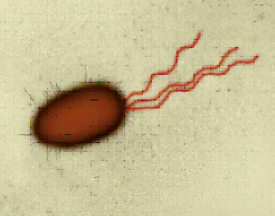
When one considers the irreducible complexity of the simplest single-cell bacteria, the evidence  should suffice to convince even the most recalcitrant skeptic, provided he has not abandoned all reason.  The motility of a bacterium is accomplished by a whip-like tail called a flagellum.   “The flagellum is constructed of 40 proteins, 10 of which are used in other structures in the cell, and 30 of which are unique to the flagellum.  The flagellum will not function unless all 40 proteins are put together the right way … If the flagellum is missing even one protein, it will not function.”[3]  I might also add that if only one protein is out of order, the flagellum will not function.

Image

Like creation, evolution cannot be proven scientifically or mathematically for that matter.  It takes an enormous amount of faith to believe “in the beginning hydrogen.”  Therefore, the only thing we can do is to consider the scientific evidence and see which origins model makes more sense or is more reasonable.

First of all, the universe and all that is in it “looks” designed.  Design demands a Designer.  Consider again the bacterium’s flagellum.


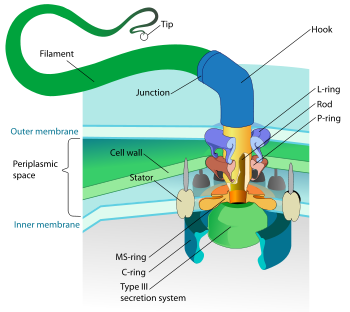
The flagellum has a motor that is about one-tenth of a micron in diameter, and a tail that turns at up to 100,000 rpm and acts as a propeller. The motor can reverse direction within a quarter turn. The electric motor of the flagellum is precisely analogous to our electric motors, but on a fantastically smaller scale, and it functions better than anything we can make.  One of the smallest man-made electric motors is 2 mm in diameter and was invented for use in boring plaque out of coronary arteries.  It involved the work of visionary cardiologists, as well as biomedical engineers.  These scientists, of course, stood on the shoulders of previous electricians, mathematicians, and engineers.

But the bacterial flagellum is 20,000 times smaller than this motor, works better, and turns faster!  The flagellum is fastened securely to the bacterial cell wall and has all the analogous parts of a man-made electric motor: It has a hook, or universal joint; a bushing; a rod (drive shaft); and an electrically-charged rotor and stator.[4]
Image

Intelligent scientists and engineers took years to design a tiny micro-motor that is clunky in comparison to the motor that drives the bacteria’s flagella, and yet we are amazed at the genius of the men that designed it.  But therein lays the answer:  men with intelligence designed it; it did not “evolve” on its own from an assortment of miscellaneous junk parts.  The same is true of the bacterial flagellum; it is of impeccable design, and only a fool will attribute its existence to the “blind watchmaker” of evolution.

From the smallest bacteria to the greatest galaxies, our universe displays incredible design and precision.  Evolution, on the other hand, wants to take credit for all that exists by claiming that 14 billion years ago some nondescript cosmic egg exploded, and that from all of the chaos of that primordial explosion, all that we now see “organized itself” into what we understand our universe to be.  It makes for a nice story, but it lacks substance.  Dr. Henry M. Morris offers five solid reasons why this “big bang” theory is a load of poppycock:

1.        The primordial explosion should have propelled all the matter/energy of the cosmos out radially from its center, and by the principle of conservation of angular momentum, none of it could ever thereafter have acquired any kind of curvilinear motion.  Yet there are all kinds of curving and orbiting motions of the stars and galaxies of the cosmos, a situation that seems quite impossible if the universe began with the big bang.
2.        Sensitive measurements in recent years have increasingly been showing that the background radiation is not homogeneous and isotropic (that is, the same in all directions), as it should be if it had been produced by the big bang, but is “anisotropic” in all directions.
3.        The universe is anything but uniform in large-scale structure, as both the big-bang and steady state theories require, but instead is full of huge agglomerations of matter in some regions and vast empty spaces in others, scattered around the cosmos in far from any uniform manner.  Some astronomers are now trying somehow to justify a primeval lumpy big bang!
4.        In the context of the primeval fireball, it is hard to justify the accumulation of any amount of matter in any one location such as a star.  If the explosion is driving all galaxies apart in the resulting expansion, how could it fail to drive all atoms apart before they came together in galaxies?
5.        The most serious objection comes back again in the second law of thermodynamics.  Explosions produce disorder, not order!  The primordial super explosion surely would have produced absolute chaos and the most utter disorder.  If the universe is indeed a closed system, as evolutionary cosmogonists allege, then how in the name of sense and science could this primeval chaotic disorder have possibly generated the beautifully organized and complexly ordered universe that we now have?  The big-bang idea, viewed in this light is as absurd as the steady state idea. [5]

“In the beginning hydrogen?”  Not hardly.  Order cannot come from disorder.  Life cannot come from non-life.  Evolutionists will attempt to deny, or otherwise skirt the issue, but the fact remains that even in the simplest form of life, all the creature’s parts must be present concurrently or the thing will not live, let alone survive.  Evolution from non-life would require that all the necessary proteins and amino acids come together instantaneously and in the proper configuration in order to produce life.  This has been attempted in the laboratory, and what was touted as a great success (the creation of a few amino acids) was in fact a miserable failure.[6] The resultant “building blocks” of life were the wrong blocks, and they did not fit together in any way to produce life.  Of course, that was conveniently left out of the headlines.

This fact alone should discredit the illusion of evolution, but the averse will adamantly cling to the myth claiming that all life originated from a single source billions of years ago.  Although it has been shown that spontaneous generation is next to impossible, let us assume an original source from which all life sprang.  Surely the fossil record would bear some evidence of transitional forms of one kind of life changing to another.  Without a doubt, several “proofs” have made the headlines only to be exposed as frauds, the lie to be revealed only in the most obscure sections of the printed media.  The fact is that the fossil record is remarkably silent on transitional forms.  Everything in the fossil record appears suddenly and fully formed, but bless their hard little hearts, the evolutionists continue their desperate search.

The Bible says that God created everything: space, time, matter/energy, earth, sky and sea, all plant life, sun, moon and stars, sea animals, land animals and at the top of His creation was man – created in the image of God.  All things were created in six 24-hour days, and at the end of each creation day, God declared His creation “good.”  Then on the final day of creation, He declared His creation “very good” – that is to say, “perfect.”  Declaring that each act of creation was good suggests that there was no need for improvement, i.e. “evolution.”  Plants were to bear seed “after its own kind.”  Animals were to reproduce “after their kind.”  This is what the fossil record bears out.

Neither creation nor evolution can be proven scientifically, but when compared side by side, creation, as recorded in the Bible, makes much more sense.  “In the beginning hydrogen?”  No!  In the beginning God!


[1] Calculation done on WebMath.Com: http://webmath.com/lottery.html

[2] From Answers in Genesis, “The Odds of Evolution,” http://aigbusted.blogspot.com/2007/11/odds-of-evolution_07.html

[3]  The Institute for Creation Research, The Creationist Worldview Program, Module 4, Course 2, Lesson 1, “Is Intelligent Design Unscientific?” Section : “Design: Purposeful Arrangement.”

[4] Ibid.

[5] Morris, Henry M., The Biblical Basis for Modern Science, (Green Forest, AZ, 2008), pp. 132-133.

[6] See article “Evolution Hopes You Don’t Know Chemistry: The Problem with Chirality” by Charles McCombs, Ph.D, http://www.icr.org/article/evolution-hopes-you-dont-know-chemistry-problem-wi/

Comments Off on The Fallacy of Time and Chance

Filed under Atheism, Christianity, Creation, Evolution, Religion