Category Archives: Religion

Heavenly Minded

Colossians 3_1-2


If ye then be risen with Christ, seek those things which are above, where Christ sitteth on the right hand of God.  Set your affection on things above, not on things on the earth. (Colossians 3:1-2)

Back in the seventies there was a saying going around in Christian circles exhorting Christians: “Don’t be so heavenly minded that you are no earthly good.”  So effective was that campaign that today it appears that the saying was taken to the extreme so that we are now producing Christians that are “so earthly minded that they are no heavenly good.”

It is sad to see so many formerly strong fundamental churches pandering to the whims of an increasing populace with an insatiable need for entertainment.  They call this being “seeker sensitive.”  This is an oxymoron because the Bible says that “there is none that seeketh after God” (Romans 3:11).  Many churches have lowered their standards in attempt to win those who have no standards and end up neither pleasing God nor pleasing man.  Jesus came “to seek and to save that which was lost” (Luke 19:10); He did not come to be sought.  Jesus was not a panderer.  When the rich young ruler came to Jesus seeking eternal life (Matthew 19:16-22), Jesus did not offer him the easy way out, nor did He go after him when “he went away from him sorrowful” because he had great possessions.

The standard for the Christian is the heavenly standard:  “But seek ye first the kingdom of God and his righteousness; and all these things shall be added unto you” (Matthew 6:33).  “And be not conformed to this world: but be ye transformed by the renewing of your mind, that ye may prove what is that good, and acceptable, and perfect, will of God” (Romans 12:2).  We are to “seek those things which are above” (Colossians 3:1), and to set our “affection on things above, not on things on earth” (v. 2).  We need to understand that “the world passeth away, and the lust thereof: but he that doeth the will of God abideth for ever” (1 John 2:17).  Our love for the lost should never exceed our affection for the things above.  We must “be ready always to give an answer to every man that asketh you a reason of the hope that is in you with meekness and fear” (1 Peter 3:15), but never at the cost of compromise.

2 Comments

Filed under Christianity, Gospel, Religion, Theology

It’s A New Year … Again!

mayan-calendar


Have not I commanded thee? Be strong and of a good courage; be not afraid, neither be thou dismayed: for the LORD thy God is with thee whithersoever thou goest. (Joshua 1:9)

Well, the Mayans let us down, and the world did not end as predicted on December 21, 2012.  Now we have 2013 for which to look forward, and if any credence can be given to the media, the prospects are not too promising.  As I write this, Congress has yet to arrive on a budget agreement that will keep the nation from going over the fiscal cliff.  The real unemployment rate is hovering around 17%, the housing market is in the tank, and it looks like we are headed for another recession.  The European Union is on the verge of financial collapse.  The Middle East is on fire.  Israel fights for its existence as Hamas rains down rockets on the Israeli population.  Iran is bent on developing atomic weapons for the sole purpose of destroying Israel.  North Korea continues test firing rockets that will have the potential of reaching our shores.  Russia continues to supply Iran with the raw materials and technology to develop their atomic weapons.  Meanwhile their nuclear ballistic missile submarines are patrolling our coastal waters as an act of defiance to the perceived impotence of our governmental and military leadership.  Happy New Year!

On the surface, there seems to be little hope.  Even so, the prospect of a new year always comes with the glimmer of hope that things can be better.  The New Year is a step forward into the unknown.  There is no way of knowing what is up ahead; there is only hope.  In our passage above, the Children of Israel had completed their 40-year sojourn in the wilderness and were preparing to enter the Promise Land.  Moses, who had been the only leader they had ever known, was dead.  In his place, Joshua had been commissioned to lead the people in the conquest of their new homeland.  Forty years before, he had been one of two of the twelve spies that returned with a good report about the land God had given them.  The other ten only saw the strength of the enemy and their own weakness and were fearful of taking on the challenge.  Now, they were once again at the frontier of the Promise Land.  The enemy they had feared forty years earlier was still in the land; nothing had changed.  They would still have to enter, fight for and conquer the land.  Even if their circumstances had not changed, neither had the promise of God changed.  “And I will bring you in unto the land, concerning the which I did swear to give it to Abraham, to Isaac, and to Jacob; and I will give it you for an heritage: I am the LORD” (Exodus 6:8).  It had always been so; the inheritance was theirs for the taking, but they had to take it, and God was their guarantee.  So here they were once again at the precipice of the unknown, but they carried with them the promise of God: “the LORD thy God is with thee whithersoever thou goest” (Joshua 1:9).

So, we are faced with another new year with an uncertain future.  No matter what that future may hold, we can rest on that same promise that the LORD our God is with us wherever we go and in whatever circumstances we may find ourselves.  We can trust that “they that wait upon the LORD shall renew their strength; they shall mount up with wings as eagles; they shall run, and not be weary; and they shall walk, and not faint” (Isaiah 40:31).  We can know that God is always at our side and “that neither death, nor life, nor angels, nor principalities, nor powers, nor things present, nor things to come, Nor height, nor depth, nor any other creature, shall be able to separate us from the love of God, which is in Christ Jesus our Lord” (Romans 8:38-39).

God’s blessings on you and yours in the coming new year; may you have a Happy and Prosperous New Year!

Comments Off on It’s A New Year … Again!

Filed under Christianity, Current Events, End Times, Religion

Bah! Humbug!

Scrooge

Wherewith shall I come before the LORD, and bow myself before the high God? shall I come before him with burnt offerings, with calves of a year old? … He hath shewed thee, O man, what is good; and what doth the LORD require of thee, but to do justly, and to love mercy, and to walk humbly with thy God? (Micah 6:6,8)

 At the risk of being labeled a Scrooge, I feel compelled to express my growing disillusion with the Christmas season and all the trappings associated with it.  Don’t get me wrong; I love Christmas, or at least I love what Christmas is supposed to signify – the condescension of the Creator God to take on the human form of His creation embodied in a helpless baby.  The thought is too awesome for words!  Yet that idea is all but lost in the midst of the tumult that has become “the holiday season.”

Beginning in October, even before the celebration of death (Halloween), which God calls the enemy (1 Corinthians 15:26) and Thanksgiving, which has become more a ritual of gluttony and football than a time to seriously pause to give thanks to God for all of His provision, the Christmas mass-marketing scheme is in full force.  This year on Thanksgiving Day the tryptophan was not even out of our systems when stores opened late to get a jump on the Black Friday spending spree.

The saying that “Christmas is for children” is meaningless these days.  Marketeers cleverly target the growing avarice in our society by creating the illusion that their product will bring genuine happiness or fill some sort of desperate need.  Mercedes-Benz has Santa loading up cars on delivery trucks – one line of red cars for his “naughty” list and white for his “nice” list.  So, even if you are “naughty” Santa will still get you what you want.  Buick has a commercial where a young man is presenting his wife (I hope) a new car for Christmas, when a brand new Buick Enclave drives by and the young woman loses interest in the car her husband (I hope) has given her as she stares lustfully after the Enclave.  Lexus, Cadillac, Nissan, etc. all have ads tempting the viewer through “the lust of the flesh, the lust of the eyes and the pride of life” (1 John 2:16).  Car manufacturers are not the only culprits.  Rosetta Stone has a cute commercial where a little boy is brought to Santa.  Santa addresses the boy in English, the boy responds in German, so Santa instantly switches to speaking German because Santa learned to speak German by using the Rosetta Stone language learning software.  The list could go on and on.

I hear Christians lament the commercialization of Christmas, but we are just as guilty as the secular world of going overboard on spending just because “it’s the season of giving.”  We bemoan the “war on Christmas” but our Christian radio stations are just as likely to play “Rockin’ Around the Christmas Tree” as “Oh Come All Ye Faithful.”  Big mega church productions of Christmas pageants typically devote the first half of the program to secular music and dancing (choreography for Baptists) and reserve the best for last – the true Christmas story.  What I am saying is that we are guilty of accommodating at best, or assimilating with, at worst, the secular world.  Then we whine because the world is losing the real meaning of Christmas!  Well, I have news! Christmas, although not called by that name, has always been a pagan celebration.  We stole their celebration, put a Christian spin on it, and now we are complaining because they are taking it back!

Without going into great detail that you can “Google” on your own, Christmas was not observed in the early Christian church until around the mid fourth century when Pope Julius I (A.D. 337-352) sanctioned the celebration of the Nativity to coincide with the Roman celebration of the winter solstice called Saturnalia.  Santa Claus originated from a third century bishop by the name of Nicholas of Myra (in Turkey) who was renowned for his generosity, which, by the way, was not limited to December 25th.  We can thank Clement C. Moore (1779 – 1863) for the red suit and the “miniature sleigh and eight tiny reindeer.”

The Christmas tree is considered by some as Christianisation [sic] of pagan tradition and ritual surrounding the Winter Solstice, which included the use of evergreen boughs, and an adaptation of pagan tree worship; according to eighth-century biographer Æddi Stephanus, Saint Boniface (634–709), who was a missionary in Germany, took an axe to an oak tree dedicated to Thor and pointed out a fir tree, which he stated was a more fitting object of reverence because it pointed to heaven and it had a triangular shape, which he said was symbolic of the Trinity. (Wikipedia)

As Christians, we should know that Jesus was not born on December 25th, but most likely sometime in late August or September.  When you think about it, God probably kept the date of His birth a secret precisely so that we would not turn it into the circus it has become.  He is not interested in our participation in meaningless rituals, but rather our genuine devotion to Him at all times.  What would happen if Christians stopped shopping for Christmas gifts for one another and instead gave that money spent to the Lord?  Would we be any less blessed?  My guess is that God would bless us even more!  What would happen to the commercialism of Christmas if Christians stopped buying?  Maybe the commercialization would become less overt. What if we practiced our generosity all year round and not reserve it just for Christmas?  What if we celebrated Christ’s advent all year round instead of just once a year?  What difference does December 25th make?  What is important is that God came into this world as a baby, to experience the same aches and pains we experience, to be faced with the same temptations we face, and then to willingly take our place on the cross to pay the death penalty we owed.  Our gifts should be presented to the One who saves, not to the ones He died to save.  That God took on human form in order to redeem us unto Himself is a significant event worthy of remembrance, but perhaps in a way that honors Him, not our own hubris.


5 Comments

Filed under Apologetics, Christianity, Christmas, Current Events, Evangelism, Religion, Salvation

Prayer With Action!

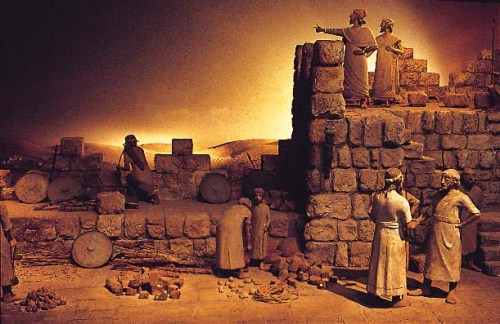
Rebuilding the Walls


Nevertheless we made our prayer unto our God, and set a watch against them day and night, because of them.  (Nehemiah 4:9)

Nehemiah faced opposition to the refortification of Jerusalem in many forms.  At first he and the Jews were laughed at (2:19) by their enemies, to which Nehemiah responded, “The God of heaven, he will prosper us; therefore we his servants will arise and build” (2:20).  When marginalizing the efforts of the Jews had no effect, their enemies resorted to ridicule and mocking.  Nehemiah turned the matter over to God:  “Hear O our God; for we are despised: and turn their reproach upon their own head, and give them for a prey in the land of captivity: And cover not their iniquity, and let not their sin be blotted out from before thee: for they have provoked thee to anger before the builders” (4:4-5), but the work went on.  Seeing that their vitriol was feckless, “they were very wroth, and conspired all of them together to come and to fight against Jerusalem, and to hinder it” (v. 8).

The threat of violence failed to hinder the progress.  Again, Nehemiah gave the matter over to God, but he did not stop there.  He “set a watch against them day and night because of them” (v. 9).  Furthermore, he motivated the people to defend the part of the wall that directly protected their families: “I even set the people after their families with their swords, and their bows” (v.13).  He also made preparations in case of a realized attack:  “And I said unto the nobles, and to the rulers, and to the rest of the people, The work is great and large, and we are separated upon the wall, one far from another.  In what place therefore ye hear the sound of the trumpet, resort ye thither unto us: our God shall fight for us” (vv. 19-20).

Nehemiah is an example of prayer with action.  Sometimes we ask God to intervene on our behalf and are disappointed when it appears that God has not answered our prayer.  The problem is that we fail to take personal responsibility in the resolution to our problems.  While it is true that some of our requests can only be accomplished by God’s miraculous intervention, more often than not, we are able to resolve our own issues with His help.  He provides the resources, the intellect and the abilities, but we need to be motivated to defend our section of the wall.  Jesus illustrated this with God’s provision for the ravens (Luke 12:24).  God provides for the needs of the birds, but the birds still have to leave the nest and search for the food God has provided.  Pray with action!

Comments Off on Prayer With Action!

Filed under Christianity, Religion

Chosen From the Womb

… God, who separated me from my mother’s womb … (Galatians 1:15)

Paul, in making his case to the Galatians for his apostleship, makes a striking statement that is overlooked or blatantly ignored by the proponents of easy abortions.  Sadly, a large number of so-called Christians fall into this camp.  Here, Paul states in no uncertain terms that his call “to preach him among the heathen” (v. 16) came before he was even born.

That human life is precious to God is clearly demonstrated in the pages of the Bible.  When Cain murdered his brother Abel, God quickly called him to account:  “What hast thou done? The voice of thy brother’s blood crieth unto me from the ground.  And now art thou cursed from the earth which hath opened up her mouth to receive thy brother’s blood” (Genesis 4:10-11).  Then to discourage others from murdering Cain, “the LORD said unto him, Therefore whosoever slayeth Cain, vengeance shall be taken on him sevenfold” (Genesis 4:15).  Over a millennia and a half later, when Noah exited the ark, God assigned the protection of life to man: “And surely your blood of your lives will I require; at the hand of every beast will I require it, and at the hand of man; at the hand of every man’s brother will I require the life of man.  Whoso sheddeth man’s blood, by man shall his blood be shed: for in the image of God made he man” (Genesis 9:5-6).

Then the question arises, “When does life begin?”  To the biologist, human life begins at the union of the sperm with the ovum, but to the secular scientist, that is “biological” human life (Greek: bíos) without the essence (Greek: zoé) of humanity or “personhood.”  This then becomes a philosophical question.  Does the “thing” become a person at conception, or after the first trimester from conception, or after the second, or the third?  Some go so far assign the quality of personhood long after the birth of the creature, even up to three years.  Killing such a creature can then be justified seeing “it” is not a “person.”

God makes no such distinctions.  From the moment of conception, and even before then, the child is a human being, a person – the image of God.  To make this point clear, God established laws to protect the child in the womb making it a capital offense to take the life of a fully developed unborn child. (Exodus 21:22-23).   The psalmist declares “My substance was not hid from thee, when I was made in secret, and curiously wrought in the lowest parts of the earth.  Thine eyes did see my substance, yet being unperfect; and in thy book all my members were written, which in continuance were fashioned, when as yet there was none of them” (Psalm 139:15-16).  God spoke to the prophet Jeremiah and said, “Before I formed thee in the belly I knew thee; and before thou camest forth out of the womb I sanctified thee, and I ordained thee a prophet unto the nations” (Jeremiah 1:5).  Life is precious to God.  Even before conception He has devised a plan for every life He creates in the womb.  Since it is God that creates, gives and sustains life, abortion is never justified or acceptable from His perspective.  That being so, it makes sense that anyone who fears God, would and should share the same perspective.

Comments Off on Chosen From the Womb

Filed under Apologetics, Christianity, Creation, Current Events, Pro-life, Religion