Category Archives: Theology

Risen Indeed!

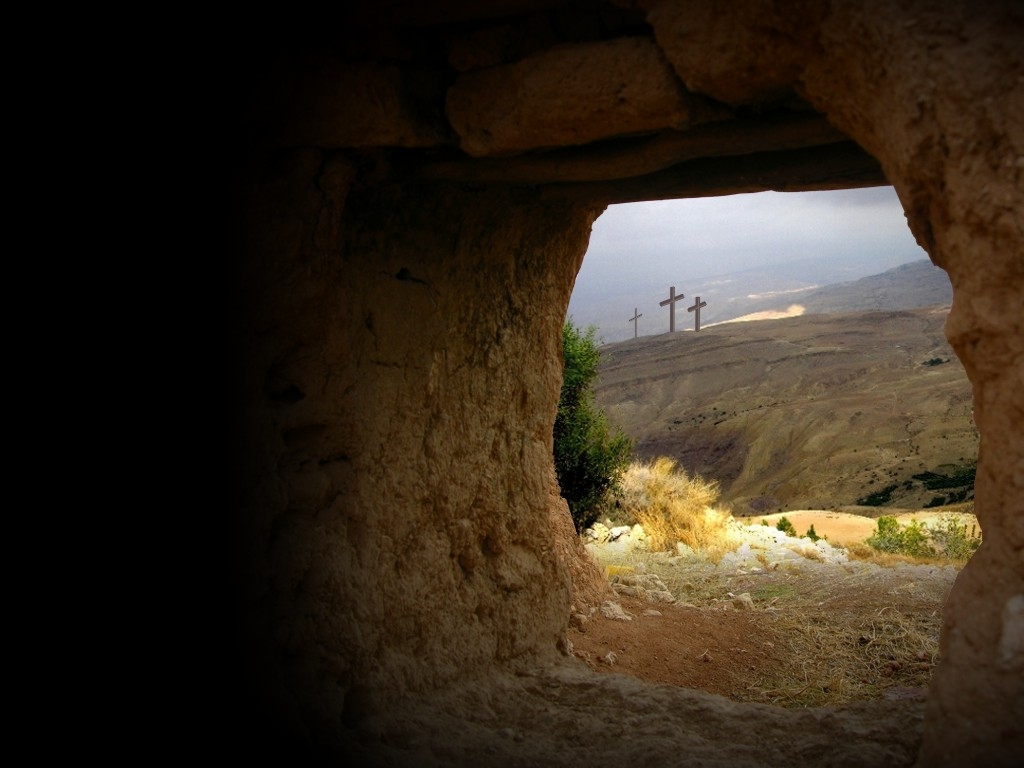
empty_tomb2


He is not here: for he is risen, as he said. Come, see the place where the Lord lay. (Matthew 28:6)

The most verifiable fact in human history is the empty tomb of Christ. Only an ignorant fool can look upon the evidence and deny the reality. Many world religions are built around a founder that is dead and buried in some grave. Al-Masjid al-Nabawī, the Mosque of the Prophet, in Medina, holds the remains of Islam’s founder, Mohammad. Buddha died and was cremated and his remains divided up amongst several Buddhist temples. Adherents of these religions can point to the remains of their founders and say, “he is there” or “there he lies.” These places have become holy shrines were the faithful worship. But Christians can only point to an empty tomb, for our Savior is risen indeed!

Cynics have tried in vain to debunk the claim. Some claim that Jesus really did not die, but that He “swooned” because of the physical abuse and blood loss, but in the coolness of the tomb He revived and came out of the grave. How ridiculous! Even if it were true that He did not really die, how could He have moved the stone weighing several thousand pounds and then had enough strength to overcome the 16 Roman soldiers guarding the tomb? And how could the Roman execution squad have mistaken His “swoon” as death? These men were expert in executing slow and painful deaths – they knew when a victim died!

Then there are those who claim the disciples stole Jesus’ body and faked His resurrection. Yes! These cowards that abandoned Jesus at the time of His arrest and then went and hid for fear of their lives! Yes these “tough guys” had the courage to go up against 16 trained Roman soldiers, over power them and rob the grave. That is highly doubtful! But that was what the soldiers were paid to say (Matthew 28:13).

If Jesus had not risen from the grave, all the religious leaders would need to have done is produce the body. They could have taken His body and paraded it around all over Jerusalem to once and for all silence the claim that he had risen.

Jesus was witnessed alive not only by His disciples, but by over 500 people (1 Corinthians 15:5-8). It is unlikely, actually it is next to impossible, for someone to be willing to die for a hoax, but these early Christians were ready to deny their old religious beliefs to follow the resurrected Christ, and were willing to give their lives for that belief.

Jesus is risen. He is risen indeed! He is alive and He offers life eternal to anyone who will believe. He is the only way, the only truth and the only life. And no one can come to the Father except through Him (John 14:6). To have this eternal life, all one needs do is repent, trust and believe: (John 1:12; 3:16-18, 36; 5:24; 6:40,47; Romans 10:9-10) Happy Resurrection Day!


4 Comments

Filed under Apologetics, Christianity, Gospel, Religion, Salvation, Theology

The Bible Stands

Bible

The grass withereth, the flower fadeth: but the word of our God shall stand for ever.   (Isaiah 40:8)

Recently a well-known pastor was interviewed by a well-known news commentator concerning the History Channel’s mini-series entitled the The Bible.  The commentator, who claims to be a Christian, began his interview with the presupposition that the Bible is all allegorical. His first question betrayed his bias: “Adam and Eve: Did they literally live in the Garden of Eden and usurp the evolutionary process?” The exchange continued on a pretty even keel from then on with the pastor responding to the commentator’s every incredulous questions. Finally the commentator challenged the compatibility of the Bible with science. The pastor responded with, “I think you’re wrong on this one. The Bible does not contradict true science. It may contradict passing fads of scientific theory that are always evolving.” The pastor could have been more straightforward with the commentator and plainly said, “No, you are wrong on this one,” and gone on to make his case. The truth that pastor made clear was that the opinions of science are always changing with every new discovery, but God and His Word never changes, so, it is either always fully reliable, or it us wholly unreliable. It is either all true or not true at all.

So the pastor continued to make his point: “For example, it used to be thought that the cosmos always existed. But then we had Sir Fred Hoyle, who named the named the Big Bang Theory, that said, ‘Guess what, the universe had a beginning 13.7 billion years ago.’” At this point the pastor had not yet fully capitulated. He was simply pointing out that scientific theories are fickle, but what he unwittingly did was give credence to the unproved “scientific” Big Bang Theory. This was reflected in the commentator’s subsequent question: “Do you believe that the universe started 13.7 billion years ago?” Now the pastor was in a tight spot. He had already opened the door to the possibility of the Big Bang, so now he had to wiggle out of it the best way he could. He responded, “I think it very well could have. One of the things fundamentalist Christians mess up on is they try to say the earth is 6000 years old. The Bible never makes that claim anywhere.” So now, before a national audience, he made the theories of man superior to the Bible, he threw fundamentalist Christians “under the bus,” and he made a false (or at least uniformed) claim about the Bible.

Of course the Bible makes no claim about the age of the earth! However, when one makes a careful study of the genealogies in the book of Genesis, one can easily determine that the time from Adam to Noah was about 1600 years. Some who doubt the veracity of Scripture will attempt to interject “gaps” in the genealogies so that the time span could be much greater, but this is unfounded when one takes Scripture for what is plainly stated. Others attempt to introduce long ages, billions of years even, between the first two verses of Genesis, but this, again, is unfounded. Or else they will attempt to make the “days” of creation be long ages, and this too has no basis in truth especially when a “day” (Hebrew: yom) is clearly defined as “evening and morning” – clearly a 24-hour day. So with a little bit of study and the use of some very simple mathematics, we can conclude, according to Scripture, that the earth is approximately 6000 years old. By yielding on this point, the pastor lost credibility for himself and for the Bible, and ultimately he lost the debate. The commentator reaffirmed his assertion that the Bible was all allegory and given that the pastor had basically conceded on the Genesis record there was really nothing more the pastor could say to convince him otherwise.

Anyone who truly believes that “All scripture is given by inspiration of God” (2 Timothy 3:16) and that “Heaven and earth shall pass away, but [God’s] words shall not pass away” (Matthew 24:35) cannot afford to compromise on Scripture even in the tiniest point. Jesus said, “For verily I say unto you, Till heaven and earth pass, one jot or one tittle shall in no wise pass from the law, till all be fulfilled” (Matthew 5:18). If this is so, then all of Scripture is true and accurate, and according to the biblical record, the earth is about 6000 years old. The atheists/evolutionists do not yield in the least on their contrived Big Bang Theory, so why should Christians compromise on the truth of Scripture?

The pastor preached a solid sermon on Sunday. He preached on:

      • The reliability of the Bible
      • The exclusivity of the Gospel
      • The sovereignty of God

All points meant to encourage Christians to trust God and His Word. So why compromise? Either God’s Word is true or it is not. It really is that simple. The words of the old hymn probably express best the attitude we ought to have toward the Word of God …

The Bible stands like a rock undaunted
’Mid the raging storms of time;
Its pages burn with the truth eternal, (emphasis added)
And they glow with a light sublime.
 
Refrain:
The Bible stands though the hills may tumble,
It will firmly stand when the earth shall crumble;
I will plant my feet on its firm foundation,
For the Bible stands.
 
The Bible stands like a mountain tow’ring
Far above the works of men; (emphasis added)
Its truth by none ever was refuted,
And destroy it they never can.
 
The Bible stands and it will forever,
When the world has passed away;
By inspiration it has been given,
All its precepts I will obey.
 
The Bible stands every test we give it, (emphasis added)
For its Author is divine;
By grace alone I expect to live it,
And to prove and to make it mine.
(“The Bible Stands” by Haldor Lillenas, 1917)


As Bible-believing Christians, there should never be room for compromise on Scripture.

Comments Off on The Bible Stands

Filed under Apologetics, Atheism, Christianity, Creation, Current Events, Evolution, Gospel, Religion, Theology

Doggie Heaven

Peeper

Are not five sparrows sold for two farthings, and not one of them is forgotten before God(Luke 12:6)

Tina, our fourteen and a half-year old Chorkie (half Chihuahua, half Yorkie) is coming to the end of her life, and the prospect of her demise is breaking our hearts. We got Tina when she was not quite three months old from my sister. She was so tiny that she fit in the palm of my hand, and she looked rather ugly with thin, grayish, wiry hair that stuck out in all directions. In the evenings when June, my wife, would come home from the hospital where she worked as a labor and delivery nurse, she would take Tina and put her in the side pocket of her scrubs, and Tina was perfectly happy to go along for the ride. She didn’t stay that small though. She grew to a whopping seven pounds, and our local vet cautioned us that she was getting too fat. Well, she didn’t get any bigger than that, but what she lacked in size, she made up in heart. Tina loves people and tolerates other dogs as long as they know that she’s the boss. She knows no fear and she won’t back down from a fight, even when the aggressor outweighs her by twenty pounds. That’s how she lost her left eye, and how she got her nickname, “Peeper.”

We have many fond memories of the time God has blessed us with our little girl. I can’t believe that I was once ready to get rid of her because she refused to be housebroken. She was almost a year old and she just wasn’t getting it. I told her, “If you don’t stop doing your business inside the house by the end of the week, you’re out of here!” I don’t know if she understood, but from that day on, we had no more problems. When I think of what we would have missed out on had I followed through on my threat, I just thank God that she got the message.

As I ponder what lies ahead for us – will she pass quietly in her sleep? – will we have to watch her waste away slowly because she refuses to eat? – will we have to put her down and hold her as her life leaves her tiny body? – I wonder, why does God allow us to love these little creatures so deeply that our hearts ache when we lose them? I think, “They are just animals.” But are they just animals? Anyone who has ever loved a dog knows that each one has their own personality. They can’t talk to us in human language, but they do communicate. We know what they are thinking and what they want, and they know how to get what they want from us. And when we talk to them, they listen, and it is almost as if they understand. When we are happy, they are happy. When we are down, they seem to know, and they will wrap themselves up next to us, or crawl up on our laps to comfort us. Remember the story of Lazarus and the rich man in Luke 16:19-31? The rich man had no concern for the plight of the poor beggar camped outside his gates. Jesus noted that the dogs had more compassion for this poor wretch and “came and licked his sores” (v. 21). Dogs are like that.

I hope that God has a special place for dogs in heaven. I know that the Bible doesn’t talk about such things. Isaiah speaks of animals in the Millennial Kingdom: “The wolf also shall dwell with the lamb, and the leopard shall lie down with the kid; and the calf and the young lion and the fatling together; and a little child shall lead them. And the cow and the bear shall feed; their young ones shall lie down together: and the lion shall eat straw like the ox. And the sucking child shall play on the hole of the asp, and the weaned child shall put his hand on the cockatrice’ [crocodile’s] den. They shall not hurt nor destroy in all my holy mountain: for the earth shall be full of the knowledge of the LORD, as the waters cover the sea” (Isaiah 11:7-9). Since the wolf is of the “dog kind,” surely domestic dogs will be included there too. The Millennial Kingdom, although it will be wonderful, is not quite heaven. There is yet a New Heaven and a New Earth to be created (Revelation 21:1). There is no mention of animals in the New Heaven and the New Earth, but it is safe to guess that since God created animals before man in His first creation, then He probably will have animals in the New Heaven and New Earth. But do dogs go to heaven?

In the beginning when God created, there was no death. Animals did not die and man did not die. It stands to reason, therefore, that animals too were created to live forever. But that ended when man sinned in the Garden (Genesis 3), and death entered into the world because of man’s sin (Romans 5:12). Man’s sin brought death upon all of God’s creation so “that the whole creation groaneth and travaileth in pain together until now” (Romans 8:22). Animals suffer death innocently because of our sin, but Jesus did not come to die for dogs. “This is a faithful saying, and worthy of all acceptation, that Christ Jesus came into the world to save sinners; of whom I am chief” (1 Timothy 1:15). In redeeming mankind, Christ will redeem His creation. “And God shall wipe away all tears from their eyes; and there shall be no more death, neither sorrow, nor crying, neither shall there be any more pain: for the former things are passed away” (Revelation 21:4).

No, the Bible doesn’t say what happens to doggies when they die. That does not mean that God does not care about them. Our beginning verse reminds us that even seemingly insignificant sparrows do not fall without their Creator taking notice of them. So, as I pray for my little four-footed friend, I ask that God will take note of her. Remember what a faithful little companion she has been. Remember that the curse of death is not her fault; it’s mine. So, if there is a doggie heaven, then please, Lord, make a place for our little Tina.

5 Comments

Filed under Apologetics, Christianity, Creation, Current Events, Dogs, End Times, Gospel, Religion, Salvation, Theology

Willful Blindness

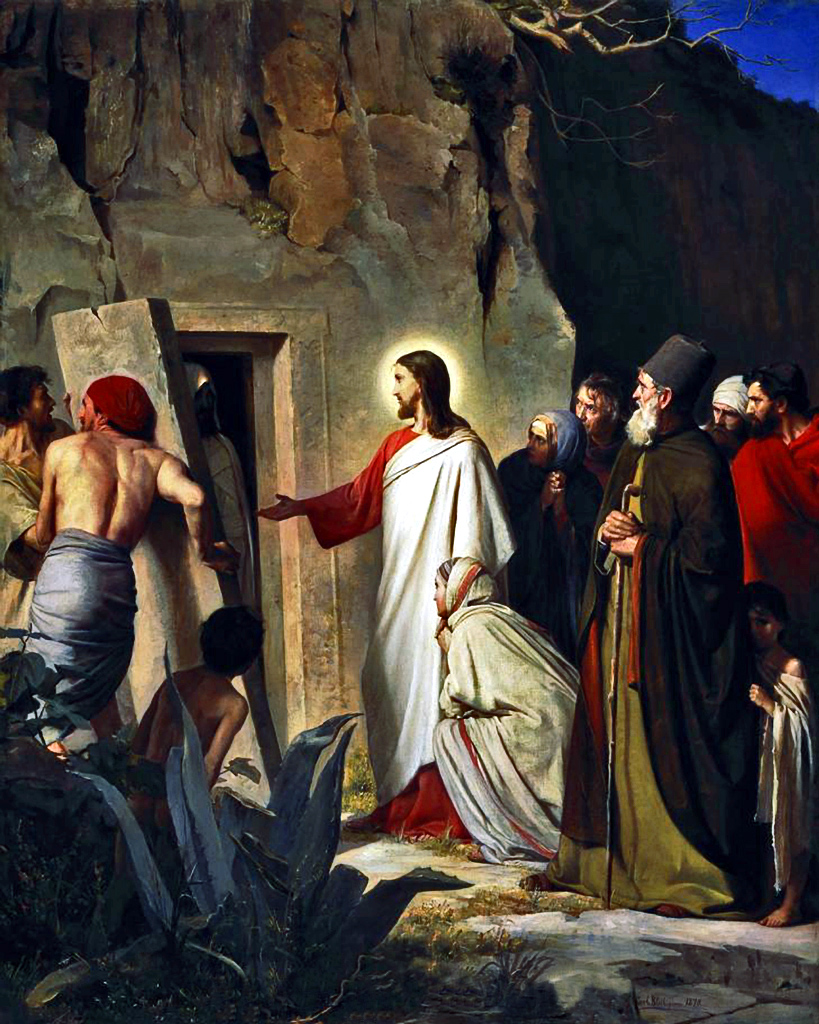
John11_1_Raising_Lazarus_Bloch

But the chief priests consulted that they might put Laz’-a-rus also to death; Because that by reason of him many of the Jews went away, and believed on Jesus. (John 12:10-11)

Jesus was entering His final week before the cross.  Just days before He had raised Lazarus from the dead (John 11:43-44), and now He was enjoying a meal with His friends and His apostles.  Lazarus was among the invited guests, and many curious spectators “came not for Jesus’ sake only, but that they might see Laz’-a-rus also, whom he had raised from the dead” (John 12:9).  Others came with ulterior motives.  After Jesus raised Lazarus, “many of the Jews which came to Mary, and had seen the things which Jesus did, believed on him.  But some of them went their ways to the Pharisees, and told them what things Jesus had done.  Then gathered the chief priests and Pharisees a council, and said, What do we? For this man doeth many miracles … Then from that day forth they took counsel together for to put him to death” (John 11:45-47, 53).  Now, not only did they want to put Jesus to death, but they wanted to destroy the evidence to His miracle by killing Lazarus too.

The reprobate mind is willfully blind.  “They profess that they know God; but in works they deny him, being abominable, and disobedient, and unto every good work reprobate” (Titus 1:16).  “Reprobate” is the Greek word adókimos meaning unapproved, rejected, or by implication, worthless.  There is no fix to a reprobate mind; once a heart is hardened against God, He can do nothing less than give them over to a reprobate mind (Romans 1:28).  For the reprobate mind, there is no amount of evidence that will turn their heart toward God.  “If they hear not Moses and the prophets, neither will they be persuaded, though one rose from the dead” (Luke 16:31).  This was proven true twice during Jesus’ final weeks: first Lazarus, then Jesus Himself.  But instead of believing the evidence, they continued in their unbelief, “knowing the judgment of God, that they which commit such things are worthy of death, not only do the same, but have pleasure in them that do them” (Romans 1:32).

Of course, as believers, we are not in the position to make such a judgment, for only God “knoweth the secrets of the heart” (Psalm 44:21).  Our responsibility is to be His witnesses (Matthew 28:18-20; Acts 1:8), for God truly is “not willing that any should perish, but that all should come to repentance” (2 Peter 3:9).  Sadly though, because of willful blindness, we may be giving “that which is holy unto dogs” and casting our “pearls before swine” (Matthew 7:6) no matter what evidence we provide, even though “One rose from the dead.”

Comments Off on Willful Blindness

Filed under Apologetics, Christianity, Gospel, Religion, Salvation, Theology

Heavenly Minded

Colossians 3_1-2


If ye then be risen with Christ, seek those things which are above, where Christ sitteth on the right hand of God.  Set your affection on things above, not on things on the earth. (Colossians 3:1-2)

Back in the seventies there was a saying going around in Christian circles exhorting Christians: “Don’t be so heavenly minded that you are no earthly good.”  So effective was that campaign that today it appears that the saying was taken to the extreme so that we are now producing Christians that are “so earthly minded that they are no heavenly good.”

It is sad to see so many formerly strong fundamental churches pandering to the whims of an increasing populace with an insatiable need for entertainment.  They call this being “seeker sensitive.”  This is an oxymoron because the Bible says that “there is none that seeketh after God” (Romans 3:11).  Many churches have lowered their standards in attempt to win those who have no standards and end up neither pleasing God nor pleasing man.  Jesus came “to seek and to save that which was lost” (Luke 19:10); He did not come to be sought.  Jesus was not a panderer.  When the rich young ruler came to Jesus seeking eternal life (Matthew 19:16-22), Jesus did not offer him the easy way out, nor did He go after him when “he went away from him sorrowful” because he had great possessions.

The standard for the Christian is the heavenly standard:  “But seek ye first the kingdom of God and his righteousness; and all these things shall be added unto you” (Matthew 6:33).  “And be not conformed to this world: but be ye transformed by the renewing of your mind, that ye may prove what is that good, and acceptable, and perfect, will of God” (Romans 12:2).  We are to “seek those things which are above” (Colossians 3:1), and to set our “affection on things above, not on things on earth” (v. 2).  We need to understand that “the world passeth away, and the lust thereof: but he that doeth the will of God abideth for ever” (1 John 2:17).  Our love for the lost should never exceed our affection for the things above.  We must “be ready always to give an answer to every man that asketh you a reason of the hope that is in you with meekness and fear” (1 Peter 3:15), but never at the cost of compromise.

2 Comments

Filed under Christianity, Gospel, Religion, Theology