Bah! Humbug!

Scrooge

Wherewith shall I come before the LORD, and bow myself before the high God? shall I come before him with burnt offerings, with calves of a year old? … He hath shewed thee, O man, what is good; and what doth the LORD require of thee, but to do justly, and to love mercy, and to walk humbly with thy God? (Micah 6:6,8)

 At the risk of being labeled a Scrooge, I feel compelled to express my growing disillusion with the Christmas season and all the trappings associated with it.  Don’t get me wrong; I love Christmas, or at least I love what Christmas is supposed to signify – the condescension of the Creator God to take on the human form of His creation embodied in a helpless baby.  The thought is too awesome for words!  Yet that idea is all but lost in the midst of the tumult that has become “the holiday season.”

Beginning in October, even before the celebration of death (Halloween), which God calls the enemy (1 Corinthians 15:26) and Thanksgiving, which has become more a ritual of gluttony and football than a time to seriously pause to give thanks to God for all of His provision, the Christmas mass-marketing scheme is in full force.  This year on Thanksgiving Day the tryptophan was not even out of our systems when stores opened late to get a jump on the Black Friday spending spree.

The saying that “Christmas is for children” is meaningless these days.  Marketeers cleverly target the growing avarice in our society by creating the illusion that their product will bring genuine happiness or fill some sort of desperate need.  Mercedes-Benz has Santa loading up cars on delivery trucks – one line of red cars for his “naughty” list and white for his “nice” list.  So, even if you are “naughty” Santa will still get you what you want.  Buick has a commercial where a young man is presenting his wife (I hope) a new car for Christmas, when a brand new Buick Enclave drives by and the young woman loses interest in the car her husband (I hope) has given her as she stares lustfully after the Enclave.  Lexus, Cadillac, Nissan, etc. all have ads tempting the viewer through “the lust of the flesh, the lust of the eyes and the pride of life” (1 John 2:16).  Car manufacturers are not the only culprits.  Rosetta Stone has a cute commercial where a little boy is brought to Santa.  Santa addresses the boy in English, the boy responds in German, so Santa instantly switches to speaking German because Santa learned to speak German by using the Rosetta Stone language learning software.  The list could go on and on.

I hear Christians lament the commercialization of Christmas, but we are just as guilty as the secular world of going overboard on spending just because “it’s the season of giving.”  We bemoan the “war on Christmas” but our Christian radio stations are just as likely to play “Rockin’ Around the Christmas Tree” as “Oh Come All Ye Faithful.”  Big mega church productions of Christmas pageants typically devote the first half of the program to secular music and dancing (choreography for Baptists) and reserve the best for last – the true Christmas story.  What I am saying is that we are guilty of accommodating at best, or assimilating with, at worst, the secular world.  Then we whine because the world is losing the real meaning of Christmas!  Well, I have news! Christmas, although not called by that name, has always been a pagan celebration.  We stole their celebration, put a Christian spin on it, and now we are complaining because they are taking it back!

Without going into great detail that you can “Google” on your own, Christmas was not observed in the early Christian church until around the mid fourth century when Pope Julius I (A.D. 337-352) sanctioned the celebration of the Nativity to coincide with the Roman celebration of the winter solstice called Saturnalia.  Santa Claus originated from a third century bishop by the name of Nicholas of Myra (in Turkey) who was renowned for his generosity, which, by the way, was not limited to December 25th.  We can thank Clement C. Moore (1779 – 1863) for the red suit and the “miniature sleigh and eight tiny reindeer.”

The Christmas tree is considered by some as Christianisation [sic] of pagan tradition and ritual surrounding the Winter Solstice, which included the use of evergreen boughs, and an adaptation of pagan tree worship; according to eighth-century biographer Æddi Stephanus, Saint Boniface (634–709), who was a missionary in Germany, took an axe to an oak tree dedicated to Thor and pointed out a fir tree, which he stated was a more fitting object of reverence because it pointed to heaven and it had a triangular shape, which he said was symbolic of the Trinity. (Wikipedia)

As Christians, we should know that Jesus was not born on December 25th, but most likely sometime in late August or September.  When you think about it, God probably kept the date of His birth a secret precisely so that we would not turn it into the circus it has become.  He is not interested in our participation in meaningless rituals, but rather our genuine devotion to Him at all times.  What would happen if Christians stopped shopping for Christmas gifts for one another and instead gave that money spent to the Lord?  Would we be any less blessed?  My guess is that God would bless us even more!  What would happen to the commercialism of Christmas if Christians stopped buying?  Maybe the commercialization would become less overt. What if we practiced our generosity all year round and not reserve it just for Christmas?  What if we celebrated Christ’s advent all year round instead of just once a year?  What difference does December 25th make?  What is important is that God came into this world as a baby, to experience the same aches and pains we experience, to be faced with the same temptations we face, and then to willingly take our place on the cross to pay the death penalty we owed.  Our gifts should be presented to the One who saves, not to the ones He died to save.  That God took on human form in order to redeem us unto Himself is a significant event worthy of remembrance, but perhaps in a way that honors Him, not our own hubris.

5 Comments

Filed under Apologetics, Christianity, Christmas, Current Events, Evangelism, Religion, Salvation

Prayer With Action!

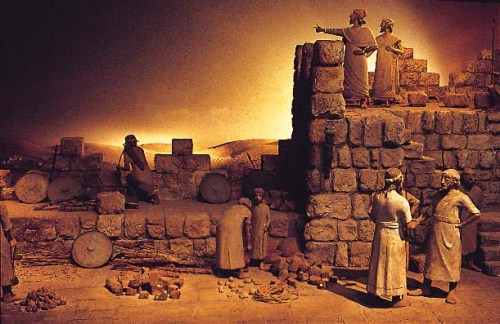
Rebuilding the Walls


Nevertheless we made our prayer unto our God, and set a watch against them day and night, because of them.  (Nehemiah 4:9)

Nehemiah faced opposition to the refortification of Jerusalem in many forms.  At first he and the Jews were laughed at (2:19) by their enemies, to which Nehemiah responded, “The God of heaven, he will prosper us; therefore we his servants will arise and build” (2:20).  When marginalizing the efforts of the Jews had no effect, their enemies resorted to ridicule and mocking.  Nehemiah turned the matter over to God:  “Hear O our God; for we are despised: and turn their reproach upon their own head, and give them for a prey in the land of captivity: And cover not their iniquity, and let not their sin be blotted out from before thee: for they have provoked thee to anger before the builders” (4:4-5), but the work went on.  Seeing that their vitriol was feckless, “they were very wroth, and conspired all of them together to come and to fight against Jerusalem, and to hinder it” (v. 8).

The threat of violence failed to hinder the progress.  Again, Nehemiah gave the matter over to God, but he did not stop there.  He “set a watch against them day and night because of them” (v. 9).  Furthermore, he motivated the people to defend the part of the wall that directly protected their families: “I even set the people after their families with their swords, and their bows” (v.13).  He also made preparations in case of a realized attack:  “And I said unto the nobles, and to the rulers, and to the rest of the people, The work is great and large, and we are separated upon the wall, one far from another.  In what place therefore ye hear the sound of the trumpet, resort ye thither unto us: our God shall fight for us” (vv. 19-20).

Nehemiah is an example of prayer with action.  Sometimes we ask God to intervene on our behalf and are disappointed when it appears that God has not answered our prayer.  The problem is that we fail to take personal responsibility in the resolution to our problems.  While it is true that some of our requests can only be accomplished by God’s miraculous intervention, more often than not, we are able to resolve our own issues with His help.  He provides the resources, the intellect and the abilities, but we need to be motivated to defend our section of the wall.  Jesus illustrated this with God’s provision for the ravens (Luke 12:24).  God provides for the needs of the birds, but the birds still have to leave the nest and search for the food God has provided.  Pray with action!

Comments Off on Prayer With Action!

Filed under Christianity, Religion

Chosen From the Womb

… God, who separated me from my mother’s womb … (Galatians 1:15)

Paul, in making his case to the Galatians for his apostleship, makes a striking statement that is overlooked or blatantly ignored by the proponents of easy abortions.  Sadly, a large number of so-called Christians fall into this camp.  Here, Paul states in no uncertain terms that his call “to preach him among the heathen” (v. 16) came before he was even born.

That human life is precious to God is clearly demonstrated in the pages of the Bible.  When Cain murdered his brother Abel, God quickly called him to account:  “What hast thou done? The voice of thy brother’s blood crieth unto me from the ground.  And now art thou cursed from the earth which hath opened up her mouth to receive thy brother’s blood” (Genesis 4:10-11).  Then to discourage others from murdering Cain, “the LORD said unto him, Therefore whosoever slayeth Cain, vengeance shall be taken on him sevenfold” (Genesis 4:15).  Over a millennia and a half later, when Noah exited the ark, God assigned the protection of life to man: “And surely your blood of your lives will I require; at the hand of every beast will I require it, and at the hand of man; at the hand of every man’s brother will I require the life of man.  Whoso sheddeth man’s blood, by man shall his blood be shed: for in the image of God made he man” (Genesis 9:5-6).

Then the question arises, “When does life begin?”  To the biologist, human life begins at the union of the sperm with the ovum, but to the secular scientist, that is “biological” human life (Greek: bíos) without the essence (Greek: zoé) of humanity or “personhood.”  This then becomes a philosophical question.  Does the “thing” become a person at conception, or after the first trimester from conception, or after the second, or the third?  Some go so far assign the quality of personhood long after the birth of the creature, even up to three years.  Killing such a creature can then be justified seeing “it” is not a “person.”

God makes no such distinctions.  From the moment of conception, and even before then, the child is a human being, a person – the image of God.  To make this point clear, God established laws to protect the child in the womb making it a capital offense to take the life of a fully developed unborn child. (Exodus 21:22-23).   The psalmist declares “My substance was not hid from thee, when I was made in secret, and curiously wrought in the lowest parts of the earth.  Thine eyes did see my substance, yet being unperfect; and in thy book all my members were written, which in continuance were fashioned, when as yet there was none of them” (Psalm 139:15-16).  God spoke to the prophet Jeremiah and said, “Before I formed thee in the belly I knew thee; and before thou camest forth out of the womb I sanctified thee, and I ordained thee a prophet unto the nations” (Jeremiah 1:5).  Life is precious to God.  Even before conception He has devised a plan for every life He creates in the womb.  Since it is God that creates, gives and sustains life, abortion is never justified or acceptable from His perspective.  That being so, it makes sense that anyone who fears God, would and should share the same perspective.

Comments Off on Chosen From the Womb

Filed under Apologetics, Christianity, Creation, Current Events, Pro-life, Religion

Mourn for the Nation

And it came to pass, when I heard these words, that I sat down and wept, and mourned certain days, and fasted, and prayed before the Lord.  (Nehemiah 1:4)

Nehemiah was chief steward, butler or “cupbearer” for the Persian king Artaxerxes (Nehemiah 1:11).  His position was one of great confidence before the king.  One of his main functions was to taste the king’s food and drink before serving it to him to ensure that it was not poisoned (Nehemiah 2:1).  Nehemiah would be comparable to the secret service agents that surround our President today and are willing take a bullet for him.

One can imagine that with a position of such great responsibility, Nehemiah was well compensated and had not a care in the world as far as material possessions are concerned.  His job was secure, and he probably enjoyed all the finer things in life.  Materially speaking, Nehemiah had nothing for which to be sad (Nehemiah 2:1).  But news from Judah wounded his spirit deeply so that he “wept and mourned” for several days.  The people of Judah were “afflicted” and defenseless (Nehemiah 1:3), and while Nehemiah was far removed from problem, he could identify with and relate to the problem of what he considered to be his nation.

Nehemiah was deeply grieved for his nation and his people, but he did more than weep and mourn over the situation.  He “fasted and prayed before the Lord.”  He interceded “for the children of Israel.”  He confessed “the sins of the children of Israel” and acknowledged “we [all of Israel] have sinned against thee: both I and my father’s house” (Nehemiah 1:6) – he did not exclude himself.  He reminded God of His promise to “scatter you abroad among the nations: But if ye turn unto me … I will gather them from thence …” (Nehemiah 1:8-9).  Nehemiah did not stop there.  He committed himself to be used of God personally to affect change in his nation: “prosper, I pray thee, thy servant this day, and grant him mercy in the sight of this man [Artaxerxes]” (Nehemiah 1:11).

At the time of this writing, a heavy, dark cloud looms over our beloved nation.  Like the children of Israel, we have been so richly blessed by God.  Now, after more than 236 years, we have cast God aside and have forgotten Him.  As a result, we are reaping what we have sown as a nation.  Yet, while life remains, there is hope.  As children of God, it is up to us not merely to weep and mourn the erosion of our liberty, but like Nehemiah, we must fast and pray acknowledging our sin in confession.  Then, when we have fasted and prayed for several days, we must assume personal responsibility and take action to rebuild the walls and the gates that have crumbled by the decay of neglect.  The America of our Founders Fathers no longer exists, and we may never again see the America of only 50 or 60 years ago, but as Christians, we are citizens of “a city which hath foundations, whose builder and maker is God” (Hebrews 11:10) and we “desire a better country, that is, an heavenly [country] … for [God] hath prepared for us a city” (Hebrews 11:16).   The current state of that city here on earth is in dire need of repair, and whereas we may not be able to affect that state of our nation, we can still rebuild the crumbling walls of our faith.  We need to pray for and work toward revival in our nation, regardless of the powers that be.

1 Comment

Filed under Christianity, Current Events, End Times, Religion

Who or What Are Witnesses?

But ye shall receive power, after that the Holy Ghost is come upon you: and ye shall be witnesses unto me both in Jerusalem, and in all Judaea, and in Samaria, and unto the uttermost part of the earth.  (Acts 1:8)

Acts 1:8 and Hebrews 12:1 both translate the Greek word mártus as “witnesses.”  In Acts 1:8 the sense is that of someone who bears witness to an event, while in Hebrews 12:1 the sense seems to be that of spectators observing an event.  Taking the apparent sense of Acts 1:8, a witness is someone who would testifies before a court trial and provides an eyewitness account, or some other form of evidence used to substantiate the facts of an event.  However, in Hebrews 12:1, the sense seems to be that of a crowd observing a sports event and cheering on their favorite team.  Considering that “witnesses” is translating the same Greek word in both Acts 1:8 and Hebrews 12:1, how do we reconcile the apparent discrepancy?

The word “witness” or “witnesses” is used extensively throughout the N.T. and also in the O.T.  The word “witness” or “witnesses” appears 184 times in the King James Bible (KJV):  87 times in the O.T. and 97 times in the N.T.  Seventy-one times in the O.T. the KJV translates the Hebrew (Strong’s OT 5707) `ed; contracted from OT: 5749 concretely, a witness; abstractly, testimony; specifically, a recorder, i.e. prince:  KJV – witness.[1]  Isaiah 33:8 translates `ed as “the cities”:  “The highways lie waste, the wayfaring man ceaseth: he hath broken the covenant, he hath despised the cities, he regardeth no man” (emphasis added).  Here, it is “the cities” that are “the record” or “the witness” to a broken covenant, but in every other appearance the word is simply translated “witness” or “witnesses.”  Four times the KJV translates the Hebrew(Strong’s OT 5749) `uwd (ood); a primitive root; to duplicate or repeat; by implication, to protest, testify (as by reiteration); intensively, to encompass, restore (as a sort of reduplication):  KJV – admonish, charge, earnestly, lift up, protest, call (take) to record, relieve, rob, solemnly, stand upright, testify, give warning, (bear, call to, give, take to) witness.  This word appears 44 times in the O.T. and is translated in several different ways, but always with the sense of bearing witness to something.

In the N.T., mártus appears 35 times: three times it is translated as “martyr” (Acts 22:20; Revelation 2:13; 17:6) and twice it is translated as “record” (2 Corinthians 1:23; Philippians 1:8).  Otherwise it is simply translated as “witness.”  Strong’s defines mártus [Strong’s NT 3144]:  of uncertain affinity; a witness (literally [judicially] or figuratively [genitive case]); by analogy, a “martyr”:  KJV – martyr, record, witness.  The verb form of the word, marturéo [Strong’s NT 3140], means:  to be witness, i.e. testify (literally or figuratively):  KJV – charge, give [evidence], bear record, have (obtain, of) good (honest) report, be well reported of, testify, give (have) testimony, (be, bear, give, obtain) witness.

Both the O.T. and the N.T. favor the sense that a witness is someone or something that gives testimony or evidence to a fact.  In Acts 1:8 Jesus said: “ye shall be witnesses unto me both in Jerusalem …”  In other words, “go bear testimony of Me.  If someone asks you about Me, give them the factual record of Me.  You may even have to die for your testimony.”

Hebrews 12:1 seems to present a different picture:  “Wherefore seeing we also are compassed about with so great a cloud of witnesses.”  From the English construction, it appears that the witnesses are spectators to an event.  Indeed, Robertson says: “An old word (Latin: nubes), here only in the New Testament, for vast mass of clouds.  Nefelee is a single cloud. The metaphor refers to the great amphitheater with the arena for the runners and the tiers upon tiers of seats rising up like a cloud.”[2]  However, he elaborates:  “The martures  here are not mere (emphasis mine) spectators [theatai ), but testifiers (witnesses) who testify from their own experience (Heb 11:2,4-5,33,39) to God’s fulfilling his promises as shown in Heb 11.”[3]  But is Hebrews 12:1 referring to the “witnesses” or to their “witness,” i.e., their “testimony”?  The USB New Testament Handbook seems to agree with Roberson: “The thought is that the Old Testament heroes are watching how the writer of Hebrews and his readers ‘run their race’ in the Christian life, since their own salvation is linked with that of Christians (Heb 11:40). This large crowd of witnesses consists of the heroes of faith recorded in chapter 11.”[4]  Wuest offers an alternative view: “Rather than seeing the witnesses as spectators looking at this earthly scene from heaven, it would seem nearer the correct interpretation here to think of these first century readers running their Christian race, not having in mind the witnesses of 11:4-40 as spectators, but rather their testimony as examples urging them on to faith in Messiah as High Priest.”[5]

The “Wherefore” (therefore) that begins this verse alerts the reader that what follows must be taken in context with what came before, i.e., “The Faith Hall of Fame.”  Because of these examples of faith – these “witnesses,” these “testimonies” – we are to “run with patience the race that is set before us.”  The examples are an enormous cloud on which we can lay hold.  “Are compassed about” translates the Greek échontes perikemeínon.  The first word, échontes, is a present, active, participle meaning to “have, hold, wear, be able or consider.”  The active voice indicates that the subject (we) is performing the action.  This indicates that we “have” or we “hold” this “great cloud of witnesses.”  The second word, perikemeínon, is a present, middle, participle meaning to “be around, surround or wear.”  The middle voice suggests that the subject acts in relation to himself.  Together the translation could be rendered: “We hold around ourselves so great a cloud of witnesses.”  Since it is impractical to think that we are holding on to saints that have gone on before, it makes more sense that we hold around ourselves their testimonies of faith.  These are the witnesses of Hebrews 12:1!  “The noun witness, even where it has the idea of looking on, anticipates bearing witness later to what had been seen earlier.  The heroes of Hebrews [11] attest to the fact that faith brings approval from God.  Believers are surrounded by this O.T. host of witnesses.  Because this is true, Christians are to run their race with endurance.”[6]

Who or what are witnesses?  The answer is both.  Witnesses are those who testify or give witness to an event, and they are the testimonies or those things which bear witness to an event.  In Acts 1:8 Jesus told His disciples, “ye shall be My witnesses” (note that there is no choice in the matter).  In Hebrews 12:1 we are encouraged to persist in our witness as we lay hold of the great testimonies of those who have gone before us.  This would not only include Bible saints, but the saints that are enduring the race along with us.  Let us also remember that God has provided substantial “witnesses” in our own lives by the way He has guided us and provided for us individually in the past.


[1] Strong’s translations are copied from the Biblesoft’s New Exhaustive Strong’s Numbers and Concordance with Expanded Greek-Hebrew Dictionary, (Copyright © 1994, 2003, 2006 Biblesoft, Inc. and International Bible Translators, Inc.).

[2]  From Robertson’s Word Pictures in the New Testament, (Electronic Database Copyright © 1997, 2003, 2005, 2006 by Biblesoft, Inc., Robertson’s Word Pictures in the New Testament, Copyright © 1985 by Broadman Press).

[3]  Ibid.

[4]  From the UBS New Testament Handbook Series, (Copyright © 1961-1997, by United Bible Societies).

[5]  From Wuest’s Word Studies from the Greek New Testament, (Copyright 1940-55 by Wm. B. Eerdmans Publishing Co., Copyrights © renewed 1968-73 by Jeannette I. Wuest).

[6]  Toussaint, Stanley D., The Epistle to the Hebrews, class notes, Revised, Spring 2008, p. 32.

Comments Off on Who or What Are Witnesses?

Filed under Apologetics, Christianity, Religion