
Sanctify them through thy truth: thy word is truth. (John 17:17)
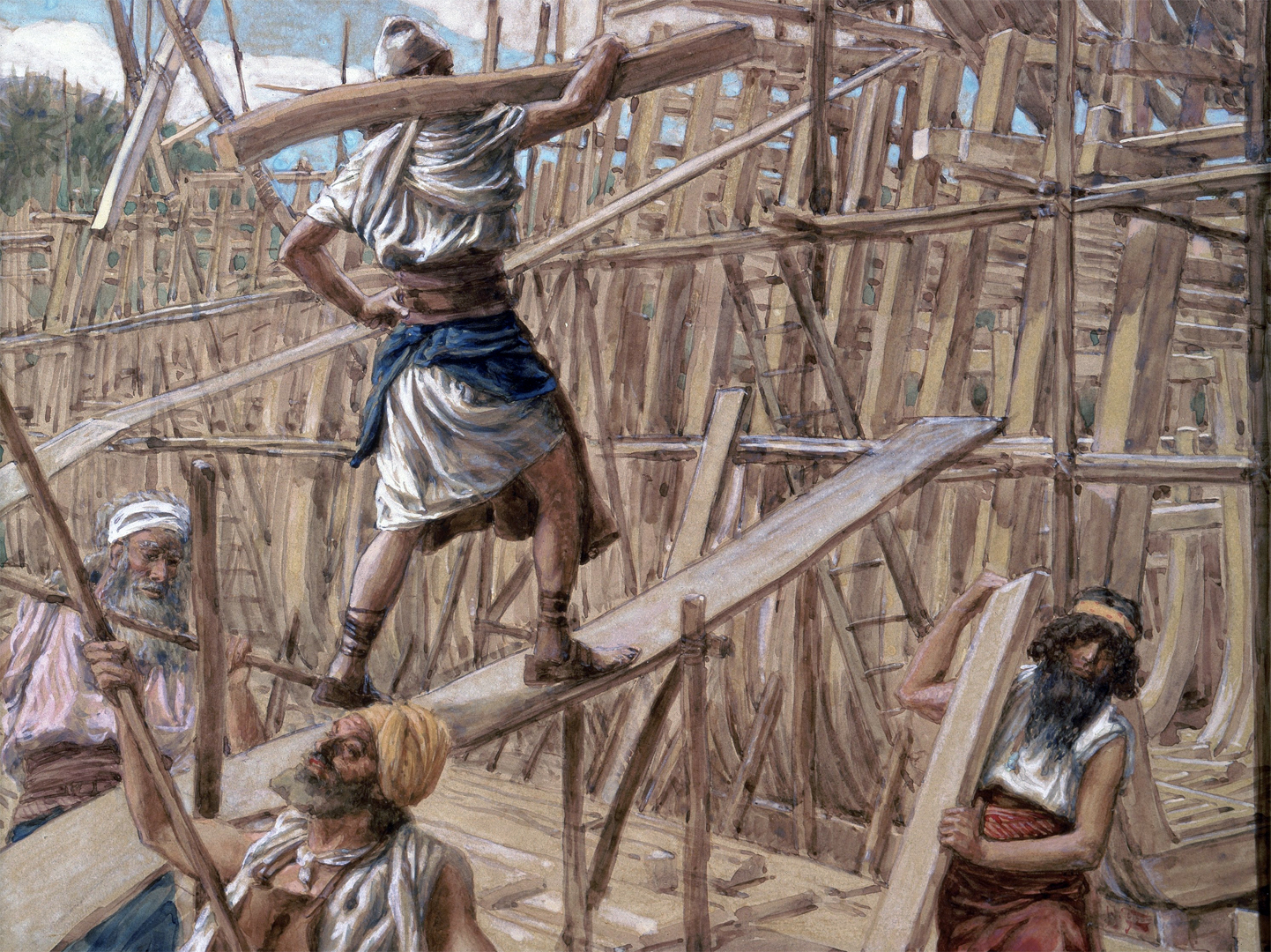
Recently, I watched a podcast that I follow. The podcaster (I’ll call him “Primate,” similar to his actual handle) is a Christian whom I respect for his knowledge of Scripture and end-times prophecy. He is also on top of current events taking place all around the world. In the podcast I watched, he discussed Noah’s Ark, suggesting that Noah could not have built the Ark without a lot of assistance. He correctly pointed out that we are not given precise details in the Bible on what was going in the world when God commissioned Noah to build the Ark. We are only given this: “And it came to pass, when men began to multiply on the face of the earth, and daughters were born unto them, That the sons of God saw the daughters of men that they were fair; and they took them wives of all which they chose … There were giants in the earth in those days; and also after that, when the sons of God came in unto the daughters of men, and they bare children to them, the same became mighty men which were of old, men of renown” (Genesis 6:1-2, 4). Biblical scholars have struggled with that over the years attempting to puzzle out what it really means instead of what it actually says, i.e., “the sons of God” (angelic beings) were messing around with human women and producing some kind of hybrids. However, the lack of detail leaves a lot of room for speculation, which is not usually the best way to study or interpret Scripture. Primate concluded that missing details like that were purposefully left out of the Bible by the compilers of our canon for our benefit, so as not to confuse us or perhaps to keep us from the temptation of experimentation in angelic arts.
Primate proposes that in order to fill in the blanks, we have other extrabiblical sources to clear things up for us, like the books of Enoch, Jubilees, Jasher, etc. I have read some of those books, and while some of their content may be true to some extent (and there is no way for us to know that for certain), I believe the Holy Spirit (the Author of our Bible) gave us all that we need to know in order to have a real and personal relationship with the Creator. The extrabiblical books are certainly interesting; however, they may or may not be factual. In any case, they are superfluous to the Bible alone.
However, that was not my main issue with the podcast. My main objection was to Primate’s comments on Noah, so I offered some alternative thoughts based on my several years of research on this particular topic. One of Primate’s arguments was that there were no trees in the place, supposedly the Middle East, where Noah built the Ark. Of course, he has no basis for that assumption. One must consider that the climate in Noah’s day was not like it is today. Genesis 2:5-6 tells us that it did not rain in those days, “But there went up a mist from the earth, and watered the whole face of the ground.” The fossil record confirms that the pre-flood Earth was tropical everywhere. There is fossil evidence that Antarctica had tropical forests growing.[1] Lush vegetation was everywhere, including in the area of Mesopotamia. Evidence for this are the rich oil fields in the Middle East, which result from the decomposition of plants. That means that Noah did not have to go far to find “gofer wood” to build the Ark. (No one really knows what gofer wood is. It could be some kind of extinct tree, or some think that it could have been a method of cross-laminating timbers to strengthen the hull.)
Primate also suggested that Noah and his sons could not have built the Ark by themselves. He based that idea on the current degraded physical condition of modern humans. We should consider this: God made Adam and Eve perfect human specimens – no physical defects – their DNA was perfect – no mutations, which is why Cain could marry his sister.[2] Even as far as Abraham, the DNA had not degraded enough so that Abraham could marry his half-sister, Sarah. Prohibitions against marriages between close relatives did not come around until Moses and the Law. That suggests that pre-flood people were superhuman, unlike modern mankind. In support of that, consider what Scripture says about Noah. “These are the generations of Noah: Noah was a just man and perfect in his generations, and Noah walked with God” (Genesis 6:9, emphasis mine). “Perfect” translates the Hebrew word “tâmı̂ym” which means “complete, whole, entire, sound.” “Generations” translates the Hebrew “dôr,” which can mean “generation (characterized by quality, condition, class of men).”[3] That suggests that Noah’s lineage had not been contaminated by the activities of the “sons of God.”[4] Primate suggested that because Noah was middle-aged at 500 years+, he could not have done the heavy work required to build the Ark. We should remember that Abraham was still fathering children at 145 years old[5] and Caleb was strong enough at 85 to conquer the hill country of Judah.[6] Primate’s assessment is based on the frailties of modern humans, but that does not apply to pre-flood humans.
Noah was 500 years old when is three sons were born[7] and 600 years old when the flood came[8]. He built the Ark in less than 100 years. John D. Morris, Ph.D., calculated that Noah and his sons could have built the Ark in just 65 years, without any help from angels.[9]
Another mistake people often make is thinking that the Middle East (all the Earth, for that matter) has always looked the same as it does now. Hence, they assume that the Euphrates River described in Genesis 2[10] is the same Euphrates River that we know today. Nothing could be further from the truth when one considers (and most geologists agree) that there used to be one supercontinent, Pangia, that broke up into the seven continents we have today. The Flood changed all of that! So, Earth’s topography was much different pre-flood than post-flood. We cannot assume that things then looked the same as they do today.
I completed the build of a 1:60 scale model of Noah’s Ark in December 2014 and delivered it to the Institute for Creation Research, where it now resides in the Discovery Center. The build took almost five years to complete, which gave me a lot of time to research and think about all that Noah might have included in the Ark. I wrote about that in an article entitled “Building the Ark.” That article covers more detail than what I covered here. It would do good if Christians would be more careful in their reading Scripture and not rely on baseless speculation. “Thy word is truth,” and that is all we need to rely on. Primate and others need to be more careful in how they handle the Word of God. It is sufficient – no need to speculate.
Notes:
[1] “Fossil Trees in Antarctica Preserve Ancient Proteins:” https://www.icr.org/article/fossil-trees-antarctica-preserve-ancient
[3] Brown-Driver-Briggs Hebrew Definitions (Published in 1906; public domain).
[9] “How Could Noah Have Built the Ark All By Himself?” https://www.icr.org/article/how-could-noah-have-built-ark-all-by-himself
 Ernie's Musings
Well written Ernie!
The Lost Books of the Bible had some interesting info, but it seemed mythical to me..