Category Archives: Salvation

What’s Special About Sunday?

In the end of the sabbath, as it began to dawn toward the first day of the week ... (Matthew 28:1)

In the end of the sabbath, as it began to dawn toward the first day of the week … (Matthew 28:1)

And very early in the morning the first day of the week, they came unto the sepulchre at the rising of the sun. (Mark 16:2)

Why should Christians worship on Sunday instead of Saturday as do the Jews and certain other “Christian” denominations? After all, in fourth of the Ten Commandments, God specifically says, “Remember the sabbath day, to keep it holy. Six days shalt thou labour, and do all thy work: But the seventh day is the sabbath of the LORD thy God: in it thou shalt not do any work, thou, nor thy son, nor thy daughter, thy manservant, nor thy maidservant, nor thy cattle, nor thy stranger that is within thy gates: For in six days the LORD made heaven and earth, the sea, and all that in them is, and rested the seventh day: wherefore the LORD blessed the sabbath day, and hallowed it” (Exodus 20:8-11). So, are we in violation of God’s commandment by worshiping on Sunday?

First of all, let me say that setting aside one day of the week for rest and worship is right and proper whether that day be Friday, Saturday, or Sunday or any day of the week for that matter.  “One man esteemeth one day above another: another esteemeth every day alike. Let every man be fully persuaded in his own mind” (Romans 14:5).

Much of the confusion comes with the interpretation of the word “Sabbath” in the Bible.  The word in the Hebrew does not mean “seventh” (shebəiʽi), but rather “rest” or “to rest” (shebbot).  Genesis 2:2 tells us that “on the shebəiʽi day God ended his work which he had made; and he shebbot on the shebəiʽi day from all his work which he had made.”  Translating that seventh day to mean Saturday “assumes” that God began His creative acts on Sunday, and we really have no textual basis for that conclusion other than what has been handed down to us by Jewish tradition – that, however, is not to say that this tradition is in error.  Furthermore, as you study the “Feasts of the Lord” given in Exodus and Leviticus, you find that each of those days is considered a shebbot (Sabbath) regardless of what day of the week it falls on.  So, we need to be careful not to become dogmatic over things on which the Bible is unclear.  However, it is clear that we need to “sanctify” – set aside – one day a week for the Lord.

Today, on Resurrection Day, we celebrate our Lord’s victory over death. (See “Risen Indeed,” where I cover the facts of the Resurrection.) The Resurrection is significant for us who believe because we have the promise that because Christ conquered death, we too can be assured of a resurrection to eternal life. “But if there be no resurrection of the dead, then is Christ not risen: And if Christ be not risen, then is our preaching vain, and your faith is also vain … But now is Christ risen from the dead, and become the firstfruits of them that slept.” (1 Corinthians 15:13-14, 20). Today we rejoice in Christ’s resurrection and look forward to our own resurrection to be with Him eternally.

In the New Testament, the first Jewish Christians went to the temple or synagogue on the Sabbath (Acts 13:14; 17:2; 18:4) for the sake of the Jews, but they also met on the First Day of the week (Acts 20:7; 1 Corinthians 16:2) because this was “the Lord’s Day” and also for the sake of the Gentiles which were not obligated to follow Jewish custom (Colossians 2:16). The reason for this change is because this is when Christ was raised from the dead (Matthew 28:1, Mark 16:2; Luke 24:1; John 20:1).

The First Day of the week was also the day that the Holy Spirit descended upon the disciples gathered in the upper room (Acts 2:1). Scripture does not specify the day of the week, but when you consider that Jesus arose on the first day of the week and count forward 50 days (the Day of Pentecost) you will find that day to be Sunday also. The day that Jesus arose was the “First Omer” (Nisan 16) and the Day of Pentecost was the “50th Omer (Sivan 6). Not only were these days important on the Jewish calendar, but they have even greater significance in the Christian calendar. For this reason, it is proper that Christians should meet on the First Day of the week to celebrate the Risen Lord and the coming of the Holy Spirit.

 So, as you celebrate this Resurrection Lord’s Day, remember why it is so special. He is risen indeed!

Comments Off on What’s Special About Sunday?

Filed under Apologetics, Christianity, Death, Evangelism, Gospel, Heaven, Hell, Religion, Salvation, Theology

No One Escapes Judgment

It is Finished!

It is Finished!

And about the ninth hour Jesus cried with a loud voice, saying, Eli, Eli, lama sabachthani? that is to say, My God, my God, why hast thou forsaken me? (Matthew 27:46)

When challenged with the question, “When you die and meet God face to face, and He asks you, ‘Why should I let you into My heaven?’ how will you respond?” many answer by saying that they have been basically a good person, they have been kind to others, they have given to the poor, etc. They mistakenly assume that God will weigh their good deeds against their bad deeds, and that their good will outweigh their bad. The Bible clearly says, “for by the works of the law shall no flesh be justified” (Galatians 2:16). This fact not even the sinless Son of God could escape.

From the dawn of creation, sin separated man from God (Genesis 3:23-24), and innocent blood has been shed to cover (atone for) the sin of man (Genesis 3:21). But this was only a temporary fix. “For it is not possible that the blood of bulls and of goats should take away sins” (Hebrews 10:4). Animals did not sin. Man sinned. Man is the violator, and responsible for his own infraction; but the infraction demands payment in blood. “For the life of the flesh is in the blood: and I have given it to you upon the altar to make an atonement for your souls: for it is the blood that maketh an atonement for the soul” (Leviticus 17:11, emphasis added); but it must be innocent blood. What man can claim innocence? “For there is not a just man upon earth, that doeth good, and sinneth not” (Ecclesiastes 7:20); “For all have sinned, and come short of the glory of God” (Romans 3:23). What can man do! “For the wages of sin is death” (Romans 6:23).

Can man live a sinless life? “For whosoever shall keep the whole law, and yet offend in one point, he is guilty of all” (James 2:10, emphasis added). There is nothing man can do. Man is doomed to die for his sin.

There is only one solution to this dilemma: “Christ Jesus: Who, being in the form of God, thought it not robbery to be equal with God: But made himself of no reputation, and took upon him the form of a servant, and was made in the likeness of men: And being found in fashion as a man, he humbled himself, and became obedient unto death, even the death of the cross” (Philippians 2:5-8, emphasis added). And “God commendeth his love toward us, in that, while we were yet sinners, Christ died for us” (Romans 5:8, emphasis added). “[God] hath made [Jesus] to be sin for us, who knew no sin; that we might be made the righteousness of God in him” (2 Corinthians 5:21). Alone, “He is despised and rejected of men; a man of sorrows, and acquainted with grief: and we hid as it were our faces from him; he was despised, and we esteemed him not. Surely he hath borne our griefs, and carried our sorrows: yet we did esteem him stricken, smitten of God, and afflicted. But he was wounded for our transgressions, he was bruised for our iniquities: the chastisement of our peace was upon him; and with his stripes we are healed.” (Isaiah 53:3-5). As our sin, for which we could not atone, was cast upon Him, He looked up into heaven and cried, “It is finished!” (Paid in full) “and he bowed his head, and gave up the ghost.” (John 19:30)

Problem solved! Now He says, “I am the way, they truth, and the life: no man cometh unto the Father, but by me” (John 14:6, emphasis added). Jesus’ death on the cross provided the way for you and me. He took upon Himself our judgment so that we would not have to, but for the one who insists on making it through his own merits, that one will face the judgment on his own. No one escapes judgment.

Comments Off on No One Escapes Judgment

Filed under Apologetics, Christianity, Death, Evangelism, Gospel, Religion, Salvation, Theology

A King On A Donkey


Hosanna!

Hosanna!

Rejoice greatly, O daughter of Zion; shout, O daughter of Jerusalem: behold, thy King cometh unto thee: he is just, and having salvation; lowly, and riding upon an ass, and upon a colt the foal of an ass. (Zechariah 9:9)

Passover was just a few days away. Jerusalem buzzed with activity. Jews from all parts of the Roman world made the pilgrimage to the Judean capitol to celebrate the first of three Feasts of the Lord that required mandatory attendance by every Jewish male (Deuteronomy 16:16). In spite of Roman oppression, this was a time of celebration as everyone anticipated the promised king that would deliver them and restore Israel’s former greatness. “Perhaps this year,” they thought.

To this cacophony of festivities entered the unassuming King of Kings. Daniel had prophesied this event more than 483 years before. “Know therefore and understand, that from the going forth of the commandment to restore and to build Jerusalem unto the Messiah the Prince shall be seven weeks, and threescore and two weeks: the street shall be built again, and the wall, even in troublous times. And after threescore and two weeks shall Messiah be cut off, but not for himself: and the people of the prince that shall come shall destroy the city and the sanctuary; and the end thereof shall be with a flood, and unto the end of the war desolations are determined” (Daniel 9:25-26). Today the prophecy appeared – lowly, and riding upon a donkey’s foal as prophesied by Zechariah. Even this unnoticed act was miraculous. A foal is a donkey (or horse) that is not yet a year old. This one, a colt (male), had never been ridden (Mark 11:2; Luke 19:30). Surely anyone reading this knows what happens when a donkey, horse or mule is mounted for the first time, but not so here. “And they brought him [the colt] to Jesus: and they cast their garments upon the colt, and they set Jesus thereon. And as he went, they spread their clothes in the way” (Luke 19:35-36). Somehow, that little animal understood the significance of the rider. He was carrying the Creator, the One who said, “Take my yoke upon you … For my yoke is easy, and my burden is light” (Matthew 11:29-30).

Thus Jesus entered His city to present Himself as the “Prince of Peace” (Isaiah 9:6). A conqueror would have entered upon a white charger parading his conquests before him, but a king who comes in peace enters in on a mule or a donkey (1 Kings 1:30-40). As Jesus made His way into the city, the crowd thronged Him singing the words of the psalm “Hosanna!” meaning “Save now!” “Blessed be he that cometh in the name of the LORD” (Psalm 118:25-26). Who knows if the mob understood the significance of the psalm or of the Man to whom they sang? When the religious leaders compelled Jesus to silence the crowd (for they understood very well the significance of the words), “he answered and said unto them, I tell you that, if these should hold their peace, the stones would immediately cry out” (Luke 19:40).

Interesting that at the first Passover, when the children of Israel were in Egypt, Moses required each family to take an unblemished lamb into their home at the first of the month. This lamb would become endeared to the family, and then on the fourteenth of the month, the lamb would be slain and its blood painted on the door posts of the house (Exodus 12:1-12). Now the Lamb of God entered the house of Israel to be sacrificed for the sins of the world. All things foreordained “from the foundation of the world” (Revelation 13:8). Thus Messiah, the King on a donkey, presented Himself only to be “despised and rejected of men” (Isaiah 53:3). Soon the Passover Lamb would be “cut off” (Daniel 9:26).

The King will return. When He returns, His mount will not be a lowly donkey, but a mighty, white steed. “And I saw heaven opened, and behold a white horse; and he that sat upon him was called Faithful and True, and in righteousness he doth judge and make war … And he hath on his vesture and on his thigh a name written, KING OF KINGS, AND LORD OF LORDS. (Revelation 19:11, 16) – no longer a King on a donkey.

Hallelujah! “Even so, come, Lord Jesus!” (Revelation 22:20)

2 Comments

Filed under Apologetics, Christianity, End Times, Gospel, Religion, Salvation, Second Coming of Christ, Theology

Seth Number Three?

Bouguereau-The_First_Mourning-1888

The First Mourning by Bouguereau (1888)

And Adam lived an hundred and thirty years, and begat a son in his own likeness, after his image; and called his name Seth (Genesis 5:3)

Where did Cain get his wife? Another question along the same line is, “From where did the people come that Cain feared after killing Abel?” (Genesis 4:14). Questions like this have spawned much conjecture in the origins debate and have led many to the misguided conclusion that other “hominids” existed prior to God’s special creation of Adam and Eve. Cain, they conclude, feared these “people” and he probably selected a wife from among them.

For better or worse, the Bible does not provide us with all of the detail we would like for filling the gaps in these historical narratives. But the Author does not concern Himself with the minor details in order to focus our attention on the greater plan, i.e., that God created everything including mankind in a “very good” state; God desired a close personal relationship with His special creation, man; man disobeyed God and severed that intimate relationship; God has continually strived to reconcile man to Himself and provided the way of salvation; and God will one day restore His creation to its original perfection. So the extraneous, irrelevant minutia is omitted in order to develop the greater story. That being said, we are left with many unimportant unanswered questions that can lead us astray, if we are careless in the way we handle God’s Word.

The above are at least two such questions. Genesis 4 begins shortly after the Fall and informs us that “Adam knew Eve his wife; and she conceived, and bare Cain, and said, I have gotten a man from the LORD” (Genesis 4:1). The Hebrew construction indicates that Eve actually believed that she had given birth to the Savior. Literally it reads “I have gotten a man, the LORD.” She believed God’s promise that “I will put enmity between thee and the woman, and between thy seed and her seed; [He] shall bruise thy head, and thou shalt bruise his heel” (Genesis 3:15, emphasis added). She later realized her error and when her second son was born, she named him Abel (Genesis 4:2) which means emptiness or vanity because her desire was not realized with the firstborn. Now, between verse 1 and verse 2 some time has elapsed, but we do not know how much time. We can surmise that Abel was the second male child born: “And she again bare his brother Abel” (emphasis added). Verse 2 tells us that “Abel was a keeper of sheep, but Cain was a tiller of the ground.” Here again, within the same verse, a long span of time has elapsed, and we are left to wonder. How old were these boys? Were they in their early teens or were they fully grown men between 30 and 40 years old? We are not told. And what about other siblings? Were they the only children of Adam and Eve? The details elude us. The intent of this narrative is to highlight the advancement of sin in this new world. Cain committed the first act of murder in killing Abel, his brother. This narrative also illuminates the downward spiral of sin. This final act of murder began with disobedience (Cain offered a sample of his harvest as a sacrifice to God, (Genesis 4:3) rather than a blood sacrifice), then he became jealous of his brother because God accepted Abel’s sacrifice and rejected his (Genesis 4:4), and finally his jealousy worked itself into a raging anger that ended in murder (Genesis 4:5). This is the focus of this narrative, and how old they were or how many other siblings there were is totally irrelevant to the story.

Obviously, Cain did not get away with the murder. Again the purpose of the narrative serves to give us insight into the nature of God and the nature of man. Notice that it is God who seeks man rather than the other way around. “And the LORD said unto Cain, Where is Abel thy brother?” (Genesis 4:9a). Why does God pose the question? Does God not know what has transpired? God is omniscient. Of course He knows. In fact, God attempted to intervene before the heinous act. “And the LORD said unto Cain, Why art thou wroth? and why is thy countenance fallen? If thou doest well, shalt thou not be accepted? and if thou doest not well, sin lieth at the door. And unto thee shall be his desire, and thou shalt rule over him” (Genesis 4:6-7, emphasis added). Cain failed to follow the prescribed method of sacrifice that God instituted in the Garden (Genesis 3:21). Only the shedding of innocent blood can cover man’s sin, but Cain tried to do it his way, and the sin lying at his door was rebellion against God. In His line of questioning, God was giving Cain the opportunity to confess his sin as ask forgiveness, but instead, he hardened his heart: “And he said, I know not: Am I my brother’s keeper?” (Genesis 4:9b). Even then God gave him a third opportunity: “And he said, What hast thou done? the voice of thy brother’s blood crieth unto me from the ground” (Genesis 4:10). Failing to confess and repent of his sin, God sentenced Cain to banishment from his home and family (Genesis 4:14).

However, it seems that the thing Cain most feared was retribution by others. “Behold, thou hast driven me out this day from the face of the earth; and from thy face shall I be hid; and I shall be a fugitive and a vagabond in the earth; and it shall come to pass, that every one that findeth me shall slay me” (Genesis 4:14, emphasis added). Who did Cain have to fear? So far, the only people named in the Bible are Adam, Eve, Cain and Abel. Who else was around that might take vengeance on Cain? Then there is the matter of Cain’s wife: “And Cain knew his wife; and she conceived, and bare Enoch: and he builded a city, and called the name of the city, after the name of his son, Enoch” (Genesis 4:17, emphasis added).

So, where did Cain get his wife? The Bible does not say. Apparently the Author thought we were sufficiently intelligent enough to figure that one out on our own, as long as we stick with the Bible. The Genesis account of creation tells us that man was created on the sixth day. Man was also created apart from the animals, who God created merely by His spoken command. Man, on the other hand, was “created” (Hebrew bârâ’ used only as applicable to God’s creative acts) in the “image of God” (Genesis 1:27). Furthermore, God “sculpted” (Hebrew yâtsar, which means to mold into a form as a potter forms clay) a special body for man. So man is truly unique among God’s creation. In addition to that, all of God’s creation is to reproduce “after its kind” (Genesis 1:11-12, 21, 25-26). So, Cain’s wife had to be of the same “kind” as he. That would preclude him having a wife of some lesser “evolved” hominid, which, if such a thing existed, would not have been created in the image of God. That leaves only one option. Cain’s wife was his sister.

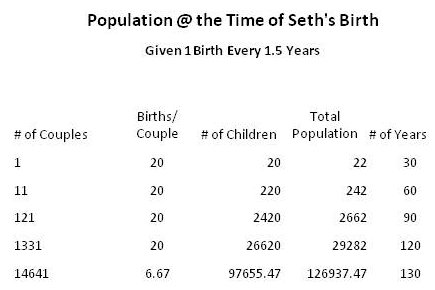
The other question is: Whom did Cain have to fear? It stands to reason that if Cain had a wife, Abel could have had a wife and perhaps even children. Since we are not given a timeframe for this event, we cannot know if the boys were in their thirties or older. Perhaps both boys were old enough by now to have grown children. If that were the case, Cain would have feared retribution from Abel’s sons. Or he could have feared retribution from his other siblings. The Bible tells us that Adam “begat sons and daughters” (Genesis 5:4), but the number and the time between births remains a puzzle. We know that Adam was 130 when Seth was born (Genesis 5:3). “And Adam knew his wife again; and she bare a son, and called his name Seth: For God, said she, hath appointed me another seed instead of Abel, whom Cain slew” (Genesis 4:25). Seth’s name means substituted (Strong’s definition) or compensation (Young’s definition). Seth is the third person named as a son of Adam, but it does not necessarily follow that he was the third born. It simply means that he was the third son of Adam who is identified in Scripture. (I will explain later.) Also, judging by the significance of his name and Adam’s age at his birth, it is reasonable that Cain and Abel were approaching that age, i.e., between 120 and 129 years old. Keep in mind that Adam was not “born;” he was created fully grown, so while chronologically he was 130, physically he was probably around 160. If this is the case, there was enough time involved for many more people to be on earth coming from Adam and Eve and approximately four generations (provided a generation equals 30 years). I am no mathematician, but I came up with what I consider to be a rather conservative figure for the possible number people on earth at the time of Seth’s birth:

Pop at Seths Birth

A young biologist friend of mine came up with a table similar to mine, but he took into account the maturation process of Adam and Eve’s offspring before they were of age to reproduce. Gee! Why didn’t I think of that! His table is too long to reproduce here, but his figures were even more conservative than mine. He calculated the possible population at the time of Seth’s birth at only 9,289. Even at this much lower count, one understands why Cain feared for his life; there were others out there who might want to take vengeance for Abel’s murder.

By now it should be evident that Seth was not Adam and Eve’s third son. His name simply means that he was the replacement for Abel. His name is significant also because it starts to point the way to our Savior, Jesus Christ. From Seth’s line came Enoch who “walked with God: and he was not; for God took him” (Genesis 5:24). From Seth’s line came Noah “a preacher of righteousness” (2 Peter 2:5); a man who “found grace in the eyes of the LORD” (Genesis 6:8). Through Noah, and then through his son Shem, extended the line that would eventually lead to Jesus (Luke 3:38). Herein lies the reason Seth’s name is recorded while other sons and daughters of Adam and Eve are excluded. Seth was not the third son, but he was the son that points us to Christ.

Comments Off on Seth Number Three?

Filed under Apologetics, Christianity, Creation, Death, Evangelism, Evolution, Gospel, Religion, Salvation, Theology

Noah

Make thee an ark of gopher wood; rooms shalt thou make in the ark, and shalt pitch it within and without with pitch. (Genesis 6:14)

Thanks to a host of well-meaning Christian movie critics, I find my enthusiasm for seeing the movie “Noah” severely waning. Thanks for all the spoilers! It goes without saying that any Bible movie coming out of Hollywood will fall woefully short on accuracy. Face it; these people are script writers that deal in fantasy, not theologians or Bible scholars who are intimate with the Word of God. Not to mention that God chose not to provide us with every detail that took place within this 121-year period of history. The Flood account takes up only four short chapters in the Bible. There is not enough material there to make a 2-hour and 18-minute movie, so Hollywood has to fill in the blanks according to their own imaginations – that being Director and Co-writer, Darren Aronofsky, an atheist, and staring actor, Russell Crowe who is no friend of Christians.

I would hope that thoughtful Christians would take that into consideration. It’s a movie. It is designed to entertain and to make money for the producers and for the theaters on the sale of popcorn and soda. Certainly Christians (or anyone else for that matter) should not take it as a serious portrayal of a biblical narrative. That said, it does get some things right. The Ark is of the correct biblical dimensions. The Flood is global. The Flood is God’s judgment for man’s sin. The Flood is not just the result of rain, but also resulted from the bursting of the “fountains of the deep.” Of course, the movie gets more things wrong than it gets things right. One glaring problem that I found from viewing movie trailers is that the Ark is of a crude construction. It looks like a huge log cabin that could hardly withstand the tsunami-like waves associated with the Great Flood. This image of the Ark stems from evolutionary thinking that assumes ancient man was technologically inept, but that is hardly the picture the Bible presents of pre-flood man: “Jubal: he was the father of all such as handle the harp and organ … Tubalcain, an instructer of every artificer in brass and iron” (Genesis 4:21-22). Not long after Noah and his family came out of the Ark, the Tower of Babel was built (Genesis 11), and after the division of languages, the Egyptians started building their pyramids. It seems implausible to me that Noah would have built anything less than a sturdy, seaworthy vessel, and besides, he had 120 years to work on it. The spoilers also point out that the movie Ark has several doors, while the biblical Ark has only one (Genesis 6:16).

The spoilers point out many other problems with the film. For instance, creation is a result of the big bang. Life emerges out of the waters. The movie implies that Adam and Eve come from apes. Noah seems to care more about animals and the planet than he does about humans including his own family. The sin of mankind is their abuse of the environment and mankind is portrayed as blight upon the earth. The Creator (Who is never referred to as “God”) is impersonal and vindictive. It is implied that God instructs Noah to kill his own granddaughters (born on the Ark, which has no biblical basis), and when he is unable to do so, Noah regards himself as a failure. More could be said concerning the failure of this movie to present a true rendition of the biblical text, however the critics, above all else, decry the film’s purposeful distortion of Scripture. For the low information viewer, the question remains, who was Noah? What was Noah really like?

To answer those questions, one must go to the source, the Bible. Noah is of the godly line of Seth, Adam’s third son named in the Bible (Genesis 4:25). There very well could have been others, but one must remember that one of the purposes of the biblical genealogies is to point to Christ. Noah’s father was Lamech, and his grandfather was Methuselah, whose name means something like “when he dies, judgment.” Methuselah holds the record for longevity; he lived to be 969 years old, and he died the year that the Flood came.

Noah was around 480 years old when God selected him to build the Ark. At that time, “the LORD said, My spirit shall not always strive with man, for that he also is flesh: yet his days shall be an hundred and twenty years” (Genesis 6:3, emphasis added). So Noah was given 120 years to build the Ark. During that time, he preached to the people trying to get them to repent of their sin. Peter speaking of the people of that time “Which sometime were disobedient, when once the longsuffering of God waited in the days of Noah, while the ark was a preparing, wherein few, that is, eight souls were saved by water” (1 Peter 3:20, emphasis added). “For if God spared not the angels that sinned, but cast them down to hell, and delivered them into chains of darkness, to be reserved unto judgment; And spared not the old world, but saved Noah the eighth person, a preacher of righteousness, bringing in the flood upon the world of the ungodly” (2 Peter 2:4-5, emphasis added). When Noah and his family (Mrs. Noah, Noah’s three sons and his three daughters-in-law) entered the Ark, Noah was 600 years old (Genesis 7:11).

The reason God brought the Flood was not for ecological reasons as the Gaia-worshiping makers of the “Noah” movie suggest. Second Peter 2:5 (above) talks about God not sparing “the angels that sinned,” and then closely follows with a description of Noah as “a preacher of righteousness.” It must be understood that the angels who rebelled against God along with Lucifer (Satan), are excluded from God’s plan of salvation. So Noah’s preaching was not to fallen angels (demons), but rather to humans who had been enticed to sin by these angels. These people would have been eligible for salvation had they repented. But the mention of the angels is interesting. Some scholars believe that these angels in some form or another mated with humans and created a race of super-humans. This is concluded from the first four verses of Genesis 6. “And it came to pass, when men began to multiply on the face of the earth, and daughters were born unto them, That the sons of God saw the daughters of men that they were fair; and they took them wives of all which they chose … There were giants in the earth in those days; and also after that, when the sons of God came in unto the daughters of men, and they bare children to them, the same became mighty men which were of old, men of renown. (Genesis 6:1-2, emphasis added). The Hebrew word for “sons of God” in verses 2 and 4 is bene ĕlôhı̂ym and it is always used when referring to angels in the Old Testament. The Hebrew word translated “giants” here is nephı̂ylim and it means “fallen ones.” Of course, there are those who will say that angels do not have sex and others who will suggest that angels (except for God’s angels) cannot take human form. I will not go to war over that, but whatever took place was sufficient to corrupt mankind to the point that God was willing to destroy His entire creation with the exception of those who made it on the Ark. “And GOD saw that the wickedness of man was great in the earth, and that every imagination of the thoughts of his heart was only evil continually. And it repented the LORD that he had made man on the earth, and it grieved him at his heart … The earth also was corrupt before God, and the earth was filled with violence. And God looked upon the earth, and, behold, it was corrupt; for all flesh had corrupted his way upon the earth.” (Genesis 6:5-6, 11-12, emphasis added). Imagine the degradation and depravity to which mankind had sunk that the great loving heart of God could be so grieved as to destroy His beautiful creation! This had nothing to do with littering the planet.

“But Noah found grace in the eyes of the LORD” (Genesis 6:8). In Noah and his family was the human race preserved. Noah was given instruction for building the Ark. It was to be 300 cubits long, 50 cubits wide and 30 cubits high (Genesis 6:15). Using an 18-inch cubit, that made the Ark 450 feet long, 75 feet wide, and 45 feet high. The Ark was the length of one and one-half football fields and of sufficient capacity to hold 522 railroad cattle cars. The Ark was to have three floors (stories or decks, Genesis 6:16) and “rooms” (Hebrew qênim meaning “nests”) for the animals (Genesis 6:14). The Ark also required a ventilation and lighting system which the Bible describes as a “window” (Genesis 6:16). God instructed Noah to bring enough food for his family and for all of the animals (Genesis 6:20) enough to last them for a year (Genesis 7:14). In order to carry out God’s instructions, Noah had to be an engineer, architect/designer, ship builder, zoologist and other duties as assigned. Noah was no dummy!

The rains came, the crust of the earth broke open allowing superheated, subterranean water to spew into the atmosphere (Genesis 7:11), and the whole earth was covered in water more than 22 feet above the tallest hills/mountains (Genesis 7:20). “And all flesh died that moved upon the earth, both of fowl, and of cattle, and of beast, and of every creeping thing that creepeth upon the earth, and every man: All in whose nostrils was the breath of life, of all that was in the dry land, died. And every living substance was destroyed which was upon the face of the ground, both man, and cattle, and the creeping things, and the fowl of the heaven; and they were destroyed from the earth: and Noah only remained alive, and they that were with him in the ark” (Genesis 7:21-23, emphasis added). The all-inclusive description of the death wrought by the Flood precludes a small local event as some have suggested.

After 371 days the waters subsided, and Noah was instructed to come out of the Ark (Genesis 8:15-16). Noah released all of the animals, and the first thing he did was to offer a sacrifice of thanksgiving to God (Genesis 8:20-21). God promised never again to destroy the earth with water, and He promised to maintain nature in a stable state (Genesis 8:21); but God was under no delusion that man would remain faithful, “for the imagination of man’s heart is evil from his youth” (v. 21). To Noah and his family and thereby to us, God reestablished man’s Dominion Mandate: “Be fruitful, and multiply, and replenish the earth … And you, be ye fruitful, and multiply; bring forth abundantly in the earth, and multiply therein.” (Genesis 9:1, 7). He also gave to man the authority to render justice. “And surely your blood of your lives will I require; at the hand of every beast will I require it, and at the hand of man; at the hand of every man’s brother will I require the life of man. Whoso sheddeth man’s blood, by man shall his blood be shed: for in the image of God made he man” (Genesis 9:5-6, emphasis added).

This is the true story of Noah. Now, feel free to go enjoy the false story of Noah, just remember that it is just a movie and not the true account. The real historical account is in the Bible. Read it, and know it before you go see “Noah” the movie.

4 Comments

Filed under Apologetics, Atheism, Book Reviews, Christianity, Creation, Current Events, Death, End Times, Evolution, Geology, Origins, Religion, Salvation, Theology