
Thank God for our heroes!
Comments Off on For my brother
Filed under Uncategorized

While the earth remaineth, seedtime and harvest, and cold and heat, and summer and winter, and day and night shall not cease. (Genesis 8:22)
In the origins debate, the young-earth creationist is confronted with the uniformitarian account for the supposed long ages they see in the earth’s crust. “Uniformitarianism is the assumption that the same natural laws and processes that operate in the universe now have always operated in the universe in the past and apply everywhere in the universe. It has included the gradualistic concept that ‘the present is the key to the past’ and is functioning at the same rates.”[1] I appreciate that definition because it clearly states that uniformitarianism is an “assumption,” which differs considerably from a “fact.” Young-earth creationists can agree with uniformitarianism to a small degree based on the biblical perspective provided in the Bible verse above.
I hope I can explain this in a way that makes sense. What uniformitarian thinking does is to look at the geologic processes that are currently taking place (as defined above) and assume that these processes have always taken place at the same rate over millions of years. The uniformitarian, then attempts to mathematically extrapolate back in time to determine the age of the rocks or the formation of strata on the earth’s crust.
In the case of rocks, different radiometric dating methods measure the current rate at which certain minerals within the rocks decay. “Radiometric dating (often called radioactive dating) is a technique used to date materials such as rocks, usually based on a comparison between the observed abundance of a naturally occurring radioactive isotope and its decay products, using known decay rates.”[2] For instance, uranium decays into lead at a certain known rate (“normally”). They can then take a rock containing uranium and measure how much uranium remains compared to the lead, and using currently known decay rates, they can calculate the age of the rock by the ratio of uranium-lead content. Keep in mind that they are “assuming” a constant decay rate.
In the case of sedimentation (or stratification), we can observe river deltas forming. We can observe, for example, that the river is depositing silt onto the delta at the rate of one inch per year. We can then take a core sample of the delta, and we discover that the silt is a mile (5280 ft.) deep. Since we know that silt deposits on the delta at the rate of one inch per year and has done so consistently in the past, we can multiply 5280 ft. by 12 in. and we calculate that the delta is 63,360 years old.
That kind of thinking is what gives us the long ages that evolutionists like to see. However, the problem with that lies in their assumption that things have always been consistent. In the case of the delta, what if the river flooded several times and deposited a foot of silt at every flood apart from the normal 1 inch per year? That would make the delta appear to be older than it really is. Or, what if the coast experiences several storms that erode the delta away? Then the delta would appear to be younger than what it really is.
In the case of radioactive decay, how can the geologist know for sure how much uranium the rock contained to begin with? Or how can they know with certainty that no uranium or lead has been infused into the rock somewhere along the way, or that some event caused greater decay than normal? These things cannot be known so the uniformitarian is left with only assumptions (and they really believe their assumptions).
Young-earth creationists believe the biblical creation account to begin with. Therefore they understand that the earth is probably around 6000 years old but certainly not more than 10,000 years old. They believe the biblical account of the Global Flood and any “uniformity” that is apparent is due to God’s promise that all things would remain consistent (Genesis 8:22 above). From this “ground zero” starting place, they can then make scientific predictions that verify the veracity of the Bible. For instance, the fact that Carbon 14, a highly volatile element having a half-life of only 5,730 +/- 40 years, is still present in petroleum, coal and diamonds. Uniformitarians would not even think to test for C-14 in these minerals, because they assume these minerals to be multimillions of years old, so naturally C-14 should not be present. Young-earth creation scientists believe that the earth is young, so C-14 should be present. So, they look for it, and BEHOLD! There it is!
If you would like to study more on this, the following are some articles from the Institute for Creation Research that may interest you:
http://www.icr.org/article/young-earth/
http://www.icr.org/article/some-recent-developments-having-do-with-time/
http://www.icr.org/article/new-rate-data-support-young-world/
http://www.icr.org/article/carbon-dating-undercuts-evolutions-long-ages/
The present is not the key to the past – the Bible is!
Endnotes:
Filed under Apologetics, Creation, Evolution

Abstain from all appearance of evil. (1 Thessalonians 5:22)
Ten years ago I was working for a non-profit “Christian” organization in the area. It was approaching Halloween, and it was decided that the staff would celebrate by dressing up in costumes; “scary” costumes were encouraged. I thought it was odd for a “Christian” organization to “go all out” like that for celebration of what is arguably the most pagan of all pagan holidays. So, I addressed the following email to all staff. I had been working there more than 90 days, and had received countless “junk” emails from other staff members, so I saw no harm in sharing my sentiments with all the staff. The email read as follows …
Hello All,
Remember the movie “Multiplicity” staring Michael Keaton? In the movie, Doug Kinney, played by Michael Keaton, can’t seem to find enough time to do all the things he needs or wants to do, so he finds a solution in duplicating himself by cloning. As the plot develops, the first clone then clones himself, then the second clone clones himself and so on. With each duplication the resultant product greatly degenerated from the previous – a lot like when one makes a copy of a copy of a copy, etc. Finally, the last clone ends up being a slobbering idiot. Doug Kinney then finds himself in the dilemma of how to deal with his “offspring.”
What does that have to do with Halloween? Well, I’m getting to that.
The first five books of the Bible tell, among other things, of how God brought the children of Israel (Jacob) out from Egyptian bondage through His servant Moses. Now Moses was not perfect, and because of one act of disobedience, he was not allowed to enter the “Promised Land.” But Moses had a protégé, a clone, if you will, that would take over for him and complete the task of taking the children of Israel into the Promised Land. His name was Joshua. Now, Joshua was a great leader, but he was no Moses.
The sixth book of the book of the Bible takes its name from him, Joshua. It tells the history of how the children of Israel conquered the Promised Land – the land of Canaan. God’s instruction to the children of Israel through Joshua was to completely wipe out the inhabitants of the land – every man, woman, child and every beast. (There are good reasons why God commanded the annihilation of an entire race of people from the land, but that is another story, which will really get me off track.) When you come to the end of Joshua, you find that Israel failed in their God-given task. Instead, they started living in and among the people of the land and started adopting their customs and their pagan religions. This act of disobedience plagued Israel throughout their history.
So, what does that have to do with Halloween? Hang on; I’m getting there.
At the end of the book of Joshua we find Joshua calling the children together for one final word. Most of the land had been conquered, but the Canaanites were still in the land. The probability was very great that the children of Israel would turn to worshipping other gods, and so Joshua gave this final admonition:
Now therefore fear the LORD, and serve him in sincerity and in truth: and put away the gods which your fathers served on the other side of the flood, and in Egypt; and serve ye the LORD. And if it seem evil unto you to serve the LORD, choose you this day whom ye will serve; whether the gods which your fathers served that were on the other side of the flood, or the gods of the Amorites, in whose land ye dwell: but as for me and my house, we will serve the LORD. (Joshua 24:14-15)
Great admonition, but not as strongly phrased as I think Moses would have put it. To me, it sounds a lot like our post-modern, relativistic rhetoric that says, “That’s your truth, but it’s not my truth,” or “You’re entitled to your truth, and I’m entitled to mine.” (Many of you may be thinking that very thing about this discourse.) In essence, what Joshua was saying was, “If you want to worship other gods, go ahead; I and mine will serve the LORD.” He started out strong: “Serve the LORD,” but then he took the edge off by giving them an option.
When you read the next book, Judges, you see how the degeneration progressed. The further the children of Israel got away from the Exodus, the further they got away from God. That’s what the movie, “Multiplicity” reminds me of. The further we get away from the original, the fuzzier the lines become. What used to be sharp lines of contrast become so blurred that one cannot tell where one line ends and another begins. What used to be considered evil is now a minor indiscretion or just another lifestyle choice or not evil at all. Black and white has blended into an indistinguishable gray.
So, what does that have to do with Halloween? Well, I’m glad you asked that question. Halloween has become one of those national pastimes that are given no thought at all. Haunted houses attract the thrill seeker looking for that rush of adrenaline. Horror flicks offer the same allure. Vampires, zombies, demons, ghosts and witches all wait in the darkness ready to pounce on us at the moment we expect them least. Of course, all of this is intended for fun, and we wholeheartedly participate in the same spirit of frivolity as we don our favorite scary costumes. What’s the harm in that? The harm is that the sharp lines of contrast between good and evil have been blurred almost to the point of oblivion.
Halloween, in its origins, was not a harmless pastime. It originated in the dark ages when, due to ignorance, people genuinely feared the “things that go bump in the night.” They feared demons and ghosts and witches and vampires. The church was no help in dispelling those fears, and to a certain extent, was responsible for propagating many of those fears.
My intent here is not to go into a history of Halloween, but rather sharpen the lines of contrast that have been blurred though the passing of time. Demons are real. The Devil is real. I have no fear of them because I know the One in whose hands I’m kept, but that does not negate the reality of their work, which is primarily that of deception. Jesus identified Satan as the father of all lies. In His debate with the Jewish leaders, He leveled the following accusation against them:
Ye are of your father the devil, and the lusts of your father ye will do. He [Satan] was a murderer from the beginning, and abode not in the truth, because there is no truth in him. When he speaketh a lie, he speaketh of his own: for he is a liar, and the father of it. (John 8:43-44)
So, the lie is that Halloween is a harmless pastime. It’s a lie because the root and the source of Halloween is evil, not good; however, the lines have been blurred to the point where we can’t tell the difference. We have accepted it into our culture for so long that we have lost all sensitivity to the danger – like a frog in a kettle.
I then offered an article by Kerby Anderson, of Probe Ministries, entitled “Ten Reasons Christians Should Not Celebrate Halloween.” It is no longer on his site. He must have caught a lot of flack over it and decided to take it down, or else he decided it was no longer relevant. Whatever the reason, I cannot offer a link to it, but I did keep it over these many years. Here are the ten reasons he offered:
Allow me to offer an eleventh reason why Christians should not celebrate Halloween. As Christians, the Bible exhorts us to abstain from any appearance of evil. Paul, in his first letter to the Thessalonians said, “Abstain from every form of evil.” (1 Thessalonians 5:22) The Greek word translated “form” is “eidous,” which means the “visible form” or the “outward show” – the appearance of something. The lines of distinction between the original form of Halloween may have been blurred by hundreds of years of “cloning,” but it still has, if nothing else, the “appearance” of evil – kind of like Doug Kinney’s last clone. It looked like him, but was really nothing like him except for his appearance.
This coming Halloween, we have been invited to dress up in costumes in celebration of the day. I, for one, do not plan to participate. I will stand with Joshua and in paraphrase say, “As for me and my house, we will not do Halloween.” If you find that odd, I will simply respond in a typical post-modern, relativistic fashion by wagging my head from side to side and exclaiming, “Whatever.” You do whatever you think is right in your own eyes, but I will abstain, as far as God will strengthen me, from any appearance of evil.
The day after the email went out, I was fired. I missed out on all of the Halloween doings at that office. But I was not left destitute. God in His faithfulness provided and has continued to bless even now. I still do not celebrate Halloween in any form or fashion, although, I will partake of Halloween candy!
Filed under Christianity, Current Events, Religion
For many are called, but few are chosen. (Matthew 22:14)
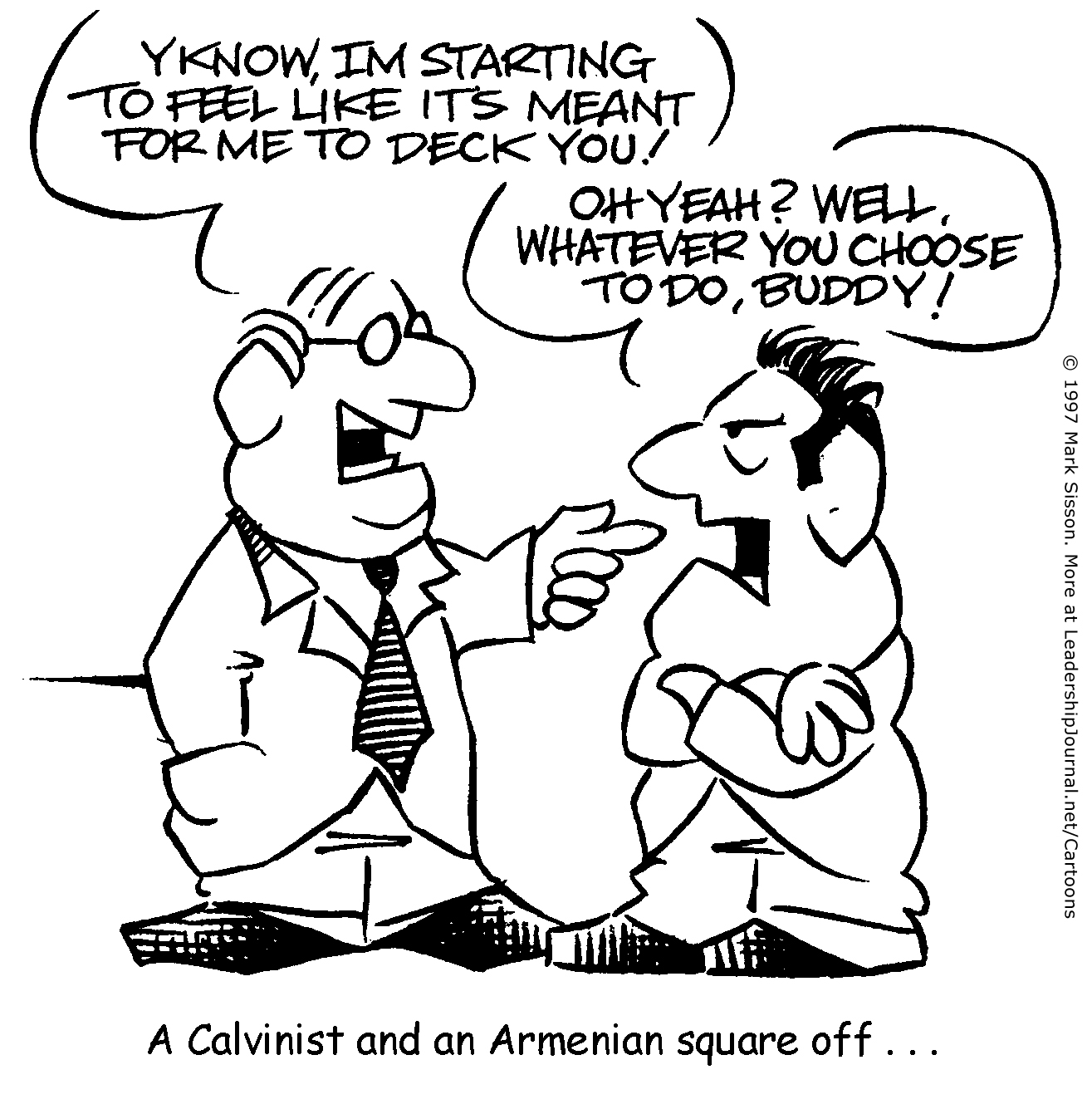
This past week I’ve had an online conversation with a fellow blogger on the topic of “limited atonement” and “total depravity.” Because of the nature of this topic, these discussions are usually fruitless and typically degenerate into “profane and vain babblings” (2 Timothy 2:16), which we should shun. At issue is the tension between the sovereignty of God and the free will of man. Calvinism (falsely attributed to the reformer, John Calvin) defends five points characterized by the acrostic TULIP: (1) Total Depravity, (2) Unconditional Election, (3) Limited Atonement, (4) Irresistible Grace, and (5) Perseverance of the Saints. Calvinism champions the complete sovereignty of God, and hyper-Calvinists go so far as to assert that God literally picks and chooses who will go to heaven and who will go to hell.
On the other side of the argument is Arminianism, attributed to the Dutch theologian Jacob Arminius. Arminianism counters Calvinism with eight points: (1) Universal Prevenient Grace, (2) Conditional Election, (3) Unlimited (or universal) Atonement, (4) Resistible Grace, (5) Uncertainty of Perseverance, (6) Libertarian Free Will, (7) Equal, Impartial, and Undifferentiated Love, (8) The Universal Call of Salvation.[1]
The conflict comes when one takes one position or the other. Both positions have scriptural support, and both have scriptural weaknesses. Contrast Calvinism’s “Total Depravity” with Arminianism’s “Universal Prevenient Grace.” The former considers individuals dead in sin so that they are incapable of choosing God’s free gift of salvation apart from God’s direct intervention on their behalf. This can be supported from Ephesians 2:8 where the Apostle Paul says in effect that the faith required to accept God’s Grace is in itself a gift of God. The latter acknowledges man’s fallen condition, but suggests that Grace “restores man’s free will which was impaired by the effects of original sin and enables him to choose or refuse the salvation offered by God in Jesus Christ.”[2] This too has scriptural support in “the Lamb slain from the foundation of the world” (Revelation 13:8). Or contrast Calvinism’s “Unconditional Election” with Arminianism’s “Conditional Election.” The former says that God picks who will be saved, the latter basically says that God “elects” or chooses those who choose Him. Both of these concepts find support in Scripture. Jesus said, “Ye have not chosen me, but I have chosen you” (John 15:16), but, of course, it could be argued that Jesus, in context, was speaking to His disciples, and as such it is not a blanket statement covering all believers. The Arminian challenge to this would be: “Then what do you do with all the ‘whosoever’ passages in the New Testament?” The Calvinist would then argue in a circle and say that all the “whosoevers” are the elect, but that also contradicts a lot of Scripture.
In Calvinism, “Unconditional Election” and “Limited Atonement” go hand in hand. The former specifies God’s sovereignty in “electing” who will be saved and “Limited Atonement” explains that Christ’s sacrifice, while having universal application, is only efficient for those who are elect. They are really two sides of the same coin. Arminianism challenges that with “Unlimited Atonement.” Since Jesus died for all, then all have equal opportunity to respond to the Gospel by the exercise of their free will. Calvinism responds that those who respond to the Gospel do so because Grace, the “call of God,” is irresistible to the elect; they cannot help but respond to the Gospel message. The Arminian would retort that Grace certainly is resistible, as is frequently proven in evangelistic encounters. Anyone who has shared their faith with an unbeliever has experienced the disappointment of bringing someone to the point of conviction and then having them reject the invitation to accept Christ as Lord and Savior. Some say, “I’m not ready now.” Others will say, “Perhaps when I’m older.” Still others may say, “I don’t want to offend my family or my friends.” The offer of God’s grace certainly can be rejected. Of course the Calvinist would counter with, “That’s because they aren’t elect” – again arguing in a circle.
This discussion could go on and on, and countless reams of paper have been spent in defense of both sides. Both sides have good points, and both sides have weak points. The answer to the debate lies somewhere in the middle. Only God knows the real inner workings of His plan. “For my thoughts are not your thoughts, neither are your ways my ways, saith the LORD. For as the heavens are higher than the earth, so are my ways higher than your ways, and my thoughts than your thoughts” (Isaiah 55:8-9). In the end, both Calvinists and Arminians have to come to Christ in the same way: “Believe on the Lord Jesus Christ, and thou shalt be saved” (Acts 16:31). “That if thou shalt confess with thy mouth the Lord Jesus, and shalt believe in thine heart that God hath raised him from the dead, thou shalt be saved” (Romans 10:9).
There is one point where the Calvinists get it right and the Arminians get it wrong, and that is the fifth point of Calvinism: “Perseverance of the Saints” vs. the Arminian “Uncertainty of Perseverance.” “Perseverance of the Saints” is the idea of “once saved always saved.”[3] The Arminians object to this based on observation. They may observe someone who claims to be saved living as a pagan. First of all, I would remind the Arminian that “the LORD seeth not as man seeth; for man looketh on the outward appearance, but the LORD looketh on the heart” (1 Samuel 16:7). Secondly, if salvation is based on man’s own effort, however that may be defined, that “salvation” is not genuine. Ephesians 2:9 tells us that salvation is “Not of works, lest any man should boast.” But when Jesus does the saving He says, “My sheep hear my voice, and I know them, and they follow me: And I give unto them eternal life; and they shall never perish, neither shall any man pluck them out of my hand” (John 10:27-28). Yes, Christians can sin and not lose their salvation. The difference is that the one who is truly saved, cannot continue in willful sin. Either the Christian will readily recognize his sin and immediately repent and ask forgiveness, or the Lord will allow the Christian to continue in his sin until the consequences of his sin bring him to the recognition of his sin that brings about repentance. If the sinner never comes to that point, he has probably never been saved because Jesus says, “My sheep hear my voice.” Either he belongs to Christ or he does not.
So, as I tried to show, the true answer to the Calvinism vs. Arminianism controversy is somewhere in the middle, and only God knows the exact details of His plan. Our task is to present the simple Gospel message, allow the Holy Spirit to do His work, and leave the details of how God accomplishes His plan to God.
[3] See my post “Impossible” of September 2, 2012.
Filed under Apologetics, Christianity, Evangelism, Gospel, Religion, Salvation, Theology
Good read. You may also want to read my comments below the post.
Contrary to Calvinism’s doctrine on “Limited Atonement” God’s offer of grace is not just for some – but for everyone who desires to receive it, trust it and obey it. I can’t tell you how many times the Bible says this, but I can tell you it says it more than once! And for something to be true the Bible only has to say it one time (and it must be said in the proper context), but when the Bible says the same thing over and over and over it might just be a clue pointing towards the obvious.
For example, when it comes to the reality of universal atonement the Bible says:
View original post 1,026 more words
Comments Off on Limited Atonement, Part 3 – The Bible is Clear, God’s Grace is a Gift Offered to Everyone
Filed under Uncategorized


