
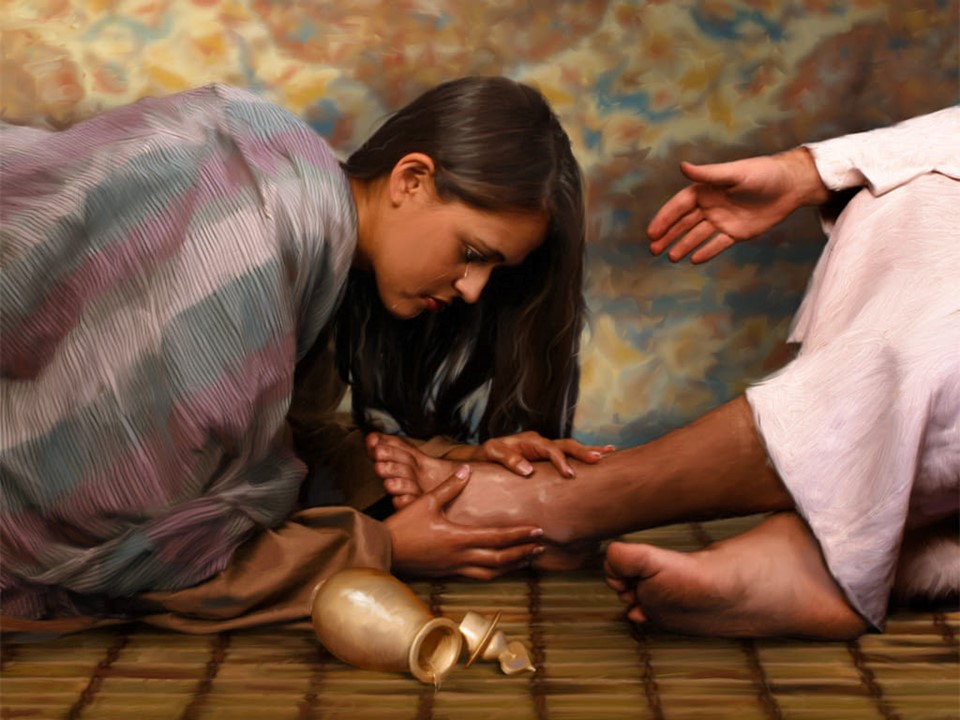
There came unto him a woman having an alabaster box of very precious ointment, and poured it on his head, as he sat at meat. (Matthew 26:7)
In one of my Bible readings this week, I came across an account of a woman anointing Jesus. All four Gospels record such an event. A detached, casual reading of the event can make the reader conclude that all four accounts are the same. Indeed, if we check the cross-references in our Bibles, they all seem to point to the other accounts leading the reader to assume they are all the same account. However, a close and careful examination of the four accounts will reveal a different story.
We have two, arguably three, different accounts of Jesus’ anointing. Luke’s account places the anointing long before the transfiguration while He was still in Capernaum (Luke 7:36-50).
Luke 7:36-39 And one of the Pharisees desired him that he would eat with him. And he went into the Pharisee’s house, and sat down to meat. (37) And, behold, a woman in the city, which was a sinner, when she knew that Jesus sat at meat in the Pharisee’s house, brought an alabaster box of ointment, (38) And stood at his feet behind him weeping, and began to wash his feet with tears, and did wipe them with the hairs of her head, and kissed his feet, and anointed them with the ointment. (39) Now when the Pharisee which had bidden him saw it, he spake within himself, saying, This man, if he were a prophet, would have known who and what manner of woman this is that toucheth him: for she is a sinner.
Matthew 26:6-9 Now when Jesus was in Bethany, in the house of Simon the leper, (7) There came unto him a woman having an alabaster box of very precious ointment, and poured it on his head, as he sat at meat. (8) But when his disciples saw it, they had indignation, saying, To what purpose is this waste? (9) For this ointment might have been sold for much, and given to the poor.
Mark 14:1-5 After two days was the feast of the passover, and of unleavened bread … (3) And being in Bethany in the house of Simon the leper, as he sat at meat, there came a woman having an alabaster box of ointment of spikenard very precious; and she brake the box, and poured it on his head. (4) And there were some that had indignation within themselves, and said, Why was this waste of the ointment made? (5) For it might have been sold for more than three hundred pence, and have been given to the poor. And they murmured against her.
John 12:1-6 Then Jesus six days before the passover came to Bethany, where Lazarus was which had been dead, whom he raised from the dead. (2) There they made him a supper; and Martha served: but Lazarus was one of them that sat at the table with him. (3) Then took Mary a pound of ointment of spikenard, very costly, and anointed the feet of Jesus, and wiped his feet with her hair: and the house was filled with the odour of the ointment. (4) Then saith one of his disciples, Judas Iscariot, Simon’s son, which should betray him, (5) Why was not this ointment sold for three hundred pence, and given to the poor? (6) This he said, not that he cared for the poor; but because he was a thief, and had the bag, and bare what was put therein.
Matthew and Mark place the anointing after the Triumphal Entry (Matthew 21:1-11; Mark 11:1-11) and two days before the Passover. John places the anointing the day before the Triumphal Entry (John 12:12). Matthew and Mark place the anointing in the “house of Simon the Leper.” John seems to place the anointing in the house of Lazarus following the raising of Lazarus from the dead. Neither Matthew nor Mark names the woman who anointed Jesus. Had she been Mary, they certainly would have known who she was. John names Lazarus, Martha, and Mary who anointed Jesus. Matthew records that the “disciples” were indignant about the waste. Mark only records that “there were some that had indignation within themselves.” The difference and precision in detail between Matthew and Mark’s account and the account of John are too distinct to be an error in recording. Therefore, these are two separate anointings. Luke’s account came too early to be confused with these that took place just before the crucifixion. Luke records that the anointing took place in the house of a Pharisee named Simon – not a leper – and the woman that anointed Jesus was “a sinner.” Surely, Mary, named by John, would not have been identified as a “sinner.” She is the one that “sat at Jesus’ feet, and heard His word” (Luke 10:39). Also, Luke’s account records nothing said about the cost of the ointment being used.
In all, we have three separate accounts of Jesus being anointed by women. Even though there are some similarities, the differences are too great to conflate them as one or two. The lesson here is to let the Bible speak for itself. The experts, while we can learn much from them, are also fallen men after all; they can make mistakes too.
Matthew and Mark describe the same anointing. John records a second anointing by Mary, Lazarus’ sister (Lazarus whom Jesus raised from the dead, John 11). Both accounts take place before the Passover when Jesus would be crucified. In both instances, Jesus commented that the anointing was for His burial (Matthew 26:12; John 12:7). Jesus knew that the cross lay before Him, and He went willingly to take our sin upon Himself. He paid a debt He did not owe to cancel the debt we could never pay. Reader, our sin debt was paid by Jesus who bought our pardon with His blood. All we have to do is accept that pardon. Have you done that? If not please read my page on “Securing Eternal Life.”
 Ernie's Musings