Category Archives: Creation

Articles that emphasize biblical six-day, young earth creation.

Proof of God

Big Bang or God?

Big Bang or God?

And God said unto Moses, I AM THAT I AM: and he said, Thus shalt thou say unto the children of Israel, I AM hath sent me unto you. (Exodus 3:14)

When someone asks, “What solid proof exists that there is a God who created everything?” that really is a foolish question. In order to “Answer a fool according to his folly, lest he be wise in his own conceit” (Proverbs 26:5), one must respond with a similar question: “What solid evidence is there that everything resulted from the Big Bang?” The God denier will attempt to make a case for the Big Bang by citing scientific consensus, but if pressed hard enough, he will have to concede that there is no “solid evidence” for the Big Bang. Hopefully, that should level the playing field.

Neither divine creation, nor the Big Bang can be proven with “solid” evidence because there was no one around to witness either one. So, we have to start with what we can observe. That is what true science is all about anyway – making observations, predictions and experiments. We cannot observe what is in the past, therefore we cannot make predictions about it because we are living the results of the past, and we cannot perform experiments to produce similar results. So, neither creation nor the Big Bang can be proven scientifically.

We are left with only what we can see today. The science that we use today is empirical science, and it is responsible for our advances in technology and medicine, but it does not tell us anything about the past. What one believes about origins has absolutely nothing to do with how one conducts empirical science. A medical doctor can be an excellent neurosurgeon regardless of whether he is an evolutionist or a creationist. Take Dr. Benjamin Carson, for example. He is a creationist, but that has not prevented him from being one of the foremost pediatric neurosurgeons in the world. (See article by ICR: http://www.icr.org/article/benjamin-carson-pediatric-neurosurgeon-with-gifted/)

The discussion of origins, then, falls into the realm of philosophy (from the Greek meaning “the love of wisdom” or “knowledge”) or theology (i.e., the study of God). Dealing in that realm involves looking at the available evidence, like the human genome, the fossil record, archeological records, ancient historical records, the Bible, etc. The investigator must then interpret the evidence and make a determination about what it reveals. This is called forensic science, and it is very subjective depending on the investigator’s presuppositions. If the investigator is an evolutionist and believes the earth is 4.5 Billion years old, he will interpret the evidence one way. If the investigator is a creationist, he will interpret the evidence another way.

So, what does this say about God? Well, the Institute for Creation Research (ICR) does a lot of scientific research on matters touching the Bible. ICR has highly qualified Ph.Ds. in micro-biology, physics, nuclear physics, astrophysics, and geology. ICR’s research has disproven evolution in the fields of biology, geology and cosmology. All their findings are published on their website and can be searched at http://www.icr.org/home/search/.

So, if we have disproven the Big Bang and evolution – order out of chaos – then what is left? Everything we observe in our universe shows signs of “design.” Everything that exists is designed with a purpose. So what does design require? It requires a designer. And what does a designer require? A designer requires intelligence! Scientists have only probed the surface of the intelligence contained in DNA. DNA in a human being is the specific instructions that make you unique to every other human being in the world or that has ever lived. But writing the programming code that makes you YOU, requires intelligence.

When someone writes an email to me, I naturally assume that it was thought out and written by an intelligent human being. It never occurs to me that some disturbance in the cosmos – a solar flare or a super nova – assembled thousands of ones and zeroes in the internet cloud in the correct order to produce intelligent communication directed specifically to me in the form of an email. That is just as ridiculous as believing that all the design and order we observe in our universe was some random, mindless accident caused by an inexplicable Big Bang.

There is intelligence – super intelligence – behind all that we see and experience. For those who reject the idea of a supreme being – i.e. God – they have to attribute the design to some other intelligence, i.e., ancient aliens, or the seed of life arriving to this planet on an asteroid, or something like that. But then, if you follow that line of reasoning, where did they get their intelligence, and on and on ad infinitum? There is no satisfactory answer in that! So, now what?

The Bible says, “In the beginning, God …” (Genesis 1:1). When Moses asked God for His name, He said “I AM THAT I AM” (Exodus 3:14). In other words, what God was saying is that He is the “Ever-Existent-One.” He has always existed, even before time began. He has no beginning and no end. When you think of it logically, that is the only thing that really makes sense. You understand by experience that any created thing is always subordinate to its creator. Just think about that for a moment. Can you name anything created by man that is greater than man? Even the world’s greatest super computer is not greater than man, and it is subject to its designer and programmer. It cannot even begin to compare to its creator.

So, whatever or whoever got the cosmos going of necessity must be greater than all that exists. God says, “That is Me.” You can reject that, if you wish, but you would be hard pressed to prove it false because His creation is hard to refute. The Bible says that, “that which may be known of God is manifest in them; for God hath shewed it unto them. For the invisible things of him from the creation of the world are clearly seen, being understood by the things that are made, even his eternal power and Godhead” (Romans 1:19-20, emphasis added). God’s creation proves that God exists. Furthermore, the Bible says that every human being has this knowledge deep within the core of their very being. Perhaps that is why the question of God comes up in the first place. Something inside every person tells them that God really does exist, but there exists another part that wants to suppress that knowledge, therefore they want “proof.” Everyone already has all the proof they need, and “they are without excuse” (Romans 1:20). One just needs to move forward with the little knowledge of God that He has given. No one really needs “proof” of God.


8 Comments

Filed under Apologetics, Atheism, Christianity, Creation, Evangelism, Evolution, Gospel, Origins, Religion, Science, Theology

Father

Father

Therefore shall a man leave his father and his mother, and shall cleave unto his wife: and they shall be one flesh.(Genesis 2:24)

From the very beginning, when God created the first couple, the design purposed the propagation of the human race. “And God blessed them, and God said unto them, Be fruitful, and multiply, and replenish the earth, and subdue it” (Genesis 1:28, emphasis added). Note that God did not create Adam and Steve or Bev and Eve. Such a combination would not have yielded the desired effect that God purposed. The family unit and the survival of mankind demanded both a father and a mother.

God, in a very real sense, is the First Father and the Father of the human race – our Father. His love for His children – His creation – is first illustrated in the life of Abraham as he offers his only son in sacrifice to God (Genesis 22:1-18). Abraham was the father of Isaac, Isaac the father of Jacob (Israel), Jacob the father of Judah, Judah the progenitor (father) of David, and David was the progenitor of the Lord Jesus Christ who would be the realization of the sacrifice portrayed by Abraham. The father is an important figure throughout Scripture and throughout history. In fact, God’s first “horizontal” commandment says, “Honour thy father and thy mother: that thy days may be long upon the land which the LORD thy God giveth thee” (Exodus 20:12). Paul repeats this commandment in Ephesians 6:1-3.

Earthly parents are far from perfect, yet we have this assurance of our Heavenly Father, “When my father and my mother forsake me, then the LORD will take me up” (Psalm 27:10). “Like as a father pitieth his children, so the LORD pitieth them that fear him” (Psalm 103:13). Yet even in their imperfection, we are exhorted to listen to the counsel of our fathers: “Hear, ye children, the instruction of a father, and attend to know understanding” (Proverbs 4:1). My father was not perfect, yet “I was my father’s son, tender and only beloved in the sight of my mother” (Proverbs 4:3). My Heavenly Father, encourages, “My son, keep thy father’s commandment, and forsake not the law of thy mother” (Proverbs 6:20). For “what man is there of you, whom if his son ask bread, will he give him a stone? Or if he ask a fish, will he give him a serpent?” (Matthew 7:9-10). Human fathers may not always get it right, but any father who loves his child always has the best in mind for his children.

However, “There is a generation that curseth their father, and doth not bless their mother” (Proverbs 30:11). Indeed, Jesus said, “Think not that I am come to send peace on earth: I came not to send peace, but a sword. For I am come to set a man at variance against his father, and the daughter against her mother, and the daughter in law against her mother in law. And a man’s foes shall be they of his own household” (Matthew 10:34-36, emphasis added). We may be experiencing that very thing now. “This know also, that in the last days perilous times shall come. For men shall be lovers of their own selves, covetous, boasters, proud, blasphemers, disobedient to parents, unthankful, unholy, Without natural affection, trucebreakers, false accusers, incontinent, fierce, despisers of those that are good, Traitors, heady, highminded, lovers of pleasures more than lovers of God” (2 Timothy 3:1-3, emphasis added). This may be demonstrated in open rebellion or in passive aggressive behavior. Either way, the son has departed from the teachings of his father. To a father who loves his son, nothing can cause more heartache than a son who rejects his father’s teaching.

I am eternally grateful for my imperfect father, who despite his imperfections demonstrated (and still demonstrates) unwavering love for me. I learned much from my father – how to drive a car at the age of ten, how to throw a curve ball, how to work hard, how to respect authority, how to love. But the most important thing my father taught me was to love and trust God and to unquestionably trust in God’s Word. Those lessons have never failed me, and they are the lessons I would impart to my sons, who now have children of their own.

My pastor recently, in a Mother’s Day sermon, offered the following illustration. A prison warden thought it would be good to offer all inmates that wanted a Mother’s Day card with free postage to be sent to the prisoner’s mother. Without exception, every single inmate took him up on the offer. The warden was so impressed with the success of the exercise that he thought he would do the same for Father’s Day. To his surprise, not a single inmate took him up on the offer. Fathers are important, but even when our earthly fathers fail us, our Heavenly Father never, never fails us. He is “A father of the fatherless,” (Psalm 68:5).

1 Comment

Filed under Christianity, Creation, Current Events, Origins, Religion, Theology

33. Evidence for God – Design Convinces Scientists 16 – Ben Carson 4 | Bible-Science Guy

Not ALL scientists believe in evolution!

33. Evidence for God – Design Convinces Scientists 16 – Ben Carson 4 | Bible-Science Guy.

Comments Off on 33. Evidence for God – Design Convinces Scientists 16 – Ben Carson 4 | Bible-Science Guy

Filed under Apologetics, Christianity, Creation, Evolution, Origins, Religion, Science

How Art Thou Fallen!

Angel of Light

How art thou fallen from heaven, O Lucifer, son of the morning! how art thou cut down to the ground, which didst weaken the nations! (Isaiah 14:12)

God deniers often challenge believers with the question of evil in the world. “If God is so good, why is there so much evil in the world?” Another closely linked question is “Why did God create Satan?” and “When did God create Satan?” My attempt to answer these questions follows.

God created Satan (his name is Lucifer) when He created the other angels. Angels were created early on during the week of creation (Genesis 1) – probably Day One or Day Two of creation. We get this from God’s response to Job’s questioning concerning the calamity that had befallen him. God asks Job:

Where wast thou when I laid the foundations of the earth? … When the morning stars sang together, and all the sons of God shouted for joy? (Job 38:4, 7, emphasis added)

“The morning stars” is used synonymously with “the sons of God” – Hebrew bene Elohim, which is used only in regard to angels in the Old Testament. From this we gather that the angels witnessed creation. Satan is included with “the sons of God.”

Now there was a day when the sons of God came to present themselves before the LORD, and Satan came also among them. (Job 1:6, emphasis added)

Again there was a day when the sons of God came to present themselves before the LORD, and Satan came also among them to present himself before the LORD. (Job 2:1, emphasis added)

Apparently by this time Satan, which means “accuser,” had already fallen, and he was actively attacking man. However, notice Who still has the final say – Satan still needed to get permission from God to attack Job. But when did Satan Fall? The Bible does not provide specific answers to this question, but we can at least conclude that it happened after creation was completed because we have God’s assessment of His finished product:

And God saw every thing that he had made, and, behold, it was very good. (Genesis 1:31, emphasis added).

God’s creation would not have been “very good,” if there were rebellion in the camp, and to suppose that perhaps God was unaware of a rebellion would be to deny God’s omniscience. So, sometime between God’s conclusion of creation and the Fall of man (Genesis 3), Satan rebelled against God. That brings up the question: Why would Satan rebel against God? We are given some hints in the books of Isaiah and Ezekiel.

How art thou fallen from heaven, O Lucifer, son of the morning! how art thou cut down to the ground, which didst weaken the nations! For thou hast said in thine heart, I will ascend into heaven, I will exalt my throne above the stars of God: I will sit also upon the mount of the congregation, in the sides of the north: I will ascend above the heights of the clouds; I will be like the most High. (Isaiah 14:12-14, emphasis added)

Thou [“king of Tyrus,” i.e., Satan] hast been in Eden the garden of God; every precious stone was thy covering, the sardius, topaz, and the diamond, the beryl, the onyx, and the jasper, the sapphire, the emerald, and the carbuncle, and gold: the workmanship of thy tabrets and of thy pipes was prepared in thee in the day that thou wast created. Thou art the anointed cherub that covereth; and I have set thee so: thou wast upon the holy mountain of God; thou hast walked up and down in the midst of the stones of fire. Thou wast perfect in thy ways from the day that thou wast created, till iniquity was found in thee. By the multitude of thy merchandise they have filled the midst of thee with violence, and thou hast sinned: therefore I will cast thee as profane out of the mountain of God: and I will destroy thee, O covering cherub, from the midst of the stones of fire. Thine heart was lifted up because of thy beauty, thou hast corrupted thy wisdom by reason of thy brightness: I will cast thee to the ground, I will lay thee before kings, that they may behold thee. (Ezekiel 28:13-17, emphasis added)

From this, especially from the Ezekiel passage, we can infer that Lucifer (“the king of Tyrus” i.e., Satan) was a high ranking angel – very likely an archangel. He was obviously very beautiful as his “covering” is described as beautiful gem stones. His name, Lucifer, means “shining one” or “day star,” therefore he must have been quite dazzling – very unlike the images of Satan we see depicted today. Notice also that his “sin” was the same sin with which he tempted Eve in the Garden: “ye shall be as gods, knowing good and evil” (Genesis 3:5).

Only three angels are named in the Bible: Lucifer, Michael, and Gabriel. Since these are the only three named, it is quite possible that these are the only archangels that God created. I arrive at this conclusion from what we read of the fall of Satan (the “old dragon”) found in Revelation 12:

And there appeared another wonder in heaven; and behold a great red dragon, having seven heads and ten horns, and seven crowns upon his heads. And his tail drew the third part of the stars of heaven, and did cast them to the earth: and the dragon stood before the woman which was ready to be delivered, for to devour her child as soon as it was born. (Revelation 12:3-4, emphasis added)

As noted in the Job passages above, angels are sometimes referred to as “stars.” That Satan drew “the third part of the stars of heaven” along with him indicates to me that these were the angels that were under his command, leaving the remaining two-thirds under the command of Michael and Gabriel.

It is conjecture on my part, but I believe the reason Satan rebelled was because he became jealous of man who was created in the image of God and given dominion over God’s creation.

And God said, Let us make man in our image, after our likeness: and let them have dominion over the fish of the sea, and over the fowl of the air, and over the cattle, and over all the earth, and over every creeping thing that creepeth upon the earth. So God created man in his own image, in the image of God created he him; male and female created he them. And God blessed them, and God said unto them, Be fruitful, and multiply, and replenish the earth, and subdue it: and have dominion over the fish of the sea, and over the fowl of the air, and over every living thing that moveth upon the earth. (Genesis 1:26-28, emphasis added)

Angels were not created in the image of God, nor were they given charge over God’s creation. That distinction was given to man; therefore Satan became jealous and plotted to cause man to fall. He thought “of himself more highly than he ought to think” (Romans 12:3) as described in the Isaiah and Ezekiel passages above. His sin was not in his thought, but in acting upon his thought and carrying out his plan to cause man to sin. This is probably where Satan fell.

There is evil in the world because of sin – rebellion – which was first birthed in the mind of Satan and brought to full fruition through man’s disobedience. Some may object that God should not have given man occasion to disobey by placing the tree of the knowledge good and evil in the garden, but love is a choice. God also provided another tree on a hill called Calvary. From that tree we are free to partake, “For God so loved the world, that he gave his only begotten Son, that whosoever believeth in him should not perish, but have everlasting life” (John 3:16). Love is a choice.

Comments Off on How Art Thou Fallen!

Filed under Apologetics, Atheism, Christianity, Creation, Evangelism, Gospel, Heaven, Hell, Origins, Religion, Salvation, Satan, Theology

Seth Number Three?

Bouguereau-The_First_Mourning-1888

The First Mourning by Bouguereau (1888)

And Adam lived an hundred and thirty years, and begat a son in his own likeness, after his image; and called his name Seth (Genesis 5:3)

Where did Cain get his wife? Another question along the same line is, “From where did the people come that Cain feared after killing Abel?” (Genesis 4:14). Questions like this have spawned much conjecture in the origins debate and have led many to the misguided conclusion that other “hominids” existed prior to God’s special creation of Adam and Eve. Cain, they conclude, feared these “people” and he probably selected a wife from among them.

For better or worse, the Bible does not provide us with all of the detail we would like for filling the gaps in these historical narratives. But the Author does not concern Himself with the minor details in order to focus our attention on the greater plan, i.e., that God created everything including mankind in a “very good” state; God desired a close personal relationship with His special creation, man; man disobeyed God and severed that intimate relationship; God has continually strived to reconcile man to Himself and provided the way of salvation; and God will one day restore His creation to its original perfection. So the extraneous, irrelevant minutia is omitted in order to develop the greater story. That being said, we are left with many unimportant unanswered questions that can lead us astray, if we are careless in the way we handle God’s Word.

The above are at least two such questions. Genesis 4 begins shortly after the Fall and informs us that “Adam knew Eve his wife; and she conceived, and bare Cain, and said, I have gotten a man from the LORD” (Genesis 4:1). The Hebrew construction indicates that Eve actually believed that she had given birth to the Savior. Literally it reads “I have gotten a man, the LORD.” She believed God’s promise that “I will put enmity between thee and the woman, and between thy seed and her seed; [He] shall bruise thy head, and thou shalt bruise his heel” (Genesis 3:15, emphasis added). She later realized her error and when her second son was born, she named him Abel (Genesis 4:2) which means emptiness or vanity because her desire was not realized with the firstborn. Now, between verse 1 and verse 2 some time has elapsed, but we do not know how much time. We can surmise that Abel was the second male child born: “And she again bare his brother Abel” (emphasis added). Verse 2 tells us that “Abel was a keeper of sheep, but Cain was a tiller of the ground.” Here again, within the same verse, a long span of time has elapsed, and we are left to wonder. How old were these boys? Were they in their early teens or were they fully grown men between 30 and 40 years old? We are not told. And what about other siblings? Were they the only children of Adam and Eve? The details elude us. The intent of this narrative is to highlight the advancement of sin in this new world. Cain committed the first act of murder in killing Abel, his brother. This narrative also illuminates the downward spiral of sin. This final act of murder began with disobedience (Cain offered a sample of his harvest as a sacrifice to God, (Genesis 4:3) rather than a blood sacrifice), then he became jealous of his brother because God accepted Abel’s sacrifice and rejected his (Genesis 4:4), and finally his jealousy worked itself into a raging anger that ended in murder (Genesis 4:5). This is the focus of this narrative, and how old they were or how many other siblings there were is totally irrelevant to the story.

Obviously, Cain did not get away with the murder. Again the purpose of the narrative serves to give us insight into the nature of God and the nature of man. Notice that it is God who seeks man rather than the other way around. “And the LORD said unto Cain, Where is Abel thy brother?” (Genesis 4:9a). Why does God pose the question? Does God not know what has transpired? God is omniscient. Of course He knows. In fact, God attempted to intervene before the heinous act. “And the LORD said unto Cain, Why art thou wroth? and why is thy countenance fallen? If thou doest well, shalt thou not be accepted? and if thou doest not well, sin lieth at the door. And unto thee shall be his desire, and thou shalt rule over him” (Genesis 4:6-7, emphasis added). Cain failed to follow the prescribed method of sacrifice that God instituted in the Garden (Genesis 3:21). Only the shedding of innocent blood can cover man’s sin, but Cain tried to do it his way, and the sin lying at his door was rebellion against God. In His line of questioning, God was giving Cain the opportunity to confess his sin as ask forgiveness, but instead, he hardened his heart: “And he said, I know not: Am I my brother’s keeper?” (Genesis 4:9b). Even then God gave him a third opportunity: “And he said, What hast thou done? the voice of thy brother’s blood crieth unto me from the ground” (Genesis 4:10). Failing to confess and repent of his sin, God sentenced Cain to banishment from his home and family (Genesis 4:14).

However, it seems that the thing Cain most feared was retribution by others. “Behold, thou hast driven me out this day from the face of the earth; and from thy face shall I be hid; and I shall be a fugitive and a vagabond in the earth; and it shall come to pass, that every one that findeth me shall slay me” (Genesis 4:14, emphasis added). Who did Cain have to fear? So far, the only people named in the Bible are Adam, Eve, Cain and Abel. Who else was around that might take vengeance on Cain? Then there is the matter of Cain’s wife: “And Cain knew his wife; and she conceived, and bare Enoch: and he builded a city, and called the name of the city, after the name of his son, Enoch” (Genesis 4:17, emphasis added).

So, where did Cain get his wife? The Bible does not say. Apparently the Author thought we were sufficiently intelligent enough to figure that one out on our own, as long as we stick with the Bible. The Genesis account of creation tells us that man was created on the sixth day. Man was also created apart from the animals, who God created merely by His spoken command. Man, on the other hand, was “created” (Hebrew bârâ’ used only as applicable to God’s creative acts) in the “image of God” (Genesis 1:27). Furthermore, God “sculpted” (Hebrew yâtsar, which means to mold into a form as a potter forms clay) a special body for man. So man is truly unique among God’s creation. In addition to that, all of God’s creation is to reproduce “after its kind” (Genesis 1:11-12, 21, 25-26). So, Cain’s wife had to be of the same “kind” as he. That would preclude him having a wife of some lesser “evolved” hominid, which, if such a thing existed, would not have been created in the image of God. That leaves only one option. Cain’s wife was his sister.

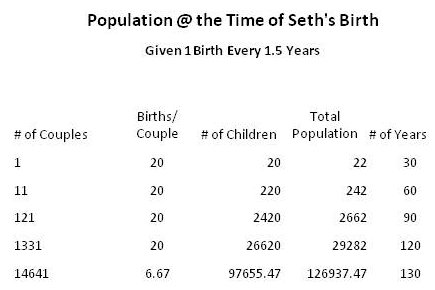
The other question is: Whom did Cain have to fear? It stands to reason that if Cain had a wife, Abel could have had a wife and perhaps even children. Since we are not given a timeframe for this event, we cannot know if the boys were in their thirties or older. Perhaps both boys were old enough by now to have grown children. If that were the case, Cain would have feared retribution from Abel’s sons. Or he could have feared retribution from his other siblings. The Bible tells us that Adam “begat sons and daughters” (Genesis 5:4), but the number and the time between births remains a puzzle. We know that Adam was 130 when Seth was born (Genesis 5:3). “And Adam knew his wife again; and she bare a son, and called his name Seth: For God, said she, hath appointed me another seed instead of Abel, whom Cain slew” (Genesis 4:25). Seth’s name means substituted (Strong’s definition) or compensation (Young’s definition). Seth is the third person named as a son of Adam, but it does not necessarily follow that he was the third born. It simply means that he was the third son of Adam who is identified in Scripture. (I will explain later.) Also, judging by the significance of his name and Adam’s age at his birth, it is reasonable that Cain and Abel were approaching that age, i.e., between 120 and 129 years old. Keep in mind that Adam was not “born;” he was created fully grown, so while chronologically he was 130, physically he was probably around 160. If this is the case, there was enough time involved for many more people to be on earth coming from Adam and Eve and approximately four generations (provided a generation equals 30 years). I am no mathematician, but I came up with what I consider to be a rather conservative figure for the possible number people on earth at the time of Seth’s birth:

Pop at Seths Birth

A young biologist friend of mine came up with a table similar to mine, but he took into account the maturation process of Adam and Eve’s offspring before they were of age to reproduce. Gee! Why didn’t I think of that! His table is too long to reproduce here, but his figures were even more conservative than mine. He calculated the possible population at the time of Seth’s birth at only 9,289. Even at this much lower count, one understands why Cain feared for his life; there were others out there who might want to take vengeance for Abel’s murder.

By now it should be evident that Seth was not Adam and Eve’s third son. His name simply means that he was the replacement for Abel. His name is significant also because it starts to point the way to our Savior, Jesus Christ. From Seth’s line came Enoch who “walked with God: and he was not; for God took him” (Genesis 5:24). From Seth’s line came Noah “a preacher of righteousness” (2 Peter 2:5); a man who “found grace in the eyes of the LORD” (Genesis 6:8). Through Noah, and then through his son Shem, extended the line that would eventually lead to Jesus (Luke 3:38). Herein lies the reason Seth’s name is recorded while other sons and daughters of Adam and Eve are excluded. Seth was not the third son, but he was the son that points us to Christ.

Comments Off on Seth Number Three?

Filed under Apologetics, Christianity, Creation, Death, Evangelism, Evolution, Gospel, Religion, Salvation, Theology