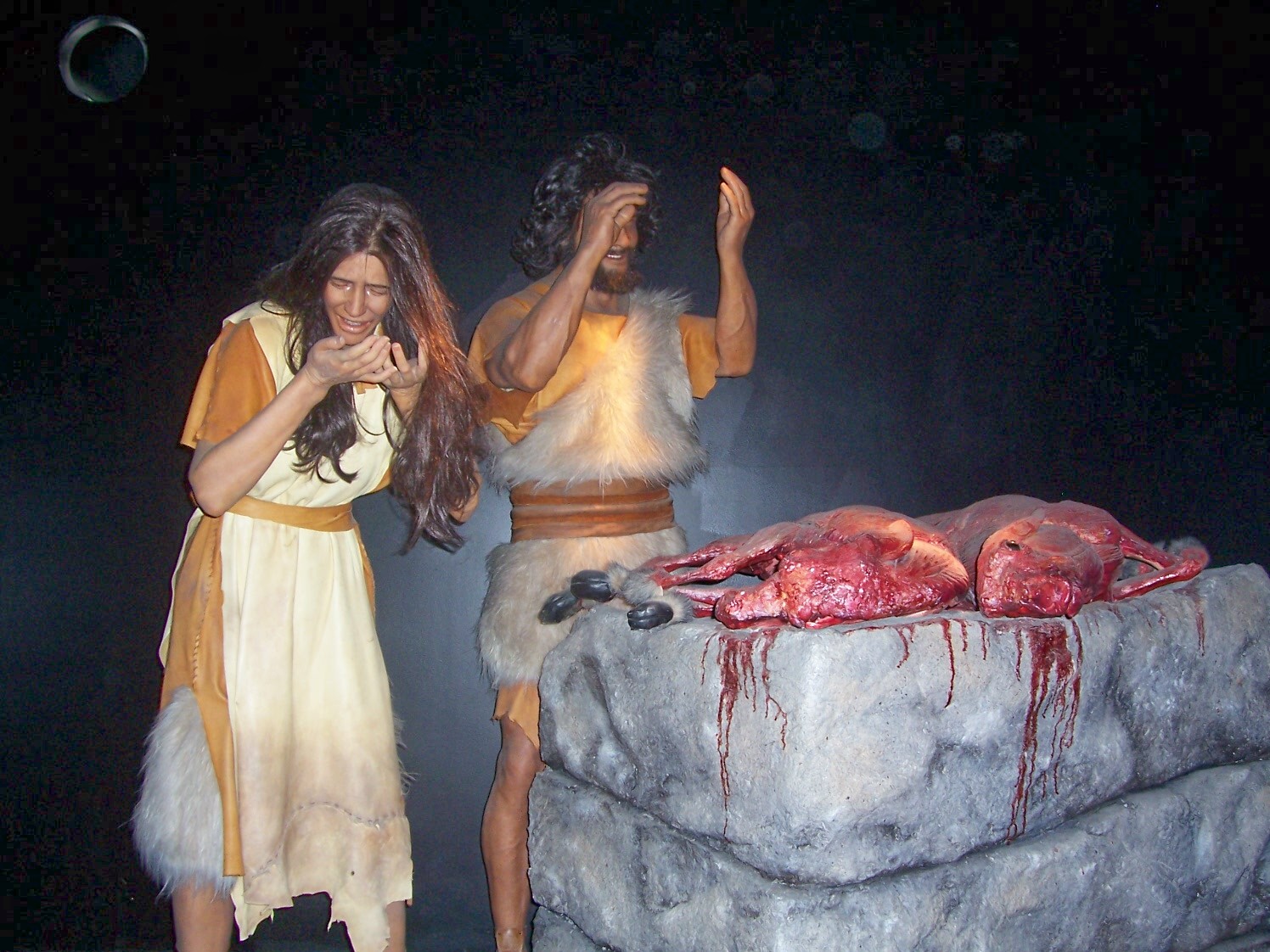
For Adam and Eve, this was the first time the first couple witnessed death. Innocent blood spilled to cover the consequence of their sin. (Romans 6:23)
“Unto Adam also and to his wife did the LORD God make coats of skins, and clothed them.” (Genesis 3:21)
Recently someone asked me a very interesting question: “Did God use human form to sacrifice the first animals, or was that done spiritually, without a body?” Of course, this is one of those questions for which we cannot give a definitive/authoritative answer. The problem is that the Bible does not provide enough detail for us make an assertive statement one way or the other. Consider our text above: “Unto Adam also and to his wife did the LORD God make coats of skins, and clothed them” (Genesis 3:21). That is it. That is all we have to go by. Anything beyond that is pure speculation on anyone’s part.
However, having said that, I believe that God took the form of the pre-incarnate Christ and performed the sacrifice before them – in their sight – so that they could witness for themselves the price or cost of their sin. Some innocent animal’s blood had to be shed in order to cover (atone for) their sin. Since they had never killed anything or experienced death in any way, they had to see how this was done in order for them to continue the practice. That they continued the practice is evidenced in the following chapter where Abel sacrificed a lamb from his flock (Genesis 4:4), while Cain offered “the fruit of the ground” (Genesis 4:3). Cain’s offering was rejected by God because it did not follow what God had prescribed in the beginning (Genesis 4:5).
This same practice of sacrifice was followed by Noah after the Flood (Genesis 8:20), by the patriarchs Abraham, Isaac and Jacob (Israel), and finally by the children of Israel after they came out of Egypt. I believe this practice of sacrifice was handed down, generation after generation beginning with Adam, and it was learned by the example given by the pre-incarnate Christ who would ultimately be the perfect Lamb of God.
“… and they that dwell on the earth shall wonder, whose names were not written in the book of life from the foundation of the world …” (Revelation 17:8)
In my last post, “The Book of Life” I talked about the Book of Life that will be opened at the Great White Throne Judgment. Anyone whose name is not found written in the Book of Life is sentenced to an eternity in hell. I also expressed my understanding that everyone who has ever been born has their names written in the Book of Life initially, but whether they remain there depends on how they respond to God’s offer of salvation.
I said this was true with some exceptions, but I did not want to go into the details at that time. The reason I did not elaborate on the “exceptions” is because it might sound a little strange or even weird to some people, and trying to explain it in one or two paragraphs would be next to impossible. In fact, books have been written on the subject, so it would be difficult to explain in just a few words.
Just by way of disclaimer: what I am suggesting in the following paragraphs should not be taken as “gospel.” These are simply my thoughts based on studies that I have done, and are not meant to represent any kind of ecclesiastical dogma. There are many things in God’s Word that are not made clear to us, and to attempt to build a case on a shaky foundation is simply foolish. So, I recommend a healthy dose of skepticism before continuing. You may think I am full of bologna, and that is fine. This is something I “think” is true, but I wouldn’t bet my next paycheck on it. So, read on.
You remember in Genesis 3 that Satan came to Eve in the form of a serpent and tempted her to eat of the fruit of the Tree of the Knowledge of Good and Evil. She then shared the fruit with Adam who also ate of the fruit so that both sinned by disobeying God’s only commandment – that they should not to eat of that tree. God punished them, as He had warned them, by causing them to die in two ways: (1) they would no longer live forever (when God created man, He intended them to live forever), and (2) they were separated from their Creator. This is what we know as original sin, and all generations since Adam and Eve have inherited original sin. We all have a “sin nature.” That is why the Bible says that “all have sinned and come short of the glory of God” (Romans 3:23, emphasis added). God also cursed the ground from which man was taken so that all of God’s creation suffers because of man’s sin. “For we know that the whole creation groaneth and travaileth in pain together until now” (Romans 8:22, emphasis added). Adam’s punishment was that work would be hard for him, and Eve’s punishment was that she would have pain in bearing children.
Following that (about 1600 years later), we are told that violence increased in the world. “And GOD saw that the wickedness of man was great in the earth, and that every imagination of the thoughts of his heart was only evil continually. And it repented the LORD that he had made man on the earth, and it grieved him at his heart” (Genesis 6:5-6). That was bad enough, but the first verses of Genesis 6 talks about something that is very strange, and has puzzled biblical scholars for ages . It says:
1 And it came to pass, when men began to multiply on the face of the earth, and daughters were born unto them,
2 That the sons of God saw the daughters of men that they were fair; and they took them wives of all which they chose …
4 There were giants in the earth in those days; and also after that, when the sons of God came in unto the daughters of men, and they bare children to them, the same became mighty men which were of old, men of renown. (Genesis 6:1-2, 4, emphasis added)
The “sons of God” in the Hebrew is bene elohim. This term always refers to angels in the Old Testament. (See Job 1:6; Job 2:1; and Job 38:7.) There are two kinds of angels: Satan’s angels (demons) and God’s angels. (Something to keep in mind is that even the devil is God’s devil. God created him, and he rebelled against God. But the devil (Satan) cannot do anything without God’s permission. This is demonstrated in the first three chapters of Job.) So, these demons “mated” with human females to create a mighty race of men. Now, angels cannot procreate directly, so what probably happened is that these demons possessed human males in order to mate with the human females. This somehow altered the DNA of the children born from these demonic unions so that they created “giants.” The Hebrew word used for “giants” is nephalim, and it literally means “fallen ones.”
Imagine just how bad things got that God felt He had to destroy them all. “But Noah found grace in the eyes of the LORD” (Genesis 6:8) and “Noah was a just man and perfect in all his generations, and Noah walked with God” (Genesis 6:9, emphasis added). The phrase that Noah was “perfect in all his generations” does not mean that he was sinless. Remember, “all have sinned.” What this means, then, is that his blood line was not contaminated by the satanic unions of the others.
When I say that there are “some exceptions,” this is to what I’m referring. Revelation 17 discusses the apostate church during the Tribulation who the Antichrist will eventually destroy. About those who follow that apostate church it says, “The beast that thou sawest was, and is not; and shall ascend out of the bottomless pit, and go into perdition: and they that dwell on the earth shall wonder, whose names were not written in the book of life from the foundation of the world, when they behold the beast that was, and is not, and yet is” (Revelation 17:8, emphasis added). It is very clear that these were never written in the Book of Life – “from the foundation of the world.” It is as if these were never meant to be born.
One would think that the Global Flood should have taken care of all of the “bad seed.” Well, perhaps not all of them. As we continue the narrative in Genesis 6, God sent the Flood that covered the entire earth for almost a whole year. The Bible tells us that Noah and his wife and his three sons and their wives were in the Ark for 371 days, before the earth was once again livable.
Then follows an incident where Noah got drunk, and his son Ham saw him naked (Genesis 9:20-29). Ham, instead of covering his father went and told his brothers, Japheth and Shem. So they went into Noah’s tent backward so as not to see the nakedness of their father and they covered him up. When Noah awoke from his drunk and discovered what Ham had done, he cursed Canaan, Ham’s youngest son. So the question is, why did Noah curse Canaan and not Ham or Ham’s other sons? The answer may be that Ham’s wife may have carried some of the “bad seed” of the Nephalim in her, and it showed up in Canaan. One of the characteristics of Nephalim is that they had six fingers. (Goliath’s father had six fingers on each hand and six toes on each foot (2 Samuel 21:20).) Canaan was probably born with six fingers and when Noah saw it, he cursed him. So, some of these probably still exist in our world today with or without six fingers, but God knows who they are. These would not qualify to be written in the Book of Life.
Canaan’s descendants settled in the “Land of Canaan” which was given to Abraham and his descendants (Genesis 13:14-18; 15:18-21). Genesis 10:15-20 describes who these people were and where they settled. “And the border of the Canaanites was from Sidon, as thou comest to Gerar, unto Gaza; as thou goest, unto Sodom, and Gomorrah, and Admah, and Zeboim, even unto Lasha” (Genesis 10:19). These are the people that the children of Israel had to face when they entered the Promise Land. As they prepared to enter into the land, 12 spies were sent in to spy out the land and report back what they encountered. The book of Numbers records the bad report returned by 10 out of the 12 spies. “And there we saw the giants, the sons of Anak, which come of the giants: and we were in our own sight as grasshoppers, and so we were in their sight” (Numbers 13:33). Again, here the Hebrew word for “giants” is nephalim – the “fallen ones.” In The Henry Morris Study Bible, Dr. Morris makes this note about this verse:
There were also other tribes of giants in the land. “That was also accounted a land of giants: giants dwelt therein in old time; and the Ammonites call them Zamzummims; A people great, and many, and tall, as the Anakims” [i.e., sons of Anak] (Deuteronomy 2:20, 21). Here, and in a number of other passages, the word for “giants” is Rephaim, evidently a tribe descended from the “Rephaims” associated with the “Zuzims” and the “Emims” of Genesis 14:5. The Emims also were called “a people great, and many, and tall, as the Anakims” (Deuteronomy 2:10).
All of these references indicate that there had been another irruption of the fallen “sons of God” just as in the days before the Flood. This time the irruption was probably in connection with the events surrounding the rebellion at Babel and the subsequent worldwide dispersion of the occult religious system introduced there. These demon-possessed men and women became the progenitors of tribes characterized by giantism, just as in the antediluvian days. (http://www.icr.org/bible/numbers/13:33/)
So, it is apparent that these nephalim somehow managed to survive the Flood. These who survived were descendants of Canaan, which explains why Noah cursed Canaan and not Ham. Oh, and by the way, Ham begat other sons before Canaan: Cush, Mizraim (Egypt), and Phut. Canaan was the youngest, but evidently, he carried the “bad seed.”
Now, to further complicate things, I am sure you have heard of UFOs and of aliens abducting humans. I believe (and I am not alone in this) that these are demons that are doing the same thing today as they were doing back in Genesis 6. (See my article “Aliens?”) These creatures, that may look very human, were never meant to be born, so their names are not written in the Book of Life.
Unless you are one of the nephalim (and you probably are not, if you are reading this), your name is written in the Book of Life. My question to you would be, is your name permanently written in the Book of Life, or is there a possibility that it could be blotted out? That choice is up to you.
Watch “On the Trail of the Nephalim” on YouTube with L.A. Marzulli.
“And I saw the dead, small and great, stand before God; and the books were opened: and another book was opened, which is the book of life …” (Revelation 20:12)
The debate between “election” (predestination) and “free will” continues with no satisfactory resolution on either side (See my article “Somewhere in the Middle”), and no clear winner. What we can know for certain is that at the final judgment, any remaining doubts will be assuaged. In the final scene before the “new heaven and a new earth: for the first heaven and the first earth were passed away” (Revelation 21:1) are revealed, John says, “And I saw the dead, small and great, stand before God; and the books were opened: and another book was opened, which is the book of life … And whosoever was not found written in the book of life was cast into the lake of fire” (Revelation 20:12,15, emphasis added).
John saw that “the books were opened.” Clearly this thorough examination includes more than one book, and one might wonder what these might be. I believe that “the books” are the journals of the life of every individual ever created by God. The psalmist says, “My substance was not hid from thee, when I was made in secret, and curiously wrought in the lowest parts of the earth. Thine eyes did see my substance, yet being unperfect; and in thy book all my members were written, which in continuance were fashioned, when as yet there was none of them” (Psalm 139:15-16). Jesus said that “the very hairs of your head are all numbered” (Matthew 10:30). In another psalm the psalmist says, “Thou tellest my wanderings: put thou my tears into thy bottle: are they not in thy book?” (Psalm 56:8). Every detail of our lives is recorded in these books: every stray thought, every word, every act whether good or bad. Sadly, the vast majority of people, from every religion including Christianity, live their lives believing that in the end, when the books are opened and examined, their good acts will outweigh the bad and gain them entrance into heaven. (See my article “Near Death.”)
Included in “the books” that will be opened is the Bible, I believe. In any court trial, the accused is judged according to a written standard – the law. Regardless of the overall good conduct of the accused, the judgment passed reflects the violation of an absolute standard. So it shall be at the final judgment. Each individuals life’s journal will be measured against God’s ultimate standard. At that final judgment it is possible, though highly unlikely, that one or maybe even two individuals lived almost flawless lives except for maybe one “indiscretion.” The Bible says, “whosoever shall keep the whole law, and yet offend in one point, he is guilty of all” (James 2:10).
So much for getting in on one’s own merits! But wait! One book remains unexamined – the Book of Life! Considering the court scene above, a human judge has the authority to extend mercy to the accused especially if the person has otherwise been law-abiding. So, the Book of Life is opened and the roll call begins, “And whosoever was not found written in the book of life was cast into the lake of fire” (Revelation 20:15). In this court, if one has “yet offended in one point, he is guilty of all” (James 2:10). Justice has been done, the verdict rendered, and there is no appeal.
We yet wait that final judgment, but it approaches nearer every day. Those whose names are written in the Book of Life know it without a doubt. The Apostle Paul alludes to this when he says, “And I intreat thee also, true yokefellow, help those women which laboured with me in the gospel, with Clement also, and with other my fellowlabourers, whose names are in the book of life” (Philippians 4:3, emphasis added).
Those not in that camp want to know how to inscribe their names in the Book of Life. I have a theory, albeit somewhat unorthodox, but I think I can support it scripturally. I believe that every person born, with some exceptions, is recorded in the Book of Life. That is why the Bible can claim that “The Lord is not slack concerning his promise, as some men count slackness; but is longsuffering to us-ward, not willing that any should perish, but that all should come to repentance” (2 Peter 3:9, emphasis added). Every person alive can receive eternal life through repentance and acceptance of God’s grace-gift of salvation by the atoning work of Christ on the cross. But when one rejects God’s offer of salvation, God blots out his name from the Book of Life. I arrive at this conclusion from Moses’ intercession for his people, Israel. “And Moses returned unto the LORD, and said, Oh, this people have sinned a great sin, and have made them gods of gold. Yet now, if thou wilt forgive their sin–; and if not, blot me, I pray thee, out of thy book which thou hast written. And the LORD said unto Moses, Whosoever hath sinned against me, him will I blot out of my book” (Exodus 32:31-33, emphasis added). Whoever thinks he can do as he pleases, “saying, I shall have peace, though I walk in the imagination of mine heart, to add drunkenness to thirst: The LORD will not spare him, but then the anger of the LORD and his jealousy shall smoke against that man, and all the curses that are written in this book shall lie upon him, and the LORD shall blot out his name from under heaven” (Deuteronomy 29:19-20, emphasis added). Messianic Psalm 69 describes the suffering Savior on the cross, and as He cries out to God for vindication He says, “Add iniquity unto their iniquity: and let them not come into thy righteousness. Let them be blotted out of the book of the living, and not be written with the righteous” (Psalm 69:27-28). Note that in these examples, the evildoers are written in “the book of the living” or the Book of Life. They must necessarily be in the book before they can be blotted out.
It seems that there comes a time, after an individual rejects God’s offer of salvation for the last time, that his name is removed from the Book of Life while he yet lives. During the time of the Great Tribulation, those whose names have been blotted out from the Book of Life while still living will readily accept the Anti-Christ and worship him. “And all that dwell upon the earth shall worship him, whose names are not written in the book of life of the Lamb slain from the foundation of the world” (Revelation 13:8, emphasis added).
“The beast that thou sawest was, and is not; and shall ascend out of the bottomless pit, and go into perdition: and they that dwell on the earth shall wonder, whose names were not written in the book of life from the foundation of the world, when they behold the beast that was, and is not, and yet is” (Revelation 17:8, emphasis added). Earlier I mentioned some exceptions to the rule that every person to ever live being recorded in the Book of Life, and this is it. Apparently, there are some born that were never intended to be born, so their names are not recorded in the Book of Life. God knows, and God has His reasons which we cannot know. I have some thoughts about this that I cannot get into at this time. But generally speaking, everyone living has their name written in the Book of Life, unless they have ultimately rejected God’s offer of salvation. Those who know that their names are permanently inscribed in the Book of Life are secure in that knowledge. Those who don’t know or are unsure have the opportunity to have their names indelibly sealed by accepting God’s gift of Salvation. For those of us who have loved ones that are lost, while they yet live we have hope that they can be saved. So we should pray for them incessantly that their names be not blotted out of the Lambs Book of Life. The issue is not getting in, but staying in the Book of Life, and that is a choice every individual must make.
“That I may know him, and the power of his resurrection, and the fellowship of his sufferings, being made conformable unto his death;” (Philippians 3:10)
I love to study Scripture and to mine the deeper treasures buried in God’s Word. It has always been a challenge for me to read the Bible all the way through in a year because I cannot just “read” the Bible. I find myself getting stuck on a passage and reaching for my Young’s Concordance, or Strong’s Dictionary to get the full meaning of a word or a phrase or to find other related passages on that verse or topic. Sometimes, I refer to commentaries to see how men like Calvin, Henry, Spurgeon, Criswell, Morris, etc. reflected on the same passage. I cannot just “read” the Bible. In fact, I would say that in my lifetime, I have read the Bible through – cover to cover – only about four times.
For my efforts, I have gained considerable knowledge about the Bible. I imagine that I can recite, in paraphrase, the entire Book. When I hear Scripture quoted, I can guess at least from what book of the Bible the quote comes. Sometimes I can even guess the book and chapter and quite often, especially for commonly quoted passages, the book, chapter, and verse.
I do not say this to brag, because there are many that are gifted far beyond me in Scripture knowledge. I know and admire pastors and teachers with the ability to, on a moment’s notice, stand up and expound on a passage complete with cross references and illustrations. That is impressive to me.
But there is danger in striving for knowledge for the sake of knowledge. Indeed, the first temptation foisted upon man included the desire for knowledge. “Ye shall be as gods, knowing good and evil. And when the woman saw that the tree was good for food, and that it was pleasant to the eyes, and a tree to be desired to make one wise, she took of the fruit thereof, and did eat, and gave also unto her husband with her; and he did eat” (Genesis 3:5-6, emphasis added).
Bertrand Russell once said, “There is much pleasure to be gained from useless knowledge,” and that is true. Certainly in the secular realm, but also in the sacred, the accumulation of great amounts of knowledge serves only to produce educated fools (and I use the word in the biblical sense: Psalm 14:1; 53:1). Even when the strife for knowledge is well-intentioned in seeking to learn more about God and His Word, the end result can be a vacuous collection of facts that serves only to stroke the possessor’s ego. In that case, as Thomas Jefferson said, “He who knows nothing is closer to the truth than he whose mind is filled with falsehoods and errors.”
What good is knowing about God without knowing God? The truth is that the knowledge about God is ubiquitous, “Because that which may be known of God is manifest in them; for God hath shewed it unto them. For the invisible things of him from the creation of the world are clearly seen, being understood by the things that are made, even his eternal power and Godhead; so that they are without excuse” (Romans 1:19-20). Here the saint and the sinner are on equal footing, and, while Thomas Jefferson was not speaking on spiritual matters, the adage holds true. Even those who claim to know nothing about God are closer to the truth than those who have filled their minds with “book learning” and placed their trust in what they “know.”
I don’t say this to downplay or discourage education – especially religious education – but rather to stress that the object of our desire to gain knowledge should be as Paul said, “to know Him” not just to know about Him. A ThD is a noble goal, but it is not a requirement for knowing God. If the focus is right, God makes this promise: “And I will give them an heart to know me, that I am the LORD: and they shall be my people, and I will be their God: for they shall return unto me with their whole heart” (Jeremiah 24:7, emphasis added). “Delight thyself also in the LORD; and he shall give thee the desires of thine heart” (Psalm 37:4). If our desire is “to know Him,” God promises: “And ye shall seek me, and find me, when ye shall search for me with all your heart” (Jeremiah 29:13).
When I was in the secular labor force it was a common saying that “It’s not what you know, but who you know that matters.” That is a rather cynical perspective for someone clawing his way to the top, but for those who seek a far superior goal, it is a word of hope. “That I may know him, and the power of his resurrection, and the fellowship of his sufferings” (Philippians 3:10). That is my desire. What about you?
“But he that shall blaspheme against the Holy Ghost hath never forgiveness, but is in danger of eternal damnation:” (Mark 3:29)
One of the charges leveled against God by unbelievers is the question of why a loving God would send anyone to hell. A corollary to that questions why God would send sinners to hell since He created them that way in the first place. Unbelievers are not alone in this camp. They are joined by many pseudo Christians, like those in the Emergent Church movement who would do away with the doctrine of hell altogether in their misguided effort to rescue God from such charges, and thus make Him more attractive to the masses.
The truth of the matter is that God sends no one to hell. Hell was not intended for man, but rather it was “prepared for the devil and his angels” (Matthew 25:41). From the beginning of time when man fell, God has always been proactive in the restoration of the broken relationship between God and man.
When man first disobeyed God, God immediately reached out to man in an effort to reconcile the broken relationship. “And the LORD God called unto Adam, and said unto him, Where art thou?” (Genesis 3:9). Does anyone really believe that God did not know where they were? David says, “Whither shall I go from thy spirit? or whither shall I flee from thy presence?” (Psalm 139:7). God knew where they were. He gave them the opportunity to come forward and confess their disobedience, but instead they made excuses: “I was afraid, because I was naked; and I hid myself” (Genesis 3:10). Again God gave opportunity for confession: “And he said, Who told thee that thou wast naked? Hast thou eaten of the tree, whereof I commanded thee that thou shouldest not eat?” (Genesis 3:11). Of course God knew what they had done. He was present when the serpent tempted Eve. In fact, Satan could not have tempted Eve without God’s permission (See Job 1-2). Just in case you are thinking it unfair of God to put Eve through such a test remember that “God is faithful, who will not suffer you to be tempted above that ye are able; but will with the temptation also make a way to escape, that ye may be able to bear it” (1 Corinthians 10:13). Adam and Eve had all of their needs met. They wanted for nothing, yet they chose to disobey. But it was God who opened the door for reconciliation.
From the beginning God initiated the plan to reconcile man to Himself. “I will put enmity between thee and the woman, and between thy seed and her seed; [He] shall bruise thy head, and thou shalt bruise his heel” (Genesis 3:15). God’s solution was to take “upon him the form of a servant, and was made in the likeness of men: And being found in fashion as a man, he humbled himself, and became obedient unto death, even the death of the cross” (Philippians 2:7-8). Such extreme measures were necessary because He is “not willing that any should perish, but that all should come to repentance” (2 Peter 3:9). That being the case, after all that effort on His part, why would He send anyone to hell?
As can be seen by the example in the Garden of Eden (Genesis 3), it was not the sin of disobedience that brought the curse, but lack of contrition on the part of the guilty couple. God gave ample opportunity to confess, assume responsibility, and ask for forgiveness, but instead they offered up excuses. If our sin kept us from being reconciled to God, no one would be saved “For all have sinned and come short of the glory of God” (Romans 3:23). But God has provided the solution to the rift that exists between God and man. Jesus said, “I am the way, the truth, and the life: no man cometh unto the Father, but by me” (John 14:6). For this reason He said, “Verily I say unto you, All sins shall be forgiven unto the sons of men, and blasphemies wherewith soever they shall blaspheme: But he that shall blaspheme against the Holy Ghost hath never forgiveness, but is in danger of eternal damnation” (Mark 3:28-29, emphasis added). To “blaspheme against the Holy Spirit” is nothing more than rejecting the message of salvation that the Holy Spirit brings to every individual.
What is that message? “Believe on the Lord Jesus Christ, and thou shalt be saved” (Acts 16:31). “That if thou shalt confess with thy mouth the Lord Jesus, and shalt believe in thine heart that God hath raised him from the dead, thou shalt be saved. For with the heart man believeth unto righteousness; and with the mouth confession is made unto salvation” (Romans 10:9-10). Reject that message, and it is not God that sends you to hell. At that point, you have rejected God and His offer of reconciliation, so He has no other option but to say, “Depart from me, ye cursed, into everlasting fire, prepared for the devil and his angels” (Matthew 25:41). You don’t go to hell because you’re a sinner, but because you have rejected God’s offer of salvation.
If you are unsure of your eternal state and are still conscious and breathing, there is hope for you. You have two choices: God or no God. Just remember, whatever choice you make, it is for eternity. If you choose God, He says, “Then shall ye call upon me, and ye shall go and pray unto me, and I will hearken unto you. And ye shall seek me, and find me, when ye shall search for me with all your heart” (Jeremiah 29:12-13). Sin won’t keep you out of heaven, but the wrong choice will.




 Ernie's Musings