Category Archives: Book Reviews

More On Election

For I have no pleasure in the death of him that dieth, saith the Lord GOD: wherefore turn yourselves, and live ye. (Ezekiel 18:32)

I could say that I have been a Baptist all of my life having been born on a Sunday morning at 10:00 AM, just in time for Sunday School. However, being a Baptist does not equate to eternal salvation; that happened to me six years later when I listened to and internalized the message that “all have sinned and come short of the glory of God” (Romans 3:23). That being the case, I understood that if my little six-year-old self were to die, I was bound for hell. I also understood that while “the wages of sin is death” (i.e., hell), “the gift of God is eternal life through Jesus Christ our Lord” (Romans 6:23). The only requirement to receive the “gift” was to “confess with thy mouth the Lord Jesus” and “believe in thine heart that God hath raised him from the dead, thou shalt be saved” (Romans 10:9). I was assured that “whosoever shall call upon the name of the Lord shall be saved” (Romans 10:13). I was a “whosoever,” and I had a choice to make. I could confess, believe, and call the name of the Lord and be saved, or continue on in my six-year-old ways and not believe. The choice was mine.

I thank God that His Holy Spirit convicted me of my need to call out to Him to be saved. I did not know then nor since that I was destined from before creation for salvation. That idea has always been foreign to me. I have witnessed to many and led some (I’m sure) to the Lord. In my testimony, I always assured my listener, that the choice was theirs alone.

As I said, I have been a Baptist (of the Southern Baptist variety) all of my life, and a born-again Christian for 68 of those years. In all of that time, the concept of “election” applied to those who were born-again by placing their faith and trust in Jesus Christ as Lord and Savior. I knew of the concept of election, i.e., “predestination” as taught by denominations with Calvinist leanings (like Presbyterians) and some “reformed” denominations, but not Baptists. All Baptists I’ve ever known – and here I am referring to pastors or Bible and theology professors – claimed to be either two or three-point Calvinists, which, when distilled, equate to 4-point Armenian with the exclusion of the possibility of “falling from grace.”

As I noted in my last article, “Chose or Chosen? (Rev. 1),” some Christian brothers believe and teach the concept of election/predestination as taught by Calvinists. They believe that God, before Creation, determined those who would be saved. While they will deny that God has predestined those that remain – the unelected ones – to hell, the outcome is the same, i.e., God predestines some to salvation and others to damnation. Not only is that on its face repugnant in light of a loving God who is “not willing that any should perish, but that all should come to repentance” (2 Peter 3:9), but it has no basis in Scripture.

In my article, I listed more than 80 New Testament verses supporting our free will in choosing to accept God’s free gift of salvation and only 15 verses that seem to support predestination. Of those 15 verses, half of them were speaking of the predestined purpose of those who were elect, i.e., to be conformed to the image of Christ.

The difference in view prompted me to seek answers in my systematic theology textbook.[1]There it became obvious that the early church fathers did not hold the doctrine of election in the sense of predestination. Polycarp and Ignatius, who were disciples of the last Apostle, John, and Irenaeus, a disciple of Polycarp, did not hold the doctrine of election. They taught that Jesus died for the sins of all mankind, however, only those who confess Jesus as Lord and Savior can be saved. Many of the later church fathers held the same view. It was not until a thousand years later (1509), when John Calvin came on the scene, that this doctrine of election/predestination took root. It seems to me that those in closer proximity to the apostles would have the best understanding of the atoning work of Christ than someone coming along a thousand years after.

The answer is clear to me; the Calvinist doctrine is flawed. I would not say these brothers are lost. They still teach that one must confess Jesus as Lord and Savior in order to be saved, and that belief is essential for salvation. They just have the curious idea that they were selected for salvation before time began.

I follow the teachings of a man on YouTube by the name of Ken Johnson, Th.D. He also has a website: BibleFacts.org. Ken has done extensive research on the Dead Sea Scrolls having translated many of them into English. His books are available on his website. Anyhow, as I listened in on one of his teachings dealing with the Essenes, a sect of Judaism that existed at the time of Christ, Ken talked about a group of Egyptian Essenes from which the gnostic doctrine of predestination sprang. Ken wrote a book on the topic, The Gnostic Origins of Calvinism.[2]

I wasted no time ordering and reading through the book (just over 100 pages). I learned that at the time of Jesus, there were actually two groups of Essenes: those who lived in the Qumran and who gave us the Dead Sea Scrolls, and a different group that lived in Egypt. The exact place where this second sect existed is not known for certain, however, it is thought to be at Canopus in Egypt.[3] “These Egyptian Essenes mixed many of the rites of magic and paganism into a Jewish context. Like most who deny the resurrection of the physical body, these Egyptian Essenes ended up believing in reincarnation, evolution, and predestination based on the doctrine of emanations” (emphasis mine).[4] Ken points out that Simon Magus – the Simon of Acts 8:9-24 who wanted to purchase the power of giving the Holy Spirit – according to Irenaeus, was the father of the Gnostic cults.

The Gnostics had many strange beliefs, but among them was the idea of predestination. “Gnosticism taught that there are thirty aeons (gods) that exist in the Pleroma, outside time and space.[5] Sophia, created the demiurge, a creator angel (the God of the Old Testament) who was a tyrant; and being unaware of the aeons, thought he was the only God. He created man; but Sophia gave man a spirit[6] … Gnostics have spirits that are emanations from Sophia. This makes them predestined to be saved. It is imposable [sic] for them to lose their salvation. It does not matter if their behavior is good or evil.”[7]

“The father of church history, Eusebius, mentions John Mark came to Alexandria, Egypt,[8] and established the first church there. As it began to grow, persecutions came and Mark was killed by pagans. Shortly thereafter, some of the Egyptian Essenes mixed strict Christan doctrine with their Jewish/pagan rites. These Gnostics called themselves the Therapeute.”[9] This doctrine of predestination has been around since the founding of the Church, but it was totally rejected by the early church fathers.

Fast forwarding to John Calvin (get Ken Johnson’s book to fill in the blanks), he “used his skill in law to find historical documents that might legally weaken Rome’s hold on the [Catholic] people. He found nothing until he went all the way back to the writings of Augustine. He understood that if he could remove the unpalatable Gnostic doctrines from the writings of Augustine, the Manicheans, and the Valentinian Gnostics, and just use their idea of predestination, it would destroy the Pope’s hold on the people. The Pope of Rome could not send anyone to hell or insure [sic] their salvation if they were already predestined for heaven or hell, especially if that predestination could never be changed. Calvin published his first edition of The Institutes of the Christian Religion  in AD 1536.”[10]

Here are just some quotations from the early church fathers cited by Ken Johnson:

God only blinds the minds of those who chose not to believe and have already rejected Him. In Romans [Chapter 1], those who would not retain God in their knowledge He gave over to a reprobate mine. In 2 Thessalonians [Chapter 2], to those who did not receive the love of the truth, strong delusion is sent to believe the lie. God knows the number of those who will not believe, since He foreknows all things, has given them over to unbelief. – Irenaeus, Against Heresies 4.29 (emphasis mine)

Man has the ability to distinguish good from evil. He has the power by his own free will to perform God’s commandments. This is taught in Romans [Chapter 2]. God does not compel people to salvation, so those who have apostatized have done so through their own fault. God allows them to blind themselves. – Irenaeus, against heresies 4.29 (emphasis mine)

The ability to freely choose salvation is a gift given by God. True faith produces repentance. – Clement of Alexandria, Stromata 2.4

Paul [Romans 3:10-18] refers to those Jews and Gentiles who blind themselves. No one is born this way. – Irenaeus, Against Heresies 1.19 (emphasis mine)

The church is being predestined to be conformed to the image of Christ. – Irenaeus, Against Heresies 4.37 (emphasis mine)

God made man a free agent from the beginning. This is the ancient law of human liberty, for there is no coercion with God. In man, as well as in angels, He has placed the power of choice. The Gnostic teaching that some men are born good and others are born bad is wrong. Everyone has the power to reject the gospel. God has free will and we do, too, because we are made in His image. God preserved the will of man free and under his own control. We will be brought to perfection in the resurrection. Irenaeus, Against Heresies 4.37 (emphasis mine)

Johnson lists many more citations, but these, I think, should suffice to make the point – the early church fathers did not agree with the Calvinist (Gnostic) view of predestination and held to the doctrine that human beings have a free will to choose or reject God’s free gift of salvation. They also taught that Jesus died for the sins of all mankind – past, present, and future – and that His sacrifice is sufficient for all, but efficient only for those who believe.

 As I said in the beginning, I have been a (Southern) Baptist all of my life. Ken pointed something out that may be the reason I am faced with this conflict between election and free will. “The Southern Baptist Convention was originally Calvinist. However, toward the beginning of the twentieth century it became Arminian (not Pelagian) in theology. There is a growing movement inside of the Southern Baptist Convention, however, pushing it to go back to Hyper-Calvinism.”[11] This is probably an overreaction to the growing liberalism within the Convention. Of course, most overreactions to correct one wrong usually move too far in the opposite direction and create a wrong in the other direction. As the old adage says, “Two wrongs don’t make a right.”

Let me reiterate, those who hold this skewed view of election are not lost themselves. They are not heretics.  They are my brothers in Christ. John Calvin was a good, godly man who was battling the heresies of the papacy and the Roman Catholic Church. He was a Reformer. However, neither he nor any other man who followed in his footsteps was or is infallible. Only the Word of God is infallible. As we study the works of any good, godly man, we need to carefully line up their words against the words of Scripture.

In his book, Dr. Ken Johnson provided a short list of high-profile Bible teachers who teach Calvinist doctrine: Alistair Begg, Al Mohler, C.J. Mahaney, J.I. Packer, John MacArthur, Jr., Mark Driscoll, Tim Keller, R.C. Sproul, Sr., Robert Schuller, Wayne Grudem.[12] I would not discourage anyone from reading the teachings of these men. I would only make you aware of their Calvinist leanings and encourage you to measure their teachings by the plumbline of God’s Holy Word.

Notes:


[1]  Gorden R. Lewis and Bruce A Demarest, Integrative Theology, Volume Two, (Zondervan Publishing House, Grand Rapids, 1990), pp. 371-382.

[2]  Ken Johnson, Th.D., The Gnostic Origins of Calvinism,  available on Amazon.

[3]  https://pubmed.ncbi.nlm.nih.gov/12557736/#:~:text=The%20Essenes%20were%2C%20allegedly%2C%20the,Lake%20Mareotis%20they%20were%20settled.

[4]  Johnson, p. 9. Ken’s note on “emanations” – This is the idea that a little piece of God is in each human being. It is found in the Kabbalah but denied by orthodox Jews and Christians.

[5]  Johnson, p. 14, citing Irenaeus, Against Heresies 1.1-3

[6]  Ibid, Against Heresies 1.5

[7]  Johnson, p. 14.

[8]  Alexandria, Egypt is one of the places from which the “older and better” Greek texts from which all modern Bibles are translated. These were Gnostic texts that the early church rejected. They are “older and better” because they were better preserved for their lack of use.

[9]  Johnson, p. 15.

[10]  Ibid, p. 27.

[11]  Ibid, p. 44

[12]  Ibid. p. 44-45

Comments Off on More On Election

Filed under Apologetics, Bible, Book Reviews, Christianity, Gospel, Heaven, Hell, Holy Spirit, Religion, Salvation, Theology

Sometimes Good Deeds Are Rewarded

Trust in the LORD, and do good; so shalt thou dwell in the land, and verily thou shalt be fed. (Psalm 37:3)

Karma characterizes the eastern idea of reaping what you sow. If you sow good deeds, you will reap good. If you sow evil deeds, you will reap evil. To be fair, the Bible teaches the same thing in a more realistic way.

“The wicked worketh a deceitful work: but to him that soweth righteousness shall be a sure reward” (Proverbs 11:18).

“Be not deceived; God is not mocked: for whatsoever a man soweth, that shall he also reap. For he that soweth to his flesh shall of the flesh reap corruption; but he that soweth to the Spirit shall of the Spirit reap life everlasting” (Galatians 6:7-8).

Of course, the Bible also says that such is not always the case. To us, it sometimes appears as if the wicked receive good for their evil.

“The tabernacles [i.e., “houses”] of robbers prosper, and they that provoke God are secure; into whose hand God bringeth abundantly” (Job 12:6).

“I was envious at the foolish, when I saw the prosperity of the wicked. For there are no bands in their death: but their strength is firm. They are not in trouble as other men; neither are they plagued like other men. Therefore pride compasseth them about as a chain; violence covereth them as a garment. Their eyes stand out with fatness: they have more than heart could wish. They are corrupt, and speak wickedly concerning oppression: they speak loftily. They set their mouth against the heavens, and their tongue walketh through the earth. Therefore his people return hither: and waters of a full cup are wrung out to them. And they say, How doth God know? and is there knowledge in the most High? Behold, these are the ungodly, who prosper in the world; they increase in riches” (Psalm 73:3-12).

The difference between karma and the Bible is that for karma, the axiom is sure and constant. The Bible makes no promises that good will be rewarded or evil will be punished in this world. The Bible offers many examples of good individuals suffering evil consequences: Joseph, Jesus, Paul, and the other apostles. Just rewards are reserved for eternity.

However, the Bible also gives examples of those who were rewarded for their righteous acts. Such was the case with one Ebed-melech. “Ebedmelech the Ethiopian, one of the eunuchs which was in the king’s house.”[1] Ebedmelech was probably not his real name. My KJV Bible hyphenates the name emphasizing the compound word, which means “Servant of the King.” He was an Ethiopian; therefore, he did not have a proper Hebrew name. Scripture tells us that he was a eunuch meaning he had been castrated at some point in his life – probably when he entered the king’s service.

“Eunuchs would usually be servants or slaves who had been castrated to make them less threatening servants of a royal court where physical access to the ruler could wield great influence. Seemingly lowly domestic functions—such as making the ruler’s bed, bathing him, cutting his hair, carrying him in his litter, or even relaying messages—could, in theory, give a eunuch “the ruler’s ear” and impart de facto power on the formally humble but trusted servant. Similar instances are reflected in the humble origins and etymology of many high offices.

Eunuchs supposedly did not generally have loyalties to the military, the aristocracy, or a family of their own (having neither offspring nor in-laws, at the very least). They were thus seen as more trustworthy and less interested in establishing a private “dynasty”. Because their condition usually lowered their social status, they could also be easily replaced or killed without repercussion. In cultures that had both harems and eunuchs, eunuchs were sometimes used as harem servants.”[2]

King Zedekiah, in whose service Ebedmelech was employed, had been set up as king over Judah by King Nebuchadnezzar[3] following the first deportation. Zedekiah called on Jeremiah for counsel from the Lord, but he despised what the Lord had to say.[4] Zedekiah sent word to Jeremiah asking him to pray to the Lord for them. At this time, the Egyptians had come up to defend Judah, but the “Chaldeans,” i.e., the Babylonians, turned them back to Egypt.

“Then came the word of the LORD unto the prophet Jeremiah, saying, Thus saith the LORD, the God of Israel; Thus shall ye say to the king of Judah, that sent you unto me to enquire of me; Behold, Pharaoh’s army, which is come forth to help you, shall return to Egypt into their own land. And the Chaldeans shall come again, and fight against this city, and take it, and burn it with fire” (Jeremiah 37:6-8).

God advised Zedekiah not to deceive himself into thinking that the Egyptians could defeat the Babylonians. “For though ye had smitten the whole army of the Chaldeans that fight against you, and there remained but wounded men among them, yet should they rise up every man in his tent, and burn this city with fire” (Jeremiah 37:10).

While the Chaldeans were off fighting the Egyptians, Jeremiah left Jerusalem and went to the territory of Benjamin. There, he was overtaken by Irijah, one of Zedekiah’s officers and accused of defecting to the Chaldeans. So, Jeremiah was arrested and imprisoned in a dungeon. While there, Zedekiah came to him requesting “any word from the Lord.” The word from the Lord was that he would be delivered over to the king of Babylon. The word displeased Zedekiah and he put Jeremiah back in prison.[5]

Jeremiah continued to prophesy from his prison cell in the court where all passersby could hear. Jeremiah’s message was harsh but true. All in the city would “die by the sword, by the famine, and by the pestilence.”[6] However, anyone surrendering to the Chaldeans would be spared.[7] The message did not appeal to the leaders because they felt it would dishearten the people. They asked Zedekiah to do something about Jeremiah, and he gave them permission to do whatever they wanted with the prophet. So, their solution was to put Jeremiah in a deep cistern that held no water but was deep in mud. Here is where Ebedmelech comes in.

“Now when Ebedmelech the Ethiopian, one of the eunuchs which was in the king’s house, heard that they had put Jeremiah in the dungeon; the king then sitting in the gate of Benjamin; Ebedmelech went forth out of the king’s house, and spake to the king, saying, My lord the king, these men have done evil in all that they have done to Jeremiah the prophet, whom they have cast into the dungeon; and he is like to die for hunger in the place where he is: for there is no more bread in the city. Then the king commanded Ebedmelech the Ethiopian, saying, Take from hence thirty men with thee, and take up Jeremiah the prophet out of the dungeon, before he die. So Ebedmelech took the men with him, and went into the house of the king under the treasury, and took thence old cast clouts and old rotten rags, and let them down by cords into the dungeon to Jeremiah. And Ebedmelech the Ethiopian said unto Jeremiah, Put now these old cast clouts and rotten rags under thine armholes under the cords. And Jeremiah did so. So they drew up Jeremiah with cords, and took him up out of the dungeon: and Jeremiah remained in the court of the prison” (Jeremiah 38:7-13).

Ebedmelech had nothing to gain by pleading on Jeremiah’s behalf, but he had surely heard Jeremiah preach and believed that he was God’s prophet. He also trusted that Jeremiah’s message was true. Seeing the mistreatment of Jeremiah moved him to compassion. As a eunuch in the king’s service, he had the trust and the ear of the king, so he acted on behalf of Jeremiah and rescued him from the mirey pit.

Again, Zedekiah requested a word from the Lord by Jeremiah and the answer came back the same. The Chaldeans would conquer the city and all would die by the sword. However, if they surrendered, they would survive. Zedekiah rejected the message and imprisoned Jeremiah again, albeit not in as harsh of conditions. Zedekiah resisted the Babylonians for two years under siege, but the Babylonians finally prevailed. All that resisted died by the sword and those that surrendered were taken away captive in the second deportation. As for Zedekiah, “Then the king of Babylon slew the sons of Zedekiah in Riblah before his eyes: also the king of Babylon slew all the nobles of Judah. Moreover he put out Zedekiah’s eyes, and bound him with chains, to carry him to Babylon” (Jeremiah 39:6-7)

In all this time, God did not forget the good that Ebedmelech had done for Jeremiah.

“Now the word of the LORD came unto Jeremiah, while he was shut up in the court of the prison, saying, Go and speak to Ebedmelech the Ethiopian, saying, Thus saith the LORD of hosts, the God of Israel; Behold, I will bring my words upon this city for evil, and not for good; and they shall be accomplished in that day before thee. But I will deliver thee in that day, saith the LORD: and thou shalt not be given into the hand of the men of whom thou art afraid. For I will surely deliver thee, and thou shalt not fall by the sword, but thy life shall be for a prey unto thee: because thou hast put thy trust in me, saith the LORD” (Jeremiah 39:15-18).

Our good deeds seldom get noticed or rewarded instantly. It is quite possible, that they many never be rewarded in our life here on earth. By the same token, neither do our evil deeds. We often see wicked people get away with murder and never get their just punishment, but God does not forget. Karma, as any false idea, is only partially true. Sometimes we do receive good for good and evil for evil, but not always. The Bible’s record shows that all deeds will eventually be justly rewarded. No one can get away with murder in the end.

Jesus is coming soon, and His reward is with Him. The signs for His appearing are increasing in intensity and frequency. Are you prepared to meet Him? If you do not know Jesus as your personal Lord and Savior, please read my page on “Securing Eternal Life.”

Notes:


[1]  Jeremiah 38:7

[2]  “Eunuch” — https://en.wikipedia.org/wiki/Eunuch

[3]  Jeremiah 37:1

[4]  Jeremiah 37:2

[5]  Jeremiah 37:11-21

[6]  Jeremiah 38:2

[7]  Jeremiah 38:3

Comments Off on Sometimes Good Deeds Are Rewarded

Filed under Apologetics, Book Reviews, Christianity, Philosophy, Theology

Something to Brag About

Thus saith the LORD, Let not the wise man glory in his wisdom, neither let the mighty man glory in his might, let not the rich man glory in his riches: (Jeremiah 9:23)

Today’s culture encourages us to put ourselves first above everything and everyone else. It’s all about YOU! In my previous life before retirement, I found it difficult to build up myself on a résumé in order to land a job. Not that I did not have the qualifications for the positions I sought, but the idea of over-emphasizing my qualifications, using just the right words and phrases, seemed a bit dishonest to me. However, that practice was encouraged by all employment counselors and followed by all who sought work. I did it, but I did not like it because it went against biblical teaching that I should “not think [of myself] more highly than [I] ought to think; but to think soberly, according as God hath dealt to every man the measure of faith” (Romans 12:3). Jesus said something similar when His disciples argued among themselves about which one would be greater in His kingdom. Jesus made a small child the example of greatness (Matthew 18:1-4). There is no one more unassuming or humble as a child.

The Bible gives other examples of this concept, for example, our opening verse above. “Let not the wise man glory in his wisdom.” The Hebrew word translated “wise” is châkâm, which can be translated “skillful, shrewd, crafty, cunning, subtle, learned, prudent,” It can also be translated as “wise” (ethically and religiously), the kind of wisdom that comes from God. The remaining definitions for “wise” seem well-suited for résumé building. However, God says not to “glory” (i.e., brag or boast) in such wisdom. What is wrong with tooting your own horn about your talents, skills, abilities, knowledge, savvy, etc.? Well, humanly speaking, while you may be better at one thing than the next guy, there is always someone that is better at it than you. Besides all that, no one can top God’s “wisdom.” The wise Solomon said, “Be not wise in thine own eyes: fear the LORD, and depart from evil” (Proverbs 3:7).

The verse goes on to say, “neither let the mighty man glory in his might.” The Hebrew word translated “mighty” is gibbôr. It means “strong, brave.” It can also mean “powerful, warrior, tyrant, a valiant man.” When God spoke these words to the Prophet Jeremiah, He was addressing the unfaithful nation of Judah, who trusted in their armies and their alliances, i.e., military might. However, the same idea can be applied to individuals who trust in their own strength, be that physical, financial, intellectual, etc. God says not to “glory” in those things for the same reasons given above. We may out-do one another, but we can never match God in might.

Then He says, “let not the rich man glory in his riches.” The wealth of this world is fleeting. If you have it, when you die, it will go to your heirs (if you have a will) or to the government (if you do not have a will). Solomon considered this when he wrote, “Yea, I hated all my labour which I had taken under the sun: because I should leave it unto the man that shall be after me. And who knoweth whether he shall be a wise man or a fool? yet shall he have rule over all my labour wherein I have laboured, and wherein I have shewed myself wise under the sun. This is also vanity” (Ecclesiastes 2:18-19, emphasis mine). Jesus also addressed the vanity of material wealth. “Lay not up for yourselves treasures upon earth, where moth and rust doth corrupt, and where thieves break through and steal: But lay up for yourselves treasures in heaven, where neither moth nor rust doth corrupt, and where thieves do not break through nor steal” (Matthew 6:19-20, emphasis mine).

Is there anything about which we can boast? Actually, yes, the Bible gives us something about which we can “glory” in the verse that follows. “But let him that glorieth glory in this, that he understandeth and knoweth me, that I am the LORD which exercise lovingkindness, judgment, and righteousness, in the earth: for in these things I delight, saith the LORD” (Jeremiah 9:24, emphasis mine). If you want to brag, brag about your understanding and knowledge of God (provided you understand and know Him). God says He exercises “lovingkindness, judgment, and righteousness.” If you understand and know God, you will exercise the same things. These are the things in which God delights and when you understand and know God, you will delight in the same things.

If you want to brag, brag on God!

If you do not know God and are unsure of where you will spend eternity, please read my page on “Securing Eternal Life.”

1 Comment

Filed under Apologetics, Book Reviews, Religion, Theology

As You Go

But ye shall receive power, after that the Holy Ghost is come upon you: and ye shall be witnesses unto me both in Jerusalem, and in all Judaea, and in Samaria, and unto the uttermost part of the earth. (Acts 1:8)

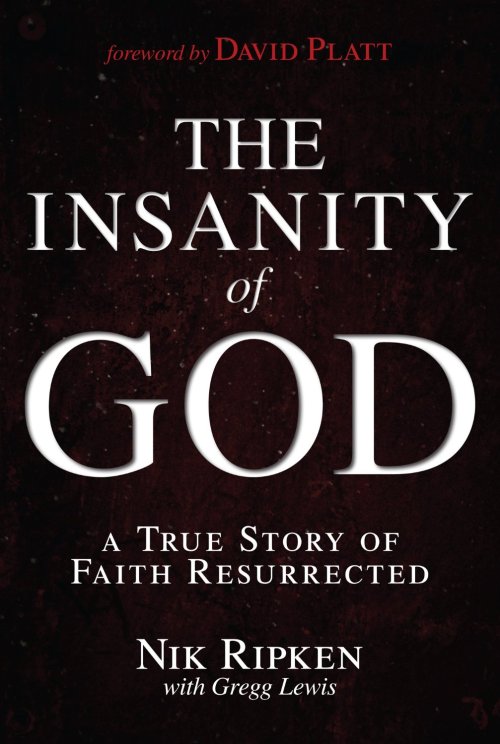
Our pastor had us read The Insanity of God by Nik Ripken (pseudonym) as a church, and this Sunday (the day of this posting), we will come together as a church and view the movie by the same title.

In the book, Nik Ripken tells of how he and his family served as missionaries in war-torn Somalia during the time of that country’s civil war from which it has yet to recover. Nik and his wife spent about twenty years serving in that place, and due to the oppressive Muslim influence, and the death of their 16-year-old son, they returned to the United States defeated with nothing to show for the effort they poured into that place. Sharing Christ openly invited the death penalty, and the Muslims would immediately kill anyone who converted to Christianity. The small minority of Christians that managed to survive fled the country because remaining there meant sure death.

One wonders why anyone would risk his life and the wellbeing of his family to serve in a God-forsaken place like Somalia. In that place, those that assume power are unconcerned about the welfare of their own people. They have no regard for the sanctity of life. They have no compassion for their own people. When help comes from outside their borders, they view the relief workers with suspicion, often taking the help meant for suffering people for themselves. Why would anyone put himself or herself in that position knowing that they cannot share their faith with the people and knowing that the “help” they provide might only extend someone’s life for maybe just another week or so? It seems a hopeless and pointless enterprise.

Nik took Matthew 28:19 as a personal calling from God to “Go!” “Go ye therefore, and teach all nations, baptizing them in the name of the Father, and of the Son, and of the Holy Ghost” (Matthew 28:19, emphasis mine). This verse known as the “Great Commission,” was given by the Lord Jesus Christ to His disciples—not just the twelve apostles, but to ALL of His disciples. It applies equally to every individual that names the Name of Christ. Albert Barns in his commentary on this verse says:

“Because” all power is mine [referring to v. 18], go! I [Jesus] can defend you. The world is placed under my control. It is redeemed. It is given me in promise by my Father, as the purchase of my death. Though you are weak, yet I am strong! Though you will encounter many troubles and dangers, yet I can defend you! Though you die, yet I live, and the work shall be accomplished!”

Nik and his wife took this commission to heart, and gave up all their worldly goods to go minister to people who showed little appreciation for their sacrifice and would just as soon kill them except for the fact that they were meeting real needs. I deeply admire their courage and their willingness to obey what I believe, at least for them, was a real call of God. However, in reading their story, one might mistakenly conclude that Jesus’ Great Commission means that we are all to pull up stakes and “go” to all nations. In other words, we are all obligated to be foreign missionaries. That is not at all what Jesus said.

The imperative in Jesus’ command is to “make disciples” not to “go.” Poreuthétes (go) is an aorist, passive, participle, masculine, plural, nominative verb. (I apologize for the Greek parsing, but this is important.) The fact that it is an aorist verb is not too special; it only means that it is a definite action. However, the fact that the verb is in the passive voice indicates that it is a consequence of something else. That it is participle indicates a continuing action (“going”). The verb is a plural nominative meaning that Jesus addressed all disciples, not just certain individuals. If Jesus spoke Texan, He might have said, “all y’all.” Therefore, the intended meaning here is, “As you (plural) are going, make disciples…” The command, i.e. the imperative, is to “make disciples,” and it applies to all followers of Jesus, not just missionaries.

The Ripkens felt God’s call to “go” to Somalia based on this verse, but the verse is not a call to all Christians to “go” somewhere to make disciples. All Christians are called to make disciples “as you are going”—at school, at work, at the supermarket, in your neighborhood. In your everyday walk of life, you are to “make disciples.”

If you claim Jesus as your Lord and Savior, you have no choice in the matter, unless you choose to rebel against Christ. Before He ascending unto heaven, Jesus said, “…ye shall be witnesses unto me both in Jerusalem, and in all Judaea, and in Samaria, and unto the uttermost part of the earth” (Acts 1:8, emphasis mine). That is a declarative statement; it is not a matter of choice. If we say we are followers of Jesus, we are witnesses, for better or worse. Our lives testify to Christ. Do our actions match our words? Perhaps we withhold our words because we know our actions betray them.

No doubt, one of the tactics Satan uses to silence us is to make us feel unworthy. Let’s face it, no one of us has lived or lives a perfectly sinless life, although, that is certainly a worthy goal for which to strive (and it can be achieved by relying daily on the Holy Spirit). The point is that we are witnesses for Christ. Satan is a conquered adversary, and besides, “Ye are of God, little children, and have overcome them: because greater is he that is in you, than he that is in the world” (1 John 4:4, emphasis mine). Satan has no power over us, unless we let him.

In the last half of The Insanity of God, Nik Ripken interviews hundreds of persecuted Christians in Russia, Ukraine, China and the Middle East. These Christians suffer horrific persecution—beatings, imprisonment, economic deprivation, etc. Through it all, they only ask of us that we pray for them, not that they should be kept from persecution, but that they remain faithful witnesses in persecution. What persecution do we, here in America, suffer because of our faith? Is being laughed at too horrible? Would losing a relationship be too much to take? What about being fired for sharing your faith with a coworker? Is that too great a risk? Nik noted that perhaps the reason we do not see persecution here in America is that Satan does not need to silence us. We do a good job of that on our own.

“As you are going, make disciples.” We are witnesses for Christ. We are either good witnesses, or we are poor witnesses; but we are witnesses nonetheless. “But sanctify the Lord God in your hearts: and be ready always to give an answer to every man that asketh you a reason of the hope that is in you with meekness and fear” (1 Peter 3:15, emphasis mine).


2 Comments

Filed under Apologetics, Book Reviews, Christianity, Evangelism, Religion

Noah

Make thee an ark of gopher wood; rooms shalt thou make in the ark, and shalt pitch it within and without with pitch. (Genesis 6:14)

Thanks to a host of well-meaning Christian movie critics, I find my enthusiasm for seeing the movie “Noah” severely waning. Thanks for all the spoilers! It goes without saying that any Bible movie coming out of Hollywood will fall woefully short on accuracy. Face it; these people are script writers that deal in fantasy, not theologians or Bible scholars who are intimate with the Word of God. Not to mention that God chose not to provide us with every detail that took place within this 121-year period of history. The Flood account takes up only four short chapters in the Bible. There is not enough material there to make a 2-hour and 18-minute movie, so Hollywood has to fill in the blanks according to their own imaginations – that being Director and Co-writer, Darren Aronofsky, an atheist, and staring actor, Russell Crowe who is no friend of Christians.

I would hope that thoughtful Christians would take that into consideration. It’s a movie. It is designed to entertain and to make money for the producers and for the theaters on the sale of popcorn and soda. Certainly Christians (or anyone else for that matter) should not take it as a serious portrayal of a biblical narrative. That said, it does get some things right. The Ark is of the correct biblical dimensions. The Flood is global. The Flood is God’s judgment for man’s sin. The Flood is not just the result of rain, but also resulted from the bursting of the “fountains of the deep.” Of course, the movie gets more things wrong than it gets things right. One glaring problem that I found from viewing movie trailers is that the Ark is of a crude construction. It looks like a huge log cabin that could hardly withstand the tsunami-like waves associated with the Great Flood. This image of the Ark stems from evolutionary thinking that assumes ancient man was technologically inept, but that is hardly the picture the Bible presents of pre-flood man: “Jubal: he was the father of all such as handle the harp and organ … Tubalcain, an instructer of every artificer in brass and iron” (Genesis 4:21-22). Not long after Noah and his family came out of the Ark, the Tower of Babel was built (Genesis 11), and after the division of languages, the Egyptians started building their pyramids. It seems implausible to me that Noah would have built anything less than a sturdy, seaworthy vessel, and besides, he had 120 years to work on it. The spoilers also point out that the movie Ark has several doors, while the biblical Ark has only one (Genesis 6:16).

The spoilers point out many other problems with the film. For instance, creation is a result of the big bang. Life emerges out of the waters. The movie implies that Adam and Eve come from apes. Noah seems to care more about animals and the planet than he does about humans including his own family. The sin of mankind is their abuse of the environment and mankind is portrayed as blight upon the earth. The Creator (Who is never referred to as “God”) is impersonal and vindictive. It is implied that God instructs Noah to kill his own granddaughters (born on the Ark, which has no biblical basis), and when he is unable to do so, Noah regards himself as a failure. More could be said concerning the failure of this movie to present a true rendition of the biblical text, however the critics, above all else, decry the film’s purposeful distortion of Scripture. For the low information viewer, the question remains, who was Noah? What was Noah really like?

To answer those questions, one must go to the source, the Bible. Noah is of the godly line of Seth, Adam’s third son named in the Bible (Genesis 4:25). There very well could have been others, but one must remember that one of the purposes of the biblical genealogies is to point to Christ. Noah’s father was Lamech, and his grandfather was Methuselah, whose name means something like “when he dies, judgment.” Methuselah holds the record for longevity; he lived to be 969 years old, and he died the year that the Flood came.

Noah was around 480 years old when God selected him to build the Ark. At that time, “the LORD said, My spirit shall not always strive with man, for that he also is flesh: yet his days shall be an hundred and twenty years” (Genesis 6:3, emphasis added). So Noah was given 120 years to build the Ark. During that time, he preached to the people trying to get them to repent of their sin. Peter speaking of the people of that time “Which sometime were disobedient, when once the longsuffering of God waited in the days of Noah, while the ark was a preparing, wherein few, that is, eight souls were saved by water” (1 Peter 3:20, emphasis added). “For if God spared not the angels that sinned, but cast them down to hell, and delivered them into chains of darkness, to be reserved unto judgment; And spared not the old world, but saved Noah the eighth person, a preacher of righteousness, bringing in the flood upon the world of the ungodly” (2 Peter 2:4-5, emphasis added). When Noah and his family (Mrs. Noah, Noah’s three sons and his three daughters-in-law) entered the Ark, Noah was 600 years old (Genesis 7:11).

The reason God brought the Flood was not for ecological reasons as the Gaia-worshiping makers of the “Noah” movie suggest. Second Peter 2:5 (above) talks about God not sparing “the angels that sinned,” and then closely follows with a description of Noah as “a preacher of righteousness.” It must be understood that the angels who rebelled against God along with Lucifer (Satan), are excluded from God’s plan of salvation. So Noah’s preaching was not to fallen angels (demons), but rather to humans who had been enticed to sin by these angels. These people would have been eligible for salvation had they repented. But the mention of the angels is interesting. Some scholars believe that these angels in some form or another mated with humans and created a race of super-humans. This is concluded from the first four verses of Genesis 6. “And it came to pass, when men began to multiply on the face of the earth, and daughters were born unto them, That the sons of God saw the daughters of men that they were fair; and they took them wives of all which they chose … There were giants in the earth in those days; and also after that, when the sons of God came in unto the daughters of men, and they bare children to them, the same became mighty men which were of old, men of renown. (Genesis 6:1-2, emphasis added). The Hebrew word for “sons of God” in verses 2 and 4 is bene ĕlôhı̂ym and it is always used when referring to angels in the Old Testament. The Hebrew word translated “giants” here is nephı̂ylim and it means “fallen ones.” Of course, there are those who will say that angels do not have sex and others who will suggest that angels (except for God’s angels) cannot take human form. I will not go to war over that, but whatever took place was sufficient to corrupt mankind to the point that God was willing to destroy His entire creation with the exception of those who made it on the Ark. “And GOD saw that the wickedness of man was great in the earth, and that every imagination of the thoughts of his heart was only evil continually. And it repented the LORD that he had made man on the earth, and it grieved him at his heart … The earth also was corrupt before God, and the earth was filled with violence. And God looked upon the earth, and, behold, it was corrupt; for all flesh had corrupted his way upon the earth.” (Genesis 6:5-6, 11-12, emphasis added). Imagine the degradation and depravity to which mankind had sunk that the great loving heart of God could be so grieved as to destroy His beautiful creation! This had nothing to do with littering the planet.

“But Noah found grace in the eyes of the LORD” (Genesis 6:8). In Noah and his family was the human race preserved. Noah was given instruction for building the Ark. It was to be 300 cubits long, 50 cubits wide and 30 cubits high (Genesis 6:15). Using an 18-inch cubit, that made the Ark 450 feet long, 75 feet wide, and 45 feet high. The Ark was the length of one and one-half football fields and of sufficient capacity to hold 522 railroad cattle cars. The Ark was to have three floors (stories or decks, Genesis 6:16) and “rooms” (Hebrew qênim meaning “nests”) for the animals (Genesis 6:14). The Ark also required a ventilation and lighting system which the Bible describes as a “window” (Genesis 6:16). God instructed Noah to bring enough food for his family and for all of the animals (Genesis 6:20) enough to last them for a year (Genesis 7:14). In order to carry out God’s instructions, Noah had to be an engineer, architect/designer, ship builder, zoologist and other duties as assigned. Noah was no dummy!

The rains came, the crust of the earth broke open allowing superheated, subterranean water to spew into the atmosphere (Genesis 7:11), and the whole earth was covered in water more than 22 feet above the tallest hills/mountains (Genesis 7:20). “And all flesh died that moved upon the earth, both of fowl, and of cattle, and of beast, and of every creeping thing that creepeth upon the earth, and every man: All in whose nostrils was the breath of life, of all that was in the dry land, died. And every living substance was destroyed which was upon the face of the ground, both man, and cattle, and the creeping things, and the fowl of the heaven; and they were destroyed from the earth: and Noah only remained alive, and they that were with him in the ark” (Genesis 7:21-23, emphasis added). The all-inclusive description of the death wrought by the Flood precludes a small local event as some have suggested.

After 371 days the waters subsided, and Noah was instructed to come out of the Ark (Genesis 8:15-16). Noah released all of the animals, and the first thing he did was to offer a sacrifice of thanksgiving to God (Genesis 8:20-21). God promised never again to destroy the earth with water, and He promised to maintain nature in a stable state (Genesis 8:21); but God was under no delusion that man would remain faithful, “for the imagination of man’s heart is evil from his youth” (v. 21). To Noah and his family and thereby to us, God reestablished man’s Dominion Mandate: “Be fruitful, and multiply, and replenish the earth … And you, be ye fruitful, and multiply; bring forth abundantly in the earth, and multiply therein.” (Genesis 9:1, 7). He also gave to man the authority to render justice. “And surely your blood of your lives will I require; at the hand of every beast will I require it, and at the hand of man; at the hand of every man’s brother will I require the life of man. Whoso sheddeth man’s blood, by man shall his blood be shed: for in the image of God made he man” (Genesis 9:5-6, emphasis added).

This is the true story of Noah. Now, feel free to go enjoy the false story of Noah, just remember that it is just a movie and not the true account. The real historical account is in the Bible. Read it, and know it before you go see “Noah” the movie.

4 Comments

Filed under Apologetics, Atheism, Book Reviews, Christianity, Creation, Current Events, Death, End Times, Evolution, Geology, Origins, Religion, Salvation, Theology