Category Archives: Christianity

Almighty Creator in Infant Form

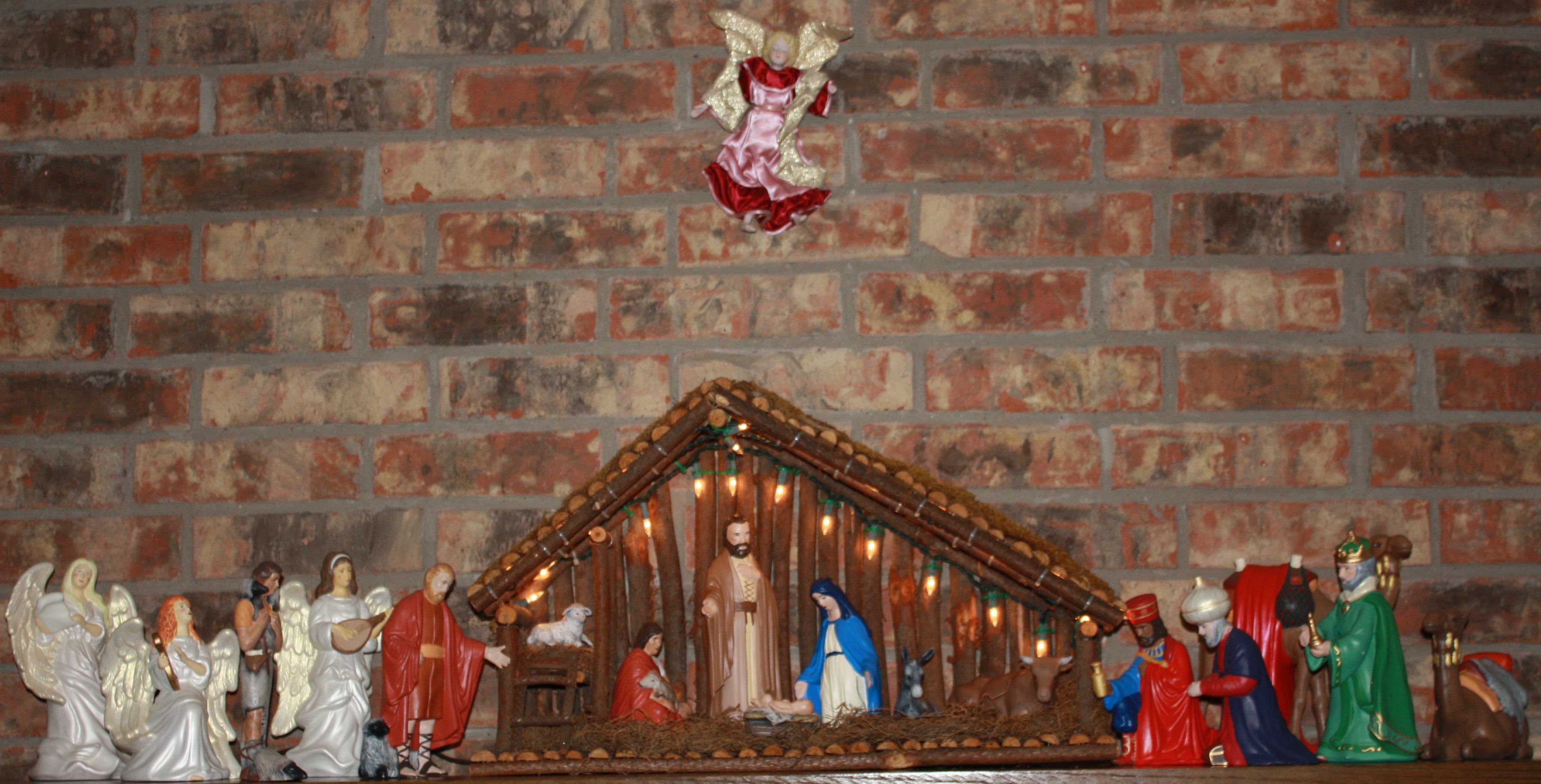
This ceramic Nativity was hand-painted by the author and has been the main feature for household decor for over 30 years.

This ceramic Nativity set was hand-painted by the author and has been the main feature for our household decor for over 30 years.

In the beginning was the Word, and the Word was with God, and the Word was God. (John 1:1)

This time of year we expect to see the story of the birth of Christ played out in humble means by children in small churches, or by freezing “actors” in “living” nativity scenes, or in glitzy performances by mega church choirs.  Even the Radio City Rockettes present the Christmas story at the end of every performance.  All of these presentations begin with the typical scene of Mary, Joseph, and the baby Jesus in a stable surrounded by farm animals, and conclude with an unbiblical menagerie of shepherds, wise men and angels all worshiping the Christ child.

While this serves as a sweet reminder to get one focused on the true meaning of Christmas, it somehow misses the awesome significance of this event.  The Word, the Logos, the revealed Wisdom of God, was manifested in a tiny, helpless infant.  This now revealed Word, our verse tells us, existed with God at the beginning of time (John 1:2), and He was, in fact, very God.  “All things were made by him; and without him was not any thing made that was made” (John 1:3).  “Who, being in the form of God, thought it not robbery to be equal with God:  But made himself of no reputation, and took upon him the form of a servant, and was made in the likeness of men” (Philippians 2:6-7).  And so, “the Word was made flesh” (John 1:14) in the form of a helpless baby – a baby that, though He existed in eternity past, entered and grew in His mother’s womb from a zygote to a fetus that had to fight His way through the birth canal.  God came as a baby that had to be nursed at His mother’s breast.  A baby that had to be carried everywhere He went.  A baby that had to have His diapers changed.  This was God in human form – the Creator of heaven and earth cloaked in human flesh as a tiny babe. Is that not incredible!

The idea of it all is inconceivable!  Yet, this was His plan from the beginning, so that “as many as received him, to them gave he power to become the sons of God, even to them that believe on his name” (John 1:12).  “And being found in fashion as a man, he humbled himself, and became obedient unto death, even the death of the cross” (Philippians 2:8).  That is the message that is often overshadowed in the scenes and sounds of the season.

The lyrics to Mark Lowry’s song, “Mary Did You Know” so poignantly express the significance of this blessed event:

Mary did you know that your baby boy is Lord of all creation?
Mary did you know that your baby boy will one day rule the nations?
Did you know that your baby boy is heaven’s perfect Lamb?
This sleeping child you’re holding is the great I am.
 

This Christmas, try to think beyond the nativity scene. See the babe for the God He truly is, and be awed that He did this for you.

1 Comment

Filed under Apologetics, Christianity, Christmas, Creation, Gospel, Origins, Religion, Salvation, Theology

Joseph: A Worthy Model

forchristandculture's avatarFor Christ and Culture

by Joe Wooddell

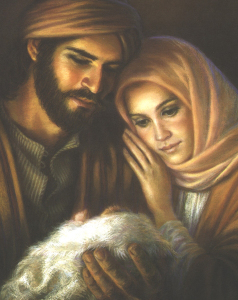
josephChristmas reminds us of baby Jesus, of course, but we also think of his mother Mary. One character we sometimes forget, however, is Jesus’ earthly father Joseph, but we do so to our detriment. There is much we can learn from his example in Matthew 1 and 2.

In Matthew 1 we read how Joseph is both righteous and compassionate. He’s already engaged, and Mary turns up pregnant! What would you do if you knew the baby wasn’t yours? He’s righteous, so he can’t marry her and bring shame to himself, admitting guilt when he wasn’t really guilty. But he’s also compassionate – he doesn’t want to disgrace her and cause her more trouble than necessary. So he decides to “send her away secretly” (v.19; NASB). Doing so will protect his righteous name (Prov. 22:1, “a good name is more desirable than great riches”; NIV), but it…

View original post 518 more words

Comments Off on Joseph: A Worthy Model

Filed under Christianity, Christmas, Religion

Clothing In Heaven

King Jesus 2

And white robes were given unto every one of them; (Revelation 6:11)

Recently we were reading our daily devotional Days of Praise. The devotional for that day was entitled “Clothing.” In that article, the author, John D. Morris, Ph.D., points out the fact that Adam and Eve were naked when they were created, and only after they sinned did their nakedness become apparent to them. The last book of the Bible informs us that we will be clothed with white robes in heaven – that is, those of us who go to heaven. So the question came up, why are we not naked in heaven the way God created us in the beginning? The Bible tells us that we will be clothed “in fine linen, clean and white,” but it makes no comment about why we are clothed rather than naked. That made me think.

When Adam and Eve sinned, God had to clothe them in skins to cover their nakedness (Genesis 3:21). Someone suggested that before they sinned, Adam and Eve were “clothed” in light. The Hebrew word for light is ‘ôr (אור). This reminds me of the time when Moses was in the presence of God for forty days, and his face shone with a light so that the people were afraid of him. He had to veil his face (Exodus 34:29-35) so that the people would not fear him. Then there was the time at the Mount of Transfiguration when Moses and Elijah appeared with Jesus, and all of them glowed (Matthew 17:1-2). Adam and Eve may have had a similar glow about them. Then when they sinned, they lost that glow so that their nakedness became apparent to them (Genesis 3:7). God then covered them with skins. The Hebrew word for skin is ‛ôr (עור). There may be a play on words here. Note that both Hebrew words are pronounced “or,” but they have different spellings in Hebrew. Before they sinned, they were clothed in אור (light), but after they sinned, God clothed them in עור (skin).

That may be a part of it, but what is of greater importance is that the skins were a covering for their nakedness which represented their sin. The idea of covering conveys the meaning of “atonement.” Throughout Scripture the shedding of innocent blood has always been the requirement for making atonement or the covering of sin.

For the life of the flesh is in the blood: and I have given it to you upon the altar to make an atonement for your souls: for it is the blood that maketh an atonement for the soul. (Leviticus 17:11, emphasis mine)

The robes given to the saints in heaven are made “white in the blood of the Lamb” (Revelation 7:14). Once again, the innocent blood of Jesus Christ, the Lamb of God (John 1:29), was shed, once for all, to cover our sin.

For if the blood of bulls and of goats, and the ashes of an heifer sprinkling the unclean, sanctifieth to the purifying of the flesh: How much more shall the blood of Christ, who through the eternal Spirit offered himself without spot to God, purge your conscience from dead works to serve the living God? (Hebrews 9:13-14, emphasis mine)

Perhaps this is why we wear robes in heaven. The robes will remind us for eternity that Jesus shed His blood to cover (atone for) our sin. Our clothing in heaven is His righteousness, not our own. “He that overcometh, the same shall be clothed in white raiment; and I [Jesus] will not blot out his name out of the book of life, but I will confess his name before my Father, and before his angels” (Revelation 3:5, emphasis mine). “For in this we groan, earnestly desiring to be clothed upon with our house which is from heaven: If so be that being clothed we shall not be found naked” (2 Corinthians 5:2-3).

Comments Off on Clothing In Heaven

Filed under Apologetics, Christianity, Creation, Heaven, Religion, Salvation, Theology

It’s All Good!

OLYMPUS DIGITAL CAMERA

And we know that all things work together for good to them that love God, to them who are the called according to his purpose.  (Romans 8:28)

 There are many passages of Scripture that I count as favorites like Genesis 1:1, “In the beginning God created the heaven and the earth,” and with it John 1:1-3 “In the beginning was the Word, and the Word was with God, and the Word was God. The same was in the beginning with God. All things were made by him; and without him was not any thing made that was made.” Both are foundational verses that identify who God is. Wrapped up in those words is the reason why we, as creatures, owe our allegiance to God as our Creator. Without Him, nothing that we enjoy, including life itself, would exist. Another favorite is John 3:16, “For God so loved the world, that he gave his only begotten Son, that whosoever believeth in him should not perish, but have everlasting life.” In light of His creative power that brought the universe into existence simply with His spoken word, it is incomprehensible to imagine that the all-powerful Creator could love His creation so much that He would condescend to the point of death on a cross to keep us from “perishing”! Then, as we trust Him, He promises to strengthen and to sustain us. “But they that wait upon the LORD shall renew their strength; they shall mount up with wings as eagles; they shall run, and not be weary; and they shall walk, and not faint” (Isaiah 40:21). And Jesus invites, “Come unto me, all ye that labour and are heavy laden, and I will give you rest” (Matthew 11:28). Then there are the promises of eternal life like, “In my Father’s house are many mansions: if it were not so, I would have told you. I go to prepare a place for you. And if I go and prepare a place for you, I will come again, and receive you unto myself; that where I am, there ye may be also” (John 14:2-3).

But perhaps my all-time favorite verse is the one above, Romans 8:28, “And we know that all things work together for good to them that love God, to them who are the called according to his purpose.” This verse is often misunderstood because it is quoted out of context. The verse does not imply that everything will work out to our liking or that because we trust in God that nothing will ever go wrong in our lives – no loss of income, no loss of health, no broken relationships, etc. Quite to the contrary, the Bible teaches that we will face trouble and trials. In fact, Jesus said, “In the world ye shall have tribulation: but be of good cheer; I have overcome the world” (John 16:33). Paul confirms this fact at the end of this chapter: “Who shall separate us from the love of Christ? shall tribulation, or distress, or persecution, or famine, or nakedness, or peril, or sword? As it is written, For thy sake we are killed all the day long; we are accounted as sheep for the slaughter” (Romans 8:35-36). The list of trials and persecution given here are as certain as Christ’s love for His children. So, Romans 8:28 is not my favorite because it paints a rosy picture. Indeed, it goes beyond a bed of roses.

What does Romans 8:28 really say? First of all it says that we “see” or “perceive” – the Greek word eidō translated “know.” In other words, this is something that we can observe; it is not a matter of “blind faith.” This is a fact that we can experience. “All things” – the Greek word panta is all-inclusive. All things “work together” – the Greek word sunergeō means to “cooperate” – for “good” – Greek agathon meaning “benefit.” So all things – good or bad – cooperate to the benefit – and here is the qualifier – “to them that love God.” In the Greek syntax priority is given to the qualifier. A strict rendering of the Greek to English would read “And we perceive that to them that love God, all things cooperate to their benefit.” So this verse is not universally applicable to all people – only those that love God. “Love” is the Greek word agapaō which is an unconditional love, the kind of love that God expressed to the world in sending His Son Jesus to die for our sins (John 3:16). To further focus the qualification, all things cooperate together for the benefit of “those who are the called according to His purpose.”

What is “His purpose”? That is explained in the verse that follows: “For whom he did foreknow, he also did predestinate to be conformed to the image of his Son, that he might be the firstborn among many brethren” (Romans 8:29, emphasis mine). God determined, before time began that man would be made in His image (Genesis 1:26). That image was marred by sin, but God’s purpose has never changed. He has determined that His “new creation” (2 Corinthians 5:17) will be “conformed to the image of his Son.” It should be of no surprise that Paul later exhorts, “be not conformed to this world: but be ye transformed by the renewing of your mind, that ye may prove what is that good, and acceptable, and perfect, will of God” (Romans 12:2, emphasis mine).

So what have we learned? Those that are called by God “according to His purpose,” and who love God unconditionally, will experience (will see/know) the blessings of God even in the face of abject adversity. These are they that can say, even in the worst of circumstances, “It’s all good!”

Comments Off on It’s All Good!

Filed under Apologetics, Christianity, Gospel, Religion, Theology

Who’s In Charge?

Yea, all kings shall fall down before him: all nations shall serve him.  (Psalm 72:11)

The 2014 elections are history now. The Republicans are celebrating the conquest of the Upper House and the ousting of the evil Majority Leader, Senator Harry Reid of Nevada. They are exuberant after gaining control over both houses of Congress. Now we can really get things done! Me? I am not so sure. I participated in “early voting,” and I do not mind admitting that I voted a straight Republican ticket. Not that I believe Republicans are the salve for all our ills, but I simply cannot bring myself to vote for a Democrat under any circumstances. As I drew near the entrance of the polling place, I was approached by a young woman holding a sign who petitioned me to vote for her. I asked, “R or D?” She answered, “D,” to which I responded, “That’s too bad.” I embarrassed my wife, who thought I had been rude, but I only spoke truth, and I wasn’t ugly or hateful about it, just matter of fact. “D” to me has become repugnant and synonymous with Demented, Deranged, Deluded, Dubious, Destructive, Deleterious, etc. I do not mean to offend my Democrat friends, but, if you are a “D,” you really should repent. (I say that with all due love and respect.)

Having said that, I do not place a lot of hope in the Republicans either. I like them only slightly better because, for the most part, they still support the First and Second Amendments and the Bill of Rights in general. They are largely pro-life, and they favor traditional (male/female) marriage and family values. But beyond that, the distinction between R and D begin to blur. In many ways they are indistinguishable from one another. Yes, I know that we have several solid conservatives in the Republican Party, and I am encouraged by them; but they are not in the majority, and are often disdained by the Establishment Republicans. Still, they give voice to conservative values, and that gives me a dull glimmer of hope. It will be interesting to see how this new Republican Congress will act and how President Obama will react. Time will tell.

The Bible teaches that it is God who establishes and dismantles governments. Paul tells us that “there is no power but of God: the powers that be are ordained of God” (Romans 13:1). “And [God] changeth the times and the seasons: he removeth kings, and setteth up kings” (Daniel 2:21, emphasis added).  To the Babylonian king, Daniel said, “Thou, O king [Nebuchadnezzar], art a king of kings: for the God of heaven hath given thee a kingdom, power, and strength, and glory” (Daniel 2:37, emphasis added). “The king answered unto Daniel, and said, Of a truth it is, that your God is a God of gods, and a Lord of kings, and a revealer of secrets, seeing thou couldest reveal this secret” (Daniel 2:47, emphasis added). “The king’s heart is in the hand of the LORD, as the rivers of water: he turneth it whithersoever he will” (Proverbs  21:1, emphasis added).

 We like to think we are in control, but the Bible is clear as to who is really in charge. “The LORD is King for ever and ever” (Psalm 10:16). However, that does not diminish our responsibility.  “I exhort therefore, that, first of all, supplications, prayers, intercessions, and giving of thanks, be made for all men; For kings, and for all that are in authority; that we may lead a quiet and peaceable life in all godliness and honesty” (1 Timothy 2:1-2, emphasis added). While God is ultimately in control, He has given the stewardship of our nation to “We the People.” In all of history, there has never existed a nation like the United States of America, whose government has been placed in the hands of its citizens. Therefore, while we still are able, we should continue to pray for our leaders and exercise our constitutional rights as citizens to elect leaders who hold and exercise godly principles. (By the way, one does not necessarily have to be a Christian to hold godly principles, but it certainly helps.) At the same time we should maintain our national motto – In God We Trust. Leaders will disappoint us. Our nation will ultimately fail, but God remains faithful forever. We can trust that God is in charge.

3 Comments

Filed under Christianity, Current Events, Politics, Theology