Category Archives: Gospel

Aliens?

Aliens

And every creature which is in heaven, and on the earth, and under the earth, and such as are in the sea, and all that are in them, heard I saying, Blessing, and honour, and glory, and power, be unto him that sitteth upon the throne, and unto the Lamb for ever and ever. (Revelation 5:13)

I received an email this week from someone who thought we were limiting God’s creative power by suggesting that there is no other life anywhere in the universe outside of what is found here on earth. I assume she was referring to other human-like life.

It is understandable how someone could arrive at the conclusion that other “races” (to differentiate between human and human-like life) could exist elsewhere in the universe. After all, the universe is immense, and we are told that at it is arrogant for us to presume that we are the only ones. Then we have evolutionary/atheistic scientists that incessantly probe the night skies “listening” for “intelligent” communications from other worlds in the tax-funded Search for Extra-Terrestrial Intelligence (SETI). If that is not enough, our “science” channels are filled with programs about UFOs or Ancient Aliens. That these programs are featured in the “science” channels lends an air of credibility to them, so that many – even the “elect” – are swayed by them. But all of these have a common thread – evolution. For decades now, the propaganda of evolution has been forced down the throats of otherwise intelligent people – starting in kindergarten – so that our society has been thoroughly indoctrinated in this unsubstantiated “theory.” As the saying goes, “Tell a lie long enough, and people will believe it.” Evolution teaches that life sprang from non-life on earth 3.5 to 4 billion years ago – by mere accident – and if it can happen here, surely it could happen elsewhere in the universe. That might be true, if evolution is true, but evolution has consistently failed the test of scientific scrutiny; even avid evolutionists will admit to this. (I could offer quotes, but that would make this article too long.)

So, back to the question of other “races” of “people” elsewhere in the universe. We are in agreement that God is certainly capable of having created life elsewhere in His universe, if He chose to do so. We cannot say with certainty that He did not. However, if He did create life elsewhere, that would raise some serious theological issues for us here on planet Earth.

God created us in His image (Genesis 1:26-27). Man sinned (Genesis 3), and brought the curse upon ALL of creation (Romans 8:21-22). God came and put on the “image” of man (Philippians 2:5-7) in order to pay the penalty (Romans 6:23) for our sin thereby redeeming us (Galatians 4:5; Titus 2:14) and all of His creation (Revelation 5:13).

Now, if there are other human-like creatures (Vulcans, Klingons, Romulans, etc.), somewhere else in the universe, it is very likely that they all sinned as well – remember, Adam was only given one rule to obey, and he chose to disobey. So what is to say those other races fared any better? That being the case, it would mean that Jesus would have to die separately for each one of those races of “people,” but that is in conflict with Scripture. The Bible tells us that Jesus died once for all (Romans 5:17-19; 1 Corinthians 15:22; Hebrews 10:10). So, according to Scripture, Jesus came to die for and redeem man-kind, not aliens.

Yes, God is certainly capable of creating other races of people, but we cannot substantiate that from Scripture. To insist that other races “might” exist “out there” is speculative and arbitrary. We need to stay with what Scripture clearly reveals to us, and it says nothing about aliens from “a galaxy far, far away.” Even though God could have created them (His omnipotence is unlimited), we need not worry about E.T.

3 Comments

Filed under Apologetics, Atheism, Christianity, Creation, Current Events, End Times, Evolution, Gospel, Religion, Salvation, Theology, UFOs

Practical Atheism

people-jumping-off-cliff


If ye love me, keep my commandments. (John 14:15)

It could be argued that there are no true atheists. The Bible says that “that which may be known of God is manifest in them; for God hath shewed it unto them” (Romans 1:19), so they are, in fact, not ignorant of the existence of God. Instead, they “hold [down or suppress] the truth in unrighteousness” (Romans 1:18). According to a recent poll reported in the Washington Post, August 13, 2012, only five percent (5%) of Americans profess to be atheists. That represents a rise from one percent (1%), but it could hardly be called epidemic.

The same poll noted a decline of those who call themselves “religious” from 73% to 60%.  “Religious” is a rather nebulous term that could range from strict fundamental Christianity to navel-gazing new age mysticism. In an article that asks, “How Many Americans are Evangelical Christians? Born-Again Christians?” Bradley Wright points out that “Currently Evangelical Christianity in the US is at about its 40-year average, with 23%-24% of Americans affiliating with an Evangelical church or denomination.” Of course, just being affiliated with an evangelical church does not necessarily mean that the adherent is “born again.” Under this classification, Wright noted that 34% of Americans claim to be born again, and that includes mainline Protestants, and Catholics besides Evangelicals. Even here, the numbers may be misleading because many who claim to be “born again” really have no idea what that means. Probably the percentage of truly born again believers in America is less than 20%, and I base that on personal observation without any scientific proof.

My observation informs me that there exist many “practical atheists” out there. Many are in our churches and are familiar with church “lingo” so that they easily “pass” as genuine Christians. Most practical atheists, however, are either “non-religious,” that is, they profess to believe in God, but do not affiliate with any organized religion, or they are simply “spiritual” holding to one or more varieties of pantheism, and they will even “allow” for a “supreme being.” None of these would deny the existence of God outright, but they live their lives as if there is no God. Their egocentric lives are a series of choices based on what is expedient for them at the time. They never consider consulting God on a matter, but rather act on what suits them at the moment. To someone like this, James says, “Go to now, ye that say, [Today] or [tomorrow] we will go into such a city, and continue there a year, and buy and sell, and get gain: Whereas ye know not what shall be on the morrow. For what is your life? It is even a vapour, that appeareth for a little time, and then vanisheth away. For that ye ought to say, If the Lord will, we shall live, and do this, or that” (James 4:13-15).  To ask God’s direction in any plan would not even occur to a practical atheist.

A practical atheist thinks that all his possessions are his because of his own effort, or in the case of him who lives off subsidies, he believes that somehow these things are owed to him. Certainly Paul’s instruction to “In [everything] give thanks: for this is the will of God in Christ Jesus concerning you” (1 Thessalonians 5:18) would make little sense. The practical atheist gives low priority to “Not forsaking the assembling of ourselves together, as the manner of some is” (Hebrews 10:25). Even if he is a member of a church, often other activities will take priority over attending the worship service and Bible study on Sundays. The practical atheist has no need to “Pray without ceasing” (1 Thessalonians 5:17) or to “Study to shew thyself approved unto God, a workman that needeth not to be ashamed, rightly dividing the word of truth. (2 Timothy 2:15). For the practical atheist, personal prayer and Bible study are of little or no value. The practical atheist lives his life as though his future is guaranteed. He is oblivious to Jesus’ warning: “Surely, I come quickly” (Revelation 22:20).

Practical atheists are not necessarily “bad” people. Jesus told of a rich man that died and went to hell (Luke 16:19-32). Jesus’ description of the man was not necessarily an evil report; albeit he was self-centered and self-absorbed, and oblivious to the needs of Lazarus who begged outside his gates. The rich man went to hell because he was a practical atheist. He lived his life as if God did not exist even though he was probably very religious in practice, yet even his religious practice was all about him, and “God” was just part of the nomenclature of his religious life.

The practical atheist may profess a superficial belief in God, but he lives his life as if God does not exist, and as if he is not accountable to Him in any way. As Christians, we should strive to live our lives consistent with our profession and the teachings of God’s Word, and not as practical atheists.

6 Comments

Filed under Apologetics, Atheism, Christianity, End Times, Gospel, Religion, Salvation, Theology

Seeing, They See Not

ConversionStPaul

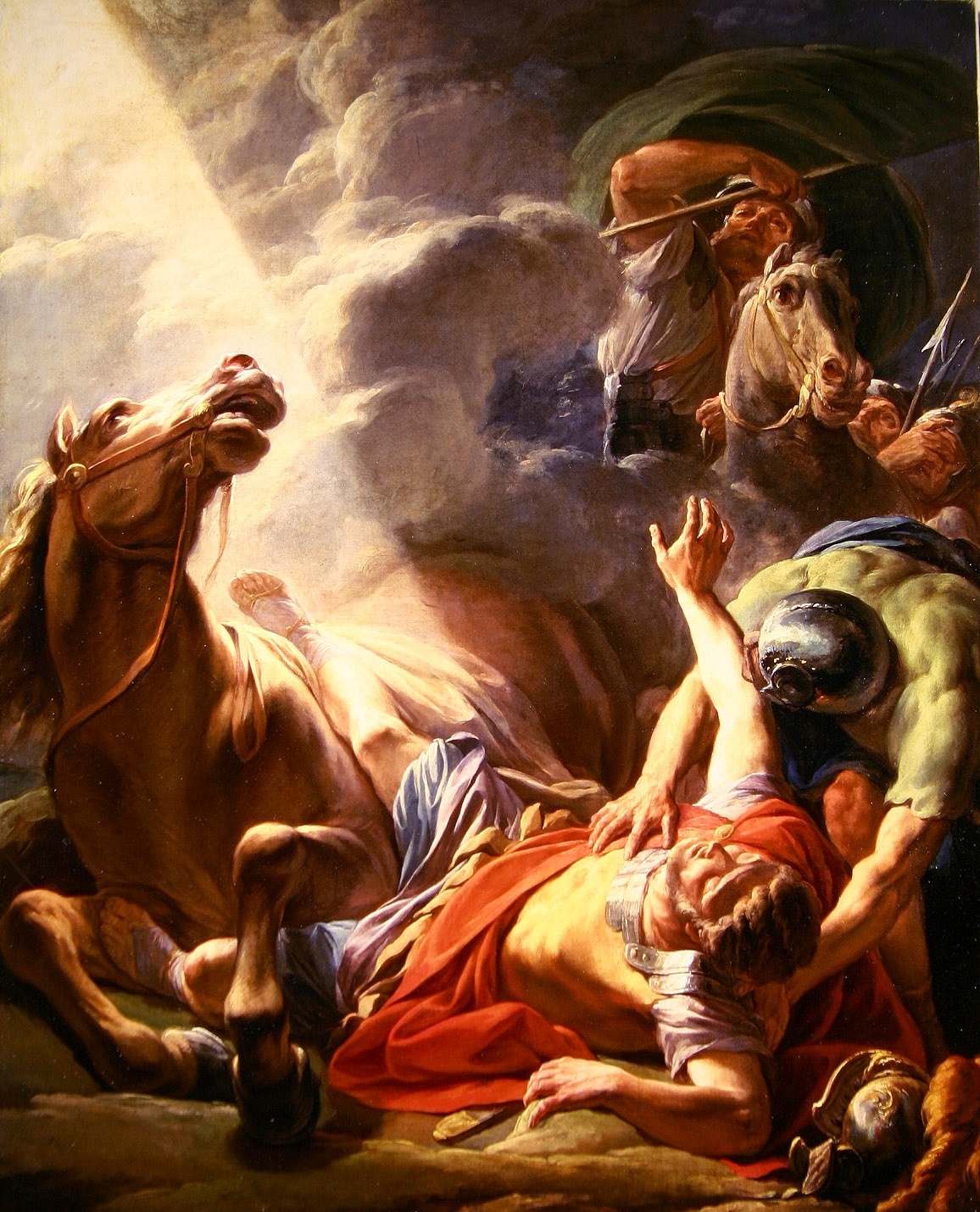
And the men which journeyed with him stood speechless, hearing a voice, but seeing no man. (Acts 9:7)

Saul was a religious fanatic. Following his approving support of the stoning of the first recorded Christian martyr, Stephan (Acts 7:58), he “yet breathing out threatenings and slaughter against the disciples of the Lord, went unto the high priest, And desired of him letters to Damascus to the synagogues, that if he found any of this way, whether they were men or women, he might bring them bound unto Jerusalem” (Acts 9:1-2). Saul was ready to bring in the followers of “The Way” either dead or alive, and he would have given his life for the extermination of these infidels – those who had turned away from the religion of their fathers. Such zeal is nothing strange to us these days, unless you are a Christian; Christians do not normally behave in this manner.

But God had something else in mind for Saul, and He would turn Saul’s zeal for his religion into zeal for the Person of Jesus Christ. Saul was a hard-case, and getting his attention would require more than witnessing the death of a faithful martyr. So Jesus met him in person on his mission to exterminate the believers that were in Damascus. “And as he journeyed, he came near Damascus: and suddenly there shined round about him a light from heaven: And he fell to the earth, and heard a voice saying unto him, Saul, Saul, why persecutest thou me?” (Acts 9:3-4). Saul was soon to learn that his mission against The Way was really a mission against God Himself as Jesus directly identified Himself with His church: “I am Jesus whom thou persecutest” (v. 5). The very God whom he thought he was serving and whom he wanted to please struck Saul blind (v. 8), and put him in “time-out” for three days (v. 9) to give him time to reflect on his experience. Saul’s life was dramatically changed following this, so much so that “after … many days were fulfilled, the Jews took counsel to kill him” (v. 23). He was even given a new name, Paul, by which he is most commonly known (Acts 13:9). Everything about Paul changed following this encounter with the risen Christ.

The conversion and transformation of Paul was miraculous indeed, but what about the others who had accompanied Paul on the same mission? They also heard a voice but saw no man. The encounter apparently had some impact on them because they “stood speechless,” but for them, nothing changed. In fact, they may have been the very ones that turned on him, and “took counsel to kill him.” When we think about it, it really should not come as a surprise. Jesus said, concerning the Jewish religious leaders, “Therefore speak I to them in parables: because they seeing see not; and hearing they hear not, neither do they understand. And in them is fulfilled the prophecy of Esaias, which saith, By hearing ye shall hear, and shall not understand; and seeing ye shall see, and shall not perceive” (Matthew 13:13-14).

Today, the Gospel is preached though every possible medium available – even this simple blog – and though it is heard by countless millions, it has no effect on most. Jesus said that “strait [small] is the gate, and narrow is the way, which leadeth unto life, and few there be that find it” (Matthew 7:14). Seeing, they see not, and hearing, they hear not.

Comments Off on Seeing, They See Not

Filed under Apologetics, Christianity, Gospel, Religion, Salvation

Tares Among the Wheat

Green Wheat Fields With Cyprus – Vincent Van Gogh (1890)

But while men slept, his enemy came and sowed tares among the wheat, and went his way. (Matthew 13:25)

Before I cranked up the lawnmower Saturday morning, I noticed that some bad grass had come up in my backyard, and it was going to seed. As much as I dreaded that task, I knew I would have to pull it all up by hand otherwise I would risk scattering bad seed all over my yard and making matters worse. Through the pain of my aching back, I recalled Jesus’ “Kingdom Parable” about the tares among wheat found in Matthew 13:24-30; 36-43.

In this parable, Jesus likens Himself to the landowner who sowed good seed into His field – i.e., the world (vv. 24, 37-38). The “good seed” which He sowed are the children of the Kingdom – i.e., true believers in Christ (vv. 24, 38). “But while men slept” … Jesus defined all the players in the parable except for these. Who are these men who fell asleep on the job? Since there is no special definition for these men, it seems that these “men” are the “good seed” that was planted in the field. These did what good seed is supposed to do: receive nourishment, grow and produce fruit. But in doing what good seed is supposed to do, it took no notice of the enemy (Satan) that came in and sowed tare seeds into the field (vv. 25, 39). These too grew up together with the wheat and were indistinguishable from the wheat. As the time of harvest approached, the distinction became obvious, and the harvesters (the angels) wanted to rip up the tares (v. 28), but the landowner, not wanting to upset the good wheat, instructed that both be allowed to grow together until the harvest (vv. 29-30).

There are tares among us. They dress Christian. They speak Christian. They, by almost any means, look Christian, but they “are the children of the wicked one” (v. 38). Perhaps “outsiders” can spot them easier than those on the “inside.” Perhaps that is why many want nothing to do with the church because, they say, “The church is full of hypocrites!” No, the church is full of tares! Jesus says, “Let both grow together until the harvest: and in the time of harvest I will say to the reapers, Gather ye together first the tares, and bind them in bundles to burn them: but gather the wheat into my barn” (v. 30).

So, what are we to do about all of this? A good self-examination would be a good place to begin. “He that saith he abideth in him ought himself also so to walk, even as he walked” (1 John 2:6). Don’t act like tares. Peter reminds us that this present world is going up in smoke, and he exhorts us: “Seeing then thatall these things shall be dissolved, what manner of persons ought ye to be in all holy conversation and godliness, Looking for and hasting unto the coming of the day of God, wherein the heavens being on fire shall be dissolved, and the elements shall melt with fervent heat? Nevertheless we, according to his promise, look for new heavens and a new earth, wherein dwelleth righteousness” (2 Peter 3:11-13, emphasis added). Yes, there are tares among the wheat. Don’t be a tare!

Comments Off on Tares Among the Wheat

Filed under Apologetics, Christianity, Current Events, End Times, Gospel, Religion, Salvation, Theology

More Than Conquerors

More Than Conquerors

What shall we then say to these things? If God be for us, who can be against us? (Romans 8:31)

One of the greatest passages on the security of the believer is found here in Romans 8:31-39.  Paul begins this passage with a challenge reminiscent of David’s challenge concerning Goliath:  “who is this uncircumcised Philistine, that he should defy the armies of the living God?” (1 Samuel 17:26).  Surely David would have responded with the words of Paul, “If God be for us, who can be against us?” (our verse).

In his counsel to Job, Eliphaz affirms, “Yet man is born unto trouble, as the sparks fly upward” (Job 5:7).  Someone once said that even as Christians we are in one of three states of trials: we have either experienced trials, we are experiencing trials, or we will experience trials.  We are not immune from trouble, but in the midst of those trials we are encouraged that “God hath not given us the spirit of fear; but of power, and of love, and of a sound mind” (2 Timothy 1:7).

That “power,” “love” and “sound mind” are a result of the answer to Paul’s follow-up question:  “Who shall separate us from the love of Christ?” (Romans 8:35)  If God did not spare His Own Son, but allowed Him to die on our behalf, will He then not freely provide or us in every way (Romans 8:32)?  Even the “accuser of the brethren” (Revelation 12:10) is unable to bring a charge against us because it is God Who has declared us just (Romans 8:33).

We are encouraged then, that nothing can come between us and God’s love for us.  Not tribulation, distress, persecution, famine, nakedness, peril, or the sword can separate us from the love of God (Romans 8:35).  Neither death, nor life, nor angels, nor principalities, nor powers, nor things present, nor things to come, nor height, nor depth, nor any other creature can separate us from the love of God, which is in Christ Jesus our Lord (Romans 8:38-39).  “Nay, in all these things we are more than conquerors through him that loved us” (Romans 8:37). So, Christian, go forth fearlessly with confidence that the battle has already been won, and we are more than conquerors!

1 Comment

Filed under Apologetics, Christianity, Gospel, Religion, Salvation, Theology