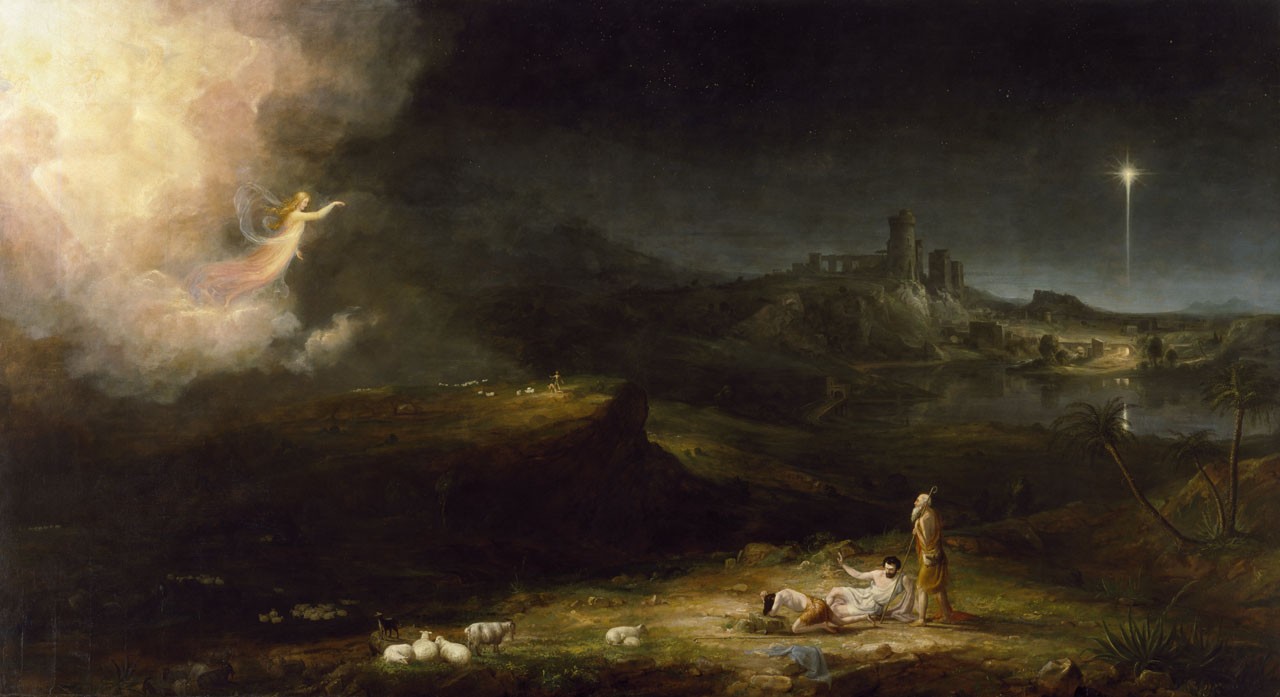
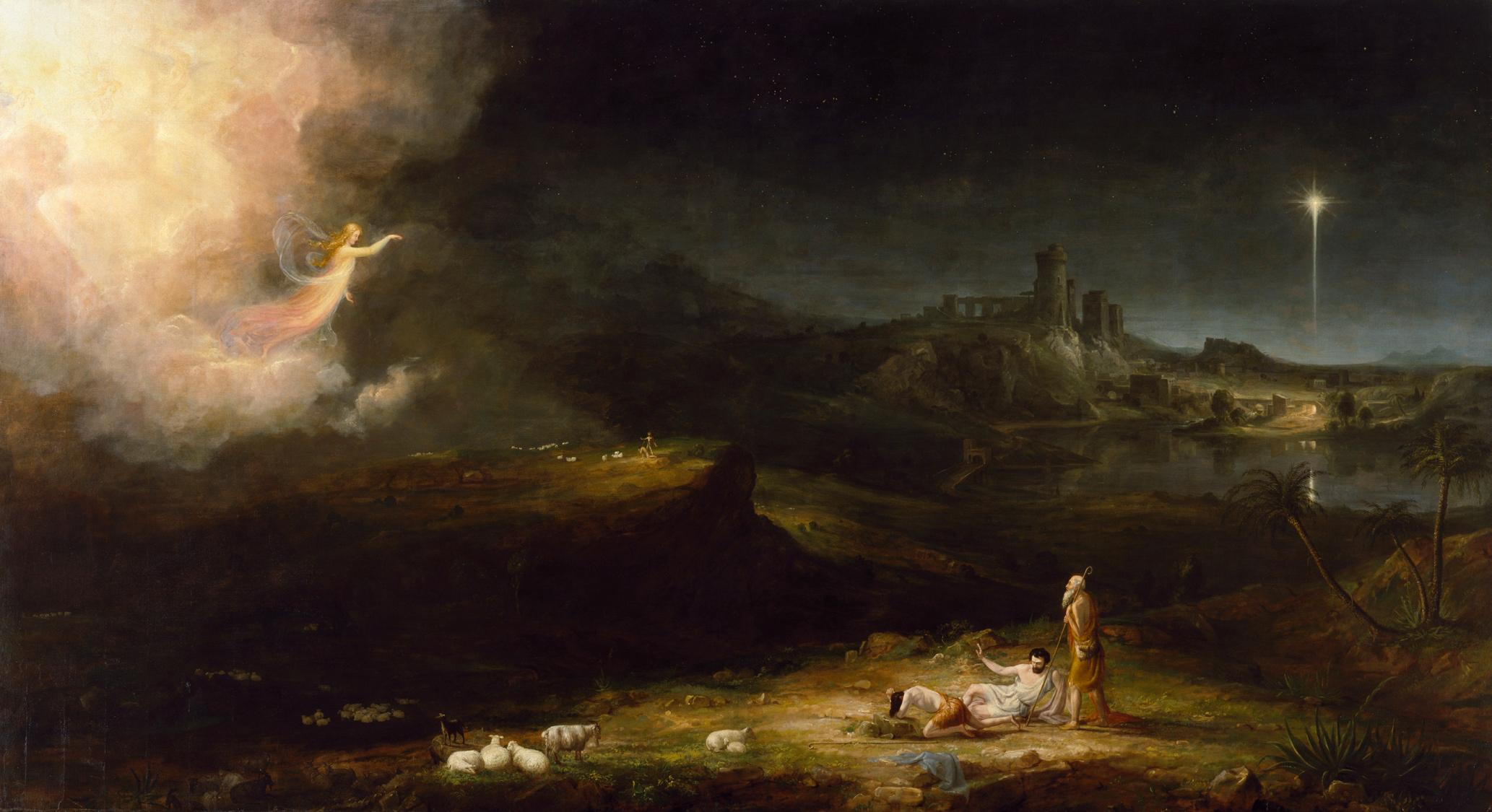
“And there were in the same country shepherds abiding in the field, keeping watch over their flock by night.” (Luke 2:8)
One of the best arguments against the birth of Christ having taken place in late December is this fact recorded by Luke in his Gospel. There were shepherds out in the fields watching over their flocks. By late December, there is not sufficient grazing to sustain large flocks of sheep. Jerusalem is near the same latitude as Dallas, Texas where I used to live, and by the middle to the end of November, there is not much left on which cattle can graze. So, they need to be fed on hay or “cake” until the next spring. So, it seems very unlikely that shepherds would be out in the fields tending to sheep in the wintertime.
The shepherds around Bethlehem generally kept the sheep and goats that were used for sacrifice in the Temple in nearby Jerusalem. Some have suggested that Jesus’ birth was around late September which coincides with the Jewish Fall Feasts: Feast of Trumpets (Rosh Hashanah), Day of Atonement (Yom Kippur), and Feast of Tabernacles (Sukkoths). These feasts required all Jewish men to make a pilgrimage to the Temple in Jerusalem. The fact that this requirement happened to coincide with the decree from Caesar Augustus for the census (Luke 2:1) may explain why “there was no room for them in the inn” (Luke 2:7) for the expectant couple. In fact, His birth may have occurred during the Feast of Tabernacles making John’s statement that “the Word was made flesh, and [tabernacled] among us” (John 1:14) even more significant. Interestingly, if one counts back nine months from the end of September, one arrives at a date sometime in late December. It could be that rather than celebrating Christ’s birth on December 25, we are actually celebrating His conception!
Regardless, it was to these simple shepherds that this paramount announcement was delivered. “For unto you is born this day in the city of David a Saviour, which is Christ the Lord” (Luke 2:11). To these shepherds who were known for feeding and protecting their flocks; who sought out the lost sheep, and rescued those that were attacked. It seems appropriate that to these the news of the arrival of the “Shepherd of Israel” should be first delivered. He who would later say, “I am the good shepherd: the good shepherd giveth his life for the sheep” (John 10:11) had come. So without hesitation, they said, “Let us now go even unto Bethlehem, and see this thing which is come to pass, which the Lord hath made known unto us” (Luke 2:15). They came “with haste” Luke tells us, “and found Mary, and Joseph, and the [Lamb of God] lying in a manger” (Luke 2:16). The name given the babe was Jesus, “for he shall save his people from their sins” (Matthew 1:21). This little Lamb of God, who was to be the Shepherd of shepherds, had finally come to them. He did not come to a palace but to a dirty, smelly stable. He was not announced to the kings of the world, but to those of the lowest social status – to shepherds.
Signing of the Mayflower Compact, November 11, 1620
Hear my prayer, O LORD, and give ear unto my cry; hold not thy peace at my tears: for I am a stranger with thee, and a sojourner, as all my fathers were. (Psalm 39:12)
On Thanksgiving Day[1] we remember the Pilgrims and the first celebration of Thanksgiving. Sadly, most Americans, including many Christians, cannot explain the significance of the day. For most, the day is a time for gathering together with family and friends to feast on turkey with all the fixings and pass out from tryptophan over a football game. On the following day, everyone swarms the malls and outlet stores to stock up on Black Friday bargains for the next big holiday. For these people, Pilgrims are people with funny clothes, stovepipe hats, big buckles on their shoes, and guns with bell-shaped muzzles. Pilgrims look cute on greeting cards or as seasonal decorations, but what is a pilgrim?
Without rehashing what can easily be found with a quick Google search or repeating what I have written in the past, allow me to give a different perspective on the word “pilgrim.” Dictionary.com defines a pilgrim as (1) a person who journeys, especially a long distance, to some sacred place as an act of religious devotion, (2) a traveler or wanderer, especially in a foreign place, (3) an original settler in a region, (4) one of the band of Puritans who founded the colony of Plymouth, Mass., in 1620, or (5) a newcomer to a region or place, especially to the western U.S.
Those fitting the fourth definition of the word celebrated the first Thanksgiving Day in 1621 after surviving a harsh winter with inadequate shelter where almost half of their company died from exposure to the elements. The Pilgrims came to America to escape religious persecution. These Pilgrims traveled to a foreign place (Definition 2) and were newcomers to the place where they landed (Definition 5). However, it cannot be said that they were the original settlers in the region (Definition 3) because the Patuxet tribe lived on the land before the Pilgrims arrived. Nor can it be said that they came to a sacred place (America) as an act of religious devotion, albeit they desired “the advancement of the Christian faith.”
In October 2017, my wife and I visited the Holy Land as pilgrims (Definition 1). We traveled a very long distance from Dallas, Texas to Israel and visited many sacred places there because of our devotion to the Word of God and our desire to visit the places about which we read in the Bible. Our pilgrimage served to bring God’s Word to life in our minds and to form a stronger bond and love for the land of Israel and especially for the city, Jerusalem, where God has placed His name. June and I were pilgrims!
As Christians, we are all pilgrims. Regardless of where on earth we dwell, we are strangers and sojourners in this world – pilgrims; “For our conversation is in heaven; from whence also we look for the Saviour, the Lord Jesus Christ” (Philippians 3:20). The Greek word translated “conversation” is politeuma and it means “community” or “citizenship.” Our true citizenship and our allegiance are in heaven; therefore, it is right for us to feel out of place in this world. If not, we might need to take a second look at our passports! “Love not the world, neither the things that are in the world. If any man love the world, the love of the Father is not in him. … And the world passeth away, and the lust thereof: but he that doeth the will of God abideth for ever” (1 John 2:15, 17). Knowing that this world is passing away, I am “Looking for and hasting unto the coming of the day of God, wherein the heavens being on fire shall be dissolved, and the elements shall melt with fervent heat? Nevertheless we, according to his promise, look for new heavens and a new earth, wherein dwelleth righteousness.” (2 Peter 3:12-13).
As a pilgrim, I yearn with an aching heart for the Lord to return as King of Kings and Lord of Lords and make this world right again. Then I will be home, no longer a pilgrim. In the meantime, fellow pilgrims, we can thank Him for all His care and provision as we travel this alien land and for the assurance that our real home is with Him.
And one of them, when he saw that he was healed, turned back, and with a loud voice glorified God, (Luke 17:15)
Thanksgiving Day is upon us, and I’m sure most of us have plans for food, family, friends, and fellowship. In today’s culture, Thanksgiving Day is just a good excuse to have a day (or two) off work, indulge in gluttonous behavior, and worship before the luminous god of football followed by the giving of alms to the god of materialism the next day, all the while in complete ignorance of the significance of the day.
As I thought about Thanksgiving coming up, the Lord brought to mind the account of Jesus healing the ten lepers. We read about that in Luke 17:11-19:
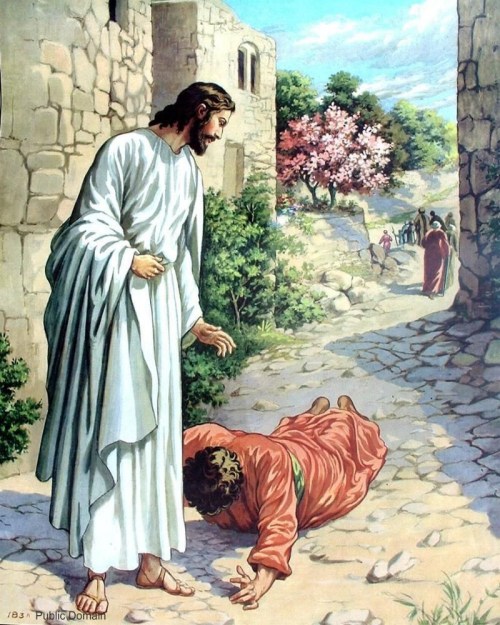
And it came to pass, as he went to Jerusalem, that he passed through the midst of Samaria and Galilee. And as he entered into a certain village, there met him ten men that were lepers, which stood afar off: And they lifted up their voices, and said, Jesus, Master, have mercy on us. And when he saw them, he said unto them, Go shew yourselves unto the priests. And it came to pass, that, as they went, they were cleansed. And one of them, when he saw that he was healed, turned back, and with a loud voice glorified God, And fell down on his face at his feet, giving him thanks: and he was a Samaritan. And Jesus answering said, Were there not ten cleansed? but where are the nine? There are not found that returned to give glory to God, save this stranger. And he said unto him, Arise, go thy way: thy faith hath made thee whole. (Luke 17:11-19)
Following the “Transfiguration” (Luke 9:28-36), Jesus “stedfastly set His face to go to Jerusalem” (Luke 9:51). Coming down from Caesarea Philippi, Luke records that Jesus “passed through the midst of Samaria and Galilee” (v. 11). He is traveling from the north to the south (toward Jerusalem), which means He must pass through Galilee first before going through Samaria. Why did Luke name Samaria first? I do not know. I could not find one commentator that could tell me, but I suspect the answer is down below. Jesus was on His way to the cross.
As the passage records, ten leprous men met Him, and while remaining at a distance –because their disease was so contagious, they were not allowed to come near other people – they cried out for Jesus to have mercy on them. They addressed Him as “Master” – Greek ἐπιστάτης (epistatēs), from epi, “superimposition, to be over, above,” and histēmi, “to stand” Together the title means “one who stands above” – Master! This is not to be confused with διδάσκαλος (didaskalos) meaning “teacher” (Luke 3:12). Thus, they recognized that Jesus had the power to heal their disease.
When Jesus saw them, “He said unto them, ‘Go show yourselves’” (v.14). Note that Jesus does not touch nor approach them. Why? Jesus had often touched lepers when He healed them, why not today? Jesus was on His way to the Cross. He could not allow Himself to become “unclean.” Note also that His Word was sufficient to heal the lepers – “as they went, they were cleansed.” This healing by His verbal command is a clear demonstration of His deity.
All ten exercised faith in believing His Word that they would be healed, but only one returned to give thanks. “When he saw that he was healed, turned back, and with a loud voice glorified God” (v. 15). “And fell down on his face at his feet, giving him thanks: and he was a Samaritan” (v. 16). He did not simply bow in reverence. He completely prostrated himself, flat with his face to the ground. He placed himself at Jesus’ feet. His attitude was one of complete humility, reverence, worship, and gratitude – “and he was a Samaritan.” That this one was a Samaritan may explain why Luke listed Samaria before Galilee. The implication is that the other nine were Jews.
Jesus seems surprised that only this one returned to give thanks. However, knowing that the Lord knows the hearts of all men, His feigned surprise was likely intended to make a point. Jesus said that “[God] is kind to the unthankful and to the evil” (Luke 6:35).
Thankfulness was not particularly characteristic of the Jews. Consider how often they complained after they were freed from Egypt. Think of how soon they fell into idol worship during the time of the Judges. Consider their presumption on God knowing that they were His people. Their lack of gratitude came as no surprise to Jesus. However, the “stranger” recognized his unworthiness and was grateful for the mercy Jesus bestowed on him.
“And he said unto him, Arise, go thy way: thy faith hath made thee whole” (v.19). The Greek word translated “whole” here is σεσωκεν (sesoken), and it means “has saved.” Literally what Jesus said is, “thy faith hath saved thee.” Obedience (which also required faith) had made him “whole,” i.e., healed him. However, his “faith” in recognizing Jesus as “Master” saved him. He was “whole” not only physically, but spiritually.
Does God Expect Us To Be Thankful?
Leviticus 22:29 And when ye will offer a sacrifice of thanksgiving unto the LORD, offer it at your own will.
Not out of obligation
2 Corinthians 9:7 Every man according as he purposeth in his heart, so let him give; not grudgingly, or of necessity: for God loveth a cheerful giver.
1 Chronicles 16:8Give thanks unto the LORD, call upon his name, make known his deeds among the people.
Can’t do the latter without the former.
1 Chronicles 16:34 O give thanks unto the LORD; for he is good; for his mercy endureth for ever.
Psalm 30:4 Sing unto the LORD, O ye saints of his, and give thanks at the remembrance of his holiness.
Considering God’s holiness and our unworthiness, how can we not be thankful for the love He has shown to us?
Psalm 95:2 Let us come before his presence with thanksgiving, and make a joyful noise unto him with psalms.
Not “come before His presence with prayer requests.” Prayer requests are fine, but let’s first thank Him.
Psalm 100:4 Enter into his gates with thanksgiving, and into his courts with praise: be thankful unto him, and bless his name.
“Bless His name,” i.e., “speak well of His name” What are some attributes of God that come to mind?
Colossians 2:6-7 As ye have therefore received Christ Jesus the Lord, so walk ye in him: (7) Rooted and built up in him, and stablished in the faith, as ye have been taught, abounding therein with thanksgiving.
Philippians 4:6 Be careful for nothing; but in every thing by prayer and supplication with thanksgiving let your requests be made known unto God.
1 Thessalonians 5:18 In every thing give thanks: for this is the will of God in Christ Jesus concerning you.
Consequences of Ingratitude:
Romans 1:21 Because that, when they knew God, they glorified him not as God, neither were thankful; but became vain in their imaginations, and their foolish heart was darkened.
Ingratitude darkens the heart.
2 Timothy 3:1-2, 7-9 This know also, that in the last days perilous times shall come. (2) For men shall be lovers of their own selves, covetous, boasters, proud, blasphemers, disobedient to parents, unthankful, unholy … (7) Ever learning, and never able to come to the knowledge of the truth. (8) Now as Jannes and Jambres withstood Moses, so do these also resist the truth: men of corrupt minds, reprobate concerning the faith. (9) But they shall proceed no further: for their folly shall be manifest unto all men, as theirs also was.
Benefits of Thankfulness:
Psalm 140:13 Surely the righteous shall give thanks unto thy name: the upright shall dwell in thy presence.
We are made “righteous” through Christ. Because of that we have His presence within us.
Jeremiah 30:19 And out of them shall proceed thanksgiving and the voice of them that make merry: and I will multiply them, and they shall not be few; I will also glorify them, and they shall not be small.
In context, this is referring to Israel’s return from Babylonian captivity.
However, the principle applies.
God will bless our thankfulness.
2 Corinthians 4:15 For all things are for your sakes, that the abundant grace might through the thanksgiving of many redound to the glory of God.
“redound” Greek περισσεύω (perisseuō)
to superabound (in quantity or quality), be in excess
God’s grace to us “supper-abounds” through thanksgiving.
2 Corinthians 9:11 Being enriched in every thing to all bountifulness, which causeth through us thanksgiving to God.
Colossians 3:15 And let the peace of God rule in your hearts, to the which also ye are called in one body; and be ye thankful.
1 Timothy 4:1-5 Now the Spirit speaketh expressly, that in the latter times some shall depart from the faith, giving heed to seducing spirits, and doctrines of devils; (2) Speaking lies in hypocrisy; having their conscience seared with a hot iron; (3) Forbidding to marry, and commanding to abstain from meats, which God hath created to be received with thanksgiving of them which believe and know the truth. (4) For every creature of God is good, and nothing to be refused, if it be received with thanksgiving: (5) For it is sanctified by the word of God and prayer.
Conclusion:
Jesus healed ten lepers. Nine of them were of “the chosen.” Their attitude reflected ingratitude for the marvelous work Jesus performed in their lives – almost as if they believed they were entitled to what they received.
One leper – a “stranger,” a Samaritan, clearly an “outsider” due to both his leprosy and his heritage – recognized his own unworthiness and the greatness of the One who healed him; and he returned to give thanks and worship the God who healed him. And he was saved. Let us recognize that we are all lepers and give thanks for all He has done for us.
And he that sat upon the throne said, Behold, I make all things new. And he said unto me, Write: for these words are true and faithful. (Revelation 21:5)
We have entered the new year, 2023. How does the future look? Do you think this year will be better than last?
Let us take a sober look at conditions worldwide. North Korea is testing nuclear ballistic missiles and threatening South Korea. China continues to build up its military and threatening the tiny island nation of Taiwan. Iran is within weeks of enriching weapons-grade uranium and continues to threaten Israel and the United States. Russia relentlessly batters the sovereign nation of Ukraine without regard for millions of innocent Ukrainian citizens. Russia, Turkey, and Iran along with their allies are amassing armies and military equipment in Syria and setting the stage for the Gog of Magog war against Israel described in Ezekiel 38-39. The wars and rumors of wars Jesus predicted are all over the world.
Violence permeates the entire world. There are riots in China, Iran, Russia, France, Brazil, and many other nations. Here in the United States, violent crimes go unanswered. Jesus said the last days would be as in the days of Noah,[1] which were days filled with violence.[2] Jesus also said that the last days would be as the days of Lot.[3] Those days were characterized by rampant sexual deviancy.[4] Consider what goes on today with the LGBTQ+ movement and their agenda to pervert innocent children with their drag queen shows that they conduct with children. What are the parents thinking! Children are being trafficked for sexual purposes to deviants and perverts, and if that is not bad enough, abortion continues to rise even with the reversal of Roe v Wade.
On top of all of that, economies are failing all over the world. When that happens, evil leaders become desperate and look to war in order to distract their people from their sufferings. Vladimir Putin has openly made threats of nuclear attacks on any nation that opposes his advances on Ukraine. North Korea, China, and Iran echo their own threats. Meanwhile, the Globalists, many of whom are powerful people in our own government, lick their chops like buzzards circling a dying corpse, eagerly waiting on the demise of the nations so they can come in, “build back better” and install a New World Order.
Our world is sick and getting sicker by the day; 2023 offers no hope for improvement.
What follows, I wrote two years ago with a few changes to bring it up to date.
I am not a pessimist, but I do read what the Bible has to say about the end times. If the Bible is true (and it is), things will get worse before the Lord returns. Jesus said, “And ye shall hear of wars and rumours of wars: see that ye be not troubled: for all these things must come to pass, but the end is not yet. For nation shall rise against nation, and kingdom against kingdom: and there shall be famines, and pestilences, and earthquakes, in divers places. All these are the beginning of sorrows” (Matthew 24:6-8, emphasis mine).
Does that not sound familiar these days? So, do not expect 2023 to get better; it will only get worse. Now, what do we do in light of this dismal outlook; crawl under a rock and hide away? NO! We face the future with the assurance that God has all things in His control.
What Does God Have to Say About It?
As Moses prepared Israel to enter the Promised Land, a new land filled with giants, dangers, and unknowns, he encouraged them not to fear because God was with them. “Behold, the LORD thy God hath set the land before thee: go up and possess it, as the LORD God of thy fathers hath said unto thee; fear not, neither be discouraged” (Deuteronomy 1:21, emphasis mine). As Israel prepared for battle against their enemies, the priests were to encourage the people, “And shall say unto them, Hear, O Israel, ye approach this day unto battle against your enemies: let not your hearts faint, fear not, and do not tremble, neither be ye terrified because of them; For the LORD your God is he that goeth with you, to fight for you against your enemies, to save you” (Deuteronomy 20:3-4, emphasis mine). The unknown is frightening, but God promises to go with us and even to fight our battles,
So, “Be strong and of a good courage, fear not, nor be afraid of them: for the LORD thy God, he it is that doth go with thee; he will not fail thee, nor forsake thee” (Deuteronomy 31:6, emphasis mine). When we attempt to face challenges on our own, WE WILL FAIL, but God will never fail us or leave us alone.
God has unlimited resources. When Syria harassed Israel, their efforts were constantly thwarted because God, through Elisha, warned the king of Israel before every attack. The king of Syria suspected that he had a spy within his ranks, but one of his servants told him about Elisha the prophet who warned the king of Israel ahead of every attack. Therefore, the king of Syria sent an army and surrounded Elisha’s house. “And when the servant of the man of God was risen early, and gone forth, behold, an host compassed the city both with horses and chariots. And his servant said unto him, Alas, my master! how shall we do? And [Elisha] answered, Fear not: for they that be with us are more than they that be with them. And Elisha prayed, and said, LORD, I pray thee, open his eyes, that he may see. And the LORD opened the eyes of the young man; and he saw: and, behold, the mountain was full of horses and chariots of fire round about Elisha” (2 Kings 6:15-17, emphasis mine).
“And David said to Solomon his son, Be strong and of good courage, and do it: fear not, nor be dismayed: for the LORD God, even my God, will be with thee; he will not fail thee, nor forsake thee, until thou hast finished all the work for the service of the house of the LORD” (1 Chronicles 28:20, emphasis mine). David referred to the Temple Solomon would build. Solomon had the promise that God would not abandon him until the work was complete. Today, believers are the “living temples” of God (1 Corinthians 3:16). As long as God lends us breath, we have work to do “for the service of the house of the LORD.”
“Fear thou not; for I am with thee: be not dismayed; for I am thy God: I will strengthen thee; yea, I will help thee; yea, I will uphold thee with the right hand of my righteousness … For I the LORD thy God will hold thy right hand, saying unto thee, Fear not; I will help thee.” (Isaiah 41:10, 13, emphasis mine). When we trust God, He is our strength and our help, He sustains us and holds our right hand.
Jesus said, “Are not five sparrows sold for two farthings, and not one of them is forgotten before God? But even the very hairs of your head are all numbered. Fear not therefore: ye are of more value than many sparrows” (Luke 12:6-7, emphasis mine). God cares for all of His creation, even those we would count as insignificant. He knows us intimately, even to the most minute detail – the number of hairs on our heads. Since God cares so much for common sparrows, how much more does He care for those created in His image?
What Can We Do?
When Babylon conquered Judah, Nebuchadnezzar carried away the Jews in three deportations. Nebuchadnezzar set Gedaliah as governor over Judah after the third deportation to Babylon. They were going into captivity. In that circumstance, the people are encouraged to “fear not,” accept the situation, and it would be well with them. “And Gedaliah the son of Ahikam the son of Shaphan sware unto them and to their men, saying, Fear not to serve the Chaldeans: dwell in the land, and serve the king of Babylon, and it shall be well with you” (Jeremiah 40:9; 2 Kings 25:24, emphasis mine). God promises to be with us even in difficult situations.
Jesus said, “And fear not them which kill the body, but are not able to kill the soul: but rather fear him which is able to destroy both soul and body in hell” (Matthew 10:28, emphasis mine). The Greek word translated “fear” (used twice in this verse) is phobeō, from which we get the English word “phobia.” Strong’s defines it this way: “to frighten, that is, (passively) to be alarmed; by analogy to be in awe of, that is, revere: – be (+ sore) afraid, fear (exceedingly), reverence” (emphasis mine). With that in mind, Jesus says not to fear or be frightened of those that can kill the body – that would include COVID-19. Rather, we should “revere” the One who ultimately determines our eternal destiny.
When Jesus selected His disciples, Luke records the account this way: “And so was also James, and John, the sons of Zebedee, which were partners with Simon. And Jesus said unto Simon, Fear not; from henceforth thou shalt catch men” (Luke 5:10, emphasis mine). The world may be falling down all around us, but we are not to “shelter in place.” Jesus gave us the “good news” for us to share with those around us.
Jesus also said, “And seek not ye what ye shall eat, or what ye shall drink, neither be ye of doubtful mind. For all these things do the nations of the world seek after: and your Father knoweth that ye have need of these things. But rather seek ye the kingdom of God; and all these things shall be added unto you. Fear not, little flock; for it is your Father’s good pleasure to give you the kingdom. Sell that ye have, and give alms; provide yourselves bags which wax not old, a treasure in the heavens that faileth not, where no thief approacheth, neither moth corrupteth. For where your treasure is, there will your heart be also” (Luke 12:29-34, emphasis mine). We are not to be overly concerned with our material needs. Jesus promises that God will provide what we need.
“For the eyes of the Lord are over the righteous, and his ears are open unto their prayers: but the face of the Lord is against them that do evil. And who is he that will harm you, if ye be followers of that which is good? But and if ye suffer for righteousness’ sake, happy are ye: and be not afraid of their terror, neither be troubled; But sanctify the Lord God in your hearts: and be ready always to give an answer to every man that asketh you a reason of the hope that is in you with meekness and fear: Having a good conscience; that, whereas they speak evil of you, as of evildoers, they may be ashamed that falsely accuse your good conversation [i.e., behavior/conduct] in Christ” (1 Peter 3:12-16, emphasis mine). When we are secure in the Lord’s care, we can be confident to face whatever the future may bring. When others see our confidence, they will want to know the reason for it, and we need to be prepared to give an answer.
Conclusion:
We cannot stop 2023 from coming. We cannot alter the circumstances that 2023 will bring. Jesus said, “These things I have spoken unto you, that in me ye might have peace. In the world ye shall have tribulation: but be of good cheer; I have overcome the world” (John 16:33, emphasis mine). However, we can control our own outlook when we place our trust in God knowing that all things are under His control and that He cares for His own. Again, Jesus said, “Peace I leave with you, my peace I give unto you: not as the world giveth, give I unto you. Let not your heart be troubled, neither let it be afraid” (John 14:27, emphasis mine). Ultimately, we have the promise of eternal life with Him in a new heaven and a new earth (Revelation 21:1-5).
Glory to God in the highest, and on earth peace, good will toward men. (Luke 2:14)
I grew up listening to the Christmas account in the Gospel of Luke (Luke 2) in the language of the King James Version of the Holy Bible. Well, that is not entirely true. My first memories of the reading were from the Reina-Valera Spanish translation, but from the time I entered school in the first grade, it was the good old King James Bible. To this day, when I hear the reading from any other translation, it just does not sound the same. It loses something of the cadence and the poetic flow. I do not care; I just like the sound of the King James better.
I always pay close attention when Scripture is read, and lately, the reading of Luke 2:14 has troubled me. Here are some examples from modern translations. I will emphasize the portion that bothers me.
“Glory to God in the highest heaven, and on earth peace to those on whom his favor rests.” (NIV)
“Glory to God in the highest and on earth peace to those on whom his favor rests.” (NABRE)
“Glory to God in highest heaven, and peace on earth to those with whom God is pleased.” (NLT)
“Glory to God in the highest heaven, and on earth peace among those whom he favors!” (NRSVUE)
“Give glory to God in heaven, and on earth let there be peace among the people who please God.” (NCV)
“Glory to God in the highest, and on earth peace among those with whom he is pleased!” (ESV)
Above are just some of the more popular modern translations. I did not quote the New King James Version (NKJV) because it reads pretty much like the KJV on this verse. So, what is the problem? Notice the phrases I emphasized. All of these seem to offer peace only to those whom God has favored. Wait a minute! What about all the others that fall outside of those boundaries? Is God’s favor withheld from some and lavished only on a select few that for whatever reason known only to God meet certain criteria?
As quoted above, the KJV (and the NKJV) read, “Glory to God in the highest, and on earth peace, good will toward men.” There are no exceptions. God’s peace and His goodwill are meant for all men, not just those who have found special favor with Him. All men!
Those who would defend the modern translations will say that those translations have been translated from “older and better (Greek) texts.” Most of us accept such statements as factual because they come from well-studied “scholars” – experts. We take it for granted that they are right. But, are they? The only way to know for certain is to look at the original language.
Here is Luke 2:14 in the original Greek: δοξα εν υψιστοις θεω και επι γης ειρηνη εν ανθρωποις ευδοκια. I know most of my readers do not read Greek, so I will translate.
There you have it. The news, the peace, and the goodwill are not only for a select, favored few, but to all mankind. The KJV has it right, the other translations have added to Scripture, a practice that is strongly condemned in Scripture.
The good news of Christmas is for all mankind. Do you know the Peace of Christmas? If not, please read my page on “Securing Eternal Life.”



 Ernie's Musings