The following presentation of the Christmas story is probably unlike any you have read before. It is all Scripture, but it has been arranged in chronological order from the very beginning. I used the King James Version because I happen to like the way it reads – it just “sounds” like Bible. I have taken the liberty of deleting book/chapter/verse headings for smoothness of reading, but all passages are properly cited at the end of the passage, as you will see. This is for the benefit of you Bible scholars that insist on verifying the text (a very good thing!). There have only been a few modifications to the text for clarity and ease of reading. These are identified with the change made within brackets ([]) and in bold type. With those few exceptions, the text is directly out of the KJV.
Before Time Began . . .
In the beginning was the Word, and the Word was with God, and the Word was God. The same was in the beginning with God. All things were made by Him, and without Him was not any thing made that was made. In Him was life; and the life was the light of men. (John 1:1-4) [HE] is the image of the invisible God, the firstborn of every creature. For by Him were all things created, that are in heaven, and that are in earth, visible and invisible, whether they be thrones, or dominions, or principalities, or powers: all things were created by Him, and for Him, and He is before all things, and by Him all things consist. (Colossians 1:15-17)
In the Beginning . . .
In the beginning God created the heaven and the earth. (Genesis 1:1) And God said, “Let Us make man in Our image, after Our likeness, and let them have dominion over the fish of the sea, and over the fowl of the air, and over the cattle, and over all the earth, and over every creeping thing that creepeth upon the earth.” So God created man in His own image, in the image of God created He him; male and female created He them. And God blessed them, and God said unto them, “Be fruitful, and multiply, and replenish the earth, and subdue it: and have dominion over the fish of the sea, and over the fowl of the air, and over every living thing that moveth upon the earth.” (Genesis 1:26-28) And God saw every thing that he had made, and, behold, it was very good. And the evening and the morning were the sixth day. (Genesis 1:31)
And the LORD God took the man, and put him into the garden of Eden to dress it and to keep it. And the LORD God commanded the man, saying, “Of every tree of the garden thou mayest freely eat; but of the tree of the knowledge of good and evil, thou shalt not eat of it, for in the day that thou eatest thereof thou shalt surely die.” And the LORD God said, “It is not good that the man should be alone; I will make him an help meet for him.” (Genesis 2:15-18)
And Adam gave names to all cattle, and to the fowl of the air, and to every beast of the field; but for Adam there was not found an help meet for him. And the LORD God caused a deep sleep to fall upon Adam and he slept: and He took one of his ribs, and closed up the flesh instead thereof; and the rib, which the LORD God had taken from man, made He a woman, and brought her unto the man. And Adam said, “This is now bone of my bones, and flesh of my flesh: she shall be called Woman, because she was taken out of Man.” (Therefore shall a man leave his father and his mother, and shall cleave unto his wife: and they shall be one flesh.) And they were both naked, the man and his wife, and were not ashamed. (Genesis 2:20-25)
Now the serpent was more subtil than any beast of the field which the LORD God had made. And he said unto the woman, “Yea, hath God said, ‘Ye shall not eat of every tree of the garden’?” And the woman said unto the serpent, “We may eat of the fruit of the trees of the garden, but of the fruit of the tree which is in the midst of the garden, God hath said, ‘Ye shall not eat of it, neither shall ye touch it, lest ye die.’” And the serpent said unto the woman, “Ye shall not surely die. For God doth know that in the day ye eat thereof, then your eyes shall be opened, and ye shall be as gods, knowing good and evil.” And when the woman saw that the tree was good for food, and that it was pleasant to the eyes, and a tree to be desired to make one wise, she took of the fruit thereof, and did eat, and gave also unto her husband with her, and he did eat. And the eyes of them both were opened, and they knew that they were naked. And they sewed fig leaves together, and made themselves aprons. (Genesis 3:1-7)
And they heard the voice of the LORD God walking in the garden in the cool of the day: and Adam and his wife hid themselves from the presence of the LORD God amongst the trees of the garden. And the LORD God called unto Adam, and said unto him, “Where art thou?” And he said, “I heard Thy voice in the garden, and I was afraid, because I was naked; and I hid myself. And He said, “Who told thee that thou wast naked? Hast thou eaten of the tree, whereof I commanded thee that thou shouldest not eat?” And the man said, “The woman whom Thou gavest to be with me, she gave me of the tree, and I did eat. And the LORD God said unto the woman, “What is this that thou hast done?” And the woman said, “The serpent beguiled me, and I did eat.” And the LORD God said unto the serpent, “Because thou hast done this, thou art cursed above all cattle, and above every beast of the field. Upon thy belly shalt thou go, and dust shalt thou eat all the days of thy life. And I will put enmity between thee and the woman, and between thy seed and her seed; He shall bruise thy head, and thou shalt bruise His heel. (Genesis 3:8-15)
And the LORD God said, “Behold, the man is become as one of Us, to know good and evil. And now, lest he put forth his hand, and take also of the tree of life, and eat, and live forever.” Therefore the LORD God sent him forth from the garden of Eden, to till the ground from whence he was taken. So He drove out the man; and He placed at the east of the garden of Eden cherubims, and a flaming sword which turned every way, to keep the way of the tree of life. (Genesis 3:22-24)
The Promise of a Savior …
And the LORD said, Shall I hide from Abraham that thing which I do; Seeing that Abraham shall surely become a great and mighty nation, and all the nations of the earth shall be blessed in him? (Genesis 18:17-18) And in thy seed shall all the nations of the earth be blessed; because thou hast obeyed my voice. (Genesis 22:18)
And thy seed [Jacob] shall be as the dust of the earth, and thou shalt spread abroad to the west, and to the east, and to the north, and to the south: and in thee and in thy seed shall all the families of the earth be blessed. (Genesis 28:14)
And Jacob called unto his sons, and said, Gather yourselves together, that I may tell you that which shall befall you in the last days (Genesis 49:1) … The sceptre shall not depart from Judah, nor a lawgiver from between his feet, until Shiloh come; and unto him shall the gathering of the people be. (Genesis 49:10)
I [Balaam] shall see him, but not now: I shall behold him, but not nigh: there shall come a Star out of Jacob, and a Sceptre shall rise out of Israel, and shall smite the corners of Moab, and destroy all the children of Sheth. (Numbers 24:17)
The LORD thy God will raise up unto thee a Prophet from the midst of thee, of thy brethren, like unto me [Moses]; unto him ye shall hearken (Deuteronomy 18:15).
And when thy days be fulfilled, and thou [David] shalt sleep with thy fathers, I will set up thy seed after thee, which shall proceed out of thy bowels, and I will establish his kingdom. He shall build an house for my name, and I will stablish the throne of his kingdom for ever. (2 Samuel 7:12-13)
Therefore the Lord himself shall give you a sign; Behold, a virgin shall conceive, and bear a son, and shall call his name Immanuel. (Isaiah 7:14) For unto us a child is born, unto us a son is given: and the government shall be upon his shoulder: and his name shall be called Wonderful, Counsellor, The mighty God, The everlasting Father, The Prince of Peace. Of the increase of his government and peace there shall be no end, upon the throne of David, and upon his kingdom, to order it, and to establish it with judgment and with justice from henceforth even for ever. The zeal of the LORD of hosts will perform this. (Isaiah 9:6-7) And there shall come forth a rod out of the stem of Jesse, and a Branch shall grow out of his roots: (Isaiah 11:1)
But thou, Bethlehem Ephratah, though thou be little among the thousands of Judah, yet out of thee shall he come forth unto me that is to be ruler in Israel; whose goings forth have been from of old, from everlasting. (Micah 5:2)
The Promise Fulfilled . . .
There was in the days of Herod, the king of Judaea, a certain priest named Zacharias, of the course of Abia, and his wife was of the daughters of Aaron, and her name was Elisabeth. And they were both righteous before God, walking in all the commandments and ordinances of the Lord blameless. And they had no child, because that Elisabeth was barren, and they both were now well stricken in years. (Luke 1:5-7)
According to the custom of the priest’s office, [Zacharias’] lot was to burn incense when he went into the temple of the Lord. (Luke 1:9) And there appeared unto him an angel of the Lord standing on the right side of the altar of incense. And when Zacharias saw him, he was troubled, and fear fell upon him. But the angel said unto him, “Fear not, Zacharias: for thy prayer is heard; and thy wife Elisabeth shall bear thee a son, and thou shalt call his name John. (Luke 1:11-13) And he shall go before him in the spirit and power of Elias, to turn the hearts of the fathers to the children, and the disobedient to the wisdom of the just; to make ready a people prepared for the Lord.” (Luke 1:17)
And it came to pass, that, as soon as the days of his ministration were accomplished, he departed to his own house. And after those days his wife Elisabeth conceived, and hid herself five months. (Luke 1:23-24)
And in the sixth month the angel Gabriel was sent from God unto a city of Galilee, named Nazareth, to a virgin espoused to a man whose name was Joseph, of the house of David; and the virgin’s name was Mary. And the angel came in unto her, and said, “Hail, thou that art highly favoured, the Lord is with thee. Blessed art thou among women.”
And when she saw him, she was troubled at his saying, and cast in her mind what manner of salutation this should be. And the angel said unto her, “Fear not, Mary: for thou hast found favour with God. And, behold, thou shalt conceive in thy womb, and bring forth a son, and shalt call His name JESUS. He shall be great, and shall be called the Son of the Highest: and the Lord God shall give unto Him the throne of His father David; and He shall reign over the house of Jacob forever; and of His kingdom there shall be no end.”
Then said Mary unto the angel, “How shall this be, seeing I know not a man?”
And the angel answered and said unto her, “The Holy Ghost shall come upon thee, and the power of the Highest shall overshadow thee: therefore also that holy thing which shall be born of thee shall be called the Son of God. And, behold, thy cousin Elisabeth, she hath also conceived a son in her old age, and this is the sixth month with her, who was called barren. For with God nothing shall be impossible.”
And Mary said, “Behold the handmaid of the Lord; be it unto me according to thy word.” And the angel departed from her. (Luke 1:26-38)
And the Word was made flesh, and dwelt among us, (John 1:14a)
Now the birth of Jesus Christ was on this wise: When as His mother Mary was espoused to Joseph, before they came together, she was found with child of the Holy Ghost. Then Joseph her husband, being a just man, and not willing to make her a publick example, was minded to put her away privily. But while he thought on these things, behold, the angel of the Lord appeared unto him in a dream, saying, “Joseph, thou son of David, fear not to take unto thee Mary thy wife. For that which is conceived in her is of the Holy Ghost; and she shall bring forth a son, and thou shalt call His name JESUS, for He shall save His people from their sins. (Now all this was done, that it might be fulfilled which was spoken of the Lord by the prophet, saying, “Behold, a virgin shall be with child, and shall bring forth a son, and they shall call his name Emmanuel, which being interpreted is, God with us.”) Then Joseph being raised from sleep did as the angel of the Lord had bidden him, and took unto him his wife; and knew her not till she had brought forth her firstborn son, and he called His name JESUS. (Matthew 1:18-25)
And Mary arose in those days, and went into the hill country with haste, into a city of Juda; and entered into the house of Zacharias, and saluted Elisabeth. And it came to pass, that, when Elisabeth heard the salutation of Mary, the babe leaped in her womb; and Elisabeth was filled with the Holy Ghost. And she spake out with a loud voice, and said, “Blessed art thou among women, and blessed is the fruit of thy womb. And whence is this to me, that the mother of my Lord should come to me? For, lo, as soon as the voice of thy salutation sounded in mine ears, the babe leaped in my womb for joy. And blessed is she that believed: for there shall be a performance of those things which were told her from the Lord.”
And Mary said, “My soul doth magnify the Lord, And my spirit hath rejoiced in God my Saviour. For He hath regarded the low estate of His handmaiden: for, behold, from henceforth all Generations shall call me blessed. For He that is mighty hath done to me great things; and holy is His name. And His mercy is on them that fear Him from Generation to Generation. He hath shewed strength with His arm; He hath scattered the proud in the imagination of their hearts. He hath put down the mighty from their seats, and exalted them of low degree. He hath filled the hungry with good things; and the rich He hath sent empty away. He hath [helped] his servant Israel, in remembrance of His mercy; As He spake to our fathers, to Abraham, and to his seed forever.”
And Mary abode with her about three months, and returned to her own house. (Luke 1:39-56)
And it came to pass in those days, that there went out a decree from Caesar Augustus, that all the world should be taxed. (And this taxing was first made when Cyrenius was governor of Syria.) And all went to be taxed, every one into his own city. (Luke 2:1-3)
And Joseph also went up from Galilee, out of the city of Nazareth, into Judaea, unto the city of David, which is called Bethlehem; (because he was of the house and lineage of David) to be taxed with Mary his espoused wife, being great with child. And so it was, that, while they were there, the days were accomplished that she should be delivered. And she brought forth her firstborn son, and wrapped him in swaddling clothes, and laid him in a manger; because there was no room for them in the inn. (Luke 2:4-7)
Christ Jesus, Who, being in the form of God, thought it not robbery to be equal with God, but made Himself of no reputation, and took upon Him the form of a servant, and was made in the likeness of men. (Philippians 2:5-7) [And] when the fulness of the time was come, God sent forth His Son, made of a woman, made under the law to redeem them that were under the law, that we might receive the adoption of sons. (Galatians 4:4-5) (and we beheld His glory, the glory as of the only begotten of the Father,) full of grace and truth. (John 1:14b)
And there were in the same country shepherds abiding in the field, keeping watch over their flock by night. And, lo, the angel of the Lord came upon them, and the glory of the Lord shone round about them, and they were sore afraid. And the angel said unto them, “Fear not: for, behold, I bring you good tidings of great joy, which shall be to all people. For unto you is born this day in the city of David a Saviour, which is Christ the Lord. And this shall be a sign unto you: ye shall find the babe wrapped in swaddling clothes, lying in a manger.” And suddenly there was with the angel a multitude of the heavenly host praising God, and saying, “Glory to God in the highest, and on earth peace, good will toward men.”
And it came to pass, as the angels were gone away from them into heaven, the shepherds said one to another, Let us now go even unto Bethlehem, and see this thing which is come to pass, which the Lord hath made known unto us. And they came with haste, and found Mary, and Joseph, and the babe lying in a manger. And when they had seen it, they made known abroad the saying which was told them concerning this child. And all they that heard it wondered at those things which were told them by the shepherds. But Mary kept all these things, and pondered them in her heart. And the shepherds returned, glorifying and praising God for all the things that they had heard and seen, as it was told unto them. (Luke 2:9-20)
And when eight days were accomplished for the circumcising of the child, His name was called JESUS, which was so named of the angel before He was conceived in the womb. And when the days of her purification according to the law of Moses were accomplished, they brought Him to Jerusalem, to present Him to the Lord. (As it is written in the law of the Lord, “Every male that openeth the womb shall be called holy to the Lord.”) And to offer a sacrifice according to that which is said in the law of the Lord — a pair of turtledoves, or two young pigeons. (Luke 2:21-24)
And, behold, there was a man in Jerusalem, whose name was Simeon; and the same man was just and devout, waiting for the consolation of Israel: and the Holy Ghost was upon him. And it was revealed unto him by the Holy Ghost, that he should not see death, before he had seen the Lord’s Christ. And he came by the Spirit into the temple; and when the parents brought in the child Jesus, to do for Him after the custom of the law, then took he Him up in his arms, and blessed God, and said, “Lord, now lettest Thou Thy servant depart in peace, according to Thy word. For mine eyes have seen Thy salvation, which Thou hast prepared before the face of all people: a light to lighten the Gentiles, and the glory of Thy people Israel.” And Joseph and His mother marvelled at those things, which were spoken of Him. And Simeon blessed them, and said unto Mary His mother, “Behold, this child is set for the fall and rising again of many in Israel; and for a sign which shall be spoken against; (Yea, a sword shall pierce through thy own soul also,) that the thoughts of many hearts may be revealed. (Luke 2:25-35)
And there was one Anna, a prophetess, the daughter of Phanuel, of the tribe of Aser: she was of a great age, and had lived with an husband seven years from her virginity. And she was a widow of about fourscore and four years, which departed not from the temple, but served God with fastings and prayers night and day. And she coming in that instant gave thanks likewise unto the Lord, and spake of Him to all them that looked for redemption in Jerusalem. (Luke 2:36-38)
Sometime Later . . .
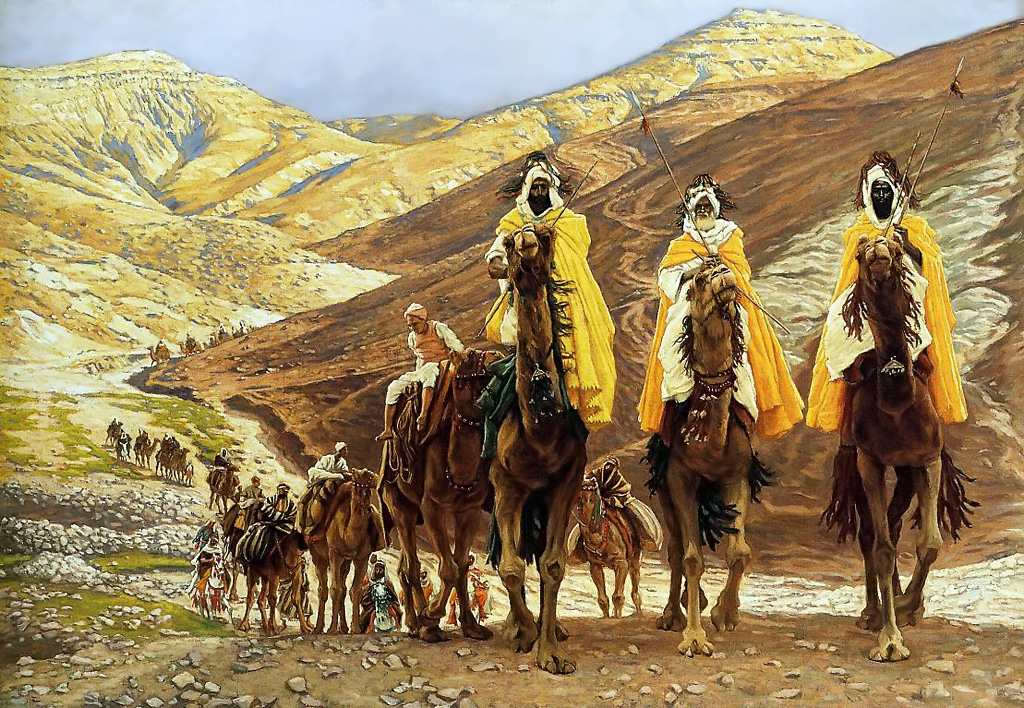
Now when Jesus was born in Bethlehem of Judaea in the days of Herod the king, behold, there came wise men from the east to Jerusalem saying, “Where is He that is born King of the Jews? For we have seen His star in the east, and are come to worship Him.” When Herod the king had heard these things, he was troubled, and all Jerusalem with him. And when he had gathered all the chief priests and scribes of the people together, he demanded of them where Christ should be born. And they said unto him, “In Bethlehem of Judaea: for thus it is written by the prophet, ‘And thou Bethlehem, in the land of Juda, art not the least among the princes of Juda: for out of thee shall come a Governor, that shall rule my people Israel.’” Then Herod, when he had privily called the wise men, inquired of them diligently what time the star appeared. And he sent them to Bethlehem, and said, “Go and search diligently for the young child; and when ye have found Him, bring me word again, that I may come and worship Him also.”
When they had heard the king, they departed; and, lo, the star, which they saw in the east, went before them, till it came and stood over where the young child was. When they saw the star, they rejoiced with exceeding great joy. And when they were come into the house, they saw the young child with Mary His mother, and fell down, and worshipped Him. And when they had opened their treasures, they presented unto Him gifts; gold, and frankincense, and myrrh. And being warned of God in a dream that they should not return to Herod, they departed into their own country another way. (Matthew 2:1-12)
And when they were departed, behold, the angel of the Lord appeareth to Joseph in a dream, saying, “Arise, and take the young child and His mother, and flee into Egypt, and be thou there until I bring thee word. For Herod will seek the young child to destroy Him.” When he arose, he took the young child and His mother by night, and departed into Egypt. And was there until the death of Herod that it might be fulfilled which was spoken of the Lord by the prophet, saying, “Out of Egypt have I called my son.” (Matthew 2:13-15)
Then Herod, when he saw that he was mocked of the wise men, was exceeding wroth, and sent forth, and slew all the children that were in Bethlehem, and in all the coasts thereof, from two years old and under, according to the time which he had diligently inquired of the wise men. Then was fulfilled that which was spoken by [Jeremiah] the prophet, saying, “In Rama was there a voice heard, lamentation, and weeping, and great mourning, Rachel weeping for her children, and would not be comforted, because they are not.” (Matthew 2:16-18)
But when Herod was dead, behold, an angel of the Lord appeareth in a dream to Joseph in Egypt, saying, “Arise, and take the young child and His mother, and go into the land of Israel: for they are dead which sought the young child’s life.” And he arose, and took the young child and His mother, and came into the land of Israel. But when he heard that Archelaus did reign in Judaea in the room of his father Herod, he was afraid to go thither: notwithstanding, being warned of God in a dream, he turned aside into the parts of Galilee. And he came and dwelt in a city called Nazareth: that it might be fulfilled which was spoken by the prophets, “He shall be called a Nazarene.” (Matthew 2:19-23)
And when they had performed all things according to the law of the Lord, they returned into Galilee, to their own city Nazareth. And the child grew, and waxed strong in spirit, filled with wisdom. And the grace of God was upon Him. (Luke 2:39-40)