

For I have no pleasure in the death of him that dieth, saith the Lord GOD: wherefore turn yourselves, and live ye. (Ezekiel 18:32)
I could say that I have been a Baptist all of my life having been born on a Sunday morning at 10:00 AM, just in time for Sunday School. However, being a Baptist does not equate to eternal salvation; that happened to me six years later when I listened to and internalized the message that “all have sinned and come short of the glory of God” (Romans 3:23). That being the case, I understood that if my little six-year-old self were to die, I was bound for hell. I also understood that while “the wages of sin is death” (i.e., hell), “the gift of God is eternal life through Jesus Christ our Lord” (Romans 6:23). The only requirement to receive the “gift” was to “confess with thy mouth the Lord Jesus” and “believe in thine heart that God hath raised him from the dead, thou shalt be saved” (Romans 10:9). I was assured that “whosoever shall call upon the name of the Lord shall be saved” (Romans 10:13). I was a “whosoever,” and I had a choice to make. I could confess, believe, and call the name of the Lord and be saved, or continue on in my six-year-old ways and not believe. The choice was mine.
I thank God that His Holy Spirit convicted me of my need to call out to Him to be saved. I did not know then nor since that I was destined from before creation for salvation. That idea has always been foreign to me. I have witnessed to many and led some (I’m sure) to the Lord. In my testimony, I always assured my listener, that the choice was theirs alone.
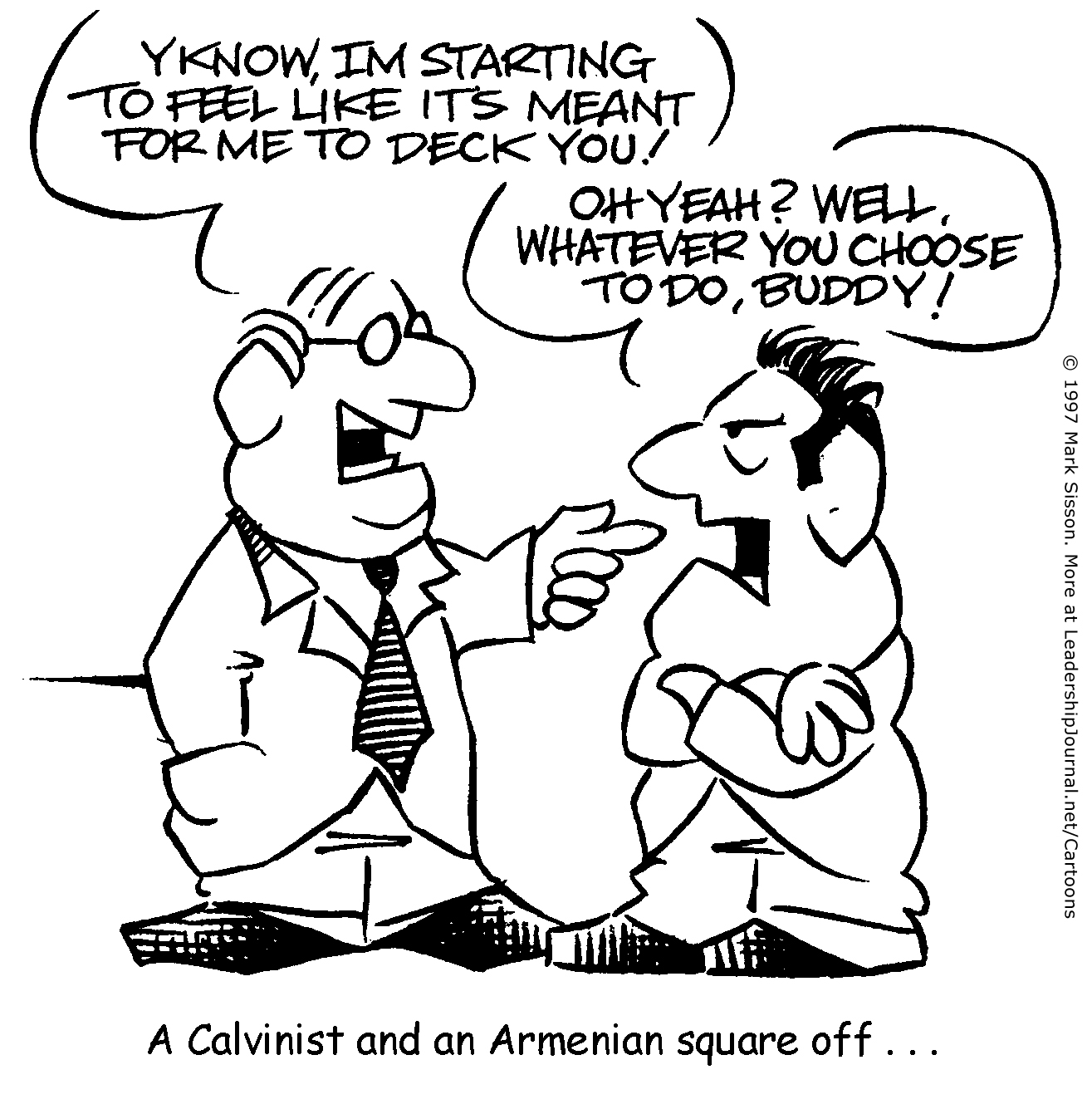
As I said, I have been a Baptist (of the Southern Baptist variety) all of my life, and a born-again Christian for 68 of those years. In all of that time, the concept of “election” applied to those who were born-again by placing their faith and trust in Jesus Christ as Lord and Savior. I knew of the concept of election, i.e., “predestination” as taught by denominations with Calvinist leanings (like Presbyterians) and some “reformed” denominations, but not Baptists. All Baptists I’ve ever known – and here I am referring to pastors or Bible and theology professors – claimed to be either two or three-point Calvinists, which, when distilled, equate to 4-point Armenian with the exclusion of the possibility of “falling from grace.”
As I noted in my last article, “Chose or Chosen? (Rev. 1),” some Christian brothers believe and teach the concept of election/predestination as taught by Calvinists. They believe that God, before Creation, determined those who would be saved. While they will deny that God has predestined those that remain – the unelected ones – to hell, the outcome is the same, i.e., God predestines some to salvation and others to damnation. Not only is that on its face repugnant in light of a loving God who is “not willing that any should perish, but that all should come to repentance” (2 Peter 3:9), but it has no basis in Scripture.
In my article, I listed more than 80 New Testament verses supporting our free will in choosing to accept God’s free gift of salvation and only 15 verses that seem to support predestination. Of those 15 verses, half of them were speaking of the predestined purpose of those who were elect, i.e., to be conformed to the image of Christ.
The difference in view prompted me to seek answers in my systematic theology textbook.[1]There it became obvious that the early church fathers did not hold the doctrine of election in the sense of predestination. Polycarp and Ignatius, who were disciples of the last Apostle, John, and Irenaeus, a disciple of Polycarp, did not hold the doctrine of election. They taught that Jesus died for the sins of all mankind, however, only those who confess Jesus as Lord and Savior can be saved. Many of the later church fathers held the same view. It was not until a thousand years later (1509), when John Calvin came on the scene, that this doctrine of election/predestination took root. It seems to me that those in closer proximity to the apostles would have the best understanding of the atoning work of Christ than someone coming along a thousand years after.
The answer is clear to me; the Calvinist doctrine is flawed. I would not say these brothers are lost. They still teach that one must confess Jesus as Lord and Savior in order to be saved, and that belief is essential for salvation. They just have the curious idea that they were selected for salvation before time began.
I follow the teachings of a man on YouTube by the name of Ken Johnson, Th.D. He also has a website: BibleFacts.org. Ken has done extensive research on the Dead Sea Scrolls having translated many of them into English. His books are available on his website. Anyhow, as I listened in on one of his teachings dealing with the Essenes, a sect of Judaism that existed at the time of Christ, Ken talked about a group of Egyptian Essenes from which the gnostic doctrine of predestination sprang. Ken wrote a book on the topic, The Gnostic Origins of Calvinism.[2]
I wasted no time ordering and reading through the book (just over 100 pages). I learned that at the time of Jesus, there were actually two groups of Essenes: those who lived in the Qumran and who gave us the Dead Sea Scrolls, and a different group that lived in Egypt. The exact place where this second sect existed is not known for certain, however, it is thought to be at Canopus in Egypt.[3] “These Egyptian Essenes mixed many of the rites of magic and paganism into a Jewish context. Like most who deny the resurrection of the physical body, these Egyptian Essenes ended up believing in reincarnation, evolution, and predestination based on the doctrine of emanations” (emphasis mine).[4] Ken points out that Simon Magus – the Simon of Acts 8:9-24 who wanted to purchase the power of giving the Holy Spirit – according to Irenaeus, was the father of the Gnostic cults.
The Gnostics had many strange beliefs, but among them was the idea of predestination. “Gnosticism taught that there are thirty aeons (gods) that exist in the Pleroma, outside time and space.[5] Sophia, created the demiurge, a creator angel (the God of the Old Testament) who was a tyrant; and being unaware of the aeons, thought he was the only God. He created man; but Sophia gave man a spirit[6] … Gnostics have spirits that are emanations from Sophia. This makes them predestined to be saved. It is imposable [sic] for them to lose their salvation. It does not matter if their behavior is good or evil.”[7]
“The father of church history, Eusebius, mentions John Mark came to Alexandria, Egypt,[8] and established the first church there. As it began to grow, persecutions came and Mark was killed by pagans. Shortly thereafter, some of the Egyptian Essenes mixed strict Christan doctrine with their Jewish/pagan rites. These Gnostics called themselves the Therapeute.”[9] This doctrine of predestination has been around since the founding of the Church, but it was totally rejected by the early church fathers.
Fast forwarding to John Calvin (get Ken Johnson’s book to fill in the blanks), he “used his skill in law to find historical documents that might legally weaken Rome’s hold on the [Catholic] people. He found nothing until he went all the way back to the writings of Augustine. He understood that if he could remove the unpalatable Gnostic doctrines from the writings of Augustine, the Manicheans, and the Valentinian Gnostics, and just use their idea of predestination, it would destroy the Pope’s hold on the people. The Pope of Rome could not send anyone to hell or insure [sic] their salvation if they were already predestined for heaven or hell, especially if that predestination could never be changed. Calvin published his first edition of The Institutes of the Christian Religion in AD 1536.”[10]
Here are just some quotations from the early church fathers cited by Ken Johnson:
God only blinds the minds of those who chose not to believe and have already rejected Him. In Romans [Chapter 1], those who would not retain God in their knowledge He gave over to a reprobate mine. In 2 Thessalonians [Chapter 2], to those who did not receive the love of the truth, strong delusion is sent to believe the lie. God knows the number of those who will not believe, since He foreknows all things, has given them over to unbelief. – Irenaeus, Against Heresies 4.29 (emphasis mine)
Man has the ability to distinguish good from evil. He has the power by his own free will to perform God’s commandments. This is taught in Romans [Chapter 2]. God does not compel people to salvation, so those who have apostatized have done so through their own fault. God allows them to blind themselves. – Irenaeus, against heresies 4.29 (emphasis mine)
The ability to freely choose salvation is a gift given by God. True faith produces repentance. – Clement of Alexandria, Stromata 2.4
Paul [Romans 3:10-18] refers to those Jews and Gentiles who blind themselves. No one is born this way. – Irenaeus, Against Heresies 1.19 (emphasis mine)
The church is being predestined to be conformed to the image of Christ. – Irenaeus, Against Heresies 4.37 (emphasis mine)
God made man a free agent from the beginning. This is the ancient law of human liberty, for there is no coercion with God. In man, as well as in angels, He has placed the power of choice. The Gnostic teaching that some men are born good and others are born bad is wrong. Everyone has the power to reject the gospel. God has free will and we do, too, because we are made in His image. God preserved the will of man free and under his own control. We will be brought to perfection in the resurrection. Irenaeus, Against Heresies 4.37 (emphasis mine)
Johnson lists many more citations, but these, I think, should suffice to make the point – the early church fathers did not agree with the Calvinist (Gnostic) view of predestination and held to the doctrine that human beings have a free will to choose or reject God’s free gift of salvation. They also taught that Jesus died for the sins of all mankind – past, present, and future – and that His sacrifice is sufficient for all, but efficient only for those who believe.
As I said in the beginning, I have been a (Southern) Baptist all of my life. Ken pointed something out that may be the reason I am faced with this conflict between election and free will. “The Southern Baptist Convention was originally Calvinist. However, toward the beginning of the twentieth century it became Arminian (not Pelagian) in theology. There is a growing movement inside of the Southern Baptist Convention, however, pushing it to go back to Hyper-Calvinism.”[11] This is probably an overreaction to the growing liberalism within the Convention. Of course, most overreactions to correct one wrong usually move too far in the opposite direction and create a wrong in the other direction. As the old adage says, “Two wrongs don’t make a right.”
Let me reiterate, those who hold this skewed view of election are not lost themselves. They are not heretics. They are my brothers in Christ. John Calvin was a good, godly man who was battling the heresies of the papacy and the Roman Catholic Church. He was a Reformer. However, neither he nor any other man who followed in his footsteps was or is infallible. Only the Word of God is infallible. As we study the works of any good, godly man, we need to carefully line up their words against the words of Scripture.
In his book, Dr. Ken Johnson provided a short list of high-profile Bible teachers who teach Calvinist doctrine: Alistair Begg, Al Mohler, C.J. Mahaney, J.I. Packer, John MacArthur, Jr., Mark Driscoll, Tim Keller, R.C. Sproul, Sr., Robert Schuller, Wayne Grudem.[12] I would not discourage anyone from reading the teachings of these men. I would only make you aware of their Calvinist leanings and encourage you to measure their teachings by the plumbline of God’s Holy Word.
Notes:
[1] Gorden R. Lewis and Bruce A Demarest, Integrative Theology, Volume Two, (Zondervan Publishing House, Grand Rapids, 1990), pp. 371-382.
[2] Ken Johnson, Th.D., The Gnostic Origins of Calvinism, available on Amazon.
[3] https://pubmed.ncbi.nlm.nih.gov/12557736/#:~:text=The%20Essenes%20were%2C%20allegedly%2C%20the,Lake%20Mareotis%20they%20were%20settled.
[4] Johnson, p. 9. Ken’s note on “emanations” – This is the idea that a little piece of God is in each human being. It is found in the Kabbalah but denied by orthodox Jews and Christians.
[5] Johnson, p. 14, citing Irenaeus, Against Heresies 1.1-3
[6] Ibid, Against Heresies 1.5
[7] Johnson, p. 14.
[8] Alexandria, Egypt is one of the places from which the “older and better” Greek texts from which all modern Bibles are translated. These were Gnostic texts that the early church rejected. They are “older and better” because they were better preserved for their lack of use.
[9] Johnson, p. 15.
[10] Ibid, p. 27.
[11] Ibid, p. 44
[12] Ibid. p. 44-45
 Ernie's Musings