[The Bereans] were more noble than those in Thessalonica, in that they received the word with all readiness of mind, and searched the scriptures daily, whether those things were so. (Acts 17:11)
Have you noticed how many churches, especially large mega churches, have compromised on basic biblical teaching? Many churches are going “woke” by tolerating deviant sexual behavior (LGBTQ+), teaching health and wealth theology, promoting the social gospel, supporting the pro-abortion agenda, ordaining woman pastors, declaring the Old Testament of the Bible null and void, and so on. Those are just some of the more obvious falsehoods, but some false teachings are much more subtle.
What surprises me (perhaps it shouldn’t) is how regular churchgoers accept whatever is fed to them without protest. To a certain degree, I understand their lack of awareness. I am retired now, but there was a time when I was busy working and making a living to support a family. I had many distractions then, as I am sure many folks do now. Of course, back then we did not have all those handheld devices that only add to our distractions making us all more than a little scatterbrained. So, when it comes to the things of God or the Bible, we tend to depend on the “experts” to tell us what’s what. After all, we assume that they know about all things biblical and godly because they have been educated in those subjects. So, we trust our religious leaders not to lead us astray.
One of Paul’s stops on his second missionary journey, after spending some time in Thessalonica, was the city of Berea. The text (Acts 17:10-12) does not specify, but Paul’s practice was to go to the Jewish synagogues first and then to the Gentiles. Again, the text does not specify, but apparently, these Bereans were Jews, because they had access to the Scriptures. (I assume Gentiles were not familiar with the Hebrew Scriptures.) The Bereans were notable in that the Holy Spirit inspired Luke to point out their diligence not taking Paul at his word, but they “searched the scriptures daily [to see] whether those things were so” (Acts 17:11). Their diligence to “search the Scriptures” inspired Paul to write to the Corinthians, “I speak as to wise men; judge ye what I say” (1 Corinthians 10:15, emphasis mine). To the Thessalonians, he wrote, “Prove all things; hold fast that which is good” (1 Thessalonians 5:21). In essence, Paul is saying, “Be a Berean; search the Scriptures daily.”
The only answer for unbiblical teaching in our churches is for churchgoers to critically listen to their teachers and weigh their words against the Word of God. Do not assume that what your teachers teach is true, biblical doctrine simply because they have a degree from an accredited seminary. I know; you have too many other distractions that get in the way, and you do not have the spare time for deep Bible study. I suggest you rearrange your priorities. It is not enough to hear it from the pulpit or discuss it in Sunday School once a week. God holds you, not your preachers, responsible for consuming your personal spiritual nutrition. “Study to shew thyself approved unto God, a workman that needeth not to be ashamed, rightly dividing the word of truth” (2 Timothy 2:15). Prefer the meat of God’s Word to the candy passed out from the pulpit. I am not accusing all pastors/teachers of unbiblical teaching, but you are still responsible for holding them accountable to the Word of God. Be a Berean!
Personally, I battle the unbiblical doctrine of “election” as taught by those in the Reformed (Calvinist) Theology camp. I have written about it:
I confronted my former pastor and elders about teaching this unbiblical doctrine. Giving them the benefit of the doubt, I cracked my old systematic theology textbook and boned up on soteriology (the study of salvation/atonement). I learned that the early church fathers did not teach “election” in the same way that Calvinists do. That teaching did not come about until more than 1000 years later from John Calvin. What I learned from my textbooks was good, but it was not The Book. So, I started from Genesis and read through to Revelation. To date, I found more than 169 (and counting) Bible verses and passages that clearly support God’s grace in giving individuals the ability to choose to follow Him or reject Him. Compared to a handful of verses Calvinists use to support their doctrine buttressed only by the flawed human logic of Calvinist authors. Proper hermeneutic demands that Scripture be compared to Scripture (not the works of men). The weight of 169 verses compared to 15 or less (most of those having alternative interpretations) should make clear to anyone that the Calvinist doctrine of election fails to hold water. So, why is it taught? It is because those who teach it are not Bereans. They have taken the word of man over the Word of God. To the church in Colossi, Paul wrote, “Beware lest any man spoil you through philosophy and vain deceit, after the tradition of men, after the rudiments of the world, and not after Christ” (Colossians 2:8, emphasis mine).
So, what do you do if you find yourself under the tutelage of a false teacher? First, you must be a Berean. Compare what is being taught to what the Word of God really says. Yes, I realize that takes effort. However, the perspicuity of Scripture makes it clear and simple to understand. God made His Word easy to understand so that the common man can understand it; sadly, it is the overly educated that make it complicated. Second, once you have searched the Scriptures, bring your complaint to your brother, the pastor/teacher. If you cannot convince him of his error, take another like-minded brother with you. If that does not convince him, then bring it before the church. That is the biblical method of resolving disagreements. If none of that works, Paul says, “Now we command you, brethren, in the name of our Lord Jesus Christ, that ye withdraw yourselves from every brother that walketh disorderly, and not after the tradition which he received of us” (2 Thessalonians 3:6, emphasis mine). The Apostle John offers a similar exhortation: “And I heard another voice from heaven, saying, Come out of her, my people, that ye be not partakers of her sins, and that ye receive not of her plagues” (Revelation 18:4, emphasis mine). Bottom line: be a Berean.
For I have no pleasure in the death of him that dieth, saith the Lord GOD: wherefore turn yourselves, and live ye. (Ezekiel 18:32)
I could say that I have been a Baptist all of my life having been born on a Sunday morning at 10:00 AM, just in time for Sunday School. However, being a Baptist does not equate to eternal salvation; that happened to me six years later when I listened to and internalized the message that “all have sinned and come short of the glory of God” (Romans 3:23). That being the case, I understood that if my little six-year-old self were to die, I was bound for hell. I also understood that while “the wages of sin is death” (i.e., hell), “the gift of God is eternal life through Jesus Christ our Lord” (Romans 6:23). The only requirement to receive the “gift” was to “confess with thy mouth the Lord Jesus” and “believe in thine heart that God hath raised him from the dead, thou shalt be saved” (Romans 10:9). I was assured that “whosoever shall call upon the name of the Lord shall be saved” (Romans 10:13). I was a “whosoever,” and I had a choice to make. I could confess, believe, and call the name of the Lord and be saved, or continue on in my six-year-old ways and not believe. The choice was mine.
I thank God that His Holy Spirit convicted me of my need to call out to Him to be saved. I did not know then nor since that I was destined from before creation for salvation. That idea has always been foreign to me. I have witnessed to many and led some (I’m sure) to the Lord. In my testimony, I always assured my listener, that the choice was theirs alone.
As I said, I have been a Baptist (of the Southern Baptist variety) all of my life, and a born-again Christian for 68 of those years. In all of that time, the concept of “election” applied to those who were born-again by placing their faith and trust in Jesus Christ as Lord and Savior. I knew of the concept of election, i.e., “predestination” as taught by denominations with Calvinist leanings (like Presbyterians) and some “reformed” denominations, but not Baptists. All Baptists I’ve ever known – and here I am referring to pastors or Bible and theology professors – claimed to be either two or three-point Calvinists, which, when distilled, equate to 4-point Armenian with the exclusion of the possibility of “falling from grace.”
As I noted in my last article, “Chose or Chosen? (Rev. 1),” some Christian brothers believe and teach the concept of election/predestination as taught by Calvinists. They believe that God, before Creation, determined those who would be saved. While they will deny that God has predestined those that remain – the unelected ones – to hell, the outcome is the same, i.e., God predestines some to salvation and others to damnation. Not only is that on its face repugnant in light of a loving God who is “not willing that any should perish, but that all should come to repentance” (2 Peter 3:9), but it has no basis in Scripture.
In my article, I listed more than 80 New Testament verses supporting our free will in choosing to accept God’s free gift of salvation and only 15 verses that seem to support predestination. Of those 15 verses, half of them were speaking of the predestined purpose of those who were elect, i.e., to be conformed to the image of Christ.
The difference in view prompted me to seek answers in my systematic theology textbook.[1]There it became obvious that the early church fathers did not hold the doctrine of election in the sense of predestination. Polycarp and Ignatius, who were disciples of the last Apostle, John, and Irenaeus, a disciple of Polycarp, did not hold the doctrine of election. They taught that Jesus died for the sins of all mankind, however, only those who confess Jesus as Lord and Savior can be saved. Many of the later church fathers held the same view. It was not until a thousand years later (1509), when John Calvin came on the scene, that this doctrine of election/predestination took root. It seems to me that those in closer proximity to the apostles would have the best understanding of the atoning work of Christ than someone coming along a thousand years after.
The answer is clear to me; the Calvinist doctrine is flawed. I would not say these brothers are lost. They still teach that one must confess Jesus as Lord and Savior in order to be saved, and that belief is essential for salvation. They just have the curious idea that they were selected for salvation before time began.
I follow the teachings of a man on YouTube by the name of Ken Johnson, Th.D. He also has a website: BibleFacts.org. Ken has done extensive research on the Dead Sea Scrolls having translated many of them into English. His books are available on his website. Anyhow, as I listened in on one of his teachings dealing with the Essenes, a sect of Judaism that existed at the time of Christ, Ken talked about a group of Egyptian Essenes from which the gnostic doctrine of predestination sprang. Ken wrote a book on the topic, The Gnostic Origins of Calvinism.[2]
I wasted no time ordering and reading through the book (just over 100 pages). I learned that at the time of Jesus, there were actually two groups of Essenes: those who lived in the Qumran and who gave us the Dead Sea Scrolls, and a different group that lived in Egypt. The exact place where this second sect existed is not known for certain, however, it is thought to be at Canopus in Egypt.[3] “These Egyptian Essenes mixed many of the rites of magic and paganism into a Jewish context. Like most who deny the resurrection of the physical body, these Egyptian Essenes ended up believing in reincarnation, evolution, and predestination based on the doctrine of emanations” (emphasis mine).[4] Ken points out that Simon Magus – the Simon of Acts 8:9-24 who wanted to purchase the power of giving the Holy Spirit – according to Irenaeus, was the father of the Gnostic cults.
The Gnostics had many strange beliefs, but among them was the idea of predestination. “Gnosticism taught that there are thirty aeons (gods) that exist in the Pleroma, outside time and space.[5] Sophia, created the demiurge, a creator angel (the God of the Old Testament) who was a tyrant; and being unaware of the aeons, thought he was the only God. He created man; but Sophia gave man a spirit[6] … Gnostics have spirits that are emanations from Sophia. This makes them predestined to be saved. It is imposable [sic] for them to lose their salvation. It does not matter if their behavior is good or evil.”[7]
“The father of church history, Eusebius, mentions John Mark came to Alexandria, Egypt,[8] and established the first church there. As it began to grow, persecutions came and Mark was killed by pagans. Shortly thereafter, some of the Egyptian Essenes mixed strict Christan doctrine with their Jewish/pagan rites. These Gnostics called themselves the Therapeute.”[9] This doctrine of predestination has been around since the founding of the Church, but it was totally rejected by the early church fathers.
Fast forwarding to John Calvin (get Ken Johnson’s book to fill in the blanks), he “used his skill in law to find historical documents that might legally weaken Rome’s hold on the [Catholic] people. He found nothing until he went all the way back to the writings of Augustine. He understood that if he could remove the unpalatable Gnostic doctrines from the writings of Augustine, the Manicheans, and the Valentinian Gnostics, and just use their idea of predestination, it would destroy the Pope’s hold on the people. The Pope of Rome could not send anyone to hell or insure [sic] their salvation if they were already predestined for heaven or hell, especially if that predestination could never be changed. Calvin published his first edition of The Institutes of the Christian Religion in AD 1536.”[10]
Here are just some quotations from the early church fathers cited by Ken Johnson:
God only blinds the minds of those who chose not to believe and have already rejected Him. In Romans [Chapter 1], those who would not retain God in their knowledge He gave over to a reprobate mine. In 2 Thessalonians [Chapter 2], to those who did not receive the love of the truth, strong delusion is sent to believe the lie. God knows the number of those who will not believe, since He foreknows all things, has given them over to unbelief. – Irenaeus, Against Heresies 4.29 (emphasis mine)
Man has the ability to distinguish good from evil. He has the power by his own free will to perform God’s commandments. This is taught in Romans [Chapter 2]. God does not compel people to salvation, so those who have apostatized have done so through their own fault. God allows them to blind themselves. – Irenaeus, against heresies 4.29 (emphasis mine)
The ability to freely choose salvation is a gift given by God. True faith produces repentance. – Clement of Alexandria, Stromata 2.4
Paul [Romans 3:10-18] refers to those Jews and Gentiles who blind themselves. No one is born this way. – Irenaeus, Against Heresies 1.19 (emphasis mine)
The church is being predestined to be conformed to the image of Christ. – Irenaeus, Against Heresies 4.37 (emphasis mine)
God made man a free agent from the beginning. This is the ancient law of human liberty, for there is no coercion with God. In man, as well as in angels, He has placed the power of choice. The Gnostic teaching that some men are born good and others are born bad is wrong. Everyone has the power to reject the gospel. God has free will and we do, too, because we are made in His image. God preserved the will of man free and under his own control. We will be brought to perfection in the resurrection. Irenaeus, Against Heresies 4.37 (emphasis mine)
Johnson lists many more citations, but these, I think, should suffice to make the point – the early church fathers did not agree with the Calvinist (Gnostic) view of predestination and held to the doctrine that human beings have a free will to choose or reject God’s free gift of salvation. They also taught that Jesus died for the sins of all mankind – past, present, and future – and that His sacrifice is sufficient for all, but efficient only for those who believe.
As I said in the beginning, I have been a (Southern) Baptist all of my life. Ken pointed something out that may be the reason I am faced with this conflict between election and free will. “The Southern Baptist Convention was originally Calvinist. However, toward the beginning of the twentieth century it became Arminian (not Pelagian) in theology. There is a growing movement inside of the Southern Baptist Convention, however, pushing it to go back to Hyper-Calvinism.”[11] This is probably an overreaction to the growing liberalism within the Convention. Of course, most overreactions to correct one wrong usually move too far in the opposite direction and create a wrong in the other direction. As the old adage says, “Two wrongs don’t make a right.”
Let me reiterate, those who hold this skewed view of election are not lost themselves. They are not heretics. They are my brothers in Christ. John Calvin was a good, godly man who was battling the heresies of the papacy and the Roman Catholic Church. He was a Reformer. However, neither he nor any other man who followed in his footsteps was or is infallible. Only the Word of God is infallible. As we study the works of any good, godly man, we need to carefully line up their words against the words of Scripture.
In his book, Dr. Ken Johnson provided a short list of high-profile Bible teachers who teach Calvinist doctrine: Alistair Begg, Al Mohler, C.J. Mahaney, J.I. Packer, John MacArthur, Jr., Mark Driscoll, Tim Keller, R.C. Sproul, Sr., Robert Schuller, Wayne Grudem.[12] I would not discourage anyone from reading the teachings of these men. I would only make you aware of their Calvinist leanings and encourage you to measure their teachings by the plumbline of God’s Holy Word.
Notes:
[1] Gorden R. Lewis and Bruce A Demarest, Integrative Theology, Volume Two, (Zondervan Publishing House, Grand Rapids, 1990), pp. 371-382.
[2] Ken Johnson, Th.D., The Gnostic Origins of Calvinism, available on Amazon.
[4] Johnson, p. 9. Ken’s note on “emanations” – This is the idea that a little piece of God is in each human being. It is found in the Kabbalah but denied by orthodox Jews and Christians.
[5] Johnson, p. 14, citing Irenaeus, Against Heresies 1.1-3
[8] Alexandria, Egypt is one of the places from which the “older and better” Greek texts from which all modern Bibles are translated. These were Gnostic texts that the early church rejected. They are “older and better” because they were better preserved for their lack of use.
For many are called, but few are chosen. (Matthew 22:14)
Some Christian brothers have strong Calvinist leanings. I accept most of the five points of Calvinism to some degree – Total Depravity, Unconditional Election, Limited Atonement, Irresistible Grace, and Perseverance of the Saints (T.U.L.I.P.) – but I cannot fully embrace U, L, and I. I completely agree with T and P – the Total Depravity of man, and the Perseverance of the Saints, i.e., “once saved, always saved.”
As already noted, the points that give me the most grief are U and L. Unconditional Election says that God predetermined from the beginning of time who would be saved, and by default, who would be damned for eternity. The argument is that God is sovereign, and He can do exactly as He pleases (no argument there). A favorite verse used to make this point is Romans 9:15 “For he saith to Moses, I will have mercy on whom I will have mercy, and I will have compassion on whom I will have compassion.” Here Paul referred to the time when Moses wanted to “see” God’s glory and God responded, “And he said, I will make all my goodness pass before thee, and I will proclaim the name of the LORD before thee; and will be gracious to whom I will be gracious, and will shew mercy on whom I will shew mercy” (Exodus 33:19, emphasis mine). Clearly, God was not speaking in soteriological terms. Indeed, neither was Paul in making the reference to Moses. When taken in context, Paul was referring to God’s sovereignty in determining the course of salvation in general, not in particular.
Limited Atonement builds on Unconditional Election. Limited Atonement says that Jesus died only for those who were unconditionally elected for salvation. That eliminates all the “whosoever” verses beginning with John 3:16 “For God so loved the world, that he gave his only begotten Son, that whosoever believeth in him should not perish, but have everlasting life” (emphasis mine). Since the Bible is always true and does not contradict itself in any way, this verse alone should serve to debunk Limited Atonement.
To a limited degree, I also disagree with Irresistible Grace. That teaches that when the Holy Spirit, Who convicts the individual’s heart of sin (John 16:8) and convinces him of his need for the Savior, calls on the individual’s heart, that call cannot be rejected. The “call” is ubiquitous (Romans 1:20), however, it is felt more strongly in some than it is in others. Thus, it can indeed be resisted, and more resist the call than respond to it (Matthew 7:13-14).
The Bible speaks to both man’s freedom in choosing and God’s work of “election.” I maintain that the answer is “Somewhere in the Middle,” and neither side of the argument can hold his view dogmatically.
The debate continues. I have made my case and the other side made their case. Neither side convinced the other, which is usually the case. However, since this debate keeps coming up, I determined to “Search the Scriptures; for in them ye think ye have eternal life: and they are they which testify of me” (John 5:39). I looked in the New Testament for all the verses I could find related to salvation for the individual. I divided my findings into three categories: (1) Choice/Free Will, (2) Predestination/Election, and (3) verses that can apply to both sides. Here is what I found: for Category 1, there were more than 80 verses; for Category 2, there were 15 verses. Of those, seven, when read in context, suggest that the “predestination” is of “purpose” not of salvation; for Category 3 there were 17. Rather than argue one side or the other, I think it best to allow the Bible to speak for itself, and the reader can decide for himself.
Verses for Category 2: Luke 10:22; John 6:37, 44, 65; 17:24; Romans 8:33;* Ephesians 1:5, 11; 2:10;* Colossians 3:12; 2 Thessalonians 2:13; 2 Timothy 2:10;* Titus 1:1;* 1 Peter 1:2;* 2 John 1:1, 13. The passages marked with an asterisk (*) speak of predestination, but when examined closely, the predestination is a “Predestination of Purpose” not predestination for salvation. In other words, it is the predetermined plan God has for those who are “justified” having placed their faith in the atoning work of Christ on the cross. As I read these passages my conclusion is that those who are “elect” are “elected” by virtue of their faith in Christ for salvation and their “predestination” is to be conformed to the image of Christ.
The message of the Gospel is simple. The Lord Jesus Christ left His place in Glory, took on human flesh (John 1:14; Philippians 2:5-11), took the penalty of our sins upon Himself, and shed His own blood on the cross to pay our sin debt. He was buried in a borrowed tomb and rose again on the third day, conquering death and the grave on our behalf to win our salvation (1 Corinthians 15:1-8). He did that for “whosoever” will accept His free, “grace” gift of salvation by faith in His finished work. “For God so loved the world, that he gave his only begotten Son, that whosoever believeth in him should not perish, but have everlasting life” (John 3:16). “Whosoever” accepts His offer by “believing in Him” is “elected” for “everlasting life.” This is the whole message of Christmas.
When one reads the Bible’s plain teaching on the topic of salvation (soteriology), the overwhelming weight of evidence supports the truth that the individual has a choice – to accept or reject – God’s free gift of salvation. So, from where does this doctrine of “election” – that God predetermines who will be saved – come? It does not come from Scripture if one truly believes in “Sola Scriptura.” The question prompted me to blow the dust off of my systematic theology textbook and review the section on soteriology. The authors of my textbook ask, “For whom did Christ die? Did the Father send his [SIC] Son into the world to die for all persons or only for the elect?”[1]
In my reading, I learned that the early church fathers, by and large, did not hold to the doctrine of election, at least not in the way proposed by John Calvin. “The apostolic fathers advanced no single theory of the atonement, but articulated a number of biblical motifs.”[2]
“Irenaeus interpreted Christ’s death as a victory over sin, death and the Devil … Christ conquered Satan, thereby freeing believing (emphasis mine) sinners from his power and giving them eternal life.”[3] Given that believing is a prerequisite for salvation, it makes sense that Jesus died for believers; however, that does not imply election. “Athanasius taught that in order to solve the problem posed by human sin and condemnation God sent the divine Word into the world. In his [SIC] body the Son bore the penalty and paid the debt that sinners owed to God. Thus Christ offered ‘the sacrifice on behalf of all, surrendering his own temple [body] to death in place of all, to settle man’s account with death and free him from the primal transgression’” (emphasis mine).[4]
“Concerning the intent or purpose of the atonement, most patristic authorities held that Christ died for the sins of the world. Athanasius maintained that in the divine scheme of things ‘death there had to be, and death for all, so that the due of all might be paid.’ Cyril of Jerusalem affirmed that ‘Jesus truly suffered for all men.’ While not speaking clearly on the issue, Augustine seemed to suggest that Christ died for the world, although the cross is effectual only for those who believe[5] (emphasis mine).
Later, Anselm of Canterbury (1033-1109) said that “adequate satisfaction [for sin] must come from one who is divine, that is, from God himself [SIC]. On the other hand, satisfaction must be paid by one who genuinely represents humanity … the sinless Jesus Christ voluntarily suffered and died, thereby accruing more merit than needed to pay the debt humanity owed. God accepted the surplus of Christ’s passion, credited it to the account of the sinful race, and thus is disposed to restore fellowship all who trust Christ’s saving provision”[6] (emphasis mine). “The English Reformer John Wycliffe also followed the main lines of the Anselmic satisfaction motif.”[7] That further supports the idea that Jesus’ sacrifice on the cross was sufficient for all mankind, but efficient only for those who believe. “Luther taught that Christ in his [SIC] life and death bore the sin, guilt, and punishment of a condemned race … As a result of his [SIC] propitiatory sacrifice, Christ frees trusting souls from the curse of the law; reconciles God and sinners; imparts perfect righteousness; and conquers sin, death and the Devil” (emphasis mine).[8]
Later came Arminius and Calvin who developed their differing views on the atonement. In opposition to the Calvinist view of Limited Atonement, “Arminian theologians consistently uphold a universal atonement: Christ died for the purpose of providing salvation for the entire world. Thus Arminius succinctly affirmed: ‘Christ died for all men and for every individual.’… The Arminians press their position by asking how persons could be held guilty for refusing to believe what was not intended for them.”[9] In this regard, Arminians hold a more correct view of Christ’s work of atonement in my opinion.
The authors of my text note that “As for John Calvin, several recent scholars believe that although Calvin held to double predestination he also taught a doctrine of unlimited atonement. In his Institutes Calvin wrote, ‘It is certain that the Lord offers us mercy and the pledge of his [SIC] grace both in his [SIC] Sacred Word and his [SIC] sacraments. But it is understood only by those who take Word and sacraments with sure faith, just as Christ is offered and held forth by the Father to all unto salvation, yet not all acknowledge and receive him.’ [SIC] In his later commentaries, Calvin more clearly postulates an unlimited atonement. With regard to Galatians 5:12 Calvin affirms: ‘God commends to us the salvation of all men without exception, even as Christ suffered for the sins of the whole world’” (emphasis mine).[10] Apparently, John Calvin was not all that “Calvinistic.”
“Scholastic Calvinism, however, narrowed the intent of the atonement and claimed that Christ died solely for the purpose of saving the elect, the exact number of whom are actually brought to salvation. Thus proponents argue that the design of the cross was not merely to provide salvation but to secure the salvation of those persons the Father gave to the Son. Christ allegedly died for all who were related to him [SIC], just as Adam sinned for all who were related to him … God purposed to save some persons and to condemn others, the high Calvinist claims that Christ died solely for those predestined to life”[11]
John Owen, a Puritan held in high regard by many who hold to this view of election, presents what to me is a ridiculous argument for the limited atonement of election. “If Christ dies for all and all are not saved, then Christ died ineffectively, which cannot be. If God loves all and not all are saved, then God loves ineffectually, which also cannot be. Thus Christ did not die for all, and God does not love all people. Says Owen: ‘We deny that all mankind are the object of that love of God which moved him [SIC] to send his [SIC] Son to die.’ God’s love is reflected in his [SIC] will to save the elect the heirs of the covenant of grace, for whose sins Christ made satisfaction on the cross. Owen concludes that if the death of Christ accomplishes all that the Father intended, ‘then died he only for those that are in the event sanctified, purged, redeemed, justified, freed from wrath and death, quickened, saved, etc.’ but that all are not thus sanctified, freed, etc., is most apparent: and, therefore they cannot be said to be the proper object of the death of Christ.’”[12] Owen’s conclusion, I believe, comes not from Scripture, but from his own feeble attempt at logic.
Against Scholastic Calvinism, Moses Amyraut, French theologian, proposed the theory of “hypothetical universalism.” “Amyraut insisted that God willed the salvation of all persons on the condition that they believe … Christ died for all persons sufficiently, but for the elect efficiently. Amyraut’s position was championed by later scholars such as Cameron of the Saumar Academy, Richard Baxter, John Bunyon, Samuel Hipkins, and Heinrich Heppe”[13] (emphasis mine).
I contend that the position of the “hyper-Calvinists” are the ideas of men – albeit well-meaning, godly men – and not necessarily the plain teaching of the Bible. Such a narrow soteriological position cannot be supported by “Sola Scriptura” as I attempted to demonstrate above with my list of biblical references in three categories. I encourage the reader to scrutinize those passages laying aside any preconceived ideas that you have been taught in the past. Allow the Bible to speak for itself without the aid of commentators or scholars of the past. The Word of God is perspicuous and perfectly able to speak for itself without outside influence.
Notes:
[1] Gordon R Lewis and Bruce A Demarest, Integrative Theology, Volume Two, (Zondervan Publishing House, Grand Rapids, Michigan, 1990), p. 372.
He is not here, but is risen: remember how he spake unto you when he was yet in Galilee, (Luke 24:6)
Christmas and Easter (I prefer “Resurrection Day”) are the two most important days on the Christian calendar with Resurrection Day being, arguably, the most important of the two. One might argue that we could not have the Resurrection without the Birth, but the Birth without the Resurrection would render both insignificant.
Jesus’ birth came like the birth of any other baby. The Gospel writer Luke records the event taking place in a humble animal shelter visited only by lowly shepherds. However, Luke points out an important fact that is summarily overlooked by most readers. Luke says that, “while they were there, the days were accomplished that she should be delivered” (Luke 2:6, emphasis mine). So, apparently, Joseph and Mary had been in Bethlehem a few days before the time of her delivery. Luke does not say, but it seems reasonable that in Bethlehem there were ladies who, seeing a young woman ready to give birth, would have offered their services as midwives. That is the way they did it in those days. Regardless, the birth was no different than any other. The conception nine months prior was the “miracle.” At that time, God planted His seed in Mary’s womb without human aid.
So Jesus came into the world and “dwelt among us”[1] and “increased in wisdom and stature, and in favour with God and man” (Luke 2:52). He grew up like any other Jewish boy and probably learned carpentry from His earthly father, Joseph. At the age of 30,[2] the age at which priests enter service,[3] Jesus started His three-year earthly ministry. We know from the four Gospel accounts that His ministry ended with His death on the cross. He was buried in a borrowed tomb and rose on the third day.
But what if the resurrection never happened? Paul put it quite succinctly when he said, “if Christ be not raised, your faith is vain; ye are yet in your sins” (1 Corinthians 15:17). If Jesus did not rise from the grave, His death for our sins is of no avail. We have no hope of eternal life, and, worse, our destiny is in hell. That explains why unbelievers live for this life alone because, for them, this life is all there is. They reject the concept of hell and prefer the idea that death ends it all, or that it begins a new cycle through reincarnation.
Many arguments against the resurrection of Jesus exist that have a long history from the very beginning. Some say that Jesus did not die on the cross but only “swooned” and revived in the cool dampness of the tomb, rolled the two-ton stone away, and walked out. That is a silly theory when one considers the beating, torture, and flogging Jesus received before being nailed to the cross. Also, the Roman soldiers who crucified Him were expert executioners and were familiar with death. Had they suspected that He “swooned,” they would have broken His legs like they did with the other two victims.[4] These were professionals; they knew death. Then, to ensure His death, one of the soldiers ran his spear into his side and punctured the pericardium.[5]
Let us say, for argument’s sake, that this one they failed to recognize and Jesus did indeed pass out. Even if He did revive in the cool tomb, the loss of blood from the beatings and flogging, not to mention the puncturing of his heart sac, would have left Him too weak to roll away the heavy stone – one that took several men to move – by Himself.
Another argument suggests that Jesus’ disciples overpowered the Roman guard posted at the tomb.[6] This too is a silly argument. All four Gospels record how the disciples went into hiding at Jesus’ arrest. They feared for their lives. It seems unlikely that these frightened men, most of them fishermen, and at least one un-calloused tax collector, would dare to take on battle-hardened professional Roman soldiers. However, this fabrication spread from the very beginning. Matthew records that an angel came to roll back the stone and the soldiers on watch were scared stiff.[7] The soldiers, knowing the consequence (death) for failing in their responsibility to keep the tomb secure, went to the chief priests, rather than their leaders, hoping to get a sympathetic hearing about the empty tomb. They made a good choice as the Jewish religious leaders paid them off and covered for them as long as they would spread the lie that the disciples had stolen the body.[8]
Still another argument insists that the women who went to the tomb on Sunday morning were so grief-stricken that they failed to recognize Jesus’ tomb and went to the wrong sepulcher which was empty. This argument simply rejects what Scripture clearly reports. Three of the four Gospels record that the women witnessed the tomb where Jesus was laid.[9] John, who was present at the crucifixion along with Jesus’ mother and the other women, does not say, but it stands to reason that he would have accompanied them to the tomb.
Jesus rose from the dead. If that were not true, the Jews, because of their hatred for Him, only needed to exhume the body and present it to the world, but they had no body. Men have tried and failed to show Jesus’ remains, but they cannot.
Jesus rose from the dead. He conquered death, and because He conquered death, we have the assurance that our sins are covered and we have eternal life with him. “If in this life only we have hope in Christ, we are of all men most miserable. But now is Christ risen from the dead, and become the firstfruits of them that slept [died]. For since by man came death, by man came also the resurrection of the dead. For as in Adam all die, even so in Christ shall all be made alive” (1 Corinthians 15:19-22, emphasis mine). “For if by one man’s [Adam] offence death reigned by one; much more they which receive abundance of grace and of the gift of righteousness shall reign in life by one, Jesus Christ.) Therefore as by the offence of one [Adam] judgment came upon all men to condemnation; even so by the righteousness of one [Jesus] the free gift came upon all men unto justification of life. For as by one man’s [Adam] disobedience many were made sinners, so by the obedience of one [Jesus] shall many be made righteous” (Romans 5:17-19, emphasis mine).
Because Jesus conquered death, we can have the assurance of eternal life with Him. That is why the resurrection matters. If you are not sure where you stand before Jesus, please read my page on “Securing Eternal Life.”
And the LORD opened the mouth of the ass, and she said unto Balaam, What have I done unto thee, that thou hast smitten me these three times? (Numbers 22:28)
My daily Bible reading brings me to the Book of Numbers, and as the name suggests, there are many long, detailed lists of names and numbers, which make for very dry reading. The minutiae serve as an important resource for deep study, but for casual reading, it can be a little boring. It is easy to forget that it is, after all, God’s Word, and God included everything in it for a reason. That said, Numbers does include some interesting accounts that play out later in Scripture.
There is the account in Chapter 11 where the children of Israel complained because all they had to eat was the manna that God sent from heaven every morning. They were tired of the heavenly bread and wanted meat to eat. (Someone rightly questioned, “With all the herds of sheep, goats, and cattle they had with them, how is it they had no meat to eat?” Good question. I do not know the answer.) Their complaining angered God and He sent them quail to eat for a whole month until it was coming out of their nostrils![1] The lesson – don’t complain about what you don’t have, but be thankful for what you do have.
In Chapter 12, Moses’ siblings, Aaron and Miriam, speak against Moses for his marriage to an Ethiopian woman.
Presumably this woman was Zipporah (Ex. 2:21; 4:25), the daughter of Jethro, since there is no other indication that Moses had more than one wife. However she is also called a Midianite (Ex 2:16), and this leaves her identity somewhat uncertain. Ethiopia is Cush in Hebrew, and the Cushites originally settled on the western shores of Arabia before moving across the Red Sea to Ethiopia, being gradually replaced by the Midianites. Thus, the Cushites and the Midianites probably experienced considerable intermingling and intermarriage in the process. Habakkuk 3:7 indicates that Cushan and Midian were sometimes considered equivalent.[2]
Evidently, they felt they were not getting their share of the limelight. “And they said, Hath the LORD indeed spoken only by Moses? hath he not spoken also by us? And the LORD heard it” (Numbers 12:2). The LORD called a meeting of the three. “And he said, Hear now my words: If there be a prophet among you, I the LORD will make myself known unto him in a vision, and will speak unto him in a dream. My servant Moses is not so, who is faithful in all mine house. With him will I speak mouth to mouth, even apparently, and not in dark speeches; and the similitude of the LORD shall he behold: wherefore then were ye not afraid to speak against my servant Moses?” (Numbers 12:6-8, emphasis mine). God struck Miriam with leprosy for only seven days because Moses interceded on her behalf. Aaron, being the high priest, was not stricken, but the sight of his sister’s punishment was lesson enough for him. The lesson – do not speak out against the Lord’s anointed.
In Chapters 13 and 14, we have the account of the 12 spies sent out to spy out the Promised Land. Ten returned with a good news/bad news report. Yes, the land was rich and fruitful as God had promised, but it was also full of giants against whom they felt powerless. Their negative report caused the people to become fearful. Only two, Caleb and Joshua encouraged the people saying that God would fight for them to give them the land. However, the people listened to the ten negative reports rather than the two positive ones. They were ready to choose a new leader and return to their life of slavery in Egypt. This too angered the LORD, and He was ready to smite them all with plague and start all over with just Moses. But Moses interceded for the people and assuaged God’s wrath, but not without consequences for the people. For forty years they would wander in the desert until the last of the fearful died out in the desert, except for Caleb and Joshua. Hearing the LORD’s decree, the people repented and took it upon themselves to go fight against the Amalekites on their own. That did not work out well for them and the Amalekites whooped up on them! The lesson – when you trust in your own strength and abilities, you will certainly fail. It always works out better when you trust God to fight your battles.
There is also the account of the sons of Korah, Levites, who rebelled against Moses and Aaron, Chapter 16. These were swallowed up by the ground. Again, don’t mess with God’s anointed. The fate of Korah’s sons failed to penetrate the brains of those that remained, so they continued to “murmur,” and they came against Moses and Aaron. Once more, God was ready to wipe them all out, but Moses and Aaron interceded for the people.
Even so, God sent a plague that killed 14,700 of them.[3]Chapter 17 records another strange event. Following the rebellion, God had Moses gather the heads of the 12 tribes with their staffs (walking sticks) to lay before the Testimony (i.e., the Ark of the Covenant). Each staff bore the name of its respective tribe. Aaron’s staff was also placed among them. To settle who God selected as leader, that man’s staff would blossom. Keep in mind, these staffs were made of hard, dead wood completely devoid of life and completely incapable of producing fruit. All staffs were laid before the Ark that resided in the Holy of Holies. The following morning, Aaron’s staff blossomed and produced almonds.[4] “And the LORD said unto Moses, Bring Aaron’s rod again before the testimony, to be kept for a token against the rebels; and thou shalt quite take away their murmurings from me, that they die not” (Numbers 17:10).
God made it perfectly clear who He had selected to lead the congregation. Yet with all of his qualities, Moses was not perfect. Chapter 20 records what was arguably Moses’ greatest failure. Their wanderings in the desert brought the children of Israel to Kadesh where they found themselves without water once again. As was their pattern, they started whining to Moses about their lack of water and accusing him of having brought them out to the desert to die. Understandably, Moses was more than a little angry with the people, but he took their complaint before the LORD. God told Moses to gather the people around a large rock that was there. He told Moses to “speak” to the rock and that it would bring forth water. “And Moses took the rod from before the LORD, as he commanded him. And Moses and Aaron gathered the congregation together before the rock, and he said unto them, Hear now, ye rebels; must we fetch you water out of this rock? And Moses lifted up his hand, and with his rod he smote the rock twice: and the water came out abundantly, and the congregation drank, and their beasts also. And the LORD spake unto Moses and Aaron, Because ye believed me not, to sanctify me in the eyes of the children of Israel, therefore ye shall not bring this congregation into the land which I have given them” (Numbers 20:9-12, emphasis mine). Moses’ failure was not that he struck the rock, but that he did not speak to it as instructed. His failure was that he took the credit for bringing water out of the rock rather than attributing the credit to God. His punishment was that he would not lead the people into the Promised Land. The lesson – when God tells you to do something, do it the way He says to do it and not like you think it ought to be done.
The next chapter records an account repeated in the New Testament making the previous lesson clear. In Chapter 21, the Canaanite king, Arad, made an unprovoked attack on the Israelite camp and took some captive. Israel made a vow to God to utterly destroy all the cities of the Canaanites if He would deliver them into their hands. God granted their request, but along the way, they started complaining “because of the way.”[5] God must have thought, “You think this is tough, I’ll show you tough,” so He sent fiery serpents to bite them and many were dying. It did not take long for them to repent and cry out to Moses to save them. So, God instructed Moses to make a brass serpent and put it atop a pole. Then, when anyone was bitten, all they needed to do was look up at the serpent on the pole and they would not die from the snake bite. Jesus referred to this event when He spoke to Nicodemus. “And as Moses lifted up the serpent in the wilderness, even so must the Son of man be lifted up: That whosoever believeth in him should not perish, but have eternal life” (John 3:14-15). There is no other cure for the sting of sin. “Jesus saith unto him, I am the way, the truth, and the life: no man cometh unto the Father, but by me” (John 14:6, emphasis mine). The lesson – God has provided only one way to survive the sting of death; there is no other way.
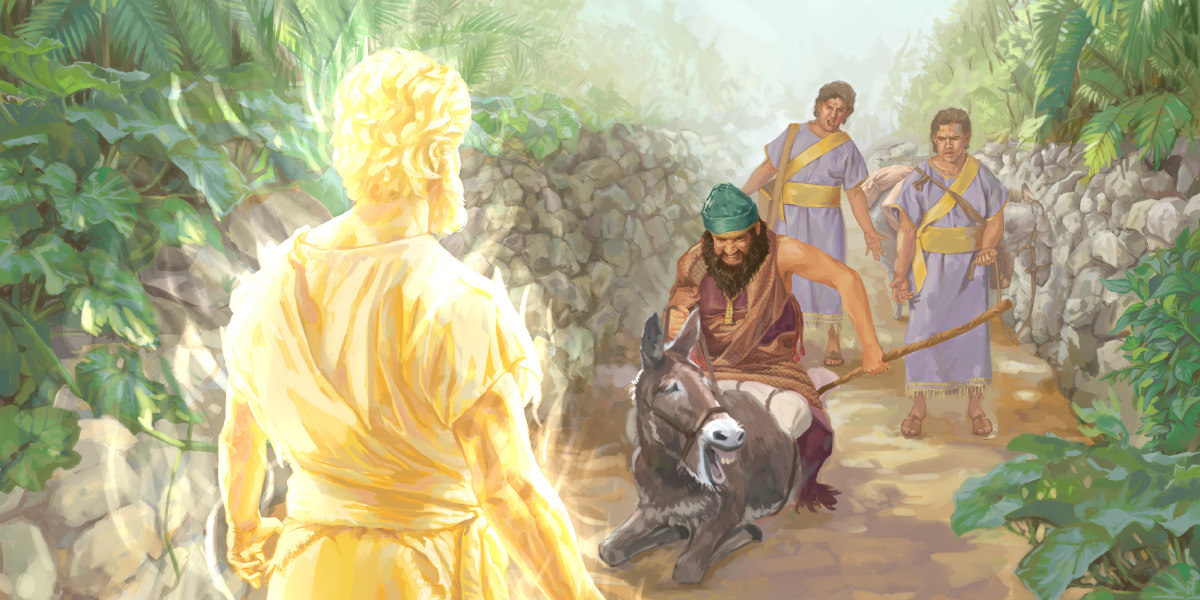
I now arrive at the subject of my provocative title. The children of Israel were nearing the end of their wanderings in the wilderness. They were approaching the borders of Moab. The Moabites were the descendants of one of Lot’s daughters.[6]Numbers 22-24 records the encounter between Moab and Israel. Balak, the king of Moab, heard about the approach of the Israelites, and God’s reputation preceded them. “And Moab was sore afraid of the people, because they were many: and Moab was distressed because of the children of Israel” (Numbers 22:3). Balak got the great idea to hire Balaam to curse Israel, “for,” he said, “I [know] that he whom thou blessest is blessed, and he whom thou cursest is cursed” (Numbers 22:6). However, Balaam assured him that he could only speak as the LORD directed him, so he turned down the job. Balak would not be deterred. He sent a second delegation with a greater offer. When Balaam consulted with God about the matter, God instructed him to return with the delegation, but that he should only speak the words He gave him. So, the next day, Balaam saddled his donkey (ass) and went to see Balak. Along the way, “the Angel of the Lord with sword drawn” confronted him. Balaam did not see Him, but the donkey did, and she veered off the main road. That angered Balaam and he beat the donkey and tried to force her back on the main road. There was a stone wall along one side of the road, and when the donkey saw the Angel of the Lord, she went up against the wall and knocked Balaam off her back. That really made Balaam angry, and he beat her again. The Angel of the Lord moved further down the road again to a place where the donkey could not get around, so she just dropped down. Balaam got off and started beating her again. Then the most remarkable thing happened. “And the LORD opened the mouth of the ass, and she said unto Balaam, What have I done unto thee, that thou hast smitten me these three times?” (Numbers 22:28). What is even more remarkable is that Balaam was not taken aback because the donkey talked. Instead, he engaged her in conversation. “And Balaam said unto the ass, Because thou hast mocked me: I would there were a sword in mine hand, for now would I kill thee” (Numbers 22:29). The donkey then laid a guilt trip on Balaam. “And the ass said unto Balaam, Am not I thine ass, upon which thou hast ridden ever since I was thine unto this day? was I ever wont to do so unto thee? And he said, Nay” (Numbers 22:30).
At that point, God opened Balaam’s eyes so that he could see what the donkey saw. Balaam saw the pre-incarnate Christ with a sword drawn. “And the angel of the LORD said unto him, Wherefore hast thou smitten thine ass these three times? behold, I went out to withstand thee, because thy way is perverse before me: And the ass saw me, and turned from me these three times: unless she had turned from me, surely now also I had slain thee, and saved her alive. And Balaam said unto the angel of the LORD, I have sinned; for I knew not that thou stoodest in the way against me: now therefore, if it displease thee, I will get me back again. And the angel of the LORD said unto Balaam, Go with the men: but only the word that I shall speak unto thee, that thou shalt speak. So Balaam went with the princes of Balak” (Numbers 22:32-35, emphasis mine).
Balaam did go to Balak, and three different times, instead of cursing Israel, to Balak’s chagrin, all Balaam could utter was a blessing upon the children of Israel. In one of those blessings, he foretold the coming of the Messiah. “I shall see him, but not now: I shall behold him, but not nigh: there shall come a Star out of Jacob, and a Sceptre shall rise out of Israel, and shall smite the corners of Moab, and destroy all the children of Sheth” (Numbers 24:17, emphasis mine).
At the end of the chapter, it appears that Balak and Balaam part ways in defeat. In the following chapter, we learn that the children of Israel started fornicating with the Moabite women. The fornication involved more than just illicit sex. The act was part of Baal worship in violation of the first two of the Ten Commandments. God had all the violators hanged or killed by the non-participants.
When we read further, we learn that Balaam had something to do with Israel’s sin. “And the LORD spake unto Moses, saying, Avenge the children of Israel of the Midianites: afterward shalt thou be gathered unto thy people” (Numbers 31:1-2). This event took place just prior to Israel entering the Promised Land. “And they warred against the Midianites, as the LORD commanded Moses; and they slew all the males. And they slew the kings of Midian, beside the rest of them that were slain; namely, Evi, and Rekem, and Zur, and Hur, and Reba, five kings of Midian: Balaam also the son of Beor they slew with the sword” (Numbers 31:7-8, emphasis mine). The Midianite women they took captive for which Moses reprimanded them. “And Moses said unto them, Have ye saved all the women alive? Behold, these caused the children of Israel, through the counsel of Balaam, to commit trespass against the LORD in the matter of Peor, and there was a plague among the congregation of the LORD” (Numbers 31:15-16, emphasis mine). So, Balaam did not just give up in defeat. He counseled Balak to seduce the men of Israel to fornicate in worship to Baal.
Evidently, Balaam was paid for his advice to Balak. The Apostle Peter writes, “… cursed children Which have forsaken the right way, and are gone astray, following the way of Balaam the son of Bosor, who loved the wages of unrighteousness” (2 Peter 2:14-15, emphasis mine). Jude adds, “Woe unto them! for they have gone in the way of Cain, and ran greedily after the error of Balaam for reward, and perished in the gainsaying of Core” (Jude 1:11, emphasis mine). Jesus Himself affirmed as much. “But I have a few things against thee, because thou hast there them that hold the doctrine of Balaam, who taught Balac to cast a stumblingblock before the children of Israel, to eat things sacrificed unto idols, and to commit fornication” (Revelation 2:14, emphasis mine). At least Balaam’s donkey was smart enough not to try to circumvent the Lord’s will. The lesson – you need to be at least as smart as Balaam’s donkey and not try to find a way around God’s will. In the end, you lose.
However, the greater lesson I learned through my reading in Numbers is that even though Israel is constantly obstinate against God (even today – their majority is secular), God is consistently faithful to His promise to Abraham, and He will bless those who bless Israel and curse those who curse Israel. Would that our government would learn that lesson. Our puppet president is making all the wrong decisions in opposition to Israel – cursing Israel. That will only result in God cursing our country. And, if you are paying attention, God has already removed His hand of blessing from our nation. Do not be fooled. Israel will survive without the US, but the US will fade from its former place of greatness. “Be not deceived; God is not mocked: for whatsoever a man soweth, that shall he also reap” (Galatians 6:7).





 Ernie's Musings