Category Archives: Apologetics

On A Hill Far Away…

And Other Biblical Misconceptions
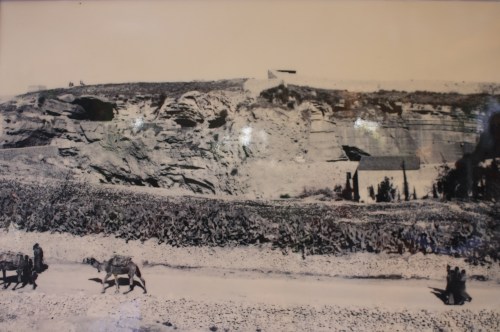
 And he bearing his cross went forth into a place called the place of a skull, which is called in the Hebrew Golgotha: (John 19:17)

With the forthcoming opening of the ICR Discovery Center for Science and Earth History, I and a co-laborer (whom I cannot name because I did not request his permission) have been honored with the task of creating the scenery for the Life of Christ Diorama that will reside across from the Empty Tomb exhibit. An ICR benefactor donated the diorama for exhibition in the Discovery Center. The set contains thousands of pieces – buildings, tents, people, animals, furnishings, etc. – fabricated mostly by an Italian company. The extensive collection cannot all fit in the space allotted, so our leaders determined only to display pivotal scenes in the life of Christ.

Not to give away all the details of the diorama, I want to focus on the crucifixion scene. Where to position the crucifixion scene came into question. Should it be elevated on top of a hill or should it be placed on a lower level between the road and the hill? As Christians, we know the familiar words of the old hymn, “The Old Rugged Cross.” The lyrics say, “On a hill far away, stood an old rugged cross…” I do not know if it is due to the lyrics of the beloved hymn or due to some other handed down tradition, but we all imagine that Jesus was crucified at the top of Mount Calvary. However, musical lyrics or timeless tradition should not be the basis for what we believe. What does the Bible say?

And when they were come unto a place called Golgotha, that is to say, a place of a skull… (Matthew 27:33)

And they bring him unto the place Golgotha, which is, being interpreted, The place of a skull. (Mark 15:22)

And when they were come to the place, which is called Calvary, there they crucified him, and the malefactors, one on the right hand, and the other on the left. (Luke 23:33)

And he bearing his cross went forth into a place called the place of a skull, which is called in the Hebrew Golgotha: (John 19:17) (Emphasis mine)

The Bible does not often provide specific detail of events, but very often it does. The language of the Gospels is Greek. The Greek word for “hill” is either oros or bounos; the latter used only in Luke 3:5, and the former used in several passages in the N.T.[1] Furthermore, Greek prepositions indicate precise positions. The Greek preposition for “on” or “upon” is epi. It means “superimposition,” that is, to be “over” or “upon.” None of the four Gospels give any indication that the crucifixion took place “on a hill called Mount Calvary”[2] regardless of what the song lyrics say. Furthermore, the public spectacle of crucifixion[3] intended as a deterrent against lawlessness took place in the most public of places, usually, a busy roadside where passersby could get a close look at the suffering victims.

I researched, albeit not extensively, information about the location of the crucifixion. Most of the information[4] argues about three possible “places,” and most shy away from making dogmatic statements. The possible locations offered are, The Church of the Holy Sepulcher (which supposedly houses both the crucifixion and burial sites), The Garden Tomb[5] area (which is very near a limestone formation whose face features two prominent grottos that look like the eye sockets of a human skull), or just some unknown place outside of the Old City (of Jerusalem) designated by the Romans for public executions. All of these resources spoke of the “place” but none ventured to suggest whether the crucifixion took place “on” the hill or “by” the hill, but all agreed that it was “at” Golgotha/Calvary.

The “experts” fail to commit to “on” or “by”, but all four Gospels omit the preposition epi (on). To me that says that Jesus was crucified “at” Calvary, not “on” Calvary. My conclusion led me to determine that the diorama will feature the crucifixion scene near the road with a skull-shaped hill in the background. Besides scriptural reasons, there are practical reasons for my decision. A crucifixion on top of a hill, while it might be visible to all, could easily be ignored by passersby thus defeating the deterrent factor of the event. To get a close-up view – and who would want to – would require extra effort making it a disincentive for gathering a crowd, thus defeating the intended purpose of the Romans. However, if the crucifixion took place on a busy road, the only way to avoid the spectacle would be to take the long way around to enter the city. A roadside crucifixion makes more sense to me.

What does that have to do with salvation? Nothing. Jesus dying for you and me on the cross and rising again on the third day matters more than the place or the position. However, there are many non-believers who will find fault with any perceived discrepancy in Scripture. As Christians, we need to “be ready always to give an answer to every man that asketh you a reason of the hope that is in you with meekness and fear” (1 Peter 3:15). Controversies like these will come up. For example: “Jesus said He would be in the grave three days and three nights.[6] There are not three days and three nights between Friday and Sunday. The Bible is wrong!” Another example is the anointing of Jesus. “All the Gospels give accounts of Jesus’ anointing, but they are all different”[7] How would you respond to this challenge? A careful study of Scripture will reveal that there were three separate anointings; Matthew and Mark refer to one before the crucifixion, Luke recounts one before the Transfiguration, and John records one by Mary after Jesus raised her brother Lazarus after four days dead.

Other examples can be cited, but the point is that we need to “Study to shew thyself approved unto God, a workman that needeth not to be ashamed, rightly dividing the word of truth,” (2 Timothy 2:15) rather than relying on song lyrics, traditions, or human scholarship. Do not just read your Bible, study it!

Notes:


[1]  Matthew 5:14; Luke 1:36, 65; 3:5; 4:29; 9:37

[2]  “I Believe In A Hill Called Mount Calvary” – https://www.youtube.com/watch?time_continue=12&v=OPByLTzkctc

[3]  “Crucifixion” – https://en.wikipedia.org/wiki/Crucifixion

[4]  “Where Was Jesus Crucified? – Golgotha ‘the Place of the Skull’” – https://www.biblestudytools.com/bible-study/topical-studies/where-was-jesus-crucified.html

[5] “Jesus’ crucifixion site? (A ‘Skull’, Garden & Tomb)” – https://www.youtube.com/watch?time_continue=7&v=-7fHnnqre1o

[6]  “Three Days, Three Nights” – https://erniecarrasco.com/2014/07/13/three-days-three-nights/

[7]  “Jesus Last Days” – https://erniecarrasco.com/2018/03/25/jesus-last-days/

Comments Off on On A Hill Far Away…

Filed under Apologetics, Bible, Christianity, Religion, Salvation

Dog Evolution

Nacho: “What! You’ve got to be kidding!”

And God said, Let the earth bring forth the living creature after his kind, cattle, and creeping thing, and beast of the earth after his kind: and it was so. (Genesis 1:24)

I came in late from work the other night, warmed up my dinner and joined my wife in front of the television set to watch the last half of “Hawaii 5-0.” I enjoy this show mostly because I do not need to exert much mental capacity to see through the incredible (a.k.a. “unbelievable”) plots.

After the show, June switched the channel to some animal show. She enjoys all kinds of animal shows, veterinarian shows, and weird shows like “Dr. Pimple Popper.” That explains why I do not watch a lot of T.V. Anyway, the channel she landed on dealt with dog evolution. That piqued my interest, so I stretched out on the couch to watch the rest of the show.

The program started out claiming that all dogs “evolved” from wolves. Evolutionists conveniently conflate two distinct forms of evolution and lump them all together and call it all evolution. However, there is a clear distinction which the evolutionists work hard to blur. They would have us believe that microevolution, minor variations within species, is evidence for macroevolution, which teaches that all life forms, i.e., sea creatures, plants, insects, animals, birds, etc. all sprung from a single-cell creature that resulted from some freak chemical reaction of inert material in some primordial pond. Many problems exist with that notion that would prevent anything to come close enough to where microevolution could take place. Evolutionists cannot explain how macroevolution happens, but they know it did happen because we observe microevolution take place. So, let’s just remove the confusion and call it all evolution.

Setting that debate aside, let’s just play along. Evolutionists want to explain the existence of life without a Life Giver and design without a Designer. If everything just popped into existence, perfectly designed to fill all kinds of environmental niches, there is no need for God.

So the T.V. program proclaimed that all dogs evolved from wolves. I agree with that, only I prefer to say that all dogs descended from wolves – two, in fact, the two Noah carried onboard the Ark. “And of every living thing of all flesh, two of every sort shalt thou bring into the ark, to keep them alive with thee; they shall be male and female. Of fowls after their kind, and of cattle after their kind, of every creeping thing of the earth after his kind, two of every sort shall come unto thee, to keep them alive” (Genesis 6:19-20, emphasis mine). That “kind” is the same “kind” that God created back in Genesis 1. We may understand “kind” by the taxonomical term of “family.” Within a “kind,” there exists enough flexibility in the DNA to allow for variation and “speciation.” So from the “wolf kind,” or “canine family” we can get wolves, foxes, jackals, hyenas, dingoes, etc., and our loving canine companions – dogs.

Evolutionists assert that evolution is progressive and that life forms improve through the process, and that weaker forms die off. That is called “survival of the fittest.” However, a close examination of dog evolution shows that the descendants of the pair carried on the Ark, have lost many of the characteristics of the first wolves. Their DNA looses information rather than gaining new information; therefore, it is impossible to breed back up the chain to make wolves out of Chihuahuas.

I found it amusing how the show’s producers discussed breeding programs to “evolve” other varying breeds of dogs. They seemed completely unaware that what they called evolution, which supposedly is a random and purposeless process, actually involved specific purposes determined by an intelligent designer, i.e., the breeder. Great Danes did not just “evolve;” they were bred to be Great Danes by intelligent human beings. Yet somehow, that minor fact seemed to elude the producers of the show.

Wolves did not “evolve” from any other animals. They were created by God in the beginning as the “canine kind.” Dogs and other canine species did not “evolve,” but rather “descended” from wolves (the original canine kind). And the reason we have so many varieties of dogs is that humans, who are created in the image of God (Genesis 1:26-27), exercised their God-given intelligence to selectively breed dogs for specific purposes. So much for dog evolution!

2 Comments

Filed under Apologetics, Dogs, Evolution, Origins, Theology

It Does Matter

For as Jonas was three days and three nights in the whale’s belly; so shall the Son of man be three days and three nights in the heart of the earth. (Matthew 12:40)

Recently I listened to a message on the crucifixion. The message excelled in many respects by providing insight into that fateful day of our Lord’s life. However, one part of the message troubled me. The messenger commented that some theologians believe Jesus was crucified on Friday, while others say He was crucified on Thursday. I know that; I’ve heard those arguments before. That is not what troubled me. What troubled me was his comment that the day on which the crucifixion took place does not really matter. The fact of the crucifixion is what really matters.

WOAH!

It does matter! Jesus said very specifically that “the Son of man [shall] be three days and three nights in the heart of the earth” (Matthew 12:40). That is three full days and three full nights.[1] You cannot get three full days and three full nights from a Friday crucifixion even if you allow for partial days and nights. Why does that matter?

One reason it matters is that “according to one Jewish tradition, the soul hovered about the body for three days in hope of reentering it.”[2] If it were not three full days and nights, then, as some have asserted, He could have resuscitated in the coolness of the tomb and walked out. (There are many problems with that idea, but that rabbit can be chased another day.)

Jesus raised Lazarus four days after his death. Lazarus was so dead that “by this time he stinketh: for he hath been dead four days” (John 11:39). Decomposition had already set in. That being the case, would it have been better for Jesus to remain in the tomb four days rather than three? No, because Scripture predicted that Jesus’ body would not decompose: “For thou wilt not leave my soul in hell; neither wilt thou suffer thine Holy One to see corruption” (Psalm 16:10). For that reason, it needed to be three full days and three full nights – long enough for the spirit to depart (in the estimation of the Jews), yet not long enough for decomposition to set in.

Another argument against a Friday crucifixion finds its basis in history. Most theologians hold the opinion that Jesus was crucified in A.D. 30. Passover, the day on which Jesus was crucified, always falls on Nissan 14 – the fourteenth day of the first month of the year.[3] Nissan 14, 30 A.D. fell on a Wednesday, not a Friday.[4] A Wednesday crucifixion allows for three full nights and three full days, meaning that Jesus would have risen anytime after 6:00 PM on Saturday evening, the first day of the week by Jewish reckoning – the day begins after sundown.

I believe those are good arguments against a Friday crucifixion, but they are not the best argument. The best argument is Jesus’ own words. He very specifically said that He would be in the heart of the earth, i.e., the grave, for three days and three nights. Anything less than that makes Jesus a liar. Do you really want to go there! If we believe God’s Word is inerrant – and Jesus IS God – then we must accept what HE said, and reject what errant men say. It Does Matter!

HE IS RISEN INDEED!

Notes:


[1]  “Three Days, Three Nights” – https://erniecarrasco.com/2014/07/13/three-days-three-nights/

[2]  Herschel Hobbs, The Illustrated Life of Jesus, (Nashville, Holman Bible Publishers, 2000), 183.

[3]  Leviticus 23:5

[4]  http://www.cgsf.org/dbeattie/calendar/?roman=30

2 Comments

Filed under Apologetics, Bible, Christianity, Easter, Gospel, Religion, Resurrection, Theology

April Fools’ Day

The fool hath said in his heart, There is no God. They are corrupt, they have done abominable works, there is none that doeth good. (Psalm 14:1)

We recognize the first day of April as April Fools’ Day. It “is an annual (primarily) Western celebration commemorated on April 1 by playing practical jokes and spreading hoaxes. The jokes and their victims are called April fools. People playing April Fool jokes often expose their prank by shouting ‘April fool(s)’ at the unfortunate victim(s). Some newspapers, magazines and other published media report fake stories, which are usually explained the next day or below the news section in smaller letters. Although popular since the 19th century, the day is not a public holiday in every country. Little is known about the origins of this tradition.”[1]

Victims of harmless pranks can hardly be called “fools.” Anyone is susceptible to deception at the hands of someone they trust. If that is a fool, then we all qualify.

The Bible has a much harsher view of a fool. The epithet is so severe that Jesus said, “whosoever shall say to his brother, Raca, shall be in danger of the council: but whosoever shall say, Thou fool, shall be in danger of hell fire” (Matthew 5:22, emphasis mine). The word “Raca” is of Chaldean origin and it means, “empty or worthless one.” A fool, on the other hand, is one who is “impious[2] or “godless.” Strong’s defines such a one as “dull, stupid or heedless.” The Greek word is mōros, from which we get our word “moron.” It is interesting that Jesus should offer such a severe condemnation as “hell fire” for the offense of calling someone a fool.

Jesus’ prohibition of the application of that word against another person comes at the beginning of His Sermon on the Mount. In the same sermon, He later said, “Judge not, that ye be not judged. For with what judgment ye judge, ye shall be judged: and with what measure ye mete, it shall be measured to you again” (Matthew 7:1-2). This verse gets misquoted and misunderstood often as meaning that we are never to exercise rational discernment about someone’s actions. However, that is not at all what Jesus was saying as subsequent verses reveal. The Greek words translated as “judge” and “judgment” are krinō and krima respectively. Both have to do with making a judgment that results in condemnation and punishment. We get our English words “crime” and “criminal” from these Greek words. The kind of judgment Jesus is describing is reserved for God alone. Therefore, if judging someone as “fool” condemns the one judging to “hell fire,” then the punishment for being a “fool” must also be “hell fire.” We deduce this from Jesus’ words, “with what measure ye mete, it shall be measured to you again.” In other words, because the punishment for being a fool is “hell fire,” then the one judging the fool will receive the same judgment because only God can make that judgment.

The English word “fool” appears often in the Bible translating other Greek or Hebrew words, but the strong word Jesus used, mōros, appears only a few times and always in the context of strong condemnation. For example, in Matthew 7:26 Jesus uses it to describe the “foolish man” who built his house on a foundation of sand. Jesus likens those hear His Word and ignore it to the fool who builds his house on sand. In Matthew 25:1-13, Jesus tells the Parable of the Ten Virgins and He calls the five unprepared virgins “foolish” because they were not ready to meet the bridegroom. The condemnation is they are not allowed into the wedding. Paul warns his young protégés, Timothy and Titus to avoid “foolish” (moronic) questions because they are unprofitable and vain and they only lead to strife.[3]

Our lead verse appears again in Psalm 53:1, “The fool hath said in his heart, There is no God. Corrupt are they, and have done abominable iniquity: there is none that doeth good.” The Hebrew word translated “fool” is nâbâl, and like mōros, it means stupid, wicked, (especially impious). Someone who does not believe in God, or rejects God is a fool. God condemns such a person to “hell fire,” which is why Jesus admonishes us not to make that judgment.

Paul describes how one sinks to that condition:

For the wrath of God is revealed from heaven against all ungodliness and unrighteousness of men, who hold the truth in unrighteousness; Because that which may be known of God is manifest in them; for God hath shewed it unto them. For the invisible things of him from the creation of the world are clearly seen, being understood by the things that are made, even his eternal power and Godhead; so that they are without excuse: Because that, when they knew God, they glorified him not as God, neither were thankful; but became vain in their imaginations, and their foolish heart was darkened. Professing themselves to be wise, they became fools” (Romans 1:18-22, emphasis mine).

By examining this passage more closely, we see that “the wrath of God” – His anger, i.e., “hell fire” – is revealed “against all ungodliness and unrighteousness of men,” i.e., “foolishness.” It is doubtful that “true” atheists exist because here we see that God reveals Himself through His creation. The “invisible things,” like viruses, bacteria, atoms, quarks, etc., clearly testify to the greatness of God. Every human being on earth can see the magnificence of God’s creation so that no one has an excuse for not acknowledging God. Everyone, even the atheist, knows that God exists, but they reject Him and refuse to glorify Him choosing rather to follow their own unintelligent (i.e., foolish) imaginations. As a result, their heart is darkened. This progressive condition results in a “reprobate mind,”[4] i.e., a mind that has lost its ability to properly reason. They think they are wise when in fact they have become fools.

“The fool hath said in his heart, There is no God” (Psalm 14:1; 53:1). And “The way of a fool is right in his own eyes” (Proverbs 12:15). “Every way of a man is right in his own eyes: but the LORD pondereth the hearts” (Proverbs 21:2). We are all fools at some time in our lives. “As it is written, There is none righteous, no, not one: There is none that understandeth, there is none that seeketh after God” (Romans 3:10-11, emphasis mine). We may all start out as fools, but we do not need to remain in that condition. If you do not know the Lord, please read my page on “Securing Eternal Life.” Don’t be an April Fool!

Notes:


[1] Wikipedia, “April Fool’s Day” – https://en.wikipedia.org/wiki/April_Fools%27_Day

[2]  “not pious or religious; lacking reverence for God, religious practices, etc.; irreligious; ungodly” Dictionary.Com definition – https://www.dictionary.com/browse/impious?s=t

[3]  2 Timothy 2:23; Titus 3:9

[4]  Romans 1:28

5 Comments

Filed under Apologetics, Atheism, Christianity, Creation, Current Events, Evangelism, Gospel, Hell, Theology

Purim And 2A

Wherein the king granted the Jews which were in every city to gather themselves together, and to stand for their life, to destroy, to slay, and to cause to perish, all the power of the people and province that would assault them, both little ones and women, and to take the spoil of them for a prey, Upon one day in all the provinces of king Ahasuerus, namely, upon the thirteenth day of the twelfth month, which is the month Adar. (Esther 8:11-12)

Just this week, the Jews celebrated the ancient feast of Purim.[1] Purim is not one of the “Feasts of the Lord” given by God in Leviticus 23. It is a celebration instituted by Jews in commemoration of their salvation from extermination under Persian rule.

Some have questioned whether the Book of Esther belongs in the canon of the Bible because the name of God, in any of its various forms, does not appear anywhere in the book. However, when one reads this account, the unmistakable hand of God is seen working throughout the narrative.

For those unfamiliar with this historical account[2], King Ahasuerus of Persia, became annoyed with his queen Vashti when she refused to dance for his drinking buddies and he removed her from being queen, i.e., he divorced her. The law of the Medes and the Persians was such that when a law was decreed by the king, it could not be rescinded.[3] When Ahasuerus sobered up, he regretted his decision, but the deed was done and could not be undone.

Kings get lonely without a wife and Vashti was gone now. What was the king to do? His servants suggested that Ahasuerus hold a beauty pageant of all the most beautiful virgins of the realm the winner of which would become the new queen. In short, Esther (a.k.a., Hadassah), a Jewess and cousin of Mordecai, who was in the service of the king,[4] was chosen and became the new queen of Persia. The king was unaware of their relationship nor did he know Esther’s ethnicity. As he “sat in the king’s gate” carrying out his duties, Mordecai overheard a plot to kill the king. He relayed the information to Esther who informed the king, and the two would-be assassins were hanged for their treason.

Later, King Ahasuerus promoted a Jew-hater by the name of Haman to a high position. Haman was rather full of himself, and when Mordecai refused to bow down to him – no God-fearing Jew would ever bow down to a mere man – he concocted a plot kill all the Jews in the realm. He convinced the king that all the Jews throughout the kingdom should be killed because they followed their own law and did not submit to the king’s law, i.e. to bow down to Haman. So it was decreed that all the Jews throughout the kingdom would be killed the following year on Adar 13.[5]

When Mordecai heard of the decree, he “rent his clothes, and put on sackcloth with ashes, and went out into the midst of the city, and cried with a loud and a bitter cry” (Esther 4:1). Mordecai pleaded with Esther to go before the king and intercede for her people, but because of palace protocol, Esther could not go before the king without being summoned.

In the meantime, Ahasuerus had trouble sleeping one night and stayed up reading court records. (That should put anyone to sleep!) There he found the record of Mordecai exposing the assassination plot against him that had gone unrewarded. So he summoned his top advisor, Hamon (who just happened to be hanging around looking for some excuse to send Mordecai to the gallows), to determine how to reward someone who had done something very special for the king. Since Ahasuerus did not name the beneficiary, Haman assumed the king was speaking of him.

And Haman answered the king, For the man whom the king delighteth to honour, Let the royal apparel be brought which the king useth to wear, and the horse that the king rideth upon, and the crown royal which is set upon his head: And let this apparel and horse be delivered to the hand of one of the king’s most noble princes, that they may array the man withal whom the king delighteth to honour, and bring him on horseback through the street of the city, and proclaim before him, Thus shall it be done to the man whom the king delighteth to honour” (Esther 6:7-9).

That was just the thing only a narcissist like Haman could appreciate, but the joke was on him when Ahasuerus instructed him to do that very thing for Mordicai.[6] As any humble man might do, Mordecai graciously accepted the accolade, but quietly returned back to his post at the king’s gate. “But Haman hasted to his house mourning, and having his head covered” (Esther 6:13).

The prior day, Esther invited the king and Haman to a banquet she had prepared in her chambers.[7] At the banquet, Esther revealed that she was a Jewess and her people, the Jews had been targeted for slaughter by “this wicked Haman” (Esther 7:6). This angered the king and he ordered that Haman be hanged on the very gallows he constructed for hanging Mordecai. However, because the law could not be abrogated,[8] Ahasuerus authorized Mordecai to write a subsequent law that would allow the Jews to take up arms and defend themselves against anyone who would do them harm.

When Adar (February/March) 13 arrived, when the first law took effect, the Jews met their assailants with equal force. The Jews kill several thousand of their attackers, and Esther records no losses on the part of the Jews. Since the law was instituted to take effect only on that one day, the Jews were safe afterward. “On the thirteenth day of the month Adar; and on the fourteenth day of the same rested they, and made it a day of feasting and gladness” (Esther 9:17).

“And Mordecai wrote these things, and sent letters unto all the Jews that were in all the provinces of the king Ahasuerus, both nigh and far, To stablish this among them, that they should keep the fourteenth day of the month Adar, and the fifteenth day of the same, yearly” (Esther 9:20-21). So was the Feast of Purim established.

So what does this have to do with the Second Amendment (2A) of the United States Constitution? We learn from this account in Esther that an armed populous can defend itself against those who would do them harm or violence. A well established historical fact teaches (for those with the ability to learn) that the first thing a tyrannical government does to subjugate the people is to disarm them. An unarmed populace cannot defend itself against tyranny nor even effectively protest – take Venezuela for example. Take note of the socialist-leaning Democrat Party in the USA and their incessant drumbeat for “gun control.” They are not interested in “gun control.” Most of the leftist elites surround themselves with armed bodyguards and hide behind high walls designed to keep out unwanted invaders. Their main interest is to disarm the populous so that they can control and exercise power over the people. The Second Amendment prevents them from doing that. So whenever some heinous crime takes place involving a firearm of any kind – even if that crime takes place in New Zealand – the cries for stricter gun laws increase in frequency and amplitude.

The One who said, “But I say unto you, That ye resist not evil: but whosoever shall smite thee on thy right cheek, turn to him the other also” (Matthew 5:39), also said, “he that hath no sword, let him sell his garment, and buy one” (Luke 22:36). The Second Amendment is our Purim.

Notes:


[1]  Purim (plural) comes from “Pur” meaning “a lot (as by means of a broken piece)” See Esther 3:7; 9:24, 26.

[2]  This synopsis omits many important details. For a better appreciation of the account, the reader should read the entire book of Esther. It is only 10 short chapters!

[3]  Esther 1:19

[4]  Esther 2:19, 21

[5]  Esther 3:13

[6]  Esther 6:10-11

[7]  Esther 5:1-8

[8]  Esther 8:8

5 Comments

Filed under Apologetics, Current Events, Holidays, Politics, Theology