Category Archives: Apologetics

What Can I Give God?

For every beast of the forest is mine, and the cattle upon a thousand hills. (Psalm 50:10)

I heard a story about two bills that were printed on the same day. One was a one-dollar bill, and the other was a twenty-dollar bill. They became good friends, but as things go with paper money, they were soon separated at the bank and went off in different directions. After many years apart, the two ended up in the same wallet. The one-dollar bill immediately recognized his long lost friend. “Andy! How have you been? What have you been up to?” The twenty-dollar bill responded enthusiastically, “Well, Georgie, let me tell you. I have just been having a grand old time. I have been on several cruises up and down both coasts of the good old USA. I’ve been to all kinds of concerts, and sports events. I have dined at the finest restaurants all over the country. I’ve been having a blast! How about you, Georgie? What have you been up to?” The one-dollar bill sheepishly answered, “Well, you know me, Andy … church, church, church.”

Giving to God is a struggle for many. I could spend a lot of ink offering many scenarios and excuses for why Christians have trouble giving to God, but the simple truth of it is lack of trust in God. Everyone has “X” amount of money coming in, and “X” amount going out and the two Xs have to balance. Unlike the government that makes its money by legalized theft, most people work for a paycheck which is limited by what the employer is willing to pay. That paycheck only goes so far, and it has to cover housing, food, transportation, medical expenses and so on. Unlike the government, real people get into real financial trouble when they spend more than they take in. Unlike the government, real people cannot print extra money when they run out of cash; that’s against the law.

After all of that, the Bible teaches that we should give to God. The Old Testament teaches the concept of tithing (giving 10%) of our income to God. The first example of this takes place early in the book of Genesis when Abram gives a tithe of all his spoils to Melchizedek (Genesis 14:17-20). Melchizedek was the pre-incarnate Christ.[1] Later the practice of tithing was codified in the Mosaic Law tithes were collected for three different occasions. They were the Levitical tithe (Numbers 18:21, 24), the tithe of the feasts (Deuteronomy 14:22-27) and the tithe for the poor (Deuteronomy 14:28-29).[2] In all, the Israelites were giving 30% not just 10%.

Why did God demand so much? The answer is that God wants His children to depend on Him for their provision. God proved Himself as Provider by giving them manna daily and water in the desert. In all their 40 years of wandering in the wilderness, neither their clothes nor their shoes wore out (Deuteronomy 29:5). God took care of them even with all of their complaining. God showed that in spite of what they gave up in tithes, God abundantly provided for all of their needs.

Another purpose for the tithe was so that the people could participate in God’s work of provision. One of the tithes was for the maintenance of “the Church.” The Levites, the priestly tribe, were not allotted any land. They derived their sustenance from the tithes the people brought to the Tabernacle (later the Temple). It was also used for the maintenance of the facilities. The third tithe provided for the poor, and through it, the people participated with God in caring for those who could not care for themselves.

Doubtless, like in other aspects of their religion, the Jews were unfaithful in the giving of their tithes. God points this out through His prophet Malachi. “Will a man rob God? Yet ye have robbed me. But ye say, Wherein have we robbed thee? In tithes and offerings” (Malachi 3:8). Of course, we cannot rob God! As our lead verse affirms, God owns the cattle on a thousand hills. In another place God makes the claim, “The silver is mine, and the gold is mine, saith the LORD of hosts” (Haggai 2:8). Every created thing belongs to God, even our very souls. “Behold, all souls are mine; as the soul of the father, so also the soul of the son is mine: the soul that sinneth, it shall die” (Ezekiel 18:4). If God owns it all, what then can I give Him?

God created us in His image (Genesis 1:27), and with that image came a free will to choose. “The soul that sinneth, it shall die” (Ezekiel 18:4), but sin is a choice every soul makes individually. Our soul, then, is the only thing over which we exercise a small measure of control, and therefore the only thing which we can give to God. “The sacrifices of God are a broken spirit: a broken and a contrite heart, O God, thou wilt not despise” (Psalm 51:17). The “sacrifice” is our offering or “gift” to God. A broken and contrite spirit and heart recognize God for who He is and submits to His ownership. It acknowledges our sinfulness before the Great and Holy God and our unworthiness of all His beneficence. By His grace, we receive what we do not deserve. By His mercy, we are spared what we do deserve. “I beseech you therefore, brethren, by the mercies of God, that ye present your bodies a living sacrifice, holy, acceptable unto God, which is your reasonable service” (Romans 12:1).

Part of that “reasonable service” includes giving of tithes and offerings for the work of the Lord. I have heard Christians say that the New Testament does not mention tithing. This is true, but neither does it negate the practice. Jesus practiced Judaism perfectly and was therefore obligated to offer tithes. (He paid taxes also: Matthew 17:27; Mark 12:17.) Jesus expanded upon the law by going beyond the external practice to the very thoughts of man – “Ye have heard it said of old … but I say” (Matthew 5:21-46). By the same token, early Christians brought more than a tithe to the church; they sold all of their possessions and gave it to the church (Acts 2:44-45). Paul relates the attitude of the Macedonian church in their giving. He said, “And this they did, not as we hoped, but first gave their own selves to the Lord, and unto us by the will of God” (2 Corinthians 8:5, emphasis mine). There is the sacrifice!

Many Christians (80%) do not tithe for a variety of reasons, but most do not tithe because they fear they will not have enough to meet their financial obligations. This demonstrates a lack of faith in God’s provision. The Bible says that without faith it is impossible to please God (Hebrews 11:6). It also demonstrates that they have not given themselves to the Lord completely; therefore they are relying on themselves for their provision. Other Christians do not tithe because they view their possessions as their own. They have not learned that God ultimately owns everything; we are merely stewards of the blessings He has placed in our possession.

Tithing is an act of faith. It is the sacrifice of ourselves to God through our lives and our possessions. Tithing is the only practice in which God challenges us to test Him. “Bring ye all the tithes into the storehouse, that there may be meat in mine house, and prove me now herewith, saith the LORD of hosts, if I will not open you the windows of heaven, and pour you out a blessing, that there shall not be room enough to receive it” (Malachi 3:10 emphasis mine). Before you take up that challenge, be sure that you give yourself to Him first.

What can I give God? I can give Him all of my life and give back all that He has given to me.

 Notes:


[1]  “Is Salem Jerusalem?” – https://erniecarrasco.com/2015/08/16/is-salem-jerusalem/

[2]  “The Three Tithes of the Old Testament” – https://www.ministrymagazine.org/archive/1958/09/the-three-tithes-of-the-old-testament

Comments Off on What Can I Give God?

Filed under Apologetics, Christianity, Religion, Thanksgiving, Theology, Worship

Come, Harvest Time!

And when the day of Pentecost was fully come, they were all with one accord in one place. (Acts 2:1)

Today, May 20, 2018, celebrates 1988 years since the birth of the Church on Pentecost (provided the Church was born in 30 A.D.). Most modern Christians pay little attention to the day since it is mainly a Jewish observance, and it has never been incorporated into the Christian tradition. However, it might behoove us to give it closer attention. Some end-times prophecy watchers see this Pentecost as a “high watch” day for the Rapture of the Church. I thought the same thing last year and wrote about it, but I was obviously wrong.[1]

This year could be different, but before I continue, I must stress that neither I nor any of those whom I have resourced are setting a date for the Rapture of the Church. Jesus instructed us to “watch” and be ready, and He provided “signs” for which to look. It amazes me how many Christians I know seem to be indifferent about the imminent return of Christ – our “blessed hope” (Titus 2:13). Not me, every day I wake up I am hoping that this will be the day. Yet, while I anxiously await His return, my heart is burdened for those who are lost and will have to go through the horrible 7-year Tribulation that will follow the Rapture. If in that awful time of Tribulation they continue in their rejection of Christ, they will face an eternity in hell. My burden is a thousand times heavier because I have two sons and their wives and my grandchildren that are lost, and it is not as if they have not been taught these things; they simply refuse to believe. Still, I am looking for Jesus to come soon.

So, why this Pentecost? Pentecost is one of the seven Feasts of the Lord.[2] As I have written in the past (See Note 2 below), the Feasts of the Lord are divine appointments for God to keep, and they are prophetic. The first three feasts were fulfilled by Jesus’ first coming: Passover, Unleavened Bread, and First Fruits. The last three will be fulfilled at His second coming: Feast of Trumpets, Day of Atonement, and Feast of Tabernacles. Both the spring and the fall feasts are closely tied together. Pentecost seems to be set apart from the rest. It comes 50 days (almost two months) after the Feast of First Fruits followed by a long space of almost four months before the fall feasts.

Pentecost celebrates the barley harvest (not wheat) which is representative of the Gentile nations. At Pentecost, the priest offers two loaves of leavened bread – again, leaven representing the Gentile nations. This Feast had a partial fulfillment when the Holy Spirit descended upon the disciples in the upper room giving birth to the church. At that time, the Shekinah Glory of God came upon the disciples in the form of “cloven tongues like as of fire” (Acts 2:3) signifying that God’s presence now resided within His people rather than in the Temple. We are now “the temple of God” (1 Corinthians 3:16).

However, as with most prophecies, Pentecost may still have a second fulfillment yet to come. Just as Pentecost is set apart from the other feast days, so is the church set apart from the feasts that directly relate to the Jews. Furthermore, just as there is a long period between Pentecost and the Feast of Trumpets, so there has been a long period between the birth of the Church and the long-awaited “marriage supper of the Lamb” (Revelation 19:6-10).

The signs indicating our Lord’s soon return are many.[3] Israel just celebrated the 70th anniversary of their rebirth as a nation fulfilling the “dry bones” prophecy of Ezekiel 37.  This is also the 70th Year of Jubilee since the Law was given to Moses. Furthermore, if you can believe biblical chronology, it is the 120th Jubilee from the time of creation (Genesis 6:3) – 120 x 50 = 6000. Put that together with the Revelation 12 sign[4] that appeared on September 23, 2017, the alignment of nations against Israel in preparation for the Ezekiel 38-39 war, the increased violence all over the world, seismic and catastrophic weather activity, and an increase in demonic activity; it becomes very apparent that something big is about to happen.

Could this Sunday, Pentecost be the day that Jesus comes for His Bride? I do not know, nor does anyone else, but the signs make for a good possibility! I am ready! How about you? If the prospect scares you, then perhaps it’s time that you make things right with your Creator. See my page on “Heaven” for help with that.

Here are some good YouTube videos to learn more about the possible Pentecost Rapture:

https://www.youtube.com/watch?v=rxMj20tU_HQ

https://www.youtube.com/watch?v=LVhOm9E1bjw

https://www.youtube.com/watch?v=ig7LXnYOLhc

https://www.youtube.com/watch?v=-CJJYIXAVwA

Notes:


[1]  “Pentecost” – https://erniecarrasco.com/2017/05/28/pentecost/

[2]  “Rosh HaShanah” – https://erniecarrasco.com/2016/10/03/rosh-hashanah/

[3]  “Now’s A Good Time!” – https://erniecarrasco.com/2017/09/17/nows-a-good-time/

[4]  “Coming Soon!” — https://erniecarrasco.com/2017/07/09/coming-soon/

3 Comments

Filed under Apologetics, Christianity, Current Events, End Times, Evangelism, Gospel, Hell, Religion, Salvation, Second Coming of Christ, Theology

Anytime Now!

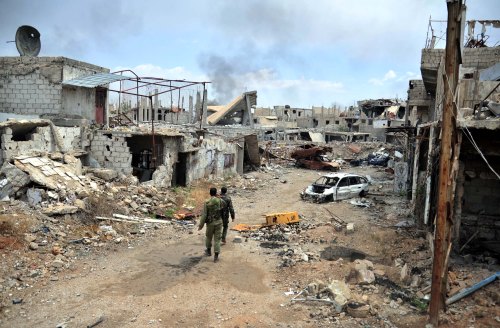
(180429) — DAMASCUS, April 29, 2018 (Xinhua) — Photo taken on April 29, 2018 shows destruction in the parts that have recently been captured from the Islamic State militants in the al-Qadam neighbourhood, south of Damascus, Syria. The Syrian army captured the IS-controlled areas in al-Qadam on Saturday, according to the state news agency SANA. (Xinhua/Ammar Safarjalani) (lrz)

The burden of Damascus. Behold, Damascus is taken away from being a city, and it shall be a ruinous heap. (Isaiah 17:1)

Much to the chagrin of the Iranian leadership, President Donald Trump announced on May 8, 2018, that he is pulling the US out of the controversial Iranian nuclear deal. In their indignation, Iran lashed out at Israel in a midnight attack sending 20 rockets aimed at Israeli military targets in the Golan Heights on May 10, 2018.[1] Israel’s Iron Dome air defense intercepted four of the 20 rockets into Israeli territory. The remaining rockets fell harmlessly in Syrian territory displaying the “iron dome” of God.

In keeping with their warning of retaliation against Iran for any attacks on Israel from Syria, the IDF responded immediately with a counter-attack on 50 Iranian military installations in Syria.[2] The attack destroyed most of Iran’s military infrastructure preventing retaliation in the very near future. However, Iran will not be deterred from her obsession to obliterate Israel from the Middle East. That obsession brings Iran into direct conflict with “he that keepeth Israel shall neither slumber nor sleep” (Psalm 121:4). Israel’s security remains tenuous. They rest secure in their military capabilities knowing they can respond to any threat. However, for the most part, their trust remains in their capabilities and those of their allies. “To wit, the prophets of Israel which prophesy concerning Jerusalem, and which see visions of peace for her, and there is no peace, saith the Lord GOD” (Ezekiel 13:16).

I enjoy the ministry of Amir Tsarfati, Behold Israel,[3] and watch his YouTube updates of current events in Israel. With all that is going on in and around Israel, Amir frequently points out that Israelis dwell in “peace and security;” that is the perception of those living in Israel which does not necessarily reflect reality. The time of the end approaches rapidly, and Amir knows this very well. We need to be ready.

Tomorrow, Monday, May 14, 2018, Israel celebrates 70 years of the rebirth of the nation. The “dry bones” of Ezekiel 37 came alive and “and stood up upon their feet, an exceeding great army” (Ezekiel 37:10). No record in history exists where a people dispersed among the nations of the earth retained their language, their religion, their traditions, and  their national identity. In 70 A.D., Israel was disseminated, Jerusalem was razed, and the land became a desolate wasteland. Then, 1878 years later, the “dry bones” miraculously came to life once more. Do you need evidence to believe in God? Look at Israel! “Who hath heard such a thing? who hath seen such things? Shall the earth be made to bring forth in one day? or shall a nation be born at once? for as soon as Zion travailed, she brought forth her children” (Isaiah 66:8, emphasis mine).

Among many other signs, concerning Israel and the nations for the end times is the destruction of Damascus. Damascus is undoubtedly the oldest consistently inhabited city in history. We first read of it in Genesis 14:15 when four marauding kings from the area that we now know as Syria attacked the kings around Sodom and Gomorrah. They spoiled the cities and took away captives including Abram’s nephew, Lot. You can read the complete account in Genesis 14, but the point being is that Damascus was a well-established city at the time.

Just as God promised that the dry bones of Israel would be reconstituted, He also promised that Damascus would be a “ruinous heap” (Isaiah 17:1, our starting verse). “And behold at eveningtide trouble; and before the morning he is not. This is the portion of them that spoil us, and the lot of them that rob us” (Isaiah 17:14). Iran has amassed a cache of war implements around Damascus as targets for Israeli warplanes. At the same time, rebels against the Assad regime have pummeled Damascus with their own arsenal of mortars, rockets, and explosives. Damascus is quickly becoming a “ruinous heap.”

The convergence of many happenings indicates that Christ’s return is very near. He is the Peace of Jerusalem for which we pray (Psalm 122:6). Indeed, He is the only hope for peace in this world. Before He returns to set things right, He will take away His Bride, the Church, from the wrath to come. “For God hath not appointed us to wrath, but to obtain salvation by our Lord Jesus Christ” (1 Thessalonians 5:9). So, as we witness prophecy fulfilled before our eyes – and this is only apparent if you are paying attention – we anxiously anticipate His call to “Come up hither” (Revelation 4:1) at any moment.

I don’t know about you, but I long with an aching in my heart to see my Savior face to face. How about you? Are you ready and waiting to meet Jesus?

Notes:

[1]  “Iran Attacks Israel. Israel Shoots Down all the Iranian Rockets” – https://israelunwired.com/iran-attacks-israel-israel-shoots-down-all-the-iranian-rockets/

[2]  “Israel Unleashes Stunning Strike Capabilities On Iranian Forces In Syria” – http://www.prophecynewswatch.com/article.cfm?recent_news_id=2253

[3]  Behold Israel Ministry YouTube Channel: https://www.youtube.com/user/beholdisrael/featured

2 Comments

Filed under Apologetics, Christianity, Current Events, End Times, Evangelism, Gospel, Religion, Second Coming of Christ, Theology

Bare Naked

And the eyes of them both were opened, and they knew that they were naked; and they sewed fig leaves together, and made themselves aprons. (Genesis 3:7)

Man (and woman) was created in the image of God – Imago Dei for the sophisticates. That image incorporates many of God’s attributes without the omni- aspect of those attributes. Man is a rational being, although that ability to reason progressively wanes through constant rejection of God (Romans 1:28). Man creates beauty: art, sculptures, music, architecture, etc. Man invents gadgets that make life easier: machines that carry us over land, through the sea or in the air to get us where we want to go. We use all kinds of machines to help us perform our work more efficiently: computers, portable communications devices, power tools of all kinds, and even sophisticated diagnostic equipment that allow doctors to “see” into our bodies to find malfunctions. Man’s ability to design, engineer and fabricate finds resolution only in that we are created in the image of God. None other of God’s creatures possesses the almost limitless creative abilities that man has. However, no other creature bears the image of God. Evolutionists (who suffer from the Romans 1:28 syndrome), would have us believe that humans are just a more highly evolved specimen of animal. However, according to evolutionists, some animals currently in existence have been around much longer than humans have. So, one must ask, why do they remain the same with no evidence of evolution – not in the least bit? Nevertheless, that is not the point of this writing.

Humans demonstrate the image of God in their ability to love and in their ability to judge right from wrong. Humans, like God, are triune creatures with a mind, spirit and physical body. Some people have difficulty understanding that God is three persons in one Godhead. That confusion becomes clear when one understands that humans are also three persons in one “soul.” The mind directs man’s activities. The spirit of man motivates man into action, and the body carries out that the plan. Of us, God says, “I have said, Ye are gods; and all of you are children of the most High” (Psalm 82:6, emphasis mine). Jesus made the same argument when the Pharisees would stone Him for blasphemy. “Jesus answered them, Is it not written in your law, I said, Ye are gods?” (John 10:34, emphasis mine). [1] Just as God is Three-in-One in complete unity, humans too possess a triune nature.

The body, the “carriage” for our mind and spirit, also represents the image of God. Jesus, “Who is the image of the invisible God, the firstborn of every creature” (Colossians 1:15, emphasis mine) is the Creator; “For by him were all things created, that are in heaven, and that are in earth, visible and invisible …” (Colossians 1:16, emphasis mine). “All things were made by him; and without him was not any thing made that was made” (John 1:3, emphasis mine). Jesus “made himself of no reputation, and took upon him the form of a servant, and was made in the likeness of men” (Philippians 2:7, emphasis mine). Knowing that He would one day be “made in the likeness of men,” it stands to reason that Jesus, the Creator, would design the kind of body suitable for Himself for His time on earth (and after).

The care that He took to design the human body becomes apparent when we read the creation account in Genesis 1. Every creature God created came about by Divine fiat. “And God said, Let the waters bring forth abundantly the moving creature that hath life, and fowl that may fly above the earth in the open firmament of heaven” (Genesis 1:20, emphasis mine). “And God said, Let the earth bring forth the living creature after his kind, cattle, and creeping thing, and beast of the earth after his kind: and it was so” (Genesis 1:24, emphasis mine). However, when it came to man, God took greater care. “And God said, Let us make man in our image, after our likeness … So God created man in his own image, in the image of God created he him; male and female created he them” (Genesis 1:26-27, emphasis mine). Chapter 2 provides even greater insight. “And the LORD God formed man of the dust of the ground, and breathed into his nostrils the breath of life; and man became a living soul … And the rib, which the LORD God had taken from man, made he a woman, and brought her unto the man” (Genesis 2:7, 22, emphasis mine).

Still, man lacks one aspect of God’s physical form. Of Jesus, Paul writes, “Who only hath immortality, dwelling in the light which no man can approach unto; whom no man hath seen, nor can see: to whom be honour and power everlasting. Amen” (1 Timothy 6:16, emphasis mine). The Beloved Apostle also wrote, “This then is the message which we have heard of him, and declare unto you, that God is light, and in him is no darkness at all” (1 John 1:5, emphasis mine).[2] The Bible often describes angels as possessing a glow about them. Moses, when he came down from the mountain after spending 40 days in the presence of God had a glow about him. The glow caused the children of Israel to fear so much that they asked him to cover his face.[3] There was a glow about Jesus when He was transfigured that left the disciples awestruck.[4]

It seems likely that part of the image of God in man would include a glow about our bodies, but we no longer see that. Oh, I know some psychics claim to see an “aura” around people, but if one is there, it is too dim for “normal” people to see it. As the guy in the motel commercial says, “Nobody glows.” Why is that? I have a theory.

As we noted, God is and dwells in light. In the beginning when He said, “Let there be light” (Genesis 1:3), He actually created darkness to contrast the light. He says as much to the prophet Isaiah: “I form the light, and create darkness: I make peace, and create evil: I the LORD do all these things”(Isaiah 45:7, emphasis mine). So, I believe that when God created man in His image, He created man robed in light. Perhaps that was included in the “breath of life.” When Adam disobeyed God and ate of the forbidden fruit, the light went out (and so too did “life”), “And the eyes of them both were opened, and they knew that they were naked” (Genesis 3:7). It is instructive to note that it was not until Adam (not Eve) ate of the fruit that their eyes were opened. It was Adam, not Eve, who received the command not to eat of the forbidden fruit directly from God; thus, his was the greater responsibility.

To cover (atone) their nakedness, God had to kill innocent animals to make clothing for the bare naked pair. “Unto Adam also and to his wife did the LORD God make coats of skins, and clothed them” (Genesis 3:21, emphasis mine). There may be an intentional play on words here. The Hebrew word for skin is ‛ôr, spelled עוֹר. The Hebrew word for “light,” the clothing they had lost, is ‘ôr, spelled אוֹר. When Adam sinned, the couple lost their ‘ôr (light), and God had to cover their nakedness with ‛ôr (skins).

That temporary covering for sin required the shedding of innocent animal blood. The permanent covering for sin required the innocent blood of the Son of Man, the Lamb of God. Now God offers that gift to us at no cost. Only one thing remains – that we accept the gift by faith. See my page on Heaven for the rest of the story.

Notes:


[1]  See John 10:24-39 for context.

[2]  This is often understood to say that God is the source of all wisdom, knowledge and truth. This is certainly true given the context surrounding this verse. However, Henry M. Morris, Ph.D sees the physical aspect of God’s light as he notes in The Henry Morris Study Bible: http://www.icr.org/Bible/1John/1:5/

[3]  See Exodus 34:30-35.

[4]  See Matthew 17:1-8; Mark 9:2-13; Luke 9:28-36.

1 Comment

Filed under Apologetics, Christianity, Creation, Death, Evolution, Gospel, Origins, Religion, Salvation, Theology

Plant Death

And God said, Behold, I have given you every herb bearing seed, which is upon the face of all the earth, and every tree, in the which is the fruit of a tree yielding seed; to you it shall be for meat. (Genesis 1:29)

Plants do not possess life in the biblical sense. The Bible almost always refers to plant “death” as “withering.” The Bible says that “the life of the flesh is in the blood” (Leviticus 17:11). Plants do not have blood; therefore, plants do not have life, neither do they die in the biblical sense. The prophet Isaiah wrote: “The grass withereth, the flower fadeth: but the word of our God shall stand for ever” (Isaiah 40:8). Notice that he says that the grass “withers,” not that it dies.

If that is true, then why did Jesus say that a grain of wheat falling to the ground dies (John 12:24)? In this passage, the word “die” translates the Greek word apothnēskō. According to Strong’s (G599), the word means, “to die off (literally or figuratively).” Jude applies the same word to “trees whose fruit withereth, without fruit, twice dead, plucked up by the roots” (Jude 1:12, emphasis mine). The word translated “dead” is the same Greek word, apothnēskō, but note that it is associated with “withereth.” Therefore, death, in the Bible, can be applied to plants, but it is more in the figurative sense than in a literal sense.

Jesus said, “Verily, verily, I say unto you, Except a corn of wheat fall into the ground and die, it abideth alone: but if it die, it bringeth forth much fruit” (John 12:24, emphasis mine). However, He used the word “die” in the figurative sense. He was referring to His pending death and resurrection. He was not using the word in a literal sense that a seed actually dies.

When a seed gets buried in the ground, it does not remain a seed. Rather, it germinates and transforms into a new plant that produces many more seeds. Similarly, Jesus died and was buried in the earth. On the third day, He came up out of the ground, and His resurrection produced eternal life for all who would believe on Him.

So, talk to your plants, if you like, but they really do not hear you. Plants are food, not pets.

Comments Off on Plant Death

Filed under Apologetics, Christianity, Creation, Death, Religion, Resurrection, Science, Theology