Category Archives: Apologetics

You Don’t Go to Hell Because You’re A Sinner

You have a choice!

You have a choice!

“But he that shall blaspheme against the Holy Ghost hath never forgiveness, but is in danger of eternal damnation:” (Mark 3:29)

One of the charges leveled against God by unbelievers is the question of why a loving God would send anyone to hell. A corollary to that questions why God would send sinners to hell since He created them that way in the first place. Unbelievers are not alone in this camp. They are joined by many pseudo Christians, like those in the Emergent Church movement who would do away with the doctrine of hell altogether in their misguided effort to rescue God from such charges, and thus make Him more attractive to the masses.

The truth of the matter is that God sends no one to hell. Hell was not intended for man, but rather it was “prepared for the devil and his angels” (Matthew 25:41). From the beginning of time when man fell, God has always been proactive in the restoration of the broken relationship between God and man.

When man first disobeyed God, God immediately reached out to man in an effort to reconcile the broken relationship. “And the LORD God called unto Adam, and said unto him, Where art thou?” (Genesis 3:9). Does anyone really believe that God did not know where they were? David says, “Whither shall I go from thy spirit? or whither shall I flee from thy presence?” (Psalm 139:7). God knew where they were. He gave them the opportunity to come forward and confess their disobedience, but instead they made excuses: “I was afraid, because I was naked; and I hid myself” (Genesis 3:10). Again God gave opportunity for confession: “And he said, Who told thee that thou wast naked? Hast thou eaten of the tree, whereof I commanded thee that thou shouldest not eat?” (Genesis 3:11). Of course God knew what they had done. He was present when the serpent tempted Eve. In fact, Satan could not have tempted Eve without God’s permission (See Job 1-2). Just in case you are thinking it unfair of God to put Eve through such a test remember that “God is faithful, who will not suffer you to be tempted above that ye are able; but will with the temptation also make a way to escape, that ye may be able to bear it” (1 Corinthians 10:13). Adam and Eve had all of their needs met. They wanted for nothing, yet they chose to disobey. But it was God who opened the door for reconciliation.

From the beginning God initiated the plan to reconcile man to Himself. “I will put enmity between thee and the woman, and between thy seed and her seed; [He] shall bruise thy head, and thou shalt bruise his heel” (Genesis 3:15). God’s solution was to take “upon him the form of a servant, and was made in the likeness of men: And being found in fashion as a man, he humbled himself, and became obedient unto death, even the death of the cross” (Philippians 2:7-8). Such extreme measures were necessary because He is “not willing that any should perish, but that all should come to repentance” (2 Peter 3:9). That being the case, after all that effort on His part, why would He send anyone to hell?

As can be seen by the example in the Garden of Eden (Genesis 3), it was not the sin of disobedience that brought the curse, but lack of contrition on the part of the guilty couple. God gave ample opportunity to confess, assume responsibility, and ask for forgiveness, but instead they offered up excuses. If our sin kept us from being reconciled to God, no one would be saved “For all have sinned and come short of the glory of God” (Romans 3:23). But God has provided the solution to the rift that exists between God and man. Jesus said, “I am the way, the truth, and the life: no man cometh unto the Father, but by me” (John 14:6). For this reason He said, “Verily I say unto you, All sins shall be forgiven unto the sons of men, and blasphemies wherewith soever they shall blaspheme: But he that shall blaspheme against the Holy Ghost hath never forgiveness, but is in danger of eternal damnation” (Mark 3:28-29, emphasis added). To “blaspheme against the Holy Spirit” is nothing more than rejecting the message of salvation that the Holy Spirit brings to every individual.

What is that message? “Believe on the Lord Jesus Christ, and thou shalt be saved” (Acts 16:31). “That if thou shalt confess with thy mouth the Lord Jesus, and shalt believe in thine heart that God hath raised him from the dead, thou shalt be saved. For with the heart man believeth unto righteousness; and with the mouth confession is made unto salvation” (Romans 10:9-10). Reject that message, and it is not God that sends you to hell. At that point, you have rejected God and His offer of reconciliation, so He has no other option but to say, “Depart from me, ye cursed, into everlasting fire, prepared for the devil and his angels” (Matthew 25:41). You don’t go to hell because you’re a sinner, but because you have rejected God’s offer of salvation.

If you are unsure of your eternal state and are still conscious and breathing, there is hope for you. You have two choices: God or no God. Just remember, whatever choice you make, it is for eternity. If you choose God, He says, “Then shall ye call upon me, and ye shall go and pray unto me, and I will hearken unto you. And ye shall seek me, and find me, when ye shall search for me with all your heart” (Jeremiah 29:12-13). Sin won’t keep you out of heaven, but the wrong choice will.

Comments Off on You Don’t Go to Hell Because You’re A Sinner

Filed under Apologetics, Christianity, Evangelism, Gospel, Hell, Origins, Religion, Salvation, Theology

Shepherd of Shepherds

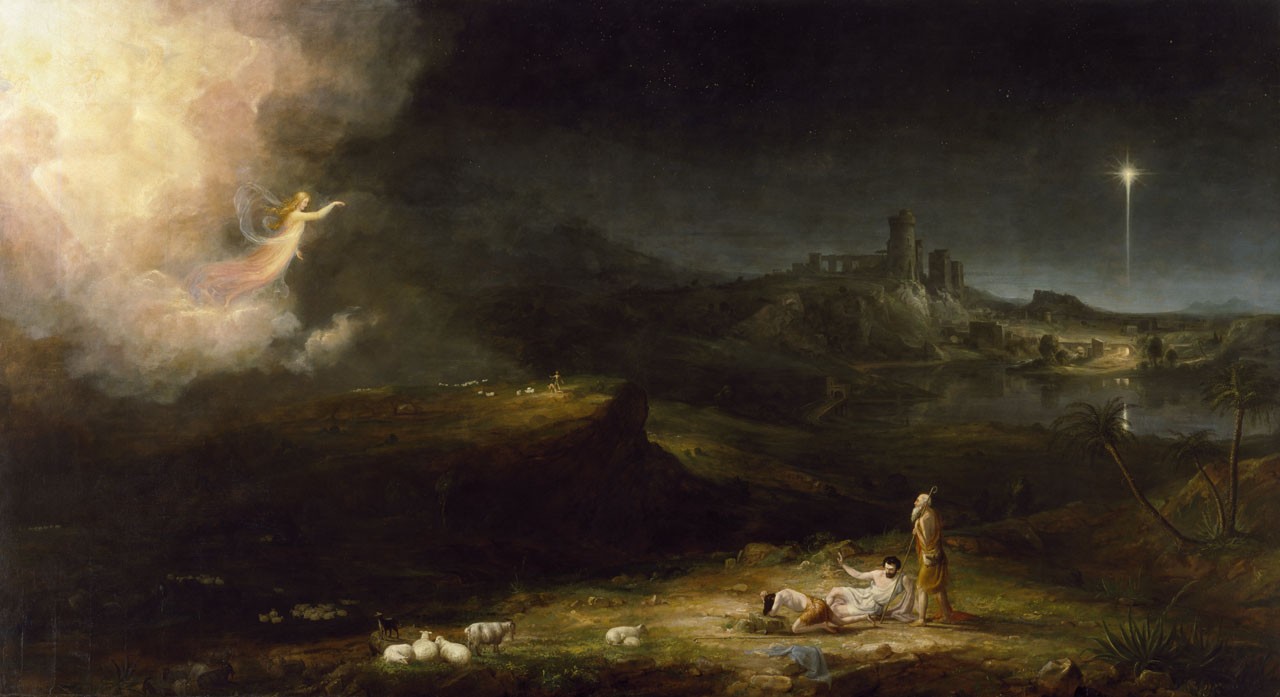
cole-angel-shepherds

“And there were in the same country shepherds abiding in the field, keeping watch over their flock by night.” (Luke 2:8)

One of the best arguments against the birth of Christ having taken place in late December is this fact recorded by Luke in his Gospel. There were shepherds out in the fields watching over their flocks. By late December, there is not sufficient grazing to sustain large flocks of sheep. Jerusalem is near the same latitude as Dallas, Texas where I live. By the middle to the end of November, there is not much left for cattle to graze on, so they need to be fed on hay or “cake.” So it seems very unlikely that shepherds would be out in the fields in the winter time.

The shepherds around Bethlehem generally kept the sheep and goats that were used for sacrifice in the Temple in nearby Jerusalem. Some have suggested that Jesus’ birth was around late September which coincides with the Jewish Fall Feasts: Feast of Trumpets (Rosh Hashanah), Day of Atonement (Yom Kippur) and Feast of Tabernacles (Sukkoths). These were feasts that required all Jewish men to make a pilgrimage to the Temple in Jerusalem. The fact that this requirement happened to coincide with the decree from Caesar Augustus for the census (Luke 2:1) may explain why “there was no room for them in the inn” (Luke 2:7) for the expectant couple. In fact, His birth may have occurred during the Feast of Tabernacles making John’s statement that “the Word was made flesh, and [tabernacled] among us” (John 1:14) even more significant. Interestingly, if one counts back nine months from the end of September, one arrives at a date sometime in late December. It could be that rather than celebrating Christ’s birth on December 25, we are actually celebrating His conception!

Regardless, it was to these simple shepherds that this paramount announcement was delivered. “For unto you is born this day in the city of David a Saviour, which is Christ the Lord” (Luke 2:11). To these shepherds who were known for feeding and protecting their flocks; who sought out the lost sheep, and rescued those that were attacked. It seems appropriate that to these the news of the arrival of the “Shepherd of Israel” should be first delivered. He who would later say, “I am the good shepherd: the good shepherd giveth his life for the sheep” (John 10:11) had come. So without hesitation they said, “Let us now go even unto Bethlehem, and see this thing which is come to pass, which the Lord hath made known unto us” (Luke 2:15). They came “with haste” Luke tells us, “and found Mary, and Joseph, and the [Lamb of God] lying in a manger” (Luke 2:16). His name was Jesus, “for he shall save his people from their sins” (Matthew 1:21). This little Lamb of God, who was to be the Shepherd of shepherds, had finally come to them.


1 Comment

Filed under Apologetics, Christianity, Christmas, Evangelism, Gospel, Religion, Salvation, Theology

Killing Jesus: A Review

V06N25 Killing Jesus Cover

“Study to shew thyself approved unto God, a workman that needeth not to be ashamed, rightly dividing the word of truth.” (2 Timothy 2:15)

Since Bill O’Reilly, commentator and host of the O’Reilly Factor on the Fox News Channel, came out with his latest book, Killing Jesus: A History, Christian “Evangelicals” have turned out to opine on the work. Some, like the pastor of the First Baptist Church of Dallas, Texas have given the book rave reviews and even encouraged Christians to buy and read the book. Others have not been so kind. Since the pastor of the First Baptist Church of Dallas happens to be my pastor, I thought I would take him up on his recommendation. Having done so, I will now attempt to offer my hopefully “fair and balanced” review of the book.

First of all, I will say that Mr. O’Reilly and co-author Martin Dugard make an excellent writing team. I first experienced their work in Killing Lincoln, which I thoroughly enjoyed. Killing Jesus is no exception. The text flows very smoothly, and it entices the reader to continue non-stop. Had I the luxury of uninterrupted time to sit with a book, I might have been tempted, but alas, I had to consume it in short bursts. That gave me the advantage of time to ruminate on the content so that I am less likely to give a knee-jerk assessment of the work.

For what it is, I would recommend it to anyone who enjoys historical or biographical genres. It is not a spiritual book or a book that it is written in a way that honors or glorifies Jesus of Nazareth for Who He is – the Creator, Savior, and King of kings and Lord of lords – nor is it blasphemous in any way. It is just matter-of-fact. The authors present Jesus as an actual historical personage who impacted the world in a significant way. “To say that Jesus of Nazareth was the most influential man who ever lived is almost trite. Nearly two thousand years after he was brutally executed by Roman soldiers, more than 2.2 billion human beings attempt to follow his teachings and believe he is God” (p. 1).[1] The authors admit: “We do not address Jesus as the Messiah, only as a man who galvanized a remote area of the Roman Empire and made very powerful enemies while preaching a philosophy of peace and love” (p. 2). This approach should not come as a surprise since O’Reilly has often expressed and asserted his conviction that Scripture is allegorical and not to be taken literally. That brings into question his use of the Gospels as a historical resource. Indeed, he admits, “Of course we have the Gospels of Matthew, Mark, Luke, and John, but they sometimes appear contradictory and were written from a spiritual point of view rather than as a historical chronicling of Jesus’s [sic] life” (p. 1) If the Gospels are allegorical, as O’Reilly claims, then this book, as a history, is not worth the paper it is written on. Would a true historian rely on allegory to construct a factual account? To be fair, the authors also rely on extra-biblical sources to compose their story. It seems, however, that the Bible is only used to “fill in” where secular historians are silent. But, let us set that aside for the moment.

Evidently, the Gospel account failed to provide sufficient content to accomplish the purpose of this book, so the authors devoted the first third of the book to early Roman history to help set the stage for the main course and perhaps to add a little spice with the depravity of the Roman emperors. I am not a historian, so I will defer to Mr. O’Reilly on the accuracy of these accounts. My strength is in Scripture, and in that regard I can give an honest assessment.

The authors get the Gospel account right for the most part. I was especially surprised by a footnote that informs us that “The Gospels clearly state that Jesus had four brothers: James, Joseph, Judas, and Simon. They also mention that he had sisters, but the number is not specified” (p. 79). O’Reilly and Dugard are both practicing Roman Catholics and for that reason the admission is remarkable. The footnote continues: “The Roman Catholic Church believes Mary remained a virgin throughout her entire life. This doctrine was first put forth four centuries after Jesus lived by an early leader in the Church named Simon. The Church considers the siblings mentioned by the Gospels to be Jesus’s [sic] cousins” (p. 79).

The authors also get it right when they describe two separate temple cleansings by Jesus, one at the beginning of His ministry and one at the end (pp. 126, 192-193). Many Bible scholars miss this point, but sadly, the authors attribute this to error rather than accept it as fact. “Before being written down, the Gospels were oral histories. This might explain some discrepancies among them. The story of Jesus and the money changers is placed at the beginning of Jesus’s [sic] ministry in John (2:14-22), while [the other Gospel writers] all place it at the end. This has led some to speculate (emphasis added) that Jesus performed this cleansing twice, as specific details of the various Gospels account differ” (p. 126). Had the authors taken the time to seek a resolution to the “discrepancy,” as any good historian should do, they may have discovered that John was with Jesus from the very beginning. Matthew came along after the fact, and Mark and Luke were not a part of the original group of disciples. To these men, the last cleansing was most significant because it occurred in Jesus’ final week. All the Gospel writers had differing objectives in relaying their message, and so they tell the story from their individual perspectives. John’s purpose for his Gospel was to present Jesus as God. For him, the first cleansing establishes Christ’s divinity from the very beginning. You will recall John 1:1 “In the beginning was the Word, and the Word was with God, and the Word was God.” There is no discrepancy here, except in the minds of these authors. But they should at least get credit for recording two separate events (pp. 192-193). Since John wrote his Gospel last, surely he had access to those written previously, so his placement of the temple cleansing was not by mistake. John had a point to make as did the other Gospel writers, and all were accurate in their record.

Another point missed by many Bible scholars is in trying to synthesize the different accounts of Jesus’ anointing into one event. O’Reilly and Dugard at least distinguished two different accounts: the anointing at the house of Simon the Pharisee in Galilee before the Transfiguration (Luke 7:36-50, p. 144) and the anointing at the house of Simon the Leper in Bethany following Jesus’ Triumphal Entry into Jerusalem (Matthew 26:6-13, Mark 14:3-9, p 209). It is easy to see how these two separate events could be confused since both hosts are named Simon, but O’Reilly and Dugard correctly identified the two as separate events. However, they failed to include a third anointing which took place in (supposedly) the house of Lazarus, whom Jesus raised from the dead. This account is found in John 12:1-7 and precedes the Triumphal Entry. Martha, as usual, is serving and Mary, her sister, performs the anointing. I cannot be too critical of the oversight, since many Bible scholars make a worse mistake by trying to reconcile the three separate events as one.

The authors accurately record the Gospel accounts for the most part, but given O’Reilly’s presuppositional conviction on the allegorical nature of Scripture, several errors creep into this work. Take for example the baptism of Jesus by John the Baptist (p.103). The Gospel of John 1:29-40 records the baptism, but does not record the interchange between The Baptist and Jesus. As stated earlier, John’s purpose in writing his Gospel was to demonstrate the deity of Christ, and so minor details are unimportant to his account. Instead, John focuses on the Spirit of God descending upon Jesus in the form of a dove. The other Gospel writers also record a voice from heaven saying, “This is my beloved Son, in whom I am well pleased” (Matthew 3:17; Mark 1:11; Luke 3:22). But instead, John focuses on the words of John the Baptist: “And I saw, and bare record that this is the Son of God” (John 1:34, emphasis added). In this passage, we learn that John, the writer of this Gospel, was a firsthand witness from the very beginning. “One of the two which heard John speak, and followed him, was Andrew, Simon Peter’s brother” (John 1:40). The “one” not mentioned is John who never mentions himself by name throughout his Gospel.

Because of their myopia to the literal accuracy of the Gospel text, the writers of Killing Jesus appear somewhat incredulous that a dove coming out of nowhere should light upon Jesus and remain on him. “Suddenly a dove lands on Jesus’s [sic] shoulder. When Jesus makes no move to shoo it away, the bird is quite content to remain there” (p. 103). Looking at it that way, I believe I would be a little incredulous myself. These kinds of errors are systemic throughout the book. 

Another kind of error in this book is that of adding to Scripture. For example, on the account of the baptism of Jesus as He comes out of the water, the writers say, “The believers drop to their knees and press their faces into the earth. Jesus does not react to this sign of worship. He does nothing to discourage it either.” (p. 104). That is nowhere to be found in Scripture, certainly not in any of the Gospels, but the authors cite no references to substantiate that detail. The writers quote John 1:34 (quoted above) and then add, “The crowd remains on its knees as Jesus steps onto the shore and keeps on walking” (p. 105). This must be something the authors learned in catechism, which perhaps explains why no reference is cited, but it has no basis in Scripture.

I understand that the authors are attempting to keep a detached and “objective” perspective, but I found one statement to be rather insulting to our Lord. In telling about the calling of Peter and Andrew (Matthew 4:18-22; Mark 1:16-18; Luke 5:4-10) They recount that Jesus got into Peter’s boat and asked him to push away from the shore so that He could speak to the crowd that had assembled, “Though he [sic] knows next to nothing about fishing” (p. 136). In the first place, Jesus grew up in Nazareth, which is not that far from the Sea of Galilee; I am sure He would have known something about fishing. Furthermore, this is God who created fish and fishermen. That He knows something about fishing is demonstrated in that He gave instructions to lower the nets after the men had fished all night and came up empty, and the catch was more than they could handle. So, I find the assessment that Jesus “knows next to nothing about fishing” a little demeaning. In the same account, the authors claim that Peter was “A fisherman in his early twenties” (p. 137). Most scholars believe that Peter was probably around Jesus’ age or perhaps a little older. Again, the authors cite no references for this claim.

Other errors include the claim that the raising of Lazarus from the dead is a “legend” (p. 199 footnote). They mistake Jesus’ assessment of the Greatest Commandment as a “new” law, but oddly, in the footnote they cite Deuteronomy 6:5 (p. 205). This Greatest Commandment was nothing new; the Deuteronomy reference harkens back to the First and Second Commandments (Exodus 20:3-4). They also confuse Jesus’ agony in the Garden of Gethsemane as “panic” (p. 212). Jesus knew His mission from the very beginning. Luke records: “And it came to pass, when the time was come that he should be received up, he stedfastly set his face to go to Jerusalem” (Luke 9:51, emphasis added) indicating that Jesus was determined to go through with His sacrifice. There was no “panic” in Him. Finally, in the “Afterword,” the writers wrongly attribute the description of “a woman clothed with the sun” in Revelation 12:1 to Mary, the mother of Jesus. This obviously comes from the authors’ Roman Catholic doctrine. More than 1920 years after the time of Christ, “On November 1, 1950 the Roman Catholic Church decreed that [Mary’s] body had been ‘assumed into heaven’” (p. 265). If the authors had bothered to research this in greater depth, they may have learned that the “woman” described in Revelation is Israel, not Mary, and the child she bore is Jesus. The reason nothing more is heard of the woman, is because she, Israel, has not, and will not be destroyed as a nation. However, I would not expect Mr. O’Reilly to accept that explanation.

My final assessment of Killing Jesus: A History is that it is a well written book, easy to read and entertaining. I would not take it seriously as a “history” given that the authors view the Bible as allegory, and allegory is a highly questionable resource when trying to document real history. Admittedly, the authors assert that this is not a spiritual book, and because of that this book has little value from a spiritual perspective. Some supposed Christians claim that the book has strengthened or renewed their faith. That may be true if the “Christian” doubted the historicity of Jesus in the first place. This book might have some value in that regard. I would not recommend this book as a “witnessing” tool as it gives a very poor witness. As I stated at the beginning, the authors are not blasphemous in any way, but at the same time, they do not give Jesus His proper due. He is presented as a mere man on a mission who got on the wrong side of the governing and religious authorities. There is more to Jesus than these authors portray. The book presents Him as a victim ignoring His very words, “I lay down my life for the sheep … No man taketh it from me, but I lay it down of myself” (John 10:15, 18).  Jesus is God, whether “some” believe it or not, and the Bible is not allegory. Killing Jesus might have been a better book, if the authors had taken the Gospel account seriously and literally. That said, I would not discourage anyone from reading it, but I would caution against taking it seriously.


[1] Direct quotes are denoted with the page number on which they are found in the book.

2 Comments

Filed under Apologetics, Book Reviews, Christianity, Religion

Time for Pride to Grow

“. . . when the morning stars sang together, and all the sons of God shouted for joy?” (Job 38:7)

A common question that arises from time to time is, “When did God make the angels?” A corollary question to that is “Was there enough time for pride to grow in Satan and for the war in Heaven to occur within the first few days?”

In the Job passage quoted above, God is telling Job that the angels were there at the time when He formed the earth. As to whether there was sufficient time for Satan’s pride to grow, we must ask, “How much time does it take for pride to grow?” In our own experience, does it take a long time to develop pride, or does it just seem to flare up unexpectedly? I would say the latter. Pride is one of the most basic sins. Human beings are naturally selfish and self-centered. Recall that very shortly after Creation, Satan was able to tempt Eve with “the pride of life” (1 John 2:16): “ye shall be as gods, knowing good and evil” (Genesis 3:5). It does not take a great amount of time for pride to grow.

The angels probably were created on the first day of the creation week. We cannot be dogmatic about this. The Bible does not specify when the angels were created, but the above passage in Job indicates that they were at least around to see the creation taking place. The angels, therefore, were created before man. Perhaps the reason for not focusing more attention on angels is that the Bible focuses mainly on the relationship between God and man. Angels play a part, but they are not central to God’s redemptive plan. But what does God say about man? “Let us make man in our image, after our likeness: and let them have dominion over the fish of the sea, and over the fowl of the air, and over the cattle, and over all the earth, and over every creeping thing that creepeth upon the earth” (Genesis 1:26, emphasis added). Did God say that about the angels? Did God give dominion over His creation to the angels? Can you see anything there that would give rise to pride and jealousy?

It would not have taken a long time for Satan’s pride to grow. Having been created first and then given lower status than man, Satan said, “I will ascend into heaven, I will exalt my throne above the stars of God: I will sit also upon the mount of the congregation, in the sides of the north: I will ascend above the heights of the clouds; I will be like the most High” (Isaiah 14:13-14, emphasis added). Satan hates man because God has bestowed upon man greater status than the angels. “What is man, that thou art mindful of him? and the son of man, that thou visitest him? For thou hast made him a little lower than the angels, and hast crowned him with glory and honour. Thou madest him to have dominion over the works of thy hands; thou hast put all things under his feet” (Psalm 8:4-6, emphasis added). The English phrase “a little lower than the angels” is not an accurate translation. “Angels” is the Hebrew ‘ĕlôhîym referring to God rather than the normal word for angels mal’âkîm. This is a messianic passage describing the condescension of Christ in taking human form, but this also has a secondary meaning as applied to man. Having been created in the image of his Maker, man holds a higher status than the angels, and this infuriates Satan.

This being the case, Satan most likely rebelled on Day Six of creation or very shortly thereafter. Seeing that man was God’s prized creation, Satan turned his ire toward destroying man. Knowing that man was created in the image of God, he employed that fact to cause man’s demise: “ye shall be as gods” (Genesis 3:5). If one analyses the source of any sin, it all goes back to pride – man wants to be his own god. This has been true from the beginning when Satan witnessed the creation of man, and since the fall of man in the Garden (Genesis 3). It really takes no time for pride to develop. It is nothing that requires any nurturing. On the contrary, it is something must actively be suppressed, and this cannot be done through human strength. It requires the supernatural power that only comes from God through the Holy Spirit. Jesus promised, “ye shall receive power, after that the Holy Ghost is come upon you” (Acts 1:8), and it is in that power alone that pride can be conquered.

1 Comment

Filed under Apologetics, Christianity, Creation, Evolution, Gospel, Origins, Theology

The Present is the Key to the Past

Grand-Canyon-Sunrise

While the earth remaineth, seedtime and harvest, and cold and heat, and summer and winter, and day and night shall not cease.  (Genesis 8:22)

In the origins debate, the young-earth creationist is confronted with the uniformitarian account for the supposed long ages they see in the earth’s crust. “Uniformitarianism is the assumption that the same natural laws and processes that operate in the universe now have always operated in the universe in the past and apply everywhere in the universe. It has included the gradualistic concept that ‘the present is the key to the past’ and is functioning at the same rates.”[1] I appreciate that definition because it clearly states that uniformitarianism is an “assumption,” which differs considerably from a “fact.” Young-earth creationists can agree with uniformitarianism to a small degree based on the biblical perspective provided in the Bible verse above.

I hope I can explain this in a way that makes sense. What uniformitarian thinking does is to look at the geologic processes that are currently taking place (as defined above) and assume that these processes have always taken place at the same rate over millions of years. The uniformitarian, then attempts to mathematically extrapolate back in time to determine the age of the rocks or the formation of strata on the earth’s crust.

In the case of rocks, different radiometric dating methods measure the current rate at which certain minerals within the rocks decay. “Radiometric dating (often called radioactive dating) is a technique used to date materials such as rocks, usually based on a comparison between the observed abundance of a naturally occurring radioactive isotope and its decay products, using known decay rates.”[2] For instance, uranium decays into lead at a certain known rate (“normally”). They can then take a rock containing uranium and measure how much uranium remains compared to the lead, and using currently known decay rates, they can calculate the age of the rock by the ratio of uranium-lead content. Keep in mind that they are “assuming” a constant decay rate.

In the case of sedimentation (or stratification), we can observe river deltas forming. We can observe, for example, that the river is depositing silt onto the delta at the rate of one inch per year. We can then take a core sample of the delta, and we discover that the silt is a mile (5280 ft.) deep. Since we know that silt deposits on the delta at the rate of one inch per year and has done so consistently in the past, we can multiply 5280 ft. by 12 in. and we calculate that the delta is 63,360 years old.

That kind of thinking is what gives us the long ages that evolutionists like to see. However, the problem with that lies in their assumption that things have always been consistent. In the case of the delta, what if the river flooded several times and deposited a foot of silt at every flood apart from the normal 1 inch per year? That would make the delta appear to be older than it really is. Or, what if the coast experiences several storms that erode the delta away? Then the delta would appear to be younger than what it really is.

In the case of radioactive decay, how can the geologist know for sure how much uranium the rock contained to begin with? Or how can they know with certainty that no uranium or lead has been infused into the rock somewhere along the way, or that some event caused greater decay than normal? These things cannot be known so the uniformitarian is left with only assumptions (and they really believe their assumptions).

Young-earth creationists believe the biblical creation account to begin with. Therefore they understand that the earth is probably around 6000 years old but certainly not more than 10,000 years old. They believe the biblical account of the Global Flood and any “uniformity” that is apparent is due to God’s promise that all things would remain consistent (Genesis 8:22 above). From this “ground zero” starting place, they can then make scientific predictions that verify the veracity of the Bible. For instance, the fact that Carbon 14, a highly volatile element having a half-life of only 5,730 +/- 40 years, is still present in petroleum, coal and diamonds. Uniformitarians would not even think to test for C-14 in these minerals, because they assume these minerals to be multimillions of years old, so naturally C-14 should not be present. Young-earth creation scientists believe that the earth is young, so C-14 should be present. So, they look for it, and BEHOLD! There it is!

If you would like to study more on this, the following are some articles from the Institute for Creation Research that may interest you:

http://www.icr.org/article/young-earth/

http://www.icr.org/article/some-recent-developments-having-do-with-time/

http://www.icr.org/article/new-rate-data-support-young-world/

http://www.icr.org/article/carbon-dating-undercuts-evolutions-long-ages/

 The present is not the key to the past – the Bible is!

Endnotes:

2 Comments

Filed under Apologetics, Creation, Evolution