Category Archives: Apologetics

Somewhere in the Middle

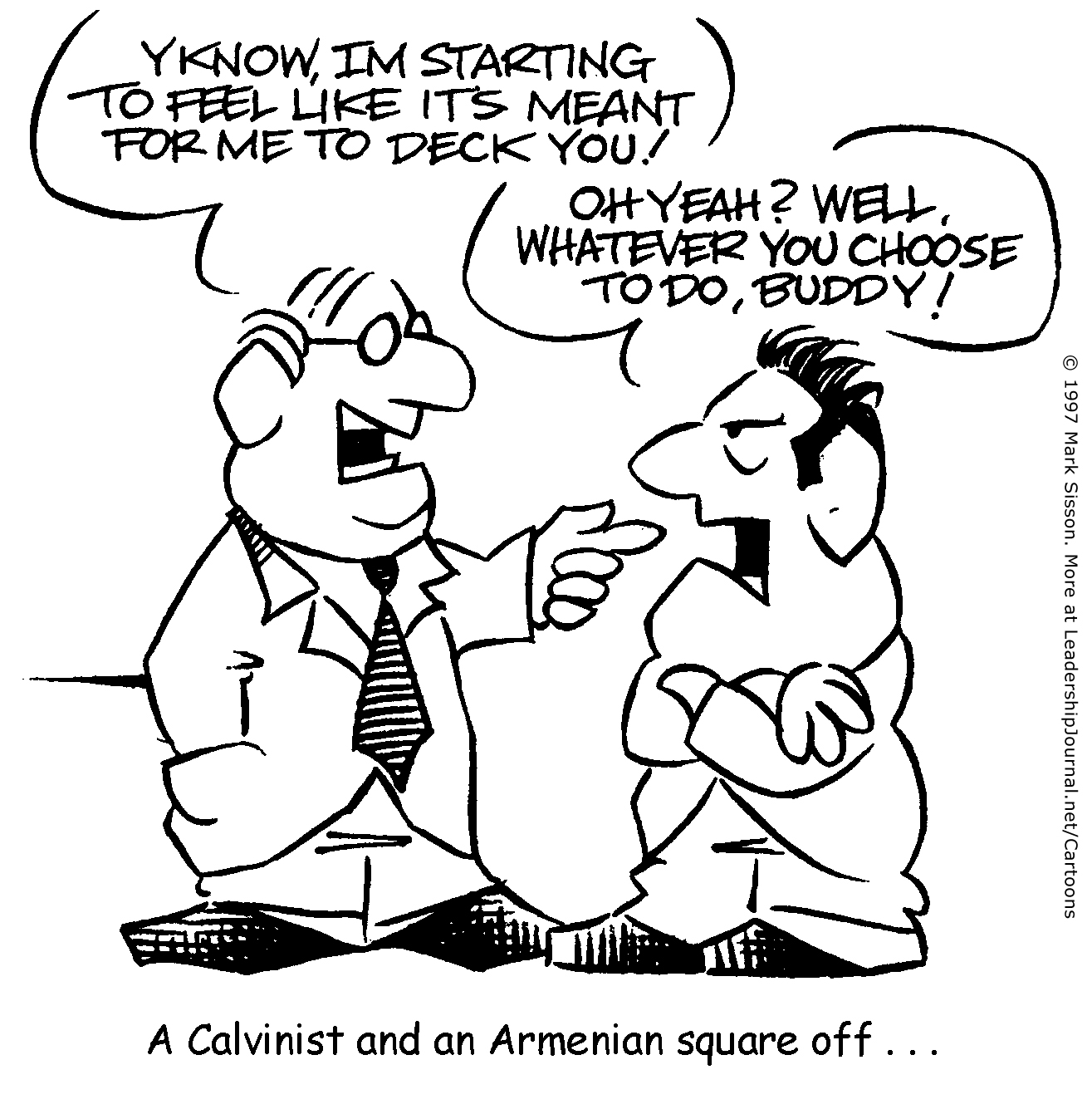
Calvinism-vs.-Arminianism-Cartoon2

For many are called, but few are chosen. (Matthew 22:14)

This past week I’ve had an online conversation with a fellow blogger on the topic of “limited atonement” and “total depravity.” Because of the nature of this topic, these discussions are usually fruitless and typically degenerate into “profane and vain babblings” (2 Timothy 2:16), which we should shun. At issue is the tension between the sovereignty of God and the free will of man. Calvinism (falsely attributed to the reformer, John Calvin) defends five points characterized by the acrostic TULIP: (1) Total Depravity, (2) Unconditional Election, (3) Limited Atonement, (4) Irresistible Grace, and (5) Perseverance of the Saints. Calvinism champions the complete sovereignty of God, and hyper-Calvinists go so far as to assert that God literally picks and chooses who will go to heaven and who will go to hell.

On the other side of the argument is Arminianism, attributed to the Dutch theologian Jacob Arminius. Arminianism counters Calvinism with eight points: (1) Universal Prevenient Grace, (2) Conditional Election, (3) Unlimited (or universal) Atonement, (4) Resistible Grace, (5) Uncertainty of Perseverance, (6) Libertarian Free Will, (7) Equal, Impartial, and Undifferentiated Love, (8) The Universal Call of Salvation.[1]

The conflict comes when one takes one position or the other. Both positions have scriptural support, and both have scriptural weaknesses. Contrast Calvinism’s “Total Depravity” with Arminianism’s “Universal Prevenient Grace.” The former considers individuals dead in sin so that they are incapable of choosing God’s free gift of salvation apart from God’s direct intervention on their behalf. This can be supported from Ephesians 2:8 where the Apostle Paul says in effect that the faith required to accept God’s Grace is in itself a gift of God. The latter acknowledges man’s fallen condition, but suggests that Grace “restores man’s free will which was impaired by the effects of original sin and enables him to choose or refuse the salvation offered by God in Jesus Christ.”[2] This too has scriptural support in “the Lamb slain from the foundation of the world” (Revelation 13:8). Or contrast Calvinism’s “Unconditional Election” with Arminianism’s “Conditional Election.” The former says that God picks who will be saved, the latter basically says that God “elects” or chooses those who choose Him. Both of these concepts find support in Scripture. Jesus said, “Ye have not chosen me, but I have chosen you” (John 15:16), but, of course, it could be argued that Jesus, in context, was speaking to His disciples, and as such it is not a blanket statement covering all believers. The Arminian challenge to this would be: “Then what do you do with all the ‘whosoever’ passages in the New Testament?” The Calvinist would then argue in a circle and say that all the “whosoevers” are the elect, but that also contradicts a lot of Scripture.

In Calvinism, “Unconditional Election” and “Limited Atonement” go hand in hand.  The former specifies God’s sovereignty in “electing” who will be saved and “Limited Atonement” explains that Christ’s sacrifice, while having universal application, is only efficient for those who are elect. They are really two sides of the same coin. Arminianism challenges that with “Unlimited Atonement.” Since Jesus died for all, then all have equal opportunity to respond to the Gospel by the exercise of their free will. Calvinism responds that those who respond to the Gospel do so because Grace, the “call of God,” is irresistible to the elect; they cannot help but respond to the Gospel message. The Arminian would retort that Grace certainly is resistible, as is frequently proven in evangelistic encounters. Anyone who has shared their faith with an unbeliever has experienced the disappointment of bringing someone to the point of conviction and then having them reject the invitation to accept Christ as Lord and Savior. Some say, “I’m not ready now.” Others will say, “Perhaps when I’m older.” Still others may say, “I don’t want to offend my family or my friends.” The offer of God’s grace certainly can be rejected. Of course the Calvinist would counter with, “That’s because they aren’t elect” – again arguing in a circle.

This discussion could go on and on, and countless reams of paper have been spent in defense of both sides. Both sides have good points, and both sides have weak points. The answer to the debate lies somewhere in the middle. Only God knows the real inner workings of His plan. “For my thoughts are not your thoughts, neither are your ways my ways, saith the LORD. For as the heavens are higher than the earth, so are my ways higher than your ways, and my thoughts than your thoughts” (Isaiah 55:8-9). In the end, both Calvinists and Arminians have to come to Christ in the same way: “Believe on the Lord Jesus Christ, and thou shalt be saved” (Acts 16:31). “That if thou shalt confess with thy mouth the Lord Jesus, and shalt believe in thine heart that God hath raised him from the dead, thou shalt be saved” (Romans 10:9).

There is one point where the Calvinists get it right and the Arminians get it wrong, and that is the fifth point of Calvinism: “Perseverance of the Saints” vs. the Arminian “Uncertainty of Perseverance.” “Perseverance of the Saints” is the idea of “once saved always saved.”[3] The Arminians object to this based on observation. They may observe someone who claims to be saved living as a pagan. First of all, I would remind the Arminian that “the LORD seeth not as man seeth; for man looketh on the outward appearance, but the LORD looketh on the heart” (1 Samuel 16:7). Secondly, if salvation is based on man’s own effort, however that may be defined, that “salvation” is not genuine. Ephesians 2:9 tells us that salvation is “Not of works, lest any man should boast.” But when Jesus does the saving He says, “My sheep hear my voice, and I know them, and they follow me: And I give unto them eternal life; and they shall never perish, neither shall any man pluck them out of my hand” (John 10:27-28). Yes, Christians can sin and not lose their salvation. The difference is that the one who is truly saved, cannot continue in willful sin. Either the Christian will readily recognize his sin and immediately repent and ask forgiveness, or the Lord will allow the Christian to continue in his sin until the consequences of his sin bring him to the recognition of his sin that brings about repentance. If the sinner never comes to that point, he has probably never been saved because Jesus says, “My sheep hear my voice.” Either he belongs to Christ or he does not.

So, as I tried to show, the true answer to the Calvinism vs. Arminianism controversy is somewhere in the middle, and only God knows the exact details of His plan. Our task is to present the simple Gospel message, allow the Holy Spirit to do His work, and leave the details of how God accomplishes His plan to God.

Endnotes: 


[3] See my post “Impossible” of September 2, 2012.

5 Comments

Filed under Apologetics, Christianity, Evangelism, Gospel, Religion, Salvation, Theology

Lordship Salvation

Moses and Before the Ten Commandments

Moses and Before the Ten Commandments

Blessed is the man to whom the Lord will not impute sin For whosoever shall call upon the name of the Lord shall be saved. (Romans 4:8; 10:13)

There is always danger in trying to condense deep theological concepts into catchy phrases. Such is the case with the title of this article. “Lordship salvation” is a nebulous term that means different things to different people. Some may consider that it implies a “works” based salvation where the individual has to make Jesus “Lord” by following some undetermined regimen of “good works” in order to earn one’s salvation. Such an idea is ludicrous when measured against Scripture. The Bible is clear that “There is none righteous, no, not one” (Psalm 14:3; 53:3; Romans 3:10). The fact of the matter is that the lost person is incapable of making such a choice of his own volition. As the Psalms suggest, they are fools (Psalm 14:1; 53:1) because “the natural man receiveth not the things of the Spirit of God: for they are foolishness unto him: neither can he know them, because they are spiritually discerned” (1 Corinthians 2:14).

Obviously any recognition of Christ’s deity necessarily implies His Creatorship and Sovereignty over His creation, including individuals at the individual level.  Thus, to “confess” that Jesus is LORD” involves a voluntary acceptance of the reality that He is the Master of all creation, including me. (JJSJ[1])

On the other hand, the Bible does teach that Jesus must be Lord of your life otherwise you cannot be saved. Paul writes in his letter to the Romans, “That if thou shalt confess with thy mouth the Lord Jesus, and shalt believe in thine heart that God hath raised him from the dead, thou shalt be saved” (Romans 10:9). This does not give a long list of things that must be done to earn salvation, but there seems to be no option other than to “confess” (i.e., profess/proclaim/acknowledge) Jesus Christ as Lord. That word “confess” is the compound Greek word homologeō: homo meaning “same,” and logos, meaning “something said.” So in essence, “confess” means to agree with what is said, i.e., that Jesus is Lord.

[A] saving belief/affirmation/acceptance (recognizing Who the Lord Jesus Christ really is, in relation to me, a sinner) is not the same thing as thinking that a “service commitment” (i.e., a promise to serve/surrender) to Him is being exchanged for “salvation” – any such “deal” would be an attempt to gain (or keep) salvation by human efforts/deeds/works/commitments/discipleship/etc., which is a losing formula soteriologically speaking.  Sinners do not qualify themselves for salvation by promising to serve Christ – that would be exchanging salvation for a (promised) life of service/worship, negating the Biblical doctrine of redemption as a divine gift of pure grace. (JJSJ)

Paul in his letter to the Philippians says, “And that every tongue should confess that Jesus Christ is Lord, to the glory of God the Father” (Philippians 2:11). Paul expresses lordship salvation this way: “I am crucified with Christ: nevertheless I live; yet not I, but Christ liveth in me: and the life which I now live in the flesh I live by the faith of the Son of God, who loved me, and gave himself for me” (Galatians 2:20). To the Philippians he writes:

10 That I may know him, and the power of his resurrection, and the fellowship of his sufferings, being made conformable unto his death;

11  If by any means I might attain unto the resurrection of the dead.

12  Not as though I had already attained, either were already perfect: but I follow after, if that I may apprehend that for which also I am apprehended of Christ Jesus.

13  Brethren, I count not myself to have apprehended: but this one thing I do, forgetting those things which are behind, and reaching forth unto those things which are before,

14 I press toward the mark for the prize of the high calling of God in Christ Jesus. (Philippians 3:10-14)

That is Paul’s picture of “lordship salvation” – to die to self and live for Christ. He does not have to live his life that way in order “to be saved,” but rather because he “is saved,” and Jesus has “apprehended” him. He lives this way because “Jesus is Lord,” and Paul recognized that fact and subjected himself to the Lordship of Christ.

Romans 14:8 sums it up pretty well: “For whether we live, we live unto the Lord; and whether we die, we die unto the Lord: whether we live therefore, or die, we are the Lord’s” Jesus Christ is Lord, whether we submit to His Lordship or not. But salvation is by grace alone. There is nothing one can do to earn it (Ephesians 2:8-9), but once we are saved we submit to His Lordship “For we are his workmanship, created in Christ Jesus unto good works, which God hath before ordained that we should walk in them” (Ephesians 2:10).


[1] Dr. James J. S. Johnson is Chief Academic Officer for the Institute for Creation Research School of Biblical Apologetics and my good friend.

Comments Off on Lordship Salvation

Filed under Apologetics, Christianity, Evangelism, Gospel, Religion, Salvation, Theology

God Is Not Allah

God vs Allah

Hear, O Israel: The LORD our God is one LORD (Deuteronomy 6:4)

In our hypersensitive and politically correct world, our society has gone to extremes to avoid offending Muslims. Indeed, if anyone anywhere says anything even in the slightest sense negative about Muhammad or about Islam in general, there is a real danger of triggering a full-scale riot somewhere in the world. That being the case, many the world over, and especially here in the United States, bend over backwards to paint Islam in the best light, calling it a “religion of peace” and making distinctions between “radical/extremist” Muslims and the more peace-loving “moderate” Muslims. Nothing could be further from the truth. To further sugarcoat the bitter truth, a concerted effort has been made to equate Allah (the Muslim god) to the God of the Bible (Jehovah, Yahweh). They are not the same, and here I will attempt to show why.

First of all, God is a triune God; that is, He is three persons (Father, Son and Holy Spirit) in one Godhead. Without digressing into a lengthy discussion of the Trinity, I will just say that this is a doctrinal truth that is taught throughout the Bible beginning with Genesis 1:1, “In the beginning God created …” The Hebrew word for God is ‘ĕlôhı̂ym (a plural noun), and the verb “created” in Hebrew is bârâ’ (a singular verb). Grammatically, the noun and the verb should agree in number so that a plural noun would have a plural verb or a singular noun should be followed by a singular verb. That is not the case here indicating the unified plurality of God. Allah is just Allah. For Muslims our idea of a triune God is blasphemous because from their perspective, we are worshiping three gods; therefore we are “infidels.”

Secondly, for the Christian (and eventually for everyone else (Philippians 2:10)), Jesus (the second person of the Trinity) is God. He is also the “only begotten Son of God.” This too is anathema to the Muslims. Allah has no son. Jesus was just a good man – a prophet like Adam, Noah, Abraham, Moses and Muhammad – but He was not God.

The similitude of Jesus before Allah is that of Adam; He [Allah] created him from dust. Then said to him: “Be” and he was. (Koran, Surah 3:59)

How can He [Allah] have a son when He hath no consort? (Koran, Surah 6:101)

By the same token, Muslims do not refer to Allah as “Father”:

And they [Jews or Christians] falsely, having no knowledge, attribute to Him sons and daughters. (Koran, Surah 6:100)

Jesus taught us to pray “Our Father, which art in Heaven, hallowed be Thy Name” (Matthew 6:9). A Muslim cannot pray in that way.

Interestingly, the Koran teaches that Jesus was Virgin Born. In fact, Surah 19 is all about Mary.

Behold! the angels said: “O Mary! Allah giveth thee glad tidings of a Word from Him: his name will be Christ Jesus. The son of Mary, held in honour in this world and the Hereafter and of (the company of) those nearest Allah …

 She said: “O my Lord! How shall I have a son when no man hath touched me?” And he [the angel] said: “Even so: Allah createth what He willeth: When He hath decreed a Plan, He but saith to it, ‘Be’ and it is!” (Koran, Surah 3:45, 47)

Perhaps you caught the phrase  “Word from Him.” The Koran often refers to Jesus as the “Word of Allah,” but the Word is NOT Allah. John 1:1 says that “the Word was God.” So, Christians are infidels because we attribute divinity to Jesus – Jesus IS God. The Koran teaches otherwise:

O People of the Book! [that would be Christians] Commit no excesses in your religion: nor say of Allah aught but the truth. Christ Jesus the son of Mary was (no more than) a Messenger of Allah, and His Word, which He bestowed on Mary, and a Spirit proceeding from Him: So believe in Allah and His Messengers. Say not “Trinity”: desist: it will be better for you: for Allah is One God: glory be to Him: (Far exalted is He) above having a son … (Koran, Surah 4:171)

They do blaspheme who say: “Allah is Christ the son of Mary.” But said Christ: “O Children of Israel! Worship Allah, my Lord and your Lord.” Whoever joins other gods with Allah – Allah will forbid him the Garden, and the Fire will be his abode. There will for the wrongdoers be no one to help. (Koran, Surah 5:72)

Thirdly, Allah discourages friendship with infidels.

O ye who believe! Take not the Jews and the Christians for your friends and protectors; they are but friends and protectors of each other. And he amongst you that turns to them (for friendship) is of them. Verily Allah guideth not a people unjust. (Koran, Surah 5:51)

Jesus (God) on the other hand says:

Ye have heard that it hath been said, Thou shalt love thy neighbour, and hate thine enemy. But I say unto you, Love your enemies, bless them that curse you, do good to them that hate you, and pray for them which despitefully use you, and persecute you; That ye may be the children of your Father which is in heaven: for [God] maketh his sun to rise on the evil and on the good, and sendeth rain on the just and on the unjust. (Matthew 5:43-45).

Jesus said unto him, Thou shalt love the Lord thy God with all thy heart, and with all thy soul, and with all thy mind. This is the first and great commandment. And the second is like unto it, Thou shalt love thy neighbour as thyself. On these two commandments hang all the law and the prophets. (Matthew 22:37-40)

Allah encourages his followers to engage in physical struggle (war) in defense of the “faith”:

Not equal are those believers who sit (at home) and receive no hurt. And those who strive and fight in the cause of Allah with their goods and their persons, Allah hath granted a grade higher to those who strive and fight with their goods and persons than to those who sit (at home). Unto all (in Faith) hath Allah promised good: but those who strive and fight hath He distinguished above those who sit (at home) by a special reward. Ranks specially bestowed by Him and Forgiveness and Mercy. For Allah is Oft-Forgiving, Most Merciful. (Koran, Surah 4:95-96)

Fighting is prescribed upon you, and ye dislike it. But it is possible that ye dislike a thing which is good for you. And that ye love a thing which is bad for you. But Allah knoweth, and ye know not. (Koran, Surah 2:216)

Fight in the cause of Allah those who fight with you, but do not transgress the limits; for Allah loveth not transgressors. And slay them [the unbelievers] wherever ye catch them, and turn them out from where they have turned you out; for tumult and oppression are worse than slaughter; but fight them not at the Sacred Mosque, unless they (first) fight you there; but if they fight you, slay them. Such is the reward of those who suppress faith. But if they cease, Allah is Oft-Forgiving, Most Merciful. And fight them on until there is no more tumult or oppression, and there prevail justice and faith in Allah. But if they cease let there be no hostility except for those who practice oppression. (Koran, Surah 2:190-193)

This is just a small sample; there is so much more. By the way, just in case you suspect that these passages from the Koran are taken out of context, the Koran has no real context. It is a disjointed collection of sayings purportedly given to the prophet Muhammad by the angel Gabriel. It is not like the narratives or poetry contained in the Bible

Hopefully, I have supplied enough information for the reader to see the striking contrast between the God of the Bible and Allah of the Koran. But the most striking contrast of all is that the God of the Bible condescended to man in the form of “Christ Jesus: Who, being in the form of God, thought it not robbery to be equal with God: But made himself of no reputation, and took upon him the form of a servant, and was made in the likeness of men: And being found in fashion as a man, he humbled himself, and became obedient unto death, even the death of the cross” (Philippians 2:5-8). Our God paid the price for our sins. Allah of the Koran expects his followers to die for him. The teachings contained in the Koran, not to mention all the other teachings contained in the Hadith, are dangerous to any Muslim believer who takes them to heart. I submit that moderate Muslims, just like lukewarm Christians, are people who are mostly ignorant of their sacred writings or for one reason or another have not taken their holy book to heart. These, whether Muslim or Christian, equate God and Allah, but the two are not the same. God is not Allah.

References:

‘Abdullah Yusuf ‘Ali, The Meaning of the Holy Qur’an, (Amana Publications, Beltsville, MD, 1999).

Robert Spencer, The Complete Infidel’s Guide to the Koran, (Regnery Publishing, Washington, DC, 2009).

Pat Zukeran, World Religions Through a Christian Worldview, (Xulon Press, 2008).


4 Comments

Filed under Apologetics, Christianity, Current Events, Evangelism, Gospel, Religion, Salvation, Theology

A Loving God

Bible-God Is Love

And we have known and believed the love that God hath to us. God is love; and he that dwelleth in love dwelleth in God, and God in him. (1 John 4:16)

In my last post, “An Angry God,” I tried to perhaps shock readers back into an awareness of the awesomeness of God, by calling attention to the wrath He is capable of displaying. However, He more often restrains His anger because of His mercy.

It is said that familiarity breeds contempt, and that is exactly what happens when all we consider is the kinder, longsuffering, patient and loving side of God. We put Him on a shelf until we need something from Him, and then we plead with all of our heart for Him to answer our prayers. We live our lives no differently than the rest of the world so that an uninterested observer can see no difference between the Christian and the pagan.

God is not someone to be trifled with. Indeed, if He were to confront us, we would be overcome with fear, and we would shake and fall down as dead men (Matthew 28:4). The prophet Isaiah came face to face with the living God (Isaiah 6:1-5). He saw Him high, and lifted up, and the train of His robe filled the temple. He was surrounded by angels who continually chanted, “Holy, Holy, Holy is the LORD of hosts: the whole earth is full of His glory.” At the sight of it all, Isaiah’s strength departed, and he cried out, “Woe is me! for I am undone; because I am a man of unclean lips, and I dwell in the midst of a people of unclean lips: for mine eyes have seen the King, the LORD of hosts” (v. 5). When Peter recognized the power of Christ “he fell down at Jesus’ knees, saying, Depart from me; for I am a sinful man, O Lord” (Luke 5:8). When John saw Jesus in all of His Glory, he said, “when I saw him, I fell at his feet as dead” (Revelation 1:17). God should not be taken lightly or taken for granted. He is GOD!

creating_adamThat said, God is a loving God. It is no accident that we find his first loving acts in the creation account in the book of Genesis. In the process of creation, Genesis records that He called all things into being only by His spoken Word. But when He created man, He made him in His own image. Not only that, but Chapter Two provides added detail telling us that “the LORD God formed man of the dust of the ground, and breathed into his nostrils the breath of life; and man became a living soul” (Genesis 2:7). The English word “formed” is the Hebrew word yâtsar which means to mold as a potter might mold a lump of clay to his liking. God took extra care in designing a body like the one He would one day inhabit.

ExpulsionFromEden

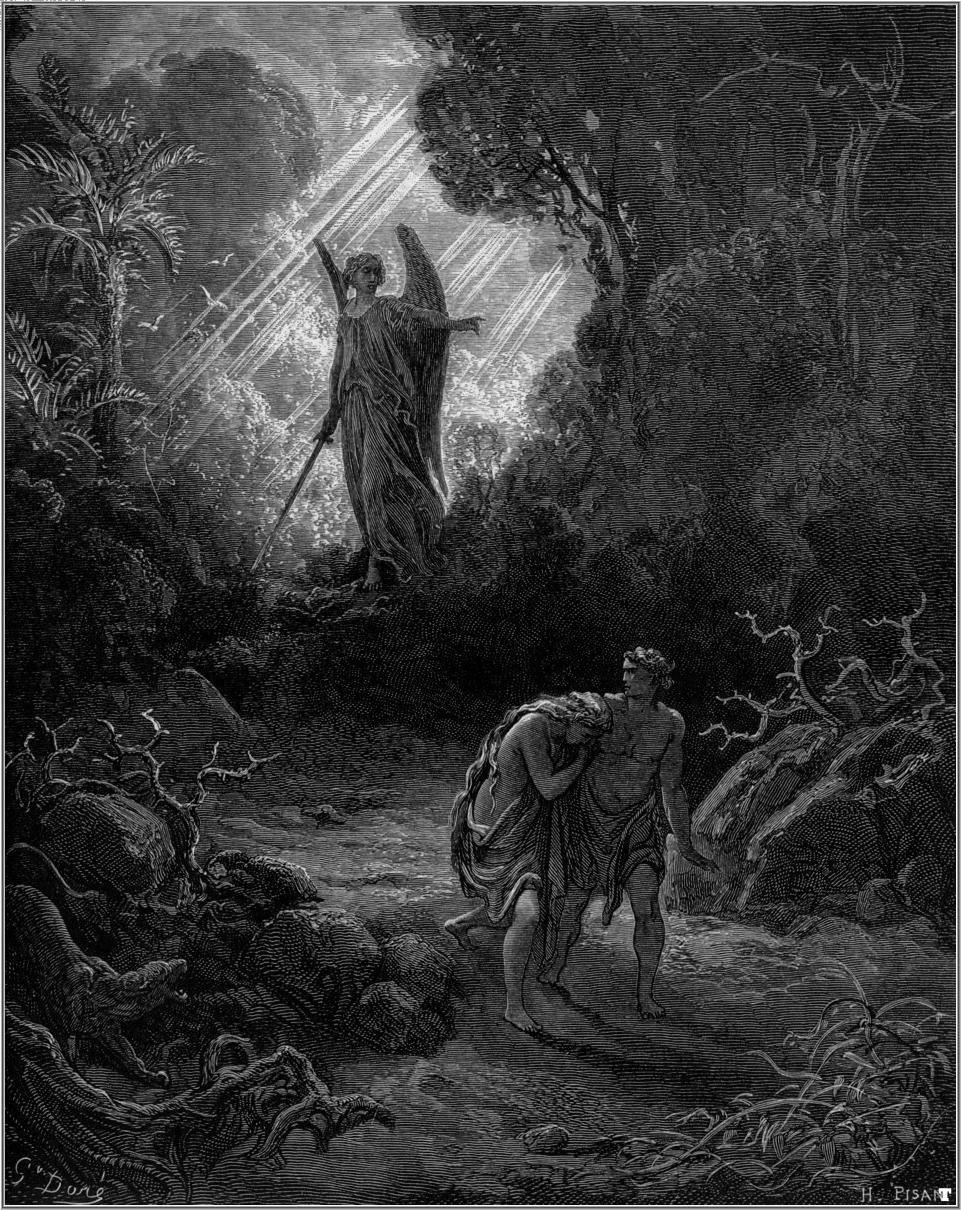
Later after the man sinned by disobeying God’s only prohibition, instead of carrying out the prescribed sentence – “of the tree of the knowledge of good and evil, thou shalt not eat of it: for in the day that thou eatest thereof thou shalt surely die” (Genesis 2:17, emphasis added) – God spared their lives and provided for future redemption: “And I will put enmity between thee [Satan] and the woman, and between thy seed and her seed; it shall bruise thy head, and thou shalt bruise his heel” (Genesis 3:15).

When Cain murdered his brother Abel (Genesis 4), instead of killing him on the spot, God put a mark on Cain to protect him from a vendetta that might have been raised against him.

ark2Almost 1600 years later (Genesis 6-9) mankind had become so wicked and violent that God was ready to end it all. “But Noah found grace in the eyes of the LORD” (Genesis 6:8), and God saved His prized creation in saving Noah and his family.

God is often criticized for His order to the Israelites to wipe out the Canaanites including men, women, children and their animals. The Canaanites were vile, wicked people who practiced child sacrifice and included all kinds of sexual perversions including the use of animals (bestiality) in the worship of the demonic gods – all of which is abhorrent to God. But God did not destroy them all at once as He did Sodom and Gomorrah. Instead, he gave opportunity for the witness of Abraham, Isaac and Jacob to have an effect as they sojourned in their land. God spoke to Abraham, “And he said unto Abram, Know of a surety that thy seed shall be a stranger in a land that is not theirs, and shall serve them; and they shall afflict them four hundred years … But in the fourth generation they shall come hither again: for the iniquity of the Amorites is not yet full” (Genesis 15:13, 16, emphasis added). God allowed for the repentance of these pagans during the time that the Patriarchs were in the land, plus 430 years that Israel was in Egyptian captivity, and 40 more years as Israel wandered the wilderness. That was a total of around 600 years that they had to repent. It may be worth noting, that while God commanded that they wipe them all out to purge the land of their wickedness, Israel did not fully obey God in killing them all. Consequently, they continually struggled with the lure of idolatry, which eventually destroyed the nation. God demonstrates His love through the patience He shows toward sinners in giving them every opportunity to repent, but His patience has limits.

Much more could be said about the love of God, but in the words of the old hymn:

Could we with ink the ocean fill, and were the skies of parchment made,
Were every stalk on earth a quill, and every man a scribe by trade,
To write the love of God above, would drain the ocean dry.
Nor could the scroll contain the whole, though stretched from sky to sky.
(“The Love of God,” Frederick M. Lehman, 1917.)

The greatest act of God’s love was demonstrated when He took upon Himself the form of man, “And being found in fashion as a man, he humbled himself, and became obedient unto death, even the death of the cross” (Philippians 2:8). God’s love is so great that He paid the death penalty in His own flesh to save us from the wrath to come. The wrath of God is nothing to be trifled with, but His love is extended to anyone who is willing to receive it.


1 Comment

Filed under Apologetics, Christianity, Creation, Evangelism, Gospel, Religion, Salvation, Theology

An Angry God

Angry God

Thou, even thou, art to be feared: and who may stand in thy sight when once thou art angry?  (Psalm 76:7)

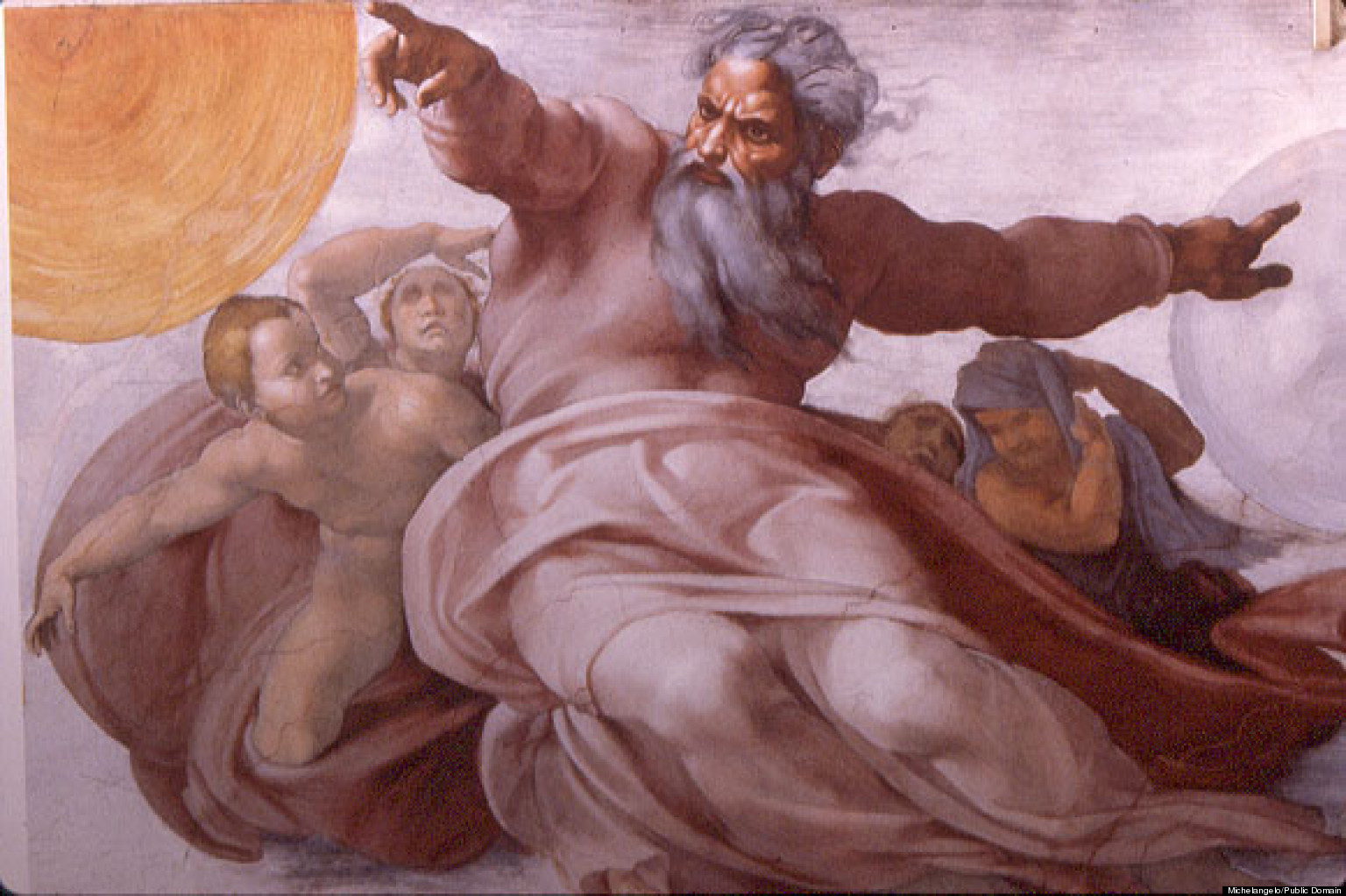
When we think of God, we do not like to think of Him as angry; rather, we want to think of Him as loving, kind, merciful and patient. We want a “nice” God, not an angry one. But when we read the Old Testament Scriptures, we can come away with a very different perspective on God. Indeed, many atheists readily see this in the pages of the Bible, and are quick to point this out as they self-righteously boast that they could never believe in a God that acts so “irrationally” against people who do not wish to follow Him. They make a valid, albeit uniformed, point.

The English word “anger” appears 229 times in the Old Testament of the King James Bible compared to only five times in the New Testament. The Hebrew word most often translated as “anger” is ‘aph and it literally means “nose, nostril, or ire.” It describes an angry person who is breathing so heavily that his nostrils flare with rage. This Hebrew word appears 276 in the Old Testament, and with regard to God, it is translated as “anger” 198 times. Second to that is the Hebrew word chêmâh which means “heat, fury, passion or anger.” In relation to God, this word is used 94 times. Another frequently used Hebrew word is chârâh which means to “glow or grow warm, or to blaze up” with anger, zeal or jealousy. This word describes God’s anger 54 times. There are other Hebrew words that describe God’s anger as an outburst of passion, vexation, indignation, provocation or froth-at-the-mouth fury.  This is certainly not the kind of God we like to think about.

Why is God so angry, and what is it that provokes Him to anger? We see the first occurrence of English word “anger” applied to God in Exodus 4 when God assigned Moses the task of bringing His “people the children of Israel out of Egypt” (Exodus 3:10). Moses gave God one excuse after another as to why he was not the right man for the job until “the anger of the LORD was kindled against Moses” (Exodus 4:14). So reluctance to do God’s will angers God. The next instance where the word “anger” is applied to God is found in Numbers 11, where the children of Israel complained: “And when the people complained, it displeased the LORD: and the LORD heard it; and his anger was kindled; and the fire of the LORD burnt among them, and consumed them that were in the uttermost parts of the camp” (Numbers 11:1). God, Who provides everything for us, meets all of our needs and protects us from danger, is angry when we complain about our circumstances rather than respond to Him with a heart of gratitude.

On another occasion, Balak, the Moabite king, went to the prophet Balaam requesting that he curse the children of Israel. Balaam understood that these people were under God’s protection and was at first unwilling to accept the task. Balak persisted offering Balaam anything he wanted to do the job. At this second request, Balaam responded against God’s will, “And God’s anger was kindled because he went” (Numbers 22:22). Deliberately going against God’s will angers God. Since God would not permit him to curse Israel, Balaam devised a plan that would cause God to curse His own people.  “Balaam … taught Balac to cast a stumblingblock before the children of Israel, to eat things sacrificed unto idols, and to commit fornication” (Revelation 2:14). “And Israel abode in Shittim, and the people began to commit whoredom with the daughters of Moab. And they called the people unto the sacrifices of their gods: and the people did eat, and bowed down to their gods. And Israel joined himself unto Baalpeor: and the anger of the LORD was kindled against Israel And the LORD said unto Moses, Take all the heads of the people, and hang them up before the LORD against the sun, that the fierce anger of the LORD may be turned away from Israel.” (Numbers 25:1-4, emphasis added). This may sound extreme, but it shows how God feels about the practice of idolatry – allowing anything else to take the place of God (Exodus 20:3). Idolatry makes God angry.

Later, as the children of Israel were preparing to enter the Promised Land, the tribes of Ruben and Gad requested to stay on the east bank of the Jordan because of its good grazing lands (Numbers 32). Moses feared that the remaining ten tribes might become discouraged, if Ruben and Gad did not join in the fight. He reminded them of another time when the people were discouraged by a bad report by 10 of the 12 spies (Numbers 14), “And the LORD’S anger was kindled the same time” (Numbers 32:10). God was so angry at that time that He was ready to wipe out the whole nation and start over with Moses (Numbers 14:12). Lack of trust or faith in God makes Him angry. Indeed, “without faith it is impossible to please him” (Hebrews 11:6).

God demonstrates His anger in many ways throughout the Old Testament. The global flood of Noah’s day (Genesis 6-9) is an extreme example of God’s wrath poured out on billions of wicked, violent people who had total disregard for God. At the Tower of Babel (Genesis 11), God expressed His anger by confusing the languages of the people and scattering them throughout the world. Later, God evinced His anger on Sodom and Gomorrah for their sin of homosexuality, violence and all forms of wickedness (Genesis 19).

There are abundant examples of God displaying His anger throughout the Old Testament, but strangely enough, the New Testament mostly speaks of God’s “wrath” in terms of end times, otherwise known as “the day of wrath,” or with regard to an individual’s lost condition: “he that believeth not the Son shall not see life; but the wrath of God abideth on him” (John 3:36, emphasis added). “[T]he wrath of God is revealed from heaven against all ungodliness and unrighteousness of men, who hold the truth in unrighteousness” (Romans 1:18). Perhaps the reason for this is that God discharged the full measure of His anger and wrath on His Son, Jesus, at the cross. When Jesus cried out “τετελεσται” (it is finished!), God’s wrath was satisfied.

There is still the wrath to come, but from the cross to the present, God has withheld His anger for the coming judgment. It would behoove us, Christian and non-Christian alike, not to take this reprieve too lightly. God is love (1 John 4:8), but God is equally anger. Many Christians today reject the Old Testament teachings and want to hold only to what is taught in the New Testament. That is to reject a very fundamental truth: God is immutable, i.e., He does not change: “I am the LORD, I change not” (Malachi 3:6). James reminds us that all good things come “from the Father of lights, with whom is no variableness, neither shadow of turning” (James 1:17, emphasis added). So why should we think that God’s anger has ceased simply because we turned the page from Malachi 4:6 to Matthew 1:1? We need to revere God and hold Him in awe for Who He is. We should have a healthy “fear” of God and strive to please Him with the way we conduct our lives. “Sanctify yourselves therefore, and be ye holy: for I am the LORD your God” (Leviticus 20:7, emphasis added). “As obedient children, not fashioning yourselves according to the former lusts in your ignorance: But as he which hath called you is holy, so be ye holy in all manner of conversation [life conduct]; Because it is written, Be ye holy; for I am holy” (1 Peter 1:14-16, emphasis added). God still gets angry. Let us not make Him angry with us by living our lives in a manner that reflects poorly or negatively on Him.

2 Comments

Filed under Apologetics, Atheism, Christianity, End Times, Evangelism, Gospel, Religion, Salvation, Theology