Category Archives: Bible

A Nutshell History of the World

Remember the former things of old: for I am God, and there is none else; I am God, and there is none like me, Declaring the end from the beginning, and from ancient times the things that are not yet done, saying, My counsel shall stand, and I will do all my pleasure: (Isaiah 46:9-10)

World history can evenly be divided into three segments of 2,000 years each: from creation to Abraham; from Abraham to Jesus; and from Jesus to the present. I realize that academic historians and anthropologists with Ph.D. degrees will disagree, but they have earned the right to be wrong; so I will acknowledge their opposition and move on.

Beginning with Genesis 1, the Bible records the creation in just six 24-hour days. Genesis 2 details the creation of man – Adam and Eve. Genesis 3 records the Fall of man and the first promise of Messiah. This event probably took place less than a month after creation. I come to this conclusion because God instructed Adam and Eve to be fruitful, multiply, and fill the earth (Genesis 1:28). Considering God’s assessment of His “very good” creation (Genesis 1:31), Adam and Eve were perfect human specimens and should not have had any trouble reproducing.

Additionally, a woman’s menstrual cycle lasts about 28 days. It takes 14 days for the ovary to release a ripened egg (ovum).[1] The ovum has another week where it is ready for fertilization. If not fertilized within that week, it will be sluffed off in the menstrual period, and the cycle begins again. Considering this, the Fall may have been less than two weeks after creation.

Genesis 4 records the first murder – Cain killing his brother Abel – and the ungodly descendants of Cain. Genesis 5 records the Godly descendants of Seth (Adam’s son to replace Abel). That genealogy records a period of about 1,658 years.[2], [3] When reading the genealogies recorded in Genesis 5, one must keep in mind that these records are from event to event – the age of the father at the birth of that son. Furthermore, the birth of the named son does not demand that he be the firstborn as precluded by the common phrase “and he begat sons and daughters (Genesis 5:4, 7, 10, 13, 16, 19, 22, 26, 30). Therefore, one can employ simple addition to add up the ages of the father at the birth of the named son.[4]

Genesis 6-9 records the depravity of man that brought God’s judgment upon the Earth through the Global Flood. Only Noah, his family. and all the animals that God brought to the Ark were saved. The animals included dinosaurs, and the Bible does mention dinosaurs although not by that name. Sir Richard Owen first coined the word dinosaur in 1841. The King James Bible was published in 1611, more than 200 years before the word “dinosaur” was invented. Before that time, these creatures were collectively known as “dragons.” The Book of Job names two of these creatures, Behemoth and Leviathan (Job 40-41), whose description is unlike anything known to modern man.

The Flood lasted 370 days (Genesis 7:11; 8:14), based on a 360-day year. After the Flood, the Earth was still in turmoil with a lot of active volcanos and much warmer oceans. These factors contributed to the Ice Age that followed.[5] The Book of Job, considered by many Bible scholars as the oldest book in the Bible, speaks more about snow, ice, and cold than any other book of the Bible suggesting that the earth was experiencing the Ice Age at that time. Creation scientists believe the Ice Age lasted only about 200-400 years, but there was only one, not many as the secular scientists suggest.

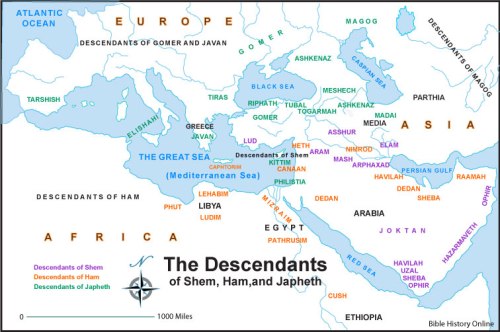
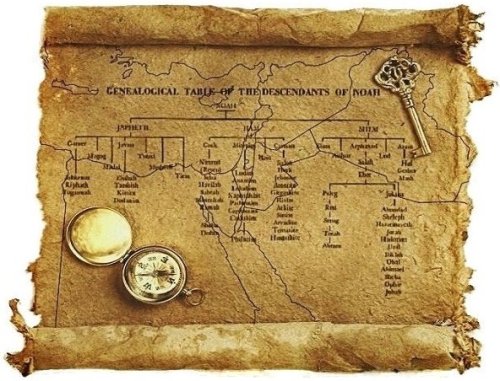
Genesis 10 is called the Table of Nations. It records the descendants of Noah’s sons, Shem, Ham, and Japheth and where they settled around the world after their dispersion at Babel. Shem’s descendants ultimately led to the Lord Jesus Christ (Luke 3:36).
Finally, Genesis 11 records the Tower of Babel and the confusion of tongues/languages. This event is the origin of all the ethnic groups (not “races”) in the world. Neanderthals were among those that scattered at Babel. Recent scientific discoveries show that Neanderthals are/were 100% human. Genesis 11 also records the genealogy of Abraham through whom God would bless all the nations of the earth 2,000 years later. The rest of the Old Testament deals with the history and the future history of Abraham’s descendants.

The future history concerns the coming of Messiah to rule all nations from His throne in Jerusalem. The Old Testament records future history in two parts. At His first coming/advent, “He came to His own, and His own received Him not” (John 1:11). He was crucified, buried, but He rose from the dead after three days and ascended to heaven (Acts 1:9-10; Ephesians 1:19-23). From there we await His return – His second coming (John 14:1-3; Acts 1:11). At that time, He will fulfill the future history recorded by the Old Testament prophets concerning His reign on earth. The time of His second advent draws near. As there were six days of creation and a Sabbath day of rest (Genesis 1:1-2:3), so have there been six millennia of history, and we await the seventh millennium (Revelation 20:1-7) of rest where Messiah will rule the nations with a “rod of iron” (Psalm 2:9; Revelation 2:27; 12:5; 19:15).

At the end of the millennial reign of Christ, world history ends and eternity, for us, begins. Are you ready? See my page on “Securing Eternal Life.”

Notes:


[1]  “Female Reproductive System” – https://tulsafertilitycenter.com/female-infertility/female-reproductive-cycle.php

[2]  “Age of the Earth” – https://erniecarrasco.com/2018/10/14/age-of-the-earth-2/

[3]  “Age of the Earth” – https://erniecarrasco.com/2014/02/23/age-of-the-earth/

[4]  James J. S. Johnson, J.D., TH.D, “How Young Is the Earth? Applying Simple Math to Data Provided in Genesis” – http://www.icr.org/article/how-young-earth-applying-simple-math-data-provided/

[5]  Jake Hebert, Ph.D., “Was There an Ice Age?” – http://www.icr.org/article/was-there-ice-age

2 Comments

Filed under Apologetics, Bible, Christianity, Creation, Evangelism, Origins, Religion, Salvation, Second Coming of Christ, Theology

Angels

There shall no evil befall thee, neither shall any plague come nigh thy dwelling. For he shall give his angels charge over thee, to keep thee in all thy ways. (Psalm 91:10-11)

I often get asked, “When did God create angels?” That is an understandable question since the Bible often speaks of angels. The word “angel” in Hebrew is mal’âk and aggelos in the Greek. In either language, the word means “messenger.” The English word “angel” appears 203 times in the Bible, and that does not account for the plural form or other terms that describe them.

The Bible names only three angels, Lucifer, Michael, and Gabriel. In the Old Testament, we read of “the angel of the Lord,” who is God Himself, the pre-incarnate Jesus. We know this because, in context, the “angel” speaks “as God,” not “for God.” Regular angels always deliver a message “from” God and give credit to God for the message – “thus saith the Lord.” The “angel of the Lord” always speaks as God. For example, the first appearance of the “angel of the Lord” is in Genesis 16, when Sarah cast out Hagar, and the “angel of the Lord” appears to her in the wilderness. “And the angel of the LORD said unto her, I will multiply thy seed exceedingly, that it shall not be numbered for multitude” (Genesis 16:10, emphasis mine). A regular angel might have said, “The Lord will multiply thy seed,” but this angel assumes the responsibility. A regular angel cannot do that, but God can.

With all the mention of angels in the Bible – and if we believe the Bible is true – angels are real creatures. Since they are real, God created them, and if God created them, He must have created them some time during the creation week. The question is, when did He do that?

The Bible does not say when the angels were created. The Bible is “a love letter from God to man,” therefore it deals mostly with the relationship between God and His prized creation –mankind. While the Bible is accurate when it describes scientific facts (the water cycle, bird migration, cosmological phenomena, etc.) or records history, that is not its main purpose. Therefore not everything that God does is revealed to us. “The secret things belong unto the LORD our God: but those things which are revealed belong unto us and to our children for ever, that we may do all the words of this law” (Deuteronomy 29:29).

Angels were created to serve God’s purpose for man, and they mostly fight for us in “the unseen realm.” Only occasionally do they enter our dimension which is why the writer to the Hebrews encourages hospitality. “Be not forgetful to entertain strangers: for thereby some have entertained angels unawares” (Hebrews 13:2).

However, the Bible does not focus on them too much probably to discourage the worship of them. “Let no man beguile you of your reward in a voluntary humility and worshipping of angels, intruding into those things which he hath not seen, vainly puffed up by his fleshly mind” (Colossians 2:18). In addition, man was created superior to the angels. “Do ye not know that the saints shall judge the world? and if the world shall be judged by you, are ye unworthy to judge the smallest matters? Know ye not that we shall judge angels? how much more things that pertain to this life?” (1 Corinthians 6:2-3, emphasis mine).

Therefore, we can understand why God did not include the creation of angels in the creation account. The Bible says, “For thus saith the LORD that created the heavens; God himself that formed the earth and made it; he hath established it, he created it not in vain, he formed it to be inhabited: I am the LORD; and there is none else” (Isaiah 45:18). The earth was created for man, not for angels, and that is the focus of the creation account.

However, we can know that angels were created (they are immortal, not “eternal” in the same way as God is eternal) very early on in the creation. In God’s response to Job, He says, “Where wast thou when I laid the foundations of the earth? declare, if thou hast understanding. Who hath laid the measures thereof, if thou knowest? or who hath stretched the line upon it? Whereupon are the foundations thereof fastened? or who laid the corner stone thereof; When the morning stars sang together, and all the sons of God shouted for joy?” (Job 38:4-7, emphasis mine). The “morning stars” and the “sons of God” is speaking of the angels. They were there to witness God’s creation. Therefore we can surmise that they were probably created on Day One or no later than Day Two, but the Bible does not say for certain. We can also surmise that Satan[1] (Lucifer) was among those angels when we read Isaiah 14:12-15 and Ezekiel 28:11-19. I believe that the reason Satan hates humanity[2] so much is that he, having been created the greatest of the angels, observed God create man in His own image and give man dominion over all of His creation. In Texas, we would say, “That really chapped his hide.”

Man lost his former estate in the Garden of Eden, but the fact remains that God created man to be superior to the angels. His will is to redeem mankind from that fallen state, and He gave us His Word both in written form – the Bible – and in physical form – Jesus, the Word – to accomplish that end. Angels are not the main focus of the Bible.

Notes:


[1]  “Why Satan?” https://erniecarrasco.com/2014/11/02/why-satan/

[2]  “Marring the Image”  https://erniecarrasco.com/2015/05/24/marring-the-image/

1 Comment

Filed under Apologetics, Bible, Christianity, Creation, Religion, Satan, Theology

Age of the Earth

“And the earth was without form and void” (Genesis 1:2)

For in six days the LORD made heaven and earth, the sea, and all that in them is, and rested the seventh day: wherefore the LORD blessed the sabbath day, and hallowed it. (Exodus 20:11)

Many Christians find it difficult to believe that the universe and the earth are only about 6000 years old. After decades of assault from all sides by evolutionists touting that billions of years of evolution are well-established scientific fact, Christian scholars, intimidated by the prospect of appearing uneducated while at the same time desiring to uphold the veracity of the Bible, seek compromises that attempt to “shoehorn” evolution into the simple text of the creation account recorded in Genesis.

Several of the compromises exist today even though solid biblical and scientific scholarship has shown them to be false. The Gap Theory,[1] for example, attempts to squeeze billions of years between Verse 1 and Verse 2 of Genesis 1 supported only by vivid imaginations and extra-biblical Jewish writings and traditions but offers zero biblical backup. The Day-Age Theory mistranslates the normal meaning of “day” into indefinitely long periods of time. The Day-Age Theory, when examined carefully and critically presents several problems. Then there is Theistic Evolution that makes out God to be some cosmic tinkerer or experimenter as if He could not get it right the first time.

Other compromises probably exist, but recently I heard a new one. Someone wrote in with the perfect solution to the age of the earth problem. He said:

I believe that the earth is young, 6000 years old, but when I look at Genesis 1: 9-10, I see that what God called the earth is DRY land, not the whole planet. In other words, it is the DRYNESS of the land that is sticking up above the surface of the seas that God had just made that is young or new or 6000 years old. This isn’t my opinion, the Bible describes this. So verses 1 and 2 plus Day 1 and Day 2 need to be interpreted using what Moses says the earth is. So you see trying use dates given by dating techniques to work out how old the ‘earth’ is a waste of time. I personally doubt that it would be possible to date the age of anything. This is because I think anything God makes would always be ‘as new’, until we get to when sin occurred here and then the flood. Using the context approach, entirely within chapter one, it is easy to see what ‘heaven’ is as well. The universe was made instantly by God’s word for sure, but that wasn’t Moses’ focus in Genesis. Another question to ask using the context approach is, ‘Why did God do what He did in Genesis One, the climax of which is Adam and Eve?

What the writer suggests is that the first two days were long periods of time – millions or billions of years, but the appearance of land on the third day is the starting point for counting the age of the earth. I can commend him for taking a hard look at Scripture, however, his disadvantage, it appears, is that he is relying strictly on the English translation of the Bible. The original language, Hebrew, makes things very clear. The Hebrew word for “day” is yôm. Yôm, in the Old Testament nearly always refers to a normal 24-hour day, especially when it is associated with an ordinal number: first day, second day, third day, etc. If that were not clear enough, God clearly defines what a day is: “And the evening and the morning were the first day” (Genesis 1:5). So, one cannot add extensive periods of time to the creation account without doing harm to the text.

Genesis 1:9-10 is another place where the English language fails to translate the Hebrew precisely. In my King James Bible, the word “land” is in italics meaning that the word was inserted in the text for clarity to the English reader. Literally, the phrase should read, “let the dry appear: and it was so. And God called the dry Earth.” (vv. 9-10). The Hebrew word translated “earth” is ‘erets, and it can mean soil, ground, land (as in a plot of land or as a region like “the land of Egypt), and in a greater sense, the planet Earth. Context determines the meaning, which makes me wonder why the translators capitalized the word “Earth” when the context is referring to the “dry land” and not to the entire planet. The conclusion that it is only the “dryness” that is 6000 years old contradicts the definition of yôm given in Verse 5 (and the rest of Scripture).

Reading in its normal context, giving the words their normal meaning, the creation account recorded in Genesis 1 clearly states that God created the universe, the earth, and everything upon the earth in six 24-hour days. One must either accept that or reject it, but woe to them who attempt to add to or take away from that Word to make it fit the whims of sinful men (Deuteronomy 12:32; Revelation 22:18).

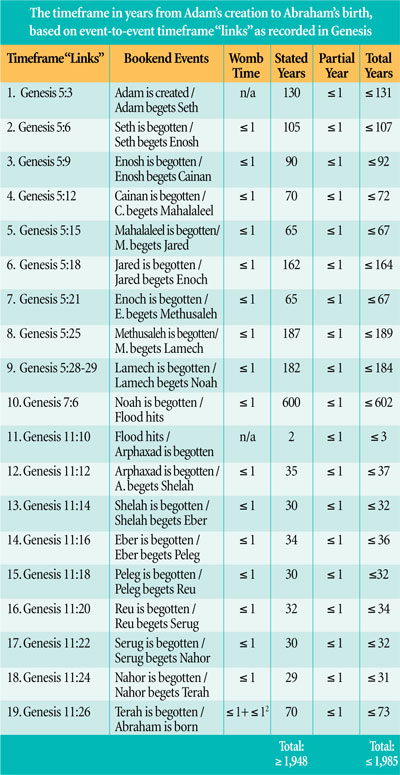
Since the writer was convinced that the 6000-year age of the earth started with the appearance of dry land, I did not expound any further on the age of the earth. However, some of the readers of this blog may still doubt since “experts” in the field of anthropology place the beginning of human history between 8000 BC and 5000 BC with “civilization” beginning around 3000 BC. According to biblical chronology, creation happened around 4000 BC, and man was “civilized” from the beginning. Many biblical scholars question this date because they fear appearing ignorant among the “experts.” The Bible presents a straightforward chronology in the “begats” cited in Genesis 5. Biblical scholars that doubt the accuracy of this chronology suggest that there may be gaps of hundreds or even thousands of years in these generations. However, a careful examination of the text reveals no such gaps. The years recorded in Genesis 5 are from event to event – from the age of the father to the birth of that son. For example, Adam was 130 years old when Seth was born or conceived (Genesis 5:3); that is 130 years from Creation. Seth was 105 years old when Enos was born or conceived (Genesis 5:6); that adds up to 235 years from Creation. Enos was 90 years old when Cainan was born or conceived (Genesis 5:9); that adds up to 325 years from Creation and so on. The table below breaks down the timeline.

Image Credit: Institute for Creation Research

[2]

Add to these the genealogies recorded in Genesis 11 (included in the table above), and we learn that Abraham was born between 1,948 to 1,985 years after Creation or around 2018 BC. The year of Abraham’s birth is pretty well established +/- 100 years, so given the chronology recorded in Genesis, all of Creation is not much more than 6000 years old. Of course, many will argue that, but their argument is against Scripture. Personally, I would be careful about challenging God on the accuracy of His Word. To question what we do not understand is one thing. To deny the veracity of God’s Word is something else altogether. According to Scripture, the Earth is only about 6000 years old.

Notes:


[1]  “No Gap” https://erniecarrasco.com/2015/10/18/no-gap/

[2]  JAMES J. S. JOHNSON, J.D., TH.D, “How Young Is the Earth? Applying Simple Math to Data Provided in Genesis” – http://www.icr.org/article/how-young-earth-applying-simple-math-data-provided/

5 Comments

Filed under Apologetics, Bible, Christianity, Creation, Evolution, Religion, Theology

Three Fingers Back

Behold, how good and how pleasant it is for brethren to dwell together in unity! (Psalm 133:1)

I often hear the charge, “that’s not very Christian” coming from non-Christians when a Christian acts or speaks in a manner which the non-Christian deems inappropriate for a Christian (as if they would know what is or is not appropriate for a Christian). I get that. They make those judgments based on their humanistic worldview that determines right or wrong according to their contrived values. It is a relativistic worldview that authorizes the individual to make value judgments as he sees fit. “Every man did that which was right in his own eyes” (Judges 21:25). Everyone has his/her own value system. Everyone has his/her own “truth.” One can say or do whatever one wishes as long as it is legal and “it does not hurt anyone else.” That rule applies to everyone – except for Christians. Christians are judged by a different measure. That measure is the subjective preconception of how a Christian ought to behave.

While I understand the source of the non-Christian’s warped perspective of how a Christian should behave, I am really taken aback when I hear the exact criticism coming from another Christian. What is up with that! One would think that all Christians should present a united front. That was Jesus’ desire for us. “Neither pray I for these alone, but for them also which shall believe on me through their word [that be us]; That they all may be one; as thou, Father, art in me, and I in thee, that they also may be one in us: that the world may believe that thou hast sent me” (John 17:20-21, emphasis mine).

Now when the Mormons come knocking on your door, this is one fault they like to point out. “Why are there so many religions when Jesus wanted us all to be one?” When someone asks me that question, I quickly agree and say, “I think we should all be Baptists!” I am joking, of course. I understand most of the denominational differences, but as Christians, we should all have one thing in common that unifies us. Salvation is through Grace alone, through Faith in Christ alone. “For by grace are ye saved through faith; and that not of yourselves: it is the gift of God: Not of works, lest any man should boast” (Ephesians 2:8-9). We can discuss our differences on how we view baptism, communion, predestination vs. free will, glossolalia (speaking in tongues), eschatology (end times), creation, etc. We can even debate over those issues – in love. However, we must keep those discussions based on Scripture, not on personal opinion or the opinions of others. What does the Bible – God’s Word – have to say about it? There is nothing wrong with that, and there is much right about that. “Iron sharpeneth iron; so a man sharpeneth the countenance of his friend” (Proverbs 27:17).

However, questioning the Christianity of another Christian – especially in a public forum like Facebook – is wholly inappropriate. That very act is “un-Christian.” The familiar axiom – “When you point the finger at someone else, you have three fingers point back at you” – is true. Jesus said, “Judge not, that ye be not judged” (Matthew 7:1). However, in saying that, He was not prohibiting value judgments. In context (Matthew 7:1-6), Jesus referred to making a condemning judgment against someone else. The Greek word translated “judge” is krinō, which means to condemn. Only Jesus can properly judge an individual because only He knows the heart and the motives of the person. We do not possess that ability. We can, however, judge actions – what can actually be seen – and determine whether those actions are right or wrong from the rubric of God’s Word. We can determine if a brother’s actions are not in keeping with God’s Word, but we have no right to accuse him of not being a Christian. We know neither his heart nor his motives.

Jesus makes it clear that we must make judgments. In the same passage, He said, “Give not that which is holy unto the dogs, neither cast ye your pearls before swine, lest they trample them under their feet, and turn again and rend you” (Matthew 7:6). Determining who the “dogs” and “swine” are demands a judgment. “That which is holy” and “your pearls” is the Gospel message we have to offer. Some people will reject the message and treat it as a dog treats a rag toy. The message will offend others to the point that they will attack you – either verbally or physically. Either way, their actions determine whether you continue to share the Gospel with them or not. When that happens, Jesus said to “shake off the dust under your feet for a testimony against them” (Mark 6:11). You have made a judgment.

Jesus later offers another example. He said, “Beware of false prophets, which come to you in sheep’s clothing, but inwardly they are ravening wolves. Ye shall know them by their fruits. Do men gather grapes of thorns, or figs of thistles?” (Matthew 7:15-16). How does one recognize a false prophet without making a judgment? One must judge! By what standard do we make that judgment? We make that judgment based on the Word of God. When the prophet speaks, do his words match up with the Word of God? You have to make a judgment! Jesus further points to the actions – fruit – of the false prophet. If that prophet talks like a Christian but behaves like the devil, then perhaps you are right to point at the “bad fruit.” If the prophet’s message is inconsistent with the Word of God, then he should be called out for his false teaching but be sure you are standing on firm, biblical ground. Also, be prepared to take on fire.

Again, we cannot judge the heart or the motives of another believer, or anyone for that matter. It is possible, though doubtful, that the false prophet is a Christian. I have known false prophets who spoke the truth, right out of God’s Word, but their lives told a different story. The truth of God’s Word remains, though the messenger may be faulty. Here is where we must be careful in making judgments. The false prophet may or may not be a true believer. I have heard testimonies of pastors that preached behind pulpits for many years before realizing their own lost condition and turning to Christ for salvation. It can happen! Jesus cautioned, “And why beholdest thou the mote that is in thy brother’s eye, but considerest not the beam that is in thine own eye? … Thou hypocrite, first cast out the beam out of thine own eye; and then shalt thou see clearly to cast out the mote out of thy brother’s eye” (Matthew 7:3, 5).

Before accusing a fellow believer of not being Christian, we must examine ourselves – critically – to make sure we are not at fault. Moreover, I cannot emphasize it strongly enough; our judgment – even our self-examination – must be based on Scripture, not personal (or “expert”) opinion. We should be willing to judge ourselves more strictly than we do the errant brother. Then, with our conscience cleared by the Holy Spirit, we can judge the “actions” of that brother – never, never the heart or motives. When we find a brother in err, Jesus said, “Moreover if thy brother shall trespass against thee, go and tell him his fault between thee and him alone: if he shall hear thee, thou hast gained thy brother” (Matthew 18:15). What if he will not listen? Read the rest of the passage.

There is another danger in Christians accusing Christians of non-Christian behavior. If you do this, you are playing for the wrong team. There is one who constantly brings charges against Christians before God. He is known as “the accuser of our brethren” (Revelation 12:10). Scripture first introduces him to us in that role in the account Job’s life (Job 1:6-7). His name is Lucifer (Isaiah 14:12), but his title is Satan – accuser. Of this one, Jesus said, “He was a murderer from the beginning, and abode not in the truth, because there is no truth in him. When he speaketh a lie, he speaketh of his own: for he is a liar, and the father of it” (John 8:44). When we wrongly judge another Christian – especially in a public way – we are guilty of slander. Another word for slander is character assassination, i.e., murder. When you do that, you are doing the devil’s work for him. Do you really want to go there?

Judge, but judge with righteous judgment. Jesus said, “Judge not according to the appearance, but judge righteous judgment” (John 7:24). The only way to carry out righteous judgment is by the standard of God’s Word – not your feelings, not your opinions, not the opinions of “experts,” and especially not by the ever-changing standards of the world. God’s Word is the only measure by which to judge righteously. When you feel tempted to judge a fellow believer, take a very close look at yourself and “first cast out the beam out of thine own eye.” You may find that you are the one in the wrong, not your brother. If your brother is in the wrong, take him aside and lovingly help him see his error from Scripture. Don’t point out his error on Facebook or some other public forum; that is what Satan would have you do because Satan’s goal is to destroy the Christian witness however he can. Don’t help him; he does a good job of that on his own. Remember, when you point the finger, three are pointing back at you.

Comments Off on Three Fingers Back

Filed under Apologetics, Bible, Christianity, Religion

Conversation

Whoso offereth praise glorifieth me: and to him that ordereth his conversation aright will I shew the salvation of God. (Psalm 50:23)

We engage in conversation on a daily basis. If there is no one around with whom to converse, we sometimes hold a conversation with ourselves or with the dog or cat. Conversation can be completely mindless or profound.

The modern dictionary defines “conversation” as: “informal interchange of thoughts, information, etc., by spoken words; oral communication between persons; talk; colloquy.” In addition, noted as “obsolete,” conversation can mean “behavior or manner of living.”[1] That “obsolete” definition is what we find throughout the King James Version (KJV) of the Bible; therefore, we must grasp this meaning of the word. Otherwise, Scripture, like the passage above, becomes confusing, and the deeper meaning of the text is lost.

Before considering the biblical application of the word, let us consider its etymology.

Conversation (n.) mid-14c., “place where one lives or dwells,” also “general course of actions or habits, manner of conducting oneself in the world,” both senses now obsolete; from Old French conversacion “behavior, life, way of life, monastic life,” and directly from Latin conversationem (nominative conversatio) “frequent use, frequent abode in a place, intercourse, conversation,” noun of action from past-participle stem of conversari “to live, dwell, live with, keep company with,” passive voice of conversare “to turn about, turn about with,” from assimilated form of com “with, together” (see con-) + versare, frequentative of vertere “to turn” (from PIE root *wer- (2) “to turn, bend”).[2]

Considering that the KJV was first published in 1611, the original meaning of the word should be applied in the reading. Basically, the word “conversation” in the Bible (and here I mean the KJV Bible) refers to the way one conducts one’s life. Our “conversation” is how we live, conduct, or carry on our lives. Each person’s conversation will differ and will reflect either who he/she really is or who he/she pretends to be. With that in mind, let us look at some passages from Scripture that provide instruction for our “conversation.”

The English word “conversation” appears 20 times in the KJV Bible, twice in the O.T. and 18 times in the N.T. In some instances, “conversation” may translate different Hebrew or Greek words and may obscure a deeper meaning. We shall see.

Both O.T. occurrences of the word appear in Psalms and translate the same Hebrew word, derek, which literally means a “road” or a “path.” By implication, it is the course of one’s life. Psalm 37:14 says that “the wicked” target those who live an “upright” or “righteous” life. “The wicked have drawn out the sword, and have bent their bow, to cast down the poor and needy, and to slay such as be of upright conversation.” That is not much incentive for living a godly life, however, Psalm 50:23 offers great encouragement from God. “Whoso offereth praise glorifieth me: and to him that ordereth his conversation aright will I shew the salvation of God.” (By the way, taking the “whole counsel” of God’s Word into account, simply living a “good life” will not earn anyone salvation. Ordering your “conversation aright” begins with trusting Jesus as your Lord and Savior.)[3]

As previously stated, “conversation” appears 18 times in the N.T., but it translates different Greek words. The most frequent Greek word translated is anastrophē, which means “behavior.” We find this first in Galatians 1:13. Here, Paul describes how he behaved before meeting the Lord Jesus. “For ye have heard of my conversation in time past in the Jews’ religion, how that beyond measure I persecuted the church of God, and wasted it.” Paul’s life changed radically after meeting Jesus face-to-face. He went from being a zealous persecutor of the Church to being persecuted for preaching the Gospel – equally as zealously. Thus he encourages believers to follow his example: “That ye put off concerning the former conversation the old man, which is corrupt according to the deceitful lusts; And be renewed in the spirit of your mind; And that ye put on the new man, which after God is created in righteousness and true holiness” (Ephesians 4:22-24). A “Christian” that continues in the sin of his/her former life does not carry on a new “conversation” indicating that no change has transpired in his/her life.

As followers of Christ, our lives should be examples to others as Paul encouraged Timothy. “Let no man despise thy youth; but be thou an example of the believers, in word, in conversation, in charity, in spirit, in faith, in purity” (1 Timothy 4:12). James says that our good behavior demonstrates “wisdom” and “knowledge.” “Who is a wise man and endued with knowledge among you? let him shew out of a good conversation his works with meekness of wisdom” (James 3:13).

Peter uses anastrophē eight times in his letters. Our behavior must be “holy,” i.e., “set apart” (for God’s use). “But as he which hath called you is holy, so be ye holy in all manner of conversation” (1 Peter 1:15). What God has done for us deserves our very best. “Forasmuch as ye know that ye were not redeemed with corruptible things, as silver and gold, from your vain conversation received by tradition from your fathers; But with the precious blood of Christ, as of a lamb without blemish and without spot: (1 Peter 1:18-19).

Relate to anastrophē is anastrepho, the verb form, which means “to overturn; also to return; by implication to busy oneself.” In other words, these are the “actions” one takes. This Greek verb is used twice in the N.T. by Paul. In 1 Corinthians 1:12, he refers to his “conversation in the world,” that is, the “work” he is doing. In Ephesians 2:3, Paul refers to the sinful activities in which we once participated. “Among whom also we all had our conversation in times past in the lusts of our flesh, fulfilling the desires of the flesh and of the mind; and were by nature the children of wrath, even as others.”

In the Epistle to the Philippians, “conversation” translates both the noun and verb form of politeuma (n.) meaning “a community” and abstractly referring to “citizenship.” “For our conversation [citizenship] is in heaven; from whence also we look for the Saviour, the Lord Jesus Christ” (Philippians 3:20). The verb form, politeuomai, means to “behave as a citizen.” When we come to Christ, we are no longer citizens of this world; we are “citizens” of heaven. Therefore, we ought to act the part.

Finally, “conversation” translates the Greek noun tropos meaning “a turn, that is, (by implication) mode or style. It is synonymous with anastrophē, and it refers to “deportment or character,” i.e., the way we conduct ourselves. We find this one-time use in Hebrews 13:5, “Let your conversation [deportment] be without covetousness; and be content with such things as ye have: for he hath said, I will never leave thee, nor forsake thee.”

Jesus paid a high price to give us eternal life. We who have placed our faith in Him are now “children of God” (John 1:12) and citizens of heaven; we are not of this world (John 17:16). Therefore, our “conversation” should reflect our status, not pridefully, but with humility and meekness, as children of the King and citizens of His Kingdom!

 Notes:


[1]  http://www.dictionary.com/browse/conversation?s=t

[2]  https://www.etymonline.com/word/conversation

[3]  “Securing Eternal Life” – https://erniecarrasco.com/securing-eternal-life/

1 Comment

Filed under Apologetics, Bible, Christianity, Religion