Category Archives: Christianity

The Greatest Commandment

Master, which is the great commandment in the law?  (Matthew 22:36)

Many people are often repulsed by Christianity because they view it as a system of regulations and restrictions designed to remove all the joy of living.  They equate church affiliation with an endless list of “thou-shall-not’s.”  Sometimes Christians themselves fall prey to this perception.  I remember my oldest son once protesting my exhortation to live a holy life by saying, “Do you expect me to become a monk!” Leave it to teenagers to exaggerate and be overly dramatic!  But in reality, that is how Christianity is often viewed.  “If I become a Christian, I’ll have to give up drinking beer, going to honky tonks, sleeping around, shacking up with my girlfriend.  I’ll have to quit going to the football games on Sundays.  I’ll have to cancel my subscription to my girly magazines” – and on and on the list would go.

 This encounter with the Pharisee (in our verse) came during Passion Week, before Jesus was crucified.  The religious leaders had swarmed around Jesus like a school of piranhas firing questions at Him in hopes of tripping Him up in order to find an excuse to have Him executed.  Jesus masterfully fielded all of their questions so that they were confounded as to how to respond.  Finally, this Pharisee approaches him with this profound question.

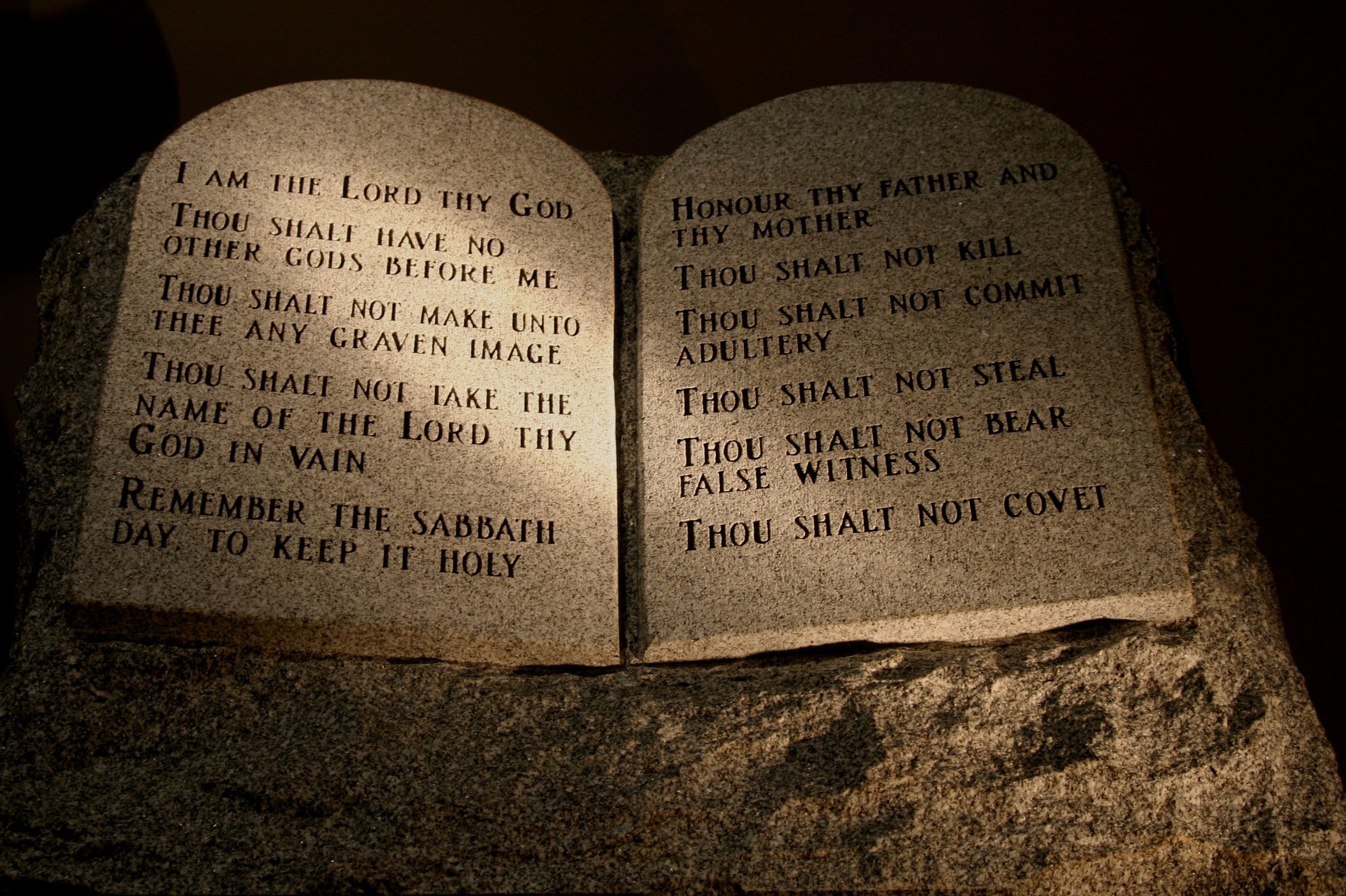
 The Pharisees took pride in their adherence to the law of Moses.  They knew the law so well, that they had devised clever ways to circumvent the law when it became too inconvenient for them.  For example, the fifth commandment said, “Honour thy father and thy mother” (Exodus 20:12).  Among other things, this commandment implied that children were to care for their parents in their old age.  This, as you might imagine, would involve some expense.  The Pharisees had devised a work-around where they would dedicate to God what they had set aside for the care of their parents.  Of course, they were free to use it for themselves, but it got them out of the expense of caring for elderly parents.  Jesus called them hypocrites (Matthew 15:3-9).

 So now, this Pharisee approaches Jesus in all of his self-righteous arrogance, sure that he will stump this simple Galilean carpenter, and asks this most profound question that only someone of his high intellect and learning can answer.  “Master,” he begins with tongue in cheek, careful not to burst out in laughter, “which is the great commandment?”  Perhaps he expected to hear one of the Ten Commandments like the fourth: “Remember the sabbath day to keep it holy” (Exodus 20:8).  Jesus had often been accused by the Pharisees of breaking the sabbath.  Perhaps he expected to hear something from the Talmud, a collection of rabbinical traditions.  Jesus responded by quoting from the Shama: “Hear, O Israel: The LORD our God is one LORD.  And thou shalt love the LORD thy God with all thine heart and with all thy soul, and with all thy might” (Deuteronomy 6:4-6).

 Why would Jesus quote this passage rather than the first of the Ten Commandments – “Thou shalt have no other gods before me” (Exodus 20:3)?  Likewise the second commandment says, “Thou shalt not make unto thee any graven image …” (v. 4).  And the third says, “Thou shalt not take the name of the LORD thy God in vain … (v. 7).  Why not one of these?

 The answer lies in recognizing Who God is.  The commandments are just so many rules, and as the saying goes, “rules are made to be broken.”  The Pharisees were expert in bending the rules. They had no love for God.  To them, God was, for all practical purposes, an academic exercise.  They did not deny God, but to them God was an impersonal being that must be appeased by strict adherence to His laws, which could be circumvented given the right conditions.  So, they had the first commandment covered, they did not recognize any other gods and they disassociated themselves from anybody who did.  They had the second commandment down; they disallowed any graven images.  In fact, they would not allow Roman coins into the temple because they bore the image of Caesar, hence they had money changers at the door of the temple that would exchange Roman coins for kosher temple coins (for a price).  They had become so proficient at not pronouncing the name of God (Yahweh) by simply replacing the Name with “LORD” (Adoni) that they literally forgot how to pronounce it!  This was all bound up in legalism, and it expressed no love toward God.

 “Jesus said unto him, Thou shalt love the Lord thy God with all thy heart, and with all thy soul, and with all thy mind.  This is the first and great commandment” (Matthew 22:37-38).  What makes this the greatest commandment is that it recognizes God as supreme in all things.  He is Creator (Genesis 1).  All creation belongs to Him.  The heavens, i.e., the universe, belong to Him (Job 41:11; Deuteronomy 10:14).  The earth belongs to Him (Exodus 9:29; Deuteronomy 10:14; Psalm 24:1; 50:12).  All the wealth of the earth belongs to Him: the animal kingdom (Psalm 50:10), and all the mineral wealth (Haggai 2:8).  All of the land belongs to Him (Leviticus 25:23).  The kingdoms of the world belong to Him (Psalm 22:28), and we each, individually, belong to Him (Leviticus 20:26; Ezekiel 18:4).  It is this last one, if the others aren’t enough, that should give us pause for concern, for Ezekiel 18:4 ends with this phrase:  “the soul that sinneth, it shall die.”  To break the greatest commandment is eternally fatal.

 We often show contempt for God when we presume ourselves to be self-sufficient, and that all we have comes by our own efforts.  When we come to that conclusion, God reminds us that when “thou say in thine heart, My power and the might of mine hand hath gotten me this wealth … thou shalt remember the LORD thy God: for it is he that giveth thee power to get wealth …” (Deuteronomy 8:17-18).  When you understand that ALL belongs to God and nothing belongs to you, then you can begin to recognize and be sincerely thankful for all He has given you.  That begins with your very existence – every breath, every beat of your heart, is a gift of God.  Then you can thank Him for your parents and all your ancestors before you without whom you would not exist.  You can thank Him for your spouse and for the children He has given to your charge – they are His and He has granted you oversight of their lives.  You can thank Him for your health and your intellect that allows you to be gainfully employed or conduct your own business.  You can thank Him for the nation in which you live.  If you are a Christian, you can thank Him for your brothers and sisters in Christ that gather around you in spiritual and material support when you are in need.  There are so many things that come from His hand for which you have to be grateful.

How can you love Him with all your heart, soul and mind?  Your heart is the seat of your emotions.  Your desire should be to have fellowship with Him, just as you desire to be with any person you love.  I love my wife, and I want to be with her always.  She is my best friend, and when she is away from me, there is an emptiness that only she can fill.  Our desire for God should be no less heartfelt than that.  To love God with your soul means that you yield every fiber of your being to His will.  Does that mean to become a monk?  Yes, if that is His will for you.  Does it mean that you surrender your life to be a missionary in a third-world country where there is a danger of losing your life?  Yes, if that is His will for you.  But mostly what it means is that you are willing to serve Him exactly where He has placed you:  to be the husband and spiritual leader of your family; to be a godly father or mother to your children; to stand up for your Christian beliefs even when it is inconvenient for you.  To love Him with all of your mind means that you spend time reading His word rather than filling your mind with the useless and unfruitful noise of the this world.  Paul said, “whatsoever things are true, whatsoever things are honest, whatsoever things are just, whatsoever things are pure, whatsoever things are lovely, whatsoever things are of good report; if there be any virtue, and if there be any praise, think on these things” (Philippians 4:8).

How can you know that you are keeping the greatest commandment?  Jesus said, “If ye love me, keep my commandments” (John 14:15).  What Jesus is saying here is that, if you keep the greatest commandment (love Me with all your heart, soul and mind), you will keep My commandments.  He also said, “If ye keep my commandments, ye shall abide in my love; even as I have kept my Father’s commandments, and abide in his love” (John 15:10).  When you love God/Jesus with all your heart, soul, and mind, His love inhabits you, which enables you to love Him more.  When you love Him with all your heart, soul, and mind, you will find that those things you treasured before are not so valuable after all, and the things you thought you would lose by surrendering your life to Him, you will find that He replaces with greater blessings.  The greatest commandment ensures that you have nothing to lose (because it’s not yours to begin with), but you have everything to gain (because as your heavenly Father, everything that is His He gives to His children).


Comments Off on The Greatest Commandment

Filed under Christianity, Religion, Theology

Holding All Things Together

And he is before all things, and by him all things consist.  (Colossians 1:17)

One of the irrefutable laws of physics is the First Law of Thermodynamics or the Law of Conservation, which states that matter and energy can neither be created nor destroyed — at least as it is observed today.  However, the Bible makes it clear that matter and energy did indeed have a starting point.  “In the beginning [time] God created the Heaven [space] and the earth [matter/energy]” (Genesis 1:1).  Scripture also makes it clear that the Creator was Jesus. “In the beginning was the Word, and the Word was with God, and the Word was God.  The same [Word] was in the beginning with God.  All things [matter/energy] were made by him [the Word], and without him was not any thing made that was made” (John 1:1-3).

Our verse further emphasizes this truth: “He is before all things.”  Before there was matter/energy, before there was time, before there was space, there was Christ.  Space and matter/energy can only be experienced in time, so it only makes sense that the Creator created time “in the beginning” for us to experience the rest of the universe.  It also makes sense that the Creator must exist outside of time in order to create time; hence, “He is before all things” including time.  The Greek word translated “all things” is pántoon, which simply means “all.”  This phrase could more accurately and simply be translated “He is before all” – not just things, but everything: time, space and matter/energy.

Not only did He exist before all, but He also created all.  “For by him were all things created, that are in heaven, and that are in earth, visible and invisible, whether they be thrones, or dominions, or principalities, or powers: all things were created by him, and for him” (v. 16).  Very simply, there is nothing that exists that Christ did not create!

The second part of the Law of Conservation is confirmed by the second part of our verse: “by him all things consist.”  The verb “consists” is the Greek verb sunésteeken, which means to “set together” or “to constitute.”  He holds all things together.  “Thus the heavens and the earth were finished, and all the host of them.  And on the seventh day God ended his work which he had made” (Genesis 2:1-2).  So, matter and energy are no longer being created.  He made it all, and he maintains it all; so we sing “Thou art worthy, O Lord, to receive glory and honour and power: for thou hast created all things, and for thy pleasure they are and were created” (Revelation 4:11).  By the way, we too were created for His pleasure.  Would that He might find pleasure in us!

Comments Off on Holding All Things Together

Filed under Christianity, Creation, Gospel, Religion, Theology

All You Need Is Love


He that loveth not knoweth not God; for God is love. (1 John 4:8)

In June of 1967, The Beatles recorded a hit single entitled “All You Need Is Love.”  The main theme of the song is that there is nothing you can do that cannot be done by someone else, so why bother – “all you need is love.”  In May 2003, Dr. Pepper Schwartz published an article in Psychology Today entitled “Love Is Not All You Need.”[1]  In the article she says, “Unlike some societies that think of passionate love as a nuisance that can undermine sound reasoning about whom and when to marry, we think passion is our truest guide.”  Of course she is talking about human relations, and the kind of “love” she addresses is physical and emotional and has little or nothing to do with God’s kind of love.

To say that all we need is love because God is love, we must understand God’s kind of love and then love in the same way that He loves.  John tells us that “God is love; and he that dwelleth in love dwelleth in God and God in him” (1 John 4:16).  The Greek word translated “love” here (and in almost every other passage in the New Testament) is agape, and it refers to an unmerited love that is offered without expectation of reciprocation.  Human nature precludes this kind of love.  Human nature is basically selfish, and it is unwilling to give something without the expectation of getting something in return.  In our human nature it is impossible to obey Christ when He says: “This is my commandment, that ye love one another, as I have loved you” (John 15:12).  Jesus’ love is sacrificial.  “Greater love hath no man than this, that a man lay down his live for his friends” (John 15:13).  When asked what the greatest commandment was, Jesus replied, “thou shalt love the Lord thy God with all thy heart, and with all thy soul, and with all thy mind, and with all thy strength: this is the first commandment.  And the second is like, namely this, Thou shalt love thy neighbour as thyself.  There is none other greater than these” (Mark 12:30-31).   The love rendered to God must be equally as selfless as the love God gives.  The same caliber of love must then be rendered to our fellow man.

Were it possible for man to love as God loves, it might then be true that all you need is love.  However, outside of God’s indwelling presence in a person’s life, it is impossible for man to love as God loves.  Furthermore, God has other attributes besides love.  He is also holy, which means that he is transcendent, set apart.  He is so far removed from any other god that there is no comparison.  In keeping with His holiness, He is also jealous of His position and unwilling to share His place with any other god.  Above Jesus quoted the Shema, which begins, “Hear O Israel, the Lord our God is one Lord” (Mark 12:29 quoting Deuteronomy 6:4).  It is no wonder that God’s first commandment is: “Thou shalt have no other God’s before me. … for the LORD thy God am a jealous God” (Exodus 20:3, 5).  In addition to His holiness, God is just.  “Doth God pervert judgment? or doth the Almighty pervert justice?” (Job 8:3).  “Behold, the days come, saith the Lord, that I will raise unto David a righteous Branch, and a King shall reign and prosper, and shall execute judgment and justice in the earth” (Jeremiah 23:5).  Because of His justice, God cannot overlook sin.  He must deal with it.  “Touching the Almighty, we cannot find him out: he is excellent in power, and in judgment, and in plenty of justice” (Job 37:23).

Humanly speaking, Dr. Schwartz is nearer the truth: “[human] love is not all you need.”   As demonstrated above, humans are incapable of loving God or loving one another in the same way that God loves.  Furthermore, God is set apart (holy) from humanity and from any god or any religious system the human mind can conceive.  God is exclusive and will not share His place with any other.  By the same token, He does not accept any religion that acknowledges a different god or gods, so more is needed than just love.  The truth of the matter is that “all you need is Jesus.”  Jesus Himself said, “I am the way, the truth, and the life:  no man cometh unto the Father but by me” (John 14:6).  After His resurrection and ascension, His apostles continued the same message:  “Neither is there salvation in any other: for there is none other name under heaven given among men, whereby we must be saved” (Acts 4:12).  Indeed, there is nothing, humanly speaking, that can be done to earn God’s favor other than accept His gift of grace (unmerited favor).  “For by grace are ye saved through faith; and that not of yourselves: it is a gift of God: Not of works, lest any man should boast” (Ephesians 2:8-9).

Anyone insisting that “all you need is love” might want to heed this warning from Jesus:  “Enter ye in at the strait gate: for wide is the gate, and broad is the way, that leadeth to destruction, and many there be which go in there at:  Because strait is the gate, and narrow is the way, which leadeth unto life, and few there be that find it” (Matthew 7:13-14).  The “wide gate,” and “the broad way” is the one that says that “all you need is love,” and that it really does not matter what one believes.  God does not share the same view.  You may want to consider changing your tune from “All You Need Is Love” to “Jesus Is All the World to Me!”


Comments Off on All You Need Is Love

Filed under Christianity, Gospel, Religion, Theology

Making God Laugh

Why do the heathen rage, and the people imagine a vain thing?  (Psalm 2:1)

The Bibles tells us “that there shall come in the last days scoffers, walking after their own lusts, And saying, Where is the promise of his coming? for since the fathers fell asleep, all things continue as they were from the beginning of the creation” (2 Peter 3:3-4).  These “evil men and seducers shall wax worse and worse, deceiving, and being deceived” (2 Timothy 3:13) while “Professing themselves to be wise, they [have become] fools” (Romans 1:22).

As the return of Christ approaches, we see the fulfillment of this prophesy all around us.  Hostility toward “God’s Anointed” and those who follow Him is rapidly increasing.  The word translated “heathen” here is the Hebrew word gowyim meaning non-Jewish nations or people.  It could also be translated “gentiles” referring to those who are not the people of God.  From a New Testament perspective, these would be any who are not Christians, and therefore not a part of God’s family.  These are they that “rage,” that is, they assemble as a tumultuous mob “against the LORD, and his anointed” [His Messiah; His Christ] (v. 2).

They “imagine a vain thing” (v. 1), that is, they imagine something that will never happen.  They rebel against God and say, “Let us break their bands asunder and cast away their cords from us” (v. 3).  Their end has been predetermined:  “And he gathered them together into a place called in the Hebrew tongue Ar-ma-ged’-don” (Revelation 16:16) “And the beast was taken, and with him the false prophet that wrought miracles before him, with which he deceived them that had received the mark of the beast, and them that worshipped his image.  These both were cast alive into a lake of fire burning with brimstone.  And the remnant were slain with the sword of him [Christ] that sat upon the horse” (Revelation 19:20-21).

Although God is “not willing that any should perish, but that all should come to repentance” (2 Peter 3:9), man’s obstinate and overt rebellion against His Anointed would be almost comical, if it were not so sad.  “Shall the thing formed say to him that formed it, Why hast thou made me thus?” (Romans 9:20).  The question is ludicrous!  “He that sitteth in the heavens shall laugh: the Lord shall have them in derision” (v. 4).

As the day of His return approaches we see more and more blatant attacks on Christians and Christianity by our government and by the liberal media.  These attacks will only grow worse as a lost populace lashes out against God and His people.  Little do they know that God just laughs at their insolence, but “Blessed are all they that put their trust in him” (v. 12).

Comments Off on Making God Laugh

Filed under Atheism, Christianity, Current Events, End Times, Religion, Theology

Why is There Evil?

July 20, 2012, the senseless shooting occurred in the Century 16 Movie Theaters at the Aurora Town Center.

God shall bring every work into judgment, with every secret thing, whether it be good, or whether it be evil (Ecclesiastes 12:14).

 In the early hours of Friday morning, July 20, 2012, in Aurora, Colorado, a lone assailant opened fire on unsuspecting movie goers whose only fault, if you want to call it that, was the desire to watch the very first viewing of Batman: The Dark Knight Rises.  After the mayhem subsided and the smoke cleared, 70 people were shot and 12 killed according to the Denver Post.  What started out for many as a night out of fun and entertainment ended in tragedy and sorrow.

Almost immediately, the news commentators and pundits filled the airwaves with their speculations as to the motives of the shooter.  Even before the arrest of the alleged shooter, James Holmes, a PhD candidate in the University of Colorado’s neuroscience program, the talking heads started prognosticating about whether the insanity plea would be used in Holmes’ defense.

Naturally, the social media was all abuzz with the events of day.  Many heartfelt sentiments were offered as were prayers for all those who were hurting.  But as always seems to be the case in times of tragedy, someone will always raise the question, “Where was God in all of this?” One Facebook ™ post mocked the futility of praying to a god that allows evil to happen at all or that is impotent to prevent evil.  “How can a loving god allow such horrific evil to happen?” he ranted.  To sit in judgment of God qualifies the arrogant purveyor of such vitriol as a “fool” as defined in Psalm 53:1.

But even when one claims a belief in God, tragedies like this have a way of shaking one’s foundations.  Where is God in all of this?  Why does He not intervene to prevent or stop these horrors?  God has promised not to leave us or forsake us (1 Kings 8:58; Hebrews 13:5).  We are also taught “that all things work together for good to them that love God” (Romans 8:28).

The simple answer is that evil exists in the world because of the fall of man back in Genesis 3.  “Wherefore, as by one man sin entered into the world, and death by sin; and so death passed upon all men, for that all have sinned” (Romans 5:12).  So great was the offense that even creation was effected: “For the earnest expectation of the [creation] waiteth for the manifestation of the sons of God.   For the [creation] was made subject to vanity, not willingly, but by reason of him who hath subjected the same in hope, Because the [creation] itself also shall be delivered from the bondage of corruption into the glorious liberty of the children of God.  For we know that the whole creation groaneth and travaileth in pain together until now” (Romans 8:19-22).  That explains why there is evil in the world, but that is about as much comfort as understanding the geodynamics of plate tectonics when you’re right in the middle of an earthquake.

The atheist foolishly dismisses God as impotent to stop or prevent evil.  If that were true, the atheist would be correct.  A god (lowercase is on purpose) that claims to be omnipotent yet is powerless to stop evil is no god at all.  But the Bible is full of examples of God intervening to stop evil.  Take for example, the mark that He placed on Cain to protect him from being murdered (Genesis 4:15).  Other examples are the Ark of Noah (Genesis 6), the plagues against Egypt to set Israel free from bondage, saving Shadrach, Meshach and Abednego from the fiery furnace (Daniel 3) or saving Daniel from the lions in the lions’ den (Daniel 6).  There are many, many others, but perhaps the greatest evil that was turned to good was the death of Christ on the cross and the victory over death through His resurrection – the greatest example of God intervening to vanquish evil.  Beyond that, there is also the testimony of real Christians that are witnesses to God’s intervening to save them from harm in one way or another.

“Yes” one might say, “but evil persists.”  Yes it does, but perhaps that is God’s greatest act of mercy.  “The Lord is not slack concerning his promise, as some men count slackness; but is longsuffering to us-ward, not willing that any should perish, but that all should come to repentance” (2 Peter 3:9).  However, people do not go out of their way to seek God.  “As it is written, There is none righteous, no, not one: There is none that understandeth, there is none that seeketh after God” (Romans 3:10-11).  And when things are going well, the likelihood that they will seek God exponentially diminishes.  God uses evil to draw people to him.  Not all will respond as in the sad case of the atheist, but many will.  In tragic times, when people have no answers, they cry out to God, and He responds.  Christians respond by lifting up the hurting in prayer and by ministering to physical and emotional needs.  Either way, people, both unbelievers and Christians, are drawn to God.

There will be an ultimate end to evil, but until then, “My brethren, count it all joy when you fall into divers [trials]; knowing this, that the trying of your faith worketh [endurance]” (James 1:2-3).  One day (and it’s closer today than ever) Christ, the Prince of Peace, will return and reclaim this broken and fallen world for Himself, and evil will no more find a place in this world.  Until then we endure the trials and minister to those that are hurting and hopefully win some to Christ.

1 Comment

Filed under Atheism, Christianity, Creation, Current Events, Religion, Theology