Category Archives: Christmas

The Star and the Cross

chasing-star-of-bethlehem-412624

When they saw the star, they rejoiced with exceeding great joy. (Matthew 2:10)

Black was the sky of the oriental night
Bejeweled as an empress displaying her might.
Lost in the tedium of nocturnal watch,
The wisest of wise appraised a new sight.
 
High in the heavens and brighter than most
A dazzling new object had joined the host.
The astrologers pondered and ventured a guess:
“A mighty new monarch this beacon does toast.”
 
Consulting their sources and making their plans
The seekers trekked westward across the hot sands.
They followed the beacon that showed them the way
To the City of David, and the Savior of man.
 
By day and by night they followed the trail
Of their guiding light with much travail,
For a curious sight its beams had revealed
— The form of a cross in full detail.
 
For two years they followed their stellar guide
Until it rested, and shown with pride
O’er a humble house and the family there
Who with the Mighty King did abide.
 
So they offered their gifts, their praise to assign
As the cross and the star continued to shine,
And knowing not why, their burden was lifted;
The child in the house did their sorrow consign.
 
Some thirty years later, on a cross made of wood
The child, now a young man, there hung in the nude,
And the bright Star of Bethlehem continued to blaze,
The King of all kings gave His life to conclude.


1 Comment

Filed under Christianity, Christmas, Evangelism, Gospel, Poetry, Religion, Salvation, Theology

Shepherd of Shepherds

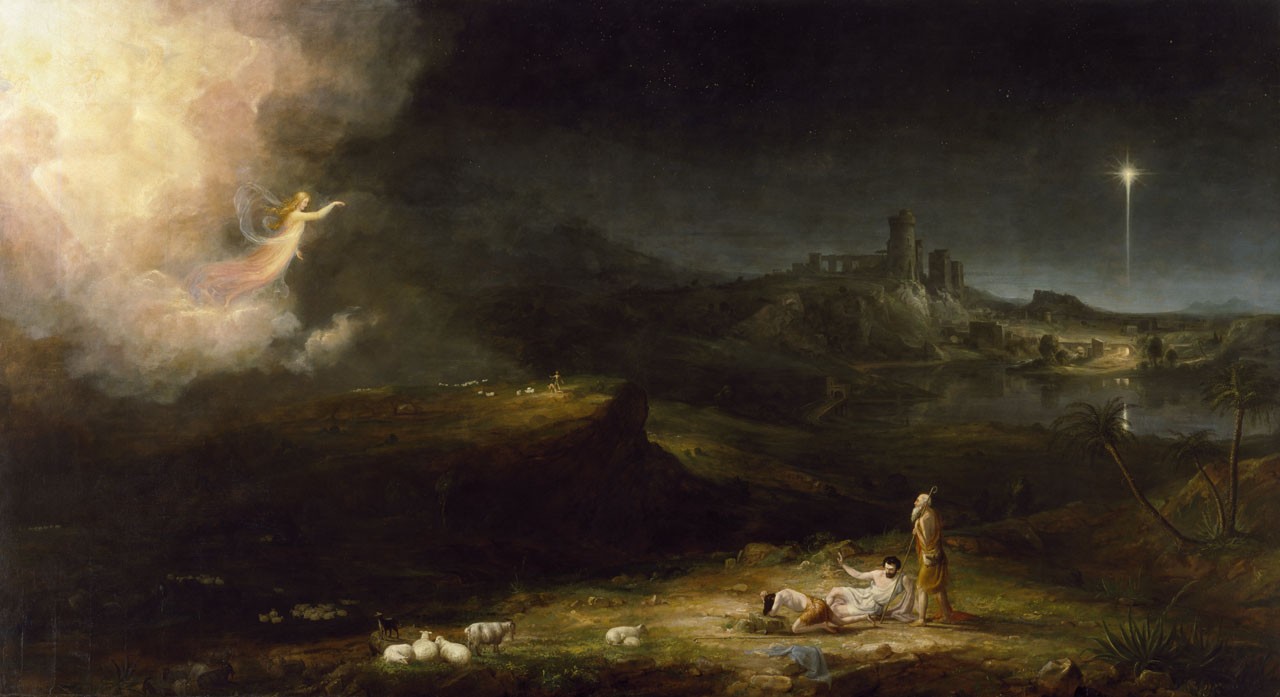
cole-angel-shepherds

“And there were in the same country shepherds abiding in the field, keeping watch over their flock by night.” (Luke 2:8)

One of the best arguments against the birth of Christ having taken place in late December is this fact recorded by Luke in his Gospel. There were shepherds out in the fields watching over their flocks. By late December, there is not sufficient grazing to sustain large flocks of sheep. Jerusalem is near the same latitude as Dallas, Texas where I live. By the middle to the end of November, there is not much left for cattle to graze on, so they need to be fed on hay or “cake.” So it seems very unlikely that shepherds would be out in the fields in the winter time.

The shepherds around Bethlehem generally kept the sheep and goats that were used for sacrifice in the Temple in nearby Jerusalem. Some have suggested that Jesus’ birth was around late September which coincides with the Jewish Fall Feasts: Feast of Trumpets (Rosh Hashanah), Day of Atonement (Yom Kippur) and Feast of Tabernacles (Sukkoths). These were feasts that required all Jewish men to make a pilgrimage to the Temple in Jerusalem. The fact that this requirement happened to coincide with the decree from Caesar Augustus for the census (Luke 2:1) may explain why “there was no room for them in the inn” (Luke 2:7) for the expectant couple. In fact, His birth may have occurred during the Feast of Tabernacles making John’s statement that “the Word was made flesh, and [tabernacled] among us” (John 1:14) even more significant. Interestingly, if one counts back nine months from the end of September, one arrives at a date sometime in late December. It could be that rather than celebrating Christ’s birth on December 25, we are actually celebrating His conception!

Regardless, it was to these simple shepherds that this paramount announcement was delivered. “For unto you is born this day in the city of David a Saviour, which is Christ the Lord” (Luke 2:11). To these shepherds who were known for feeding and protecting their flocks; who sought out the lost sheep, and rescued those that were attacked. It seems appropriate that to these the news of the arrival of the “Shepherd of Israel” should be first delivered. He who would later say, “I am the good shepherd: the good shepherd giveth his life for the sheep” (John 10:11) had come. So without hesitation they said, “Let us now go even unto Bethlehem, and see this thing which is come to pass, which the Lord hath made known unto us” (Luke 2:15). They came “with haste” Luke tells us, “and found Mary, and Joseph, and the [Lamb of God] lying in a manger” (Luke 2:16). His name was Jesus, “for he shall save his people from their sins” (Matthew 1:21). This little Lamb of God, who was to be the Shepherd of shepherds, had finally come to them.


1 Comment

Filed under Apologetics, Christianity, Christmas, Evangelism, Gospel, Religion, Salvation, Theology

Peace!

Christmas Bells

Glory to God in the highest, and on earth peace, good will toward men. (Luke 2:14)

Peace.  Such an elusive word.  So full of hope, and yet so seemingly unattainable.  The angels proclaimed “peace on earth, and good will toward men” as they announced the Savior’s birth that holy night.  There was no peace on earth at the time of that proclamation.  The Roman Empire was in control of a major part of the western world, and there was unrest in the land of Judea as one uprising after another was crushed by the heavy hand of the Roman legions.  Things then were not much different than what we see today – unrest in the Middle East, the constant threat of war, North Korea bent on becoming a nuclear power, China vamping up her navy and playing havoc with the American economy, Europe on the verge of economic collapse.  There is no peace on earth.

I heard the bells on Christmas day
Their old familiar carols play,
And wild and sweet the words repeat
Of peace on earth good will to men.
 
Then, in despair I bowed my head,
“There is no peace on earth,” I said,
“For hate is strong and mocks the song
Of peace on earth good will to men”
 

But the hope of peace is strong within man, and so the lowly shepherds to whom the announcement was made, left their flocks in hopes of catching a glimpse of the tiny Prince of Peace that had come into the world.  As a man, He would later say, “Peace I leave with you, my peace I give unto you: not as the world giveth, give I unto you.  Let not your heart be troubled, neither let it be afraid” (John 14:27).  Amidst all the trouble and chaos of the world, He still promises peace and encouragement: “Let not your heart be troubled, neither let it be afraid.”

Then peal the bells more loud and deep;
God is not dead, nor doth He sleep.
The wrong shall fail, the right prevail
With peace on earth good will to men.
 

A dear friend recently enlightened me to the fact that “Joy to the World” is not really a Christmas carol.  It is not about Christ’s first coming; it is about His second coming!  There will be no peace on earth until the King of Kings comes to reign over all of His creation.  At that time, it will be most appropriate to sing:

Joy to the world the Lord is come!
Let earth receive her king!
Let every heart prepare Him room,
And heaven and nature sing.
 
Joy to the earth! the Savior reigns!
Let men their songs employ;
While fields and floods, rocks, hills and plains
Repeat the sounding joy.
 
No more let sin and sorrow grow,
Or thorns infest the ground.
He comes to make His blessings flow
Far as the curse is found.
 
He rules the world with truth and grace,
And makes the nations prove
The glories of His righteousness,
And wonders of His love.
 

Writing almost 800 years before the first advent, the prophet Isaiah proclaims, “For unto us a child is born, unto us a son is given: and the government shall be upon his shoulder: and his name shall be called Wonderful, Counsellor, The mighty God, The everlasting Father, The Prince of Peace” (Isaiah 9:6).  The tiny babe Whose birth we celebrate this Christmas is the hope of peace for a troubled world and the realization of peace for those who know Him as Savior.  Let us find our peace in Him!

2 Comments

Filed under Christianity, Christmas, Current Events, End Times, Evangelism, Gospel, Religion, Salvation, Theology

Bah! Humbug!

Scrooge

Wherewith shall I come before the LORD, and bow myself before the high God? shall I come before him with burnt offerings, with calves of a year old? … He hath shewed thee, O man, what is good; and what doth the LORD require of thee, but to do justly, and to love mercy, and to walk humbly with thy God? (Micah 6:6,8)

 At the risk of being labeled a Scrooge, I feel compelled to express my growing disillusion with the Christmas season and all the trappings associated with it.  Don’t get me wrong; I love Christmas, or at least I love what Christmas is supposed to signify – the condescension of the Creator God to take on the human form of His creation embodied in a helpless baby.  The thought is too awesome for words!  Yet that idea is all but lost in the midst of the tumult that has become “the holiday season.”

Beginning in October, even before the celebration of death (Halloween), which God calls the enemy (1 Corinthians 15:26) and Thanksgiving, which has become more a ritual of gluttony and football than a time to seriously pause to give thanks to God for all of His provision, the Christmas mass-marketing scheme is in full force.  This year on Thanksgiving Day the tryptophan was not even out of our systems when stores opened late to get a jump on the Black Friday spending spree.

The saying that “Christmas is for children” is meaningless these days.  Marketeers cleverly target the growing avarice in our society by creating the illusion that their product will bring genuine happiness or fill some sort of desperate need.  Mercedes-Benz has Santa loading up cars on delivery trucks – one line of red cars for his “naughty” list and white for his “nice” list.  So, even if you are “naughty” Santa will still get you what you want.  Buick has a commercial where a young man is presenting his wife (I hope) a new car for Christmas, when a brand new Buick Enclave drives by and the young woman loses interest in the car her husband (I hope) has given her as she stares lustfully after the Enclave.  Lexus, Cadillac, Nissan, etc. all have ads tempting the viewer through “the lust of the flesh, the lust of the eyes and the pride of life” (1 John 2:16).  Car manufacturers are not the only culprits.  Rosetta Stone has a cute commercial where a little boy is brought to Santa.  Santa addresses the boy in English, the boy responds in German, so Santa instantly switches to speaking German because Santa learned to speak German by using the Rosetta Stone language learning software.  The list could go on and on.

I hear Christians lament the commercialization of Christmas, but we are just as guilty as the secular world of going overboard on spending just because “it’s the season of giving.”  We bemoan the “war on Christmas” but our Christian radio stations are just as likely to play “Rockin’ Around the Christmas Tree” as “Oh Come All Ye Faithful.”  Big mega church productions of Christmas pageants typically devote the first half of the program to secular music and dancing (choreography for Baptists) and reserve the best for last – the true Christmas story.  What I am saying is that we are guilty of accommodating at best, or assimilating with, at worst, the secular world.  Then we whine because the world is losing the real meaning of Christmas!  Well, I have news! Christmas, although not called by that name, has always been a pagan celebration.  We stole their celebration, put a Christian spin on it, and now we are complaining because they are taking it back!

Without going into great detail that you can “Google” on your own, Christmas was not observed in the early Christian church until around the mid fourth century when Pope Julius I (A.D. 337-352) sanctioned the celebration of the Nativity to coincide with the Roman celebration of the winter solstice called Saturnalia.  Santa Claus originated from a third century bishop by the name of Nicholas of Myra (in Turkey) who was renowned for his generosity, which, by the way, was not limited to December 25th.  We can thank Clement C. Moore (1779 – 1863) for the red suit and the “miniature sleigh and eight tiny reindeer.”

The Christmas tree is considered by some as Christianisation [sic] of pagan tradition and ritual surrounding the Winter Solstice, which included the use of evergreen boughs, and an adaptation of pagan tree worship; according to eighth-century biographer Æddi Stephanus, Saint Boniface (634–709), who was a missionary in Germany, took an axe to an oak tree dedicated to Thor and pointed out a fir tree, which he stated was a more fitting object of reverence because it pointed to heaven and it had a triangular shape, which he said was symbolic of the Trinity. (Wikipedia)

As Christians, we should know that Jesus was not born on December 25th, but most likely sometime in late August or September.  When you think about it, God probably kept the date of His birth a secret precisely so that we would not turn it into the circus it has become.  He is not interested in our participation in meaningless rituals, but rather our genuine devotion to Him at all times.  What would happen if Christians stopped shopping for Christmas gifts for one another and instead gave that money spent to the Lord?  Would we be any less blessed?  My guess is that God would bless us even more!  What would happen to the commercialism of Christmas if Christians stopped buying?  Maybe the commercialization would become less overt. What if we practiced our generosity all year round and not reserve it just for Christmas?  What if we celebrated Christ’s advent all year round instead of just once a year?  What difference does December 25th make?  What is important is that God came into this world as a baby, to experience the same aches and pains we experience, to be faced with the same temptations we face, and then to willingly take our place on the cross to pay the death penalty we owed.  Our gifts should be presented to the One who saves, not to the ones He died to save.  That God took on human form in order to redeem us unto Himself is a significant event worthy of remembrance, but perhaps in a way that honors Him, not our own hubris.

5 Comments

Filed under Apologetics, Christianity, Christmas, Current Events, Evangelism, Religion, Salvation