Category Archives: Death

Jesus’ Seven Signs in John (7)

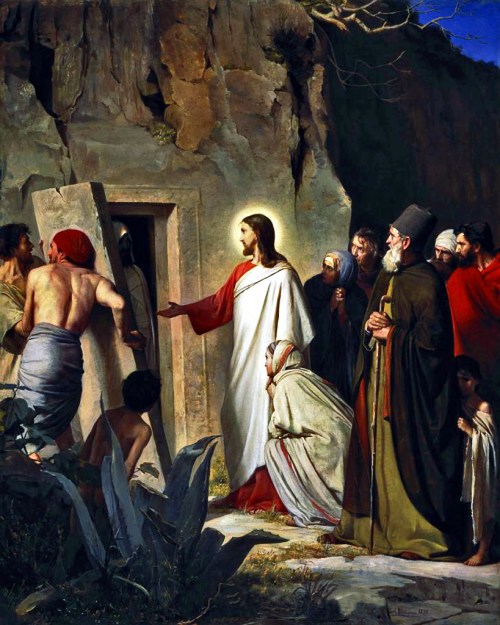
john11_1_raising_lazarus_bloch

Jesus saith unto her, Said I not unto thee, that, if thou wouldest believe, thou shouldest see the glory of God? (John 11:40)

The events surrounding this seventh sign were previously covered in the discussion of Jesus’ fifth I AM statement:[1] “Jesus said unto her, I am the resurrection, and the life: he that believeth in me, though he were dead, yet shall he live: And whosoever liveth and believeth in me shall never die. Believest thou this?” (John 11:25-26, emphasis mine).

Jesus “stedfastly set his face to go to Jerusalem” (Luke 9:51) as He made a stopover in Jericho along the way. The cross loomed ominous – less than two weeks away – when He received word from Bethany, “Lord, behold, he whom thou lovest is sick” (John 11:3). It was Lazarus. The content of the message did not convey the gravity of the matter. “When Jesus heard that, he said, This sickness is not unto death, but for the glory of God, that the Son of God might be glorified thereby” (John 11:4, emphasis mine).

However, it was “unto death,” and the Lord knew it. “When he had heard therefore that he was sick, he abode two days still in the same place where he was” (John 11:6, emphasis). After the two-day delay, Jesus “saith he to his disciples, Let us go into Judaea again … Our friend Lazarus sleepeth; but I go, that I may awake him out of sleep.” (John 11:7, 11). Sleep, for someone who is sick, helps the healing process. The disciples understood this. They also understood that Jesus’ life was in peril in Jerusalem. “His disciples say unto him, Master, the Jews of late sought to stone thee; and goest thou thither again? … Then said his disciples, Lord, if he sleep, he shall do well” (John 11:8, 12, emphasis mine). Jesus completely knew and understood the situation although the euphemism escaped the disciples’ conscious thought, so to clarify, “Then said Jesus unto them plainly, Lazarus is dead” (John 11:14, emphasis mine).

The small village of Bethany was about a day’s walk from Jericho. Lazarus probably died shortly after the messengers departed to Jericho. The travel took a day. Jesus delayed two days before leaving for Bethany and He took another day to arrive – four days total.

When Jesus arrived in Bethany, Martha met Him with the “news” that Lazarus had died (John 11:20). Mary followed Martha. “Then when Mary was come where Jesus was, and saw him, she fell down at his feet, saying unto him, Lord, if thou hadst been here, my brother had not died” (John 11:32). Both Martha and Mary believed that Jesus could heal the sick. They had probably witnessed many of His healing miracles, and perhaps they heard about or witnessed Jesus restoring life to the dead.[2] Those other resurrections Jesus performed involved someone who was dead just a matter of hours. However, it had been FOUR DAYS! They also believed that Jesus could raise the dead “at the resurrection” (John 11:24), but that was future. “Then when Jesus came, he found that he had lain in the grave four days already” (John 11:17, emphasis mine). FOUR DAYS! – “There is a tradition in Judaism (that still exists today), that the soul after death does not immediately depart the deceased, but hovers over the body for a period of three days, during which time resurrection is possible.”[3]

In the minds of Martha and Mary, Lazarus was too far gone for a resurrection now. They were resigned to wait until the resurrection at the end of time.

Jesus asked to see the grave (John 11:34), and to their shock, Jesus asked for the stone to be rolled away from the opening. “Martha, the sister of him that was dead, saith unto him, Lord, by this time he stinketh: for he hath been dead four days” (John 11:39, emphasis mine). What was He doing? Did Jesus want a private viewing? By now, the process of decomposition would have caused the body to reek. Surely, Jesus could not bring life to a decaying body! “Jesus saith unto [Martha], Said I not unto thee, that, if thou wouldest believe, thou shouldest see the glory of God? … And when he thus had spoken, he cried with a loud voice, Lazarus, come forth” (John 11:40, 43). The dead man responded, and though bound in grave clothes, walked out of the cave.

Jesus demonstrated His power over death. He said, “I AM the resurrection and the life” (John 11:25, emphasis mine), and He proved it by giving life to one for whom consensus offered no hope. FOUR DAYS dead and Jesus brought Lazarus back to the land of the living. From the beginning, Jesus knew what He would do. “When Jesus heard that, he said, This sickness is not unto death, but for the glory of God, that the Son of God might be glorified thereby” (John 11:4, emphasis mine). Then before the skeptical crowd that included that included some of His harshest opponents (John 11:45-53) Jesus prayed, “Father, I thank thee that thou hast heard me. And I knew that thou hearest me always: but because of the people which stand by I said it, that they may believe that thou hast sent me” (John 11:41-42, emphasis mine).

Luke relays an account given by Jesus of a rich man that died and went to hell and a beggar by the name of Lazarus (different person) who also died and was carried by the angels to Abraham’s bosom (Luke 16:19-31). The rich man in hell could see Lazarus enjoying paradise with Abraham. After failing get relief for himself, he requested that Lazarus be sent back to the world of the living and evangelize his brothers, for he thought, “if one went unto them from the dead, they will repent” (Luke 16:30). The brothers had the Law and the Prophets, i.e., the Bible. In other words, they had all they needed to avoid the same fate. Abraham’s response settled the matter. “And he said unto him, If they hear not Moses and the prophets, neither will they be persuaded, though one rose from the dead” (Luke 16:31, emphasis mine).  The truth of this assertion could not be better illustrated than in the reaction of the religious leaders that witnessed “one that rose from the dead.” Rather than believe in Jesus, who raised the dead, they sought to kill Him. “Then from that day forth they took counsel together for to put him to death” (John 11:53). Not only that, but now Lazarus was a liability. “But the chief priests consulted that they might put Lazarus also to death; Because that by reason of him many of the Jews went away, and believed on Jesus” (John 12:10-11, emphasis mine).

Truth is offensive. “Jesus saith unto him, I am the way, the truth, and the life: no man cometh unto the Father, but by me” (John 14:6, emphasis mine). Many would rather destroy the Truth than submit to Him, but the Truth will not die. “And the Jews’ passover was nigh at hand: and many went out of the country up to Jerusalem before the passover, to purify themselves” (John 11:55). In a few days, Jesus would be put to death, but after three days, He would do an even greater miracle than raising Lazarus. Jesus Himself would conquer death and rise from the grave. Yet, many are not “persuaded, though one rose from the dead.” – Jesus Himself.

Do you believe? You have the Bible. You have the voices of thousands of “prophets” declaring the Word of the Lord. Jesus is not in the grave. What more do you need? This life you have been given is the only opportunity you will ever have to make that choice. Tomorrow is not guaranteed. “While it is said, To day if ye will hear his voice, harden not your hearts” (Hebrews 3:15). After this life, there are no more chances. Jesus rose from the dead and lives forever to give us eternal life. “Believe on the Lord Jesus Christ, and thou shalt be saved” (Acts 16:31), and you will not end up like the rich man being tortured in the flames (Luke 16:24) with no escape.

 Notes:


[1]  See: https://erniecarrasco.com/2016/10/02/jesus-seven-i-am-statements-in-john-5/

[2]  See Matthew 9:18-26; Mark 5:21-43; Luke 8:40-56; Luke 7:11-16.

[3]  Eli Lizorkin-Eyzenberg, The Jewish Gospel of John: Discovering Jesus, King of All Israel, (Jewish Studies for Christians, Tel Aviv, Israel, 2015), 184.


Comments Off on Jesus’ Seven Signs in John (7)

Filed under Bible, Christianity, Death, Evangelism, Gospel, Heaven, Hell, Religion, Resurrection, Salvation, Theology

Jesus’ Seven ‘I AM’ Statements in John (7)

I am the vine, ye are the branches: He that abideth in me, and I in him, the same bringeth forth much fruit: for without me ye can do nothing.  (John 15:5)

A large sycamore tree grows in my front yard. Its large palmate leaves provide ample shade from the hot Texas sun, but that same Texas heat stresses the tree so that it drops many of its leaves in mid-summer, long before autumn when trees normally defoliate. It also drops limbs constantly making it a self-pruning tree that creates a lot of extra work for me. One thing I have noticed is that the leaves and branches that detach from the tree die. Even though they fall on fertile ground, they do not rejuvenate. Even if I “plant” them in the ground, feed, and water them, they will not take root. They remain dead. They only remain alive while attached to the tree.

Jesus had this image in mind in this seventh and final I AM statement recorded by John. He said, “I AM the vine.” When we think of a vine, we picture the entire plant: trunk or main stalk, limbs, branches, leaves, and (eventually) fruit. However, here Jesus refers to Himself as the trunk or main stalk of the plant. We do not need an advanced horticultural degree to know that the main stalk supports and provides nourishment for the entire plant. Part of the trunk is the taproot that reaches deep into the earth to draw nourishment for distribution to other parts of the plant. Jesus compares Himself to this vital part of the plant.

Next, He says, “ye are the branches.” I like the KJV use of “ye” that distinguishes the second person pronoun as plural as it appears in the Greek. Therefore, in speaking to His disciples, Jesus includes all believers. “You ALL are the branches.” He establishes a vital relationship here. The branches receive their sustenance from the trunk, i.e., “the vine.” The branches cannot live apart from the vine; detached from the vine, they die. Furthermore, the branch attached to the vine has the vine attached to it: “He that abideth in me, and I in him, the same bringeth forth much fruit” (emphasis mine). In a plant, it is easy to see a branch abiding on a vine, but a vine abiding in the branch is not so obvious. Vein-like vessels made up of xylem cells in the vine grow into the branch from the vine carrying the essential nutrients to maintain the branch alive, so in effect, the vine abides in the branches. Through this mutual attachment, the branches produce “much fruit.” I might be wrong, but only branches produced fruit, never the trunk of the plant; but without the trunk, the branches cannot live to produce fruit: “for without me ye can do nothing.”

Thus, Jesus invites us, the branches, to attach ourselves to Him, The Vine. “Abide in me, and I in you. As the branch cannot bear fruit of itself, except it abide in the vine; no more can ye, except ye abide in me” (John 15:4, emphasis mine). What kind of fruit should a branch of The Vine produce? The Apostle Paul lists several. “But the fruit of the Spirit is love, joy, peace, longsuffering, gentleness, goodness, faith, Meekness, temperance …” (Galatians 5:22-23), and add to that “righteousness and truth” (Ephesians 5:9, emphasis mine). “Against such there is no law” (Galatians 5:23). We cannot produce such fruit unless we are firmly abiding in and drawing nourishment from The Vine.

As I walk around my front yard picking up dead branches from my living sycamore tree, I gather those branches up and throw into the trash. If I lived outside of the city, I would throw them into the fire. In the same way, Jesus said, “If a man abide not in me, he is cast forth as a branch, and is withered; and men gather them, and cast them into the fire, and they are burned” (John 15:6, emphasis mine). Here Jesus refers to the final judgment where those who reject Him will be cast into hell for eternity (Revelation 20:14-15). In His sixth I AM statement, Jesus said He was The Life. By this, He meant “eternal life.” Apart from The Vine, there is no life, and Jesus said, “I AM The Vine.”

1 Comment

Filed under Apologetics, Christianity, Death, Evangelism, Gospel, Hell, Salvation, Theology

Dad

Left to right: Dad, Me, Ednoi, Eli and Esther

Left to right: Dad, Me, Ednoi, Eli and Esther

Behold, I have taught you statutes and judgments, even as the LORD my God commanded me…  (Deuteronomy 4:5)

He came to the United States from Mexico in 1943 with false papers under an assumed name and started working for the railroad. Not long after, his work brought him to the West Texas town of Monahans where his eye fell upon the lovely Elena, and his life changed forever. Elena was one of five children of store owner and Baptist lay preacher, Porfírio Enriquez. Elena was hard to get, especially since her father wanted her to have nothing to do with the “mojado” (“wetback”), especially since he was not a Christian. But, eventually Elena fell prey to his boyish charm and the couple soon married – he was 20, she was 18.

The “unequally yoked” couple (2 Corinthians 6:14) soon experienced struggle over religious differences. Chale (Chah-leh), as he was known to his friends, was a non-practicing Catholic, so “church” mattered little to him. In fact, he found the practice of praying to inanimate images silly and pointless, so church to him was a waste of time. Chale also loved to party, and he loved to dance, much to the chagrin of the good Southern Baptist girl he had married. But Elena was not without recourse. On Saturday nights when Chale wanted to go dancing, Elena promised to go with him, if he would come to church with her on Sunday. Chale would dance all night with all the other ladies while Elena sat patiently by and watched. She would later say that he looked like a little demon dancing around through the haze of cigarette smoke. That arrangement worked well. Chale honored his promise to attend church with her on Sunday, and before long Chale surrendered his life to the Lord, gave up his partying ways, and took after his father-in-law as a lay preacher.

Shortly after Chale surrendered his life to the Lord, Elena became pregnant with me. At that time, Chale still resided in the US under an assumed name and false documentation. His new “tenderized” conscience started to bother him not only because of his illegal status, but also because he did not want his son given some stranger’s name. Determined to set the record straight, he returned to Mexico to earn the right to return to the United States legally. Wenceslao Carrasco de Cortez (his legal name) was required to spend two years in the Mexican Army Reserves to fulfill his military obligation to that nation, while at the same time working with a Mexican lawyer to legally come to America. While in Juarez, Chihuahua, Mexico, he served as assistant pastor in a Baptist church in that city.

I was born in Monahans in 1950, and when I was about one year old, Elena, Mom, took me with her to be with Dad in Juarez. We lived there a year until Dad got all his legal matters resolved and fulfilled his military obligation to Mexico. We returned in 1952, and the following year I was blessed with a baby brother, Ednoi.

Dad continued to work on the railroad, and soon his work carried us to Odessa, Texas where, in 1955, another baby brother came along – Eliseo (Eli). Around this time Dad felt called of God to go into full-time ministry, and soon we moved to San Antonio, Texas for Dad to train for the ministry. W.C., as English speakers referred to him, was not well educated. He got as far as the third grade in Mexico where he learned reading, writing, and arithmetic, but the needs of his father’s ranch were of higher priority than education, and school fell by the wayside. Study at the Instituto Biblico Mexicano proved difficult for Dad, not to mention the burden of a family that needed provision. There were times when we had no food and no money for food. Mom told me of a time when she sent me to school with the last bit of beans folded in a flour tortilla (a bean taco), and after that no food was left for the rest of the family. That day, Dad was in the school chapel crying out to God; Mom was at home on her knees in prayer, when a knock came at the door, and some ladies from an Anglo church showed up, completely unaware of our need, with a month’s worth of groceries. In the meantime, the president of the school overheard Dad crying out to God and came to see what was troubling him. When he discovered the need, he reprimanded Dad for failing to make his need known, and promptly wrote him out a check for $100. In 1957, that was a lot of money! Dad couldn’t wait to come home to give Mom the news, and when he arrived, he found her in tears of joy for how God had provided.

I could relate many more stories just like that, but what I experienced in my young life taught me that God is real. His love is real, and He really does care about our every need, and He will provide exactly what we need, exactly when we need it.

W.C. spent five years in school preparing for the ministry. In the end, he left the school without having completed his training. Our family moved to Cotton Center, Texas in 1960 where Dad was ordained as a Baptist minister, and where he pastored his first mission church in that capacity. Many mission churches followed. In 1963 we moved to Raton, New Mexico where Dad served as pastor of his first non-mission church. In 1965, God blessed us with our baby sister, Esther. I only got to know her the first five years of her life, and then I was off to the Navy and a life of my own.

Dad taught me many things. He taught me to read and write in Spanish. He taught me how to play baseball and throw a curve ball. He taught me how to drive; in fact, at 10 years old, when we were living in Cotton Center, he would send me, by my 10-year-old self, in our 1956 Ford Victoria to pick up kids for Sunday school. By the time I was old enough for my driver’s permit, I was already the most experienced driver in my Driver’s Ed class! Dad taught me the value of hard work. And even though he was not yet a naturalized citizen of the United States, he taught me patriotism, love of my country, love of my flag, and respect for authority. Dad taught me to take responsibility for myself and to never shy away from a challenge. He would always say, “Si está hecho por hombres, yo también lo puedo hacer.” (If it’s done by man, I can do it too!). But the greatest thing Dad ever taught me was the love of God and the love of God’s Word. The lessons learned from that have kept me from drifting to the left or to the right knowing that God does not change, and God’s Word never changes. Some have thought me insensitive, or unmoving, but although Dad taught me to love, and God’s Word teaches me to love, I also know that some things, from God’s perspective, are non-negotiable, so I do not easily yield to compromise even when “love” comes into play. The love of God must always supersede all others.

Dad was always strong – a trait I greatly admired in him, and one that I tried to emulate. He almost always had a cheerful disposition. He loved life, and he loved people – something else I admired in him. And he sang (or hummed) incessantly – to the point of annoyance – oblivious to anyone around him. But even that I admired in him – there was always a song – usually a hymn – in his heart. The world could be falling apart all around us, but one would never know it around Dad.

After Mom went to be with Jesus in December 2001, he, now 75, continued on with life as before, only without his lifelong partner. Shortly after we buried Mom, he took the pastorate of a small dwindling church in Brady, Texas, and served and ministered to them the remaining years of his life. His knees gave him trouble since his late 60’s, but the fear of knee replacement surgery kept him from taking care of the problem. It finally got to the point where he could hardly get around, and that interfered with his ministry, which to him was a high priority. So he finally conceded to replace his knees, first the right one followed by the left the next year. Dad got a new lease on life with his new knees, and it was hard to slow him down at age 85. I found out through the grapevine that he helped a family put a new roof on their house. He was climbing ladders with bundles of shingles on his shoulder, and down on his new knees nailing shingles to the roof. He even outworked two much younger men that were helping him. I had to give him a good scolding for that, but that was just Dad. He would make the four and a half hour drive from Brady to Dallas and mix it up in Dallas traffic to make his doctors’ appointments.

He was an incredible man, my dad. As I watched him live his life – full-bore, filled with joy, loving the Lord with all of his heart and soul – I dreaded the thought of his decline into helplessness in later life. That would not have suited Dad at all, and I prayed and asked God not to allow my dad to decline physically or mentally, but rather that when his time came, that God would just take him. God answered my prayer on August 26, 2014. Dad got up that morning with respiratory issues (he had developed asthma late in life) and collapsed in the kitchen of his Brady home. My brother Ednoi, who was living with him, called emergency services, but by the time they arrived, Dad’s brain had been deprived of oxygen too long. The EMTs worked on him, got him to the Brady hospital, and then on a Care Flight to San Angelo. Dad lingered on a ventilator long enough for all of us kids, grandkids and some of his siblings to come and say goodbye. His body was functioning with the help of the ventilator, but he was not there. On August 28, 2014, we had the ventilator removed, and in a short seventeen minutes all life-functions stopped. Dad went to be with Jesus and to celebrate his 64th wedding anniversary with Mom the following day. Dad was exactly one month shy of his 88th birthday when he went to be with our Lord, but because of the greatest thing he taught me, I KNOW I will see him again, and maybe some time very soon.

This year (2015) marks the first year that I celebrate Father’s Day without my dad, but it will not be a time for sorrow. Rather it will be a time to thank God for the father He gave me, and for the instrument that he was in my life to instruct and guide me in the ways of God. It will be a time of joy knowing that soon I will be together with him again forever because God is faithful, and His Word is true. That is not hope. That is assurance! Happy Father’s Day, Dad! Thank you for all you meant to me, to our family, and to everyone whose life you touched. See you soon!

11 Comments

Filed under Bible, Christianity, Current Events, Death, End Times, Holidays, Prayer, Religion, Salvation

The Bible Says

The Bible Says

But he answered and said, It is written, Man shall not live by bread alone, but by every word that proceedeth out of the mouth of God. (Matthew 4:4)

I am blessed to have been raised by Christian parents who, not only took me to church every Sunday, but they taught me from God’s Word at home. Dad was not well educated. He was raised on his father’s ranch in Chihuahua, Mexico and only went to school until the third grade where he learned to read, write and do basic arithmetic. That was sufficient at a time and place where hard work was valued above book learning – education extends beyond the confines of a classroom. After he came to the United States and met Mom, God called him into the pastoral ministry, and he spent the rest of his life pastoring small Hispanic congregations, mostly around West Texas. Before entering the ministry, he prepared for five years at the Instituto Biblico Mexicano in San Antonio, Texas that taxed his third-grade education to the limit, but he persevered and completed his training.

My parents, my father in particular, taught me at a very early age that the Bible is the very Word of God. Every word of it is true and trustworthy, even when it comes to things that are hard to believe like the Red Sea parting (Exodus 14:21-31), the walls of Jericho falling (Joshua 6:15-20), or an axe head floating (2 Kings 6:5-7). These things have no natural explanation other than the record in God’s Word. “God is not a man, that he should lie; neither the son of man, that he should repent: hath he said, and shall he not do it? or hath he spoken, and shall he not make it good?” (Numbers 23:19). Therefore, if God says something in His Word, it must be true regardless of our ability to explain it.

However, one does not have to cast off reason and believe the Bible simply because the Bible says so. The Bible contains more than sufficient, historical, scientific, practical, fulfilled prophetic evidence of its accuracy to lend credence to those areas demanding “faith.” Archeologists have time and again confirmed the Bible’s historical account. For example, the Bible was long criticized for recording the existence of the Hittite people until archeological evidence proved the Bible right. To date, archeological digs uncover evidences confirming the historical accuracy of biblical accounts.

Scientifically, although not a text book on science, the Bible accurately records scientific matters. For example, the Bible matter-of-factly records the existence of ocean currents (Psalm 8:8), earth suspended in space (Job 26:7),[1] a spherical earth and expanding universe (Isaiah 40:22), the water cycle (Psalm 135:7), and even Pi (π) rounded to the nearest whole number (1 Kings 7:23). As for practical matters, one need only read and apply the book of Proverbs or Jesus’ Sermon on the Mount (Matthew 5-7) to live a successful life. The Bible accurately records fulfilled prophecies. The prophecies concerning Israel’s captivity in Babylon were pronounced as far back Deuteronomy, prior to their entry into the Promised Land. This same prophecy was repeated by later prophets, and it came to pass. Their return to the land was predicted and it came to pass. The Diaspora was predicted and it came to pass, as was their return once again to the land of Israel which took place on May 14, 1948. All the prophecies of Jesus’ first coming, His death, His burial, and His resurrection were all fulfilled to the letter.

When the Bible is correct in all of these areas, then why should one doubt when miracles are presented? Miracles are acts whose only explanation is that of divine intervention even when those acts defy natural laws. The same God who “cannot lie” (Titus 1:2), and who will do as He says also says, “So shall my word be that goeth forth out of my mouth: it shall not return unto me void, but it shall accomplish that which I please, and it shall prosper in the thing whereto I sent it” (Isaiah 55:11). Jesus concurred with the prophet when He said, “For verily I say unto you, Till heaven and earth pass, one jot or one tittle shall in no wise pass from the law, till all be fulfilled” (Matthew 5:18).

There is a scene in The Lion, the Witch, and the Wardrobe, by C.S. Lewis after Lucy has visited Narnia for the first time and returns to report to her siblings. They would not believe her story. In her defense, Professor Kirke (the old man in whose home the children were staying for protection from German air raids over London in World War II), challenges Lucy’s siblings by asking them if she has ever been known to lie. Since Lucy was not prone to lying, Professor Kirke suggested that perhaps the children should take her at her word. The same can be said about the Bible. Since the Bible can be proven accurate historically, scientifically, practically and prophetically, then perhaps it should be taken for at face value when it speaks of miracles.

This brings me to what perhaps is the greatest miracle of all, next to the incarnation and resurrection of Jesus Christ, i.e. the creation of the universe and all that it contains. This account of creation is found in the first chapter of Genesis, and it is foundational to the rest of Scripture. It is this creation account that I found myself defending against evolution and the Big Bang theory after I left home as a young man. I could not explain a literal six 24-hour day creation other than to stand on “the Bible says.” My conversations usually ended up something like this: “I believe God could have used Big Bang and taken billions of years to create everything, if He chose to. I believe God could have used evolution to create life, if He chose to. But the Bible says that God created everything in only six days. I believe God is great enough to do whatever He chooses to do. He could have created everything in a split second, if wanted; but the Bible says He did it in six days, and that is what I believe.”

I know that answer rings hollow to a hardened evolutionist, but it was good enough for me. I will never take man’s word over God’s Word about anything. Yet, far too many “Christian” leaders waffle as to the veracity of this record. Many, certainly not all, highly trained theologians and pastors wear their Ph.D.s and Th.D.s as a mantle of pride that they dare not tarnish by defending the literal reading of Genesis 1 against “experts” in the sciences. They fear appearing “uneducated” for their inability to explain biblical creation to the satisfaction of the skeptics who relentlessly insist that “science has proven” evolution. So rather than defend the clear reading of Genesis 1, they come up with silly compromises, like the Gap Theory, the Day-Age Theory, or Theistic Evolution to appear “scholarly” in their defenses. In the end, they subjugate God’s Word to man’s word.

Some say such compromises make Scripture, especially where Creation is concerned, more believable/acceptable/palatable to people steeped in evolutionary indoctrination. After all, the teaching of evolution is ubiquitous in the world. Not only is evolution taught as fact (albeit unproven, but that’s a minor matter) in schools beginning at the lowest levels, but it is broadcast on television, the movies, and in print. Take notice when watching or listening to commercials at how many products “evolve.” Missing in these messages is the fact that this is “evolution” guided by “intelligence.” The message that comes across is that “everything evolves.” Learning channels like Discovery, Science, History, etc. often present evolution without question. Considering the constant brainwashing of our society to accept evolution as a “proven” fact, it is no wonder that religious leaders shrink back from defending biblical creation. Well, they ought to grow a backbone!

The Bible says, “In the beginning God created the heaven and the earth” (Genesis 1:1). There in one sentence is the universe: time, space, matter. The Bible says, God created everything there is in six 24-hour days. “For in six days the LORD made heaven and earth, the sea, and all that in them is, and rested the seventh day: wherefore the LORD blessed the sabbath day, and hallowed it” (Exodus 20:11, emphasis mine). He did it in six days rather than a split second in order to set the pattern of a seven-day week for us – work six days, rest one. Furthermore, the “days” in Genesis 1 are normal 24-hour days. The Hebrew word used is yom, and with very few exceptions (clarified by context), it means a normal 24-hour day. God then took extra care to define the “day” as “evening and morning” (Genesis 1:5, 8, 13, 19, 23, 31)[2] to forfend against any notion of undetermined time.

The Bible says that God created plants before animals and even before the sun (Genesis 1:9-13). The Bible says there is no to plant evolution. “And God said, Let the earth bring forth grass, the herb yielding seed, and the fruit tree yielding fruit after his kind, whose seed is in itself, upon the earth: and it was so” (Genesis 1:11, emphasis mine). “After his kind” means no evolution, and the regenerative process resides within the seed (the DNA) of each plant. Some critics point out that plants need the sun for photosynthesis. That is only partially true. Plants need “light.” Light was created on Day One (Genesis 1:3). Even if it can be argued that plants need “sunlight,” surely plants can survive 24 hours without sunlight, which was created the following day.

The Bible says God created the earth before all other celestial objects (Genesis 1:14-19). My scientist friends might challenge me on this point because it cannot be proven “scientifically,” but this tells me that the earth is at or near the center of the universe. This is not to say that I believe in a geocentric solar system where the earth is stationary and the sun, moon and planets revolve around the earth. (I have seen models that show how this is possible; however, I will stick with what my scientists friends say in this regard – all planets, including the earth orbit around the sun.) However, that does not preclude the earth being located somewhere near the center of the universe. It just makes sense because the Bible says so. Also, according to biblical chronology, the earth (and the universe) is only about 6000 years old. The critics challenging this point to light from galaxies billions of light years away. How is it that we can see that light now, if the earth is only 6000 years old? I cannot explain it, but my astrophysicist friend, Dr. Jason Lisle offers a great theory on it that I cannot condense in the space of this article.[3]

The Bible says God created sea creatures (crustaceans, fish, marine mammals, and reptiles) and air creatures (birds, flying mammals, insects, etc.) on Day Five (Genesis 1:20-23). Here again, God created all creatures so that they would reproduce “after his kind.” The Bible says no to evolution. By the way, note that plants came before any kind of animal. Evolutionists teach that everything came from the sea; they have it backward. On Day Six, God created all land creatures that reproduce “after his kind” – no allowances for evolution. Dinosaurs would be included on Day Six of creation. Note also that birds were created before dinosaurs, which contradicts the notion of birds having evolved from dinosaurs.

The Bible says that the last thing that God created on Day Six was mankind. Male and female were both created in the image of God (Genesis 1:26-27). At the end of the day, God assessed His total creation and declared it “very good” (Genesis 1:31). The Bible says that God placed the man and the woman in His special garden east of Eden (Genesis 2:8). There, man had complete freedom. His only prohibition was not to eat of the Tree of the Knowledge of Good and Evil (Genesis 2:17). Having been created in the image of God, man had the free will to obey or disobey God. Man chose to disobey God (Genesis 3:1-7), and through his act of disobedience brought upon himself, his posterity and all of creation the curse of death (Romans 5:12). In His foreknowledge, God had a plan for that eventuality with the promise of a Savior (Genesis 3:15).

In these first three chapters of Genesis, the foundation for the Gospel is set. Without a firm foundation, the entire message of the Gospel crumbles. Those who would insert long ages to the simple reading of Genesis 1, allow for ages of death and misery long before the Fall of man. The Bible says death is the enemy (1 Corinthians 15:26). If that is true, why would God make death the curse, when death had already been around for eons of time? And if death is not the curse, then what does Jesus’ death and resurrection accomplish? If Adam and Eve evolved from some ape-like ancestor (again, death and suffering already exist, and God’s creation is not so “very good”), then Jesus, who Scripture identifies as God (John 1:1-3) was wrong when He said, “But from the beginning of the creation God made them male and female” (Mark 10:6). Can God be wrong?

More can be said on this topic. For now, I think I have gone on long enough. I will end by saying this: there are those who say that the Bible is the inerrant, infallible Word of God, but when it comes to defending the biblical record of creation, they defer to the evolutionists rather that defend God’s Word for what it says from the very beginning. I really don’t care if a pastor can’t give scientific proof that the Genesis record is accurate. Most pastors do not have a background in science; their training is mostly in Bible and church stuff. I get that. But for goodness sakes, if you say you believe that the Bible is true, then preach it like it’s true. Creation took place exactly like God recorded it in Genesis 1; that is the bottom line. Now, if a pastor feels the need to back up that statement with scientific proof, there are scientific organizations like the Institute for Creation Research, Answers in Genesis, Creation Ministries International, the Creation Research Society, and others that uncompromisingly defend the veracity of Scripture with scientific research that confirms the biblical account of creation. There are also organization like Biologos and Reasons to Believe that compromise on the biblical account and attempt to make the Bible “fit” modern science. Avoid such; they are wolves in sheep’s clothing. Stand by what the Bible says!

Notes:


[1]  The book of Job is considered to predate Genesis by almost 500 years or more, and certainly long before man traveled to the moon and visually confirmed that God “hangeth the earth upon nothing.”

[2]  By Jewish reckoning, the day begins in the evening; so from dark to light, and then evening begins a new day.

[3]  Go to http://www.icr.org/home/search/ and search under keyword “distant starlight”

5 Comments

Filed under Apologetics, Bible, Christianity, Creation, Death, Evolution, Gospel, Origins, Religion, Science, Theology

Eyes That See Not

Miracles 9812570_ml

Son of man, thou dwellest in the midst of a rebellious house, which have eyes to see, and see not; they have ears to hear, and hear not: for they are a rebellious house.  (Ezekiel 12:2)

In this day of technological marvels it is increasingly more difficult to believe in miracles. It seems that every extraordinary accomplishment or phenomenon can be explained by some naturalistic means. Today we possess the ability to send men to the moon and return them safely. We send probes deep into space to explore distant planets in our solar system. Our space telescopes look deep into the far reaches of our universe. Medical science, while it has yet to find the cure for cancer, has made remarkable progress in healing patients having the dread disease. Scientists in the study of eugenics continue to make inroads into the modification of human DNA with the hopes of creating super humans with capabilities for greater physical endurance, greater mental agility and intellectual acuity, better vision with the ability to see into the infrared light spectrum, and all of this while consuming less food.[1],[2] This, of course, is for the betterment of mankind, and is seen as our next step in human evolution.

No wonder, then, that scoffers deny the miracles recorded in the Bible. However, this is nothing new. Skepticism in the Word of God has existed since the Garden of Eden: “Yea, hath God said …” (Genesis 3:1). During the Age of Enlightenment (a misnomer in my opinion) “reason” supplanted “faith” so that every effect resulted from a natural cause. Reason, then, eliminated miracles because from this perspective, everything has a natural explanation. Enlightened theologians attempted to explain the miracles of the Bible though natural means. Some who were less capable for the task simply rejected the miracles altogether and relegated them to the category of myth. Thomas Jefferson, for example, redacted the New Testament by excluding every record of Jesus’ miracles from the Gospels.[3]

Rejection of the Bible continues today in greater force due to our technological advancements. So, what is a miracle, anyway? By definition, a miracle is “an effect or extraordinary event in the physical world that surpasses all known human or natural powers and is ascribed to a supernatural cause[4] (emphasis mine). By definition, a miracle has no natural explanation and can only be attributed to the supernatural. Arguably, the greatest miracle of all is the universe itself, and all that it contains – from the largest star to the tiniest subatomic particle. Even though there is great disagreement among atheistic scientists about the origin of the universe, they all tenaciously seek a natural explanation for the existence of it all. The Big Bang theory is in such crisis that some have proposed an “eternal” universe disregarding the Second Law of Thermodynamics (entropy – everything is dying). Yet the Bible offers the simplest explanation of all: “In the beginning God created the heaven and the earth” (Genesis 1:1, emphasis mine) – beginning (time), heaven (space), earth (matter/energy) – the universe. The existence of the universe is a miracle – an immense effect brought about by a “supernatural” cause – God.

If one rejects this greatest of all miracles, which has no natural explanation despite all the theories man can contrive, then no other miracles recorded in Scripture are credible. For this reason, liberal theologians contend that the Global Flood (Genesis 6-9) was just local in spite of the unreasonableness of the command to build an Ark for the event. The confusion of tongues at the Tower of Babel mythically explains the diversity of languages. The destruction of Sodom and Gomorrah resulted from an asteroid impact or a long-since vanished volcano. The Red Sea crossing came about by a hot easterly wind that died up the very shallow Reed Sea – a marsh. The quail with which God fed the Israelites in the wilderness (Exodus 16:13) were migrating and coincidently tired out exactly where Israel was camped so that about a million Israelites ate until full. Downplaying such miracles takes little effort, but they are equally defensible by employing some simple logic. What about the sun stopping (Joshua 10:11-13), or regressing ten degrees (2 Kings 20:11)? Can an ax head really float (2 Kings 6:5-6)? These things defy the physical laws as we know them, and since the skeptic fails in concocting natural explanations for such occurrences, these miracles are attributed to either fantasy or myth. Either way, the skeptic rejects all miracles. For the skeptic, miracles either have a natural explanation, or they will have a natural explanation when “science” learns more, or they are simply fantasy.

These are they who “have eyes to see, and see not” (our starting verse); but for those who “have eyes to see,” miracles are real, and they happen every day.  The creation of a new life in the womb occurs thousands of times daily. Those who “see not” attribute that to natural biological reproduction. But out of millions of sperm cells deposited during sexual intercourse, how does one particular sperm cell just happen to fertilize one particular ovum to create one very unique individual? Who writes the DNA code for the 46 chromosomes (23 from each parent) that make up the one-of-a-kind person we are individually? Even identical twins are not exactly identical. The naturalist has no explanation for this and attributes it to random chance. God says, “Before I formed thee in the belly I knew thee; and before thou camest forth out of the womb I sanctified thee …” (Jeremiah 1:5). Those who have “eyes to see” respond, “I will praise thee; for I am fearfully and wonderfully made: marvellous are thy works; and that my soul knoweth right well. My substance was not hid from thee, when I was made in secret, and curiously wrought in the lowest parts of the earth. Thine eyes did see my substance, yet being unperfect; and in thy book all my members were written, which in continuance were fashioned, when as yet there was none of them” (Psalm 139:14-16). They who “have eyes to see, and see not” suffer from a spiritual blindness that prevents them from seeing the supernatural work of God – the miracles that take place every day.

They who have “eyes to see,” believe the words of Jesus when He said, “Again I say unto you, That if two of you shall agree on earth as touching any thing that they shall ask, it shall be done for them of my Father which is in heaven” (Matthew 18:19). When God answers their prayer, they who have “eyes to see” recognize the Source and give credit to Whom credit is due.

Recently my brother-in-law was involved in a farming accident where he was run over by a huge farm tractor. There are so many ways that he could have died that day. He tells me that when the tractor ran over him he was completely at peace knowing that he would soon see Jesus. He says, “I kept looking around expecting to see heaven, but all I could see was corn stalks.” The tractor he had been driving was pulling a trailer full of silage, and it was coming toward him to get him a second time. The tractor had crushed his pelvis and broken his hip so that he was unable to move, yet he felt that “Someone” rolled him out of the way of the oncoming trailer. Some time elapsed before his son-in-law found him and contacted emergency services. He was flown to Omaha where he spent two weeks in the Intensive Care Unit of the hospital. He had several surgeries to reconstruct his pelvis and replace his hip. Today, nearly four months after the accident, he has returned to work and is walking with the assistance of a cane. The skeptic would attribute his recovery to the excellent work of the physicians that attended him, and they completely miss the miracle that transpired. Those who have “eyes to see” know that even before anyone knew of the accident, God was already at work to preserve his life. Then as soon as “believing” friends and family were made aware of the situation, petitions to the Father started flooding the gates of heaven on his behalf and continued throughout his recovery. Those with “eyes to see” see the miracle that those who “see not” miss.

For them who “see not” the miracles that God performs every day but have a desire to see, Jesus says, “blessed are they that have not seen, and yet have believed” (John 20:29). “But without faith it is impossible to please him: for he that cometh to God must believe that he is, and that he is a rewarder of them that diligently seek him” (Hebrews 11:6). “Now faith is the substance of things hoped for, the evidence of things not seen” (Hebrews 11:1). Jesus said, “Ask, and it shall be given you; seek, and ye shall find; knock, and it shall be opened unto you: For every one that asketh receiveth; and he that seeketh findeth; and to him that knocketh it shall be opened” (Matthew 7:7-8).  To have eyes that see requires only that one take God at His Word and ask. “[I]f thou shalt confess with thy mouth the Lord Jesus, and shalt believe in thine heart that God hath raised him from the dead, thou shalt be saved” (Romans 10:9). If you have “eyes that see not,” Jesus says, “anoint thine eyes with eyesalve, that thou mayest see” (Revelation 3:18). That “eye-salve” is the Word of God contained in the Bible. It will teach you how to see the miracles of God.

Notes:


[1]  http://www.inhumanthemovie.com/

[2]  Horn, Thomas and Nita Horn, Forbidden Gates: How Genetics, Robotics, Artificial Intelligence, Synthetic Biology, Nanotechnology, and Human Enhancement Herald The Dawn Of TechnoDimensional Spiritual Warfare, (Defender Publishing LLC, January 1, 2011)

[3]  https://en.wikipedia.org/wiki/Jefferson_Bible

[4]  http://dictionary.reference.com/browse/miracle?s=t

Comments Off on Eyes That See Not

Filed under Apologetics, Atheism, Bible, Christianity, Creation, Death, Evangelism, Evolution, Gospel, Heaven, Origins, Prayer, Religion, Salvation, Science, Theology, Worship