
Category Archives: Gospel

Tough Love

He that loveth father or mother more than me is not worthy of me: and he that loveth son or daughter more than me is not worthy of me. (Matthew 10:37)

I may be wrong, but I sense that every Christian experiences this dilemma to one degree or another. We have experienced God’s love and grace in a very real sense. We know the Gospel is true, “that Christ Jesus came into the world to save sinners; of whom I am chief” (1 Timothy 1:15). We know that salvation comes through faith in Jesus Christ alone, “for there is none other name under heaven given among men, whereby we must be saved” (Acts 4:12). Jesus himself said, “I am the way, the truth, and the life: no man cometh unto the Father, but by me” (John 14:6).

We know that all other paths lead to an eternal hell, “for wide is the gate, and broad is the way, that leadeth to destruction, and many there be which go in thereat” (Matthew 7:13). We know all of this, and we rest secured in the knowledge “that neither death, nor life, nor angels, nor principalities, nor powers, nor things present, nor things to come, Nor height, nor depth, nor any other creature, shall be able to separate us from the love of God, which is in Christ Jesus our Lord” (Romans 8:38-39).

 That is good for us! However, not everyone we know shares that knowledge and that assurance. In fact, most of the people we know – friends, co-workers, fathers, mothers, sons, daughters, other relatives – travel that “broad way” of life that “leads to destruction.” Sadly, most of them are, by worldly standards, very nice and good people. They do not know about the “tight door” and the “narrow way, which leadeth unto life” (Matthew 7:14). They could find out from us, but we love them too much to tell them! If we tell them, they could be offended, and our relationship with them will suffer. They may stop talking to us. They may hate us and never want to have anything to do with us. In the case of a co-worker, we could lose our job over it. What a terrible loss that would be for us! Instead, we would rather love them right into hell! Does that sound like love to you?

Jesus said, “Whosoever therefore shall be ashamed of me and of my words in this adulterous and sinful generation; of him also shall the Son of man be ashamed, when he cometh in the glory of his Father with the holy angels” (Mark 8:38). So, why do we hesitate to share the Gospel with those whom we love the most? Is it because we love them too much? If that is the case, then according to Jesus, we are not worthy of Him (see our leading verse above). Telling your loved ones about Jesus takes tough love, but guess what? Jesus loves them more than you do. He died to save them too.

Comments Off on Tough Love

Filed under Christianity, Evangelism, Gospel, Heaven, Hell, Religion, Salvation

Happy Chanukah!

Hanukkah

In him was life; and the life was the light of men. And the light shineth in darkness; and the darkness comprehended it not.   (John 1:4-5)

Today, December 12, 2017 (at sundown), begins the Jewish Festival of Lights otherwise known as Chanukah (pronounced (with a guttural “H”) hah-noo-kah). The festival is observed for eight days, and while it is not one of the “Feasts of the Lord” (Leviticus 23) nor is it recorded anywhere in the Old Testament, it is nonetheless an important commemoration of God’s provision. Most Gentiles are vaguely aware of the celebration in that it takes place around Christmastime, but besides that, they really do not know much about it.

Chanukah originated in the second century B.C. during the “silent” period of the Bible – between the Old and New Testaments. It came about as a result of a Jewish rebellion against the Greek (Syrian) ruler Antiochus IV Epiphanes for his desecration of the Jewish temple in Jerusalem in 168 B.C. This act was prehistorically recorded by the prophet Daniel: “Then shall he return into his land with great riches; and his heart shall be against the holy covenant; and he shall do exploits, and return to his own land … And arms shall stand on his part, and they shall pollute the sanctuary of strength, and shall take away the daily sacrifice, and they shall place the abomination that maketh desolate.” (Daniel 11:28, 31, emphasis mine). Antiochus IV defiled the temple by erecting a statue of Zeus in the sanctuary and sacrificing a pig on the altar. This incited the Maccabean Revolt, and, as prophesied by Daniel: “the people that do know their God shall be strong, and do exploits. And they that understand among the people shall instruct many: yet they shall fall by the sword, and by flame, by captivity, and by spoil, many days” (Daniel 11:32-33, emphasis mine).  Two years later, 164 B.C. the Jews managed to expel the Syrians out of Jerusalem and take back their temple.

With the Greeks out of the way, the Temple had to be cleansed and rededicated. Part of the consecration required that the menorah, the “candlestick” or “lampstand,” that stood on the south wall of the Holy Place (Exodus 26:35), remain constantly lighted (Exodus 27:20). The problem was that there was only enough pure oil, i.e. oil that was undefiled, to last for only one day. So, they lit the menorah, and miraculously, the lamp continued to burn for eight days until sufficient oil was produced to replenish the supply from then on. And so, the Temple was dedicated. “Chanukah” means “dedication.”

Jesus celebrated Chanukah. We see in John’s Gospel “And it was at Jerusalem the feast of the dedication, and it was winter. And Jesus walked in the temple in Solomon’s porch” (John 10:22-23, emphasis mine). Just before this, He made the claim “I am the light of the world: he that followeth me shall not walk in darkness, but shall have the light of life” (John 8:12, emphasis mine). This He said after forgiving the woman caught in adultery (John 8:1-11). Not long after, He healed a man who was blind from birth (John 9) saying, “As long as I am in the world, I am the light of the world” (John 9:5, emphasis mine). That light would soon be extinguished, but not for long. In the spring following that Chanukah, Jesus would be nailed to a cross, and for three long days the world would be without the Light. The Sunday before His crucifixion, Jesus prepared His disciples (and us), “Yet a little while is the light with you. Walk while ye have the light, lest darkness come upon you: for he that walketh in darkness knoweth not whither he goeth. While ye have light, believe in the light, that ye may be the children of light” (John 12:35-36).

The menorah in the Temple was permanently extinguished in 70 A.D. when the Romans razed Jerusalem. Now it is only remembered on Chanukah. The Light of the World was temporarily extinguished, but He rose again, and His glory fills the heavenly Temple. Yet on Earth, His light still shines in those who are “the children of light.” “[Y]e are washed, but ye are sanctified, but ye are justified in the name of the Lord Jesus, and by the Spirit of our God” (1 Corinthians 6:11, emphasis mine). Since you are “sanctified,” that means you are “dedicated,” and Jesus said, “Ye are the light of the world. A city that is set on an hill cannot be hid … Let your light so shine before men, that they may see your good works, and glorify your Father which is in heaven” (Matthew 5:14, 16, emphasis mine). So, shine!

Happy Chanukah!

4 Comments

Filed under Christianity, Christmas, Evangelism, Gospel, Religion

What A Thing!

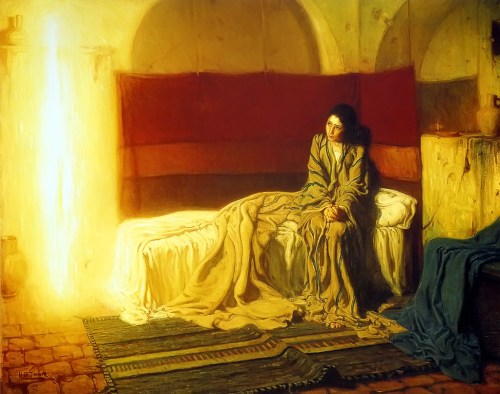
Annunciation by Henry Ossawa Tanner

… Christ Jesus: Who, being in the form of God, thought it not robbery to be equal with God: But made himself of no reputation, and took upon him the form of a servant, and was made in the likeness of men: (Philippians 2:5-7)

The Christmas season is upon us once again, and once more, I sense the dilemma of mixing the commercialization of the season by the world with the celebration of the First Advent. Any Christian well taught in Scripture recognizes that Jesus was not born on December 25, but thanks to the Catholics, we are stuck with that date. Regardless of how one feels about that, it is appropriate to set aside a special time to contemplate the magnitude of the miracle that is the Incarnation[1] – God becoming a man.

Consider our leading verse. No other religion[2] in the world makes the claim that their gods willingly depose themselves of all divine powers to assume the life of a human. Then, to top it off, offer themselves as a blood sacrifice in order to save the lowly human race. However, contemplate seriously the significance of these words of Scripture.

“Christ Jesus” – the anointed Savior (meaning of the name) – “who being in the form of God.” The Greek word translated “form” is morphē, and it means “shape” or “nature.” The Apostle John calls Jesus “the Word.” He wrote, “In the beginning was the Word, and the Word was with God, and the Word was God: (John 1:1, emphasis mine). In the Greek, the phrase “the Word was God” literally reads, “God was the Word” — θεος ην ο λογος. What a thing!

Though He was in every way, in very nature, God, He “Thought it not robbery to be equal with God.” Verse 8 clarifies this phrase when it explains that Jesus “humbled Himself.” He did not regard it robbery to lay aside His Divine nature and assume human form in order to redeem fallen humanity. What a Thing!

“He made Himself of no reputation.” This entire phrase is summed up in one Greek word, εκενωσεν (hekenoōsen), which means, “He emptied Himself” without any sense of deprivation. In exchange, “He took upon Himself the morphē (see above) of a servant” – doulos – a “slave.” He “was made in the likeness of men.” The Greek word translated “likeness” is homoiōma meaning “resemblance.” So, not only did He take on the “nature” of man, He “looked” like any other man. There was no halo around Him to distinguish Him from any other man. Of Him Isaiah the prophet said, “he hath no form nor comeliness; and when we shall see him, there is no beauty that we should desire him” (Isaiah 53:2, emphasis mine). The Hebrew word translated “comeliness” is hâdâr meaning “magnificence,” and “beauty” is the Hebrew word mar-eh’ meaning a “handsome appearance.” So much for those soft-faced images of Jesus, we are so used to seeing! It was not enough that He condescended from His Divine nature to assume the nature of an ordinary, common-looking man, but He took the form of the lowliest kind of man – a slave. Not only did He come as a slave, but He chose a peasant girl for a mother and a stable for His birthplace.[3] What a THING!

The passage goes on to say, “And being found in fashion as a man, he humbled himself, and became obedient unto death, even the death of the cross” (Philippians 2:8, emphasis mine). “Fashion” is the Greek word, schēma and it means the “mode, circumstance, or external condition.” The Bible tells us that “the wages of sin is death” (Romans 6:23). Man must die eternally to pay the penalty for sin. Unless some sinless one can be found to serve as a suitable sacrifice for all of mankind, every one of us must pay “the wages of sin.”[4] Who could qualify as a suitable sacrifice? “As it is written, There is none righteous, no, not one … For all have sinned, and come short of the glory of God” (Romans 3:10, 23). Therefore, God clad Himself in human flesh and took the penalty for universal sin upon Himself. However, His death was not enough. He conquered death when He rose from the grave on the third day. He paid the sin debt that we owe and broke the curse of death[5] with His resurrection. WHAT A THING!

This Christmas, regardless of the commercialization of the season and regardless of the fact that Jesus was not born on December 25, God’s gift of salvation freely offered to all who will accept it, is worthy of commemoration and celebration. “This is a faithful saying, and worthy of all acceptation, that Christ Jesus came into the world to save sinners; of whom I am chief” (1 Timothy 1:15, emphasis mine). WHAT A THING!!

Merry Christmas!

Notes:


[1] “Miracle of the Incarnation” – https://erniecarrasco.com/2012/12/24/miracle-of-the-incarnation/

[2]  “False Religion” – https://erniecarrasco.com/2014/07/27/false-religion/

[3]  “Extreme Measures” – https://erniecarrasco.com/2016/12/11/extreme-measures/

[4]  “Eternal Sacrifice” – https://erniecarrasco.com/2012/09/30/eternal-sacrifice/

[5]  “Why Jesus?” – https://erniecarrasco.com/2015/12/13/why-jesus/

5 Comments

Filed under Apologetics, Bible, Christianity, Christmas, Evangelism, Gospel, Holidays, Religion, Theology

Creation Ex Nihilo

A Picture of Nothing

In the beginning God created the heaven and the earth. (Genesis 1:1)

It seems strange to me when people readily accept the origin of the universe from a Big Bang, yet balk at the suggestion that God created the universe out of nothing – ex nihilo – simply by speaking it into existence. Even Christians who claim to believe that every word of the Bible as inerrant and infallible fall prey to the notion that God somehow initiated and used the Big Bang to create over billions of years of time.

Recently the Institute for Creation Research (ICR) published an article,[1] which raised questions in one reader’s mind. He wrote:

Since God is omnipotent, omniscient, and omnipresent, doesn’t it make more sense to think that either…

  • God first created nothingness?
  • He created time at the same time as nothingness?
  • As He was everything, from within Himself He created everything?

Another question I have regards the space/time/matter continuum. While our human minds at present can’t conceive of the three dimensions going on into infinity in both directions, doesn’t it stand to reason to think that the universe and its three dimensions is endless in both directions?

I am not sure what he meant by his last question. He affirms (at least by our understanding) a three-dimensional universe, but then he questions the three-dimensional universe being infinite (endless) in “both directions.” That suggests only two dimensions. He seems confused, as often happens when we “over think” things that are beyond our understanding.

Our problem in a question like this is that we tend to think of God from our limited human perspective. As theologians like to describe God, He is totally “other,” i.e., He is nothing like us, and we have nothing outside of His Word with which to compare Him. This is why His second commandment prohibits that we make an image of Him (Exodus 20:4). It would be impossible for any image to accurately depict God in His fullness.

When we say God is eternal,[2] we sometimes view “eternity”[3] with some kind of cosmic clock[4] in mind, but that would confine God to time. God is timeless. He has no past, present or future; He simply “is.” That is why when Moses asked His name, He responded, “I AM” (Exodus 3:11). He is the All-Existent One. His omnipresence means more than He is everywhere at all times; it means that He exists IN all times, i.e., He is in our past, present and future all at once. This explains why He knows the future before it happens. This is also why our sin bears eternal consequences. Our sin is an infinite offense to God.

When we understand that, we can look at Genesis 1:1 and see that “In the beginning (time) God created (bara – only used in reference to God creating) the heavens (space) and the earth (matter/energy),” ergo, the universe. God created time. There would be no universe without time – i.e., the space-time continuum to which the writer referred. The universe, like God, is a trinity; time, space and matter/energy must all exist simultaneously for the universe to exist. Remove any one of the three components, and the universe ceases. God created time “in the beginning.”

The Bible does not specifically say that God created out of nothing (“ex nihilo” is the theological term we use to describe God’s creation), but the implication that there was nothing before verse 1 of Genesis is certainly there. When God confronts Job’s questions, He responds, “Where wast thou when I laid the foundations of the earth? declare, if thou hast understanding” (Job 38:4). What are “the foundations of the earth,” if not the basic elements of the universe? Obviously, we have no way of knowing precisely “how” God did it. The Bible encourages us to rest in the fact that God brought it all about “In the beginning.” “The secret things belong unto the LORD our God: but those things which are revealed belong unto us and to our children for ever, that we may do all the words of this law” (Deuteronomy 29:29).

On the final question, the universe is not infinite for the very reason that it was created. Nothing that is created can be infinite. Only God is infinite; everything else is finite.

When we think on that, “What is man, that thou art mindful of him? and the son of man, that thou visitest him?” (Psalm 8:4). Yes, as immeasurably great as God is, He took on human form and condescended to us, His creation, to dwell among us, take on the eternal offense of our sin, and pay for it with His death on the cross so that we might share eternity with Him. After all He has done for us, “How shall we escape, if we neglect so great salvation” (Hebrews 2:3)? Thank God for His infinite love!

Notes:


[1]  “The Universe Out of Nothing” – https://www.icr.org/article/10286

[2]  “The Eternality of God” – https://erniecarrasco.com/2017/06/04/the-eternality-of-god/

[3]  “Time Confusion” – https://erniecarrasco.com/2016/07/31/time-confusion/

[4]  “No Time Like the Present” – https://erniecarrasco.com/2015/01/18/no-time-like-the-present/

2 Comments

Filed under Apologetics, Christianity, Creation, Evolution, Gospel, Origins, Religion, Salvation, Theology

Pre-Flood Fish Food

And God said, Behold, I have given you every herb bearing seed, which is upon the face of all the earth, and every tree, in the which is the fruit of a tree yielding seed; to you it shall be for meat. And to every beast of the earth, and to every fowl of the air, and to every thing that creepeth upon the earth, wherein there is life, I have given every green herb for meat: and it was so. (Genesis 1:29-30)

Our lead verse above often leads to questions about the diet of carnivores prior to the Fall recorded in Genesis 3. Those who raise the question point out that some animals’ teeth are designed for eating plants and others are designed for eating meat. I can answer that question by simply pointing out that my dogs (and probably yours) eat grass, carrots, apples, potatoes, green beans, watermelon, etc. Not only that, but their kibble is made mostly of vegetable products; they do not have to eat meat to survive. In addition, many animals existing today survive on a purely vegetarian diet even though they have sharp meat-eating teeth;[1] for example, panda bears are strict vegetarians, even though they have a mouth full of sharp meat-grinding teeth! Likewise, dinosaurs were all vegetarians before the Fall[2] for the same reason.

Someone recently asked, “What about the sea creatures? Can we assume that there are plants in the oceans? How would that make any sense? What were the sea creatures feeding on if not one another according to the food chain? Doesn’t that represent some kind of death already existing before the fall?”

That is a very good question. The Bible says that when God finished creation, He said it was “very good” (Genesis 1:31). Since the Bible calls death “the enemy” (1 Corinthians 15:26), death cannot be a part of a “very good” creation. Both humans and animals were vegetarian, as pointed out in our verse above. (Genesis 1:29-30); therefore we can safely conclude that applied to sea creatures as well.

We must first define what “life” is. The Bible says that “life is in the blood” (Leviticus 17:11). Therefore, anything that has blood has life. “Life,” according to God’s Word, is not the same as defined by modern science. Modern scientists define life as anything that grows and reproduces, so to modern scientists, plants are “alive,” but that is not what the Bible says. Many creatures grow, reproduce and move freely in the oceans, like plankton. These are considered “motile organisms.” However, they have no blood; therefore, according to the Bible, they do not really have “life.” Whales eat tons of plankton every day and so do other sea creatures. Besides that, many kinds of plants grow in the shallows where sunlight for photosynthesis can still penetrate. Therefore, it should not be difficult to conclude that all sea creatures were vegetarian before the Fall (Genesis 3).

Consider also that the Fall took place probably less than a month after creation – perhaps even within the following week. I say that because Adam and Eve were perfect human specimens, created in the image of God (Genesis 1:26-27). They had absolutely no physical flaws. God gave them instruction to “Be fruitful, and multiply, and [fill] the earth” (Genesis 1:28). Eve did not conceive until after the Fall (Genesis 4:1). Considering that a woman’s menstrual cycle is about 28 days and that Eve was the most beautiful woman in the world – literally – Adam, I am certain, would have gotten busy right away to keep God’s command to “be fruitful and multiply.” Eve, being the perfect example of femininity and physical health should have gotten pregnant right away. Since that did not happen until after the Fall, we must conclude that the Fall occurred before she became pregnant, and therefore less than one month after creation. That should not be too long to survive a vegetarian diet. I could even do that for a month, although, I might not be too much fun to be around!

Aside from the academic exercise of a pre-Fall animal diet is the question of death before sin.[3] If death existed before Adam and Eve disobeyed God by eating from the forbidden tree, then how can death be the logical consequence of sin? Death before sin destroys the whole premise of the Gospel. Therefore, biblical compromises like the Gap Theory,[4] the Day-Age Theory,[5] and Theistic Evolution[6] must be rejected. With all of that, we can conclude that all creatures were vegetarian prior to the Fall.

Notes:


[1]  “Why God Created Large, Sharp Teeth?” – http://www.icr.org/article/why-god-created-large-sharp-teeth

[2]  “How Do the Dinosaurs Fit In?” – http://www.icr.org/article/how-do-dinosaurs-fit-in

[3]  “The Curse of Death” – https://erniecarrasco.com/2015/06/14/the-curse-of-death/

[4]  “No Gap” – https://erniecarrasco.com/2015/10/18/no-gap/

[5]  “A Day Is A Day” – https://erniecarrasco.com/2015/10/25/a-day-is-a-day/

[6]  “The Bible Says” – https://erniecarrasco.com/2016/04/03/the-bible-says/

3 Comments

Filed under Apologetics, Christianity, Creation, Death, Gospel, Origins, Random Musings, Science