
Category Archives: Gospel

No Gap

earth-implosion

And the earth was without form, and void; and darkness was upon the face of the deep. And the Spirit of God moved upon the face of the waters. (Genesis 1:2)

Ever since Charles Darwin published his On the Origin of Species by Means of Natural Selection or the Preservation of Favored Races in the Struggle for Life, (in which, by the way, he never addresses the main thesis of his book) it seems that Christian theologians have been scrambling to defend the Genesis creation account and allow for millions of years of evolution. Even now with all the great research being done by creation scientists in the fields of biology, cosmology, geology, meteorology, paleontology, physics, and others, and by great organizations like Answers In Genesis, Creation Ministries International, the Creation Research Society, the Institute for Creation Research and others, still we have far too many Christian pastors and theologians that cower at the roar of atheists and evolutionists when it comes to the question of origins. They fear being labeled as ignorant and uneducated and likened to geocentric flat-earthers. Rather than defend the clear teaching of Scripture on this matter, they will either completely capitulate to the evolutionists, or they will find some compromise to accommodate evolutionary concepts. What really frustrates me is when some of these cowards claim to defend the infallible, inerrant, Word of God. If the Word of God is truly infallible and inerrant, then compromise is not an option.

One such compromise is known as the Gap Theory which proposes that there is a “gap” of long ages – billions of years – between the first two verses of Genesis 1. “According to this concept, Genesis 1:1 describes the initial creation of the universe. Following this, the standard events of cosmic evolution took place, which eventually produced our solar system about five billion years ago. Then, on the earth, the various geologic ages followed, as identified by their respective assemblages of fossils (trilobites, dinosaurs, etc.).”[1] Following this, some sort of global cataclysm takes place destroying all life and God must re-create the earth. Thus, Genesis 1:2 is describing the earth “becoming” without form and void. This idea was popularized by the Scofield Bible, and widely accepted for almost a century, but it was due more to fear of ridicule than solid Bible apologetics.

The first problem with this view begins with the first word of the second verse – “And.” We must first keep in mind that the original text did not include chapter and verse divisions. The text was a continuous reading. The “And” at the beginning of verse two is the Hebrew letter waw (pronounced “vav”). In Hebrew grammar, this construct is known as a “waw consecutive” indicating that there is no break between what precedes it and what follows. The text, then, is one continuous thought without any break: “In the beginning God created the heaven and the earth, and the earth was without form, and void.” By the way, punctuation marks were not part of the original Hebrew text; punctuations were added by the translators as they thought proper according to English grammar. The same is true for the remainder of verse two: “and darkness was upon the face of the deep. And the Spirit of God moved upon the face of the waters.” Each of those “ands” is a “waw consecutive” indicating no break in the action. Furthermore, verses 3-5 all begin with a “waw consecutive,” indicating no break in the action from the beginning of verse one to the end of verse five. Simply analyzing the Hebrew grammatical construction of these first five verses of Genesis destroys any notion of “gaps” in the creation account in Genesis. Attempting to insert a gap in the text is simply sloppy hermeneutics.

The second problem presents itself with the final statement in verse five: “And the evening and the morning were the first day.” “Evening and morning” define a normal 24-hour day. In addition, the Hebrew word translated “day” is yom, and it is normally understood to mean a single 24-hour day. Although it is rarely used to indicate an undetermined time as in “the day of the Lord” or “in that day” or “in those days”; it is never used to indicate an indefinite amount of time as in millions of years. There are other options for specifying longer periods of time. For example, in Daniel 9:24, the use of shâbûa‛ meaning “seven” and translated “weeks” in the King James Bible (KJV), is used to indicate a period of seven years. Later, in Daniel 12:7, the use of mô‛êd, meaning “an appointment” or a “fixed season” and translated “time” in the KJV, is used to indicate a year, although “year” in Hebrew is actually shâneh. Hebrew does have a word for an indefinite amount of time; that word is ‛ôlâm, which is often used in the sense of eternity. So, God had other word options to indicate eons of time, yet He chose to use the word for a normal 24-hour day.

Finally, God regards “death” as an enemy. “The last enemy that shall be destroyed is death” (1 Corinthians 15:26, emphasis mine). At the end of the sixth day, God assessed His work, “And God saw every thing that he had made, and, behold, it was very good. And the evening and the morning were the sixth day” (Genesis 1:31, emphasis mine). Think about this: God, who is incapable of any error whatsoever, declares His creation, not just “good,” but “very good.” The Hebrew word for “very” is mǝ‘ôd, and it is an adjective meaning “vehemence” or “vehemently.” That is a very strong word describing God’s assessment of His perfect creation. Now think about this: if God considers death the enemy, why would He allow billions of years of death inserted between Genesis 1:1 and 1:2 and then turn around and exuberantly declare His creation “very good”? That makes no sense! God does not contradict Himself like that. Furthermore, the enemy, death, entered through Adam’s sin (Romans 5:12), and the penalty for sin is death (Romans 6:23). That being true, then how could death have existed before Adam’s sin? And if death existed in “the gap” prior to Adam’s sin, then how could death be “the enemy” and the “penalty” for sin? So, the “Gap Theory” raises some serious theological issues.

If a preacher, pastor, theologian or layman professes to believe in the infallibility and inerrancy of Scripture, it is time to claim ALL of it, stand by ALL of it, defend ALL of it, and stop making excuses and compromising with the secularists that disregard both the Bible and the Creator. There is NO GAP in Genesis. The only gap that exists is the chasm of sin that separates man from God, and that gap cannot be bridged by compromising any part of God’s Word.

Notes:


[1]  Henry M. Morris, “Why the Gap Theory Won’t Work” (http://www.icr.org/article/why-gap-theory-wont-work), accessed October 16, 2015.

12 Comments

Filed under Apologetics, Atheism, Christianity, Creation, Evolution, Gospel, Origins, Religion, Salvation, Theology

Clothing

Fashion-And-Modern-Youth

Behold, I have caused thine iniquity to pass from thee, and I will clothe thee with change of raiment.   (Zechariah 3:4b)

Someone asked about clothing. How did it develop, and what does the Bible have to say about it? If you consult secular sources, you may learn that “Evidence suggests that human beings may have begun wearing clothing as far back as 100,000 to 500,000 years ago.”[1] Of course, those guesses find their basis in evolutionary thought, which is inconsistent with biblical chronology.  These same sources admit that “It is not known when humans began wearing clothes, but anthropologists believe that animal skins and vegetation were adapted into coverings as protection from cold, heat and rain…”[2] We can agree that clothing has been important in human history from the very beginning.  “The wearing of clothing is exclusively a human characteristic and is a feature of most human societies.”[3] I do not know this for a fact, but I would venture to say all human societies, even the most primitive, wear some type of clothing.

As for what the Bible has to say, Genesis 2:25 tells us that both the man and the woman were naked at the time of their creation. Genesis 3:7-8 tells us that after they sinned, they discovered that they were naked, and were ashamed. Why were they ashamed? I cannot be dogmatic about this, but I think that when they were first created (in the image of God), they had an aura (light) about them. I arrive at this conclusion from examples given in the Bible of individuals, like Moses, acquiring a glow or radiance about them from being in the presence of God. Angels are described as having this glow (Acts 10:30). Jesus had this glow at His transfiguration (Matthew 17:2), and He has it in the descriptions of Him given in Revelation 1:16. So, I believe Adam and Eve had this glow about them, and when they sinned, the light went out, and they saw that they were naked. More than that, they recognized that they had lost something of the image of the One in whose image they were made. They lost their identity with their Creator, and they were afraid (Genesis 3:10).

At the end, God (and I believe this was God in human form – the pre-incarnate Christ) sacrificed innocent animals (probably sheep or goats), and He made clothes to cover the fallen couple. There is an interesting but subtle play on words here with the Hebrew word for skins – ‛ôr. It is pronounced the same as the Hebrew word for light – ‘ôr – but it is spelled differently. The former is spelled with an aleph (א), and the latter is spelled with an ayin, (ע). Before the Fall, they were clothed in light, ‛ôr, and after the Fall they were clothed in skins, ‘ôr. That Jesus shed the blood of innocent animals in order to provide coverings for His fallen creatures, Adam and Eve, speaks of “atonement” – Hebrew kâphar meaning “to cover.” We see in this a representation of the Gospel: Jesus, the innocent Lamb of God, shedding His blood to cover our sins.

Our clothing, then, should serve as a reminder of our sinfulness and of God’s provision for covering that sin. Like the fig leaves Adam and Eve sewed together (Genesis 3:7), our clothing is inadequate to cover our sins. Clothes wear out, they get dirty, or they fall out of fashion. Daily we have to change one outfit for another. However, in heaven, our clothing will not wear out or have to be replaced.[4] “After this I beheld, and, lo, a great multitude, which no man could number, of all nations, and kindreds, and people, and tongues, stood before the throne, and before the Lamb, clothed with white robes, … These are they which came out of great tribulation, and have washed their robes, and made them white in the blood of the Lamb” (Revelation 7:9, 14). I do not know, but I think that our “robes” will be that same “light” which covered Adam and Eve before the Fall.

Do you have your heavenly wardrobe reserved? If you are not sure, here are some other articles that may help answer your questions:

No One Escapes Judgment

You Don’t Go to Hell Because You’re A Sinner

Only One Way In

Notes:


[1]  https://en.wikipedia.org/wiki/History_of_clothing_and_textiles accessed October 9, 2015.

[2]  Ibid.

[3]  Ibid.

[4]  See “Clothing In Heaven” https://erniecarrasco.com/2014/11/30/clothing-in-heaven/

3 Comments

Filed under Apologetics, Christianity, Creation, Current Events, End Times, Gospel, Heaven, Salvation, Second Coming of Christ, Theology

Jesus Said It

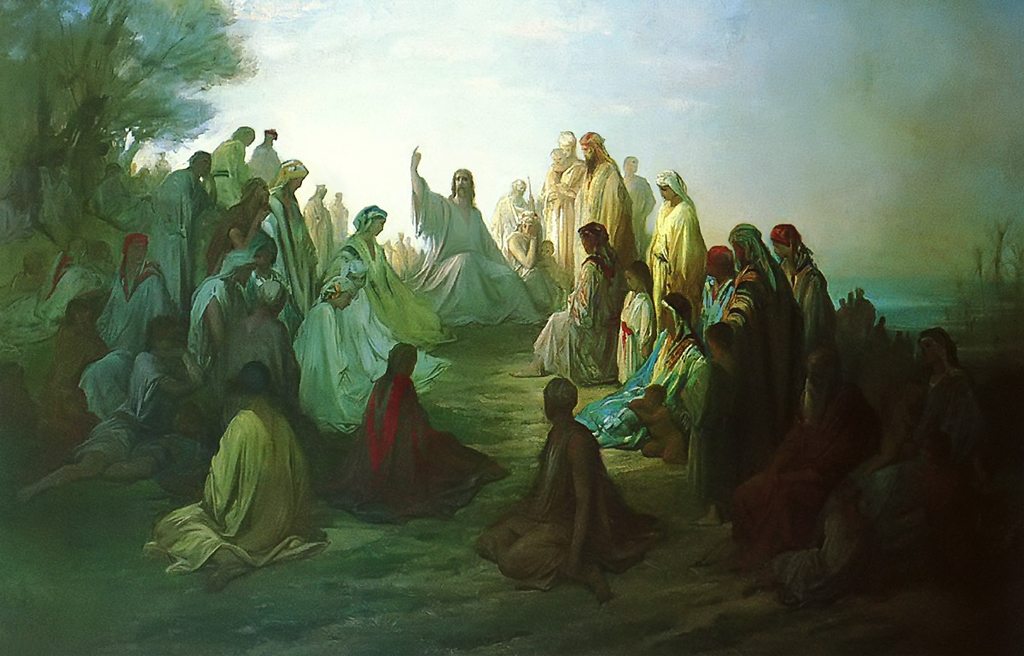
Jesus Preaching the Sermon on the Mount - Gustave Dore

                 Jesus Preaching the Sermon on the Mount – Gustave Dore

Heaven and earth shall pass away, but my words shall not pass away.   (Matthew 24:35)

The general conception of Jesus, if He is thought of at all, is that He was a nice guy, a good teacher, and perhaps a miracle worker. A lot of what He said are words to live by, like, “all things whatsoever ye would that men should do to you, do ye even so to them” (Matthew 7:12), and “Judge not, that ye be not judged” (Matthew 7:1 – taken out of context, a great verse for Christian bashing). There is no doubt that Jesus taught many things that benefit when applied to every-day life. Those kinds of teachings find general acceptance by all, but Jesus also said many things that many in this politically correct culture would find offensive.

Jesus said, “Repent: for the kingdom of heaven is at hand.” Repent? Many today who, like Donald Trump, believe they have done nothing from which to repent. The Bible says, “For all have sinned, and come short of the glory of God” (Romans 3:23), and “the soul that sinneth, it shall die” (Ezekiel 18:4, 20). Jesus said, “Repent”!

Jesus said, “Ye have heard that it was said by them of old time, Thou shalt not commit adultery: But I say unto you, That whosoever looketh on a woman to lust after her hath committed adultery with her already in his heart” (Matthew 5:27-28). What man alive can claim innocence of that sin? These days, the same could be said of woman. Along with that He said, “whosoever shall put away his wife, saving for the cause of fornication, causeth her to commit adultery: and whosoever shall marry her that is divorced committeth adultery” (Matthew 5:32). With today’s high rate of easy divorce, to how many does this apply? Speaking of adultery, Jesus said marriage is between one man and one woman: “But from the beginning of the creation God made them male and female. For this cause shall a man leave his father and mother, and cleave to his wife; And they twain shall be one flesh: so then they are no more twain, but one flesh. What therefore God hath joined together, let not man put asunder” (Mark 10:6-9, emphasis mine) – so much for same-sex unions.

Many think of Jesus as peaceful and gentle, but Jesus said, “Think not that I am come to send peace on earth: I came not to send peace, but a sword” (Matthew 10:34). Why is that? To His followers Jesus said, “And ye shall be hated of all men for my name’s sake” (Matthew 10:22, emphasis mine). “If the world hate you, ye know that it hated me before it hated you” (John 15:18).  Jesus said, “And a man’s foes shall be they of his own household” (Matthew 10:36).  “And the brother shall deliver up the brother to death, and the father the child: and the children shall rise up against their parents, and cause them to be put to death” (Matthew 10:21).  Jesus said, “For I am come to set a man at variance against his father, and the daughter against her mother, and the daughter in law against her mother in law” (Matthew 10:35); so “He that loveth father or mother more than me is not worthy of me: and he that loveth son or daughter more than me is not worthy of me. And he that taketh not his cross, and followeth after me, is not worthy of me.” (Matthew 10:37-38). However, He offers this promise: “he that loseth his life for my sake shall find it” (Matthew 10:39).

Jesus wants total allegiance; He wants first place in our lives. The reward is eternal life, but it is not without cost. Some will protest, and rightfully so, “Salvation is a free gift. It cannot be earned, Ephesians 2:8-9!” True. The “wages of sin” (Romans 3:23) were paid by Christ on the cross, but along with accepting the free gift comes the responsibility that goes with it. The Christian life is not one of ease, a life of “do as you please,” but the Christian has the promise of the Savior who says “my yoke is easy, and my burden is light” (Matthew 11:30) because He becomes your “yoke partner.”

Jesus said that the Global Flood was real: “But as the days of Noe were, so shall also the coming of the Son of man be. For as in the days that were before the flood they were eating and drinking, marrying and giving in marriage, until the day that Noe entered into the ark, And knew not until the flood came, and took them all away; so shall also the coming of the Son of man be (Matthew 24:37-39). Jesus said that the Jonah “fish story” was true: “For as Jonas was three days and three nights in the whale’s belly; so shall the Son of man be three days and three nights in the heart of the earth” (Matthew 12:40). He said this in foretelling of His own death, burial, and resurrection which He fulfilled at His crucifixion.

Jesus said hell is real. He spoke of those within the church – “tares” – that by all appearances look like genuine Christians, but are not. Of these He said, “As therefore the tares are gathered and burned in the fire; so shall it be in the end of this world. The Son of man shall send forth his angels, and they shall gather out of his kingdom all things that offend, and them which do iniquity; And shall cast them into a furnace of fire: there shall be wailing and gnashing of teeth” (Matthew 13:40-42, emphasis mine). He spoke of the kingdom of heaven being like a net cast into the sea (the “sea” is often used as a metaphor for “the people” of the world) and gathered in by the angels who separate the good from the bad. “So shall it be at the end of the world: the angels shall come forth, and sever the wicked from among the just, And shall cast them into the furnace of fire: there shall be wailing and gnashing of teeth” (Matthew 13:49-50, emphasis mine).  Jesus said that if your hand, foot, or eye causes you to sin, you should get rid of them, for it is better to enter into heaven maimed than to be whole and “to go into hell, into the fire that never shall be quenched: Where their worm dieth not, and the fire is not quenched” (Mark 9:43-48, emphasis mine). Notice that Jesus stressed the eternality of hell; “never” means NEVER.  Jesus spoke of hell as a real place. He told the true account of a rich man and a poor beggar who both died and stepped into eternity (Luke 16:19-31).  The rich man ended up in hell, “And in hell he lift up his eyes, being in torments” (Luke 16:23, emphasis mine). Hell is real. Jesus said it.

Just as hell is real, Jesus said heaven is real. “Let not your heart be troubled: ye believe in God, believe also in me. In my Father’s house are many mansions: if it were not so, I would have told you. I go to prepare a place for you. And if I go and prepare a place for you, I will come again, and receive you unto myself; that where I am, there ye may be also” (John 14:1-3, emphasis mine). That place has dimensions: “And the city lieth foursquare, and the length is as large as the breadth: and he measured the city with the reed, twelve thousand furlongs. The length and the breadth and the height of it are equal” (Revelation 21:16).  A furlong is 660 feet. Twelve-thousand furlongs would be 7.92 million feet, and divided by 5280 feet (i.e. one mile), that is equal to 1500 miles. That is about the distance from Dallas, TX to New York, NY. Now imagine that in the size of a cube. It is not a small place! And that is just the “New Jerusalem.” There is no telling just how large the rest of heaven is, but with all that space, it is a very exclusive place. Jesus said, “Enter ye in at the strait [narrow/tight] gate: for wide is the gate, and broad is the way, that leadeth to destruction, and many there be which go in thereat: Because strait is the gate, and narrow is the way, which leadeth unto life, and few there be that find it” (Matthew 7:13-14, emphasis mine).

Many today appeal to the “love” of Jesus suggesting that a “loving God” would not send anyone to hell. Even the Pope has boarded that band wagon claiming that all roads lead to God. Those who appeal to a loving God are partially correct; God sends no one to hell. They end up there by their own choice. Those who claim John 3:16 fail to read any further. Two verses down, John 3:18 says, “He that believeth on him is not condemned: but he that believeth not is condemned already, because he hath not believed in the name of the only begotten Son of God” (emphasis mine). In my Bible, those words are written in red; Jesus said it.  God is not swayed by popular consensus. Jesus said, “I am the way, the truth, and the life: no man cometh unto the Father, but by me” (John 14:6, emphasis mine). There is no other way. Jesus said it.

Jesus taught many good lessons that when taken to heart prove beneficial to our day-to-day lives. But He also taught some very hard lessons that, when ignored, lead to eternal damnation. It’s tough to hear, but Jesus said it.

If you are unsure of your eternal destination, you alone can do something about it. “Ask, and it shall be given you; seek, and ye shall find; knock, and it shall be opened unto you: For every one that asketh receiveth; and he that seeketh findeth; and to him that knocketh it shall be opened” (Matthew 7:7-8). Jesus said it.

4 Comments

Filed under Apologetics, Christianity, Evangelism, Gospel, Heaven, Hell, Religion, Salvation, Theology

Are You Focused on Doom Instead of Him? – Is September the End?

Source: Are You Focused on Doom Instead of Him? – Is September the End?

focused.doom.logo.1

Eric Barger presents a very balanced perspective on the upcoming September events. This is a must-read article for all Christians who are looking forward to the soon return of the Lord Jesus Christ.

Comments Off on Are You Focused on Doom Instead of Him? – Is September the End?

Filed under Apologetics, Christianity, Current Events, End Times, Evangelism, Gospel, Religion, Salvation, Second Coming of Christ

Kings and Priests

golden-city-of-heaven-image

And hath made us kings and priests unto God and his Father; to him be glory and dominion for ever and ever. Amen. (Revelation 1:6)[1]

Heaven is a place everyone wants to go, but what will we do when we get there? Some imagine Heaven as a place “up there” in the clouds somewhere where we will all sit around in white robes plunking on harps. Everyone looks forward to seeing friends and loved ones there (provided they chose Jesus during their time on earth). The last two chapters of the book of Revelation describe Heaven as a recreated earth with a “new Jerusalem” in the form of a cube 1500 miles cubed – that is 3.375 billion cubic miles. The description is beautiful beyond imagination, but it is a physical place where the saints will be employed as “kings and priests.”

The phrase “kings and priests,” in Revelation 1:6, is best understood as “kingdom of priests” or, as some translations have it, “royal priesthood.” Jesus is “KING OF KINGS AND LORD OF LORDS” (Revelation 19:16). That statement itself suggests that there are other kings and other lords, but Jesus rules over all of them. Revelation 1:5 says:

And from Jesus Christ, who is the faithful witness, and the first begotten of the dead, and the prince of the kings of the earth. Unto him that loved us, and washed us from our sins in his own blood, (emphasis mine).

“Prince” translates the Greek word archōn, which means “first” or “chief ruler.” That establishes Jesus’ reign as supreme. Below Him is His “kings and priests” who reign with Him, but are subject to Him. Dr. Henry M. Morris, founder of the Institute for Creation Research, writes:

Those who were slaves became kings and priests, (or “a kingdom of priests”) seated with Him in heavenly places (Ephesians 2:6) and serving as a holy priesthood, offering up spiritual sacrifices to God (1 Peter 2:5). In the coming Kingdom, He promises that we shall actually “reign with him” (Revelation 20:6; 2 Timothy 2:12). But though we shall reign with Him, we are still His servants (Revelation 22:3) and it will be our joy to acknowledge His glory and dominion forever.[2]

Other scriptural confirmation (all emphasis mine):

But ye are a chosen generation, a royal priesthood [kingdom of priests], an holy nation, a peculiar people; that ye should shew forth the praises of him who hath called you out of darkness into his marvellous light (1 Peter 2:9)

And he that overcometh, and keepeth my works unto the end, to him will I give power over the nations: And he shall rule them with a rod of iron; as the vessels of a potter shall they be broken to shivers: even as I received of my Father (Revelation 2:26-27).

And I saw thrones, and they sat upon them, and judgment was given unto them: and I saw the souls of them that were beheaded for the witness of Jesus, and for the word of God, and which had not worshipped the beast, neither his image, neither had received his mark upon their foreheads, or in their hands; and they lived and reigned with Christ a thousand years. (Revelation 20:4)

Do ye not know that the saints shall judge the world? and if the world shall be judged by you, are ye unworthy to judge the smallest matters? (1 Corinthians 6:2)

But the saints of the most High shall take the kingdom, and possess the kingdom for ever, even for ever and ever … And the kingdom and dominion, and the greatness of the kingdom under the whole heaven, shall be given to the people of the saints of the most High, whose kingdom is an everlasting kingdom, and all dominions shall serve and obey him (Daniel 7:18, 27).

So, regardless of whatever else will occupy our time in Heaven, one of those tasks will be to serve as kings and priests in service to the KING OF KINGS AND LORD OF LORDS. Hope to see you there!

NOTES:


[1] Scripture citations are linked to The Henry Morris Study Bible online Bible at http://www.icr.org/ that has additional notes.

[2] Henry M Morris, The Revelation Record, (Tyndale House Publishers, Carol Stream, Ill., 1983), 38.

4 Comments

Filed under Christianity, End Times, Evangelism, Gospel, Heaven, Religion, Salvation, Theology