
Institute for Creation Research.
“Understand, ye brutish among the people: and ye fools, when will ye be wise? He that planted the ear, shall he not hear? he that formed the eye, shall he not see?” (Psalm 94:8-9)
Institute for Creation Research.
“Understand, ye brutish among the people: and ye fools, when will ye be wise? He that planted the ear, shall he not hear? he that formed the eye, shall he not see?” (Psalm 94:8-9)
Comments Off on The Designed Creation
Filed under Apologetics, Atheism, Christianity, Creation, Evolution, Gospel, Origins, Science, Theology

Borrowed from: http://blog.mrm.org/2012/03/mormons-and-the-bible/
But though we, or an angel from heaven, preach any other gospel unto you than that which we have preached unto you, let him be accursed. As we said before, so say I now again, If any man preach any other gospel unto you than that ye have received, let him be accursed. (Galatians 1:8-9)
Mormonism, otherwise known as the Church of Jesus Christ of Latter Day Saints (LDS Church), was founded by Joseph Smith in 1820. The religion is of rather dubious origins. Allegedly in 1823, Joseph Smith was visited by the angel Moroni and told Smith about a book of golden plates containing “the fullness of the everlasting Gospel” (see our lead verse above). Four years later, Smith discovered the golden plates along with a special set of spectacles that allowed him to translate the hieroglyphics into what we now know as The Book of Mormon. Once his translation work was done, he conveniently buried the plates again at an undisclosed location never to be seen again. More could be said about the beginnings of this cult, its founder, and its early history, but my purpose here is to point out some of the fallacious teachings of this false religion.
As I pointed out in my last post, “False Religion,” three characteristics of false religions are: (1) deny or reject the God of the Bible, (2) deny the unique deity of Christ, and (3) reject the Bible as the inerrant, infallible Word of God. The LDS Church is guilty on all three counts.
If one is not paying attention, one might think that Mormons believe in God. However, their concept of God is nothing like the God of the Bible. To be sure, the Bible makes it abundantly clear that there is only one God.
Hear, O Israel: The LORD our God is one LORD (Deuteronomy 6:4)
Ye are my witnesses, saith the LORD, and my servant whom I have chosen: that ye may know and believe me, and understand that I am he: before me there was no God formed, neither shall there be after me. I, even I, am the LORD; and beside me there is no saviour (Isaiah 43:10-11).
Thus saith the LORD the King of Israel, and his redeemer the LORD of hosts; I am the first, and I am the last; and beside me there is no God … Fear ye not, neither be afraid: have not I told thee from that time, and have declared it? ye are even my witnesses. Is there a God beside me? yea, there is no God; I know not any (Isaiah 44:6, 8).
I am the LORD, and there is none else, there is no God beside me: I girded thee, though thou hast not known me … Tell ye, and bring them near; yea, let them take counsel together: who hath declared this from ancient time? who hath told it from that time? have not I the LORD? and there is no God else beside me; a just God and a Saviour; there is none beside me. Look unto me, and be ye saved, all the ends of the earth: for I am God, and there is none else (Isaiah 45:5, 21-22).
The following comes from The Kingdom of the Cults (1985) by Walter Martin. Note how the Mormon concept of “God” is polytheistic, not monotheistic as the God of the Bible.
There are more, but the reader can readily see the pattern here. According to the LDS Church, “God” was once a man who was elevated to godhood, and apparently he is one among other “Gods.” Apparently, man, by following the practices prescribed by the Mormon Church, can also achieve godhood. Note here another principle of false religion: “salvation” is achieved through one’s own efforts, something the Bible rejects. “For by grace are ye saved through faith; and that not of yourselves: it is the gift of God: Not of works, lest any man should boast” (Ephesians 2:8-9, emphasis added).
The LDS Church also rejects the unique deity of Christ. Note the qualifier “unique.” The Mormons do indeed believe that Jesus Christ is “a God” – one among many others. They also recognize “Elohim” as Jesus’ father, albeit in a “carnal” way, i.e., as from the union of a man and woman. Martin [p. 212] quotes Brigham Young: “When the Virgin Mary conceived the child Jesus, the Father had begotten him in his own likeness. He was not begotten by the Holy Ghost. And who was the Father? He is the first of the human family; and when he took a tabernacle [body], it was begotten by his Father in heaven, after the same manner as the tabernacles of Cain, Abel, and the rest of the sons and daughters of Adam and Eve; from the fruits of the earth, the first earthly tabernacles were originated by the Father, and so on in succession … Jesus, our elder brother was begotten in the flesh by the same character that was in the garden of Eden, and who is our Father in Heaven” (Journal of Discourses, Vol. I, pp. 50 and 51). From the Mormon perspective, the “Father” was Adam who came down from heaven with one of his wives, Eve, and populated the earth. This same “Father” begat Jesus through the Virgin Mary. Even the least studied student of the Bible can see through this fallacy. Not only is Jesus the only begotten Son of God; He is in every way the only God in human form (John 1:1; Philippians 2:5-8; Colossians 2:9; Revelation 4:11).
The LDS Church denies the inerrancy and infallibility of the Bible and elevates The Book of Mormon and other Mormon writings (as quoted above) over the Word of God. Indeed, Joseph Smith said, “…it was apparent that many important points touching the salvation of men, had been taken from the Bible, or lost before it was compiled” (Teachings of the Prophet Joseph Smith, p. 10, cited at “The Plain Truth About Mormons”). The LDS Church accepts the King James Version of the Bible as “part” of God’s Word “insofar as it is correctly translated,” but in addition to that, they give higher regard to The Book of Mormon, Doctrine and Covenants (Brigham Young), and The Pearl of Great Price. While the Bible has never been scientifically, historically, or archeologically falsified, The Book of Mormon fails miserably on all three counts, and yet the LDS Church reveres The Book of Mormon and their other writings above the Bible. “There is a great wealth of information concerning the material contained in the Book of Mormon and the various plagiarisms, anachronisms, false prophesies and other unfortunate practices connected with it” (Martin, 186). Martin (pp. 186-187) goes on to list a series of corrections made to The Book of Mormon since it was first published in 1830. Martin comments that “…it appears that either God made a mistake when He inspired the record or Joseph [Smith] made a mistake when he translated it. Mormons will admit to neither, so they are stuck, so to speak, with the contradiction” (Martin, 186). Similar allegations have been levied against the Word of God, but none have been proven true. “The record of Scripture [the Bible] rings true. The Book of Mormon, on the other hand, is patently false in far too many places to be considered coincidence” (Martin, 187).
These are only some of the problems with the false religion of Mormonism. For a more complete study, I highly recommend The Kingdom of the Cults by Walter Martin, but here in brief I have shown that Mormonism is a false religion. It denies the God of the Bible. It denies the unique deity of Christ, and it rejects the inerrant, infallible Word of God. In addition, like all other false religions, salvation is dependent on the works of the believer. Mormonism does not even qualify as “Christian” even though “Jesus Christ” is part of their name. Do not be fooled by this false religion. Mormons are very nice people, and they live exemplary and admirable lives; but according to the Bible, they are self-deceived, and they are lost. Treat them accordingly with all due love and respect.
Filed under Apologetics, Christianity, Gospel, Religion, Theology

But though we, or an angel from heaven, preach any other gospel unto you than that which we have preached unto you, let him be accursed. As we said before, so say I now again, If any man preach any other gospel unto you than that ye have received, let him be accursed. (Galatians 1:8-9)
In my last post, I attempted to point out some broad characteristics that distinguish “True Religion.” In the article “I Am A Christian,” I went into greater detail on what it means to be a Christian, which is the only true religion. But in order to distinguish between true religion and false religion, one must be able to recognize false religion on sight.
First of all, a false religion denies the God of the Bible. Immediately that includes all pagan religions that worship multiple gods (polytheism), or believe that everything is god (pantheism). By the way, evolutionism or naturalism is a form of pantheism in that it attributes to nature creative abilities and intellect. Evolution/naturalism in turn gives rise to secular humanism that, for all practical purposes, bestows upon mankind a divine nature. They perhaps would not go so far as to call themselves gods (although some have), but the ideology attributes value to mankind apart from God, so in essence, man is God. Romans 1:23 encapsulates false religion this way: “And changed the glory of the uncorruptible God into an image made like to corruptible man, and to birds, and fourfooted beasts, and creeping things” (emphasis mine). This list would include Hinduism (which is both pantheist and polytheist), Buddhism, and a variety of others (the list is too long for this post). Islam would also be included here. Although many may argue that Islam’s god, Allah, is the same as the God of the Bible, a close comparison reveals that they are not the same. See my article “God Is Not Allah.”
Second, a false religion rejects the deity of Christ. All those listed above fall into this category, but now the list broadens to include the Jewish religion. While the Jewish religion accepts the God of the Bible, their Bible ends with the book of Malachi. (Technically, the Hebrew Scriptures end with Chronicles; it is only a matter of how the books are arranged.) Jews reject the Messiah that was prophesied in their own Scriptures. The New Testament is clear: “Who is a liar but he that denieth that Jesus is the Christ? He is antichrist, that denieth the Father and the Son” (1 John 2:22). “Christ” is the Greek rendering of “Messiah” which means “anointed one.” John would say that the Jews who deny that Jesus is the Christ are liars. It is a false religion.
The Church of Jesus Christ of Latter Day Saints (the LDS church otherwise known as the Mormons) while associating their religion with Jesus Christ, denies the unique deity of Christ. To the Mormons, Jesus is one of many “sons of God.” In their belief system, Jesus is brother to Lucifer. LDS adherents believe that they too will become gods and be in charge of their own worlds. Of course, when the young “Elders” come knocking on your door, they will not willingly volunteer any of this information. The Bible teaches that the “Word,” by whom all things were created (John 1:3), became flesh, and John testifies that “we beheld his glory, the glory of the only begotten of the Father” (John 1:14, emphasis mine). “No man hath seen God at any time; the only begotten Son, which is in the bosom of the Father, he hath declared him” (John 1:18, emphasis mine). The moniker “only begotten Son” (see also John 3:16, 18; 1 John 4:9) clearly indicates that there is no other. That automatically disqualifies Lucifer and all others that the Mormons might want to add to the list.
The Jehovah’s Witnesses also deny the deity of Christ. These too are fervent “evangelists” for their cause and they are very well trained in the use of Scripture taken out of context. They are not well trained in Scripture; they are trained in Watch Tower literature. One of the verses they like to use as proof text to deny the deity of Christ is John 1:1: “In the beginning was the Word, and the Word was with God, and the Word was God.” In their mistranslation of the Scriptures the verse ends: “and the word was a god.” They attribute this to the fact that in the Greek, theos (god) is not preceded by the definite article. However, the same construct appears again in John 1:6: “There was a man sent from God, whose name was John,” but here they render it correctly. So, why is there an inconsistency? They cannot tell you. They have other problems as well, but denial of Christ as God is their greatest problem.
Muslims, while they acknowledge Jesus as a great prophet second only to Mohammed, and even accept His virgin birth, also deny the deity of Christ. So, not only is Jesus not God, but He is less than the human prophet Mohammed.
Finally, false religion minimizes or altogether rejects the Word of God, the Holy Bible. Many pagan religions, like Hinduism, and Buddhism have their own holy books. Islam, while it acknowledges the Holy Bible and affords it some value, has the Koran (Quran). The Mormons accept and give verbal assent to the Bible, but in practice they prefer the Book of Mormon and The Pearl of Great Price. In doing so, they have overlooked Paul’s stern warning in Galatians 1:8-9 that even if an angel (like Moroni) preach any other gospel than what is preached in the Bible, that one should be accursed. The Jehovah’s Witnesses violate the Word of God by rewriting it to conform to their preconceptions. They ignorantly disregard the admonition from Scripture against tampering with the Word of God (Deuteronomy 4:2; Revelation 22:19). The Roman Catholic Church venerates the Bible, but in practice they prefer the edicts of the Pope over the teachings of the Bible. In fact, the Roman Catholic Church teaches that the Bible cannot be understood by the common layperson, or even the priests. Only the Pope has the authority to give proper interpretation and meaning to Scripture. Worthless as it may be, at least they claim some authority. Many mainline Protestant denominations with their liberal theologians have divested Scripture of all authority and set their adherents aimlessly adrift on a sea of relativistic humanism and existentialism. Recently I heard a Methodist minister base his sermon on Ephesians 6:3-4 (two completely unrelated verses regardless of their proximity). He never addressed the Scripture, but instead built his sermon on Harry Chapin’s “Cat’s In the Cradle.” Build your theology on that!
The Bible tells us that God’s Word is eternally trustworthy. “For ever, O LORD, thy word is settled in heaven” (Psalm 119:89). “Thy word is true from the beginning: and every one of thy righteous judgments endureth for ever” (Psalm 119:160). “The grass withereth, the flower fadeth: but the word of our God shall stand for ever” (Isaiah 40:8). God says, “So shall my word be that goeth forth out of my mouth: it shall not return unto me void, but it shall accomplish that which I please, and it shall prosper in the thing whereto I sent it” (Isaiah 55:11). Jesus said, “For verily I say unto you, Till heaven and earth pass, one jot or one tittle shall in no wise pass from the law, till all be fulfilled” (Matthew 5:18). Any religion that rejects any part or the entire Bible has nothing on which to stand and has built a house on shifting sand (Matthew 7:26-27).
Any one or all of these characteristics identify a false religion. False religion will reject the God of the Bible. False religion rejects the deity of Christ. False religion rejects the authority of the Bible.
Filed under Apologetics, Christianity, Evangelism, Evolution, Gospel, Religion, Theology

Borrowed from: http://south-asian-news.sandhira.com/religion.html
Pure religion and undefiled before God and the Father is this, To visit the fatherless and widows in their affliction, and to keep himself unspotted from the world. (James 1:27)
Not long ago, a couple of Mormon missionaries knocked on my door and attempted to engage me in conversation. Now, I understand that these kinds of conversations seldom lead anywhere, but I am not one to turn away such opportunities, so I engage. On this particular occasion, these “elders” (I think it’s cute these young men, no more than 18 or 19, call themselves “Elder” so-and-so), brought up the question of “Why are there so many religions?” By that, of course, they meant “Christian” religions. They pointed out that Jesus wanted all His followers to be united (John 17:11, 21-23) as one. I agreed and jokingly said, “I think all Christians should be Baptist!” They were not sure how to respond to that. They naturally wanted to make a case for the LDS church. Had I been serious in my quip, I would have been just as guilty as they in giving allegiance to a “brand” rather than to the “person” of Jesus Christ.
All world religions, including all Christian “denominations” are man-made and therefore subject to the fallacies of men, granted some more than others. So what is true religion? According to Dictionary.com, “religion” is:
Notice the emphasis on “practice,” “conduct,” “adherence,” and “ritual observance.” All religions designed by man employ some kind of merit system to gain eternal rewards for the adherents, but none offer any security for the same. Instead the adherent gets “Do your best and perhaps your good will outweigh the bad.” Frankly, I would find little comfort in that.
Jesus does not offer religion; He offers a personal relationship with the Creator. In our beginning verse above, James seems to confirm the usual pattern for man-made religion – care for the widows and orphans and keep yourself unspotted from the world. In other words, do all of the right kind of stuff, and you will have “pure religion.” One must understand that James was speaking to Christians. His instruction was not for the purpose leading one to heaven, but rather to demonstrate the life conduct of a person that is heaven bound. The fact that one is “born again” should result in altered behavior that demonstrates a changed life. This change in life should not be rote ritualism as suggested in the dictionary definition above, but rather, because of a new nature (Galatians 2:20), such behavior should “come natural” for the genuine believer. It should not be a forced act.
Another characteristic of man-made religion is that the adherent constantly strives – works – to gain the favor of his god. (I plan to show specifics of how this is done in future posts.) True religion understands that God, the transcendent Creator, is infinitely offended by sin – man’s rebellion against God. True religion understands that man is incapable through his own efforts of being reconciled to God. True religion understands that only God can bridge the divide that separates God from man. To do so, God became man (Philippians 2:5-11), and did what man could not – pay restitution for the offense. Herein lies the difference between man-made religion and true religion. In man-made religion, man does all the work and gains nothing in return; in true religion, God does all of the redemptive work, and “as many as received him, to them gave he power to become the sons of God, even to them that believe on his name” (John 1:12).
The old saying that “You can lead a horse to water, but you can’t make him drink” applies here. God has done all of the work of redemption, and He freely offers reconciliation to everyone who will receive it; but it must be received, and He will not force it on anyone. The choice is yours.
Comments Off on True Religion
Filed under Apologetics, Christianity, Gospel, Heaven, Religion, Salvation, Theology
For he taught his disciples, and said unto them, The Son of man is delivered into the hands of men, and they shall kill him; and after that he is killed, he shall rise the third day. (Mark 9:41)
Bible critics often charge the Scripture with error pointing out that Jesus said He would be in the tomb three days and three nights, but the actual time from Friday evening to Sunday morning is less than 36 hours. That would give Him one full day and two full nights in the grave. That is not exactly what He prophesied. So, is the Bible wrong on this account?
First of all, we need to make one thing perfectly clear: Jesus was raised on the “third day” (Acts 10:40) which was the “first day” of the week (Matthew 28:1; Mark 16:2; Luke 24:1; John 20:1). So, Jesus was in the tomb three days; however, the problem comes up in how those days are reckoned.
Secondly, we need to remember that much of our Christian “practice” has come to us by way of almost 2000 years of “tradition.” The birth of Christ being celebrated on December 25 is one such tradition and “Good Friday” being another. Neither have biblical support. The important thing to remember is that Christ was born, He lived, He died and He rose again. Those events are well worthy of memorializing and celebrating even if our dates (and by that I mean the time of year) are in error. Of course, for those of us who really want to go deeper, those questions do matter, and they are important.
Now, the arguments for the crucifixion having occurred on Friday are weak ones, in my opinion. I arrive at that conclusion from what Jesus clearly said in Matthew 12:40 (at least it’s clear to me): “For as Jonas was three days and three nights in the whale’s belly; so shall the Son of man be three days and three nights in the heart of the earth” (emphasis mine). To me that sounds like 72 hours, but bound by the tradition that Jesus was crucified on Friday, many commentators try to make it work by arguing that any part of a day is considered a day. Jesus was buried at the end of the day (before 6 PM) on Friday; that is one day. He was in the tomb all day on Saturday; that is two days. Finally He arose on Sunday morning (after 6 AM); that makes three days. However, even given partial days counting as a whole, there is no way to get three nights out of that.
In the book, Hard Sayings of the Bible (Intervarsity Press, 1996) the writers argue:
[We] know (emphasis mine) that Jesus was not in the tomb more than thirty-six to thirty-eight hours, since he was buried at evening (which began at about 6 p.m.) on Friday and rose by morning (about 6 a.m.) on Sunday. (p. 380)
Note that they “know.” How do they know? They concede that we understand the phrase “three days and three nights” to mean a 72-hour period, but:
[We] know (emphasis mine) that the phrase “three days and three nights” was not a problem for Matthew, for he can use both that and “on the third day” and include no explanation, which he does in other cases where he senses a problem. (pp. 380-381)
The problem with this argument is that the phrase “three days and three nights” and the phrase “on the third day” have different meanings and certainly different connotations. They go on:
In quoting the scriptural phase [Matthew 12:40] Jesus probably (emphasis mine) did not mean that he [sic] would be buried the exact length of time as Jonah was in the fish, but that he [sic] would like Jonah be “buried” for that approximate (emphasis mine) time and then be “raised.” (p. 381)
Now, I have a real problem with second guessing Jesus. Jesus spoke clearly, and even when He spoke in parables to hide His meaning from the Pharisees, He later clarified the meaning for His disciples. Even when He did not explain His sayings to His disciples, the Gospel writers would parenthetically interpret His meaning. For example, when Jesus said, “Destroy this temple, and in three days I will raise it up” (John 2:19), John quickly explains, “But he spake of the temple of his body” (v. 21). There is no such clarification in Matthew 12:40 given by either Jesus or the Gospel writer, Matthew. That leads me to conclude that when Jesus said He would be in the earth “three days, and three nights,” that is exactly what He meant. A Friday burial does not allow for that even if one concedes partial days because this allows for only two nights, which contradicts Jesus’ words. As an aside, note how God defines His creation days in Genesis 1 by “the evening and the morning;” both are necessary to define a complete 24-hour day. Why would Jesus, the Creator (John 1:1-3), redefine His terms on such an important issue without clarifying His meaning, if He meant something other than what He said?
Some argue for Friday because Scripture tells us that Jesus had to be buried quickly because the following day (which started at 6 PM) was a Sabbath (Mark 15:42; Luke 23:54-56; John 19:31). This error comes from the mistaken idea that the Sabbath means the seventh day of the week (Saturday). The fact is that all Jewish feast days are considered Sabbaths (a day of “rest” – the meaning of the word in Hebrew) regardless of the day of the week on which they fall. Christians do not normally pay attention to Jewish feast days, but if they did, they would find that Passover does not always fall on the same day of the week. Furthermore, the day following Passover is the Feast of Unleavened Bread, and that too is considered a Sabbath regardless of the day of the week on which it falls (see Leviticus 23:4-7). So, the fact that they had to quickly bury Jesus because the following day was the Sabbath does not necessarily mean that the following day was Saturday; it could have been Thursday or Friday.
It might be apparent by now that I do not favor a Friday crucifixion and burial. I base my conclusion solely on the words of Jesus and that He meant exactly what He said, i.e., that He would be in the earth (the tomb) three days and three nights. Some reckon this to mean that He was buried on Wednesday and rose on Sunday morning, but this gives four nights and three days if one discounts any part of Wednesday afternoon (3 PM to 6 PM). This is more than 72 hours. However, this discrepancy is resolved when one considers that the first day of the week started after 6 PM on Saturday, so that eliminates Jesus having to spend an extra night in the tomb. I would also be comfortable with a Thursday crucifixion and burial counting the last three hours of Thursday (3 PM to 6 PM) as “a day” with the resurrection taking place on Sunday morning after 6 AM. This will render three days and three nights albeit not exactly 72 hours. Either of these two options are preferable to a Friday crucifixion and burial.
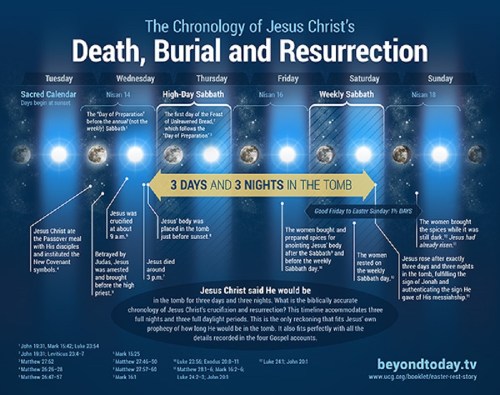
Borrowed from: http://116boyz.com/2014/04/21/3-days-and-3-nights/
The Bible is not in error because the Bible never specifies the day of the week on which Jesus was crucified. We know that Jesus was crucified on Passover. We know that the following day was “the Day of Preparation” ( Matthew 27:62; Mark 15:42; Luke 23:54; John 19: 42) otherwise known as the Feast of Unleavened Bread – a Sabbath. We also know that Jesus rose on the first day of the week (Matthew 28:1; Mark 16:2; Luke 24:1; John 20:1), and we know He was in the tomb three days. So, counting back three full days from Sunday takes us back to Thursday or Wednesday, but not Friday. So, the Bible is true and the traditions of men are false.
Filed under Apologetics, Christianity, Easter, Evangelism, Gospel, Religion, Resurrection, Salvation, Theology

 Ernie's Musings