Category Archives: Heaven

Psalm 103

All that is within me, bless His Holy Name!

All that is within me, bless His Holy Name!

Psalm 103

A Psalm of David. Bless the LORD, O my soul: and all that is within me, bless his holy name. (Psalm 103:1)

This wonderful psalm reminds us to give grateful praise to God for all His goodness and love that He continually demonstrates for His children. When we think of blessing someone, we often think of doing something good for that person. When we think of God blessing us, we might think of having good health, a nice home, a wonderful family and friends or any number of things – good things. But is that really what it means to be blessed? And if that is so, how can we possibly bless God? I mean, what can we give to God that He does not already have? (Besides your heart)

Perhaps “blessing” is not what we think it is. As translated in this psalm (and many other places in the Old Testament) the Hebrew word is bârak, and according to the Strong’s Dictionary, it means: “to kneel; by implication to bless God (as an act of adoration), and (vice-versa) man (as a benefit); also (by euphemism) to curse (God or the king, as treason): –  X abundantly, X altogether, X at all, blaspheme, bless, congratulate, curse, X greatly, X indeed, kneel (down), praise, salute, X still, thank.” I don’t know about you, but that definition is certainly confusing. In reading the context of the psalm, we gather that cannot mean to curse God, so by the general tone of the psalm we can infer “an act of adoration.” The Greek translation in the Septuagint (LXX) of this psalm uses the word eulόgei, which means “to speak well of,” and from which we get our English word “eulogy.” I have never been to a funeral where an ill word was spoken of the dearly departed; only good is spoken of the dead in a eulogy.

So this psalm encourages us to “eulogize” God from the very core of our being. We are to “speak well of” His holy name. Why should we do this? The next four verses instruct us. We “eulogize” Him because of how He treats us, i.e., “His benefits.” He forgives our perversities (“iniquities”) which is a disease that only He can heal. He “redeems” our lives, i.e., He “buys us back” from destruction, i.e., eternity in hell. Not only that, but He elevates us to royal status by awarding us a crown, and all of this is because of His “loving-kindness” and “tender mercies.” This reminds me of Jesus’ parable of the Prodigal Son (Luke 15:11-32) who spurned his father’s love and wasted all that his father gave to him. Then, while in the filthy, smelly pigsty, having hit absolute bottom, the son remembered all that the father’s house had to offer, and leaving his pride in the mud pit, he determined to return to his father’s house as a lowly servant. But rather than chastise him for his ingratitude and cast him out as a worthless vagrant, the father welcomed him with open arms and elevated him to his former status of the master’s son and heir to the father’s wealth. Then the father threw a huge party with lots of wonderful food – he killed the “fatted calf” that was reserved for special occasions – to celebrate his boy’s return. The fifth verse tells us that He “satisfieth thy mouth with good things; so that thy youth is renewed like the eagle’s.” Imagine how the son felt after a long season of hunger, shame, and disgrace! That is what God offers us, and we should speak well of Him for that.

We eulogize the Lord because He carries out righteous judgment on behalf of all who are oppressed. He is merciful – He withholds the punishment we deserve; He is slow to anger. He is gracious – granting us what we do not deserve; He is abounding in mercy. “He hath not dealt with us after our sins; nor rewarded us according to our iniquities” (v. 10). As great as His mercy is – greater than the heights of heaven – it is there for those “that fear Him.” Do not think for one moment that you can live like the devil and obtain His mercy; but His mercy is there when you recognize Him for Who He is – the great Creator God, Who is to be feared, and whose name is holy and deserves to be “well-spoken of.” When we understand that, He will remove our transgressions, “As far as the east is from the west so far hath he removed our transgressions from us” (v. 12).

“Like as a father pitieth his children, so the LORD pitieth them that fear him” (v. 13). “Pity” is an unfortunate translation here. The Hebrew word is râcham, and it means to fondle, love, show compassion. Picture a father or mother cuddling an infant child – that’s the picture; and again it is qualified by “them that fear Him.” His love and compassion stem from the fact that He knows our “frame.” That Hebrew noun is yêtser, whose verb form is yâtsar, which means to “mold” or “form” as a potter fashions a clay vessel. God knows how we were made because He made us out of the dust of the earth, and He cherishes us. This should cause us to “bless” His name!

Our life on earth is brief. Moses said, “The days of our years are threescore years and ten; and if by reason of strength they be fourscore years, yet is their strength labour and sorrow; for it is soon cut off, and we fly away” (Psalm 90:10). This psalm reminds us of that truth. When compared to eternity, our life is like grass or a Texas wild flower; when the hot winds of summer blow in, they dry up and their beauty is forgotten. But God’s mercy is not like that. This psalm says that His mercy “is from everlasting to everlasting” (v. 17). Once again, the promise is to “them that fear Him,” i.e., “To such as keep his covenant, and to those that remember his commandments to do them” (v. 18). For these “The LORD hath prepared his throne in the heavens; and his kingdom ruleth over all” (v. 19).

In light of all that God has done, all of His creation – the hosts of angels that do His bidding and all of His “works” over which He has dominion (that includes everything and excludes nothing) – can do no less than “speak highly, reverently, and fearfully of the Lord.” And if we fail to do so, Jesus says that the very “stones would immediately cry out” (Luke 19:40). Let not the stones do what we were created to do.  “Bless the LORD, O my soul: and all that is within me, bless his holy name.”
Comments Off on Psalm 103

Filed under Christianity, Creation, Evangelism, Gospel, Heaven, Origins, Thanksgiving, Theology, Worship

God’s Not Fair

Judgment of God

O man, who art thou that repliest against God? Shall the thing formed say to him that formed it, Why hast thou made me thus? (Romans 9:20)

Someone complained that God is unfair to send people to hell simply because they don’t know any better. She said, “I’ve recently hit a point where my faith is all but dead, not by will but by fear that the worst is true, that there is no God after all.” Her reasons for arriving at this conclusion are as follows: “It’s two-fold in that [1] God has never revealed Himself to me in ways that I was taught He would (Pentecostal background), and [2] more recently that I just cannot wrap my head around the idea of a God of ultimate love knowingly creating even one single soul knowing it was destined for eternal damnation. I question why God would create such a being, knowing beforehand the choices he would make.”

Her first reason, it seems to me, finds an explanation in her “Pentecostal background.” I see this problem with many Pentecostals because many (not all) are taught (if not directly then by inference) that God must reveal Himself in miraculous ways: speaking in tongues, healings, tangible answers to prayer, etc. The fact is that God is not obligated to reveal Himself to us in any way other than He has already done, i.e., through His creation (Romans 1:19-20) and through His Word (John 1:1-3, 14; Psalm 119:105; 2 Timothy 3:16, et. al.). Her Pentecostal background may also have something to do with her second issue against God in the Arminian soteriology of Pentecostals, which holds, in part, that a believer can “fall from grace,” and if they die in that condition, they will go to hell. So, Pentecostals must continuously “work out their own salvation” so as not to lose their salvation. That, in itself I think, might give one a tenuous grasp on their eternal status and sense of eternal security.

Her Pentecostal background may be the source of her sense of insecurity which she then projects on those whom she sees as victims of a merciless God. Why would God create humans knowing that He is going to send them to hell? Not only is God merciless, but she finds eternity in hell to be cruel and unusual punishment.  She said, “I am a pale imitation of God, an ignorant human born in a world of decay, yet to me the pain of one soul, any soul, even the worst example of humanity, is not worth the existence of this universe” (emphasis mine). Can you see what she has done? She made moral judgment against God and placed herself in a position of moral superiority above God. Though she is “a pale imitation of God,” she makes herself morally superior  to God because she would not cause pain even to the worst example of humanity. If she were in the place of God, she would not even create the universe, if even one soul would suffer eternal torment. Furthermore, God has no basis “to extend this eternal punishment further to those that fail to heed words in a book thousands of years old when other books tell their own versions (other religions).”

As I read her tirade, I distinctly heard echoes of Genesis 3:1-5: “Tssssssssssssssss! Yea, hath God said in the Bible? That book is so ancient. Those are just the words of men. What about all those other holy books? Aren’t they just as valid? Ye shall not surely die. If God is so loving, He wouldn’t send anyone to hell would He? And even if He did, surely He wouldn’t make someone suffer for eternity. If He does, then God’s not fair! Why should you follow a God like that!”

When we put ourselves in a position where we question why God made us the way He did, we in effect pass judgment on Him and make ourselves superior to Him because we are saying that we could have done it better. “Who art thou that repliest against God? Shall the thing formed say to him that formed it, Why hast thou made me thus? Hath not the potter power over the clay, of the same lump to make one vessel unto honour, and another unto dishonour?” (Romans 9:20-21 also Isaiah 29:16, emphasis mine). We are not in a position to question God’s motives in creating us as He did. We are not God. Humanly speaking, does not a creator/inventor of anything have the right to assign value to his/her creation/invention, and to decide how to dispose of it? By the same token, can we not allow the Creator to decide the “worth” of His creation and select what He will keep and what He will discard without our input? Let’s be fair here!

The fact is that God made us in His image (Genesis 1:27), and part of that image includes rational thought and the ability to make decisions and exercise our free will. Along with that comes the responsibility to assume the consequences for our decisions.  When God made Adam and Eve and He placed them in the Garden, He gave them one choice: eat of the tree of life and live, or eat of the tree of the knowledge of good and evil and die, i.e., be eternally separated from God (Genesis 2:16-17). God created Adam and Eve with a will and the ability to choose whether to obey or disobey God. Had God not given that choice, His creatures would be no different than any other animal, and they certainly would not have the “image” of God. The will and the ability to make choices is part of having the image of God. Without that, we are just animals.

Adam and Eve disobeyed God’s only prohibition (Genesis 3:1-6). Eve was deceived, but Adam disobeyed willingly (1 Timothy 2:14). That disobedience, whether willful or through deception, brought death upon all of God’s creation. Because of that original sin, all of mankind receives the curse of sin which is death (Genesis 3:19). Every human being is born “dead” – eternally damned – due to Adam’s original sin. We are not sinners because we sin; we sin because we are sinners. We are all in the same condition; there is no escaping it. How well informed or how misinformed one is has nothing to do with it.

Wherefore, as by one man sin entered into the world, and death by sin; and so death passed upon all men, for that all have sinned. (Romans 5:12)

And you, being dead in your sins and the uncircumcision of your flesh, hath he quickened together with him, having forgiven you all trespasses (Colossians 2:13)

And you hath he quickened, who were dead in trespasses and sins … Even when we were dead in sins, hath quickened us together with Christ, (by grace ye are saved;) (Ephesians 2:1, 5)

Behold, all souls are mine; as the soul of the father, so also the soul of the son is mine: the soul that sinneth, it shall die. (Ezekiel 18:4)

This is the truth, and it is not going to change simply because it offends our sensibilities. It does not matter whether someone is duped by evolution, or whether they have not had the Gospel explained clearly enough for them to understand; the fact of the matter is that every human being that is born, is born “dead” because of sin. The penalty for sin is eternal death (separation from God) in hell.

However, this dead condition is not without resolution. God provided the way to eternal life through the death and resurrection of Jesus Christ. God makes Himself available to all who will seek Him. “For by [the free gift of] grace [i.e., unmerited favor] are ye saved through faith [Hebrews 11:6]; and that not of yourselves [even the faith to believe comes from God]: it is the gift of God: Not of works, lest any man should boast” (Ephesians 2:8-9). What God asks of us is not that difficult: “That if thou shalt confess with thy mouth the Lord Jesus, and shalt believe in thine heart that God hath raised him from the dead, thou shalt be saved” (Romans 10:9). “Neither is there salvation in any other [than Jesus]: for there is none other name under heaven given among men, whereby we must be saved” (Acts 4:12). “Jesus saith unto him, I am the way, the truth, and the life: no man cometh unto the Father, but by me” (John 14:6).

People like to quote John 3:16 because it expresses the love of God for the entire world, but two verses later it says, “He that believeth on him is not condemned: but he that believeth not is condemned already, because he hath not believed in the name of the only begotten Son of God” (John 3:18, emphasis mine). A choice has to be made. Because of Adam’s sin, we all begin from the point of “condemned already.” We all have the same choice: believe or disbelieve. Not choosing is actually choosing to disbelieve. And to remove any excuses, God’s creation testifies to His existence, “For the invisible things of him from the creation of the world are clearly seen, being understood by the things that are made, even his eternal power and Godhead; so that they are without excuse” (Romans 1:20, emphasis mine). God reveals Himself in His creation. Without exception, everyone has a choice.

The charge that God is somehow unmerciful and unloving dissolves in light of His personal intervention on our behalf. God’s grace and mercy was expressed on the cross of Christ. “The gift of God is eternal life through Jesus Christ our Lord” (Romans 6:23). God has given sufficient evidence in His creation to make man wonder about his origin and about the origin of the world around him. God says, “And ye shall seek me, and find me, when ye shall search for me with all your heart” (Jeremiah 29:13). God does not hide Himself. The fault is with man for rejecting the evidence God has provided and refusing to seek God. Jesus said that the way to destruction is broad, and many go that way; but the way to life is narrow and difficult to find, and very few find it (Matthew 7:13-14).

Answering the criticism of God sending people to hell: God created hell for “the devil and his angels” (Matthew 25:41), not for human beings. People choose to go to hell by not choosing God. God demonstrated “his love toward us, in that, while we were yet sinners, Christ [God in the flesh] died for us” (Romans 5:8, emphasis mine). What more could He possibly do and still respect our will and our right to choose? He could have made us animals, but He didn’t. He made each one of us unique, created in His very image. That is why He values us, and because He values us, He gives us the choice to either accept Him or reject Him. Because He cherishes us, He will not impose Himself on any one of us. But, if we reject Him, we make an eternal choice, but it is our choice. God didn’t create us for hell. Do you think for one moment that God has any desire to destroy His image! “The Lord is not slack concerning his promise, as some men count slackness; but is longsuffering to us-ward, not willing that any should perish, but that all should come to repentance” (2 Peter 3:9), but He respects our choice.

There you have it. Rather than criticize God for His methods with which we may disagree, why not simply submit to Him? He is God, and by definition, His way is right regardless of what we may think. “For my thoughts are not your thoughts, neither are your ways my ways, saith the LORD. For as the heavens are higher than the earth, so are my ways higher than your ways, and my thoughts than your thoughts” (Isaiah 55:8-9, emphasis mine). If we are truly concerned for those that are bound for hell, perhaps rather than criticizing God for His methods, we should be a light to show the way (Matthew 5:14).

5 Comments

Filed under Apologetics, Atheism, Christianity, Creation, Death, Evangelism, Evolution, Gospel, Heaven, Hell, Origins, Religion, Salvation, Theology

Clothing

Fashion-And-Modern-Youth

Behold, I have caused thine iniquity to pass from thee, and I will clothe thee with change of raiment.   (Zechariah 3:4b)

Someone asked about clothing. How did it develop, and what does the Bible have to say about it? If you consult secular sources, you may learn that “Evidence suggests that human beings may have begun wearing clothing as far back as 100,000 to 500,000 years ago.”[1] Of course, those guesses find their basis in evolutionary thought, which is inconsistent with biblical chronology.  These same sources admit that “It is not known when humans began wearing clothes, but anthropologists believe that animal skins and vegetation were adapted into coverings as protection from cold, heat and rain…”[2] We can agree that clothing has been important in human history from the very beginning.  “The wearing of clothing is exclusively a human characteristic and is a feature of most human societies.”[3] I do not know this for a fact, but I would venture to say all human societies, even the most primitive, wear some type of clothing.

As for what the Bible has to say, Genesis 2:25 tells us that both the man and the woman were naked at the time of their creation. Genesis 3:7-8 tells us that after they sinned, they discovered that they were naked, and were ashamed. Why were they ashamed? I cannot be dogmatic about this, but I think that when they were first created (in the image of God), they had an aura (light) about them. I arrive at this conclusion from examples given in the Bible of individuals, like Moses, acquiring a glow or radiance about them from being in the presence of God. Angels are described as having this glow (Acts 10:30). Jesus had this glow at His transfiguration (Matthew 17:2), and He has it in the descriptions of Him given in Revelation 1:16. So, I believe Adam and Eve had this glow about them, and when they sinned, the light went out, and they saw that they were naked. More than that, they recognized that they had lost something of the image of the One in whose image they were made. They lost their identity with their Creator, and they were afraid (Genesis 3:10).

At the end, God (and I believe this was God in human form – the pre-incarnate Christ) sacrificed innocent animals (probably sheep or goats), and He made clothes to cover the fallen couple. There is an interesting but subtle play on words here with the Hebrew word for skins – ‛ôr. It is pronounced the same as the Hebrew word for light – ‘ôr – but it is spelled differently. The former is spelled with an aleph (א), and the latter is spelled with an ayin, (ע). Before the Fall, they were clothed in light, ‛ôr, and after the Fall they were clothed in skins, ‘ôr. That Jesus shed the blood of innocent animals in order to provide coverings for His fallen creatures, Adam and Eve, speaks of “atonement” – Hebrew kâphar meaning “to cover.” We see in this a representation of the Gospel: Jesus, the innocent Lamb of God, shedding His blood to cover our sins.

Our clothing, then, should serve as a reminder of our sinfulness and of God’s provision for covering that sin. Like the fig leaves Adam and Eve sewed together (Genesis 3:7), our clothing is inadequate to cover our sins. Clothes wear out, they get dirty, or they fall out of fashion. Daily we have to change one outfit for another. However, in heaven, our clothing will not wear out or have to be replaced.[4] “After this I beheld, and, lo, a great multitude, which no man could number, of all nations, and kindreds, and people, and tongues, stood before the throne, and before the Lamb, clothed with white robes, … These are they which came out of great tribulation, and have washed their robes, and made them white in the blood of the Lamb” (Revelation 7:9, 14). I do not know, but I think that our “robes” will be that same “light” which covered Adam and Eve before the Fall.

Do you have your heavenly wardrobe reserved? If you are not sure, here are some other articles that may help answer your questions:

No One Escapes Judgment

You Don’t Go to Hell Because You’re A Sinner

Only One Way In

Notes:


[1]  https://en.wikipedia.org/wiki/History_of_clothing_and_textiles accessed October 9, 2015.

[2]  Ibid.

[3]  Ibid.

[4]  See “Clothing In Heaven” https://erniecarrasco.com/2014/11/30/clothing-in-heaven/

3 Comments

Filed under Apologetics, Christianity, Creation, Current Events, End Times, Gospel, Heaven, Salvation, Second Coming of Christ, Theology

Jesus Said It

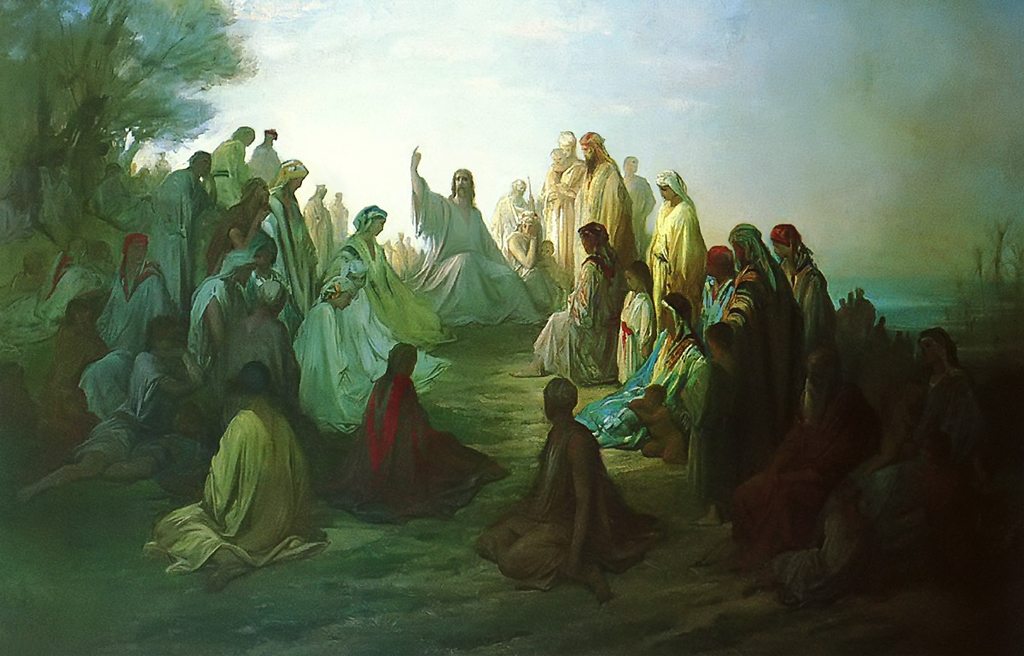
Jesus Preaching the Sermon on the Mount - Gustave Dore

                 Jesus Preaching the Sermon on the Mount – Gustave Dore

Heaven and earth shall pass away, but my words shall not pass away.   (Matthew 24:35)

The general conception of Jesus, if He is thought of at all, is that He was a nice guy, a good teacher, and perhaps a miracle worker. A lot of what He said are words to live by, like, “all things whatsoever ye would that men should do to you, do ye even so to them” (Matthew 7:12), and “Judge not, that ye be not judged” (Matthew 7:1 – taken out of context, a great verse for Christian bashing). There is no doubt that Jesus taught many things that benefit when applied to every-day life. Those kinds of teachings find general acceptance by all, but Jesus also said many things that many in this politically correct culture would find offensive.

Jesus said, “Repent: for the kingdom of heaven is at hand.” Repent? Many today who, like Donald Trump, believe they have done nothing from which to repent. The Bible says, “For all have sinned, and come short of the glory of God” (Romans 3:23), and “the soul that sinneth, it shall die” (Ezekiel 18:4, 20). Jesus said, “Repent”!

Jesus said, “Ye have heard that it was said by them of old time, Thou shalt not commit adultery: But I say unto you, That whosoever looketh on a woman to lust after her hath committed adultery with her already in his heart” (Matthew 5:27-28). What man alive can claim innocence of that sin? These days, the same could be said of woman. Along with that He said, “whosoever shall put away his wife, saving for the cause of fornication, causeth her to commit adultery: and whosoever shall marry her that is divorced committeth adultery” (Matthew 5:32). With today’s high rate of easy divorce, to how many does this apply? Speaking of adultery, Jesus said marriage is between one man and one woman: “But from the beginning of the creation God made them male and female. For this cause shall a man leave his father and mother, and cleave to his wife; And they twain shall be one flesh: so then they are no more twain, but one flesh. What therefore God hath joined together, let not man put asunder” (Mark 10:6-9, emphasis mine) – so much for same-sex unions.

Many think of Jesus as peaceful and gentle, but Jesus said, “Think not that I am come to send peace on earth: I came not to send peace, but a sword” (Matthew 10:34). Why is that? To His followers Jesus said, “And ye shall be hated of all men for my name’s sake” (Matthew 10:22, emphasis mine). “If the world hate you, ye know that it hated me before it hated you” (John 15:18).  Jesus said, “And a man’s foes shall be they of his own household” (Matthew 10:36).  “And the brother shall deliver up the brother to death, and the father the child: and the children shall rise up against their parents, and cause them to be put to death” (Matthew 10:21).  Jesus said, “For I am come to set a man at variance against his father, and the daughter against her mother, and the daughter in law against her mother in law” (Matthew 10:35); so “He that loveth father or mother more than me is not worthy of me: and he that loveth son or daughter more than me is not worthy of me. And he that taketh not his cross, and followeth after me, is not worthy of me.” (Matthew 10:37-38). However, He offers this promise: “he that loseth his life for my sake shall find it” (Matthew 10:39).

Jesus wants total allegiance; He wants first place in our lives. The reward is eternal life, but it is not without cost. Some will protest, and rightfully so, “Salvation is a free gift. It cannot be earned, Ephesians 2:8-9!” True. The “wages of sin” (Romans 3:23) were paid by Christ on the cross, but along with accepting the free gift comes the responsibility that goes with it. The Christian life is not one of ease, a life of “do as you please,” but the Christian has the promise of the Savior who says “my yoke is easy, and my burden is light” (Matthew 11:30) because He becomes your “yoke partner.”

Jesus said that the Global Flood was real: “But as the days of Noe were, so shall also the coming of the Son of man be. For as in the days that were before the flood they were eating and drinking, marrying and giving in marriage, until the day that Noe entered into the ark, And knew not until the flood came, and took them all away; so shall also the coming of the Son of man be (Matthew 24:37-39). Jesus said that the Jonah “fish story” was true: “For as Jonas was three days and three nights in the whale’s belly; so shall the Son of man be three days and three nights in the heart of the earth” (Matthew 12:40). He said this in foretelling of His own death, burial, and resurrection which He fulfilled at His crucifixion.

Jesus said hell is real. He spoke of those within the church – “tares” – that by all appearances look like genuine Christians, but are not. Of these He said, “As therefore the tares are gathered and burned in the fire; so shall it be in the end of this world. The Son of man shall send forth his angels, and they shall gather out of his kingdom all things that offend, and them which do iniquity; And shall cast them into a furnace of fire: there shall be wailing and gnashing of teeth” (Matthew 13:40-42, emphasis mine). He spoke of the kingdom of heaven being like a net cast into the sea (the “sea” is often used as a metaphor for “the people” of the world) and gathered in by the angels who separate the good from the bad. “So shall it be at the end of the world: the angels shall come forth, and sever the wicked from among the just, And shall cast them into the furnace of fire: there shall be wailing and gnashing of teeth” (Matthew 13:49-50, emphasis mine).  Jesus said that if your hand, foot, or eye causes you to sin, you should get rid of them, for it is better to enter into heaven maimed than to be whole and “to go into hell, into the fire that never shall be quenched: Where their worm dieth not, and the fire is not quenched” (Mark 9:43-48, emphasis mine). Notice that Jesus stressed the eternality of hell; “never” means NEVER.  Jesus spoke of hell as a real place. He told the true account of a rich man and a poor beggar who both died and stepped into eternity (Luke 16:19-31).  The rich man ended up in hell, “And in hell he lift up his eyes, being in torments” (Luke 16:23, emphasis mine). Hell is real. Jesus said it.

Just as hell is real, Jesus said heaven is real. “Let not your heart be troubled: ye believe in God, believe also in me. In my Father’s house are many mansions: if it were not so, I would have told you. I go to prepare a place for you. And if I go and prepare a place for you, I will come again, and receive you unto myself; that where I am, there ye may be also” (John 14:1-3, emphasis mine). That place has dimensions: “And the city lieth foursquare, and the length is as large as the breadth: and he measured the city with the reed, twelve thousand furlongs. The length and the breadth and the height of it are equal” (Revelation 21:16).  A furlong is 660 feet. Twelve-thousand furlongs would be 7.92 million feet, and divided by 5280 feet (i.e. one mile), that is equal to 1500 miles. That is about the distance from Dallas, TX to New York, NY. Now imagine that in the size of a cube. It is not a small place! And that is just the “New Jerusalem.” There is no telling just how large the rest of heaven is, but with all that space, it is a very exclusive place. Jesus said, “Enter ye in at the strait [narrow/tight] gate: for wide is the gate, and broad is the way, that leadeth to destruction, and many there be which go in thereat: Because strait is the gate, and narrow is the way, which leadeth unto life, and few there be that find it” (Matthew 7:13-14, emphasis mine).

Many today appeal to the “love” of Jesus suggesting that a “loving God” would not send anyone to hell. Even the Pope has boarded that band wagon claiming that all roads lead to God. Those who appeal to a loving God are partially correct; God sends no one to hell. They end up there by their own choice. Those who claim John 3:16 fail to read any further. Two verses down, John 3:18 says, “He that believeth on him is not condemned: but he that believeth not is condemned already, because he hath not believed in the name of the only begotten Son of God” (emphasis mine). In my Bible, those words are written in red; Jesus said it.  God is not swayed by popular consensus. Jesus said, “I am the way, the truth, and the life: no man cometh unto the Father, but by me” (John 14:6, emphasis mine). There is no other way. Jesus said it.

Jesus taught many good lessons that when taken to heart prove beneficial to our day-to-day lives. But He also taught some very hard lessons that, when ignored, lead to eternal damnation. It’s tough to hear, but Jesus said it.

If you are unsure of your eternal destination, you alone can do something about it. “Ask, and it shall be given you; seek, and ye shall find; knock, and it shall be opened unto you: For every one that asketh receiveth; and he that seeketh findeth; and to him that knocketh it shall be opened” (Matthew 7:7-8). Jesus said it.

4 Comments

Filed under Apologetics, Christianity, Evangelism, Gospel, Heaven, Hell, Religion, Salvation, Theology

Kings and Priests

golden-city-of-heaven-image

And hath made us kings and priests unto God and his Father; to him be glory and dominion for ever and ever. Amen. (Revelation 1:6)[1]

Heaven is a place everyone wants to go, but what will we do when we get there? Some imagine Heaven as a place “up there” in the clouds somewhere where we will all sit around in white robes plunking on harps. Everyone looks forward to seeing friends and loved ones there (provided they chose Jesus during their time on earth). The last two chapters of the book of Revelation describe Heaven as a recreated earth with a “new Jerusalem” in the form of a cube 1500 miles cubed – that is 3.375 billion cubic miles. The description is beautiful beyond imagination, but it is a physical place where the saints will be employed as “kings and priests.”

The phrase “kings and priests,” in Revelation 1:6, is best understood as “kingdom of priests” or, as some translations have it, “royal priesthood.” Jesus is “KING OF KINGS AND LORD OF LORDS” (Revelation 19:16). That statement itself suggests that there are other kings and other lords, but Jesus rules over all of them. Revelation 1:5 says:

And from Jesus Christ, who is the faithful witness, and the first begotten of the dead, and the prince of the kings of the earth. Unto him that loved us, and washed us from our sins in his own blood, (emphasis mine).

“Prince” translates the Greek word archōn, which means “first” or “chief ruler.” That establishes Jesus’ reign as supreme. Below Him is His “kings and priests” who reign with Him, but are subject to Him. Dr. Henry M. Morris, founder of the Institute for Creation Research, writes:

Those who were slaves became kings and priests, (or “a kingdom of priests”) seated with Him in heavenly places (Ephesians 2:6) and serving as a holy priesthood, offering up spiritual sacrifices to God (1 Peter 2:5). In the coming Kingdom, He promises that we shall actually “reign with him” (Revelation 20:6; 2 Timothy 2:12). But though we shall reign with Him, we are still His servants (Revelation 22:3) and it will be our joy to acknowledge His glory and dominion forever.[2]

Other scriptural confirmation (all emphasis mine):

But ye are a chosen generation, a royal priesthood [kingdom of priests], an holy nation, a peculiar people; that ye should shew forth the praises of him who hath called you out of darkness into his marvellous light (1 Peter 2:9)

And he that overcometh, and keepeth my works unto the end, to him will I give power over the nations: And he shall rule them with a rod of iron; as the vessels of a potter shall they be broken to shivers: even as I received of my Father (Revelation 2:26-27).

And I saw thrones, and they sat upon them, and judgment was given unto them: and I saw the souls of them that were beheaded for the witness of Jesus, and for the word of God, and which had not worshipped the beast, neither his image, neither had received his mark upon their foreheads, or in their hands; and they lived and reigned with Christ a thousand years. (Revelation 20:4)

Do ye not know that the saints shall judge the world? and if the world shall be judged by you, are ye unworthy to judge the smallest matters? (1 Corinthians 6:2)

But the saints of the most High shall take the kingdom, and possess the kingdom for ever, even for ever and ever … And the kingdom and dominion, and the greatness of the kingdom under the whole heaven, shall be given to the people of the saints of the most High, whose kingdom is an everlasting kingdom, and all dominions shall serve and obey him (Daniel 7:18, 27).

So, regardless of whatever else will occupy our time in Heaven, one of those tasks will be to serve as kings and priests in service to the KING OF KINGS AND LORD OF LORDS. Hope to see you there!

NOTES:


[1] Scripture citations are linked to The Henry Morris Study Bible online Bible at http://www.icr.org/ that has additional notes.

[2] Henry M Morris, The Revelation Record, (Tyndale House Publishers, Carol Stream, Ill., 1983), 38.

4 Comments

Filed under Christianity, End Times, Evangelism, Gospel, Heaven, Religion, Salvation, Theology