Category Archives: Holidays

The King Is Coming!

Rejoice greatly, O daughter of Zion; shout, O daughter of Jerusalem: behold, thy King cometh unto thee: he is just, and having salvation; lowly, and riding upon an ass, and upon a colt the foal of an ass. (Zechariah 9:9)

Around 1,987 years ago on a Sunday afternoon (Mark 11:11), Jesus rode into Jerusalem as prophesied by the prophet Zechariah. The Gospel writer, Matthew, quotes Zachariah in part, “Tell ye the daughter of Sion, Behold, thy King cometh unto thee, meek, and sitting upon an ass, and a colt the foal of an ass” (Matthew 21:5, emphasis mine). Matthew conspicuously omits Zachariah’s description of the coming King as “just, and having salvation.” Why the omission? Matthew Henry comments on Zachariah 9:9:

“He is a righteous ruler; all his acts of government will be exactly according to the rules of equity, for he is just. 2. He is a powerful protector to all those that bear faith and true allegiance to him, for he has salvation; he has it in his power; he has it to bestow upon all his subjects. He is the God of salvation; treasures of salvation are in him. He is servatussaving himself (so some read it), rising out of the grave by his own power and so qualifying himself to be our Saviour.”[1] (Emphasis mine)

Perhaps Matthew’s omission (as directed by the Holy Spirit) was purposeful. Granted, Matthew wrote after the fact from a vantage point of hindsight, yet the omission retained the prophetic formula of immediate and future fulfillment. Jesus did something similar when He applied Isaiah’s prophecy to Himself. “The Spirit of the Lord is upon me, because he hath anointed me to preach the gospel to the poor; he hath sent me to heal the brokenhearted, to preach deliverance to the captives, and recovering of sight to the blind, to set at liberty them that are bruised, To preach the acceptable year of the Lord” (Luke 4:18-19). He deliberately omitted the remainder of Isaiah’s prophecy: “and the day of vengeance of our God; to comfort all that mourn” (Isaiah 61:1-2).  Jesus fulfilled the first part of Isaiah’s prophecy at His first coming; “the day of vengeance of our God” will be fulfilled at His second coming when He will set up His millennial kingdom and “comfort all that mourn.”

In the same way, Jesus entered into Jerusalem as the coming King, “lowly [meek], and riding upon an ass, and upon a colt the foal of an ass” (Zechariah 9:9). “He came unto his own, and his own received him not” (John 1:11). In a matter of days, the adoring crowd crying, “Hosanna: Blessed is the King of Israel that cometh in the name of the Lord” (John 12:13) would turn into a raging mob shouting, “Away with him, away with him, crucify him … We have no king but Caesar” (John 19:15). They took the King and nailed Him to a cross.

Three days later, He conquered death and once again walked on earth. After forty days (Acts 1:3), He ascended to His throne having “purged our sins, sat down on the right hand of the Majesty on high” (Hebrews 1:3). However, He is not done. There remains prophecy yet unfulfilled. Many still mourn. Injustice still reigns. The Lord has not executed His vengeance and His creation still needs salvation. There is yet more to come.

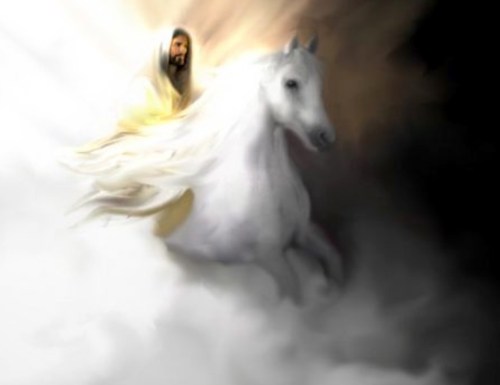
The prophets spoke of God reigning on the earth. His Messiah will rule the world from the throne of David in Jerusalem. Jesus promised to return. “In my Father’s house are many mansions: if it were not so, I would have told you. I go to prepare a place for you. And if I go and prepare a place for you, I will come again, and receive you unto myself; that where I am, there ye may be also” (John 14:2-3, emphasis mine). This same Gospel writer was granted the great privilege of seeing things to come. “And after these things I heard a great voice of much people in heaven, saying, Alleluia; Salvation, and glory, and honour, and power, unto the Lord our God … And I saw heaven opened, and behold a white horse; and he that sat upon him was called Faithful and True, and in righteousness he doth judge and make war. His eyes were as a flame of fire, and on his head were many crowns; and he had a name written, that no man knew, but he himself. And he was clothed with a vesture dipped in blood: and his name is called The Word of God … And out of his mouth goeth a sharp sword, that with it he should smite the nations: and he shall rule them with a rod of iron: and he treadeth the winepress of the fierceness and wrath of Almighty God. And he hath on his vesture and on his thigh a name written, KING OF KINGS, AND LORD OF LORDS” (Revelation 19:1, 11-13, 15-16, emphasis mine).

He will once again enter the gates of Jerusalem, this time on a white horse as a conquering king. “And his feet shall stand in that day upon the mount of Olives, which is before Jerusalem on the east, and the mount of Olives shall cleave in the midst thereof toward the east and toward the west, and there shall be a very great valley; and half of the mountain shall remove toward the north, and half of it toward the south” (Zechariah 14:4, emphasis mine). What an awesome sight to behold!

Lately, I have been hearing many modern prophets suggesting that this year, 2017, will be the year that Christ will return to rescue His people from “the wrath of God” that is to come upon the earth. Their reasoning, from a biblical standpoint, is sound. All the ones I listen to are quick to issue the disclaimer that they are not setting dates. Jesus clearly stated, “But of that day and hour knoweth no man, no, not the angels of heaven, but my Father only” (Matthew 24:36); so I respect that note of caution by these prognosticators. However, I sense, because of what I observe happening all around the world, that what they are predicting may be true. For the Church, the return of Christ has always been imminent, but it is truer today than ever before in the history of the Church. The King is coming! Jesus is coming very soon. Personally, I am looking for and anxiously awaiting His return.

Reader, you will meet Jesus very soon. The best way to meet Him is to be one of His own. Very soon, Jesus will return for His Bride, the Church, the collective body of all who have placed their trust in Him. When that day comes, all the powers of hell will be unleashed upon the world. No place will escape or be immune. You will still have the opportunity to repent when that time comes, but you will suffer tremendously for it. Why not give your life to Jesus now and avoid the horrors that are to come. All you need to do is confess your sin and recognize your need for Him. Ask Him to save you. Invite Him into your heart. Give Him first place in your life; make Him the Lord (the “Boss”) of your life, and trust that He will keep His promise. The King is coming, but this time He will not be meek and lowly. Are you ready to meet Him?

Notes:


[1] Matthew Henry’s Commentary on the Whole Bible, note on Zechariah 9:9.

6 Comments

Filed under Apologetics, Christianity, Easter, End Times, Evangelism, Gospel, Heaven, Holidays, Religion, Resurrection, Salvation, Second Coming of Christ, Theology

A New Thing

2017-future-road

Remember ye not the former things, neither consider the things of old. Behold, I will do a new thing; now it shall spring forth; shall ye not know it? I will even make a way in the wilderness, and rivers in the desert. (Isaiah 43:18-19)

Whew! Got by that one! We dodged a bullet in 2016! While I remain skeptical of a Donald Trump presidency, I believe God granted us a reprieve by saving us from Hillary Clinton. Even so, the current administration continues to do its best to inflict as much damage to this nation, while in the death throes of its waning days.

Who knows what lies ahead in 2017? The stock market has taken an upward turn with the prospect of “President” Donald Trump. If he follows through on half of his promises, there is hope for better days ahead. However, the best of intentions must still deal with reality, and the reality is that we live in a very unstable and volatile world. The future is future. We can look to the past. We exist in the present, but the future is opaque at best, and dark and obscure for the most part. We cannot know what will come to pass. We can plan and hope for the best, but there is no guarantee of a calamity-free future. We can sound the waters, but sometimes there are hidden shoals that can sink our ship.

When navigating unfamiliar waters, an experienced pilot can help the captain guide the ship through safe waterways. A wise captain will turn the ship over to the pilot who knows the way. William Ernest Henley said, “I am the captain of my soul.” That foolish boast failed to avert his bout with tuberculosis, and did not stay the death angel when Henley succumbed to the disease at the age of 53.

We cannot know what 2017 will bring, nor can we avert the adversities that may come upon us. Like Henley, we may prefer to “captain” our own soul, but if we are wise, we will turn the helm over to The Pilot that knows the way. “Remember the former things of old: for I am God, and there is none else; I am God, and there is none like me, Declaring the end from the beginning, and from ancient times the things that are not yet done, saying, My counsel shall stand, and I will do all my pleasure” (Isaiah 46:9-10, emphasis mine).

No matter what 2017 may bring, God promises to give us “a new thing” and to “make a way in the wilderness, and in rivers in the desert.” If God is your Pilot, you will do fine!

Happy New Year!

4 Comments

Filed under Christianity, Holidays, New Year's Day, Politics, Theology

Jesus’ Birthday

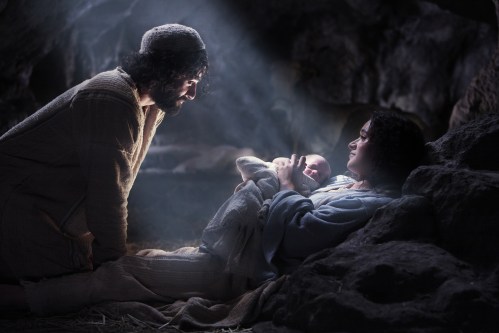
DF-09134 Nativity , May 18, 2006 Photo by Jaimie Trueblood/newline.wireimage.com To license this image (9139053), contact NewLine: U.S. +1-212-686-8900 / U.K. +44-207 659 2815 / Australia +61-2-8262-9222 / Japan: +81-3-5464-7020 +1 212-686-8901 (fax) info@wireimage.com (e-mail) NewLine.wireimage.com (web site)

And she brought forth her firstborn son, and wrapped him in swaddling clothes, and laid him in a manger; because there was no room for them in the inn. (Luke 2:7)

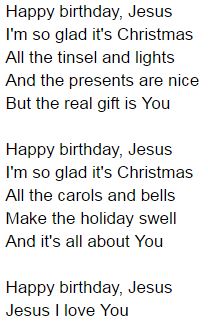
In 1992, Carol Cymbala published a song, which brings a tear to my eyes when I hear the sweet, tender voice of a child sing, “Happy Birthday, Jesus.” The words are simple and true, and when intoned by a puerile melody, they grip the heart and focus the mind on the real meaning of Christmas.

happy-b-day-jesus

Everyone, I assume, knows that Jesus was not born on December 25. The Bible does not give us a date. Was it Kislev 25, the first day of Chanukah? If that were the case, the date on the western calendar would fluctuate within the months of mid-November to mid-December. Luke recorded the events around the time of His birth thus providing an approximate year for Jesus’ arrival to earth. Augustus was emperor of Rome, and he issued an order for a census “that all the world should be taxed” (Luke 2:1), and “Cyrenius was governor of Syria” (Luke 2:2).

From Matthew’s account, we know that Herod the Great was “king” in Judah (Matthew 2:1). If secular history records accurately (and the record is dubious[1]), Herod the Great died in 4 B.C. Matthew reports that Herod, upon hearing of Jesus’ birth and not receiving word from the magi, ordered all the babies in Bethlehem, two years and under, slaughtered (Matthew 2:16). After the magi left, an angel warned Joseph to take the family and flee to Egypt, and Matthew says that they remained there until after the death of Herod. Given that we have no record of the time that elapsed between the family’s flight into Egypt and the death of Herod, Jesus’ birth could have occurred in 6 B.C. or earlier. That creates other chronological problems that distract from the point I am trying to make. (I find it strangely humorous that Jesus would be born “Before Christ.”)

The “time” of year also presents a problem. Luke records that “shepherds [were] abiding in the field, keeping watch over their flock by night” (Luke 2:8). Late December would not be a good time for shepherds to be out in the field by night. It gets cold in Jerusalem/Bethlehem in December at night! Some attempt to rationalize December 25 by suggesting that it may have been the actual time of the conception, making the delivery sometime around mid-September to mid-October, the Jewish month of Tishri. That is certainly plausible. Some suggest the conception may have been in the Jewish month of Tishri (September-October), and the birth in the Jewish month of Tammuz (June-July), and that the magi arrived on December 25, after the family had moved into a house as recorded by Matthew 2:11. That is also feasible.

Who cares! The point is that the Creator God took human form and presented Himself to His creation as fully one of them – Son of God, Son of Man; fully God, fully man. He came to us because that was the ONLY way He could save us from our sins. God took extreme measures[2] to rescue His fallen creation. That is worthy of commemoration and celebration.

December 25 seems to be a fitting time in other respects. During this time, Chanukah, the “Festival of Lights,” is celebrated. By this time, the winter solstice is past and the days start getting longer. The prophet exhorts, “Arise, shine; for thy light [speaking of Jesus] is come, and the glory of the LORD is risen upon thee. For, behold, the darkness shall cover the earth, and gross darkness the people: but the LORD shall arise upon thee, and his glory shall be seen upon thee. And the Gentiles shall come to thy light, and kings to the brightness of thy rising” (Isaiah 60:1-3). Jesus also said, “I am the light of the world: he that followeth me shall not walk in darkness, but shall have the light of life” (John 8:12, emphasis mine). With all the talk about “light,” December 25 makes as much sense as any other day to celebrate Jesus’ birthday.  Happy Birthday, Jesus!

Notes:


[1] It is very probable, and more in line with the biblical account that Herod died in 1 B.C. http://www.biblicalarchaeology.org/daily/people-cultures-in-the-bible/jesus-historical-jesus/herods-death-jesus-birth-and-a-lunar-eclipse/

[2] “Extreme Measures” https://erniecarrasco.com/2016/12/11/extreme-measures/

Comments Off on Jesus’ Birthday

Filed under Apologetics, Bible, Christianity, Christmas, Evangelism, Gospel, Holidays, Religion, Salvation

Extreme Measures

nativity-scene

And the Word was made flesh, and dwelt among us, (and we beheld his glory, the glory as of the only begotten of the Father,) full of grace and truth. (John 1:14)

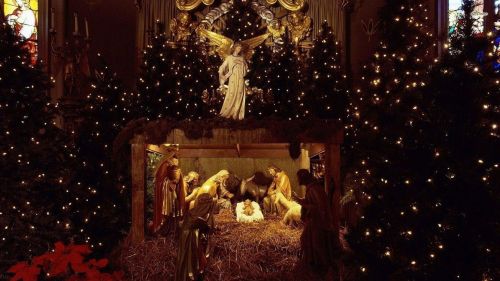
The baby in the feeding trough, surrounded by smelly farm animals and adored by a small crowd including a soft-faced young mother, strong bewildered father, common shepherds and majestic kings makes for a sweet, albeit often overlooked, tableau. If noticed at all, its significance evaporates in clouds of sentimentality. How precious!

Do you not see! The Creator of heaven and earth reduced to a helpless, needy, human infant boy. The Owner and Master of all Creation presented to the world through the birth canal of a young virgin girl. The conception itself made an object of ridicule and shame; conceived outside the “knowledge” of a poor carpenter willing to accept the ridicule of the town’s people, and adopt someone else’s child. The engineer and designer of a finely tuned universe born in a dirty cave allotted to animals rather than a fine palace suitable for the King of the Universe. Rather than a reception by kings, dignitaries, and nobles, the first to greet Him were the low-class, detestable shepherds that kept the sheep for the Temple sacrifices.

This was “God With Us,” Emmanuel. God wrapped up in human flesh. Who could conceive of such a thing! The Jews expected a Messiah to turn Israel into a superpower; but Messiah was a man, not God in the flesh even though Isaiah had predicted, “Therefore the Lord himself shall give you a sign; Behold, a virgin shall conceive, and bear a son, and shall call his name Immanuel” (Isaiah 7:14). “And he shall pass through Judah; he shall overflow and go over, he shall reach even to the neck; and the stretching out of his wings shall fill the breadth of thy land, O Immanuel” (Isaiah 8:8).

No religion in the world envisions a god condescending to the level of mankind. The Greek gods occasionally mated with humans to produce demigods, yet they remained aloof from humanity. Islam has a god that demands absolute submission of his creation and even perfection (if that were possible) is subject to rejection according to his whim. Eastern religions like Buddhism and Hinduism picture god as some nebulous ether of which all the universe is made and of which we are all part, and the human must achieve an unknowable level of perfection in order to be joined to that undefinable “oneness.”

Only the Bible – both Old and New Testaments – brings the Creator down to the lowest level of humankind in order to elevate humanity to a place near equal to God Himself. (The created thing can NEVER be equal to its creator.) The thought is incomprehensible. The method seems too extreme. If God is so great – omniscient, omnipotent, omnipresent, etc. – could He not come up with a more sensible plan? Surely, some kind of merit system to earn a place at His side would be more appropriate. At least, that is what every other world religion offers. Man must do certain things – pray five times a day while facing Mecca, crawl ten miles over sharp rocks to light a candle for a saint, disassociate oneself from all worldly things, etc. – to appease the gods. However, that is not what the God of the Bible does (or did). He took extreme measures to rescue His fallen creation.

Man severed the intimate bond he had with his Creator at the Garden of Eden (Genesis 3:6-7). Love is an act of the will. It is always an act of the will. It cannot be imposed. It cannot be coerced. It must be offered and accepted freely and willingly, otherwise it is not love. Therefore, God placed only one stipulation on the man He created. “And the LORD God commanded the man, saying, Of every tree of the garden thou mayest freely eat: But of the tree of the knowledge of good and evil, thou shalt not eat of it: for in the day that thou eatest thereof thou shalt surely die (Genesis 2:16-17, emphasis mine). The man chose wrongly, and all of mankind, along with the whole of creation, suffered the curse of that choice. God introduced temporary measures to cover for human shortcomings – He shed the blood of innocent animals to cover (atone) their nakedness (Genesis 3:21), He accepted the sacrifice of innocent animals for the sins of man (Genesis 4:4; 8:20-21), and He institutionalized the sacrificial system shedding innocent animal blood to atone for sins (Exodus 12) – but this was insufficient. “For it is not possible that the blood of bulls and of goats should take away sins” (Hebrews 10:4). Animals, while innocent of any wrongdoing, are not responsible for the fall of man. The sentence for the infraction was death for the guilty party – the man. Therefore, the only reasonable and adequate sacrifice must be that of an innocent man, but there are none. “For all have sinned, and come short of the glory of God” (Romans 3:23).

What then! God took extreme measures to resolve the problem. God, Himself, put on human flesh. Through an act possible only for the omniscient, omnipotent, Creator God created a single-cell human zygote, in the pure virgin womb of a young Jewish maiden that developed as a normal human embryo. “But when the fulness of the time was come, God sent forth his Son, made of a woman, made under the law” (Galatians 4:4). God was born like any normal human baby. “Behold the Lamb of God, which taketh away the sin of the world” (John 1:29). “Christ Jesus: Who, being in the form of God, thought it not robbery to be equal with God: But made himself of no reputation, and took upon him the form of a servant, and was made in the likeness of men: And being found in fashion as a man, he humbled himself, and became obedient unto death, even the death of the cross” (Philippians 2:5-8, emphasis mine).

Only the blood of a perfectly sinless, innocent man could suffice to pay the “wages of sin” (Romans 6:23). God took extreme measures to buy back His fallen creation. There was no other way to solve the sin problem. Jesus said, “I am the way, the truth, and the life: no man cometh unto the Father, but by me” (John 14:6, emphasis mine).

The next time you view a nativity scene, look beyond the sweet baby in the manger and see the cross. Two trees still grow in God’s garden, the Tree of Life, i.e. the Cross of Christ, and the worldly tree of man’s perverted “knowledge of good and evil.” One tree gives eternal life, the other eternal death, i.e. eternal separation from the Creator. The choice is yours.

Comments Off on Extreme Measures

Filed under Christianity, Christmas, Evangelism, Gospel, Holidays, Religion, Salvation, Theology

WHERE IS THE LAMB?

The reflection shining in the night sky above the tree tops was nothing short of a thousand-watts of brilliance. I crossed the little bridge and rounded the curve where acres of pastureland opened …

Source: WHERE IS THE LAMB?

Comments Off on WHERE IS THE LAMB?

Filed under Christmas, Holidays