Category Archives: Holidays

Rosh HaShanah

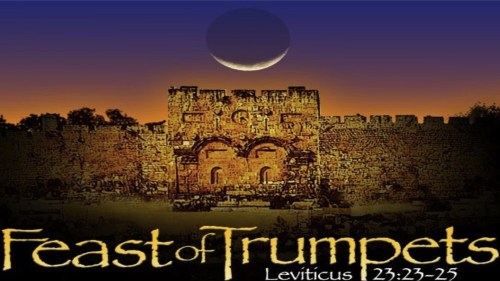
feast-of-trumpets

Speak unto the children of Israel, saying, In the seventh month, in the first day of the month, shall ye have a sabbath, a memorial of blowing of trumpets, an holy convocation.  (Leviticus 23:24)

Today, October 3, 2016, is Rosh HaShanah, the first month and day of the Jewish civil year. It is the seventh month (Tishri) of the ecclesiastical year which begins on Nissan 1, sometime in early spring.

Rosh HaShanah is also known as the Feast of Trumpets, and it is celebrated by the daily sounding of trumpets leading up to Yom Kippur, the Day of Atonement, ten days later. This year, that day begins on the evening of October 11, 2016.

Most Christians are unfamiliar with the Jewish feast days that are observed in keeping with the Law given to Moses on Mt. Sinai. These are not your run-of-the-mill festivals. They were ordained by God and are collectively known as the “Feasts of the Lord;” therefore, they are solemn observations. The first four feasts occur in the spring beginning with Passover, and the last three take place in the fall ending with Sukkot, the Feast of Tabernacles (or “Booths”).

For the Christian, these feasts offer a picture of Christ. Jesus “fleshed out” the first four feasts at His first advent. Arguably, He has yet to fulfill the final three. Consider the following and how these feasts represent the ministry of Christ:

  1. Passover – Jesus is crucified as the Lamb of God taking away the sins of the world.
  2. Unleavened Bread – Leaven represents sin. Jesus, with the sins of the world on Him, is removed from the “house” (Jerusalem) and buried outside the city walls in a tomb.
  3. First Fruits – This feast celebrated the “promise” of the coming harvest. It was observed by waving the first sprouts of the fields before the Lord. Jesus rose from the dead on this day with the promise of a great harvest to follow.
  4. Feast of Shavuot (Pentecost) – Fifty days after First Fruits celebrated the barley harvest. Jesus ascended into heaven 40 days after First Fruits, and 10 days later the Holy Spirit fell upon “the Church” – the disciples – and 3000 souls were saved that day (Acts 2:41) – truly a great “harvest.”
  5. Rosh HaShanah – The Feasts of Trumpets was a “Holy Convocation” and a gathering in of all of God’s people. Christians may see this as the “Rapture” where “the trumpet shall sound, and the dead shall be raised incorruptible, and we shall be changed” (1 Corinthians 15:52; 1 Thessalonians 4:16-17).
  6. Yom Kippur – The Day of Atonement was the day when the people of God repented of past sins and the High Priest entered the Most Holy Place, the Holy of Holies, into the very presence of God to pour the blood of the sacrifice for the whole nation on the Mercy Seat of the Ark of the Covenant. The Ark contained the tablets of God’s Law that was violated, and the blood covered the infraction. Each Christian, being a “priest” (Revelation 1:6; 5:10; 20:6), now enters into the very presence of God offering the blood that was shed for them by Christ. Through His blood, our sins are covered, i.e. atoned for.
  7. Sukkot – The Feast of Tabernacles was a seven-day celebration remembering the time when God’s people were wandering in the wilderness dwelling in tents. Now they have come into the Promised Land and live in permanent dwellings. For the Christian, who are in the world but not of the world (John 17:14-16), this represents Christ’s reign on earth as King of Kings and Lord of Lords beginning with His millennial kingdom on earth and beyond into eternity.

I’ve said this before. Each year around time, I start looking up and listening for the trumpet to sound. Yes, I know that the Rapture can occur at any time, but to me it seems logical that it would be consistent with God’s calendar. Of course, God is not obligated to follow my line of reasoning. At any rate, this time of year causes me to pray ever more earnestly that God would call us home and fix this really messed up world once and for all.

However, at the same time, it causes me even greater concern because I know that those who are left behind will literally experience hell on earth for the next seven years, not to mention for eternity. I have two sons with their wives that are lost and hell bound. My youngest son has two daughters, my granddaughters, that by now have reached the age of accountability. My heart aches for them knowing what is ahead unless they repent and turn to Christ as their personal Savior. I have nieces and nephews and other relatives who are lost. I have friends and acquaintances who are doomed to an eternity in hell. That is not a pleasant thought. So, on the one hand I long to go and be with the Lord right now, but on the other hand, I am deeply concerned for those that will be left behind. The longer the Lord delays His return, the more time and opportunity they have to alter their course.

The Lord is not slack concerning his promise, as some men count slackness; but is longsuffering to us-ward, not willing that any should perish, but that all should come to repentance. But the day of the Lord will come as a thief in the night; in the which the heavens shall pass away with a great noise, and the elements shall melt with fervent heat, the earth also and the works that are therein shall be burned up. (2 Peter 3:9-10, emphasis mine)

On the other hand, the longer He delays the more time for unbelievers to scoff: “And saying, Where is the promise of his coming? for since the fathers fell asleep, all things continue as they were from the beginning of the creation” (2 Peter 3:4).

Even so, come Lord Jesus! (Revelation 22:20)
Shanah Tovah!

3 Comments

Filed under Christianity, Current Events, End Times, Evangelism, Gospel, Hell, Holidays, Salvation, Second Coming of Christ

O Beautiful!

My people are destroyed for lack of knowledge: because thou hast rejected knowledge, I will also reject thee, that thou shalt be no priest to me: seeing thou hast forgotten the law of thy God, I will also forget thy children. (Hosea 4:6)

O beautiful! For spacious skies,

For amber waves of grain,

For purple mountain majesties

Above the fruited plain!

Our land truly is beautiful. Arguably, no fairer land exists in all the earth. From the Smokey Mountains in the east, to the rolling plains of the Mid-west, to the Grand Tetons and the Rocky Mountains, to the Grand Canyon and the Painted Desert, to the sunny West Coast and the Pacific, our landscapes are breathtakingly beautiful. Our land is rich and productive, feeding not only our people, but much of the world. God has blessed our land tremendously.

America! America!

[May] God shed His grace on thee,

And crown thy good with brotherhood

From sea to shining sea!

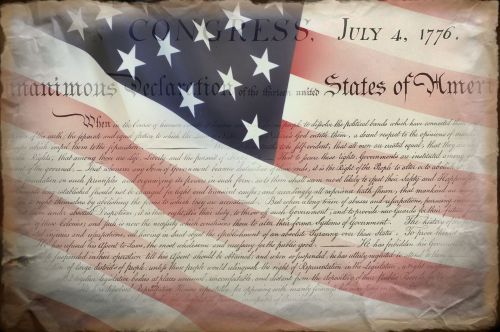
God has shed His grace on our nation. Beginning with the first settlers of Jamestown to the landing of the Pilgrims on Plymouth Rock, who set pen to paper and wrote: “Having undertaken, for the Glory of God, and advancements of the Christian faith…”, to the founding fathers who declared, “We hold these truths to be self-evident, that all men are created equal, that they are endowed by their Creator with certain unalienable Rights, that among these are Life, Liberty and the pursuit of Happiness.” to the framers who gave us “a more perfect union,” God shed His grace on our nation.

O beautiful! For Pilgrim feet

Whose stern impassioned stress

A thoroughfare of freedom beat

Across the wilderness!

In less than a century, our borders stretched from the Atlantic Ocean to the Pacific Ocean, and the industriousness of the American people created the wealthiest nation on earth – but not without cost.

O beautiful! For heroes proved

In liberating strife.

Who more than self their country loved,

And mercy more than life.

About eighteen months before the end of the Civil War, November 19, 1863, on the battlefield of Gettysburg, Pennsylvania, President Abraham Lincoln addressed the crowd gathered for the dedication of the Soldiers’ National Cemetery with these words: “Fourscore and seven years ago our fathers brought forth on this continent a new nation, conceived in liberty and dedicated to the proposition that all men are created equal.” The test of the conflict would prove, “whether that nation or any nation so conceived and so dedicated can long endure.”

On this, the 240th celebration of America’s birth, the question looms more crucial than at any time in the history of America the beautiful. A land dedicated to “the glory of God and the advancements of the Christian faith,” to the equality of man, and to liberty derived from “nature’s God” now rejects God, advances all but the Christian faith, creates class warfare, and dispenses “liberty” as determined by an elite class of “elected” rulers. “Nature” is now god, and the unnatural is elevated above the natural. We have exchanged “beauty for ashes” (Isaiah 61:3), and liberty for tyranny. We call what is evil good and what is good evil. We protect those who commit evil acts in the name of Allah, and demonize those who speak truth in the name of Christ. How long can America the Beautiful endure having abandoned the principles on which it was founded?

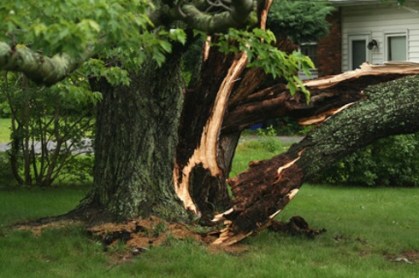
tree-trunk-with-damage_medI used to have a huge ash tree in my backyard that looked beautiful on the outside. It extended heavy, foliage-laden boughs reaching for the sun from a massive, well-rooted trunk. The tree appeared as if it would stand forever. Then one day, a big windstorm blew in and broke off one of the heavy main branches. As the limb fell, it that split the tree all the way to the base, and it took half of the trunk with it. Upon a closer inspection, I discovered that the tree was rotten on the inside. It looked great on the outside, but on the inside, it was really sick. So, when the big storm blew it, it could not stand up to the tempest. That is how I picture America today.


America! America!

[May] God mend thine every flaw,

Confirm thy soul in self-control,

Thy liberty in law!

America! America!

May God thy gold refine

Till all success is nobleness

And every gain divine!

Blessed is the nation whose God is the LORD; and the people whom he hath chosen for his own inheritance. (Psalm 33:12)

5 Comments

Filed under Christianity, Current Events, Holidays, Religion

Dad

Left to right: Dad, Me, Ednoi, Eli and Esther

Left to right: Dad, Me, Ednoi, Eli and Esther

Behold, I have taught you statutes and judgments, even as the LORD my God commanded me…  (Deuteronomy 4:5)

He came to the United States from Mexico in 1943 with false papers under an assumed name and started working for the railroad. Not long after, his work brought him to the West Texas town of Monahans where his eye fell upon the lovely Elena, and his life changed forever. Elena was one of five children of store owner and Baptist lay preacher, Porfírio Enriquez. Elena was hard to get, especially since her father wanted her to have nothing to do with the “mojado” (“wetback”), especially since he was not a Christian. But, eventually Elena fell prey to his boyish charm and the couple soon married – he was 20, she was 18.

The “unequally yoked” couple (2 Corinthians 6:14) soon experienced struggle over religious differences. Chale (Chah-leh), as he was known to his friends, was a non-practicing Catholic, so “church” mattered little to him. In fact, he found the practice of praying to inanimate images silly and pointless, so church to him was a waste of time. Chale also loved to party, and he loved to dance, much to the chagrin of the good Southern Baptist girl he had married. But Elena was not without recourse. On Saturday nights when Chale wanted to go dancing, Elena promised to go with him, if he would come to church with her on Sunday. Chale would dance all night with all the other ladies while Elena sat patiently by and watched. She would later say that he looked like a little demon dancing around through the haze of cigarette smoke. That arrangement worked well. Chale honored his promise to attend church with her on Sunday, and before long Chale surrendered his life to the Lord, gave up his partying ways, and took after his father-in-law as a lay preacher.

Shortly after Chale surrendered his life to the Lord, Elena became pregnant with me. At that time, Chale still resided in the US under an assumed name and false documentation. His new “tenderized” conscience started to bother him not only because of his illegal status, but also because he did not want his son given some stranger’s name. Determined to set the record straight, he returned to Mexico to earn the right to return to the United States legally. Wenceslao Carrasco de Cortez (his legal name) was required to spend two years in the Mexican Army Reserves to fulfill his military obligation to that nation, while at the same time working with a Mexican lawyer to legally come to America. While in Juarez, Chihuahua, Mexico, he served as assistant pastor in a Baptist church in that city.

I was born in Monahans in 1950, and when I was about one year old, Elena, Mom, took me with her to be with Dad in Juarez. We lived there a year until Dad got all his legal matters resolved and fulfilled his military obligation to Mexico. We returned in 1952, and the following year I was blessed with a baby brother, Ednoi.

Dad continued to work on the railroad, and soon his work carried us to Odessa, Texas where, in 1955, another baby brother came along – Eliseo (Eli). Around this time Dad felt called of God to go into full-time ministry, and soon we moved to San Antonio, Texas for Dad to train for the ministry. W.C., as English speakers referred to him, was not well educated. He got as far as the third grade in Mexico where he learned reading, writing, and arithmetic, but the needs of his father’s ranch were of higher priority than education, and school fell by the wayside. Study at the Instituto Biblico Mexicano proved difficult for Dad, not to mention the burden of a family that needed provision. There were times when we had no food and no money for food. Mom told me of a time when she sent me to school with the last bit of beans folded in a flour tortilla (a bean taco), and after that no food was left for the rest of the family. That day, Dad was in the school chapel crying out to God; Mom was at home on her knees in prayer, when a knock came at the door, and some ladies from an Anglo church showed up, completely unaware of our need, with a month’s worth of groceries. In the meantime, the president of the school overheard Dad crying out to God and came to see what was troubling him. When he discovered the need, he reprimanded Dad for failing to make his need known, and promptly wrote him out a check for $100. In 1957, that was a lot of money! Dad couldn’t wait to come home to give Mom the news, and when he arrived, he found her in tears of joy for how God had provided.

I could relate many more stories just like that, but what I experienced in my young life taught me that God is real. His love is real, and He really does care about our every need, and He will provide exactly what we need, exactly when we need it.

W.C. spent five years in school preparing for the ministry. In the end, he left the school without having completed his training. Our family moved to Cotton Center, Texas in 1960 where Dad was ordained as a Baptist minister, and where he pastored his first mission church in that capacity. Many mission churches followed. In 1963 we moved to Raton, New Mexico where Dad served as pastor of his first non-mission church. In 1965, God blessed us with our baby sister, Esther. I only got to know her the first five years of her life, and then I was off to the Navy and a life of my own.

Dad taught me many things. He taught me to read and write in Spanish. He taught me how to play baseball and throw a curve ball. He taught me how to drive; in fact, at 10 years old, when we were living in Cotton Center, he would send me, by my 10-year-old self, in our 1956 Ford Victoria to pick up kids for Sunday school. By the time I was old enough for my driver’s permit, I was already the most experienced driver in my Driver’s Ed class! Dad taught me the value of hard work. And even though he was not yet a naturalized citizen of the United States, he taught me patriotism, love of my country, love of my flag, and respect for authority. Dad taught me to take responsibility for myself and to never shy away from a challenge. He would always say, “Si está hecho por hombres, yo también lo puedo hacer.” (If it’s done by man, I can do it too!). But the greatest thing Dad ever taught me was the love of God and the love of God’s Word. The lessons learned from that have kept me from drifting to the left or to the right knowing that God does not change, and God’s Word never changes. Some have thought me insensitive, or unmoving, but although Dad taught me to love, and God’s Word teaches me to love, I also know that some things, from God’s perspective, are non-negotiable, so I do not easily yield to compromise even when “love” comes into play. The love of God must always supersede all others.

Dad was always strong – a trait I greatly admired in him, and one that I tried to emulate. He almost always had a cheerful disposition. He loved life, and he loved people – something else I admired in him. And he sang (or hummed) incessantly – to the point of annoyance – oblivious to anyone around him. But even that I admired in him – there was always a song – usually a hymn – in his heart. The world could be falling apart all around us, but one would never know it around Dad.

After Mom went to be with Jesus in December 2001, he, now 75, continued on with life as before, only without his lifelong partner. Shortly after we buried Mom, he took the pastorate of a small dwindling church in Brady, Texas, and served and ministered to them the remaining years of his life. His knees gave him trouble since his late 60’s, but the fear of knee replacement surgery kept him from taking care of the problem. It finally got to the point where he could hardly get around, and that interfered with his ministry, which to him was a high priority. So he finally conceded to replace his knees, first the right one followed by the left the next year. Dad got a new lease on life with his new knees, and it was hard to slow him down at age 85. I found out through the grapevine that he helped a family put a new roof on their house. He was climbing ladders with bundles of shingles on his shoulder, and down on his new knees nailing shingles to the roof. He even outworked two much younger men that were helping him. I had to give him a good scolding for that, but that was just Dad. He would make the four and a half hour drive from Brady to Dallas and mix it up in Dallas traffic to make his doctors’ appointments.

He was an incredible man, my dad. As I watched him live his life – full-bore, filled with joy, loving the Lord with all of his heart and soul – I dreaded the thought of his decline into helplessness in later life. That would not have suited Dad at all, and I prayed and asked God not to allow my dad to decline physically or mentally, but rather that when his time came, that God would just take him. God answered my prayer on August 26, 2014. Dad got up that morning with respiratory issues (he had developed asthma late in life) and collapsed in the kitchen of his Brady home. My brother Ednoi, who was living with him, called emergency services, but by the time they arrived, Dad’s brain had been deprived of oxygen too long. The EMTs worked on him, got him to the Brady hospital, and then on a Care Flight to San Angelo. Dad lingered on a ventilator long enough for all of us kids, grandkids and some of his siblings to come and say goodbye. His body was functioning with the help of the ventilator, but he was not there. On August 28, 2014, we had the ventilator removed, and in a short seventeen minutes all life-functions stopped. Dad went to be with Jesus and to celebrate his 64th wedding anniversary with Mom the following day. Dad was exactly one month shy of his 88th birthday when he went to be with our Lord, but because of the greatest thing he taught me, I KNOW I will see him again, and maybe some time very soon.

This year (2015) marks the first year that I celebrate Father’s Day without my dad, but it will not be a time for sorrow. Rather it will be a time to thank God for the father He gave me, and for the instrument that he was in my life to instruct and guide me in the ways of God. It will be a time of joy knowing that soon I will be together with him again forever because God is faithful, and His Word is true. That is not hope. That is assurance! Happy Father’s Day, Dad! Thank you for all you meant to me, to our family, and to everyone whose life you touched. See you soon!

11 Comments

Filed under Bible, Christianity, Current Events, Death, End Times, Holidays, Prayer, Religion, Salvation

A Day to Give Thanks

horn-of-plenty

In every thing give thanks: for this is the will of God in Christ Jesus concerning you. (1 Thessalonians 5:18)

In the “Jaywalking” segment of the “Tonight Show,” Jay Leno posed some Thanksgiving Day trivia questions to passersby, and the results were humorous and sad at the same time. Here is a sample of questions asked and the responses:

  1. What year was the first Thanks giving? 1966, 1492
  2. Pilgrims are often shown wearing what on their shoes and their hats? Moccasins
  3. What is a male turkey called? Fred, Richard
  4. 280 Million Americans will cook turkey on Thanksgiving. How many Americans are there in our country? 8 Million
  5. Where did the first Pilgrims land? Hawaii, the East Coast
  6. What President declared Thanksgiving a national holiday? Ronald Reagan, Theodore Roosevelt, Benjamin Franklin
  7. How many days did the first Thanksgiving last? Three: one day for breakfast, one day for lunch, and one day for dinner
  8. What is the name of the ship the Pilgrims came over on? the Nina
  9. Where did the Pilgrims come from? Spain

This may be good for a belly laugh, but it is really tragic that Americans today are so ignorant of our nation’s history and traditions. In today’s culture, Thanksgiving Day is just a good excuse to have a day (or two) off of work, indulge in gluttonous behavior, and worship before the luminous god of football followed by the giving of alms to the god of materialism the next day all the while in complete ignorance of the significance of the day.

It does not have to be that way. The psalmist said, “Therefore will I give thanks unto thee, O LORD, among the heathen, and sing praises unto thy name” (Psalm 18:49). The “heathen,” in this case, were the gôyim, Hebrew for the “nations” or the “Gentiles,” and by implication, the “godless.” Our attitude of thanksgiving should be a testimony to those that are without God not just on Thanksgiving Day, but everyday of our lives. In these “last days” we should live in contrast to those who are “lovers of their own selves, covetous, boasters, proud, blasphemers, disobedient to parents, unthankful, unholy (2 Timothy 3:2).

C. S. Lewis once said, “We ought to give thanks for all fortune: if it is ‘good,’ because it is good, if ‘bad’ because it works in us patience, humility and the contempt of this world and the hope of our eternal country.” Paul expressed this same idea when he said, “Not that I speak in respect of want: for I have learned, in whatsoever state I am, therewith to be content. I know both how to be abased, and I know how to abound: every where and in all things I am instructed both to be full and to be hungry, both to abound and to suffer need” (Philippians 4:11-12). We assimilate this attitude when “we know that all things work together for good to them that love God, to them who are the called according to his purpose” (Romans 8:28). “Them who are the called according to His purpose” do not live their lives like the “heathen” who are ungrateful or “unthankful” in their life conduct.

Perhaps the reason the “heathen” are unthankful is because they do not know to whom they should be thankful. That, of course, presupposes that in every other respect they are caring of others beyond themselves. If expressed at all, we often hear such empty platitudes as: I’m thankful for my job; I’m thankful for my family; I’m thankful for good friends, etc. That is fine, but thankful to whom?

When the Pilgrims landed at Plymouth in 1620, they arrived in the face of a harsh New England winter. They were without food and without shelter. Of the 121 souls that departed England to escape religious persecution and “for the Glory of God, and advancements of the Christian faith and honor of our King and Country,” only 47 of the original colonists survived that brutal winter. With the help of neighboring Indian tribes, the colonists learned to cultivate and enjoy the bounty of the land. At the harvest that followed, they celebrated a season of thanksgiving to God for His providence and protection. The third year after having landed, William Bradford officially proclaimed November 29, 1623 a day of thanksgiving.

In as much as the great Father has given us this year an abundant harvest … and in as much as He has protected us from the ravages of the savages, has spared us from pestilence and disease, has granted us freedom to worship God according to the dictates of our own conscience; now I, your magistrate, do proclaim that all ye Pilgrims, with your wives and ye little ones, do gather at ye meeting house on ye hill, between the hours of 9 and 12 in the day time, on Thursday, November ye 29th, of the year of our Lord one thousand six hundred and twenty-three … there to listen to ye pastor and render thanksgiving to ye Almighty God for all His blessings.

Our nation, from its beginning, has always set aside a special day to give thanks to God, but not always on a consistent basis. George Washington declared a national day of thanksgiving on November 26, 1789 with these words:

Whereas it is the duty of all nations to acknowledge the providence of Almighty God, to obey His will, to be grateful for his benefits, and humbly to implore His protection and favor … Now, therefore, I do recommend and assign Thursday, the twenty-sixth day of November next, to be devoted by the people of these United States to the service of that great and glorious Being, who is the beneficent Author of all the good that was, that is or that will be … that we may then unite in most humbly offering our prayers and supplications to the great Lord and Ruler of Nations, and beseech Him to pardon our national and other transgressions …

Would that our current national leaders adopt that attitude!

Finally, Thanksgiving Day was proclaimed an annual national holiday by President Abraham Lincoln in 1863. He said:

No human counsel hath devised, nor hath any mortal hand worked out these great things. They are the gracious gifts of the most high God, who, while dealing with us in anger for our sins, hath nevertheless remembered mercy … I do, therefore, invite my fellow citizens in every part of the United States, and those who are sojourning in foreign lands, to set apart and observe the last Thursday of November next as a day of Thanksgiving and Praise to our beneficent Father who dwelleth in the heavens … [it is] announced in the Holy Scriptures and proven by all history, that those nations are blessed whose God is the Lord … It has seemed fit to me and proper that God should be solemnly, reverently and gratefully acknowledged, as with one heart and one voice, by the whole American people.

This Thanksgiving Day, amid all the festivities and family gatherings, try to devote at least some time to “Sing unto the LORD, O ye saints of his, and give thanks at the remembrance of his holiness” (Psalm 30:4). “Praise God from whom all blessings flow.”

Comments Off on A Day to Give Thanks

Filed under Atheism, Christianity, Current Events, Holidays, Religion, Thanksgiving, Theology

Thankful to Whom?

thankful2

Now therefore, our God, we thank thee, and praise thy glorious name. (1 Chronicles 29:13)

It is that time of year again where almost everyone says they are thankful for something. At least, we are expected to be thankful. I enjoy browsing through my Facebook newsfeed and reading all the things for which my “friends” are thankful. I read comments like:

  • I am thankful for my husband/wife.
  • I am thankful for my family.
  • I am thankful for my kids.
  • I am thankful for my home.
  • I am thankful for my friends.
  • I am thankful for my health.
  • I am thankful for my job.

Of course, there is always the spiritual one that will remember to be thankful for Jesus, or for their salvation.

Whenever I receive something from someone, whether a gift or simply a kind gesture, I say “thank you” to that individual – the giver. I don’t say, “I am thankful for the gift” or “I am thankful that the door was held open for me.” No, I thank the person.

To be thankful for something one must recognize the originator of the benefit. Who gave you that husband or wife? Who gave you that family, children, home, friends, health or job? After giving that some thought, some may conclude that all those things came about through their own effort. After all one has to attract and win the affections of a good mate. Or they may surmise that their children are the “product” of their marital union. Home, job, friends, are all products of one’s own effort. Good health? Well maybe that is just the luck of the draw or the result of good genes. So, for what does one have to be grateful? To whom must one give thanks? To self or to dumb luck? To thank yourself or dumb luck would be silly!

If we are to be thankful, we must recognize the originator of the gifts or “blessings.” Ultimately that is God. Without God, there is really nothing for which to be thankful. For starters, without God to give you life, you are nothing more than a leech on the planet sucking out of it all that you can get in order to survive. Who is there to thank? The Doxology exhorts:

Praise God from whom all blessings flow;
Praise Him all creatures here below;
Praise Him above ye heavenly host;
Praise Father, Son, and Holy Ghost.
 

If you are truly thankful for what you have, the thanks must go to the Giver. I thank God for giving me life, and for the blessing of good health. I thank God for giving me a loving wife. I thank God for giving me sons and grandchildren. I thank God for my extended family, especially those who are “twice” family. I thank God for giving me the ability to work and earn a living and for providing a job where I can exercise those abilities. I thank God for my home and all the material blessings that fill it. I thank God for surrounding me with good friends and for my brothers and sisters in Christ. I thank God for Jesus, my Savior, and for the sure promise of an eternal home in Glory. I thank God.

Comments Off on Thankful to Whom?

Filed under Christianity, Holidays, Religion, Thanksgiving