Category Archives: Holidays

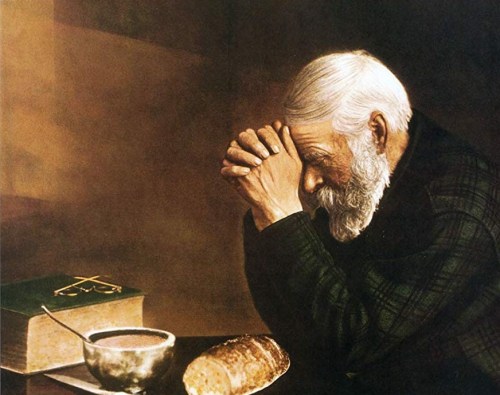
Give Thanks

In every thing give thanks: for this is the will of God in Christ Jesus concerning you. (1 Thessalonians 5:18)

Without question, we live in the richest nation in the world. In terms of material possessions, even our poor own more stuff than many of the “well-off” in the world. Poverty, in the rest of the world, means that people have only one meal a day if that. They have no clean water to drink, no shoes to wear, and perhaps only one change of clothes. Their children are diseased and dying with little or no hope for medical care. That is real poverty.

America knows no such poverty. During my time as a bilingual elementary school teacher in Dallas and Garland, I visited in the homes of some of my students. All of them, as far as I know (it was not my place to ask), were children of illegal immigrant parents. All of them were considered “poor” and usually received assistance for their normal school supplies. I do not recall a single home I visited that did not have large flat-screen TVs, usually more than one, and the children had some kind of electronic devices including video games. The parents drove late-model cars often decked out with expensive custom wheels (“rims”). I do not say this to criticize, but only to point out that our “poor” are not really poor compared to the poor in the rest of the world. This explains why millions attempt to breach our borders to leave the poverty of their countries for the “poverty” in ours.

America has been richly blessed by God, yet the voices from the left grow louder by the day denigrating America as evil, intolerant, and bigoted. What God has blessed, they curse. Paul warned that these days would come (2 Timothy 3:1-7), so we should not be surprised by this. Rather than succumb to the venomous rhetoric of the loud left by retreating into a shell of depression, we should cast our light on the darkness though our proclamation of thanksgiving.

Thanksgiving Day comes once a year, but our attitude of thanksgiving should be voiced daily. We have much for which to be thankful, and the Bible says much about giving thanks to God. “Surely the righteous shall give thanks unto thy name: the upright shall dwell in thy presence” (Psalm 140:13). The “righteous” are those who have been made righteous by the blood of Christ forever; therefore our thanksgiving should be forever. “By him therefore let us offer the sacrifice of praise to God continually, that is, the fruit of our lips giving thanks to his name” (Hebrews 13:15).

“I will praise the name of God with a song, and will magnify him with thanksgiving” (Psalm 69:30). I have much for which to be thankful. Every breath I take and every beat of my heart is a gift from God. I thank God for all those He orchestrated in my lineage, going all the way back to Adam so that I might have life. God has blessed me with good health for which I am thankful. I thank God for Jesus Christ who shed His blood on the cross so that I might receive His righteousness. I thank God for Jesus rising from the dead so that I might also have eternal life with Him. I thank God for my first wife through whom God gave me my two sons, their wives, and my four grandchildren. I thank God for June my wife of almost 32 years, with whom I have shared the best years of my life, and I thank God for her family who in every way has become my family. I thank God for my siblings and their families and the double bond we share in Christ. I thank God for my church family and the fellowship we share that will last throughout eternity. I thank God for my work and the talents and abilities God has given me with which I can make a living. I thank God for my job at the Institute for Creation Research and the privilege I have to work among fellow believers; they too are my brothers and sisters in Christ. Through my work – all the skills and talents God has given me – God has provided a home, “stuff” to fill our home, food, clothing, vehicles for going to work, church, and anywhere we want to go. God provides more than just our basic needs so that we are able to bless others from the overflow.

My list is short. If I were to provide an itemized list of everything with which God has blessed me, it would fill a book. I am sure my readers could say the same. The hypocrites on the left want to stir up envy against the “rich” one percent by making the rest of us feel deprived because we do not have what they have. Such envy stirs up hate and is divisive for our nation. Nowhere does the Bible promote the kind of egalitarianism promoted by the left. It is a lie of the devil and the only way to combat that perverse philosophy is by adopting an attitude of gratitude. “In everything, give thanks.”

2 Comments

Filed under Christianity, Holidays, Religion, Thanksgiving

Purim And 2A

Wherein the king granted the Jews which were in every city to gather themselves together, and to stand for their life, to destroy, to slay, and to cause to perish, all the power of the people and province that would assault them, both little ones and women, and to take the spoil of them for a prey, Upon one day in all the provinces of king Ahasuerus, namely, upon the thirteenth day of the twelfth month, which is the month Adar. (Esther 8:11-12)

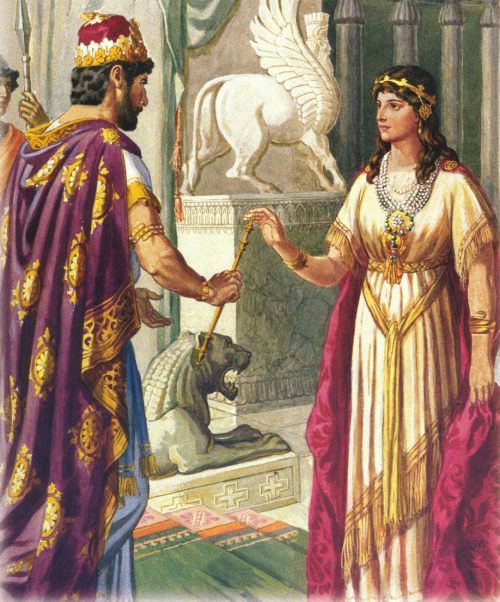
Just this week, the Jews celebrated the ancient feast of Purim.[1] Purim is not one of the “Feasts of the Lord” given by God in Leviticus 23. It is a celebration instituted by Jews in commemoration of their salvation from extermination under Persian rule.

Some have questioned whether the Book of Esther belongs in the canon of the Bible because the name of God, in any of its various forms, does not appear anywhere in the book. However, when one reads this account, the unmistakable hand of God is seen working throughout the narrative.

For those unfamiliar with this historical account[2], King Ahasuerus of Persia, became annoyed with his queen Vashti when she refused to dance for his drinking buddies and he removed her from being queen, i.e., he divorced her. The law of the Medes and the Persians was such that when a law was decreed by the king, it could not be rescinded.[3] When Ahasuerus sobered up, he regretted his decision, but the deed was done and could not be undone.

Kings get lonely without a wife and Vashti was gone now. What was the king to do? His servants suggested that Ahasuerus hold a beauty pageant of all the most beautiful virgins of the realm the winner of which would become the new queen. In short, Esther (a.k.a., Hadassah), a Jewess and cousin of Mordecai, who was in the service of the king,[4] was chosen and became the new queen of Persia. The king was unaware of their relationship nor did he know Esther’s ethnicity. As he “sat in the king’s gate” carrying out his duties, Mordecai overheard a plot to kill the king. He relayed the information to Esther who informed the king, and the two would-be assassins were hanged for their treason.

Later, King Ahasuerus promoted a Jew-hater by the name of Haman to a high position. Haman was rather full of himself, and when Mordecai refused to bow down to him – no God-fearing Jew would ever bow down to a mere man – he concocted a plot kill all the Jews in the realm. He convinced the king that all the Jews throughout the kingdom should be killed because they followed their own law and did not submit to the king’s law, i.e. to bow down to Haman. So it was decreed that all the Jews throughout the kingdom would be killed the following year on Adar 13.[5]

When Mordecai heard of the decree, he “rent his clothes, and put on sackcloth with ashes, and went out into the midst of the city, and cried with a loud and a bitter cry” (Esther 4:1). Mordecai pleaded with Esther to go before the king and intercede for her people, but because of palace protocol, Esther could not go before the king without being summoned.

In the meantime, Ahasuerus had trouble sleeping one night and stayed up reading court records. (That should put anyone to sleep!) There he found the record of Mordecai exposing the assassination plot against him that had gone unrewarded. So he summoned his top advisor, Hamon (who just happened to be hanging around looking for some excuse to send Mordecai to the gallows), to determine how to reward someone who had done something very special for the king. Since Ahasuerus did not name the beneficiary, Haman assumed the king was speaking of him.

And Haman answered the king, For the man whom the king delighteth to honour, Let the royal apparel be brought which the king useth to wear, and the horse that the king rideth upon, and the crown royal which is set upon his head: And let this apparel and horse be delivered to the hand of one of the king’s most noble princes, that they may array the man withal whom the king delighteth to honour, and bring him on horseback through the street of the city, and proclaim before him, Thus shall it be done to the man whom the king delighteth to honour” (Esther 6:7-9).

That was just the thing only a narcissist like Haman could appreciate, but the joke was on him when Ahasuerus instructed him to do that very thing for Mordicai.[6] As any humble man might do, Mordecai graciously accepted the accolade, but quietly returned back to his post at the king’s gate. “But Haman hasted to his house mourning, and having his head covered” (Esther 6:13).

The prior day, Esther invited the king and Haman to a banquet she had prepared in her chambers.[7] At the banquet, Esther revealed that she was a Jewess and her people, the Jews had been targeted for slaughter by “this wicked Haman” (Esther 7:6). This angered the king and he ordered that Haman be hanged on the very gallows he constructed for hanging Mordecai. However, because the law could not be abrogated,[8] Ahasuerus authorized Mordecai to write a subsequent law that would allow the Jews to take up arms and defend themselves against anyone who would do them harm.

When Adar (February/March) 13 arrived, when the first law took effect, the Jews met their assailants with equal force. The Jews kill several thousand of their attackers, and Esther records no losses on the part of the Jews. Since the law was instituted to take effect only on that one day, the Jews were safe afterward. “On the thirteenth day of the month Adar; and on the fourteenth day of the same rested they, and made it a day of feasting and gladness” (Esther 9:17).

“And Mordecai wrote these things, and sent letters unto all the Jews that were in all the provinces of the king Ahasuerus, both nigh and far, To stablish this among them, that they should keep the fourteenth day of the month Adar, and the fifteenth day of the same, yearly” (Esther 9:20-21). So was the Feast of Purim established.

So what does this have to do with the Second Amendment (2A) of the United States Constitution? We learn from this account in Esther that an armed populous can defend itself against those who would do them harm or violence. A well established historical fact teaches (for those with the ability to learn) that the first thing a tyrannical government does to subjugate the people is to disarm them. An unarmed populace cannot defend itself against tyranny nor even effectively protest – take Venezuela for example. Take note of the socialist-leaning Democrat Party in the USA and their incessant drumbeat for “gun control.” They are not interested in “gun control.” Most of the leftist elites surround themselves with armed bodyguards and hide behind high walls designed to keep out unwanted invaders. Their main interest is to disarm the populous so that they can control and exercise power over the people. The Second Amendment prevents them from doing that. So whenever some heinous crime takes place involving a firearm of any kind – even if that crime takes place in New Zealand – the cries for stricter gun laws increase in frequency and amplitude.

The One who said, “But I say unto you, That ye resist not evil: but whosoever shall smite thee on thy right cheek, turn to him the other also” (Matthew 5:39), also said, “he that hath no sword, let him sell his garment, and buy one” (Luke 22:36). The Second Amendment is our Purim.

Notes:


[1]  Purim (plural) comes from “Pur” meaning “a lot (as by means of a broken piece)” See Esther 3:7; 9:24, 26.

[2]  This synopsis omits many important details. For a better appreciation of the account, the reader should read the entire book of Esther. It is only 10 short chapters!

[3]  Esther 1:19

[4]  Esther 2:19, 21

[5]  Esther 3:13

[6]  Esther 6:10-11

[7]  Esther 5:1-8

[8]  Esther 8:8

5 Comments

Filed under Apologetics, Current Events, Holidays, Politics, Theology

Another One Gone!

But my covenant will I establish with Isaac, which Sarah shall bear unto thee at this set time in the next year. (Genesis 17:21)

It seems like yesterday that we faced the prospect of 2018, and here we stand on the threshold of 2019. The truth of the adage, “time flies,” manifests itself more conspicuously each year that goes by. It is said that once one reaches middle age (whenever that is), it’s all downhill from there. What is not said is also true. The closer one gets to the bottom of the hill the faster the slide goes. I can confirm that from experience!

As I approach the foot of the hill and the skid velocity increases, it’s the big scenes rushing by that captures my attention. I know what awaits at the bottom of the hill, and it is not the sudden stop that most people would suspect. No. At the bottom of my hill is a beautiful warm eternal ocean, and the events that lead to that peaceful place are the things that capture my attention.

There were several such events in 2018. The nation of Israel celebrated its 70th year as a nation. Students of the Bible recognize the significance of the number 70; 7 represents perfection, and 10 represents completeness. Together (7×10), “it symbolizes perfect spiritual order carried out with all power. It can also represent a period of judgment.”[1] Twenty-eighteen was a Jubilee year for Israel.[2] Not only that, but it was the 70th Jubilee since the Law was given to Moses.

At the celebration of Israel’s “re-birth” day in Jerusalem, the United States, at the direction of our President Donald J. Trump, opened the US Embassy in Jerusalem confirming our country’s recognition of Jerusalem as the capital of Israel.

With all of these milestone events converging with other “signs of the times,” I sincerely expected the Rapture to take place sometime around the Jewish New Year – Rosh HaShanah – that transpired between September 10-30. Obviously, because I am still here along with all my brothers and sisters whom the Lord has not taken home, the Rapture did not take place.

End-times prophecy focuses mainly on Israel. While many “signs of the times” have general application like, signs in the sun, moon, and stars,[3] wars and rumors of wars,[4] famines, pestilences, and earthquakes,[5] days like those of Noah,[6] and the general decline in “common” decency,[7] (we see these things occurring all over the world), the true indicator of the proximity of our Lord’s return is the nation of Israel and those things pertaining particularly to her.

The greatest of these signs was Israel’s rebirth as predicted by several of the Major Prophets, but particularly by the Prophet Ezekiel. Ezekiel described the re-gathering of the Jews from the four corners of the globe to their ancient homeland given to them by God. Ezekiel saw a valley full of dry bones come together and rise to be a mighty army.[8] His vision came true on May 14, 1948, and indeed, Israel has become a “mighty army,” who, even for its tiny size, boasts the eighth strongest military in the world. Jesus compared Israel to a fig tree. He said that the generation that sees the fig tree bud would see all these prophecies come to pass.[9]

Ezekiel also prophesied a confederation of nations that would attack Israel from the north.[10] The names of those nations, translated from their ancient biblical names, are Russia, Turkey, and Iran. Twenty-eighteen has seen the strengthening of these nations within the borders of Israel’s northern neighbor, Syria.

Interestingly, Syria is not part of the prophesied coalition. The Prophet Isaiah provides insight as to why Syria is not counted among Israel’s attackers. “The burden of Damascus. Behold, Damascus is taken away from being a city, and it shall be a ruinous heap” (Isaiah 17:1, emphasis mine). Damascus, Syria’s capital, is the oldest continuously inhabited city in the world. However, the prophet predicts that it will be a “ruinous heap.” Current pictures of the city suggest that it is almost there. When Damascus is completely destroyed, Syria will functionally cease from being a nation, which explains why she is not mentioned in Ezekiel’s prophecy. The players are in place for the fulfillment of this prophecy.

Very recently, President Trump announced that the US will rapidly pull all of its troops out of Syria within the next few months. Needless to say, this announcement for Israel is cause for grave concern. Without the US in Syria, there is nothing to stop Iran (whose whole purpose in life is to eradicate Israel), Russia, and Turkey from setting up shop in Syria. Who is to stop them? So far, Israel has managed to keep Iran at bay by bombing Iranian military installations in Syria. Russia has “allowed” this probably due to US presence, but with the US pullout, things may change. Iran’s buildup of arms in and around Damascus could bring about the complete destruction of the city by Israel as prophesied by Isaiah and could prompt the invasion of Israel by the coalition. Israel’s misplaced concern about an attack from the north will subside when God comes to her rescue.[11]

For those who are watching and paying attention, 2018 has been an exciting year. When the Rapture did not take place as I anticipated, I was a little disappointed, but not disheartened. Jesus promised, “In my Father’s house are many mansions: if it were not so, I would have told you. I go to prepare a place for you. And if I go and prepare a place for you, I will come again, and receive you unto myself; that where I am, there ye may be also” (John 14:2-3, emphasis mine). Jesus will come to Rapture His Bride to keep her from “the hour of temptation.”[12] However, that event is imminent; it could happen at any moment. There are no “signs” to alert us to its proximity. Based on the seven Feasts of the Lord,[13] and knowing that Jesus fulfilled the spring feasts at His first coming, I reasoned that He would fulfill the fall feasts at His Second Coming. That conclusion is still correct. However, His Second Coming takes place at the end of the seven-year Tribulation period.

Some suggest that the Second Coming takes place in two phases. In the first phase, Jesus comes for His church, and we meet Him in the air;[14] He does not come to earth at that time. In the second phase, He returns with His Bride (His “armies”),[15] and the touch of His foot on the Mount of Olives will cause the mountain to split.[16] At that point, He will establish His 1000-year reign on earth.

What I learned in 2018 is that the Feasts of the Lord, like the prophecies of last days, are meant for Israel, not the church. Jesus wants His Bride to be ready at all times, as we learn from the Parable of the Ten Virgins.[17] The Bride Groom may come at any hour when we least expect it. He will not come at the Feast of Trumpets, the Day of Atonement or the Feast of Tabernacles. Those feasts are for Israel, not the Church. However, as we discern the signs of the times, and keep an eye on God’s timepiece, Israel, we can be sure that our Bride Groom will come for us very soon. So, be ready. Keep plenty of oil so that your lamp won’t go out. Jesus may come to take us home in 2019 – or not. Regardless, we need to be ready at all times!


[1]  Meaning of Numbers in the Bible: http://www.biblestudy.org/bibleref/meaning-of-numbers-in-bible/70.html

[2]  Leviticus 25:8-13

[3]  Luke 21:25

[4]  Matthew 24:6; Mark 13:7; Luke 21:9

[5]  Matthew 24:7; Mark 13:8; Luke 21:11

[6]  Matthew 24:37; Luke 17:26

[7]  2 Timothy 3:1-7

[8]  Ezekiel 37:1-14

[9]  Matthew 24:32-35

[10]  Ezekiel 38-39

[11]  Ezekiel 38:17-39:4

[12]  Revelation 3:10

[13]  “Rosh HaShanah” – https://erniecarrasco.com/2016/10/03/rosh-hashanah/

[14]  1 Thessalonians 4:17

[15]  Revelation 19:14

[16]  Zechariah 14:4

[17]  Matthew 25:1-13

6 Comments

Filed under Bible, Christianity, Current Events, End Times, Holidays, New Year's Day, Second Coming of Christ

Why Christmas?

For God sent not his Son into the world to condemn the world; but that the world through him might be saved. (John 3:17)

It is said that “familiarity breeds contempt.” One need look no further than the season of Christmas to see the truth of this axiom. Forget about the lost world that has no concept of the true meaning of Christmas. Christians, who should possess at least a rudimentary understanding of the significance of the season, too often get caught up in the madness associated with “the holidays” right along with those who know no better.

In all the cacophony of TV and radio commercials, traffic noise, buzzing shopping malls, clanging Salvation Army bells, and “holiday” music at every turn, does the question even come up? Why Christmas? Why all the fuss? In spite of all the warm sentiments intoned by joyful holiday songs, the season carries with it an increase in stress, depression and even suicide. So much for “Happy Holidays!” Why bother?

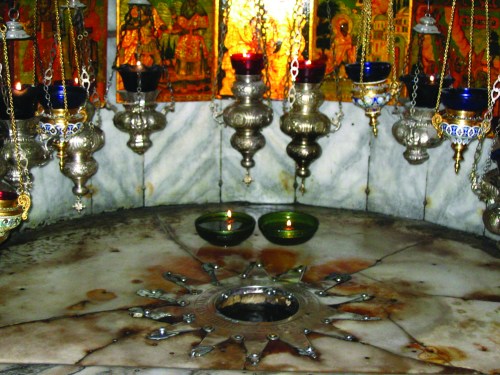
Church of the Nativity, Bethlehem, Israel

I remember visiting the Church of the Nativity in Bethlem, Israel last year. We stood for two and a half painful hours on hard, uneven limestone floors waiting to see the supposed place of Jesus’ birth. When we finally crouched through the constricted cave opening, we found a small alcove adorned with a plethora of lighted candles illuminating a gold 14-pointed star in the center of a polished marble floor. A hole in the center of the star marked the very spot where Mary gave birth to the baby Jesus. The garish display rendered the prolonged anticipation anticlimactic. Perhaps in a similar fashion, the significance of Christmas has been long lost to the millennia of ostentatious trappings and traditions we have attached to it.

So, why Christmas? Stop! Silence the noise! Trash the shiny paper and bright bows and ribbons! Douse the twinkling lights! Be still and think!

We, humans, suffer from a terminal condition called death. We inherited this terminal condition from our original parents, Adam and Eve (Genesis 3). They were originally created to live forever, but their disobedience to God’s only command brought upon them the death penalty. Did I mention that they were created to live forever? The death penalty, therefore, comes in two phases: physical death and spiritual death. Because of Adam’s sin, we all die physically. “And as it is appointed unto men once to die, but after this the judgment” (Hebrews 9:27). However, the spirit continues through eternity. Spiritual death is eternal separation from the Creator; the Bible calls that the “second death.” “And death and hell were cast into the lake of fire. This is the second death” (Revelation 20:14).

Because of Adam’s sin, all humans suffer the same fate. “Wherefore, as by one man sin entered into the world, and death by sin; and so death passed upon all men, for that all have sinned” (Romans 5:12). No one is excluded from the death sentence, and all must pay the price. “For the wages of sin is death …” (Romans 6:23).

However, God made a temporary provision for covering the sins of man. It was the blood sacrifice of an innocent animal, but that was not a permanent fix. “For it is not possible that the blood of bulls and of goats should take away sins” (Hebrews 10:4). The fact remains that sin is humanity’s problem. Animals do not sin; they are innocent. Therefore, the “wages of sin” must be paid by man, not animals, but that is the problem. No human is innocent, i.e., sinless. “All have sinned, and come short of the glory of God” (Romans 3:23).

The Bible teaches God loves us, even though we are all sinners. However, God is holy and just, and He cannot and will not allow sin to go unpunished. “The Lord is not slack concerning his promise, as some men count slackness; but is longsuffering to us-ward, not willing that any should perish, but that all should come to repentance” (2 Peter 3:9, emphasis mine). God does not want us to be eternally separated from Him, but the sin debt must be paid.

Therefore God became a man born of a virgin untouched by any man so that He could be born completely free from the curse of sin. He grew up like any other man but without sin. “For we have not an high priest [Jesus Christ] which cannot be touched with the feeling of our infirmities; but was in all points tempted like as we are, yet without sin” (Hebrews 4:15, emphasis mine). “Let this mind be in you, which was also in Christ Jesus: Who, being in the form of God, thought it not robbery to be equal with God: But made himself of no reputation, and took upon him the form of a servant, and was made in the likeness of men: And being found in fashion as a man, he humbled himself, and became obedient unto death, even the death of the cross” (Philippians 2:5-8, emphasis mine). “For Christ also hath once suffered for sins, the just for the unjust, that he might bring us to God, being put to death in the flesh, but quickened by the Spirit” (1 Peter 3:18).

Why Christmas? “For God so loved the world, that he gave his only begotten Son, that whosoever believeth in him should not perish, but have everlasting life” (John 3:16, emphasis mine). There’s your Christmas present! God became a man to be the perfect sacrifice to pay the wages of sin in our stead so that we will not have to be eternally separated from Him. He offers us our redemption as a gift if we choose to accept it. That’s why Christmas.

7 Comments

Filed under Christianity, Christmas, Evangelism, Gospel, Holidays, Salvation, Theology

The Bethlehem Star

When they had heard the king, they departed; and, lo, the star, which they saw in the east, went before them, till it came and stood over where the young child was. (Matthew 2:9)

Once more the Christmas season arrived with all the usual pre-season hype of merchants competing for your hard-earned bucks by attempting to convince you that their product will bring you all the love an joy you deserve for “the holidays,” or that their product is the perfect gift to demonstrate your love for a loved one. As Christians, we know, or should know, that the celebration centers around the person of Jesus Christ – God’s gift to us.

Our church choir and orchestra performed our annual Christmas concert last Sunday. It was a program of beautiful Christmas music with a simple skit in the middle to give the choir a break. There was no pageantry; no live angles suspended in midair; no live animals herded down the aisles; no blinding laser lights flashing or smoke machines making fog. No, it was just good music meant to focus our attention on “the Reason for the season.”

This time of year should cause us to reflect on the significance of that incredible event when God came down to take on human flesh in the form of a baby. He came to a poor Nazarene couple. She was a virgin, pregnant out of wedlock.[1] He was a simple carpenter, an honorable man willing to fulfill his vow to his pregnant bride and to raise her child that was not his.[2]

Luke records the circumstances of their arrival to the little village of Bethlehem[3] and the birth of God-made-man in a stable – probably a grotto – meant for sheltering animals. It was a most malapropos place for the birth of the King of Kings and Lord of Lords. Yet, as Paul puts it, “[He] made himself of no reputation, and took upon him the form of a servant, and was made in the likeness of men” (Philippians 2:7).

In the fields outside of Bethlehem, shepherds kept the sheep destined for Temple sacrifice. Luke tells of an angel appearing to the shepherds to announce the birth of their Good Shepherd and how an army of angels illuminated the night sky and filled the air with their chorus of praise to God, “Glory to God in the highest, and on earth peace, good will toward men” (Luke 2:14). It must have been a spectacular sight to behold, and yet only shepherds witnessed it. It was their private invitation.

Matthew records a visitation by foreigners – gentiles – of high estate. These were the Magi[4] from somewhere in Mesopotamia, perhaps even from Babylon. They were not invited to the “presentation” as were the shepherds. In fact, they did not arrive until more than a year later. We conclude this by comparing the two accounts. Luke calls the child a “babe” – Greek brephos meaning “infant.”[5] Matthew’s record describes the baby Jesus as a “young child” – Greek paidion meaning a “little one” or “little boy,” perhaps a toddler. We can further infer this because of Herod’s edict to kill all the baby boys in Bethlehem that were two years old and younger.[6] Additionally, the shepherds found the child wrapped in swaddling clothes in a manger,[7] while the Magi found Him in a “house.”[8]

The Magi were not invited. They were looking for Him. Some Bible scholars suggest that these “Wise Men” were of the “School of Daniel,” and were familiar with the Hebrew Scriptures and the prophecies of the coming Messiah. God revealed to Daniel, “Know therefore and understand, that from the going forth of the commandment to restore and to build Jerusalem unto the Messiah the Prince shall be seven weeks, and threescore and two weeks: the street shall be built again, and the wall, even in troublous times” (Daniel 9:25, emphasis mine). “Weeks” are groups of seven years. “Threescore” is sixty (60). Applying simple math, we get (7×7)+(60×7)+(2×7) or 483 years. The Magi were “Wise Men,” and they could do the math. They knew the time was near. Not only that, but they were astronomers who carefully studied the stars, which God created for signs (i.e., a signal, flag, beacon, etc.) and seasons (i.e., appointment or festival).[9]

As the Magi studied the night sky, they observed an unusual pattern in the heavens that alerted them to the birth of a new king. But who was this new king and where was he to be born? They searched the source where all wise men should look; they searched the Scriptures. There, in the Hebrew Book of Numbers, they found this prophecy, “I shall see him, but not now: I shall behold him, but not nigh: there shall come a Star out of Jacob, and a Sceptre shall rise out of Israel, and shall smite the corners of Moab, and destroy all the children of Sheth” (Numbers 24:17, emphasis mine). Ah ha! The king (the “Sceptre”) was to come from Jacob, i.e., Judah and a star would “beacon” His arrival. Add to this, Daniel’s prophecy of 483 years suggested that the time was up.

The Magi assembled a caravan and headed west toward the only place where a Jewish king would be born – Jerusalem. When they arrived, they went to the king’s palace – the only suitable place for the birth of a king, “Saying, Where is he that is born King of the Jews? for we have seen his star in the east, and are come to worship him” (Matthew 2:2, emphasis mine). This announcement was unsettling for Herod, but after inquiring of those who should have known, the Wise Men were directed to Bethlehem. “And they said unto him, In Bethlehem of Judaea: for thus it is written by the prophet [Micah 5:2], And thou Bethlehem, in the land of Juda, art not the least among the princes of Juda: for out of thee shall come a Governor, that shall rule my people Israel” (Matthew 2:5-6, emphasis mine).

So off they went toward Bethlehem, and something very strange happened. “When they had heard the king, they departed; and, lo, the star, which they saw in the east, went before them, till it came and stood over where the young child was” (Matthew 2:9, emphasis mine). That last statement has caused much controversy. “Stars” do not behave in that way. All stars rise in the east (because of the earth’s rotation) and set in the west, just like the sun does. Bethlehem is south-southeast of Jerusalem. For the star to go “before them,” it would have to alter its normal course from east to west and travel north to south instead.

For this reason, many have suggested that the star was a comet – “Have you seen what I’ve seen? A star, a star shining in the night with a tail as big as a kite.” However, a comet will not go before you and then stop and hover over a house.

Some have suggested that the star was a conjunction of Jupiter (the King Planet) and Venus (the Mother Planet). Still, others have suggested that it was a conjunction of Jupiter and Regulus (the King Star), which is the major star in the constellation Leo (Jesus is the “Lion of Judah). This conjunction has some possibilities for the star the Magi saw “in the east,” while they were still in Mesopotamia. On September 11 (hmmm, 9-11), 3 BC, Jupiter joined Regulus (chief star in Leo), Royal Planet and Royal Star. The sun was in Virgo (Virgin Constellation), and the New Moon in Royal Constellation Leo (Judah). It was the first day of Jewish New Year – Rosh HaShannah.[10] This conjunction announced the Savior’s Birth.

However, that does not explain the strange movement of the star that led the wise men to Bethlehem. Besides, the conjunction that alerted the Magi would not remain in that configuration for the duration of time that it took them to arrive in Jerusalem. This “Bethlehem Star” must have been something else. Interestingly, there was another phenomena that occurred the following year, December 25, 2 BC. “Jupiter began to move westward, At its stationary point in Virgo Winter Solstace [sic], Daystar in Coma[11] Overhead at Bethlehem at Dawn?” [sic][12] Jesus at this time would have been 15 months old (provided He was born on September 11, 3 BC) – a “young child.” Obviously, this is not the same star the Magi saw originally, and Matthew seems to confirm this. When they arrived in Jerusalem, the Magi announced that they had “seen” (past tense) “His star in the east” (Matthew 2:2, emphasis mine). However, in verse 9, Matthew simply calls it “the star, which they saw in the east.” Perhaps that is a difference without a distinction, but this phenomena, except for the presence of Jupiter, does not seem to shout “King” as clearly. Again, all stars rise in the east, so seeing the star in the east to me merely suggests the direction from which they observed the star rise. That still does not explain the strange movement of the star.

Here is what I think – and I can speculate just as well as the next man. In the evening, as the Magi made their way to Bethlehem, they looked toward the east and observed a bright conjunction of stars – perhaps it was the December 25, 2 BC phenomena. There in the midst of this bright gathering of stars appeared an angel. Angels are sometimes referred to as “stars” in the Bible.[13] As the Magi observed the star, the angel (star) descended from the midst of the stellar conjunction and dropped down into the atmosphere where it could lead the Magi to where Jesus was. In case you are skeptical of my suggestion, let me remind you again of what the shepherds witnessed out in the field. “And, lo, the angel of the Lord came upon them, and the glory of the Lord shone round about them: and they were sore afraid” (Luke 2:9, emphasis mine). That must have been a pretty dazzling angel!

It might have happened that way, or maybe not. Perhaps it was a one-time, special occasion miracle of God. Whatever it was, the message was clear. “For unto you is born this day in the city of David a Saviour, which is Christ the Lord” (Luke 2:11).

Notes:


[1]  Luke 1:26-38

[2]  Matthew 1:18-25

[3]  Luke 2:1-20

[4]  “Who Were the Magi?” – https://erniecarrasco.com/2014/12/14/who-were-the-magi/

[5]  Luke 2:16

[6]  Matthew 2:16

[7]  Luke 2:12, 16

[8]  Matthew 2:11

[9]  Genesis 1:14

[10]  “Summary of Conjunctions of Planets (“wandering stars”), Constellations and Stars: Meanings, Interpretations, Timetable, Other Astronomical Events Near Time Of Christ’s Birth” – http://www.tccsa.tc/articles/star_dates.html

[11]  Ibid. “The Star in the Head of the Infant in “Coma” visible in daylight for 300 years.”

[12]  Ibid.

[13]  Job 38:7; Revelation 1:20; 6:13;12:4

3 Comments

Filed under Apologetics, Christianity, Christmas, Gospel, Holidays, Religion, Theology