Category Archives: Holidays

What’s The Rush!

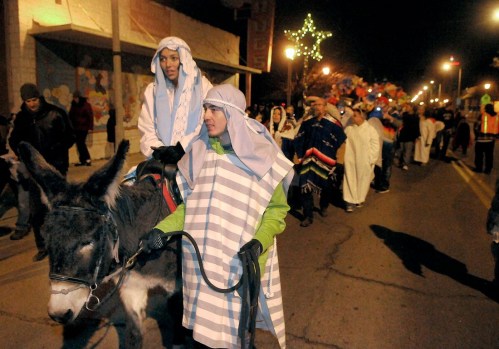
Typical “Las Posadas” Celebration

And so it was, that, while they were there, the days were accomplished that she should be delivered. (Luke 2:6)

Many Christmas traditions come from a fundamental misunderstanding or outright ignorance of Scripture. Such is the case of Joseph and Mary finding nowhere to stay in Bethlehem.

One of my favorite recent movies this time of year is The Nativity Story because it portrays a very realistic account of the birth of Christ, but even it resorts to unfounded tradition in its representation of the account. One of the most flagrant is the final tableau depicting the nativity scene complete with shepherds and wise men together on the night of the birth. It makes a pretty scene, but it is scripturally inaccurate.

Another error I discovered just recently is the scene when the Joseph and Mary arrive in Bethlehem. They arrive just when it starts to get dark. Suddenly, Mary starts having contractions and she pleads with Joseph to quickly find a place because the baby is coming. Frantically, Joseph runs from house to house banging on doors and pleading for someone to give them refuge in their desperate hour of need. No one has room to offer. Finally, one man offers a grotto where he shelters his animals. As the saying goes, “any port in a storm.” They take the offer and Mary gives birth to baby Jesus.

This tradition has been played out through the centuries. In Mexico and other Latin American countries, they observe Las Posadas (“the inns”) where a young girl and boy are selected to play the part of Mary and Joseph. They go from house to house in town followed by all the town’s people seeking refuge. Finally, they get to the last house where they are given posada, and the whole town enjoys a time of celebration.

Such traditions are neither good nor bad in themselves except that they have no basis in Scripture. Dr. Luke gives no indication that Joseph and Mary arrived in Bethlehem on the very night that Jesus was born. He does record that “there was no room for them in the inn” (Luke 2:7), but he gives a reasonable explanation for this.  Caesar Augustus had issued a census requiring everyone to go to his ancestral home of origin to be counted (Luke 2:1-3). Joseph and Mary both were descendants of King David whose birthplace was Bethlehem. Therefore, they were required to travel from Nazareth, their home, to Bethlehem in order to comply with Caesar’s decree. They arrived in Bethlehem. Visitors from all over Judea and Samaria overran the place so that every house in town was full. Joseph and Mary took the only place available – a shelter for animals.

They made the best of their accommodations. “And so it was, that, while they were there, the days were accomplished that she should be delivered” (Luke 2:6, emphasis mine). Luke gives no indication that they were in panic mode as tradition has taught. “Silent Night” makes more sense in a setting of peace rather than desperation. Yes, it was a stable, and yes, baby Jesus’ crib was a feeding trough for animals, but God, not desperation was in control.

After the crowd departed and returned to their homes, Joseph and Mary remained in Bethlehem for some time. With the excess population gone, they were able to find suitable lodging in a house. Matthew records that “wise men from the east” (Matthew 2:1) came in search of “he that is born King of the Jews” (Matthew 2:2).  “And when they were come into the house, they saw the young child with Mary his mother, and fell down, and worshipped him: and when they had opened their treasures, they presented unto him gifts; gold, and frankincense, and myrrh” (Matthew 2:11, emphasis mine). By this time, Jesus was no longer a “babe” (Luke 2:12) but a “young child” under two years of age (Matthew 2:16).

We often attach too much sentimentality to this event that may obscure of the real wonder of God’s entrance into the world of His creation. God became man, to live as a man – from conception to death – so that He could redeem His fallen creation from the curse of death by His own death, burial, and resurrection. Remove all the fluff from Christmas traditions, and what remains is staggeringly awesome!

Comments Off on What’s The Rush!

Filed under Apologetics, Christianity, Christmas, Holidays, Religion, Salvation, Theology

What A Thing!

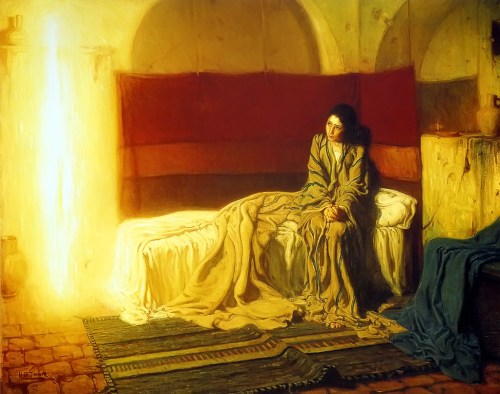
Annunciation by Henry Ossawa Tanner

… Christ Jesus: Who, being in the form of God, thought it not robbery to be equal with God: But made himself of no reputation, and took upon him the form of a servant, and was made in the likeness of men: (Philippians 2:5-7)

The Christmas season is upon us once again, and once more, I sense the dilemma of mixing the commercialization of the season by the world with the celebration of the First Advent. Any Christian well taught in Scripture recognizes that Jesus was not born on December 25, but thanks to the Catholics, we are stuck with that date. Regardless of how one feels about that, it is appropriate to set aside a special time to contemplate the magnitude of the miracle that is the Incarnation[1] – God becoming a man.

Consider our leading verse. No other religion[2] in the world makes the claim that their gods willingly depose themselves of all divine powers to assume the life of a human. Then, to top it off, offer themselves as a blood sacrifice in order to save the lowly human race. However, contemplate seriously the significance of these words of Scripture.

“Christ Jesus” – the anointed Savior (meaning of the name) – “who being in the form of God.” The Greek word translated “form” is morphē, and it means “shape” or “nature.” The Apostle John calls Jesus “the Word.” He wrote, “In the beginning was the Word, and the Word was with God, and the Word was God: (John 1:1, emphasis mine). In the Greek, the phrase “the Word was God” literally reads, “God was the Word” — θεος ην ο λογος. What a thing!

Though He was in every way, in very nature, God, He “Thought it not robbery to be equal with God.” Verse 8 clarifies this phrase when it explains that Jesus “humbled Himself.” He did not regard it robbery to lay aside His Divine nature and assume human form in order to redeem fallen humanity. What a Thing!

“He made Himself of no reputation.” This entire phrase is summed up in one Greek word, εκενωσεν (hekenoōsen), which means, “He emptied Himself” without any sense of deprivation. In exchange, “He took upon Himself the morphē (see above) of a servant” – doulos – a “slave.” He “was made in the likeness of men.” The Greek word translated “likeness” is homoiōma meaning “resemblance.” So, not only did He take on the “nature” of man, He “looked” like any other man. There was no halo around Him to distinguish Him from any other man. Of Him Isaiah the prophet said, “he hath no form nor comeliness; and when we shall see him, there is no beauty that we should desire him” (Isaiah 53:2, emphasis mine). The Hebrew word translated “comeliness” is hâdâr meaning “magnificence,” and “beauty” is the Hebrew word mar-eh’ meaning a “handsome appearance.” So much for those soft-faced images of Jesus, we are so used to seeing! It was not enough that He condescended from His Divine nature to assume the nature of an ordinary, common-looking man, but He took the form of the lowliest kind of man – a slave. Not only did He come as a slave, but He chose a peasant girl for a mother and a stable for His birthplace.[3] What a THING!

The passage goes on to say, “And being found in fashion as a man, he humbled himself, and became obedient unto death, even the death of the cross” (Philippians 2:8, emphasis mine). “Fashion” is the Greek word, schēma and it means the “mode, circumstance, or external condition.” The Bible tells us that “the wages of sin is death” (Romans 6:23). Man must die eternally to pay the penalty for sin. Unless some sinless one can be found to serve as a suitable sacrifice for all of mankind, every one of us must pay “the wages of sin.”[4] Who could qualify as a suitable sacrifice? “As it is written, There is none righteous, no, not one … For all have sinned, and come short of the glory of God” (Romans 3:10, 23). Therefore, God clad Himself in human flesh and took the penalty for universal sin upon Himself. However, His death was not enough. He conquered death when He rose from the grave on the third day. He paid the sin debt that we owe and broke the curse of death[5] with His resurrection. WHAT A THING!

This Christmas, regardless of the commercialization of the season and regardless of the fact that Jesus was not born on December 25, God’s gift of salvation freely offered to all who will accept it, is worthy of commemoration and celebration. “This is a faithful saying, and worthy of all acceptation, that Christ Jesus came into the world to save sinners; of whom I am chief” (1 Timothy 1:15, emphasis mine). WHAT A THING!!

Merry Christmas!

Notes:


[1] “Miracle of the Incarnation” – https://erniecarrasco.com/2012/12/24/miracle-of-the-incarnation/

[2]  “False Religion” – https://erniecarrasco.com/2014/07/27/false-religion/

[3]  “Extreme Measures” – https://erniecarrasco.com/2016/12/11/extreme-measures/

[4]  “Eternal Sacrifice” – https://erniecarrasco.com/2012/09/30/eternal-sacrifice/

[5]  “Why Jesus?” – https://erniecarrasco.com/2015/12/13/why-jesus/

5 Comments

Filed under Apologetics, Bible, Christianity, Christmas, Evangelism, Gospel, Holidays, Religion, Theology

Liberty

And ye shall hallow the fiftieth year, and proclaim liberty throughout all the land unto all the inhabitants thereof: it shall be a jubile unto you; and ye shall return every man unto his possession, and ye shall return every man unto his family. (Leviticus 25:10)

Liberty. Dictionary.com defines “liberty” as freedom from arbitrary or despotic government control, external or foreign rule, or from control, interference, obligation, restriction or hampering conditions. It is the power of right doing, thinking, speaking, etc., according to choice.

The Webster’s Dictionary 1828 – Online Edition – published nearer the time of our nation’s founding – defines it more precisely, and its definition includes our leading verse. The 1828 Webster’s says that “liberty” is freedom from restraint and applicable to the body, or to the will, or mind. It is the power of acting as one thinks fit, without any restraint or control, except from the laws of nature. It goes on to say that this liberty is abridged by the establishment of government. This governmental abridgment is necessary and expedient for the safety and interest of the society, state or nation. However, a restraint of natural liberty not necessary or expedient for the public, is tyranny or oppression. “Civil liberty” is an exemption from the arbitrary will of others, which exemption is secured by established laws, which restrain every man from injuring or controlling another. Hence the restraints of law are essential to civil liberty. The liberty of one depends not so much on the removal of all restraint from him, as on the due restraint upon the liberty of others. “Religious liberty” is the free right of adopting and enjoying opinions on religious subjects, and of worshiping the Supreme Being according to the dictates of conscience, without external control. More follows, but for now this will suffice.

It is worth noting that the modern definition makes no mention of “natural law” or the “laws of nature.” Nor does it mention the “Supreme Being” and the “free right” to religious liberty. It is easy to see why using the modern definition to interpret our founding documents dampens the meaning to words like freedom, liberty and the laws of nature and nature’s God.

In the first paragraph of the Declaration of Independence, the Founders appealed to “the Laws of Nature and of Nature’s God.” They affirmed that “these truths” are “self-evident that all Men are created equal … they are endowed by their Creator with certain unalienable Rights, that among these are Life, Liberty and the Pursuit of Happiness.”

From where did such a notion arise? Arguably, such ideas were adopted from enlightened philosophers of the time, who borrowed from the ancient Greek philosophers. However, it goes beyond that. These laws ultimately come from “Nature’s God.” The “Creator” created “all men” equal, and He “endowed” them with inherent rights that cannot be taken away – they are “unalienable.”[1]

God does as He pleases. “For I am the LORD: I will speak, and the word that I shall speak shall come to pass; it shall be no more prolonged: for in your days, O rebellious house, will I say the word, and will perform it, saith the Lord GOD” (Ezekiel 12:25, emphasis mine). God is Creator. “For thus saith the LORD that created the heavens; God himself that formed the earth and made it; he hath established it, he created it not in vain, he formed it to be inhabited: I am the LORD; and there is none else” (Isaiah 45:18, emphasis mine). God created man in His image (Genesis 1:27). God first gave man the “breath of life (Genesis 2:7), and “endowed” him with the attribute of autonomy that He Himself possesses. Hence, “liberty,” i.e., “freedom,” is a God-like attribute inherent to man that cannot be taken away. Therefore, those who would deprive another of “Life” (even unborn life) violate the “Law of Nature” and are called murderers, and likewise, those that would deprive another of “Liberty” (autonomy) violate the “Law of Nature’s God,” and are called tyrants.

The pursuit of happiness is a gift that comes from God. “For thou shalt eat the labour of thine hands: happy shalt thou be, and it shall be well with thee” (Psalm 128:2, emphasis mine). From the beginning, work has been both a curse and a blessing. “In the sweat of thy face shalt thou eat bread, till thou return unto the ground; for out of it wast thou taken: for dust thou art, and unto dust shalt thou return” (Genesis 3:19, emphasis mine). The Preacher says, “I know that there is no good in [the sons of men], but for a man to rejoice, and to do good in his life. And also that every man should eat and drink, and enjoy the good of all his labour, it is the gift of God” (Ecclesiastes 3:12-13, emphasis mine). Because man bears the image of the Creator, he too creates, from his mind through his hands, that which brings him joy and happiness. “But Jesus answered them, My Father worketh hitherto, and I work” (John 5:17, emphasis mine). Indeed, God views in dishonor those who will not work; the Bible calls such “sluggards.” “The soul of the sluggard desireth, and hath nothing: but the soul of the diligent shall be made fat” (Proverbs 13:4, emphasis mine). “The sluggard will not plow by reason of the cold; therefore shall he beg in harvest, and have nothing” (Proverbs 20:4, emphasis mine). Paul reminded the Thessalonians, “For even when we were with you, this we commanded you, that if any would not work, neither should he eat” (2 Thessalonians 3:10, emphasis mine).

Work is the means by which we “pursue happiness,” and by which we obtain private property. It is a gift of God. Life, Liberty, and the Pursuit of Happiness, are the Laws of Nature that are derived from Nature’s God. They belong to all men[2] equally. The fact that ancient and modern philosophers tout these “laws” (as if conceived by their own intellect), is that they, whether they give assent to God or not, carry within themselves the image of God. We can thank God that these noble and lofty ideals found sanctuary in the founding documents of our nation. Liberty comes from God alone. “… happy is that people, whose God is the LORD (Psalm 144:15), and “If the Son therefore shall make you free, ye shall be free indeed” (John 8:36).

Notes:


[1]  This is why the Muslim religion that adheres to Sharia Law is incompatible with American Law, i.e., the Constitution of the United States of America.

[2]  By “men,” I mean mankind or humankind, male and female. I reject the political correctness that has invaded the English language whereby we must overly complicate the language by such as, he/she, his/hers, men/women, etc.

Comments Off on Liberty

Filed under Creation, Current Events, Holidays, Origins, Theology

Father

Do ye thus requite the LORD, O foolish people and unwise? is not he thy father that hath bought thee? hath he not made thee, and established thee? (Deuteronomy 32:6)

On Father’s Day, we set aside a special time to honor the one who gave us life. For better or worse, without our fathers, we could not celebrate anything, especially our birthdays. Mothers get all the glory because they carried us in their bodies for nine months, but it did not stop there. Our arrival and entry into the world caused Mama unspeakable anguish and pain. After that came all the late night feedings, nursing us through illness, and nurturing us through all the bumps and bruises of life. Of course, Dad got in on some of that, but not like Mama, but let’s face it, without Dad, Mama would have missed out on all those cherished experiences.

The verse above reminds us not to minimize the importance of a father. It is obvious that the verse is speaking about the LORD as Father, but the connection is clear that God identifies Himself with human fathers. The verb “requite” is not heard in normal, everyday speech today, but it means to make a “repayment.” The Hebrew word translated “requite” is gâmal, and it means “to treat a person (well or ill).” So, the question can be stated: “Is this how you treat or repay the LORD?” In context, God gave life to the nation of Israel. Remember? He called Abraham out of the land of the Chaldeans and promised him the land of Canaan. God gave life to Isaac, and He chose Jacob (Israel). God brought the children of Israel out of Egyptian bondage and established them in the land. Likewise, our earthly fathers gave us the spark of life and brought us into this world. Even if they were not the fathers that stayed around and provided for us in our childhood, they gave us the life we now enjoy. We should “requite” them with our honor and respect.

God is the model Father from which we can all learn. Granted, in our fallen condition, we cannot meet His standard, but we have a pattern to follow. We can thank our earthly fathers for “the seed” from which we sprang, but ultimately, God is Father to us all. “Have we not all one father? hath not one God created us? why do we deal treacherously every man against his brother, by profaning the covenant of our fathers?” (Malachi 2:10, emphasis mine) “But now, O LORD, thou art our father; we are the clay, and thou our potter; and we all are the work of thy hand” (Isaiah 64:8, emphasis mine).

King David expressed his wonder for the Father this way: “I will praise thee; for I am fearfully and wonderfully made: marvellous are thy works; and that my soul knoweth right well. My substance was not hid from thee, when I was made in secret, and curiously wrought in the lowest parts of the earth. Thine eyes did see my substance, yet being unperfect; and in thy book all my members were written, which in continuance were fashioned, when as yet there was none of them. (Psalm 139:14-16, emphasis mine). Our Father concerns Himself with every detail of our being. Jesus said, “But the very hairs of your head are all numbered” (Matthew 10:30, emphasis mine). Hairs! Someone “follically challenged” like myself might see this as insignificant, but in truth, God even counts those hairs I have lost. As earthly fathers, we may not know the hair count on our children’s heads, but we should be encouraged to pay close attention to every detail of their lives.

Knowing every detail of our children’s lives makes us aware of their needs. “Like as a father pitieth his children, so the LORD pitieth them that fear him” (Psalm 103:13). The Hebrew verb translated “pity” here is râcham, and it means “to love” or “have compassion on.” Jesus said, “your Father knoweth what things ye have need of, before ye ask him” (Matthew 6:8, emphasis mine). Further on He says, “Therefore take no thought, saying, What shall we eat? or, What shall we drink? or, Wherewithal shall we be clothed? (For after all these things do the Gentiles seek:) for your heavenly Father knoweth that ye have need of all these things” (Matthew 6:31-32).  “Every good gift and every perfect gift is from above, and cometh down from the Father of lights, with whom is no variableness, neither shadow of turning” (James 1:17, emphasis mine). Fathers provide for the needs of their children.

The Father disciplines His children. “Discipline” in essence means “to teach.” “Train up a child in the way he should go: and when he is old, he will not depart from it” (Proverbs 22:6).  Sometimes, this might include corporal punishment. “He that spareth his rod hateth his son: but he that loveth him chasteneth him betimes [in good time]” (Proverbs 13:24). “Beatings” are never appropriate, but the “board of education” properly and lovingly applied with wisdom to the “seat of understanding” is sometimes necessary. God the Father and God the Son provided the example. “Then answered Jesus and said unto them, Verily, verily, I say unto you, The Son can do nothing of himself, but what he seeth the Father do: for what things soever he doeth, these also doeth the Son likewise. For the Father loveth the Son, and sheweth him all things that himself doeth: and he will shew him greater works than these, that ye may marvel” (John 5:19-20, emphasis mine).

Jesus, the Son, was subjected to and endured capital punishment for our sins. “For he [the Father] hath made him [the Son] to be sin for us, who knew no sin; that we might be made the righteousness of God in him” (2 Corinthians 5:21). At first sight, it seems abhorrent for a father to put his own son to death for the offenses of another, but this is a unique case. Jesus said, “I and my Father are one” (John 10:30). Jesus, “the Word was made flesh, and dwelt among us” (John 1:14, emphasis mine).  “In the beginning was the Word, and the Word was with God, and the Word was God. The same was in the beginning with God. All things were made by him; and without him was not any thing made that was made” (John 1:1-3, emphasis mine). The Father, punished His own Flesh, i.e. Jesus, for His children’s sins. “Behold, what manner of love the Father hath bestowed upon us, that we should be called the sons of God: therefore the world knoweth us not, because it knew him not” (1 John 3:1).

Even so, we do not escape the Father’s discipline when we need it. “My son, despise not the chastening of the LORD; neither be weary of his correction” (Proverbs 3:11). “For whom the Lord loveth he chasteneth, and scourgeth every son whom he receiveth. If ye endure chastening, God dealeth with you as with sons; for what son is he whom the father chasteneth not?” (Hebrews 12:6-7, emphasis mine) “Now no chastening for the present seemeth to be joyous, but grievous: nevertheless afterward it yieldeth the peaceable fruit of righteousness unto them which are exercised thereby” (Hebrews 12:11). Our Father’s discipline serves to sanctify us, that is, to make us holy, i.e., set us apart from the world. If we live in sin like the world, and God does not punish us for it, that only means that we do not belong to Him, because “whom the Lord loves, He chastens.”

The Father gives good gifts to His children. “If ye then, being evil, know how to give good gifts unto your children, how much more shall your Father which is in heaven give good things to them that ask him?” (Matthew 7:11). Fathers want to leave an inheritance for their children. Some leave great wealth; others can only leave a good name. However, the Lord gives His children the ultimate inheritance. Jesus said, “Let not your heart be troubled: ye believe in God, believe also in me. In my Father’s house are many mansions: if it were not so, I would have told you. I go to prepare a place for you. And if I go and prepare a place for you, I will come again, and receive you unto myself; that where I am, there ye may be also” (John 14:1-3, emphasis mine). “He that overcometh shall inherit all things; and I will be his God, and he shall be my son” (Revelation 21:7, emphasis mine). “And if ye be Christ’s, then are ye Abraham’s seed, and heirs according to the promise” (Galatians 3:29). “And if children, then heirs; heirs of God, and joint-heirs with Christ; if so be that we suffer with him, that we may be also glorified together.” (Romans 8:17).

Reader, if you are a child of God, regardless of your earthly father, whether good or bad, your heavenly Father cares for you and deserves your gratitude, devotion and obedience. If you are not a child of God, put yourself up for adoption; the Father will not turn you away. “The Lord is not slack concerning his promise, as some men count slackness; but is longsuffering to us-ward, not willing that any should perish, but that all should come to repentance” (2 Peter 3:9, emphasis mine). If you are a father, let God the Father be your example.

Comments Off on Father

Filed under Apologetics, Christianity, Creation, Evangelism, Gospel, Heaven, Holidays, Origins, Religion, Salvation, Theology

Risen Indeed!

And if Christ be not risen, then is our preaching vain, and your faith is also vain.  (1 Corinthians 15:14)

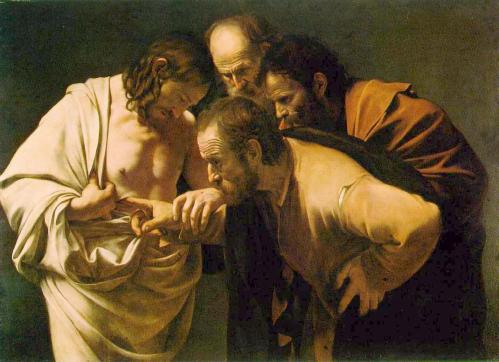
It has been 1,987 years since Jesus gave His life on the cross and rose again, and many in the world today still deny the fact. This denial began with one of Jesus’ own disciples. “The other disciples therefore said unto him [Thomas], We have seen the Lord. But he said unto them, Except I shall see in his hands the print of the nails, and put my finger into the print of the nails, and thrust my hand into his side, I will not believe” (John 20:25, emphasis mine).

Thomas needed physical evidence in order to believe, and many today still want to see some physical manifestation. They want to see a miracle, experience a “feeling.” or suddenly speak in an unknown language in order to believe. Eight days later, Jesus granted Thomas’ request, but also lovingly reprimanded him for his lack of faith. “Jesus saith unto him, Thomas, because thou hast seen me, thou hast believed: blessed are they that have not seen, and yet have believed” (John 20:29, emphasis mine).

For those that demand evidence, God provides abundant evidence, however, “they seeing see not; and hearing they hear not, neither do they understand” (Matthew 13:13). Let us briefly examine just some of the evidence.

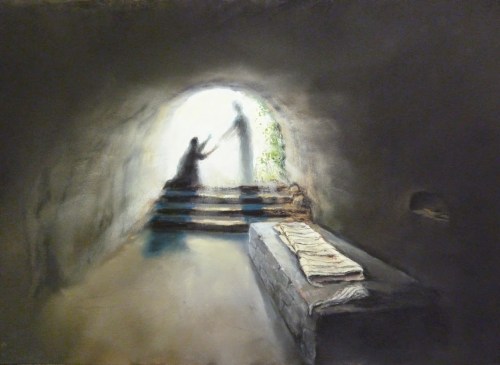
First, there is the evidence of an empty tomb.  No court in the world will try someone for murder without a dead body. Where is Jesus’ body? Where are His bones? Not long ago, an ossuary was found in Jerusalem supposedly having the inscription “Jesus son of Joseph,” but that was soon proven a hoax.[1] Besides that, many fail to understand that “James, Jesus, Joseph, and Mary” were very common names in those days, so the inscriptions prove nothing. However, an inscription found on another ossuary said “James, son of Joseph, brother of Jesus.” This may indeed contain the remains of James the brother of Jesus.[2] However, the fact remains that the tomb (and there are several suspected) which temporarily held Jesus’ body remains empty.

No body means no victim, and for this reason many suggest that the crucifixion never really took place. One rumor suggests that the betrayer, Judas, was crucified in Jesus’ place and that Jesus walked away free. Those same people are the ones looking for His bones in ossuaries. Muhammad is buried in the Al-Masjid an-Nabawi mosque in Medina, Saudi Arabia. Confucius’ body rests in his home town of Qufu, Shandong Province, China. Buddha’s cremated remains (the “relics”) are distributed among several stupas. Bahá’u’lláh, founder of the Bahá’í faith, is buried in Bahji near Acre, Israel.[3] Two main tombs in Jerusalem compete as the burial place of Christ, the Church of the Holy Sepulcher and the Garden Tomb, but both remain empty.

Second, many eyewitnesses saw Jesus alive the third day after His crucifixion and other times thereafter. The four Gospels report that the women (disciples also) that followed Jesus discovered the empty tomb first (Matthew 28:1-8; Mark 16:1-8; Luke 24:1-11; John 20:1-2, 11-18).  Luke records that Jesus appeared to two disciples on the road to Emmaus (Luke 24:13-32). Those two return to report to the eleven (Judas had taken his own life because of the guilt he felt for betraying Jesus), and while they gave their report, Jesus appeared to all of them (Luke 24:33-43). John’s account notes that Thomas missed that first appearance (John 20:19-25). All of this happened on Resurrection Day. The next Sunday, Jesus appeared to them again, but this time Thomas, the doubter, was in the group of disciples (John 20:26-29). Thomas’ doubt transformed into belief, “And Thomas answered and said unto him, My Lord and my God” (John 20:28, emphasis mine).
Jesus had many “disciples” (both men and women) besides the twelve “apostles” composing His core group; so when the Gospel writers talk about disciples, they likely include the many that followed Jesus during His ministry on earth. The word “disciple” literally means “student,” so the number of eyewitnesses went beyond the core group. Following Jesus’ ascension into heaven, there were many that could testify to His resurrection. The Apostle Paul asserts “After that, he [the risen Christ] was seen of above five hundred brethren at once; of whom the greater part remain unto this present, but some are fallen asleep” (1 Corinthians 15:6, emphasis mine). At the time of Paul’s writing the letter to the Corinthians, there remained many eyewitness that could attest to the resurrected Lord. The Law says that “at the mouth of two witnesses, or at the mouth of three witnesses, shall the matter be established” (Deuteronomy 19:15), and Jesus had more than 250 times the number of witnesses required by the Law. Paul himself, never having known Jesus during His earthly ministry, met the risen Christ as he traveled toward Damascus to persecute the followers of The Way. Of all the witnesses, he says of himself, “And last of all he [the risen Christ] was seen of me also, as of one born out of due time. For I am the least of the apostles, that am not [worthy] to be called an apostle, because I persecuted the church of God” (1 Corinthians 15:8-9, emphasis mine). Despite the abundance of eyewitness, some hold to the silly notion that all these witnesses experienced mass hallucinations. Seriously? I will not dignify that with a response!

Third is the matter of the radical change in the lives of all of the disciples. Immediately after Jesus’ arrest, they all went into hiding. Mark, probably writing for Peter, remembers Jesus’ arrest: “And they all forsook him, and fled” (Mark 14:50, emphasis mine). Mark probably witnessed this firsthand. Speaking of himself in third person (out of embarrassment I am sure), he says, “And there followed him a certain young man, having a linen cloth cast about his naked body; and the young men laid hold on him: And he left the linen cloth, and fled from them naked” (Mark 14:51-52, emphasis mine). Peter, who boasted, “… If I should die with thee, I will not deny thee in any wise. Likewise also said they all” (Mark 14:31, emphasis mine) was the first disassociate himself from Jesus with a verbal denial despite Jesus’ warning. “Jesus said unto him, Verily I say unto thee, That this night, before the cock crow, thou shalt deny me thrice” (Matthew 26:34).  Faced with the challenge of making a public declaration of his association with Jesus, Peter succumbed to fear. “Then began he to curse and to swear, saying, I know not the man. And immediately the cock crew. And Peter remembered the word of Jesus, which said unto him, Before the cock crow, thou shalt deny me thrice. And he went out, and wept bitterly.” (Matthew 26:74-75, emphasis mine).

Shortly after Jesus appeared to them, the disciples maintained a low profile. They met secretly in the Upper Room and evangelism never entered their minds. At first, they must have wondered if they had all experienced a mass hallucination. The Gospels give no indication that Jesus met with them regularly following His resurrection. Indeed, some could not believe their own eyes with those brief encounters. “And when they saw him, they worshipped him: but some doubted” (Matthew 28:17, emphasis mine). Jesus was alive, but so what! The Jews would kill anyone proclaiming Jesus’ name. Not surprisingly, the disciples wanted to get things back to “normal.” “Simon Peter saith unto them, I go a fishing. They say unto him, We also go with thee. They went forth, and entered into a ship immediately; and that night they caught nothing” (John 21:3, emphasis mine).

These cowering, fearful men were not likely candidates to “have turned the world upside down” (Acts 17:6) with the message of a risen Christ. Even with their firsthand encounters with the risen Lord, they dared not speak out. These (“To whom also he shewed himself alive after his passion by many infallible proofs, being seen of them forty days, and speaking of the things pertaining to the kingdom of God” (Acts 1:3, emphasis mine)) would not put their lives on the line for the risen Christ whom they, as John put it, “… have seen with our eyes, which we have looked upon, and our hands have handled, of the Word of life” (1 John 1:1, emphasis mine). Why would they put their lives on the line for what they knew to be a lie? Yet only fifty days after the Crucifixion, at Pentecost, these same men boldly stood in Jerusalem and proclaimed the risen Savior to every tongue and nation (Acts 2:1-5). The fear of death no longer silenced them. When commanded to stop teaching in the name of Jesus, “Then Peter and the other apostles answered and said, We ought to obey God rather than men” (Acts 5:29, emphasis mine). What made the difference? They saw and handled the risen Christ, and they experienced His power, the Holy Spirit, indwelling their lives. Christ is risen indeed!

Reader, we cannot see or handle the risen Christ, but we have the empty tomb. We have the written testimony of hundreds of eyewitnesses. Men and women who would rather die than deny what they had witnessed firsthand. We have the continuing witness of the living body of Christ, the Church. “Jesus saith unto him, Thomas, because thou hast seen me, thou hast believed: blessed are they that have not seen, and yet have believed” (John 20:29, emphasis mine). You and I are they “that have not seen.” To us Jesus says, “… be not faithless, but believing.” (John 20:27). Christ is risen indeed. One day, very soon, He will return to reclaim His creation as King of Kings, and Lord of Lords. Be sure you are ready to meet Him.

Notes:


[1]  “Jesus’ tomb story: Does the evidence add up?” (http://www.icr.org/article/1063/386), accessed 04/14/2017.

[2]  Jackson, Wayne. “The Jesus Ossuary Inscription.” ChristianCourier.com. Access date: April 14, 2017. https://www.christiancourier.com/articles/578-jesus-ossuary-inscription-the, accessed 04/14/2017.

[3]  “Burial places of founders of world religions,” https://en.wikipedia.org/wiki/Burial_places_of_founders_of_world_religions, accessed 04/14/2017.

3 Comments

Filed under Apologetics, Christianity, Easter, Evangelism, Gospel, Holidays, Resurrection, Salvation, Theology