Category Archives: Religion

Articles that deal with religions other than orthodox Christianity.

Making Time Count

So teach us to number our days, that we may apply our hearts unto wisdom. (Psalm 90:12)

On Tuesday of this last week, I completed my 69th lap around the sun. The Sunday before, June and I led the last lesson in the Crown ™ Do Well: The Crown Biblical Financial Study.[1] The lesson was on “Eternity,” and one of the questions we were asked to ponder was this: “Estimate the number of days you have left on earth. How does this impact your thinking?” Wow! That is a sobering thought! Psalm 90:10 brings this thought into sharp focus. “The days of our years are threescore years and ten [70]; and if by reason of strength they be fourscore years [80], yet is their strength labour and sorrow; for it is soon cut off, and we fly away” For me, age 70 looms a mere 366 days (2020 is a leap year). And “if by reason of strength” I reach 80 years, that is only 4020 days away (there are three leap years between 2020-2030). For me, at least, that is not a lot of time. However, no one is guaranteed tomorrow; we are all living on borrowed time.

The same psalm, quoted above, offers a prayer to help us think soberly about the time we are given. “So teach us to number our days, that we may apply our hearts unto wisdom” (Psalm 90:12). Time is a precious asset and to squander it on frivolity[2] is poor stewardship. Frivolity opposes “wisdom.” God gives us all the freedom to “apply our hearts unto wisdom” or to apply our hearts to frivolity. That was heavy food for thought.

Then on Friday, our devotional in Days of Praise: “Redeeming the Time,”[3] by ICR’s founder, Dr. Henry M. Morris brought this thought back to mind. In the devotional, Dr. Morris points out that “time is a very valuable asset, in danger of being lost forever unless it is rescued or redeemed.” It occurs to me that we experience the “present” in nanoseconds.[4] We constantly move from the past into the future, so when we misuse time, that is lost forever. Therefore, the only way to “redeem” time is to redeem it in the “future” toward which we are moving. That requires thought and planning – always.

Dr. Morris further asserts, “If we squander our money or lose our health, there is always the possibility of earning more money or being restored to health, but wasted time is gone forever.”

As I begin my 70th trip around the sun, I want to remember what a precious commodity time is. I what to remember that the time I am given is not mine and it can be taken away from me at any time. Jesus said, “Lay not up for yourselves treasures upon earth, where moth and rust doth corrupt, and where thieves break through and steal: But lay up for yourselves treasures in heaven, where neither moth nor rust doth corrupt, and where thieves do not break through nor steal … But seek ye first the kingdom of God, and his righteousness; and all these things shall be added unto you. (Matthew 6:19-20, 33). My time belongs to God; therefore I want to invest it wisely in His kingdom. “So teach [me] to number [my] days, that [I] may apply [my] heart unto wisdom” (Psalm 90:12).

Notes:


[1]  Crown Financial Ministries website: https://www.crown.org/

[2]  Dictionary.Com definition of : frivolous: https://www.dictionary.com/browse/frivolous

[3]  Henry M. Morris, Ph.D., “Redeeming the Time”: https://www.icr.org/article/11211/

[4]  “No Time Like the Present”: https://erniecarrasco.com/2015/01/18/no-time-like-the-present/

4 Comments

Filed under Christianity, Heaven, Philosophy, Random Musings, Religion, Theology

It Does Matter

For as Jonas was three days and three nights in the whale’s belly; so shall the Son of man be three days and three nights in the heart of the earth. (Matthew 12:40)

Recently I listened to a message on the crucifixion. The message excelled in many respects by providing insight into that fateful day of our Lord’s life. However, one part of the message troubled me. The messenger commented that some theologians believe Jesus was crucified on Friday, while others say He was crucified on Thursday. I know that; I’ve heard those arguments before. That is not what troubled me. What troubled me was his comment that the day on which the crucifixion took place does not really matter. The fact of the crucifixion is what really matters.

WOAH!

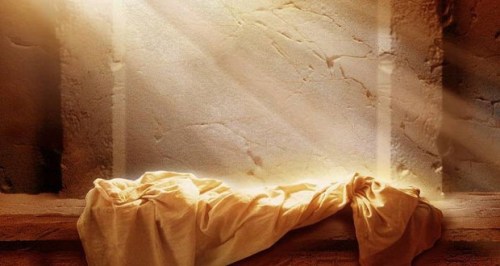
It does matter! Jesus said very specifically that “the Son of man [shall] be three days and three nights in the heart of the earth” (Matthew 12:40). That is three full days and three full nights.[1] You cannot get three full days and three full nights from a Friday crucifixion even if you allow for partial days and nights. Why does that matter?

One reason it matters is that “according to one Jewish tradition, the soul hovered about the body for three days in hope of reentering it.”[2] If it were not three full days and nights, then, as some have asserted, He could have resuscitated in the coolness of the tomb and walked out. (There are many problems with that idea, but that rabbit can be chased another day.)

Jesus raised Lazarus four days after his death. Lazarus was so dead that “by this time he stinketh: for he hath been dead four days” (John 11:39). Decomposition had already set in. That being the case, would it have been better for Jesus to remain in the tomb four days rather than three? No, because Scripture predicted that Jesus’ body would not decompose: “For thou wilt not leave my soul in hell; neither wilt thou suffer thine Holy One to see corruption” (Psalm 16:10). For that reason, it needed to be three full days and three full nights – long enough for the spirit to depart (in the estimation of the Jews), yet not long enough for decomposition to set in.

Another argument against a Friday crucifixion finds its basis in history. Most theologians hold the opinion that Jesus was crucified in A.D. 30. Passover, the day on which Jesus was crucified, always falls on Nissan 14 – the fourteenth day of the first month of the year.[3] Nissan 14, 30 A.D. fell on a Wednesday, not a Friday.[4] A Wednesday crucifixion allows for three full nights and three full days, meaning that Jesus would have risen anytime after 6:00 PM on Saturday evening, the first day of the week by Jewish reckoning – the day begins after sundown.

I believe those are good arguments against a Friday crucifixion, but they are not the best argument. The best argument is Jesus’ own words. He very specifically said that He would be in the heart of the earth, i.e., the grave, for three days and three nights. Anything less than that makes Jesus a liar. Do you really want to go there! If we believe God’s Word is inerrant – and Jesus IS God – then we must accept what HE said, and reject what errant men say. It Does Matter!

HE IS RISEN INDEED!

Notes:


[1]  “Three Days, Three Nights” – https://erniecarrasco.com/2014/07/13/three-days-three-nights/

[2]  Herschel Hobbs, The Illustrated Life of Jesus, (Nashville, Holman Bible Publishers, 2000), 183.

[3]  Leviticus 23:5

[4]  http://www.cgsf.org/dbeattie/calendar/?roman=30

2 Comments

Filed under Apologetics, Bible, Christianity, Easter, Gospel, Religion, Resurrection, Theology

Dry Bones

Now learn a parable of the fig tree; When his branch is yet tender, and putteth forth leaves, ye know that summer is nigh: So likewise ye, when ye shall see all these things, know that it is near, even at the doors. Verily I say unto you, This generation shall not pass, till all these things be fulfilled. Heaven and earth shall pass away, but my words shall not pass away. (Matthew 24:32-35)

With the cross looming just days away, Jesus’ naïve apostles wondered about Jesus’ coming kingdom and what part they would play. “And as he sat upon the mount of Olives, the disciples came unto him privately, saying, Tell us, when shall these things be? and what shall be the sign of thy coming, and of the end of the world?” (Matthew 24:3, emphasis mine) The question inaugurated Jesus’ end-times sermon known as the Olivet Discourse. The sermon, addressed to Jesus’ Jewish disciples, delineated the events that would take place in the Great Tribulation spoken of by the Prophet Daniel[1] and detailed by John the Apostle.[2] Now, in order to pinpoint the proximity of these events, Jesus offered the Parable of the Fig Tree (our passage above).

Israel is compared to a fig tree in the Old Testament,[3] and Jesus uses this imagery to signal the last days. Just as the budding of a fig tree singals the proximity of summer, so the “budding” of Israel singals the nearness of the Lord’s return. The generation that witnesses Israel bud, Jesus said, “shall not pass, till all these things be fulfilled” (Matthew 24:34).

Ezekiel was one of the Jewish priests taken to Babylon in the first group of captives.[4] He was contemporary with the prophets Jeremiah and Daniel, and he ministered to the captives in Babylon. God gave the Prophet Ezekiel a preview of Israel’s rebirth. Ezekiel describes his experience as “The hand of the LORD was upon me, and carried me out in the spirit of the LORD, and set me down in the midst of the valley which was full of bones” (Ezekiel 37:1). “The spirit of the LORD” refers to the Holy Spirit who appears often in the Old Testament. Often we think of the Holy Spirit showing up at Pentcost[5] in the New Testament, and indeed He operates differently today than in Old Testament times, but He was no less active in those days. Today, the Holy Spirit indwells every true believer. In Old Testament time, He “came upon” individuals for specific purposes.

The Holy Spirit carried Ezekiel in a “vision” to a valley full of dry bones. We learn later that these dry bones represent the nation of Israel. “Then he said unto me, Son of man, these bones are the whole house of Israel: behold, they say, Our bones are dried, and our hope is lost: we are cut off for our parts” (Ezekiel 37:11, emphasis mine). Dry bones indicate that these bodies died many years before, perhaps hundreds or even thousands of years. We know by experience that when a body dies and is left unattended, it will decay. Scavengers will eat away at the flesh until nothing is left but the bones. The bones maintain their “boniness” for a long time, but eventually, the sun will bake them dry and they become brittle and eventually turn to dust.

The bones Ezekiel saw were disarticulated and scattered throughout the valley. The vision foretold of a time when Israel would be broken and scattered all over the world with no sign of life and no hope for revival. “And he said unto me, Son of man, can these bones live? And I answered, O Lord GOD, thou knowest” (Ezekiel 37:3). Ezekiel saw no hope of life for these bones, but he trusted that with the Lord, nothing is impossible.[6]

God commanded Ezekiel to prophesy to the dry bones. In his vision, Ezekiel witnessed the bones come together and tendons grow to hold the frame together. Then muscle and finally skin, but the bodies remained dead.[7] Then God told him to prophesy to the wind so that it would breathe life into the lifeless bodies. Ezekiel prophesied as instructed and the bodies came alive and stood to their feet and became a mighty army.[8]

After rejecting their Messiah, God punished Israel by destroying the nation and scattering the Jews all over the earth. This took place in 70 A.D. when the Roman general Titus destroyed Jerusalem and razed the Temple to the ground. The nation of Israel died that day, and its bones were scattered among the Gentile nations. Everywhere they went, they were persecuted, often having to flee from one nation to another with no place they could call their own. Remarkably, they never lost their national identity, traditions, customs, and language, and at every Passover celebration they recited the incessant prayer, “Next year in Jerusalem.”

For nearly 2000 years, the land lay fallow. By all human reconning, the land became a barren desert wasteland. Jews throughout the world could only dream of returning once again to their beloved homeland. Then at the turn of the 20th Century, God started working on Israel’s behalf again. The dry bones started coming together, Then on May 14, 1948, the dry bones stood up “a mighty army.” Immediately, they faced a fight for their lives, but God intervened and the newborn nation survived. Then in 1967, another invasion by their hostile, more powerful neighbors ended in only six days by God’s help, and Israel regained control of their beloved Jerusalem and the Temple Mount.

Today, more than 70 years later, tiny Israel is considered the eighth most powerful country in the world.[9] And we are that generation of which Jesus spoke that has witnessed the fig tree bud and the dry bones rise. This is the generation that will see the Lord’s return. Are you ready? If not, read my page, “Securing Eternal Life.”

Notes:


[1]  Daniel 9:24-27; 11:36-45

[2]  Revelation 6-19

[3]  Joel 1:7, 12

[4]  2 Kings 24:11-16; 2 Chronicles 36:5-8

[5]  Acts 2:1-4

[6]  Jeremiah 32:27

[7]  Ezekiel 37:7-8

[8]  Ezekiel 37:9-10

[9]  “Top 10 Most Powerful Countries in the World 2019

2 Comments

Filed under Christianity, Current Events, End Times, Religion, Second Coming of Christ, Theology

Cause For Tears

As for us, our eyes as yet failed for our vain help: in our watching we have watched for a nation that could not save us. They hunt our steps, that we cannot go in our streets: our end is near, our days are fulfilled; for our end is come. (Lamentations 4:17-18)

I have tried to maintain a habit of reading the Bible through every year. I like getting a different translation of The One Year Bible because it presents a systematic method of reading a portion from the Old Testament, portion from the New Testament, and a reading out of the “Wisdom Books”[1] every day. The year before last, I tried reading through the Chronological Study Bible (NKJV), because I thought it would be interesting to read Scripture in the sequence of the historical events.

The trouble, for me, in following a prescribed reading plan of any kind is the pressure that comes from knowing you have so much reading to get done today because if you don’t, you will get behind. And if you fall more than one day behind in your reading, it easy to become discouraged and stop. I got behind on my reading several times, but I never became discouraged enough to quit. I am not bragging; I am confessing. When I felt pressure like that, I felt I had to get my reading done, so in my rush to get through it, I missed a lot.

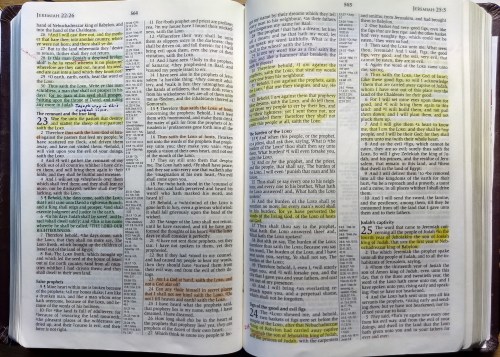
I do not like to read the Bible like that. I like to take my time and really soak it in. I read slowly anyway, but I like to read for detail, and I enjoy “interacting” with what I read. I have developed a system of color coding[2] passages of Scripture with color pencils so that when I leaf through my Bible, I can tell about what the passage refers by the color that highlights it.

Last year I started reading my new King James Bible without the words of Jesus in red. (Red interferes with color coding.) I have not made it all the way through yet, but I am enjoying the “study” much better. I started with the New Testament, then the Minor Prophets, then the books of Wisdom, and now I am in the Major Prophets. I finished Isaiah, Jeremiah, and Lamentations, and I just started on Ezekiel.

That brings me to the subject of my title. The study of Scripture is not a “cause for tears.” Quite the contrary, it brings me a lot of joy. However, as I mentioned, I just finished my study of Jeremiah and Lamentations. The Prophet Jeremiah authored both books. Jeremiah is known as the “Weeping Prophet,” and he had great cause for tears.

He lived at the time of Judah’s demise. He ministered during the time of Judah’s last three kings: Josiah, Jehoiakim, and Zedekiah.[3] He witnessed the first invasion by the Chaldeans under Nebuchadnezzar that took the first round of captives to Babylon. The Prophet Daniel was in this first group. Nebuchadnezzar took Jehoiakim captive and replaced him with his brother, Zedekiah. After nine years, Zedekiah rebelled against Nebuchadnezzar by refusing to pay tribute, so Nebuchadnezzar mounted a second invasion of Jerusalem. This time he razed Jerusalem to the ground. Nebuchadnezzar took Zedekiah captive, but not before making him watch the slaughter of his sons before having his eyes gouged out.[4] Jeremiah witnessed all of this.

Jeremiah had cause for tears. For 40 years he pleaded with Judah to repent of her idolatries. He warned of impending doom for their obstinance and refusal to abandon their pagan gods and return to “the God of Israel.” For this, he was persecuted, mistreated and imprisoned, yet he refused to stop proclaiming, “Thus saith the LORD.” To the first round of captives taken, he wrote letters encouraging them to build houses, plant gardens, take wives and raise families, seek the welfare of the city in which they lived, and not to listen to the false prophets that said the captivity would not be for long.[5] This oft-quoted out-of-context passage followed God’s admonition. “For I know the thoughts that I think toward you, saith the LORD, thoughts of peace, and not of evil, to give you an expected end” (Jeremiah 29:11). Although we can take comfort knowing that God only desires the best for His people, we must also keep in mind to whom this was addressed and the circumstances that precipitated it.

What follows clearly shows that this message was for them, not necessarily for us. “Then shall ye call upon me, and ye shall go and pray unto me, and I will hearken unto you. And ye shall seek me, and find me, when ye shall search for me with all your heart. And I will be found of you, saith the LORD: and I will turn away your captivity, and I will gather you from all the nations, and from all the places whither I have driven you, saith the LORD; and I will bring you again into the place whence I caused you to be carried away captive” (Jeremiah 29:12-14). They treated Jeremiah as a traitor for this message of hope.

God gave many promises to Jeremiah concerning Israel’s bright future. “And I will gather the remnant of my flock out of all countries whither I have driven them, and will bring them again to their folds; and they shall be fruitful and increase. And I will set up shepherds over them which shall feed them: and they shall fear no more, nor be dismayed, neither shall they be lacking, saith the LORD” (Jeremiah 23:3-4). “Therefore fear thou not, O my servant Jacob, saith the LORD; neither be dismayed, O Israel: for, lo, I will save thee from afar, and thy seed from the land of their captivity; and Jacob shall return, and shall be in rest, and be quiet, and none shall make him afraid. For I am with thee, saith the LORD, to save thee: though I make a full end of all nations whither I have scattered thee, yet will I not make a full end of thee: but I will correct thee in measure, and will not leave thee altogether unpunished” (Jeremiah 30:10-11). “Behold, I will gather them out of all countries, whither I have driven them in mine anger, and in my fury, and in great wrath; and I will bring them again unto this place, and I will cause them to dwell safely: And they shall be my people, and I will be their God: And I will give them one heart, and one way, that they may fear me for ever, for the good of them, and of their children after them: And I will make an everlasting covenant with them, that I will not turn away from them, to do them good; but I will put my fear in their hearts, that they shall not depart from me” (Jeremiah 32:37-40).

We see these promises being fulfilled before our eyes. Israel has returned to her land. From all over the world, Jews are returning to their Promised Land, and the desert is blooming.[6] Yet, in spite of the promise of a bright future, Jeremiah watched his beloved Jerusalem crumble to dust and all her people either killed by the sword or taken away captive. It was cause for tears.

As I read Jeremiah’s record, it is a cause for tears because I see what Jeremiah saw but in my beloved nation. Our nation is steeped in idolatry. It is not so much in the form of pagan deities, although there is some of that in the growing number of occult practices – Wicca, witchcraft, satanism, etc. – but mostly in the worship of all forms of entertainment and materialism. Anything that takes a higher priority than God is idolatry.

Our country has fallen prey to the practice of infanticide in the form of abortion even up to the time of birth. There may not be a blazing bronze statue of Baal on which to burn the babies, but abortion is an offering to Baal nonetheless.

Pornography is often a secret sin harbored by many Christians, even Christian leaders. Prostitution has become passé so much that even President Trump’s indiscretion with a porn star is only a slight embarrassment because of its exposure.

The “gay” agenda continues to force its presence into the mainstream so that public schools are indoctrinating children as young as kindergarten into the “normalcy” of this perverse behavior. Children are being taught that they can reject the biological sex with which they were born and be whatever sex they choose to be. Recently, the media celebrated an eleven-year-old “drag princess” for his “talent” in dancing for dollars at a gay bar.[7] Another ten-year-old “drag princess” was photographed posing with a naked adult drag queen,[8] and our society seems to think nothing of it. How is this not considered a form of child abuse?

Then there are child prostitution rings where grown men go to engage in sexual intercourse with little girls and boys. There is an island in the Caribbean where many of our politicians go to engage in sex with children.[9] Imagine the power the ring operators hold over politicians for keeping their secrets.

All of this and more is cause for tears. It took Israel less than 1000 years to arrive at such a depraved condition where God had to banish them from the land. Our nation, from the arrival of the Pilgrims in 1620, is only 399 years old, and look at how far we have fallen! Arguably, this moral decline has taken place within the last generation – 70 years – and has rapidly accelerated within the last 20 years.

Another popular verse of Scripture quoted out of context is 2 Chronicles 7:14. God made this promise to Solomon at the dedication of the Temple. He said, “If my people, which are called by my name, shall humble themselves, and pray, and seek my face, and turn from their wicked ways; then will I hear from heaven, and will forgive their sin, and will heal their land.” His people did not humble themselves, pray, seek His face, nor turn from their wickedness, and the Temple to which they were to turn was completely destroyed. Surely there was a remanent of faithful ones among the wicked. Daniel, Hananiah, Mishael, and Azariah were among those,[10] but that did not stop God from punishing the nation.

We do not have a Temple toward which to pray except for the one “not made with hands, eternal in the heavens” (2 Corinthians 5:1). Still, God throughout the ages instructed us to pray for our nation and our leaders;[11] but that offers little security if God deems the nation unredeemable. Perhaps part of God’s punishment will include taking out the faithful before the final destruction. However, like Jeremiah knowing the future promise of restoration yet living in the midst of national decline, we have cause for tears. Come quickly, Lord Jesus!

Notes:


[1]  The “books of Wisdom” or the “Wisdom Books” include Job, Psalms, Proverbs, Ecclesiastes, and Song of Solomon.

[2]  My system of color coding: Yellow = Noteworthy; Orange = Attributes of God; Green = Attributes of Jesus; Light Blue = Attributes of Holy Spirit; Purple = Word of God; Red = Blood/Salvation; and Brown = End-Times Prophecy

[3]  Jeremiah 1:2-3

[4]  Jeremiah 39:6-7

[5]  Jeremiah 29:4-9

[6]  Isaiah 35:1

[7]  “Nolte: 11-Year-Old ‘Drag Queen’ Dances for Dollar Bills in Gay Bar

[8]  “10yo Drag Queen Posing with Naked Adult Man is “Beautiful” and “Not Sexualized

[9]  “Sex Tourism And Trafficking In The Dutch Caribbean

[10]  Daniel 1:6

[11]  1 Timothy 2:2; 1 Peter 2:13-15,17

4 Comments

Filed under Christianity, Current Events, End Times, Random Musings, Religion, Second Coming of Christ, Theology

Faith, Hope, & Love

And now abideth faith, hope, charity, these three; but the greatest of these is charity. (1 Corinthians 13:13)

Since my car accident at the end of November, I have been faithfully attending therapy sessions to realign my neck and spine. If you have to go, it is a blessing to have friendly people to work with you. Where I go, the therapist’s ages are all about mid-thirties and younger, and they are all very friendly and caring.

Last week a new one showed up at the clinic, and she fit in perfectly with the rest of the crew. One day as I picked up my chart to check out, I noticed an interesting tattoo on the posterior side of her left wrist. Personally, I dislike tattoos, but this one caught my attention. It was an anchor with an unfinished heart above the stock of the anchor. I asked her what it signified, and she said it stood for faith (the anchor), hope (the cross), and love (the heart). I picked up my chart, smiled, and said, “Nice,” and left to start the rest of my day.

At my next appointment, I saw her again, pointed to her tattoo and asked, “And the greatest of these is ______?” She looked at me as if I had two heads, so I clarified. “Your tattoo stands for faith, hope, and love. Of the three, which is the greatest?” She looked at me and then looked at her tattoo and then answered with a question in her voice, “Love?” I asked why, and she said, “because it’s bigger?” I told her that it was from a passage in the Bible, and I quoted, “And now abideth faith, hope, love, these three; but the greatest of these is love” (1 Corinthians 13:13). She smiled, took out a pen and scribbled “1 Cor 13 13” inside the heart, and said, “I’ll have to look that up.”

At my next session, I asked her if she had looked up the verse. She confessed that she had been too busy. I pulled out my cell phone that has my favorite Bible app on it. I looked up 1 Corinthians 13:13 for her and let her read it for herself. She was a little confused when she read “charity” instead of “love.” I explained that the Greek word translated “charity” is agapē which is translated as “love” in other parts of the New Testament. The reason the KJV translators used “charity” here is that “charity” explains the nature of agapē more clearly. Charity is a kind of giving or expressing of love that is offered freely without expectation of receiving anything in return. She seemed to appreciate the brief lesson, and I think she gained a better appreciation for her tattoo. (I still dislike tattoos.)

As I left the clinic, I thought about that verse. Why is love the greatest of these three? The verse begins, “And now abideth…” Currently, right now, exist faith, hope, and charity. We need “faith” because “without faith it is impossible to please him: for he that cometh to God must believe that he is, and that he is a rewarder of them that diligently seek him” (Hebrews 11:6, emphasis mine). John’s Gospel records, “For God so loved the world, that he gave his only begotten Son, that whosoever believeth in him should not perish, but have everlasting life” (John 3:16). The word translated “believeth” is the Greek word, pisteuō, and it means “to have faith in.” We must have “faith” in Jesus in order to be saved.

Once we have trusted in Jesus for our eternal salvation, then we have “hope” that one day He will return to take us to be with Him as He promised. Jesus said, “In my Father’s house are many mansions: if it were not so, I would have told you. I go to prepare a place for you. And if I go and prepare a place for you, I will come again, and receive you unto myself; that where I am, there ye may be also” (John 14:2-3, emphasis mine). All of this is future, and we have no “hard” evidence that it will come true, but in Hebrews, we read, “Now faith is the substance of things hoped for, the evidence of things not seen” (Hebrews 11:1). Our “faith” is “substantive,” and we have the evidence of the Holy Spirit within us to confirm the truth of those “things not seen.” That same Spirit assures us that our hope is real.

Then there is “charity” (love). The pages of the Bible are replete with demonstrations of God’s love. John reminds us, “And we have known and believed the love that God hath to us. God is love; and he that dwelleth in love dwelleth in God, and God in him” (1 John 4:16, emphasis mine). Paul tells us that “charity” (love) never fails. It stands to reason that if “God is love,” then love will never fail. Paul makes it clear that all things will fail, but love will never fail (1 Corinthians 13:8).

“And now abideth faith, hope, charity, these three; but the greatest of these is charity” (1 Corinthians 13:13). On the day we enter into our Lord’s presence, there will be no need for faith because our faith will be transformed into reality. There will be no need for hope, for our hope will be realized. However, love will remain as eternal as God Himself. Now remain faith, hope, and love, these three, but the greatest, because it will outlast the other two, is love.

P.S.

I searched the internet for a picture of a tattoo like the one this young lady had and could not find an exact match. The one I selected for this post was a close match, but I had to do a little “photoshopping” to get it to look right. Notice the unfinished heart. That made me think that the love – even God’s love – that we experience in this life is incomplete. Not until we are in His presence will we experience the completeness of His love. That is something for which to look forward!

6 Comments

Filed under Christianity, Heaven, Random Musings, Religion, Salvation, Theology