Category Archives: Religion

Articles that deal with religions other than orthodox Christianity.

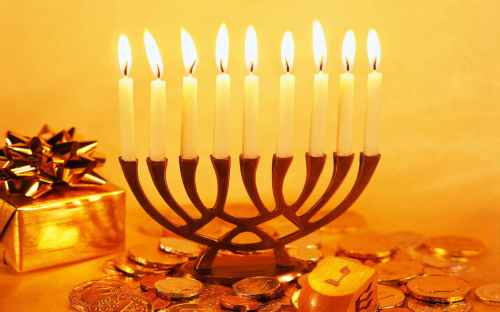
Happy Chanukah!

Hanukkah

In him was life; and the life was the light of men. And the light shineth in darkness; and the darkness comprehended it not.   (John 1:4-5)

Today, December 12, 2017 (at sundown), begins the Jewish Festival of Lights otherwise known as Chanukah (pronounced (with a guttural “H”) hah-noo-kah). The festival is observed for eight days, and while it is not one of the “Feasts of the Lord” (Leviticus 23) nor is it recorded anywhere in the Old Testament, it is nonetheless an important commemoration of God’s provision. Most Gentiles are vaguely aware of the celebration in that it takes place around Christmastime, but besides that, they really do not know much about it.

Chanukah originated in the second century B.C. during the “silent” period of the Bible – between the Old and New Testaments. It came about as a result of a Jewish rebellion against the Greek (Syrian) ruler Antiochus IV Epiphanes for his desecration of the Jewish temple in Jerusalem in 168 B.C. This act was prehistorically recorded by the prophet Daniel: “Then shall he return into his land with great riches; and his heart shall be against the holy covenant; and he shall do exploits, and return to his own land … And arms shall stand on his part, and they shall pollute the sanctuary of strength, and shall take away the daily sacrifice, and they shall place the abomination that maketh desolate.” (Daniel 11:28, 31, emphasis mine). Antiochus IV defiled the temple by erecting a statue of Zeus in the sanctuary and sacrificing a pig on the altar. This incited the Maccabean Revolt, and, as prophesied by Daniel: “the people that do know their God shall be strong, and do exploits. And they that understand among the people shall instruct many: yet they shall fall by the sword, and by flame, by captivity, and by spoil, many days” (Daniel 11:32-33, emphasis mine).  Two years later, 164 B.C. the Jews managed to expel the Syrians out of Jerusalem and take back their temple.

With the Greeks out of the way, the Temple had to be cleansed and rededicated. Part of the consecration required that the menorah, the “candlestick” or “lampstand,” that stood on the south wall of the Holy Place (Exodus 26:35), remain constantly lighted (Exodus 27:20). The problem was that there was only enough pure oil, i.e. oil that was undefiled, to last for only one day. So, they lit the menorah, and miraculously, the lamp continued to burn for eight days until sufficient oil was produced to replenish the supply from then on. And so, the Temple was dedicated. “Chanukah” means “dedication.”

Jesus celebrated Chanukah. We see in John’s Gospel “And it was at Jerusalem the feast of the dedication, and it was winter. And Jesus walked in the temple in Solomon’s porch” (John 10:22-23, emphasis mine). Just before this, He made the claim “I am the light of the world: he that followeth me shall not walk in darkness, but shall have the light of life” (John 8:12, emphasis mine). This He said after forgiving the woman caught in adultery (John 8:1-11). Not long after, He healed a man who was blind from birth (John 9) saying, “As long as I am in the world, I am the light of the world” (John 9:5, emphasis mine). That light would soon be extinguished, but not for long. In the spring following that Chanukah, Jesus would be nailed to a cross, and for three long days the world would be without the Light. The Sunday before His crucifixion, Jesus prepared His disciples (and us), “Yet a little while is the light with you. Walk while ye have the light, lest darkness come upon you: for he that walketh in darkness knoweth not whither he goeth. While ye have light, believe in the light, that ye may be the children of light” (John 12:35-36).

The menorah in the Temple was permanently extinguished in 70 A.D. when the Romans razed Jerusalem. Now it is only remembered on Chanukah. The Light of the World was temporarily extinguished, but He rose again, and His glory fills the heavenly Temple. Yet on Earth, His light still shines in those who are “the children of light.” “[Y]e are washed, but ye are sanctified, but ye are justified in the name of the Lord Jesus, and by the Spirit of our God” (1 Corinthians 6:11, emphasis mine). Since you are “sanctified,” that means you are “dedicated,” and Jesus said, “Ye are the light of the world. A city that is set on an hill cannot be hid … Let your light so shine before men, that they may see your good works, and glorify your Father which is in heaven” (Matthew 5:14, 16, emphasis mine). So, shine!

Happy Chanukah!

4 Comments

Filed under Christianity, Christmas, Evangelism, Gospel, Religion

What A Thing!

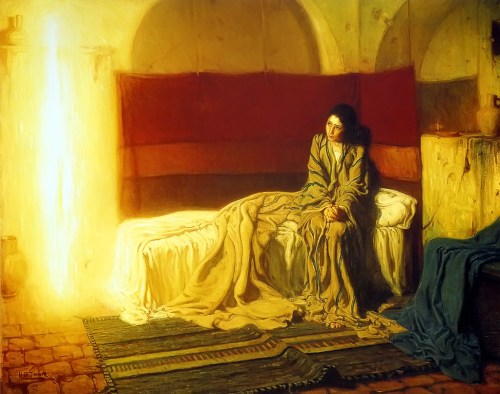
Annunciation by Henry Ossawa Tanner

… Christ Jesus: Who, being in the form of God, thought it not robbery to be equal with God: But made himself of no reputation, and took upon him the form of a servant, and was made in the likeness of men: (Philippians 2:5-7)

The Christmas season is upon us once again, and once more, I sense the dilemma of mixing the commercialization of the season by the world with the celebration of the First Advent. Any Christian well taught in Scripture recognizes that Jesus was not born on December 25, but thanks to the Catholics, we are stuck with that date. Regardless of how one feels about that, it is appropriate to set aside a special time to contemplate the magnitude of the miracle that is the Incarnation[1] – God becoming a man.

Consider our leading verse. No other religion[2] in the world makes the claim that their gods willingly depose themselves of all divine powers to assume the life of a human. Then, to top it off, offer themselves as a blood sacrifice in order to save the lowly human race. However, contemplate seriously the significance of these words of Scripture.

“Christ Jesus” – the anointed Savior (meaning of the name) – “who being in the form of God.” The Greek word translated “form” is morphē, and it means “shape” or “nature.” The Apostle John calls Jesus “the Word.” He wrote, “In the beginning was the Word, and the Word was with God, and the Word was God: (John 1:1, emphasis mine). In the Greek, the phrase “the Word was God” literally reads, “God was the Word” — θεος ην ο λογος. What a thing!

Though He was in every way, in very nature, God, He “Thought it not robbery to be equal with God.” Verse 8 clarifies this phrase when it explains that Jesus “humbled Himself.” He did not regard it robbery to lay aside His Divine nature and assume human form in order to redeem fallen humanity. What a Thing!

“He made Himself of no reputation.” This entire phrase is summed up in one Greek word, εκενωσεν (hekenoōsen), which means, “He emptied Himself” without any sense of deprivation. In exchange, “He took upon Himself the morphē (see above) of a servant” – doulos – a “slave.” He “was made in the likeness of men.” The Greek word translated “likeness” is homoiōma meaning “resemblance.” So, not only did He take on the “nature” of man, He “looked” like any other man. There was no halo around Him to distinguish Him from any other man. Of Him Isaiah the prophet said, “he hath no form nor comeliness; and when we shall see him, there is no beauty that we should desire him” (Isaiah 53:2, emphasis mine). The Hebrew word translated “comeliness” is hâdâr meaning “magnificence,” and “beauty” is the Hebrew word mar-eh’ meaning a “handsome appearance.” So much for those soft-faced images of Jesus, we are so used to seeing! It was not enough that He condescended from His Divine nature to assume the nature of an ordinary, common-looking man, but He took the form of the lowliest kind of man – a slave. Not only did He come as a slave, but He chose a peasant girl for a mother and a stable for His birthplace.[3] What a THING!

The passage goes on to say, “And being found in fashion as a man, he humbled himself, and became obedient unto death, even the death of the cross” (Philippians 2:8, emphasis mine). “Fashion” is the Greek word, schēma and it means the “mode, circumstance, or external condition.” The Bible tells us that “the wages of sin is death” (Romans 6:23). Man must die eternally to pay the penalty for sin. Unless some sinless one can be found to serve as a suitable sacrifice for all of mankind, every one of us must pay “the wages of sin.”[4] Who could qualify as a suitable sacrifice? “As it is written, There is none righteous, no, not one … For all have sinned, and come short of the glory of God” (Romans 3:10, 23). Therefore, God clad Himself in human flesh and took the penalty for universal sin upon Himself. However, His death was not enough. He conquered death when He rose from the grave on the third day. He paid the sin debt that we owe and broke the curse of death[5] with His resurrection. WHAT A THING!

This Christmas, regardless of the commercialization of the season and regardless of the fact that Jesus was not born on December 25, God’s gift of salvation freely offered to all who will accept it, is worthy of commemoration and celebration. “This is a faithful saying, and worthy of all acceptation, that Christ Jesus came into the world to save sinners; of whom I am chief” (1 Timothy 1:15, emphasis mine). WHAT A THING!!

Merry Christmas!

Notes:


[1] “Miracle of the Incarnation” – https://erniecarrasco.com/2012/12/24/miracle-of-the-incarnation/

[2]  “False Religion” – https://erniecarrasco.com/2014/07/27/false-religion/

[3]  “Extreme Measures” – https://erniecarrasco.com/2016/12/11/extreme-measures/

[4]  “Eternal Sacrifice” – https://erniecarrasco.com/2012/09/30/eternal-sacrifice/

[5]  “Why Jesus?” – https://erniecarrasco.com/2015/12/13/why-jesus/

5 Comments

Filed under Apologetics, Bible, Christianity, Christmas, Evangelism, Gospel, Holidays, Religion, Theology

Light From Afar

… he made the stars also. (Genesis 1:16)

The question about the age of the universe is certainly a hotly debated question among both young earth and old earth creationists. Young earth creationists affirm and accept the literal account recorded in Genesis.[1] Old earth creationists accept that God is Creator, but they accommodate long ages because they are convinced that “science” has “proven” that the universe is old. They arrive at this conclusion because we see light from stars and galaxies that are billions of lightyears away from us. The “proof” is questionable, but that is a separate matter.

If one considers God’s account of creation recorded in the first chapter of Genesis, one notes that all things, plants, sea creatures, avian life, land creatures and even humans were all created fully mature and immediately able to reproduce (“the seed is in itself”). The earth itself was created, formed, and organized in the first three days of creation (Genesis 1:1-13). The Bible gives no indication that these were long periods of time.[2] When God records the day (Hebrew yom), He uses the word normally understood as a 24-hour day. By assigning an ordinal number to modify the day (first day, second day, third day, etc.), He further qualifies the day as a normal 24-hour day. If that is not enough, He further defines the day by “evening and morning” indicating a normal 24-hour day.

Some may want to argue that, but their argument is against God’s Word, and that is reminiscent of the first words from the tempter’s mouth: “Yea, hath God said…?” (Genesis 3:1).

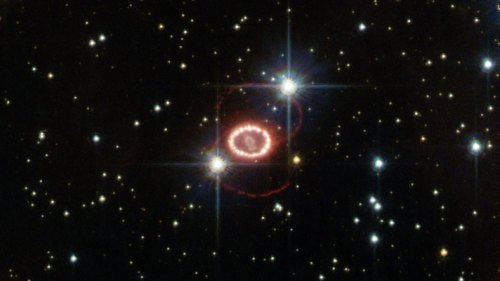
With all of that in mind, look again at Genesis 1:14-19, Day Four of creation. In God’s account of creation, God created the earth first, then the other heavenly bodies beginning with the sun and moon and finally He “created the stars also” (v. 16). This in itself contradicts the notion of a Big Bang. Verse 15 establishes the purpose for the heavenly bodies: Lit. “to light over the earth.” In the KJV verse 17 reads: “And God set them [the stars] in the firmament of the heaven to give light upon the earth.” The Hebrew word translated “set” is nâthan, which means “to give.” A strict translation of the verse would read: “God gave them in the expanse of the heavens to light over the earth.” As with all of God’s creation, the light of the stars upon the earth was created in place and fully mature. This eliminates any discussion about how long it takes for light from distant stars to arrive on earth. It makes the argument irrelevant. Whatever is now is not what it was in the beginning.

Notes:


[1]  “The Universe is Young” https://erniecarrasco.com/2017/05/21/the-universe-is-young/

[2]  “The Bible Says” https://erniecarrasco.com/2016/04/03/the-bible-says/

1 Comment

Filed under Apologetics, Creation, Origins, Religion, Science

Creation Ex Nihilo

A Picture of Nothing

In the beginning God created the heaven and the earth. (Genesis 1:1)

It seems strange to me when people readily accept the origin of the universe from a Big Bang, yet balk at the suggestion that God created the universe out of nothing – ex nihilo – simply by speaking it into existence. Even Christians who claim to believe that every word of the Bible as inerrant and infallible fall prey to the notion that God somehow initiated and used the Big Bang to create over billions of years of time.

Recently the Institute for Creation Research (ICR) published an article,[1] which raised questions in one reader’s mind. He wrote:

Since God is omnipotent, omniscient, and omnipresent, doesn’t it make more sense to think that either…

  • God first created nothingness?
  • He created time at the same time as nothingness?
  • As He was everything, from within Himself He created everything?

Another question I have regards the space/time/matter continuum. While our human minds at present can’t conceive of the three dimensions going on into infinity in both directions, doesn’t it stand to reason to think that the universe and its three dimensions is endless in both directions?

I am not sure what he meant by his last question. He affirms (at least by our understanding) a three-dimensional universe, but then he questions the three-dimensional universe being infinite (endless) in “both directions.” That suggests only two dimensions. He seems confused, as often happens when we “over think” things that are beyond our understanding.

Our problem in a question like this is that we tend to think of God from our limited human perspective. As theologians like to describe God, He is totally “other,” i.e., He is nothing like us, and we have nothing outside of His Word with which to compare Him. This is why His second commandment prohibits that we make an image of Him (Exodus 20:4). It would be impossible for any image to accurately depict God in His fullness.

When we say God is eternal,[2] we sometimes view “eternity”[3] with some kind of cosmic clock[4] in mind, but that would confine God to time. God is timeless. He has no past, present or future; He simply “is.” That is why when Moses asked His name, He responded, “I AM” (Exodus 3:11). He is the All-Existent One. His omnipresence means more than He is everywhere at all times; it means that He exists IN all times, i.e., He is in our past, present and future all at once. This explains why He knows the future before it happens. This is also why our sin bears eternal consequences. Our sin is an infinite offense to God.

When we understand that, we can look at Genesis 1:1 and see that “In the beginning (time) God created (bara – only used in reference to God creating) the heavens (space) and the earth (matter/energy),” ergo, the universe. God created time. There would be no universe without time – i.e., the space-time continuum to which the writer referred. The universe, like God, is a trinity; time, space and matter/energy must all exist simultaneously for the universe to exist. Remove any one of the three components, and the universe ceases. God created time “in the beginning.”

The Bible does not specifically say that God created out of nothing (“ex nihilo” is the theological term we use to describe God’s creation), but the implication that there was nothing before verse 1 of Genesis is certainly there. When God confronts Job’s questions, He responds, “Where wast thou when I laid the foundations of the earth? declare, if thou hast understanding” (Job 38:4). What are “the foundations of the earth,” if not the basic elements of the universe? Obviously, we have no way of knowing precisely “how” God did it. The Bible encourages us to rest in the fact that God brought it all about “In the beginning.” “The secret things belong unto the LORD our God: but those things which are revealed belong unto us and to our children for ever, that we may do all the words of this law” (Deuteronomy 29:29).

On the final question, the universe is not infinite for the very reason that it was created. Nothing that is created can be infinite. Only God is infinite; everything else is finite.

When we think on that, “What is man, that thou art mindful of him? and the son of man, that thou visitest him?” (Psalm 8:4). Yes, as immeasurably great as God is, He took on human form and condescended to us, His creation, to dwell among us, take on the eternal offense of our sin, and pay for it with His death on the cross so that we might share eternity with Him. After all He has done for us, “How shall we escape, if we neglect so great salvation” (Hebrews 2:3)? Thank God for His infinite love!

Notes:


[1]  “The Universe Out of Nothing” – https://www.icr.org/article/10286

[2]  “The Eternality of God” – https://erniecarrasco.com/2017/06/04/the-eternality-of-god/

[3]  “Time Confusion” – https://erniecarrasco.com/2016/07/31/time-confusion/

[4]  “No Time Like the Present” – https://erniecarrasco.com/2015/01/18/no-time-like-the-present/

2 Comments

Filed under Apologetics, Christianity, Creation, Evolution, Gospel, Origins, Religion, Salvation, Theology

The Good Muslim

But I say unto you, Love your enemies, bless them that curse you, do good to them that hate you, and pray for them which despitefully use you, and persecute you;  (45)  That ye may be the children of your Father which is in heaven: for he maketh his sun to rise on the evil and on the good, and sendeth rain on the just and on the unjust. ( Matthew 5:44-45)

At the time of this writing (November 1, 2017), the news is all abuzz over the latest act of jihad by another Muslim terrorist. On Tuesday, October 31, 2017, Halloween, Sayfullo Habibullaevic Saipov, drove his rented Home Depot truck onto a bike lane along Manhattan’s West Side Highway killing at least eight and injuring half a dozen others. Saipov, a recent Muslim import, hails from Uzbekistan and entered by way of the “green card lottery” in 2010. The odious piece of legislation that opened the door for Saipov sprang from the frothing cesspool of Demoncrat minds known as the “Diversity Visa Program” – it sounds nice. Demoncrat Senate Minority Leader, Chuck Schumer pushed the legislation through in 1990, as if our nation is not “diverse” enough!

Several people interviewed reported that Saipov was a “nice guy.” No one that knew him suspected that he was capable of such a heinous act. They all thought he was one of the “good Muslims.” I found an interview of one of Saipov’s “Mosque-ovites” (one who worships at the same mosque) less than amusing. The FOX street reporter prompted the “Mosque-ovite” by asking, “How do ‘good Muslims’ respond to these acts of terror?” (or something to that effect). Of course, the “Mosque-ovite” denounced the act in the strongest terms even calling the culprit “an animal.” Apparently, “good Muslims” harbor no tolerance for Muslims who perform acts of terror. But, how do we know that they really believe what they proclaim? Where is the outcry from the Muslim community calling for these acts to stop!

Allow me to say at the onset that I do not believe all Muslims are out to wage war on the “infidels” and convert or kill us all. Surely many Muslims want to live in peace and have a “normal” life; but how can we distinguish “the good Muslim” from the one that seeks to convert infidels through force or otherwise eliminate the infidel from the earth? Good and “bad” Muslims are indistinguishable until one of them receives the inspiration to wage jihad and kill a bunch of innocent people. Then we know—that was one of the bad ones.

From what I have learned about the Muslim religion, “the good Muslim” – “good” by American standards – can be likened to the nominal Christian. The nominal Christian claims the name of Christ. They may or may not attend church services on a regular basis. They probably own a Bible, but rarely open it. If they carry their Bible to church, they will read what is put on the big screen, but they will not open their Bible to see if the preacher quoted the Scripture correctly. A nominal Christian might say, “the Bible says” and then quote some pious platitude that has no basis in Scripture. A nominal Christian believes that all people are basically good and that anyone can go to heaven as long as they exercise good moral behavior and follow the “golden rule.” They conduct themselves by the motto, “live and let live.”

Likewise, “good Muslims” acknowledge Allah as their god.[1] They go to the mosque every Friday and pray five times a day. They may own a Qur’an but not really read it. The Qu’ran is written in Arabic, although there are some parallel versions that have the English translation on one side. I would venture to say that a good majority of American Muslims can neither read nor speak Arabic, so that must rely on the teachings of their Imams. Good Muslims believe that Islam is a religion of peace and that “jihad” is an “inner struggle” to please Allah. While they may believe that infidels are going to hell, they are happy enough to let them go there. They share the same motto with nominal Christians: “Just live and let live.”

From an American perspective, “good Muslims” are just like us. Americans believe that Muslims share the same values, and that “good Muslims” just want to live their lives in peace. However, Americans view the world through a skewed westernized lens that, like it or not, originates from a biblical foundation. Ideas like “Love your enemies, bless them that curse you, do good to them that hate you, and pray for them which despitefully use you, and persecute you” (Matthew 5:44) are basic to the American psyche. “Thou shalt not murder” (Exodus 20:13) and “all things whatsoever ye would that men should do to you, do ye even so to them: for this is the law and the prophets” (Matthew 7:12) are all principles taught in the Bible. Americans, whether they know the Bible or not, pretty much live by these principles; and because they do not know the source, they assume the rest of the world lives by these principles too. Consequently, Americans believe “good Muslims” live by the same principles.

The Bible instructs us to love our enemies, to do good to them that hate you, and to pray for those who despitefully use you and persecute you. It teaches that we should treat others as we would have them treat us. We are told not to murder or to lie (Exodus 20:16; Proverbs 14:5). We are instructed to care for the poor, the widows and the orphans. How does the Qur’an[2] compare with what the Bible teaches?

Infidels – anyone who does not adhere to Islam – are enemies according to the Qur’an (2:98; 4:101).[3] The Qur’an teaches that Allah does not love the infidels (3:32, 140), unlike the Bible that teaches that “God is love” (1 John 4:8) and He is not willing that any should perish (2 Peter 3:9). Therefore, since Allah does not love infidels, they must be persecuted (4:104-105; 2:217). Unlike the Bible’s teaching that Christians are to witness for Christ (Matthew 28:18-20; Acts 1:8), the Qur’an teaches that Muslims should “not take the infidels for friends … whoever does this has nothing to do with Allah” (3:28: 4:144; 5:51; 60:1-2). That is pretty harsh! Is it any wonder that Muslims do not assimilate into the American culture? To be sure, Allah encourages emigration for the sake of jihad (2:218), which explains their invasion of Europe, Canada, the U.S., and others. Moreover, Allah encourages the killing of infidels (4:89), and if the Muslim dies in the process of jihad, they automatically gain entry into heaven (3:169; 4:95). Sadly, even this effort carries with it no guarantee: “O you who have believed [i.e. the Muslim], fear Allah and desire the way to him. And perform jihad for his sake, perhaps you may prosper: (5:35, emphasis mine).

More could be said concerning the contrast between the Bible and Qur’an, but from this brief review, Americans should hope that “good Muslims” do not take seriously the Qur’an. When they do take it seriously the contents of this satanic book and convert to “good Muslims” (according to the standards of the Qur’an), it only spells danger for us poor infidels. The problem is further exacerbated when one realizes that Muslims are not obligated to deal honestly with infidels (2:225; 3:28, 54; 9:3; 16:106; 40:28; 66:2). Unlike the Bible that exhorts truthfulness and honesty (Exodus 20:16; Psalm 101:7; Proverbs 12:22; Colossians 3:9-10; et al), the Qur’an encourages Muslims to lie[4] to infidels if it is to their advantage. The practice is known as taqiyya.[5] Knowing this, how can one discern one “good Muslim” from another? One cannot know if a Muslim is nominal, moderate, or a full-fledged jihadist, because their “holy” book discourages them from befriending an infidel unless it is for the dishonest purpose of gaining some advantage. Can the distrust of Muslims honestly be labeled “Islamophobia” when the Muslim “holy” book instructs “good Muslims” to lie to infidels? The Qur’an itself claims that Allah is the greatest liar of all (3:54; 4:142; 8:30). Compare that to the Bible’s teaching that God does not lie (Numbers 23:19). Additionally, the Bible identifies the “father of lies” as Satan (John 8:44).

What are we to do? Surely, there are Muslims that hold their religion in name only and they truly want to live in peace with their neighbors, but the tenets of that religion are incompatible with the American way of life. I desire that they would all convert to Christianity, but barring that, I would be happy if they would just renounce that satanic religion, embrace the law of this land, the United States Constitution, and assimilate into the American culture.

Notes:


[1]  “God Is Not Allah” – https://erniecarrasco.com/2013/09/29/god-is-not-allah/

[2]  A English/Arabic paperback copy of the Qur’an can be obtained at Amazon.com. I would recommend the one translated by Abdulla Yusuf, which is the copy I have. For my study, however, I use The Generous Qur’an: An accurate, Modern English Translation of the Qur’an, Islam’s Holiest Book, translated and annotated by Usama K. Dadok. It too is available from Amazon.com.

[3]  Citations from the Qur’an follow the format of Chapter:Verse, e.g. (2:98). The Qur’an does not have “books” like the Bible.

[4]  “Islam Permits Lying to Deceive Unbelievers and Bring World Domination!” – http://muslimfact.com/bm/terror-in-the-name-of-islam/islam-permits-lying-to-deceive-unbelievers-and-bri.shtml

[5]  “Deception, Lying and Taqiyya” – https://www.thereligionofpeace.com/pages/quran/taqiyya.aspx

Comments Off on The Good Muslim

Filed under Current Events, Random Musings, Religion