Category Archives: Religion

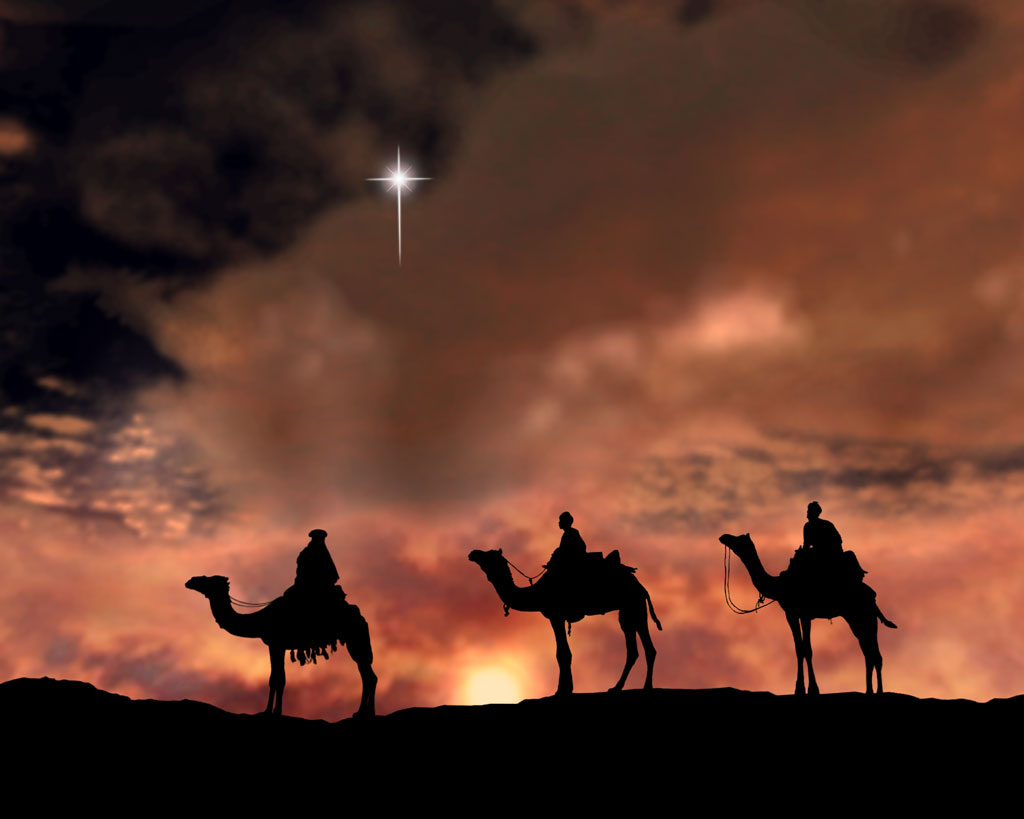
The Star and the Cross

chasing-star-of-bethlehem-412624

When they saw the star, they rejoiced with exceeding great joy. (Matthew 2:10)

Black was the sky of the oriental night
Bejeweled as an empress displaying her might.
Lost in the tedium of nocturnal watch,
The wisest of wise appraised a new sight.
 
High in the heavens and brighter than most
A dazzling new object had joined the host.
The astrologers pondered and ventured a guess:
“A mighty new monarch this beacon does toast.”
 
Consulting their sources and making their plans
The seekers trekked westward across the hot sands.
They followed the beacon that showed them the way
To the City of David, and the Savior of man.
 
By day and by night they followed the trail
Of their guiding light with much travail,
For a curious sight its beams had revealed
— The form of a cross in full detail.
 
For two years they followed their stellar guide
Until it rested, and shown with pride
O’er a humble house and the family there
Who with the Mighty King did abide.
 
So they offered their gifts, their praise to assign
As the cross and the star continued to shine,
And knowing not why, their burden was lifted;
The child in the house did their sorrow consign.
 
Some thirty years later, on a cross made of wood
The child, now a young man, there hung in the nude,
And the bright Star of Bethlehem continued to blaze,
The King of all kings gave His life to conclude.


1 Comment

Filed under Christianity, Christmas, Evangelism, Gospel, Poetry, Religion, Salvation, Theology

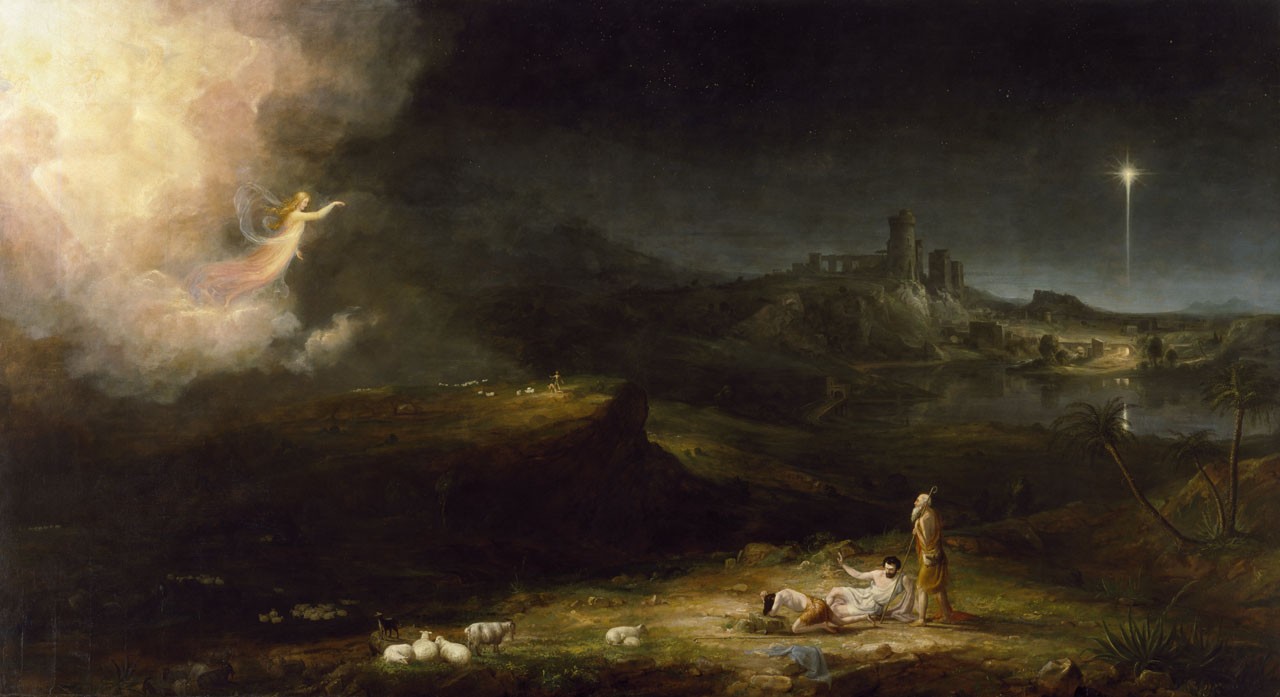
Shepherd of Shepherds

cole-angel-shepherds

“And there were in the same country shepherds abiding in the field, keeping watch over their flock by night.” (Luke 2:8)

One of the best arguments against the birth of Christ having taken place in late December is this fact recorded by Luke in his Gospel. There were shepherds out in the fields watching over their flocks. By late December, there is not sufficient grazing to sustain large flocks of sheep. Jerusalem is near the same latitude as Dallas, Texas where I live. By the middle to the end of November, there is not much left for cattle to graze on, so they need to be fed on hay or “cake.” So it seems very unlikely that shepherds would be out in the fields in the winter time.

The shepherds around Bethlehem generally kept the sheep and goats that were used for sacrifice in the Temple in nearby Jerusalem. Some have suggested that Jesus’ birth was around late September which coincides with the Jewish Fall Feasts: Feast of Trumpets (Rosh Hashanah), Day of Atonement (Yom Kippur) and Feast of Tabernacles (Sukkoths). These were feasts that required all Jewish men to make a pilgrimage to the Temple in Jerusalem. The fact that this requirement happened to coincide with the decree from Caesar Augustus for the census (Luke 2:1) may explain why “there was no room for them in the inn” (Luke 2:7) for the expectant couple. In fact, His birth may have occurred during the Feast of Tabernacles making John’s statement that “the Word was made flesh, and [tabernacled] among us” (John 1:14) even more significant. Interestingly, if one counts back nine months from the end of September, one arrives at a date sometime in late December. It could be that rather than celebrating Christ’s birth on December 25, we are actually celebrating His conception!

Regardless, it was to these simple shepherds that this paramount announcement was delivered. “For unto you is born this day in the city of David a Saviour, which is Christ the Lord” (Luke 2:11). To these shepherds who were known for feeding and protecting their flocks; who sought out the lost sheep, and rescued those that were attacked. It seems appropriate that to these the news of the arrival of the “Shepherd of Israel” should be first delivered. He who would later say, “I am the good shepherd: the good shepherd giveth his life for the sheep” (John 10:11) had come. So without hesitation they said, “Let us now go even unto Bethlehem, and see this thing which is come to pass, which the Lord hath made known unto us” (Luke 2:15). They came “with haste” Luke tells us, “and found Mary, and Joseph, and the [Lamb of God] lying in a manger” (Luke 2:16). His name was Jesus, “for he shall save his people from their sins” (Matthew 1:21). This little Lamb of God, who was to be the Shepherd of shepherds, had finally come to them.


1 Comment

Filed under Apologetics, Christianity, Christmas, Evangelism, Gospel, Religion, Salvation, Theology

Peace!

Christmas Bells

Glory to God in the highest, and on earth peace, good will toward men. (Luke 2:14)

Peace.  Such an elusive word.  So full of hope, and yet so seemingly unattainable.  The angels proclaimed “peace on earth, and good will toward men” as they announced the Savior’s birth that holy night.  There was no peace on earth at the time of that proclamation.  The Roman Empire was in control of a major part of the western world, and there was unrest in the land of Judea as one uprising after another was crushed by the heavy hand of the Roman legions.  Things then were not much different than what we see today – unrest in the Middle East, the constant threat of war, North Korea bent on becoming a nuclear power, China vamping up her navy and playing havoc with the American economy, Europe on the verge of economic collapse.  There is no peace on earth.

I heard the bells on Christmas day
Their old familiar carols play,
And wild and sweet the words repeat
Of peace on earth good will to men.
 
Then, in despair I bowed my head,
“There is no peace on earth,” I said,
“For hate is strong and mocks the song
Of peace on earth good will to men”
 

But the hope of peace is strong within man, and so the lowly shepherds to whom the announcement was made, left their flocks in hopes of catching a glimpse of the tiny Prince of Peace that had come into the world.  As a man, He would later say, “Peace I leave with you, my peace I give unto you: not as the world giveth, give I unto you.  Let not your heart be troubled, neither let it be afraid” (John 14:27).  Amidst all the trouble and chaos of the world, He still promises peace and encouragement: “Let not your heart be troubled, neither let it be afraid.”

Then peal the bells more loud and deep;
God is not dead, nor doth He sleep.
The wrong shall fail, the right prevail
With peace on earth good will to men.
 

A dear friend recently enlightened me to the fact that “Joy to the World” is not really a Christmas carol.  It is not about Christ’s first coming; it is about His second coming!  There will be no peace on earth until the King of Kings comes to reign over all of His creation.  At that time, it will be most appropriate to sing:

Joy to the world the Lord is come!
Let earth receive her king!
Let every heart prepare Him room,
And heaven and nature sing.
 
Joy to the earth! the Savior reigns!
Let men their songs employ;
While fields and floods, rocks, hills and plains
Repeat the sounding joy.
 
No more let sin and sorrow grow,
Or thorns infest the ground.
He comes to make His blessings flow
Far as the curse is found.
 
He rules the world with truth and grace,
And makes the nations prove
The glories of His righteousness,
And wonders of His love.
 

Writing almost 800 years before the first advent, the prophet Isaiah proclaims, “For unto us a child is born, unto us a son is given: and the government shall be upon his shoulder: and his name shall be called Wonderful, Counsellor, The mighty God, The everlasting Father, The Prince of Peace” (Isaiah 9:6).  The tiny babe Whose birth we celebrate this Christmas is the hope of peace for a troubled world and the realization of peace for those who know Him as Savior.  Let us find our peace in Him!

2 Comments

Filed under Christianity, Christmas, Current Events, End Times, Evangelism, Gospel, Religion, Salvation, Theology

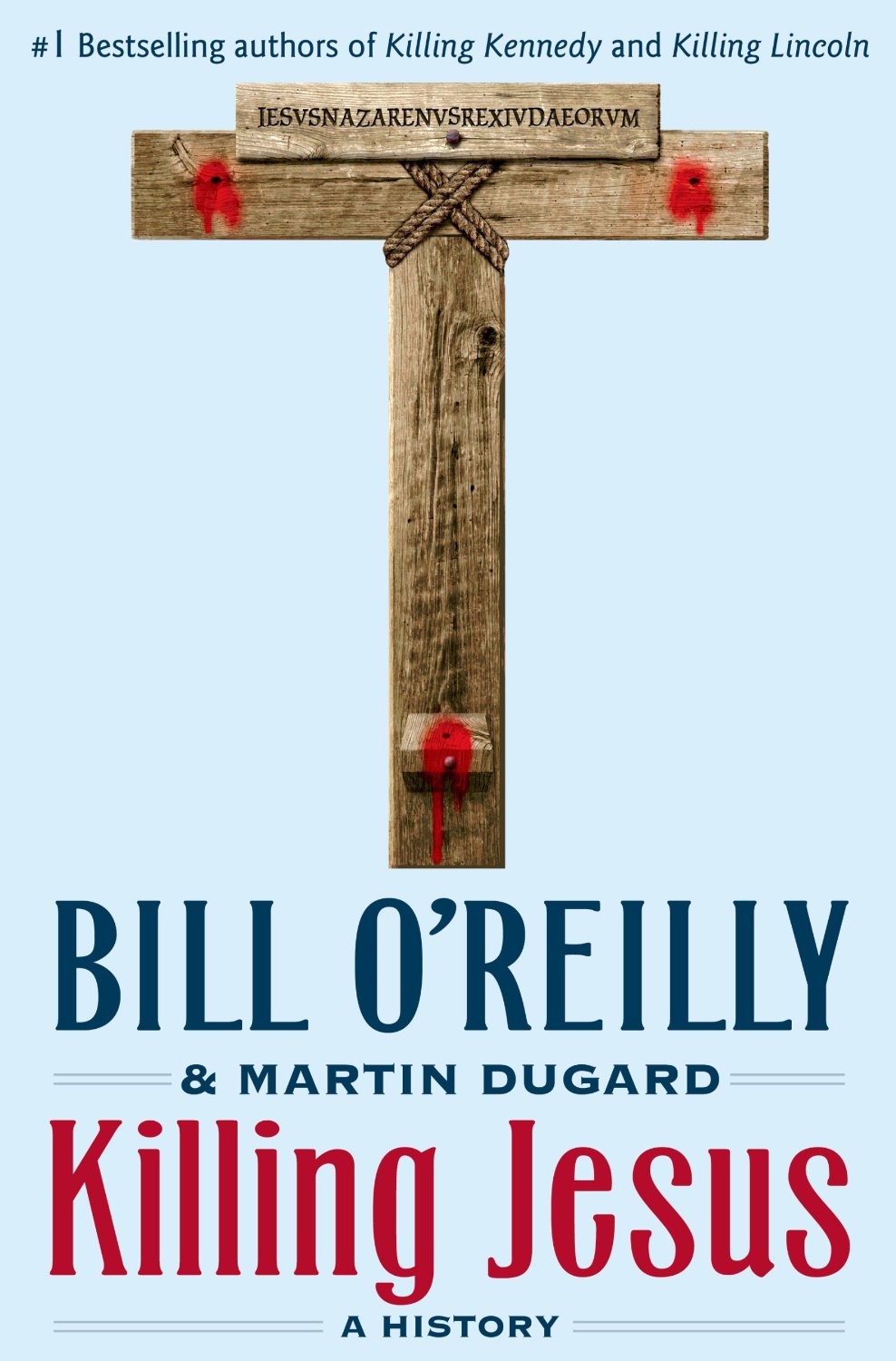
Killing Jesus: A Review

V06N25 Killing Jesus Cover

“Study to shew thyself approved unto God, a workman that needeth not to be ashamed, rightly dividing the word of truth.” (2 Timothy 2:15)

Since Bill O’Reilly, commentator and host of the O’Reilly Factor on the Fox News Channel, came out with his latest book, Killing Jesus: A History, Christian “Evangelicals” have turned out to opine on the work. Some, like the pastor of the First Baptist Church of Dallas, Texas have given the book rave reviews and even encouraged Christians to buy and read the book. Others have not been so kind. Since the pastor of the First Baptist Church of Dallas happens to be my pastor, I thought I would take him up on his recommendation. Having done so, I will now attempt to offer my hopefully “fair and balanced” review of the book.

First of all, I will say that Mr. O’Reilly and co-author Martin Dugard make an excellent writing team. I first experienced their work in Killing Lincoln, which I thoroughly enjoyed. Killing Jesus is no exception. The text flows very smoothly, and it entices the reader to continue non-stop. Had I the luxury of uninterrupted time to sit with a book, I might have been tempted, but alas, I had to consume it in short bursts. That gave me the advantage of time to ruminate on the content so that I am less likely to give a knee-jerk assessment of the work.

For what it is, I would recommend it to anyone who enjoys historical or biographical genres. It is not a spiritual book or a book that it is written in a way that honors or glorifies Jesus of Nazareth for Who He is – the Creator, Savior, and King of kings and Lord of lords – nor is it blasphemous in any way. It is just matter-of-fact. The authors present Jesus as an actual historical personage who impacted the world in a significant way. “To say that Jesus of Nazareth was the most influential man who ever lived is almost trite. Nearly two thousand years after he was brutally executed by Roman soldiers, more than 2.2 billion human beings attempt to follow his teachings and believe he is God” (p. 1).[1] The authors admit: “We do not address Jesus as the Messiah, only as a man who galvanized a remote area of the Roman Empire and made very powerful enemies while preaching a philosophy of peace and love” (p. 2). This approach should not come as a surprise since O’Reilly has often expressed and asserted his conviction that Scripture is allegorical and not to be taken literally. That brings into question his use of the Gospels as a historical resource. Indeed, he admits, “Of course we have the Gospels of Matthew, Mark, Luke, and John, but they sometimes appear contradictory and were written from a spiritual point of view rather than as a historical chronicling of Jesus’s [sic] life” (p. 1) If the Gospels are allegorical, as O’Reilly claims, then this book, as a history, is not worth the paper it is written on. Would a true historian rely on allegory to construct a factual account? To be fair, the authors also rely on extra-biblical sources to compose their story. It seems, however, that the Bible is only used to “fill in” where secular historians are silent. But, let us set that aside for the moment.

Evidently, the Gospel account failed to provide sufficient content to accomplish the purpose of this book, so the authors devoted the first third of the book to early Roman history to help set the stage for the main course and perhaps to add a little spice with the depravity of the Roman emperors. I am not a historian, so I will defer to Mr. O’Reilly on the accuracy of these accounts. My strength is in Scripture, and in that regard I can give an honest assessment.

The authors get the Gospel account right for the most part. I was especially surprised by a footnote that informs us that “The Gospels clearly state that Jesus had four brothers: James, Joseph, Judas, and Simon. They also mention that he had sisters, but the number is not specified” (p. 79). O’Reilly and Dugard are both practicing Roman Catholics and for that reason the admission is remarkable. The footnote continues: “The Roman Catholic Church believes Mary remained a virgin throughout her entire life. This doctrine was first put forth four centuries after Jesus lived by an early leader in the Church named Simon. The Church considers the siblings mentioned by the Gospels to be Jesus’s [sic] cousins” (p. 79).

The authors also get it right when they describe two separate temple cleansings by Jesus, one at the beginning of His ministry and one at the end (pp. 126, 192-193). Many Bible scholars miss this point, but sadly, the authors attribute this to error rather than accept it as fact. “Before being written down, the Gospels were oral histories. This might explain some discrepancies among them. The story of Jesus and the money changers is placed at the beginning of Jesus’s [sic] ministry in John (2:14-22), while [the other Gospel writers] all place it at the end. This has led some to speculate (emphasis added) that Jesus performed this cleansing twice, as specific details of the various Gospels account differ” (p. 126). Had the authors taken the time to seek a resolution to the “discrepancy,” as any good historian should do, they may have discovered that John was with Jesus from the very beginning. Matthew came along after the fact, and Mark and Luke were not a part of the original group of disciples. To these men, the last cleansing was most significant because it occurred in Jesus’ final week. All the Gospel writers had differing objectives in relaying their message, and so they tell the story from their individual perspectives. John’s purpose for his Gospel was to present Jesus as God. For him, the first cleansing establishes Christ’s divinity from the very beginning. You will recall John 1:1 “In the beginning was the Word, and the Word was with God, and the Word was God.” There is no discrepancy here, except in the minds of these authors. But they should at least get credit for recording two separate events (pp. 192-193). Since John wrote his Gospel last, surely he had access to those written previously, so his placement of the temple cleansing was not by mistake. John had a point to make as did the other Gospel writers, and all were accurate in their record.

Another point missed by many Bible scholars is in trying to synthesize the different accounts of Jesus’ anointing into one event. O’Reilly and Dugard at least distinguished two different accounts: the anointing at the house of Simon the Pharisee in Galilee before the Transfiguration (Luke 7:36-50, p. 144) and the anointing at the house of Simon the Leper in Bethany following Jesus’ Triumphal Entry into Jerusalem (Matthew 26:6-13, Mark 14:3-9, p 209). It is easy to see how these two separate events could be confused since both hosts are named Simon, but O’Reilly and Dugard correctly identified the two as separate events. However, they failed to include a third anointing which took place in (supposedly) the house of Lazarus, whom Jesus raised from the dead. This account is found in John 12:1-7 and precedes the Triumphal Entry. Martha, as usual, is serving and Mary, her sister, performs the anointing. I cannot be too critical of the oversight, since many Bible scholars make a worse mistake by trying to reconcile the three separate events as one.

The authors accurately record the Gospel accounts for the most part, but given O’Reilly’s presuppositional conviction on the allegorical nature of Scripture, several errors creep into this work. Take for example the baptism of Jesus by John the Baptist (p.103). The Gospel of John 1:29-40 records the baptism, but does not record the interchange between The Baptist and Jesus. As stated earlier, John’s purpose in writing his Gospel was to demonstrate the deity of Christ, and so minor details are unimportant to his account. Instead, John focuses on the Spirit of God descending upon Jesus in the form of a dove. The other Gospel writers also record a voice from heaven saying, “This is my beloved Son, in whom I am well pleased” (Matthew 3:17; Mark 1:11; Luke 3:22). But instead, John focuses on the words of John the Baptist: “And I saw, and bare record that this is the Son of God” (John 1:34, emphasis added). In this passage, we learn that John, the writer of this Gospel, was a firsthand witness from the very beginning. “One of the two which heard John speak, and followed him, was Andrew, Simon Peter’s brother” (John 1:40). The “one” not mentioned is John who never mentions himself by name throughout his Gospel.

Because of their myopia to the literal accuracy of the Gospel text, the writers of Killing Jesus appear somewhat incredulous that a dove coming out of nowhere should light upon Jesus and remain on him. “Suddenly a dove lands on Jesus’s [sic] shoulder. When Jesus makes no move to shoo it away, the bird is quite content to remain there” (p. 103). Looking at it that way, I believe I would be a little incredulous myself. These kinds of errors are systemic throughout the book. 

Another kind of error in this book is that of adding to Scripture. For example, on the account of the baptism of Jesus as He comes out of the water, the writers say, “The believers drop to their knees and press their faces into the earth. Jesus does not react to this sign of worship. He does nothing to discourage it either.” (p. 104). That is nowhere to be found in Scripture, certainly not in any of the Gospels, but the authors cite no references to substantiate that detail. The writers quote John 1:34 (quoted above) and then add, “The crowd remains on its knees as Jesus steps onto the shore and keeps on walking” (p. 105). This must be something the authors learned in catechism, which perhaps explains why no reference is cited, but it has no basis in Scripture.

I understand that the authors are attempting to keep a detached and “objective” perspective, but I found one statement to be rather insulting to our Lord. In telling about the calling of Peter and Andrew (Matthew 4:18-22; Mark 1:16-18; Luke 5:4-10) They recount that Jesus got into Peter’s boat and asked him to push away from the shore so that He could speak to the crowd that had assembled, “Though he [sic] knows next to nothing about fishing” (p. 136). In the first place, Jesus grew up in Nazareth, which is not that far from the Sea of Galilee; I am sure He would have known something about fishing. Furthermore, this is God who created fish and fishermen. That He knows something about fishing is demonstrated in that He gave instructions to lower the nets after the men had fished all night and came up empty, and the catch was more than they could handle. So, I find the assessment that Jesus “knows next to nothing about fishing” a little demeaning. In the same account, the authors claim that Peter was “A fisherman in his early twenties” (p. 137). Most scholars believe that Peter was probably around Jesus’ age or perhaps a little older. Again, the authors cite no references for this claim.

Other errors include the claim that the raising of Lazarus from the dead is a “legend” (p. 199 footnote). They mistake Jesus’ assessment of the Greatest Commandment as a “new” law, but oddly, in the footnote they cite Deuteronomy 6:5 (p. 205). This Greatest Commandment was nothing new; the Deuteronomy reference harkens back to the First and Second Commandments (Exodus 20:3-4). They also confuse Jesus’ agony in the Garden of Gethsemane as “panic” (p. 212). Jesus knew His mission from the very beginning. Luke records: “And it came to pass, when the time was come that he should be received up, he stedfastly set his face to go to Jerusalem” (Luke 9:51, emphasis added) indicating that Jesus was determined to go through with His sacrifice. There was no “panic” in Him. Finally, in the “Afterword,” the writers wrongly attribute the description of “a woman clothed with the sun” in Revelation 12:1 to Mary, the mother of Jesus. This obviously comes from the authors’ Roman Catholic doctrine. More than 1920 years after the time of Christ, “On November 1, 1950 the Roman Catholic Church decreed that [Mary’s] body had been ‘assumed into heaven’” (p. 265). If the authors had bothered to research this in greater depth, they may have learned that the “woman” described in Revelation is Israel, not Mary, and the child she bore is Jesus. The reason nothing more is heard of the woman, is because she, Israel, has not, and will not be destroyed as a nation. However, I would not expect Mr. O’Reilly to accept that explanation.

My final assessment of Killing Jesus: A History is that it is a well written book, easy to read and entertaining. I would not take it seriously as a “history” given that the authors view the Bible as allegory, and allegory is a highly questionable resource when trying to document real history. Admittedly, the authors assert that this is not a spiritual book, and because of that this book has little value from a spiritual perspective. Some supposed Christians claim that the book has strengthened or renewed their faith. That may be true if the “Christian” doubted the historicity of Jesus in the first place. This book might have some value in that regard. I would not recommend this book as a “witnessing” tool as it gives a very poor witness. As I stated at the beginning, the authors are not blasphemous in any way, but at the same time, they do not give Jesus His proper due. He is presented as a mere man on a mission who got on the wrong side of the governing and religious authorities. There is more to Jesus than these authors portray. The book presents Him as a victim ignoring His very words, “I lay down my life for the sheep … No man taketh it from me, but I lay it down of myself” (John 10:15, 18).  Jesus is God, whether “some” believe it or not, and the Bible is not allegory. Killing Jesus might have been a better book, if the authors had taken the Gospel account seriously and literally. That said, I would not discourage anyone from reading it, but I would caution against taking it seriously.


[1] Direct quotes are denoted with the page number on which they are found in the book.

2 Comments

Filed under Apologetics, Book Reviews, Christianity, Religion

The Email That Got Me Fired

halloween-picture

Abstain from all appearance of evil. (1 Thessalonians 5:22)

Ten years ago I was working for a non-profit “Christian” organization in the area. It was approaching Halloween, and it was decided that the staff would celebrate by dressing up in costumes; “scary” costumes were encouraged. I thought it was odd for a “Christian” organization to “go all out” like that for celebration of what is arguably the most pagan of all pagan holidays. So, I addressed the following email to all staff. I had been working there more than 90 days, and had received countless “junk” emails from other staff members, so I saw no harm in sharing my sentiments with all the staff. The email read as follows …

Hello All,

Remember the movie “Multiplicity” staring Michael Keaton? In the movie, Doug Kinney, played by Michael Keaton, can’t seem to find enough time to do all the things he needs or wants to do, so he finds a solution in duplicating himself by cloning. As the plot develops, the first clone then clones himself, then the second clone clones himself and so on. With each duplication the resultant product greatly degenerated from the previous – a lot like when one makes a copy of a copy of a copy, etc. Finally, the last clone ends up being a slobbering idiot.  Doug Kinney then finds himself in the dilemma of how to deal with his “offspring.”

What does that have to do with Halloween?  Well, I’m getting to that.

The first five books of the Bible tell, among other things, of how God brought the children of Israel (Jacob) out from Egyptian bondage through His servant Moses.  Now Moses was not perfect, and because of one act of disobedience, he was not allowed to enter the “Promised Land.”  But Moses had a protégé, a clone, if you will, that would take over for him and complete the task of taking the children of Israel into the Promised Land.  His name was Joshua.  Now, Joshua was a great leader, but he was no Moses.

The sixth book of the book of the Bible takes its name from him, Joshua. It tells the history of how the children of Israel conquered the Promised Land – the land of Canaan.  God’s instruction to the children of Israel through Joshua was to completely wipe out the inhabitants of the land – every man, woman, child and every beast. (There are good reasons why God commanded the annihilation of an entire race of people from the land, but that is another story, which will really get me off track.) When you come to the end of Joshua, you find that Israel failed in their God-given task. Instead, they started living in and among the people of the land and started adopting their customs and their pagan religions. This act of disobedience plagued Israel throughout their history.

So, what does that have to do with Halloween? Hang on; I’m getting there.

At the end of the book of Joshua we find Joshua calling the children together for one final word. Most of the land had been conquered, but the Canaanites were still in the land. The probability was very great that the children of Israel would turn to worshipping other gods, and so Joshua gave this final admonition:

Now therefore fear the LORD, and serve him in sincerity and in truth: and put away the gods which your fathers served on the other side of the flood, and in Egypt; and serve ye the LORD.  And if it seem evil unto you to serve the LORD, choose you this day whom ye will serve; whether the gods which your fathers served that were on the other side of the flood, or the gods of the Amorites, in whose land ye dwell: but as for me and my house, we will serve the LORD. (Joshua 24:14-15)

Great admonition, but not as strongly phrased as I think Moses would have put it. To me, it sounds a lot like our post-modern, relativistic rhetoric that says, “That’s your truth, but it’s not my truth,” or “You’re entitled to your truth, and I’m entitled to mine.”  (Many of you may be thinking that very thing about this discourse.)  In essence, what Joshua was saying was, “If you want to worship other gods, go ahead; I and mine will serve the LORD.”  He started out strong: “Serve the LORD,” but then he took the edge off by giving them an option.

When you read the next book, Judges, you see how the degeneration progressed.  The further the children of Israel got away from the Exodus, the further they got away from God.  That’s what the movie, “Multiplicity” reminds me of.  The further we get away from the original, the fuzzier the lines become.  What used to be sharp lines of contrast become so blurred that one cannot tell where one line ends and another begins.  What used to be considered evil is now a minor indiscretion or just another lifestyle choice or not evil at all. Black and white has blended into an indistinguishable gray.

So, what does that have to do with Halloween?  Well, I’m glad you asked that question.  Halloween has become one of those national pastimes that are given no thought at all.  Haunted houses attract the thrill seeker looking for that rush of adrenaline.  Horror flicks offer the same allure.  Vampires, zombies, demons, ghosts and witches all wait in the darkness ready to pounce on us at the moment we expect them least.  Of course, all of this is intended for fun, and we wholeheartedly participate in the same spirit of frivolity as we don our favorite scary costumes.  What’s the harm in that?  The harm is that the sharp lines of contrast between good and evil have been blurred almost to the point of oblivion.

Halloween, in its origins, was not a harmless pastime.  It originated in the dark ages when, due to ignorance, people genuinely feared the “things that go bump in the night.”  They feared demons and ghosts and witches and vampires.  The church was no help in dispelling those fears, and to a certain extent, was responsible for propagating many of those fears.

My intent here is not to go into a history of Halloween, but rather sharpen the lines of contrast that have been blurred though the passing of time.  Demons are real.  The Devil is real.  I have no fear of them because I know the One in whose hands I’m kept, but that does not negate the reality of their work, which is primarily that of deception.  Jesus identified Satan as the father of all lies.  In His debate with the Jewish leaders, He leveled the following accusation against them:

Ye are of your father the devil, and the lusts of your father ye will do. He [Satan] was a murderer from the beginning, and abode not in the truth, because there is no truth in him. When he speaketh a lie, he speaketh of his own: for he is a liar, and the father of it. (John 8:43-44)

So, the lie is that Halloween is a harmless pastime.  It’s a lie because the root and the source of Halloween is evil, not good; however, the lines have been blurred to the point where we can’t tell the difference.  We have accepted it into our culture for so long that we have lost all sensitivity to the danger – like a frog in a kettle.

I then offered an article by Kerby Anderson, of Probe Ministries, entitled “Ten Reasons Christians Should Not Celebrate Halloween.” It is no longer on his site. He must have caught a lot of flack over it and decided to take it down, or else he decided it was no longer relevant. Whatever the reason, I cannot offer a link to it, but I did keep it over these many years. Here are the ten reasons he offered:

  1. October 31st has long been known as “The Festival of the Dead.” The Celtic tribes and their priests the Druids celebrated this day as a marker for the change from life to death.
  2. Halloween today is performed usually by adherents of witchcraft who use the night for their rituals. Witches celebrate Halloween as the “Feast of Samhain,” the first feast of the witchcraft year. Being a festival of the dead, Halloween is a time when witches attempt to communicate with the dead through various forms of divination.
  3. Christians should not be involved with occultic practice or divination. Note God’s command against divination in Deuteronomy 18.
  4. Occultists believe Halloween is a time of transition between life and death. Some occult practitioners practiced divination and believed you could learn the secrets of life and wisdom by lying on a grave and listening to the messages from the long-departed.
  5. Occultists also taught that spirits and ghosts left the grave during this night and would seek out warmth in their previous homes. Villagers, fearful of the possibility of being visited by the ghosts of past occupants, would dress up in costumes to scare the spirits on their way. They would also leave food and other treats at their door to appease the spirits so they would not destroy their homes or crops but instead move on down the road. That is the real reason why kids dress up in costumes today and go door-to-door seeking treats.
  6. Occultists also would try to scare away the spirits by carving a scary face into a pumpkin. This horrible visage would hopefully move the spirit on to another home or village and spare that home from destruction. Sometimes the villagers would light a candle and place it within the pumpkin and use it as a lantern (hence the name, Jack-o-Lantern). This is the origin of carving pumpkins at Halloween.
  7. In some witchcraft covens, the closing ritual includes eating an apple or engaging in fertility rites. In the Bible (Genesis 3), eating a piece of fruit brought sin and death into the world. In witchcraft, eating an apple is symbolic of bringing life. The practice of bobbing for apples brings together two pagan traditions: divination and the fertility ritual.
  8. Schools are removing any religious significance from Christmas (often called winter break) and Easter (spring break). Isn’t it ironic that most public schools still celebrate Halloween even though it has occultic origins?
  9. Participating in Halloween gives sanction to a holiday that promotes witches, divination, haunted houses, and other occultic practices.
  10. Christians should avoid Halloween and develop creative alternatives. Churches can hold a Fall Fun Festival and/or celebrate Reformation Day (also October 31). They should not endorse or promote Halloween.

Allow me to offer an eleventh reason why Christians should not celebrate Halloween.  As Christians, the Bible exhorts us to abstain from any appearance of evil.  Paul, in his first letter to the Thessalonians said, “Abstain from every form of evil.” (1 Thessalonians 5:22)  The Greek word translated “form” is “eidous,” which means the “visible form” or the “outward show” – the appearance of something.  The lines of distinction between the original form of Halloween may have been blurred by hundreds of years of “cloning,” but it still has, if nothing else, the “appearance” of evil – kind of like Doug Kinney’s last clone.  It looked like him, but was really nothing like him except for his appearance.

This coming Halloween, we have been invited to dress up in costumes in celebration of the day.  I, for one, do not plan to participate.  I will stand with Joshua and in paraphrase say, “As for me and my house, we will not do Halloween.”  If you find that odd, I will simply respond in a typical post-modern, relativistic fashion by wagging my head from side to side and exclaiming, “Whatever.”   You do whatever you think is right in your own eyes, but I will abstain, as far as God will strengthen me, from any appearance of evil.

The day after the email went out, I was fired. I missed out on all of the Halloween doings at that office. But I was not left destitute. God in His faithfulness provided and has continued to bless even now. I still do not celebrate Halloween in any form or fashion, although, I will partake of Halloween candy!

5 Comments

Filed under Christianity, Current Events, Religion