Category Archives: Theology

All New Things

And he that sat upon the throne said, Behold, I make all things new. And he said unto me, Write: for these words are true and faithful. (Revelation 21:5)

 We have entered the new year, 2023. How does the future look? Do you think this year will be better than last?

Let us take a sober look at conditions worldwide. North Korea is testing nuclear ballistic missiles and threatening South Korea. China continues to build up its military and threatening the tiny island nation of Taiwan. Iran is within weeks of enriching weapons-grade uranium and continues to threaten Israel and the United States. Russia relentlessly batters the sovereign nation of Ukraine without regard for millions of innocent Ukrainian citizens. Russia, Turkey, and Iran along with their allies are amassing armies and military equipment in Syria and setting the stage for the Gog of Magog war against Israel described in Ezekiel 38-39. The wars and rumors of wars Jesus predicted are all over the world.

Violence permeates the entire world. There are riots in China, Iran, Russia, France, Brazil, and many other nations. Here in the United States, violent crimes go unanswered. Jesus said the last days would be as in the days of Noah,[1] which were days filled with violence.[2] Jesus also said that the last days would be as the days of Lot.[3] Those days were characterized by rampant sexual deviancy.[4] Consider what goes on today with the LGBTQ+ movement and their agenda to pervert innocent children with their drag queen shows that they conduct with children. What are the parents thinking! Children are being trafficked for sexual purposes to deviants and perverts, and if that is not bad enough, abortion continues to rise even with the reversal of Roe v Wade.

On top of all of that, economies are failing all over the world. When that happens, evil leaders become desperate and look to war in order to distract their people from their sufferings. Vladimir Putin has openly made threats of nuclear attacks on any nation that opposes his advances on Ukraine. North Korea, China, and Iran echo their own threats. Meanwhile, the Globalists, many of whom are powerful people in our own government, lick their chops like buzzards circling a dying corpse, eagerly waiting on the demise of the nations so they can come in, “build back better” and install a New World Order.

Our world is sick and getting sicker by the day; 2023 offers no hope for improvement.

What follows, I wrote two years ago with a few changes to bring it up to date.

I am not a pessimist, but I do read what the Bible has to say about the end times. If the Bible is true (and it is), things will get worse before the Lord returns. Jesus said, “And ye shall hear of wars and rumours of wars: see that ye be not troubled: for all these things must come to pass, but the end is not yet. For nation shall rise against nation, and kingdom against kingdom: and there shall be famines, and pestilences, and earthquakes, in divers places. All these are the beginning of sorrows” (Matthew 24:6-8, emphasis mine).

Does that not sound familiar these days? So, do not expect 2023 to get better; it will only get worse. Now, what do we do in light of this dismal outlook; crawl under a rock and hide away? NO! We face the future with the assurance that God has all things in His control.

 What Does God Have to Say About It?

As Moses prepared Israel to enter the Promised Land, a new land filled with giants, dangers, and unknowns, he encouraged them not to fear because God was with them. “Behold, the LORD thy God hath set the land before thee: go up and possess it, as the LORD God of thy fathers hath said unto thee; fear not, neither be discouraged” (Deuteronomy 1:21, emphasis mine). As Israel prepared for battle against their enemies, the priests were to encourage the people, “And shall say unto them, Hear, O Israel, ye approach this day unto battle against your enemies: let not your hearts faint, fear not, and do not tremble, neither be ye terrified because of them; For the LORD your God is he that goeth with you, to fight for you against your enemies, to save you” (Deuteronomy 20:3-4, emphasis mine). The unknown is frightening, but God promises to go with us and even to fight our battles,

So, “Be strong and of a good courage, fear not, nor be afraid of them: for the LORD thy God, he it is that doth go with thee; he will not fail thee, nor forsake thee” (Deuteronomy 31:6, emphasis mine). When we attempt to face challenges on our own, WE WILL FAIL, but God will never fail us or leave us alone.

God has unlimited resources. When Syria harassed Israel, their efforts were constantly thwarted because God, through Elisha, warned the king of Israel before every attack. The king of Syria suspected that he had a spy within his ranks, but one of his servants told him about Elisha the prophet who warned the king of Israel ahead of every attack. Therefore, the king of Syria sent an army and surrounded Elisha’s house. “And when the servant of the man of God was risen early, and gone forth, behold, an host compassed the city both with horses and chariots. And his servant said unto him, Alas, my master! how shall we do? And [Elisha] answered, Fear not: for they that be with us are more than they that be with them. And Elisha prayed, and said, LORD, I pray thee, open his eyes, that he may see. And the LORD opened the eyes of the young man; and he saw: and, behold, the mountain was full of horses and chariots of fire round about Elisha” (2 Kings 6:15-17, emphasis mine).

“And David said to Solomon his son, Be strong and of good courage, and do it: fear not, nor be dismayed: for the LORD God, even my God, will be with thee; he will not fail thee, nor forsake thee, until thou hast finished all the work for the service of the house of the LORD” (1 Chronicles 28:20, emphasis mine). David referred to the Temple Solomon would build. Solomon had the promise that God would not abandon him until the work was complete. Today, believers are the “living temples” of God (1 Corinthians 3:16). As long as God lends us breath, we have work to do “for the service of the house of the LORD.”

Fear thou not; for I am with thee: be not dismayed; for I am thy God: I will strengthen thee; yea, I will help thee; yea, I will uphold thee with the right hand of my righteousness … For I the LORD thy God will hold thy right hand, saying unto thee, Fear not; I will help thee.” (Isaiah 41:10, 13, emphasis mine). When we trust God, He is our strength and our help, He sustains us and holds our right hand.

 Jesus said, “Are not five sparrows sold for two farthings, and not one of them is forgotten before God? But even the very hairs of your head are all numbered. Fear not therefore: ye are of more value than many sparrows” (Luke 12:6-7, emphasis mine). God cares for all of His creation, even those we would count as insignificant. He knows us intimately, even to the most minute detail – the number of hairs on our heads. Since God cares so much for common sparrows, how much more does He care for those created in His image?

What Can We Do?

When Babylon conquered Judah, Nebuchadnezzar carried away the Jews in three deportations. Nebuchadnezzar set Gedaliah as governor over Judah after the third deportation to Babylon. They were going into captivity. In that circumstance, the people are encouraged to “fear not,” accept the situation, and it would be well with them. “And Gedaliah the son of Ahikam the son of Shaphan sware unto them and to their men, saying, Fear not to serve the Chaldeans: dwell in the land, and serve the king of Babylon, and it shall be well with you” (Jeremiah 40:9; 2 Kings 25:24, emphasis mine). God promises to be with us even in difficult situations.

Jesus said, “And fear not them which kill the body, but are not able to kill the soul: but rather fear him which is able to destroy both soul and body in hell” (Matthew 10:28, emphasis mine). The Greek word translated “fear” (used twice in this verse) is phobeō, from which we get the English word “phobia.” Strong’s defines it this way: “to frighten, that is, (passively) to be alarmed; by analogy to be in awe of, that is, revere: – be (+ sore) afraid, fear (exceedingly), reverence” (emphasis mine). With that in mind, Jesus says not to fear or be frightened of those that can kill the body – that would include COVID-19. Rather, we should “revere” the One who ultimately determines our eternal destiny.

When Jesus selected His disciples, Luke records the account this way: “And so was also James, and John, the sons of Zebedee, which were partners with Simon. And Jesus said unto Simon, Fear not; from henceforth thou shalt catch men” (Luke 5:10, emphasis mine). The world may be falling down all around us, but we are not to “shelter in place.” Jesus gave us the “good news” for us to share with those around us.

Jesus also said, “And seek not ye what ye shall eat, or what ye shall drink, neither be ye of doubtful mind. For all these things do the nations of the world seek after: and your Father knoweth that ye have need of these things. But rather seek ye the kingdom of God; and all these things shall be added unto you. Fear not, little flock; for it is your Father’s good pleasure to give you the kingdom. Sell that ye have, and give alms; provide yourselves bags which wax not old, a treasure in the heavens that faileth not, where no thief approacheth, neither moth corrupteth. For where your treasure is, there will your heart be also” (Luke 12:29-34, emphasis mine). We are not to be overly concerned with our material needs. Jesus promises that God will provide what we need.

 “For the eyes of the Lord are over the righteous, and his ears are open unto their prayers: but the face of the Lord is against them that do evil. And who is he that will harm you, if ye be followers of that which is good? But and if ye suffer for righteousness’ sake, happy are ye: and be not afraid of their terror, neither be troubled; But sanctify the Lord God in your hearts: and be ready always to give an answer to every man that asketh you a reason of the hope that is in you with meekness and fear: Having a good conscience; that, whereas they speak evil of you, as of evildoers, they may be ashamed that falsely accuse your good conversation [i.e., behavior/conduct] in Christ” (1 Peter 3:12-16, emphasis mine). When we are secure in the Lord’s care, we can be confident to face whatever the future may bring. When others see our confidence, they will want to know the reason for it, and we need to be prepared to give an answer.

 Conclusion:

We cannot stop 2023 from coming. We cannot alter the circumstances that 2023 will bring. Jesus said, “These things I have spoken unto you, that in me ye might have peace. In the world ye shall have tribulation: but be of good cheer; I have overcome the world” (John 16:33, emphasis mine). However, we can control our own outlook when we place our trust in God knowing that all things are under His control and that He cares for His own. Again, Jesus said, “Peace I leave with you, my peace I give unto you: not as the world giveth, give I unto you. Let not your heart be troubled, neither let it be afraid” (John 14:27, emphasis mine). Ultimately, we have the promise of eternal life with Him in a new heaven and a new earth (Revelation 21:1-5).
Notes:


[1]  Matthew 24:37-38

[2]  Genesis 6:13

[3]  Luke 17:28

[4]  Genesis 19:5

Comments Off on All New Things

Filed under Apologetics, Christianity, Current Events, End Times, Eschatology, Gospel, Holidays, New Year's Day, Theology

Came and Coming

But when the fulness of the time was come, God sent forth his Son, made of a woman, made under the law, (Galatians 4:4)

Today is the 1,686th Christmas since the holy day was first sanctioned in AD 336. Before then, the date of Jesus’ birth remained in question, but December 25 was not considered an option. “Around AD 200, Clement of Alexandria wrote: ‘There are those who have determined not only the year of our Lord’s birth, but also the day; and they say that it took place in the 28th year of Augustus, and in the 25th day of [the Egyptian month] Pachon [May 20] … Further, others say that He was born on the 24th or 25th of Pharmuthi [April 20 or 21].’”[1]

This year December 25th falls on Sunday and this will not recur again for another 11 years. What better day to celebrate the birth of our Lord than on “the Lord’s Day”! Of course, we gather and worship together every Sunday, the Lord’s Day, because it commemorates His resurrection from the dead. So, this Sunday, we remember both His entry into this world to die for our sins and His victory over death to provide eternal life for us.

He came once as foretold by the prophets. I have not counted them myself, but supposedly, there are over 300 prophecies foretelling Jesus’ first coming.[2] “Using the science of probability, we find that the chances of just forty-eight [48] of these prophecies being fulfilled in one person to be only one in ten157[1×10157].”[3] That is a mathematical impossibility! Even so, Jesus fulfilled every prophecy concerning His first coming.

The Old Testament also foretells of Jesus’ second coming. However, the OT prophets conflated both prophecies of His first and second coming. For them, the prophecies foretold the coming Messiah who would rule as king over all the world. In retrospect, we can read these prophecies and distinguish those that have been fulfilled by His first coming and those that are yet to be fulfilled.

Since Jesus fulfilled the prophecies of His first coming, we can conclude that He will fulfill all those concerning His second coming beginning with Jesus’ own promise of His return. “Let not your heart be troubled: ye believe in God, believe also in me. In my Father’s house are many mansions: if it were not so, I would have told you. I go to prepare a place for you. And if I go and prepare a place for you, I will come again, and receive you unto myself; that where I am, there ye may be also” (John 14:1-3, emphasis mine).

The most meaningful thing for me about this Christmas is knowing that just as Jesus came the first time, He is coming again. As we study the prophecies of Jesus’ second coming, we recognize the “signs of the times” that signal the soon return of Jesus. I look forward to what 2023 will bring. I hope to meet Him in the air.[4]

He came, and He is coming again. Are you prepared to meet Him? If not, please read my page on “Securing Eternal Life.”

Notes:


[1] Christmas – Wikipedia

[2]  Prophecies Fulfilled by Jesus at his First Coming – Jesus is God and Lord Ministries

[3]  Josh McDowell, More Than A Carpenter, (Tyndale House, Wheaton, Ill, 1977), p. 103.

[4] 1 Thessalonians 4:17

Comments Off on Came and Coming

Filed under Apologetics, Bible, Christianity, Christmas, End Times, Eschatology, Rapture, Second Coming of Christ, Theology

Peace, Goodwill Toward Men

Glory to God in the highest, and on earth peace, good will toward men. (Luke 2:14)

I grew up listening to the Christmas account in the Gospel of Luke (Luke 2) in the language of the King James Version of the Holy Bible. Well, that is not entirely true. My first memories of the reading were from the Reina-Valera Spanish translation, but from the time I entered school in the first grade, it was the good old King James Bible. To this day, when I hear the reading from any other translation, it just does not sound the same. It loses something of the cadence and the poetic flow. I do not care; I just like the sound of the King James better.

 I always pay close attention when Scripture is read, and lately, the reading of Luke 2:14 has troubled me. Here are some examples from modern translations. I will emphasize the portion that bothers me.

“Glory to God in the highest heaven, and on earth peace to those on whom his favor rests.” (NIV)

“Glory to God in the highest and on earth peace to those on whom his favor rests.” (NABRE)

“Glory to God in highest heaven, and peace on earth to those with whom God is pleased.” (NLT)

“Glory to God in the highest heaven, and on earth peace among those whom he favors!” (NRSVUE)

“Give glory to God in heaven, and on earth let there be peace among the people who please God.” (NCV)

“Glory to God in the highest, and on earth peace among those with whom he is pleased!” (ESV)

Above are just some of the more popular modern translations. I did not quote the New King James Version (NKJV) because it reads pretty much like the KJV on this verse. So, what is the problem? Notice the phrases I emphasized. All of these seem to offer peace only to those whom God has favored. Wait a minute! What about all the others that fall outside of those boundaries? Is God’s favor withheld from some and lavished only on a select few that for whatever reason known only to God meet certain criteria?

As quoted above, the KJV (and the NKJV) read, “Glory to God in the highest, and on earth peace, good will toward men.” There are no exceptions. God’s peace and His goodwill are meant for all men, not just those who have found special favor with Him. All men!

Those who would defend the modern translations will say that those translations have been translated from “older and better (Greek) texts.” Most of us accept such statements as factual because they come from well-studied “scholars” – experts. We take it for granted that they are right. But, are they? The only way to know for certain is to look at the original language.

Here is Luke 2:14 in the original Greek: δοξα εν υψιστοις θεω και επι γης ειρηνη εν ανθρωποις ευδοκια. I know most of my readers do not read Greek, so I will translate.

δοξα – Glory

εν υψιστοις – in highest

θεω – to God

και επι γης – and on earth

ειρηνη – peace

εν ανθρωποις – to men

ευδοκια – goodwill; kindly intent; benevolence; delight; pleasure; satisfaction

There you have it. The news, the peace, and the goodwill are not only for a select, favored few, but to all mankind. The KJV has it right, the other translations have added to Scripture, a practice that is strongly condemned in Scripture.

The good news of Christmas is for all mankind. Do you know the Peace of Christmas? If not, please read my page on “Securing Eternal Life.”

Comments Off on Peace, Goodwill Toward Men

Filed under Apologetics, Bible, Christianity, Christmas, Holidays, Theology

The Fullness of Time

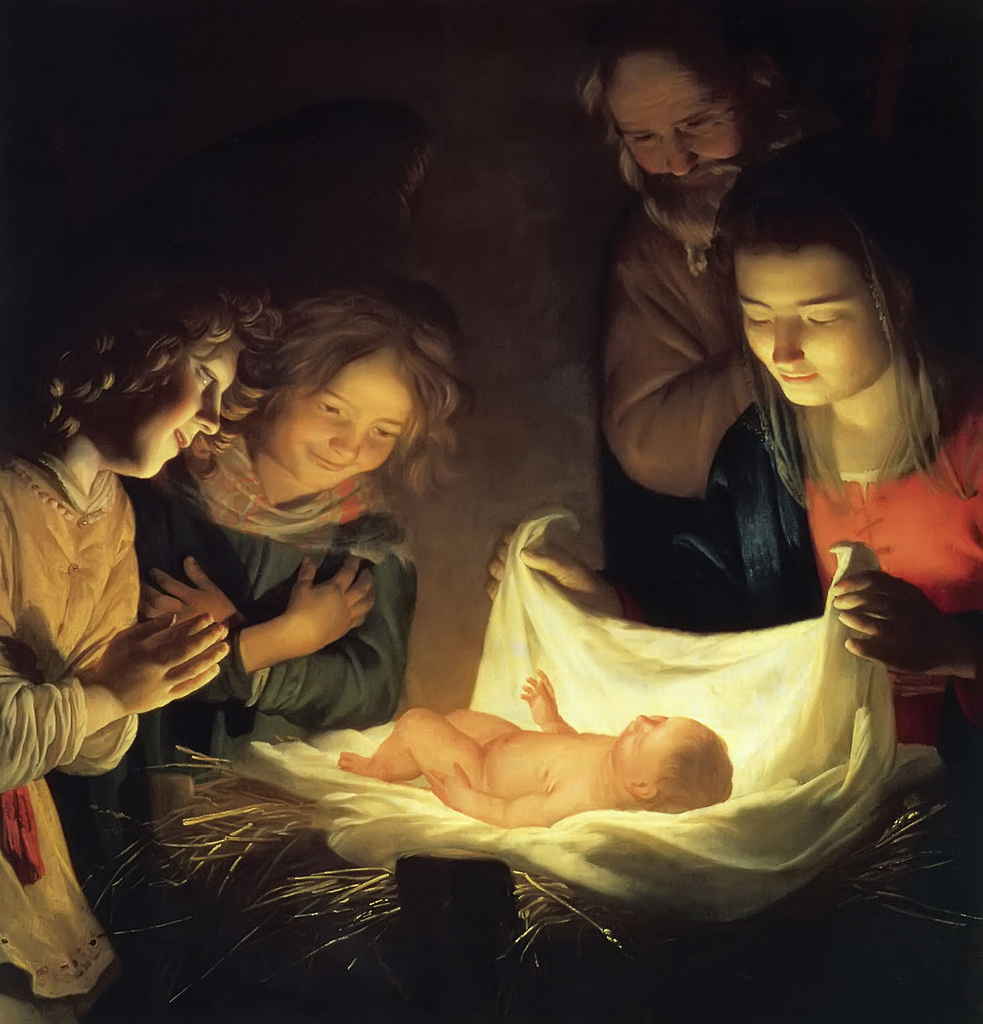
Adoration of the Child

But when the fulness of the time was come, God sent forth his Son, made of a woman, made under the law, To redeem them that were under the law, that we might receive the adoption of sons.  (Galatians 4:4-5)

It’s that time of year again; Christmas is in the air. Regardless of your perception of Christmas – it’s too commercial, it’s under attack, it’s just a pagan celebration dressed up in Christian garb, etc. – it is altogether appropriate that Christians set time aside to commemorate the first advent of our Lord and Savior Jesus Christ.

At this time we remember the miraculous conception and birth of God made man (John 1:14), but too often our focus shifts away from the significance of that event to the sappy sentimentality of the Nativity scene. As sweet as the image of a cuddly infant lying in a feeding trough adored by loving parents and worshipped by shepherds and wise men may be, the fact remains that this baby was God clothed in human flesh. The thought that the Creator condescended to take the form of His fallen creation (Philippians 2:7) to redeem as many as would receive Him (John 1:12), should leave us awestruck.

This was no afterthought on the part of God. In my article, “Why Satan?,” I address the issue of why God allowed sin in the first place, but along with the possibility of sin, God provided a way out (Hebrews 4:3; Revelation 13:8). From the very beginning there was the promise of a Savior (Genesis 3:15). Eve understood this promise, and at the birth of her first-born she rejoiced, “and said, I have gotten a man from the LORD” (Genesis 4:1). The literal translation of the Hebrew actually says “I have gotten a man Yahweh (the Lord).” She believed that she had given birth to the Savior according to the promise of God. But the time was not right. God wanted His creation, man in particular, to “be fruitful and multiply” (Genesis 1:28; 9:1). Abraham “Who against hope believed in hope, that he might become the father of many nations, according to that which was spoken, So shall thy seed be” (Romans 4:18).  That promise was not only for Abraham, “But for us also, to whom it shall be imputed, if we believe on him that raised up Jesus our Lord from the dead; Who was delivered for our offences, and was raised again for our justification” (Romans 4:24-25). For “The Lord is not slack concerning his promise, as some men count slackness; but is longsuffering to us-ward, not willing that any should perish, but that all should come to repentance” (2 Peter 3:9). So, when the time was right, God entered the world He created (John 1:3) as a helpless baby – fully God and fully man – to give up His life to buy back and restore His fallen creation. “For God so loved the world, that he gave his only begotten Son, that whosoever believeth in him should not perish, but have everlasting life” (John 3:16).

Very soon, at the fullness of time, He will return for His own as He promised: “And if I go and prepare a place for you, I will come again, and receive you unto myself; that where I am, there ye may be also” (John 14:3). So, regardless of your perspective on Christmas, as Christians it is a good time to remember that baby in the manger was God who came to die for us that we may live with Him, and soon we will be with Him.

1 Comment

Filed under Apologetics, Christianity, Christmas, Creation, Current Events, End Times, Evangelism, Gospel, Heaven, Religion, Second Coming of Christ, Theology

Miracle of the Incarnation*

Baby Jesus in Manger

And the Word was made flesh, and dwelt among us, (and we beheld his glory, the glory as of the only begotten of the Father,) full of grace and truth”

(John 1:14).

At Christmastime many of us take time to reflect on the birth of Christ and the miracle of His incarnation; but His birth was not a miracle.  Jesus came into this world like billions of babies before Him and like billions of babies after Him.  Yes, the angels announced His birth to humble “shepherds abiding in the field, keeping watch over their flock by night” (Luke 2:8), and some magi saw “His star in the east” and came “to worship Him” (Matthew 2:2); but His birth, as special as it was, was no miracle.  A line in a favorite Christmas carol says, “The cattle are lowing, the dear baby wakes; but little Lord Jesus no crying He makes.” That is a sweet sentiment, but it is completely false.  Jesus cried at His birth just like any other baby.  He wet and soiled his diapers, just like any other baby.  He took nourishment from Mary’s breasts as any baby would from its mother.  There was nothing miraculous in any of that.

The miracle was not in His birth, but in His incarnation as a zygote in a virgin’s womb.  Skeptics challenge this on the impossibility of a virgin conceiving without the natural function of a man, but the impossibility of such a thing is what qualifies it as a “miracle.”  Mary expressed the same concerns when the angel relayed the news of her impending pregnancy.  The angel assured her that “with God nothing shall be impossible” (Luke 1:37).  This was in keeping with and in the fulfillment of Isaiah’s prophecy saying “Therefore the Lord himself shall give you a sign; Behold, a virgin shall conceive, and bear a son, and shall call his name Immanuel” (Isaiah 7:14).  Critics will point out that the Hebrew word translated “virgin” here is ‘almā, which strictly translated means “young woman.”  However, the translators of the Septuagint translated the same Hebrew word into the Greek parthenos, which has no other meaning than “virgin.”  This is the same Greek word that Matthew uses when he points to the fulfillment of Isaiah’s prophecy: “Behold, a virgin [parthenos] shall be with child, and shall bring forth a son, and they shall call his name Emmanuel, which being interpreted is, God with us” (Matthew 1:23).

Another problem arises with Jesus’ lineage.  He was prophesied to be in the line of David the king (2 Samuel 7:12-13, 16).  This promise was confirmed to Mary by the angel Gabriel: “He shall be great, and shall be called the Son of the Highest: and the Lord God shall give unto him the throne of his father David” (Luke 1:32).  Matthew presents an ancestral line (Matthew 1:1-17) that disagrees with the ancestral line presented by Luke (Luke 3:23-38).  Matthew traces Jesus’ genealogy through Joseph, His adoptive father.  This line is the “legal” line to the throne of David; however, this line had been cursed by God at the time of Jehoiachin (Coniah) shortly before Judah fell to the Babylonian empire.  Jeremiah records: “Thus saith the LORD, Write ye this man [Coniah] childless, a man that shall not prosper in his days: for no man of his seed shall prosper, sitting upon the throne of David, and ruling any more in Judah” (Jeremiah 22:30).  Luke, on the other hand, records Jesus’ genealogy through Mary who takes a branch through Nathan, another son of David.  This line escaped the curse.

That resolves the legality issue of Jesus’ right to David’s throne, but now we have another problem.  Since the conception was “parthenogenetic,” that would imply that Jesus received at least part of His genes (His DNA) from Mary.  Mary, being human, is under the curse of original sin, as we all are.  That being the case, Jesus could not be the sinless sacrifice required to atone for our sin.  The Roman Catholic Church recognized this dilemma early on and attempted to resolve the problem by proclaiming Mary sinless.  To achieve this status, they further proclaimed that she was immaculately conceived, i.e., she too was virgin-born.  That begs the question then, how was Mary immaculately conceived, if her mother had a sin nature?  And what about her grandmother, and her great-grandmother, etc.  If one follows that line of reasoning to its logical conclusion, one comes to Eve in the Garden of Eden, and it is generally accepted that Eve sinned.  The solution cannot be in Mary’s sinless nature, for she, herself, was in need of a Savior.  “And Mary said, My soul doth magnify the Lord, And my spirit hath rejoiced in God my Saviour” (Luke 1:46-47).

The truth is, that if one of Mary’s ova was used in the conception, Jesus would have inherited our sin nature.  Even half of a sin nature is full of sin for “a little leaven leaveneth the whole lump” (Galatians 5:9).   In his book, The Chemistry of the Blood (Zondervan, 1943), Dr. M. R. DeHann attempted to resolve this problem based on the idea that it is the blood that makes atonement for sin (Hebrews 9:22).  He concluded that since the embryo develops its own blood, and since there is no blood exchanged between the embryo and its mother, therefore Jesus’ blood was sinless.  At first sight, this may look like a good solution, however, the embryo develops its own blood based on the genes that it gets from its parents.  There is no DNA in red blood cells, but there is DNA in an ovum, and Mary’s ova were contaminated.

The only reasonable solution that remains is that Jesus’ earthly body was a wholly (and yes, “holy”) and unique creation without the inherited sin nature of any human parent.  Understandably, the objection immediately arises that He, therefore, could not really be considered fully human.  To answer that objection, we must recall the creation of the “first Adam” (Genesis 1:27; 2:7).  God created man from the dust of the ground, including his DNA.  There was no human agent required for this process.  It should not be a stretch, therefore, to accept that God created an entirely new body for the “Second Adam.”  It should also not stretch the imagination, in our technological age, to understand that this new creation was implanted into Mary’s womb to be carried to term.  Mary was the “surrogate” mother of Jesus.  She contributed none of her DNA to give Him life, and therefore she contributed none of her sin nature.  Mary’s little lamb was truly “without blemish and without spot” (1 Peter 1:19).  Conceived in this way He was “holy, harmless, undefiled, separate from sinners” (Hebrews 7:26), and because He developed in the womb from a zygote, He was “made like unto his brethren, that he might be a merciful and faithful high priest in things pertaining to God, to make reconciliation for the sins of the people” (Hebrews 2:17).  Jesus understood this. Once …

While he yet talked to the people, behold, his mother and his brethren stood without, desiring to speak with him.  Then one said unto him, Behold, thy mother and thy brethren stand without, desiring to speak with thee.  But he answered and said unto him that told him, Who is my mother? and who are my brethren?  And he stretched forth his hand toward his disciples, and said, Behold my mother and my brethren!  For whosoever shall do the will of my Father which is in heaven, the same is my brother, and sister, and mother (Matthew 12:46-50)

There is substantial scriptural support for the argument that Jesus’ body was an entirely new creation.  He “was made in the likeness of men” (Philippians 2:7).  Before His condescension, in conversation with His Father “he saith, Sacrifice and offering thou wouldest not, but a body hast thou prepared me” (Hebrews 10:5).  It was the Divine plan from the beginning that the Savior “Who verily was foreordained before the foundation of the world” (1 Peter 1:20) would come to be the ransom for our sin.  Paul tells us that “The first man [Adam] is of the earth, earthy: the second man [Jesus] is the Lord from heaven” (1 Corinthians 15:47).  John tells us that “The Word was made flesh” (John 1:14).  This is as it should be “For as in Adam all die, even so in Christ shall all be made alive” (1 Corinthians 15:22).

The miracle was the incarnation, not the birth.  It is an awesome thing to consider that the Creator of heaven and earth, would prepare for Himself a body of the same kind as His creation, begin life as a single human cell, go through the process of development in the womb of a virgin girl, pass through the birth canal, gasp for His first breath, grow up as a child and experience all the bumps and bruises of growing up, grow into manhood, only to give His life in the place of His fallen creation, so that we might experience life eternal with Him.  Who could conceive such a plan except a loving God!  It is too marvelous for words.

Merry Christmas!

*NOTE: This article was inspired by my Sunday school teacher and friend, Henry M. Morris III, D.Min., in a lesson he presented to our class on December 16, 2012.  Dr. Morris is CEO of the Institute for Creation Research, Dallas, Texas.

2 Comments

Filed under Apologetics, Christianity, Christmas, Creation, Gospel, Religion, Salvation, Theology