Tag Archives: Bible

Trading Old For New

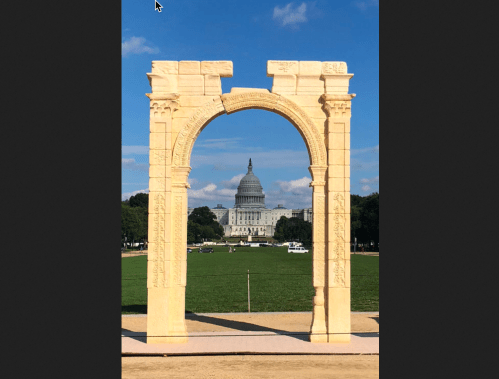
Replica of the Arch to the entrance to the temple of Baal erected in Washington DC

For God hath not called us unto uncleanness, but unto holiness. He therefore that despiseth, despiseth not man, but God, who hath also given unto us his holy Spirit. (1 Thessalonians 4:7-8)

Things get old and lose the attraction we once held for them. Certainly, this is obvious with material things like cars, houses, stuff that goes in houses, jewelry, gadgets, etc. There are few things more exciting than getting a new car – the new-car smell, the sparkling paint, the way that it handles on the road. After a few years, though, the interior smells of stale hamburgers, wet dog or baby vomit. The shine fades and obscures the dings, dents, and scratches from parking too close to the entrance at Walmart. Driving then becomes just a thing you do to get from here to there. That car we fell in love with is just a thing now, and we take it pretty much for granted.

We do the same with traditions and relationships. It is bad enough when we take human traditions and relationships for granted, but it is worse when we treat God and the things of God the same way. We find a good example of this in the account of Ahaz, king of Judah.

No doubt Ahaz was brought up in the traditions and ways of God. He came from good stock, beginning with King David. His father Jotham, his grandfather, Azariah (a.k.a. Uzziah), great-grandfather Amaziah, and great-great-grandfather Jehoash (a.k.a. Joash) were all “good” kings and “did that which was right in the sight of the LORD.”[1] However, even though these kings faithfully obeyed God for themselves, they failed to lead the nation in that regard by not removing “the high places” where the people followed pagan practices. By allowing idolatry to continue, rather than stoning idolaters to death,[2] God’s commandments were largely ignored or followed only by rote. The recommended capital punishment for idolatry may seem extreme to our liberal ears, but God’s reasoning is impeccable. “And all Israel shall hear, and fear, and shall do no more any such wickedness as this is among you” (Deuteronomy 13:11).

So, even though Ahaz had good, Godly fathers, what he observed around him caused him to regard the things of God of little value. Perhaps the pagan practices he observed looked like a lot more fun. He could enjoy all the sex he wanted, and if his promiscuous acts produced offspring, he could sacrifice those to Molech[3] – all the fun and none of the responsibility! (Sound familiar?)

During his short reign of 16 years,[4] the Assyrian Empire was rising up. At that time, Pekah, king of Israel, and Rezin, king of Syria joined forces to come against Jerusalem,[5] but they could not overcome the fortified city. Ahaz needed help, so rather than turning to God, he sought help from Tiglath-pileser, king of Assyria. In order to buy the help, Ahaz robbed the treasures of the Temple of God (which had been robbed in the past beginning with Rehoboam.[6]). When one reads the spare-no-expense details of the building of Solomon’s Temple, it is sad to think of what had become of the once “wonder of the world.” Now, it was just a rundown building useful only for buying alliances. It was of little value to Ahaz, and the LORD God was not better than any other god in Ahaz’s eyes.

After Tiglath-pileser defeated Rezin, king of Syria, and carried off all the Syrians, Ahaz paid a visit to Damascus, the capital of Syria. There he saw the temple of Baalshamin (Baal), and he was deeply impressed by the altar to Baal. Not having a cell phone with a camera, he sketched a drawing of the altar along with the exact dimensions and sent them to the Urijah the high priest with orders to build a replica in the Temple in Jerusalem.

When Ahaz returned from Damascus, he instructed Urijal to move the original brazen altar built by Solomon to the north side of the Temple. In its place on the east side before the entrance to the Temple, Ahaz erected the Baal altar and offered sacrifices to God on a pagan altar.[7] The brazen “sea” (it was a mikvah for the priests) that rested on the backs of twelve brass oxen was removed.[8] Ahaz was trading the old for the new. More than that, Ahaz erected other altars to pagan gods around the Temple. In his estimation, this new way of worship exceeded the way that had been around for hundreds of years.

Many churches these days follow Ahaz’s example. Oh, they don’t build altars to pagan gods. However, perhaps in some ways they do. Some “worship services” seem more like rock concerts. The house lights are dimmed while the “altar” is ablaze with stage lighting, spotlights, and strobe lights. As the “worship team” rocks out their worship tunes, the congregation stands with arms waving in the air swaying as if in a trance. This is new! The old way of singing hymns out hymn books accompanied by piano and organ is too old-school. We need something new and “vibrant” so that young people can “experience” worship. Too many sermons from such pulpits are designed to make the congregants “feel” encouraged. No need to talk about sin and hell, much less warn about Christ’s soon return. Talk like that might turn people off, and they might not come back, or worse, they may stop contributing to the church. Such churches sacrifice the Gospel (old) for the audience (new). The Laodicean Church[9] flourishes in our day.

Ahaz’s reign only lasted 16 years. His son Hezekiah, a “good” king, restored the Temple[10] and the Temple sacrifice. However, the Scripture does not record whether the altar Ahaz built was dismantled or not. We can assume that it was. We can be sure that sacrifices offered on a pagan altar would be unacceptable to God. Scripture notes that following the first Passover celebration in the restored Temple that “Then the priests the Levites arose and blessed the people: and their voice was heard, and their prayer came up to [God’s] holy dwelling place, even unto heaven” (2 Chronicles 30:27). That tells me the sacrifices were done properly and on the proper altar, the old fashioned way. Hezekiah did the opposite of his father; he traded the new for the old, and that pleased God.

I can only hope that we could learn that lesson before God “smites” our nation. Perhaps the smiting has begun. When governors boast that “we” have beaten this pandemic and chide that God had nothing to do with it, we may be beyond help. I hope not, but either way, my hope is in Christ. How about you?

Notes:


[1]  2 Kings 12:2; 14:3; 15:3,34

[2]  Deuteronomy 13:6-11

[3]  2 Kings 16:3

[4]  2 Kings 16:2

[5]  2 Kings 16:5

[6]  1 Kings 14:25-27

[7]  2 Kings 16:14-15

[8]  2 Kings 16:17

[9]  Revelation 3:14-22

[10]  2 Chronicles 29

Comments Off on Trading Old For New

Filed under Bible, Christianity, Current Events, Religion, Worship

Losing Your Props

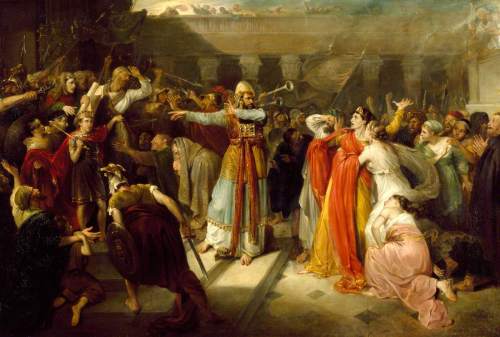
Bird, Edward; Proclaiming Joash King; Royal Academy of Arts; http://www.artuk.org/artworks/proclaiming-joash-king-148516

Trust in the LORD with all thine heart; and lean not unto thine own understanding. In all thy ways acknowledge him, and he shall direct thy paths. Be not wise in thine own eyes: fear the LORD, and depart from evil. (Proverbs 3:5-7)

Atheists ridicule Christians for being weak and needing God as a “crutch” to lean on in life. I say, “Guilty!” If the atheists were honest, they would confess that they too need a crutch on which to lean that supports their worldview. That crutch could be “science,” or perhaps they are so vain as to rely on themselves. Sadly, in times of crisis, those props will prove woefully inadequate.

I read an account of a king of Judah who did “that which was right in the sight of the Lord all his days wherein Jehoiada the priest instructed him.” (2 Kings 12:2, emphasis mine). His name was Jehoash, a.k.a. Joash, King of Judah.

Jehoash’s father, Ahaziah, reigned as king of Judah only one year “and he did evil in the sight of the LORD” (2 Kings 8:27). His mother, Athaliah, was the daughter of Omri, king of Israel (the northern kingdom) and sister of Ahab, Omri’s successor. Needless to say, she was not a nice lady.

The twenty-three-year-old King Ahaziah got caught up in a coup against the king of Israel and was killed after one year on the throne. When his mother, Athaliah, heard of his death, she quickly killed all possible successors to the throne and set herself up as Judah’s first and only queen, and she ruled in Judah for six years. That Judah ever had a queen is seldom discussed, however, one indeed existed.

Athaliah’s plot to extinguish all of Ahaziah’s “seed” failed because Ahaziah’s sister, Jehosheba, whose name means “Jehovah has sworn,” took Ahaziah’s baby son, Joash (Jehoash), to the Temple to be hid there by the high priest, Jehoiada, whose name means “Jehovah knows.”

Joash was about one year old when he came to Jehoiada who raised him and continued to advise him after he became king. After six years, when Joash was seven years old, Jehoiada, anointed Joash king of Judah, and Athaliah was put to death (2 Kings 11:16).

So Joash/Jehoash reigned as king of Judah for forty years (2 Kings 12:1). As previously mentioned, his actions pleased the LORD. He tore down the “high places” of idol worship and restored the Temple that had fallen into disrepair. But then Jehoiada “waxed old, and was full of days when he died. An hundred and thirty years old was he when he died” (2 Chronicles 24:15).

After that, it was all downhill for Joash. He lost his prop, his “crutch.” Without the priest that instructed him, Joash was lost. “Now after the death of Jehoiada came the princes of Judah, and made obeisance to the king. Then the king hearkened unto them. And they left the house of the LORD God of their fathers, and served groves and idols: and wrath came upon Judah and Jerusalem for this their trespass. Yet [God] sent prophets to them, to bring them again unto the LORD; and they testified against them: but they would not give ear” (2 Chronicles 24:17-19, emphasis mine).

Joash lost his prop so he found another in the perverted “princes of Judah.” Joash’s problem was that he looked to men for guidance. When he had a godly man to follow, he did well, but when Jehoiada was gone, he listened to ungodly men. So radical was his turn that when Zechariah, the son of Jehoiada, came to call him to account, that Joash ordered him killed.

Another boy king would later come along that would stand strong because he had a different prop. His name was Josiah (2 Chronicles 34:1). Josiah likewise repaired the Temple and took down the high places of idol worship. In the process of repairing the Temple, the “book of the law” (the “Bible”) was found. Josiah read it and repented for failing to follow the law of God. From then on, Josiah ruled “by the Book” and in that was his strength.

What do you lean on? Men, even great preachers and pastors will let you down. Other Christians will hurt you and disappoint you. The Christian denomination you followed all your life will drift from its moorings and soon you will find yourself without a church. Friends, all these things are of “men” and men are fallen. You cannot rest your life on them; they will fail. Instead, learn a lesson from Joash and Josiah. Trust God and His Word and there you will find a support that will never let you down.

1 Comment

Filed under Bible, Christianity, Theology

Which Sounds Best?

Read this out loud:

The Lord is my shepherd;
    I have all that I need.
He lets me rest in green meadows;
    he leads me beside peaceful streams.
    He renews my strength.
He guides me along right paths,
    bringing honor to his name.
Even when I walk
    through the darkest valley,[a]
I will not be afraid,
    for you are close beside me.
Your rod and your staff
    protect and comfort me.
You prepare a feast for me
    in the presence of my enemies.
You honor me by anointing my head with oil.
    My cup overflows with blessings.
Surely your goodness and unfailing love will pursue me
    all the days of my life,
and I will live in the house of the Lord
    forever.

Now read this out loud:

1 The Lord is my shepherd; I shall not want.

He maketh me to lie down in green pastures: he leadeth me beside the still waters.

He restoreth my soul: he leadeth me in the paths of righteousness for his name’s sake.

Yea, though I walk through the valley of the shadow of death, I will fear no evil: for thou art with me; thy rod and thy staff they comfort me.

Thou preparest a table before me in the presence of mine enemies: thou anointest my head with oil; my cup runneth over.

Surely goodness and mercy shall follow me all the days of my life: and I will dwell in the house of the Lord for ever.

Which reading “sounds” better? Both are renderings of Psalm 23. The first is taken from The New Living Translation, (copyright © 1996, 2004, 2015 by Tyndale House Foundation). The latter comes from the King James Version of the Bible.

Today, many translations of the Bible exist. Sadly, the purpose behind most of these translations is that of profit (not prophet). I could argue about the inferiority of modern translations based mostly on the source texts (mostly in the New Testament, but some in the Old) used in their translations, but I’ll lay that aside for now. One of the goals of the King James translators “was to produce a Bible that would ‘sing’ with beauty and power and would retain literal faithfulness to the Greek and Hebrew texts, which had themselves been written with majestic musical beauty” (Henry M. Moris, The Henry Morris Study Bible, p. 2152).

If this were my only reason for sticking with the KJV, it would be enough. It just “sounds” like Bible. However, the KJV is the only English translation (with the exception of perhaps the Geneva Bible) that was translated from the Textus Receptus – the “Received Texts,” aka, the “Majority Texts.” All other modern translations use the Westcott-Hort Greek texts which utilize old manuscripts that were rejected by early church fathers. There is much information available to the reader who really wants to investigate. For now, I will just leave it at that.

6 Comments

Filed under Apologetics, Bible, Christianity, Random Musings

The First Day of the Week

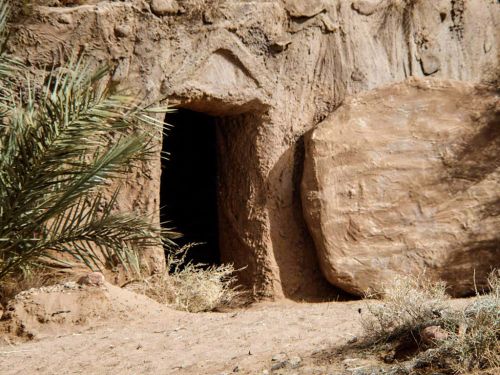
The first day of the week cometh Mary Magdalene early, when it was yet dark, unto the sepulchre, and seeth the stone taken away from the sepulchre. (John 20:1)

The unbelieving Pharisees sought a sign from Jesus proving His credentials. “But he answered and said unto them, An evil and adulterous generation seeketh after a sign; and there shall no sign be given to it, but the sign of the prophet Jonas [Jonah]: For as Jonas was three days and three nights in the whale’s belly; so shall the Son of man be three days and three nights in the heart of the earth” (Matthew 12:39-40).

Most of us know the historical account of Jonah the rebellious prophet of God who ran in the opposite direction of where God had sent him. God has a heart for the lost. The Bible tells us that “The Lord is not slack concerning his promise, as some men count slackness; but is longsuffering to us-ward, not willing that any should perish, but that all should come to repentance” (2 Peter 3:9, emphasis mine). So, God commanded Jonah to go preach to the wicked Assyrians, the mortal enemies of Israel, in Nineveh. These were mean people that tortured and abused their victims harshly. All the neighboring nations feared and hated them, and Israel was next on their menu. Jonah wanted nothing to do with them, and he especially did not want God to bless them in any way. So, rather than obey God’s command, Jonah boarded a ship bound for Spain (Tarshish).

You know the story. God sent a storm that put the ship in danger. Jonah confessed of his rebellion to the crew and they tossed him overboard to appease the Lord, quiet the storm, and calm the sea. The second chapter of Jonah describes the “sign” to which Jesus referred.

God prepared a great fish to swallow up Jonah. Much ink has been spilt in attempt to identify the creature that swallowed Jonah. Some think it could have been something like a whale shark; they certainly are large enough to swallow a man whole. Others propose it was a whale, but a whale is not a “fish” and the Hebrew uses another word for whale, tannı̂yn, which means “sea monster,” or any large sea animal like a dragon or sea serpent. But the Hebrew word used, dâg, means “fish.” If the scholars would just listen to me I can easily resolve the question. The “fish” resembled nothing that we might recognize because the Bible says that God “prepared” this fish specifically for this occasion. The Hebrew word “prepared” is mânâh and it also means “to weigh out; to allot; to appoint.” God designed this fish for an appointment with Jonah.

It is difficult to imagine any man surviving the ordeal of being in the belly of a fish for three days. It seems from Jonah’s prayer that perhaps he actually died. He says, “I cried by reason of mine affliction unto the LORD, and he heard me; out of the belly of hell cried I, and thou heardest my voice” (Jonah 2:2). The Hebrew word translated “hell” here is she’ôl, the “abode of the dead.” It was understood to be the place where the spirits of the dead resided. The Greek word for the same place is hadēs. Jesus referred to this place when He spoke of the rich man who died and went to “hell” (hadēs).[1] Jesus said that when the rich man arrived in this place, “…he lift up his eyes, being in torments, and seeth Abraham afar off, and Lazarus in his bosom. And he cried and said, Father Abraham, have mercy on me, and send Lazarus, that he may dip the tip of his finger in water, and cool my tongue; for I am tormented in this flame” (Luke 16:23-24). Obviously, the man, though he was physically dead, retained all of his senses.

Likewise, Jonah describes his experience in Sheol. He says, “For thou hadst cast me into the deep, in the midst of the seas; and the floods compassed me about: all thy billows and thy waves passed over me. Then I said, I am cast out of thy sight; yet I will look again toward thy holy temple” (Jonah 2:3-4, emphasis mine). Jonah sensed the separation, yet he maintained the hope that one day he would see the “holy temple.”

Jonah prophesied in Israel, the Northern Kingdom, which had no temple. The only Temple resided in Jerusalem, so it seems that Jonah referred to the Holy Temple in heaven of which the earthly Temple was modeled.

Jonah also hints of his death when he says, “I went down to the bottoms of the mountains; the earth with her bars was about me for ever: yet hast thou brought up my life from corruption, O LORD my God” (Jonah 2:6, emphasis mine). The word “corruption” (Hebrew: shachath) can also be translated “destruction.” Jonah continues, “When my soul fainted within me I remembered the LORD: and my prayer came in unto thee, into thine holy temple” (Jonah 2:7). Again, Jonah’s prayer ascended to God’s Holy Temple in heaven.

Jonah died in the belly of the fish, and God revived him after three days and three nights.[2] In like manner, Jesus said He would be in the heart of the earth three days and three nights and rise again.

Jesus died on the cross on Passover. He was our Passover Sacrifice.[3] His death paid the debt of our sins. They buried Him before sundown on Passover and rolled a heavy stone over His tomb. Pilate sealed the tomb with his official seal and posted a Roman guard to watch and ensure that no one tampered with the sepulcher.[4] Then, after three days and three nights in the grave, like Jonah, God raised Jesus from the grave on the first day of the week. Jonah died again eventually, but Jesus lives on. Forty days following His resurrection, Jesus ascended into heaven[5] where He awaits His return to this earth.

The “sign of Jonah” was for the unbelieving Pharisees, who, after His resurrection, continued in their unbelief. The validity of the sign continues even unto our generation. Christ has risen. The tomb is empty. Doubters continue in their rejection hoping that one day someone will find His bones and say, “Here He lies!” But they fail. One day, maybe soon, they will gaze into the sky and behold Him in all His glory “this same Jesus, which is taken up from you into heaven, shall so come in like manner as ye have seen him go into heaven” (Acts 1:11).

Reader, if you are not prepared for that day, please see my page “Securing Eternal Life” before it is too late for you. And as Jesus said, “be not faithless, but believing” (John 20:27).

Notes:


[1]  Luke 16:19-31

[2]  Jonah 1:17

[3]  1 Corinthians 5:7

[4]  Matthew 27:62-66

[5]  Acts 1:3

Comments Off on The First Day of the Week

Filed under Apologetics, Christianity, Easter, Heaven, Hell, Resurrection, Salvation, Second Coming of Christ, Theology

A King In Israel

Rejoice greatly, O daughter of Zion; shout, O daughter of Jerusalem: behold, thy King cometh unto thee: he is just, and having salvation; lowly, and riding upon an ass, and upon a colt the foal of an ass. (Zechariah 9:9)

In my last article, I recounted the early history of Israel.[1] The period of the Judges lasted between 450 and 500 years (my estimation). The Book of Judges ends with this sad assessment: “In those days there was no king in Israel: every man did that which was right in his own eyes” (Judges 21:25). Israel finally got a king to rule over them. By popular consent, God allowed them to choose a king for themselves, Saul, a Benjamite.[2] But Saul was not the king God had in mind for them. From the time Israel entered Egypt and prior to their enslavement, God had already determined that the king would come from the tribe of Judah.[3] This king’s reign would be eternal. “The sceptre shall not depart from Judah, nor a lawgiver from between his feet, until Shiloh come; and unto him shall the gathering of the people be” (Genesis 49:10).

Saul was a miserable failure as king. Only two years into his reign, he disobeyed God by doing things his own way rather than waiting on God’s direction. God took the kingdom away from Saul, “For rebellion is as the sin of witchcraft, and stubbornness is as iniquity and idolatry. Because thou hast rejected the word of the LORD, he hath also rejected thee from being king” (1 Samuel 15:23).

Not long after, Samuel the prophet anointed God’s choice for Israel’s king, a young shepherd boy, a young man of the tribe of Judah and resident of Bethlehem, David, the son of Jesse.[4] During David’s reign, Israel followed the Lord and the Lord helped David conquer most of the land God had promised to Israel. After 40 years on the throne, David’s son Solomon became king, and the spiritual state of the nation slowly started to degenerate again, in part due to the king’s own practice of marrying pagan women and bringing their pagan worship into the land and even participating in their practices himself.[5] It is said of Solomon that he was the wisest man alive, but his behavior brings that into question. However, toward the end of his life, he finally did wise up. He wrote, “Vanity of vanities, saith the preacher; all is vanity … Let us hear the conclusion of the whole matter: Fear God, and keep his commandments: for this is the whole duty of man. For God shall bring every work into judgment, with every secret thing, whether it be good, or whether it be evil” (Ecclesiastes 12:8, 13-14).

Regardless, the damage was done. The leaven already permeated the loaf. Solomon’s son, Rehoboam, rejected the advice of his old advisors, listening rather to his young cronies. This ended up dividing the kingdom with ten tribes to the north and only Judah and Benjamin remaining of David’s kingdom.[6] Both kingdoms soon fell into idolatry once more, Israel (the Northern Kingdom) first followed by Judah (the Southern Kingdom) later. Israel was conquered by the Assyrians and displaced from the land never to return. Judah fell to the Babylonians and was carried away to Babylonian captivity. After 70 years in Babylonian captivity, the Medo-Persian Empire under Cyrus allowed the Jews to return to their land to rebuild Jerusalem and their Temple.[7] However, Israel never really became an independent state again. They were always under some other nation’s thumb. For over 400 years, they longed for their promised Messiah of whom Daniel foretold, “Know therefore and understand, that from the going forth of the commandment to restore and to build Jerusalem unto the Messiah the Prince shall be seven weeks, and threescore and two weeks: the street shall be built again, and the wall, even in troublous times” (Daniel 9:25). The day would come when their king would come and throw off the oppressive yoke of Gentile nations and make Israel great again, as in the days of David and Solomon.

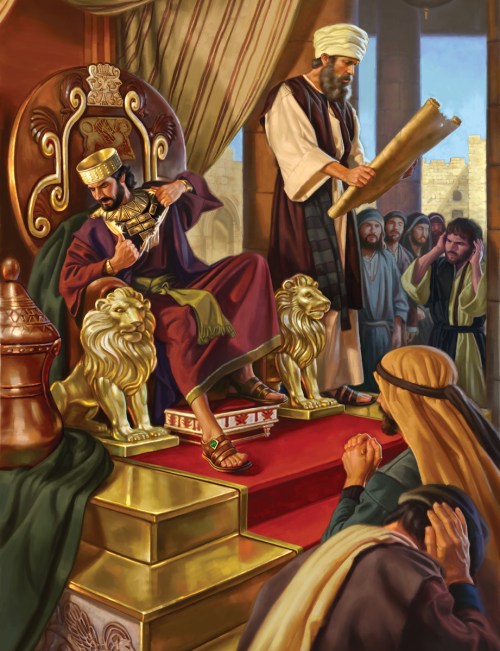
After 400 years, nothing had changed. Then one Sunday morning their long-awaited king made His entrance. However, they did not recognize Him. They were expecting a strong military general that would overthrow the Romans and set up a kingdom equal to or greater than that of Solomon. Perhaps the expected king would expand their borders to include all the lands God had promised.[8] But rather than ride in on a white stallion with a flashing sword and dazzling armor, Jesus rode in on an unbroken donkey’s colt.[9] Rather than the pomp and pageantry of a conqueror’s parade, Jesus was greeted by the cheers of the poor and downcast. “And the multitudes that went before, and that followed, cried, saying, Hosanna to the Son of David: Blessed is he that cometh in the name of the Lord; Hosanna in the highest” (Matthew 21:9); and “Saying, Blessed be the King that cometh in the name of the Lord: peace in heaven, and glory in the highest” (Luke 19:38). The religious leaders, those who should have recognized His presentation, considering the specificity of Daniel’s prophecy,[10] despised the thought of this lowly Galilean being king and rejected His claims to deity. “The Pharisees therefore said among themselves, Perceive ye how ye prevail nothing? behold, the world is gone after him” (John 12:19). “And some of the Pharisees from among the multitude said unto him, Master, rebuke thy disciples” (Luke 19:39). Had these kept silent, Jesus answered them, the very rocks would cry out in proclamation of His kingship.[11]

A few days later, their rejection would be complete as Pilate presented Jesus to them, “Behold your king!”[12] “But they cried out, Away with him, away with him, crucify him. Pilate saith unto them, Shall I crucify your King? The chief priests answered, We have no king but Caesar” (John 19:15, emphasis mine). Rejecting their true King, they preferred rather to remain under the thumb of their oppressors.

This came as no surprise to Jesus. Earlier He confided in His disciples, “Now is my soul troubled; and what shall I say? Father, save me from this hour: but for this cause came I unto this hour” (John 12:27, emphasis mine). His kingdom, at this time, was not an earthly one. His kingdom was not for the Jews alone, but “that whosoever believeth in him should not perish, but have everlasting life” (John 3:16). Before going to the cross, He made this promise. “Let not your heart be troubled: ye believe in God, believe also in me. In my Father’s house are many mansions: if it were not so, I would have told you. I go to prepare a place for you. And if I go and prepare a place for you, I will come again, and receive you unto myself; that where I am, there ye may be also” (John 14:1-3, emphasis mine).

His disciples were naturally curious as to when that time would be. “And as he sat upon the mount of Olives, the disciples came unto him privately, saying, Tell us, when shall these things be? and what shall be the sign of thy coming, and of the end of the world?” (Matthew 24:3, emphasis mine). Jesus gave many indicators of His return at “the end of the world,” but He cautioned, “All these are the beginning of sorrows” (Matthew 24:8). Jesus spoke of wars and rumors of wars, earthquakes in different places, famines, and pestilences.

All these things are taking place today. The naysayers point out that these things have occurred throughout history. Peter foresaw such “scoffers.” “Knowing this first, that there shall come in the last days scoffers, walking after their own lusts, And saying, Where is the promise of his coming? for since the fathers fell asleep, all things continue as they were from the beginning of the creation” (2 Peter 3:3-4). The truth is that these things have never occurred with such frequency and with such unity. The convergence of all of these signs is “unprecedented” (to borrow a term in frequent use these days). Consider the pestilence the world experiences today, the Wuhan virus. This bug has brought the world to a standstill and threatens not only the lives but the livelihoods of millions of people. The world’s economies are on the verge of collapse, and this is but one of the signs of which Jesus spoke.

The time is near. Soon there will be a King in Israel and His Kingdom is forever. Jesus will reign on earth for 1000 years.[13] The world seeks a one-world government ruled by fallible men. Jesus will bring a one-world government, “and he shall rule them with a rod of iron …” (Revelation 19:15). After that, in a recreated heaven and earth, He will reign forever in the “New Jerusalem.”[14]

Are you ready to live with King Jesus in His eternal kingdom? If you are not sure of your eternal destiny, read my page on “Securing Eternal Life.”

Notes:


[1]  “No King In Israel” – https://erniecarrasco.com/2020/04/01/no-king-in-israel/

[2]  1 Samuel 10

[3]  Genesis 49:8-12

[4]  1 Samuel 16

[5]  1 Kings 11:1-8

[6]  1 Kings 12

[7]  2 Chronicles 36:22-23

[8]  Genesis 15:18-21; Exodus 6:4; Numbers 34:1-15; Joshua 1:4

[9]  Mark 11:2

[10]  Daniel 9:24-26

[11]  Luke 19:40

[12]  John 19:14

[13]  Revelation 20

[14]  Revelation 21

Comments Off on A King In Israel

Filed under Christianity, Current Events, Easter, End Times, Gospel, Heaven, Holidays, Religion, Salvation, Second Coming of Christ, Theology