Tag Archives: Christianity

Making Time Count

So teach us to number our days, that we may apply our hearts unto wisdom. (Psalm 90:12)

On Tuesday of this last week, I completed my 69th lap around the sun. The Sunday before, June and I led the last lesson in the Crown ™ Do Well: The Crown Biblical Financial Study.[1] The lesson was on “Eternity,” and one of the questions we were asked to ponder was this: “Estimate the number of days you have left on earth. How does this impact your thinking?” Wow! That is a sobering thought! Psalm 90:10 brings this thought into sharp focus. “The days of our years are threescore years and ten [70]; and if by reason of strength they be fourscore years [80], yet is their strength labour and sorrow; for it is soon cut off, and we fly away” For me, age 70 looms a mere 366 days (2020 is a leap year). And “if by reason of strength” I reach 80 years, that is only 4020 days away (there are three leap years between 2020-2030). For me, at least, that is not a lot of time. However, no one is guaranteed tomorrow; we are all living on borrowed time.

The same psalm, quoted above, offers a prayer to help us think soberly about the time we are given. “So teach us to number our days, that we may apply our hearts unto wisdom” (Psalm 90:12). Time is a precious asset and to squander it on frivolity[2] is poor stewardship. Frivolity opposes “wisdom.” God gives us all the freedom to “apply our hearts unto wisdom” or to apply our hearts to frivolity. That was heavy food for thought.

Then on Friday, our devotional in Days of Praise: “Redeeming the Time,”[3] by ICR’s founder, Dr. Henry M. Morris brought this thought back to mind. In the devotional, Dr. Morris points out that “time is a very valuable asset, in danger of being lost forever unless it is rescued or redeemed.” It occurs to me that we experience the “present” in nanoseconds.[4] We constantly move from the past into the future, so when we misuse time, that is lost forever. Therefore, the only way to “redeem” time is to redeem it in the “future” toward which we are moving. That requires thought and planning – always.

Dr. Morris further asserts, “If we squander our money or lose our health, there is always the possibility of earning more money or being restored to health, but wasted time is gone forever.”

As I begin my 70th trip around the sun, I want to remember what a precious commodity time is. I what to remember that the time I am given is not mine and it can be taken away from me at any time. Jesus said, “Lay not up for yourselves treasures upon earth, where moth and rust doth corrupt, and where thieves break through and steal: But lay up for yourselves treasures in heaven, where neither moth nor rust doth corrupt, and where thieves do not break through nor steal … But seek ye first the kingdom of God, and his righteousness; and all these things shall be added unto you. (Matthew 6:19-20, 33). My time belongs to God; therefore I want to invest it wisely in His kingdom. “So teach [me] to number [my] days, that [I] may apply [my] heart unto wisdom” (Psalm 90:12).

Notes:


[1]  Crown Financial Ministries website: https://www.crown.org/

[2]  Dictionary.Com definition of : frivolous: https://www.dictionary.com/browse/frivolous

[3]  Henry M. Morris, Ph.D., “Redeeming the Time”: https://www.icr.org/article/11211/

[4]  “No Time Like the Present”: https://erniecarrasco.com/2015/01/18/no-time-like-the-present/
4 Comments

Filed under Christianity, Heaven, Philosophy, Random Musings, Religion, Theology

It Does Matter

For as Jonas was three days and three nights in the whale’s belly; so shall the Son of man be three days and three nights in the heart of the earth. (Matthew 12:40)

Recently I listened to a message on the crucifixion. The message excelled in many respects by providing insight into that fateful day of our Lord’s life. However, one part of the message troubled me. The messenger commented that some theologians believe Jesus was crucified on Friday, while others say He was crucified on Thursday. I know that; I’ve heard those arguments before. That is not what troubled me. What troubled me was his comment that the day on which the crucifixion took place does not really matter. The fact of the crucifixion is what really matters.

WOAH!

It does matter! Jesus said very specifically that “the Son of man [shall] be three days and three nights in the heart of the earth” (Matthew 12:40). That is three full days and three full nights.[1] You cannot get three full days and three full nights from a Friday crucifixion even if you allow for partial days and nights. Why does that matter?

One reason it matters is that “according to one Jewish tradition, the soul hovered about the body for three days in hope of reentering it.”[2] If it were not three full days and nights, then, as some have asserted, He could have resuscitated in the coolness of the tomb and walked out. (There are many problems with that idea, but that rabbit can be chased another day.)

Jesus raised Lazarus four days after his death. Lazarus was so dead that “by this time he stinketh: for he hath been dead four days” (John 11:39). Decomposition had already set in. That being the case, would it have been better for Jesus to remain in the tomb four days rather than three? No, because Scripture predicted that Jesus’ body would not decompose: “For thou wilt not leave my soul in hell; neither wilt thou suffer thine Holy One to see corruption” (Psalm 16:10). For that reason, it needed to be three full days and three full nights – long enough for the spirit to depart (in the estimation of the Jews), yet not long enough for decomposition to set in.

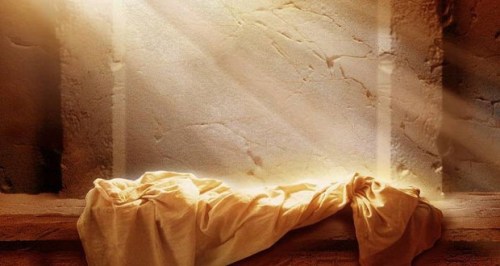
Another argument against a Friday crucifixion finds its basis in history. Most theologians hold the opinion that Jesus was crucified in A.D. 30. Passover, the day on which Jesus was crucified, always falls on Nissan 14 – the fourteenth day of the first month of the year.[3] Nissan 14, 30 A.D. fell on a Wednesday, not a Friday.[4] A Wednesday crucifixion allows for three full nights and three full days, meaning that Jesus would have risen anytime after 6:00 PM on Saturday evening, the first day of the week by Jewish reckoning – the day begins after sundown.

I believe those are good arguments against a Friday crucifixion, but they are not the best argument. The best argument is Jesus’ own words. He very specifically said that He would be in the heart of the earth, i.e., the grave, for three days and three nights. Anything less than that makes Jesus a liar. Do you really want to go there! If we believe God’s Word is inerrant – and Jesus IS God – then we must accept what HE said, and reject what errant men say. It Does Matter!

HE IS RISEN INDEED!

Notes:


[1]  “Three Days, Three Nights” – https://erniecarrasco.com/2014/07/13/three-days-three-nights/

[2]  Herschel Hobbs, The Illustrated Life of Jesus, (Nashville, Holman Bible Publishers, 2000), 183.

[3]  Leviticus 23:5

[4]  http://www.cgsf.org/dbeattie/calendar/?roman=30

2 Comments

Filed under Apologetics, Bible, Christianity, Easter, Gospel, Religion, Resurrection, Theology

April Fools’ Day

The fool hath said in his heart, There is no God. They are corrupt, they have done abominable works, there is none that doeth good. (Psalm 14:1)

We recognize the first day of April as April Fools’ Day. It “is an annual (primarily) Western celebration commemorated on April 1 by playing practical jokes and spreading hoaxes. The jokes and their victims are called April fools. People playing April Fool jokes often expose their prank by shouting ‘April fool(s)’ at the unfortunate victim(s). Some newspapers, magazines and other published media report fake stories, which are usually explained the next day or below the news section in smaller letters. Although popular since the 19th century, the day is not a public holiday in every country. Little is known about the origins of this tradition.”[1]

Victims of harmless pranks can hardly be called “fools.” Anyone is susceptible to deception at the hands of someone they trust. If that is a fool, then we all qualify.

The Bible has a much harsher view of a fool. The epithet is so severe that Jesus said, “whosoever shall say to his brother, Raca, shall be in danger of the council: but whosoever shall say, Thou fool, shall be in danger of hell fire” (Matthew 5:22, emphasis mine). The word “Raca” is of Chaldean origin and it means, “empty or worthless one.” A fool, on the other hand, is one who is “impious[2] or “godless.” Strong’s defines such a one as “dull, stupid or heedless.” The Greek word is mōros, from which we get our word “moron.” It is interesting that Jesus should offer such a severe condemnation as “hell fire” for the offense of calling someone a fool.

Jesus’ prohibition of the application of that word against another person comes at the beginning of His Sermon on the Mount. In the same sermon, He later said, “Judge not, that ye be not judged. For with what judgment ye judge, ye shall be judged: and with what measure ye mete, it shall be measured to you again” (Matthew 7:1-2). This verse gets misquoted and misunderstood often as meaning that we are never to exercise rational discernment about someone’s actions. However, that is not at all what Jesus was saying as subsequent verses reveal. The Greek words translated as “judge” and “judgment” are krinō and krima respectively. Both have to do with making a judgment that results in condemnation and punishment. We get our English words “crime” and “criminal” from these Greek words. The kind of judgment Jesus is describing is reserved for God alone. Therefore, if judging someone as “fool” condemns the one judging to “hell fire,” then the punishment for being a “fool” must also be “hell fire.” We deduce this from Jesus’ words, “with what measure ye mete, it shall be measured to you again.” In other words, because the punishment for being a fool is “hell fire,” then the one judging the fool will receive the same judgment because only God can make that judgment.

The English word “fool” appears often in the Bible translating other Greek or Hebrew words, but the strong word Jesus used, mōros, appears only a few times and always in the context of strong condemnation. For example, in Matthew 7:26 Jesus uses it to describe the “foolish man” who built his house on a foundation of sand. Jesus likens those hear His Word and ignore it to the fool who builds his house on sand. In Matthew 25:1-13, Jesus tells the Parable of the Ten Virgins and He calls the five unprepared virgins “foolish” because they were not ready to meet the bridegroom. The condemnation is they are not allowed into the wedding. Paul warns his young protégés, Timothy and Titus to avoid “foolish” (moronic) questions because they are unprofitable and vain and they only lead to strife.[3]

Our lead verse appears again in Psalm 53:1, “The fool hath said in his heart, There is no God. Corrupt are they, and have done abominable iniquity: there is none that doeth good.” The Hebrew word translated “fool” is nâbâl, and like mōros, it means stupid, wicked, (especially impious). Someone who does not believe in God, or rejects God is a fool. God condemns such a person to “hell fire,” which is why Jesus admonishes us not to make that judgment.

Paul describes how one sinks to that condition:

For the wrath of God is revealed from heaven against all ungodliness and unrighteousness of men, who hold the truth in unrighteousness; Because that which may be known of God is manifest in them; for God hath shewed it unto them. For the invisible things of him from the creation of the world are clearly seen, being understood by the things that are made, even his eternal power and Godhead; so that they are without excuse: Because that, when they knew God, they glorified him not as God, neither were thankful; but became vain in their imaginations, and their foolish heart was darkened. Professing themselves to be wise, they became fools” (Romans 1:18-22, emphasis mine).

By examining this passage more closely, we see that “the wrath of God” – His anger, i.e., “hell fire” – is revealed “against all ungodliness and unrighteousness of men,” i.e., “foolishness.” It is doubtful that “true” atheists exist because here we see that God reveals Himself through His creation. The “invisible things,” like viruses, bacteria, atoms, quarks, etc., clearly testify to the greatness of God. Every human being on earth can see the magnificence of God’s creation so that no one has an excuse for not acknowledging God. Everyone, even the atheist, knows that God exists, but they reject Him and refuse to glorify Him choosing rather to follow their own unintelligent (i.e., foolish) imaginations. As a result, their heart is darkened. This progressive condition results in a “reprobate mind,”[4] i.e., a mind that has lost its ability to properly reason. They think they are wise when in fact they have become fools.

“The fool hath said in his heart, There is no God” (Psalm 14:1; 53:1). And “The way of a fool is right in his own eyes” (Proverbs 12:15). “Every way of a man is right in his own eyes: but the LORD pondereth the hearts” (Proverbs 21:2). We are all fools at some time in our lives. “As it is written, There is none righteous, no, not one: There is none that understandeth, there is none that seeketh after God” (Romans 3:10-11, emphasis mine). We may all start out as fools, but we do not need to remain in that condition. If you do not know the Lord, please read my page on “Securing Eternal Life.” Don’t be an April Fool!

Notes:


[1] Wikipedia, “April Fool’s Day” – https://en.wikipedia.org/wiki/April_Fools%27_Day

[2]  “not pious or religious; lacking reverence for God, religious practices, etc.; irreligious; ungodly” Dictionary.Com definition – https://www.dictionary.com/browse/impious?s=t

[3]  2 Timothy 2:23; Titus 3:9

[4]  Romans 1:28

5 Comments

Filed under Apologetics, Atheism, Christianity, Creation, Current Events, Evangelism, Gospel, Hell, Theology

Dry Bones

Now learn a parable of the fig tree; When his branch is yet tender, and putteth forth leaves, ye know that summer is nigh: So likewise ye, when ye shall see all these things, know that it is near, even at the doors. Verily I say unto you, This generation shall not pass, till all these things be fulfilled. Heaven and earth shall pass away, but my words shall not pass away. (Matthew 24:32-35)

With the cross looming just days away, Jesus’ naïve apostles wondered about Jesus’ coming kingdom and what part they would play. “And as he sat upon the mount of Olives, the disciples came unto him privately, saying, Tell us, when shall these things be? and what shall be the sign of thy coming, and of the end of the world?” (Matthew 24:3, emphasis mine) The question inaugurated Jesus’ end-times sermon known as the Olivet Discourse. The sermon, addressed to Jesus’ Jewish disciples, delineated the events that would take place in the Great Tribulation spoken of by the Prophet Daniel[1] and detailed by John the Apostle.[2] Now, in order to pinpoint the proximity of these events, Jesus offered the Parable of the Fig Tree (our passage above).

Israel is compared to a fig tree in the Old Testament,[3] and Jesus uses this imagery to signal the last days. Just as the budding of a fig tree singals the proximity of summer, so the “budding” of Israel singals the nearness of the Lord’s return. The generation that witnesses Israel bud, Jesus said, “shall not pass, till all these things be fulfilled” (Matthew 24:34).

Ezekiel was one of the Jewish priests taken to Babylon in the first group of captives.[4] He was contemporary with the prophets Jeremiah and Daniel, and he ministered to the captives in Babylon. God gave the Prophet Ezekiel a preview of Israel’s rebirth. Ezekiel describes his experience as “The hand of the LORD was upon me, and carried me out in the spirit of the LORD, and set me down in the midst of the valley which was full of bones” (Ezekiel 37:1). “The spirit of the LORD” refers to the Holy Spirit who appears often in the Old Testament. Often we think of the Holy Spirit showing up at Pentcost[5] in the New Testament, and indeed He operates differently today than in Old Testament times, but He was no less active in those days. Today, the Holy Spirit indwells every true believer. In Old Testament time, He “came upon” individuals for specific purposes.

The Holy Spirit carried Ezekiel in a “vision” to a valley full of dry bones. We learn later that these dry bones represent the nation of Israel. “Then he said unto me, Son of man, these bones are the whole house of Israel: behold, they say, Our bones are dried, and our hope is lost: we are cut off for our parts” (Ezekiel 37:11, emphasis mine). Dry bones indicate that these bodies died many years before, perhaps hundreds or even thousands of years. We know by experience that when a body dies and is left unattended, it will decay. Scavengers will eat away at the flesh until nothing is left but the bones. The bones maintain their “boniness” for a long time, but eventually, the sun will bake them dry and they become brittle and eventually turn to dust.

The bones Ezekiel saw were disarticulated and scattered throughout the valley. The vision foretold of a time when Israel would be broken and scattered all over the world with no sign of life and no hope for revival. “And he said unto me, Son of man, can these bones live? And I answered, O Lord GOD, thou knowest” (Ezekiel 37:3). Ezekiel saw no hope of life for these bones, but he trusted that with the Lord, nothing is impossible.[6]

God commanded Ezekiel to prophesy to the dry bones. In his vision, Ezekiel witnessed the bones come together and tendons grow to hold the frame together. Then muscle and finally skin, but the bodies remained dead.[7] Then God told him to prophesy to the wind so that it would breathe life into the lifeless bodies. Ezekiel prophesied as instructed and the bodies came alive and stood to their feet and became a mighty army.[8]

After rejecting their Messiah, God punished Israel by destroying the nation and scattering the Jews all over the earth. This took place in 70 A.D. when the Roman general Titus destroyed Jerusalem and razed the Temple to the ground. The nation of Israel died that day, and its bones were scattered among the Gentile nations. Everywhere they went, they were persecuted, often having to flee from one nation to another with no place they could call their own. Remarkably, they never lost their national identity, traditions, customs, and language, and at every Passover celebration they recited the incessant prayer, “Next year in Jerusalem.”

For nearly 2000 years, the land lay fallow. By all human reconning, the land became a barren desert wasteland. Jews throughout the world could only dream of returning once again to their beloved homeland. Then at the turn of the 20th Century, God started working on Israel’s behalf again. The dry bones started coming together, Then on May 14, 1948, the dry bones stood up “a mighty army.” Immediately, they faced a fight for their lives, but God intervened and the newborn nation survived. Then in 1967, another invasion by their hostile, more powerful neighbors ended in only six days by God’s help, and Israel regained control of their beloved Jerusalem and the Temple Mount.

Today, more than 70 years later, tiny Israel is considered the eighth most powerful country in the world.[9] And we are that generation of which Jesus spoke that has witnessed the fig tree bud and the dry bones rise. This is the generation that will see the Lord’s return. Are you ready? If not, read my page, “Securing Eternal Life.”

Notes:


[1]  Daniel 9:24-27; 11:36-45

[2]  Revelation 6-19

[3]  Joel 1:7, 12

[4]  2 Kings 24:11-16; 2 Chronicles 36:5-8

[5]  Acts 2:1-4

[6]  Jeremiah 32:27

[7]  Ezekiel 37:7-8

[8]  Ezekiel 37:9-10

[9]  “Top 10 Most Powerful Countries in the World 2019

2 Comments

Filed under Christianity, Current Events, End Times, Religion, Second Coming of Christ, Theology

Weeds

Let both grow together until the harvest: and in the time of harvest I will say to the reapers, Gather ye together first the tares, and bind them in bundles to burn them: but gather the wheat into my barn. (Matthew 13:30)

Many, many years ago, when I was between the ages of 10 and 16, my family used to “chop cotton”[1] in the Texas Panhandle. At that time, herbicides were unheard of, and the only way for farmers to rid their fields of invading weeds was to employ temporary workers to walk the long rows of cotton (or sorghum) with hoes to chop the weeds. Several farmers hired “bazeros” that came from Mexico on temporary work visas. A Quonset hut barracks next to our home in Cotton Center, Texas housed around 200 bazeros from planting season to harvest. Some of the farmers could afford to hire large crews of brazeros that could clean their fields in a day or two. Others had to rely on smaller crews, like us, to walk the fields. It took us a little longer, and by the time we had cleaned out a large field, it was time to start all over.

Weed control is important to the health of the cotton plant, especially in its younger stages. Weeds grow rapidly and they rob the young cotton plants of needed nutrition. Additionally, weeds can overshadow the young plants and block the sunlight that they need for photosynthesis. As the cotton plant matures, they are better able to hold their own against the weeds, and in fact, beat the weeds at their own game.

Chopping cotton was not fun work! We started at sunrise in the cool of the morning when the temperature was only 95° or so, and we worked a good 12-hour day. At $1.25 an hour, we were making a killing! By noon, the temperature approached 100°, and by midafternoon, it was well beyond that. I remember trudging through the long cotton rows – some of them a mile long – and the hot soil would fill our shoes. We stopped often to dump a load of dirt back onto the field where it belonged. Plenty of water and Mom’s refried bean tacos kept us going all day! Perhaps today, such work for a 10-year old boy might be considered a form of child abuse, but back then, we worked together as a family for a common goal. We were united. Yes, it was miserable work, but the family bonds drew us closer together. At the end of the season, the money we earned on the last job went to buy school clothes for the next year. I remember rolling up the cuffs of my jeans at the beginning of the school year, and by the start of the spring semester, they were an inch above my ankles.

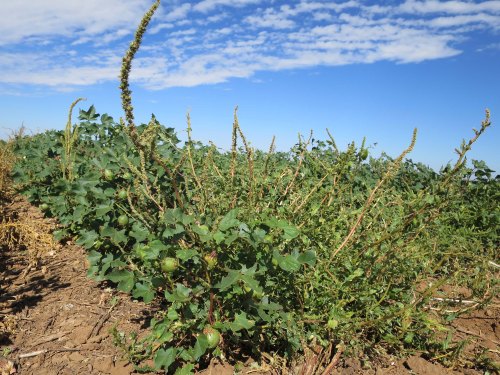
One cotton field I will never forget brought dread to our souls as we drove up on it. As we stared at the sight, we urged Dad to take us back home. By the looks of it, it appeared that the farmer had planted weeds rather cotton. At the time, I was a little above five-foot tall, and the rows of weeds towered at least a foot above me. The trunks of the “quelite”[2] (“keli weeds”) were two to three inches in diameter at the base requiring four or five good chops with a sharp hoe to take them down. The rows on this field were one mile long with a solid wall of quelite from one end to the other. The cotton sprouts struggled to survive in this forest of weeds, and we had to be careful not to damage the cotton seedlings while felling the giant quelite.

Less than three hours into our day we stopped to sharpen our hoes. Experience taught us to carry a file in our back pocket for these occasions. As we had walked our rows, our focus remained on the ground taking careful aim at the weeds while avoiding the tender cotton plants. Now as we took a strategic respite and looked behind us, we could see that our advance was minimal. The end of the row ahead still stretched a mile away. By lunchtime, we were almost halfway down our rows. We ate our warm bean tacos on the ground in the shade of the tall keli weeds. By the end of the day, we finished one row. The farmer came and paid us our wages and told us not to bother coming back. The field was too far-gone to save and he decided it would be better to plow it under and start over.

As I reminisce about that weed-infested cotton field, I recall Jesus’ Parable of the Tares.[3] In the parable, Jesus tells of a farmer who planted good (wheat) seed in his field and an enemy came in by night and planted tares, i.e. weeds that resemble wheat. The point of Jesus’ parable explains an aspect of “the Kingdom” often applied to the Church. God seeds the church with “good seed,” i.e. genuine, born-again Christians, and later Satan infiltrates and introduces bad seed into the field, i.e. the Church. Both good and bad seed look pretty much alike, so the owner of the field (the Church), allows both to grow together to be separated at the end of time.

My recollection of the quelite field reminds me of the state of our nation. The weeds are gaining strength. They are spreading out and overshadowing the light to the point that many churches are losing any influence they once had. Worse, many churches are being influenced by the weeds and are beginning to look and sound much like the weeds.

Christians that are paying attention and see the decline of our nation (and the world) encourage other Christians to be bolder in their witness and work harder to turn our nation back to its Christian roots and to do whatever we can to get rid of the weeds. However, that is not happening, much to the chagrin of many well-intentioned Christians. Like that farmer with the weed-infested field, it may be time to plow everything under and start all over. Farmer Jesus may be getting ready to do just that! Come quickly, Lord Jesus!

Notes:


[1]  The misnomer, “chop cotton,” referred to ridding the cotton fields of undesirable weeds by chopping them out with a hoe. The intent was to chop the weeds and leave the cotton standing.

[2]  “Quelite” [keh-lee-teh] is the Spanish name of the plant. Locals “Englishized” the word and called them “keli weeds.” The leaves of the plant are edible and cooked up like turnip greens. As boys, we loved eating them as much as spinach!

[3]  Matthew 13:24-43

4 Comments

Filed under Christianity, Current Events, End Times, Random Musings, Second Coming of Christ