Tag Archives: Christianity

All Things Work Together For Good

Everything will be alright

And we know that all things work together for good to them that love God, to them who are the called according to his purpose. (Romans 8:28)

Were you to ask me what my all-time favorite verse of the Bible is, without hesitation I would say Romans 8:28.  I favor many verses for various reasons, for example, Genesis 1:1 is foundational: “In the beginning God created the heaven[s] and the earth.” God as Creator settles a lot of unanswered and unanswerable questions. Along with that is John 1:1-3, “In the beginning was the Word, and the Word was with God, and the Word was God. The same was in the beginning with God. All things were made by him; and without him was not any thing made that was made” reveals that Jesus Christ is the Creator, who “was made flesh, and dwelt among us” (John 1:14). It was He who, “being found in fashion as a man, he humbled himself, and became obedient unto death, even the death of the cross” (Philippians 2:8) because, “God so loved the world, that he gave his only begotten Son, that whosoever believeth in him should not perish, but have everlasting life” (John 3:16). I take comfort from knowing that, “The LORD is my shepherd, I shall not want” (Psalm 23:1). He will meet my every need.

Sometimes, everyone comes to a point in life, maybe more than once in a lifetime, when we feel abandoned by our Shepherd, and we feel that our needs are not being met. In those times, I take refuge in the assurance of Romans 8:28, but it can easily be misunderstood to mean that everything will always be good. That has certainly not been my life experience. To properly understand the significance of this verse, we must see it in its context and examine it in its original language, Greek.

In context, Paul is addressing a group of Christians in Rome. He assures them that for those who have placed their trust in Christ, there is “no condemnation to them which are in Christ Jesus, who walk not after the flesh, but after the Spirit” (Romans 8:1). Those who “are in Christ Jesus” manifest that fact in the way they conduct their lives, i.e. “who walk not after the flesh, but after the Spirit,” and he explains what that means in the succeeding verses. Those who walk (conduct their life) after (according to the leading of) the Spirit have the Spirit of God dwelling (residing) in them (v. 9). Let that thought sink in and penetrate your heart. If you are a child of God, you have His Spirit taking up residence in you! Because that is true, “The Spirit itself beareth witness with our spirit, that we are the children of God” (v. 16). If you are truly God’s child, you should never have a doubt about that. If you do, the Holy Spirit is there to reassure you of that fact. Now, if you never get that reassurance, you need to reexamine your status before God and get that settled. God will let you know whether you are His or not; He does not want you to be deceived.

Another benefit of being a child of God, is that you share the same inheritance with Christ (v. 17). All the unimaginable glory of heaven belongs to God’s children for eternity! The condition (“if so be that we suffer with him”) means we “who walk not after the flesh, but after the Spirit” (v. 1). Here in America, we have not experienced persecution like many of our brothers and sisters in other parts of the world, but we should not get too comfortable in that thought. Persecution may yet come. Jesus said, “If the world hate you, ye know that it hated me before it hated you. If ye were of the world, the world would love his own: but because ye are not of the world, but I have chosen you out of the world, therefore the world hateth you” (John 15:18-19, emphasis mine). Unless you have just not been paying attention, there is a growing animosity toward Christians in this nation. Have you sensed it? Have you been rejected by friends or family because of your faith in Christ? Have you suffered with Him and because of Him? Take heart, such suffering is only temporary for God’s children, but the payoff is out of this world (v. 18)!

God’s Spirit in us also helps us in our weakness. When we stray and “walk after the flesh,” the Spirit is there to remind us and bring us back in line. Also, when our heart is burdened to the point that we cannot express what is in our heart so that “we know not what we should pray for as we ought: but the Spirit itself maketh intercession for us with groanings which cannot be uttered” (v.26). Because God’s Spirit indwells us, He knows us intimately, better than we know ourselves, and He gives expression to the Father of what is on our hearts.

Verse 29 tells us that God, in His foreknowledge, predetermined (predestined) that His children would be conformed – molded into – to the image of His Son. That is God’s purpose for our lives. We are not completely passive in this process, but as we make ourselves available and malleable to the Holy Spirit’s leading in our life, God, not we, shapes us into the form of Jesus Christ to minister to the world around us, and yes, even to suffer for Him.

It is in this context we read, “And we know that all things work together for good to them that love God, to them who are the called according to his purpose” (v. 28). The Greek syntax places the words of greatest significance at the beginning of the sentence, and those of secondary significance at the end of the sentence. The strict translation of the Greek text is: “We know, moreover, that to those [who are] loving God, all things work together for good, to those according to [His] purpose called [are] being.” First, we who are His children know. This is not up for debate. It is firm. It is assured, and this we know because the Spirit informs us. We are those “who are loving God” consistently. For us, “all things” – the Greek panta is all inclusive – work together for our “good” (Greek: agathon, meaning benefit). This does not say that everything that happens to us will be “good.” Just look around. We see our brothers and sisters suffering with cancer or other illnesses. We see them losing employment or in financial difficulty. We see them struggle with familial difficulties or other relationship problems. Perhaps we experience those things ourselves. No one can say these things are “good.” But the promise of this verse is that God will use those trials for our benefit. God blesses us with many good things, but often, when things go well, we forget the source of those blessings. Sadly, it is the trials that come into our lives that draw us closer to God. Those are the times of our greatest benefit, and God uses those times to help conform us into the image of His Son. Remember, our inheritance is not in this world but with Christ.

God uses ALL things – good and bad – to work for good for His children. This promise does not apply generally to all people. This promise is specifically for God’s people – those “who are called according to His purpose” – that of being conformed to the image of His Son.

When I experience trials in my life, Romans 8:28 gives me the assurance that God works all things for my benefit, and I trust Him for that. Paul ends this chapter in Romans by asking, “If God be for us, who can be against us? … Who shall separate us from the love of Christ? shall tribulation, or distress, or persecution, or famine, or nakedness, or peril, or sword?” (vv. 31, 35). His answer, “Nay, in all these things we are more than conquerors through him that loved us … [nothing] shall be able to separate us from the love of God, which is in Christ Jesus our Lord” (vv. 37, 39). No, all of these things work together for our good – our benefit.

3 Comments

Filed under Apologetics, Christianity, Evangelism, Gospel, Religion, Theology

No Choice!

Bad Choices

Daniel answered and said, Blessed be the name of God for ever and ever: for wisdom and might are his: And he changeth the times and the seasons: he removeth kings, and setteth up kings: he giveth wisdom unto the wise, and knowledge to them that know understanding: (Daniel 2:20-21)

The Republican National Convention looms ahead within a few short weeks, and it appears that Donald Trump is the presumptive GOP candidate for President of the United States. The prospect is disheartening to many Christians including me, but unlike me, many Christians are resolved to “suck it up” and vote for Trump as the “lesser of two evils.” I don’t know about you, but I am tired of voting for the lesser of two evils. I voted for the lesser of two evils in 2008 when I voted for John McCain. I voted for the lesser of two evils when I voted for Mitt Romney in 2012. What did that get us? It got us eight years of Barrack Obama! To me, Donald Trump measures up so far below either McCain or Romney that it’s like drinking the dregs of cold, stale coffee.

I have stated openly that I will not vote for that man. Unless he assumes some real principles greater than his own ambitions, I cannot with clear conscience bring myself to cast my ballot for Trump. I will vote, but I will either vote for a reasonable third or fourth party candidate or write in my choice, which at the moment happens to be Ted Cruz – the only principled, constitutional conservative that ran in the primaries. Ted Cruz also holds solid Christian values, and lives by them.

Many of my friends criticize me for making that statement saying, “That will just guarantee Hillary will be the next President” (provided she doesn’t end up in prison). Is that true?

As Christians we should make our decisions based on biblical principles. Does the Bible give us any guidance? The verse above says that God removes and sets up kings, i.e. rulers. Arguably, presidents of the United States, are not “rulers” per se – at least not constitutionally – but now that is highly suspect considering how President Obama has performed in his administration. Whether kings, rulers, or presidents, the principle holds true: God sets up and takes down rulers.

At the installation of Solomon, King David blessed the Lord saying, “Thine, O LORD, is the greatness, and the power, and the glory, and the victory, and the majesty: for all that is in the heaven and in the earth is thine; thine is the kingdom, O LORD, and thou art exalted as head above all. Both riches and honour come of thee, and thou reignest over all; and in thine hand is power and might; and in thine hand it is to make great, and to give strength unto all” (1 Chronicles 29:11-12, emphasis mine). Clearly, David recognized God’s sovereignty over all earthly matters. The Apostle Paul applies this concept as to how we should relate to those in power over us. “Let every soul be subject unto the higher powers. For there is no power but of God: the powers that be are ordained of God” (Romans 13:1, emphasis mine). In Paul’s day, Rome resembled a republic somewhat like ours, except that citizens did not elect their leaders. The Senate was composed of the aristocracy, who obtained their position though inheritance, appointment or through bribe. The point is that citizens had no say in their government. Under these circumstances, Paul exhorts Christians to submit to their leaders because “the powers that be are ordained of God.” The Greek word translated “ordained” is tassō and it means “to arrange in an orderly manner.” When we consider some of the tyrants that ruled Rome and their persecution of the saints, we might wonder what kind of “orderly manner” God arranged, but Paul clearly affirms that God controls who sits in power. Nero, Diocletian, Muhamad, Napoleon, Hitler, Lennon, Stalin, Putin, Obama, Ayatollah Khomeini and many more could be listed – all had Divine appointments. No leader or ruler on earth exists or has ever existed that God did not put in place.

That said, if we truly believe God’s Word, can we honestly say we have any real influence on who will be our next President? Can we realistically assume the responsibility for who will lead us? The Bible says that God makes those decisions.

So, what is the use in Christians voting?

The United States of America is unique among all the nations of the world and among all the nations throughout history. In no other nation has God vested power in the governed, i.e. the people, rather than in governors. At the conclusion of the Constitutional Convention in 1788, it is said that a lady asked Benjamin Franklin what kind of government they had given us to which he replied, “A republic, Madam, if you can keep it.” We stand at the precipice of losing our republic. By many standards, one may say we have already lost it; but we can still vote for our leaders – for all the good that does. The problem is that most of the leaders we elect are unprincipled liars seeking their own gain, personal privilege, and power. They hear the people’s cries and promise to fulfill their wishes (like “repeal every word of Obama Care”), and once they are elected they become deaf to the voice of the people.

What are we to do? We must do what is right before God. That is what we do! “Blessed are they that keep judgment, and he that doeth righteousness at all times” (Psalm 106:3).  “Little children, let no man deceive you: he that doeth righteousness is righteous, even as he is righteous” (1 John 3:7). At the conclusion of his exposé on the vanity of life seeking pleasure and possessions, Solomon sums up, “Let us hear the conclusion of the whole matter: Fear God, and keep his commandments: for this is the whole duty of man. For God shall bring every work into judgment, with every secret thing, whether it be good, or whether it be evil” (Ecclesiastes 12:13-14, emphasis mine).

What is the right thing to do? Chief Justice John Jay, the first Chief Justice of the Supreme Court of the United States, said, “Providence [meaning “God”] has given our people the choice of their rulers, and it is the duty, as well as privilege and interest, of a Christian nation to select and prefer Christians for their rulers” (emphasis mine). For Christians, then, the right thing means preferring Christians as our rulers. Of course, someone will undoubtedly retort, “We are not electing a pastor, we’re electing a President.” Perhaps, at this point, it behooves us to elect a pastor in the truest sense of that word. A pastor, i.e. a “shepherd,” looks out for the welfare of his sheep even to the point of giving his life for them. Jesus said, “I am the good shepherd: the good shepherd giveth his life for the sheep” (John 10:11). Wouldn’t that be a great attribute in a President! – or any of our elected representatives for that matter!

Voting for a pastor as President might not be such a bad thing; however, there is not one running for the office. Many of my Christian brothers and sisters fear a Hillary Clinton presidency so much that they are willing to vote for the reprobate Donald Trump as the “lesser of two evils.” By what standard they make that judgment I cannot discern. Joel Rosenberg offered 32 reasons a Trump presidency would be a catastrophe for America.[1] I also wrote about this and provided links to other articles giving reasons why Christians should not support Donald Trump.[2]

Donald Trump is no pastor. Judging from his “fruits,” he is not even a Christian. He may be a Presbyterian, but he is not a Christian, I don’t care how he labels himself. If Christians are to prefer Christians as their leaders, then, my friends, we have no choice. That is why, unless God raises up a principled, Christian man (or woman) that cares about this nation more than he/she cares about him/herself, the only right thing I see to do is write in someone I, in good conscience, believe is worthy of the office. To me, at least for now, that is Ted Cruz. My conscience is clear, and I trust in the sovereignty of God for the outcome, even if it is Hillary Clinton.

Friends, our nation rejected God a long time ago. God’s judgment is not coming upon our nation; it’s already on us, like it or not. What we see these days – the violence, perversion, disregard for law and order, etc. – is the judgment of God. Read Romans 1:18 ff. Even if Trump is elected, do not deceive yourself into thinking that he will be any better than what we have already. Remember that choosing the lesser of two evils is still evil. For that reason, I cannot vote for Donald Trump. I feel I have no choice.

Notes:


[1] Joel C. Rosenberg’s Blog: https://flashtrafficblog.wordpress.com/2016/01/31/32-reasons-a-trump-presidency-would-be-a-catastrophe-for-america/

[2] “The Trump Sounds,” https://erniecarrasco.com/2016/02/28/the-trump-sounds/

12 Comments

Filed under Christianity, Current Events, End Times, Politics, Theology

The True Moral Fallacy of #justiceforHarambe – Fall on Grace Fall on Grace

And surely your blood of your lives will I require; at the hand of every beast will I require it, and at the hand of man; at the hand of every man’s brother will I require the life of man. Whoso sheddeth man’s blood, by man shall his blood be shed: for in the image of God made he man. (Genesis 9:5-6)

Equating animals to humans is the logical result of evolutionary thinking. If we all evolved from the same source, then all creatures are equally amoral, and there should be no outrage over a human killing an ape to save a human. But there is outrage, and the humans are held to a higher standard. Why? As you point out so clearly, it is because humans are created in God’s image, and we have His innate moral standard, but the ape does not. Furthermore, God’s moral standard does hold human life as more valuable than animal life. (See Genesis 9:5-6 above) Human life is to be preserved above all others. By the way, that would include “unborn” human life.

Source: The True Moral Fallacy of #justiceforHarambe – Fall on Grace Fall on Grace

Comments Off on The True Moral Fallacy of #justiceforHarambe – Fall on Grace Fall on Grace

Filed under Apologetics, Christianity, Creation, Current Events, Evolution, Origins, Pro-life, Theology

No Accident


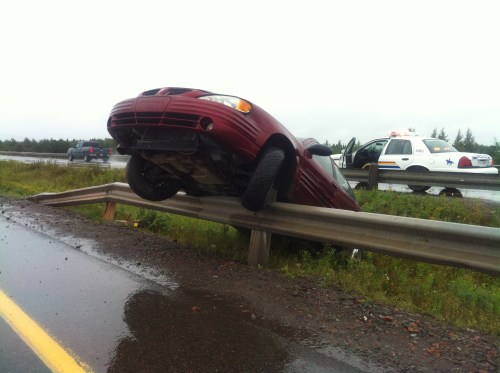
CAUSE: Hydroplaning. EFFECT: Wreck. No Accident!

CAUSE: Hydroplaning. EFFECT: Wreck. No Accident!

All things were made by him; and without him was not any thing made that was made. (John 1:3)

Commuting to work on the rain-drenched LBJ Freeway in Dallas, Texas this past week, I was at once amused and terrified at the maneuvers made by some crazy drivers obviously unaware of the hazardous road conditions. It reminded me of something that my old Driver’s Ed teacher repeated often a hundred years ago, “Accidents don’t happen; they are caused.” Apparently the crazies on LBJ never took driving lessons from my old Driver’s Ed teacher.

The truth of the adage obeys the very basic law of physics, that of cause and effect. Simply stated, everything that happens, i.e. every “effect,” has a cause. On the highway, this basic law expresses itself through Newton’s three Laws of Motion: (1) Inertia – an object in motion tends to stay in motion unless some external force acts upon it, (2) Acceleration – when a force acts on a mass (object) to produce motion, and (3) Reaction – for every action, there is an equal and opposite reaction. These three laws are expressions of the primary law of cause and effect. There is a series of cause-and-effect scenarios that propel a vehicle down the road at high rates of speed. Friction is a stabilizing force acting upon the tires of a car to counter the inertia that would maintain the car’s high rate of speed. However, on a wet, rainy day, friction yields to a phenomenon known as hydroplaning. This “cause” creates a thin barrier of water between the surface of the road and the tires, which effectively negates the force of friction on the tires. The tires lose contact with the road surface and now skim along on a slippery sheet of water. Inertia now controls the forward motion of the vehicle, and the incognizant operator unwittingly presumes he is in full control until he has to make a quick lane change or a sudden stop. It takes little imagination to visualize the “effects” that may result. The frequent “mishaps” witnessed on the highway are “incidents” not “accidents.” The majority of the time, the main cause of these incidents is the loose nut behind the wheel. Lesson: be aware of road conditions!

Forgive the defensive driving lesson, but the point was to illustrate the law of cause and effect. Nothing that exists just happens. There are no accidents. This simple and common fact is overlooked or ignored by naturalists/evolutionists/atheists when dealing with the matter of origins. What caused the universe? The Big Bang they say. What caused the Big Bang? They say that an infinitesimal “singularity” rapidly expanded and produced all that there is. Even though no one existed to witness or record this great event, they (the “theoretical” physicists) can tell us what happened one second after the Big Bang, one minute after, five minutes after, and so on. So, from where did this singularity come? What caused the singularity? What made it expand? “We don’t know,” they admit, “but we are still working on it.” This is what is passed off as science today.

Everything must have a cause, but cause-and-effect can only be taken back so far. Eventually, we must arrive at the cause that caused all other causes, and this cause cannot itself be caused. “Science” has no explanation for this, therefore hypotheses abound. In desperation, absurdities, like the “multiverse” hypothesis, arise to account for what cannot be proven in this universe. Since it cannot be proven in this universe, it must be true in another. The problem is that this universe is the only universe to which we have access to do science. There remains this nagging requirement for science called observation, and we cannot observe other universes, if indeed they do exist. Ours is the only universe we can observe. Our science is limited to what we can observe in this universe.

That brings us back to question of origins. How did our universe come to be? If nothing else, the Big Bang asserts that our universe must have had a beginning. But what caused it all? Reason demands that the original cause cannot itself have a cause. Our universe is no accident.

Where science fails us, the Bible provides a reasonable answer. Naturalists automatically reject this notion; however they offer nothing in its place that makes more sense. “In the beginning God …” (Genesis 1:1). Time, “the beginning,” was caused by God. The reader will note that nothing is presented before God, the Cause. God is the “uncaused Cause,” and the Scripture’s presentation of nothing prior to God expresses His eternal nature, His infiniteness. His eternal existence is the only reasonable and logical response to an infinite series of causes and effects. God is no accident. He is and always has been and ever will be. He is the eternal “I AM THAT I AM” (Exodus 3:14). John identifies Jesus as the eternal Creator (John 1:1-3), and later records the Lord’s self-identification as the Eternal One: “I am Alpha and Omega, the beginning and the end” (Revelation 1:18; 21:6), “I am Alpha and Omega, the first and the last” (Revelation 1:11), “I am Alpha and Omega, the beginning and the end, the first and the last” (Revelation 22:13). He is the One, the initial Cause that started it all. Before Him nothing else existed.

Our universe is no accident; it had a cause – God the Creator. Our world, our earth, is no accident; it had a cause – God the Creator. You and I are no accidents. We have a Creator that fashioned us in His own image (Genesis 1:27), and loved us enough to give us the choice to accept or reject Him. Either choice produces eternal effects. If we choose to reject Him, that decision is eternal. If we choose to accept Him, that decision is eternal. The choice is no accident.

2 Comments

Filed under Apologetics, Atheism, Bible, Christianity, Creation, Evangelism, Evolution, Gospel, Origins, Philosophy, Religion, Science, Theology

Not Passed On In The Genes

genetic-battle

And Solomon did evil in the sight of the LORD, and went not fully after the LORD, as did David his father. (1 Kings 11:6)

I have heard the lament of many good Christian parents who did all they knew to do to “bring [their children] up in the nurture and admonition of the Lord” (Ephesians 6:4) only to have them walk away from the faith as adults. This is nothing new, and the Bible offers examples from which we can take comfort.

Israel had no greater king than David. Although the Bible makes no effort to hide David’s imperfections, it does make one claim that defines David’s overall character. David was a man after God’s own heart (Acts 13:22). With all of his flaws, David’s greatest desire was to please God. “As the hart panteth after the water brooks, so panteth my soul after thee, O God. My soul thirsteth for God, for the living God: when shall I come and appear before God?” (Psalm 43:1-3).

One would think that kind of love for God would be reflected in his children, but the record shows that David’s children did not share the same devotion.  Amnon, David’s first-born son by Ahinoam’s (2 Samuel 3:2) loved (actually lusted after) his half-sister Tamar so much that he raped her (2 Samuel 13). Tamar was Absalom’s sister by Maacah. When Absalom (his name means “Father of Peace”) heard of Amnon’s deed, he waited for a time to see if his father, David would take any action. When that did not happen, Absalom acted on his own accord and had his older half-brother murdered. After two years of self-exile, he was allowed to return to Jerusalem, but David refused to see him. This caused Absalom to rebel against his father and incite a coup to overthrow the king. David fled for his life, and the rebellion was finally quelled with the slaying of Absalom, much to David’s regret. All of this illustrates the point that children do not automatically inherit the parent’s zeal for God. Some may blame David for being an inattentive father. Some may attempt to excuse him; after all, he had a kingdom to manage. But the Bible is clear, God holds every individual responsible for his own actions.

Another illustration of this truth shows up in David’s successor, Solomon, supposedly the wisest of all Israel’s kings. But a close inspection of the Biblical record reveals a different story. At the beginning, Solomon started out on the right track. On his ascendancy, David charged his son, “I go the way of all the earth: be thou strong therefore, and shew thyself a man; And keep the charge of the LORD thy God, to walk in his ways, to keep his statutes, and his commandments, and his judgments, and his testimonies, as it is written in the law of Moses, that thou mayest prosper in all that thou doest, and whithersoever thou turnest thyself (1 Kings 2:2-3, emphasis mine). Early in his reign, Solomon honored his father’s admonition. “And Solomon loved the LORD, walking in the statutes of David his father” (1 Kings 3:3) so much so that when God offered him anything he wished, he asked for wisdom to rule God’s people (1 Kings 3:5-13). God granted him not only wisdom, but wealth and fame.

Solomon used his God-given gifts to build the Temple, purportedly the envy of the known world. Solomon built up the kingdom and extended it borders, and God granted him peace throughout his realm. “So king Solomon exceeded all the kings of the earth for riches and for wisdom. And all the earth sought to Solomon, to hear his wisdom, which God had put in his heart” (1 Kings 10:23-24, emphasis mine). However, not long after the Temple construction dust settled, Solomon’s love for God waned, replaced by a love for something else. “But king Solomon loved many strange women, together with the daughter of Pharaoh, women of the Moabites, Ammonites, Edomites, Zidonians, and Hittites; Of the nations concerning which the LORD said unto the children of Israel, Ye shall not go in to them, neither shall they come in unto you: for surely they will turn away your heart after their gods: Solomon clave unto these in love” (1 Kings 11:1-2. emphasis mine). These “strange” women were not of Israelite stock. Solomon violated God’s prohibition against marrying “foreign” women, not because God is “racist,” (He’s not; He created all nations of one blood- Acts 17:26), but for “religious” reasons. These women all worshiped demonic gods, and God knew they would negatively influence His people. “For it came to pass, when Solomon was old, that his wives turned away his heart after other gods: and his heart was not perfect with the LORD his God, as was the heart of David his father. For Solomon went after Ashtoreth the goddess of the Zidonians, and after Milcom the abomination of the Ammonites” (1 Kings 11:4-5). What happened to Solomon? Did he not have a great example in his father David?

Yet, hope remains. Solomon is known for his many proverbs and sayings. It is said that Solomon “spake three thousand proverbs” (1 Kings 4:32), only a fraction of which survived as recorded in the Book of Proverbs. Near the end of his life, perhaps he regained some of his wisdom, which he tried to pass on to the son who would succeed him, Rehoboam. Proverbs 1-9 record Solomon’s words of advice to his son where he admonishes his son to seek “wisdom.” Imagine that! The Biblical record is clear that his son ignored his father’s counsel, which resulted in splitting the kingdom. That Solomon returned to his “first love” at the end of his life comes through in the Book of Ecclesiastes, “probably [written] in his old age, as he was looking back on the happy early years of his reign and regretting his tragic failures in his later years.”[1] The tone seems rather pessimistic, which results from man’s quest to fill one’s life through material and/or sensual means. In the end, Solomon reveals the true source of joy and satisfaction. “Let us hear the conclusion of the whole matter: Fear God, and keep his commandments: for this is the whole duty of man” (Ecclesiastes 12:13).

Having experienced my own children walking away from God, I can only sympathize with those experiencing the same thing.  I can relate to all the second guessing that goes on in the hearts and minds of such parents. They wonder where they failed, where they went wrong, what they could have done differently. Parents, regardless of the heartache we endure over our lost children, we must realize that God does not hold us responsible for the actions of our children after they are on their own.  “The soul that sinneth, it shall die. The son shall not bear the iniquity of the father, neither shall the father bear the iniquity of the son: the righteousness of the righteous shall be upon him, and the wickedness of the wicked shall be upon him” (Ezekiel 18:20, emphasis mine). It works both ways. I have also known many good Christians that had wicked parents. God holds each individual responsible. We can only hope and pray that, like Solomon, one day they will see the vanity of their lives, and return to the God of their fathers. Only God can change the heart. Salvation is not passed on in the genes.

Notes:


[1]  Henry M. Morris, Ph.D., The Henry Morris Study Bible, (Master Books, Green Forest, AR, 2012), 985.

Post Script:

By Dr. James J.S. Johnson

  1. Perfect example in a well-known Christian family, the son of 2 very godly parents, Francis & Edith Schaeffer, is Franky Schaeffer, a vile & blasphemous apostate Christian-hater – total opposite of his parents; in fact, the true “heir” to the Schaeffer ministry is Fran & Edith’s son-in-law, Udo Middelmann  —  see  www.theschaefferfoundation.com/bios_francis_a_schaeffer_foundation.php .
  2. A less famous example is a less-well-known (yet very godly) couple, Ian & Ginny McLaren, whose vile & blasphemous apostate son is emergent-church “prophet” Brian McLaren.
  3. But my 3rd post-script is the reverse – my own father was an apostate clergyman who spent huge amounts of energy denigrating the Holy Bible – yet, by God’s grace, I rejected his blasphemy.

No one can blame their parents, or get into Heaven on their parents’ coattails.  God has no “grandchildren” – He is the Heavenly Father (not grandfather) of the redeemed; Satan is father of the lost.

><> JJSJ

4 Comments

Filed under Apologetics, Christianity, Evangelism, Religion, Salvation, Theology