Tag Archives: Holy Spirit

God’s Laws

GodsLaw

… in thy seed shall all the nations of the earth be blessed; Because that Abraham obeyed my voice, and kept my charge, my commandments, my statutes, and my laws. (Genesis 26:4-5)

I don’t know where we, Evangelical Christians, have gotten the idea that the Old Testament laws no longer apply. A few years ago, Dr. Charles Swindoll came out with a book entitled Grace Awakening where, I think, he attempts to assuage the guilt some Christians bear due to unnecessary legalism and encourage Christians to take joy in the freedom found through Christ. I have a great deal of respect for Dr. Swindoll. He is a far greater scholar and theologian that I can ever hope to be, but I think he unintentionally opened the door to liberalism here.

Swindoll rightly affirms that salvation, i.e., “justification” cannot be achieved through the works of the Law (Galatians 2:16, Ephesians 2:8-9), but then he unintentionally, I hope, implies that the Christian is no longer subject to the law. Here it is that we part ways, because the results of “grace living,” from my observation, are “carnal” Christians. The result is that modern Evangelical Christians are indistinguishable from the world around them, except on Sundays, when they are at their worship services.

Here is the truth: no one can be saved – be justified, have eternal life – through any act or effort of their own (Galatians 2:16, Ephesians 2:8-9). It is only through grace – the unmerited favor, the free gift – of God. It is all God’s doing, and it happens the instant one believes – places his trust – in the saving work of Jesus’ death, burial and resurrection (John 1:12; 3:16, 36). Once that takes place, the matter is forever settled. One does not have to keep a long list of laws to come to that point. One does not need the proper theological understanding to come to that point. In the words of the children’s chorus, “Jesus loves me this I know, for the Bible tells me so.” Salvation takes place the instant one believes. That one act settles the matter. Now there remains the matter of “living” the Christian life. Here is where the Law comes to play.

Before I develop that point, let me preface the keeping of the Law by assuring the believer, especially the new Christian, that keeping the Laws of God is not accomplished through our own effort. At the moment we are saved, God’s Spirit comes to reside in us (1 Corinthians 3:16). God says, “I will put my law in their inward parts, and write it in their hearts” (Jeremiah 31:33). Jesus said, “Take my yoke upon you … For my yoke is easy, and my burden is light (Matthew 11:29-30). The “burden” of the Law, for the Christian, is born supernaturally, so that the Christian should not suffer undue stress over keeping the law; however that does not mean no effort is required. Jesus said, “If ye love me, keep my commandments” (John 14:15), so obviously some effort is involved on the part of the Christian, but that effort is aided by the Holy Spirit that dwells within us.

So, what are those commandments, i.e. the laws, which the Christian must keep? Simply speaking, they are the same laws God has always maintained. God’s laws are eternal. God says, “I am the LORD, I change not” (Malachi 3:6, emphasis mine). Jesus said, “For verily I say unto you, Till heaven and earth pass, one jot or one tittle shall in no wise pass from the law, till all be fulfilled” (Matthew 5:18, emphasis mine). In our beginning verse above (Genesis 26:4-5), Abraham lived about 500 years before the Mosaic Law was given, and yet God says of him, “Abraham obeyed my voice, and kept my charge, my commandments, my statutes, and my laws” (emphasis mine). When Jesus said, “Think not that I am come to destroy the law, or the prophets: I am not come to destroy, but to fulfil” (Matthew 5:17, emphasis mine).  By fulfilling the Law, He did not negate God’s law. Rather, by perfectly keeping God’s law, He qualified Himself to be the perfect, sinless sacrifice for our sins, so that we don’t have to – not that we could ever keep God’s law perfectly. As His followers, we are still responsible to keep His commandments.

How does the Christian accomplish that? Jesus gave us the simplest way to accomplish this. He said, “Thou shalt love the Lord thy God with all thy heart, and with all thy soul, and with all thy mind … And the second is like unto it, Thou shalt love thy neighbour as thyself. On these two commandments hang all the law and the prophets” (Matthew 22:37-40). This is good for beginners, but as the Christian grows in the faith, the “heart, soul, and mind” will want to do more out of love for “the Lord thy God.”

Love for God implies love for God’s Word – all of God’s Word, which includes the Old Testament. There the Christian will find the Law of God in the first five books of the Bible. Obviously some of those laws no longer apply. For example, we no longer have to offer animal sacrifices, because the blood of Christ is the ultimate sacrifice. Most of us Christians are Gentiles, so the dietary laws no longer apply, although, following them might make us healthier. Some of the dress code does not apply to Christians, however the principal behind such laws is still in effect.

Many of those laws were given to distinguish God’s people from the heathen nations around them.  God said, “Now therefore, if ye will obey my voice indeed, and keep my covenant, then ye shall be a peculiar treasure unto me above all people: for all the earth is mine (Exodus 19:5, emphasis mine). That word “peculiar” in the Hebrew implies something “special” that is “shut up” and treasured. In another place, God said, “For thou art an holy people unto the LORD thy God, and the LORD hath chosen thee to be a peculiar people unto himself, above all the nations that are upon the earth” (Deuteronomy 14:2, emphasis mine). “Holy” means to be set aside as consecrated or sacred. In fact God demands holiness from His people: “Sanctify yourselves therefore, and be ye holy: for I am the LORD your God” (Leviticus 20:7, emphasis mine). For those who think that the Old Testament no longer applies, that command is repeated in the New Testament (1 Peter 1:15-16).

God’s people are to be distinct from the world. They should be set apart. They should be holy. God’s people should reflect God, not mimic the world. The way we do that is to follow God’s laws. Will we be able to follow God’s laws perfectly? Don’t count on it, and don’t be disheartened when you fail. But that does not mean that we don’t try. When we do fail, we can find comfort in knowing that “If we confess our sins, he is faithful and just to forgive us our sins, and to cleanse us from all unrighteousness” (1 John 1:9). We can still be joyful knowing that God loves us and has forgiven us even when we fail to keep His laws perfectly. But don’t think for one moment that God’s laws can be discarded by the Christian. Indeed, Paul, that great advocate of grace said, “Wherefore the law is holy, and the commandment holy, and just, and good” (Romans 7:12) because it gives us a standard that we can follow. It helps us to recognize sin in our lives and it guides us to holy living. But on the day we stand before God’s throne, we will not be judged by the Law, but by the blood that Jesus shed on the cross for us.

2 Comments

Filed under Apologetics, Christianity, Evangelism, Gospel, Religion, Salvation, Theology

Is Salem Jerusalem?

Melchizedek_Abraham

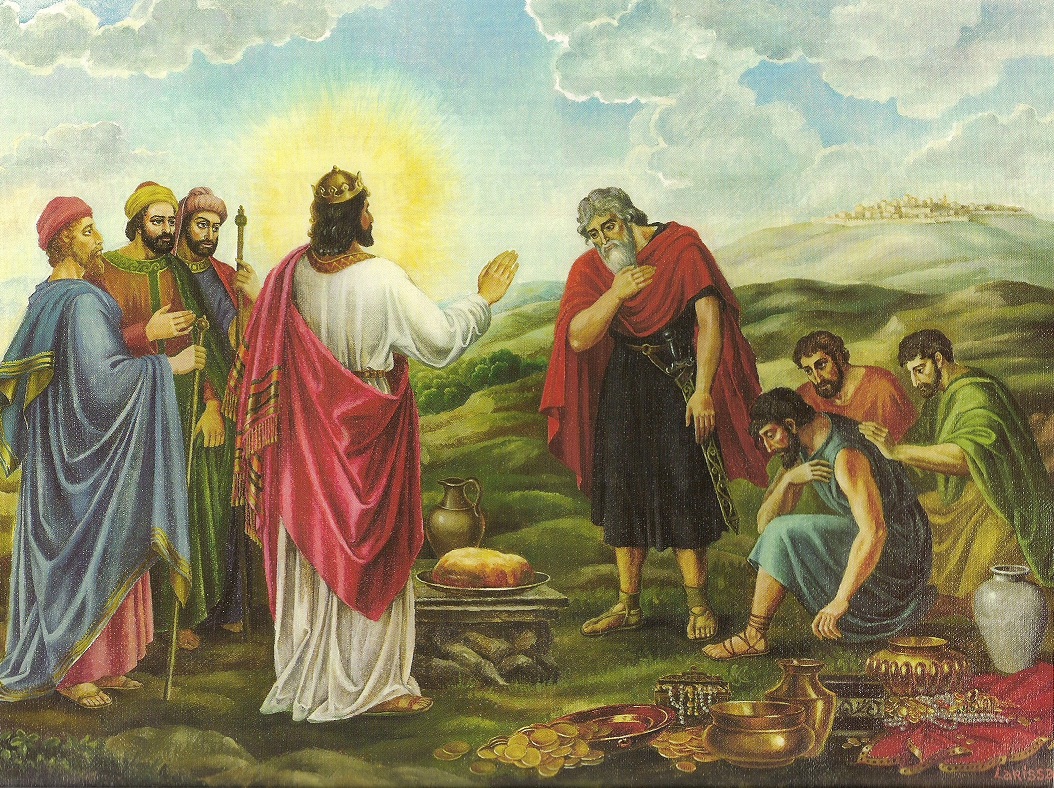
And Melchizedek king of Salem brought forth bread and wine: and he was the priest of the most high God. (Genesis 14:18)

Melchizedek is one of the most mysterious characters recorded in the Bible. He makes his debut in Genesis 14, and the totality of information provided about him is encapsulated within three brief verses (Genesis 14:18-20). It is interesting that the “Book of Beginnings,” which meticulously records all the “begets” of who’s who of important personages of early history, completely ignores the lineage of this apparently most significant person. The New Testament letter to the Hebrews does no better at identifying the parentage of this mysterious figure. Of Melchizedek, the writer of the book of Hebrew writes: “Without father, without mother, without descent, having neither beginning of days, nor end of life; but made like unto the Son of God; abideth a priest continually” (Hebrews 7:3, emphasis mine).

Some believe that Melchizedek was a real person, king of the city-state of Salem. However, Salem is only associated with Melchizedek in the Bible.[1],[2] Nowhere is it listed with the other cities in Canaan, and it is given no significance other than its association with Melchizedek. Some have suggested that Salem was the former name of Jerusalem. They attribute this to clay tablets found at the Tell el Amarna site, dated at 1400 B.C., identifying Urusalim as an early name for Jerusalem. They conclude that “Salem” is just an abbreviated form of Urusalim, and is therefore the same as Jerusalem.

I see several problems with that conclusion. First of all, the date of the Tell el Amarna tablets is about 800 years after Abraham’s encounter with Melchizedek. Israel’s entry into Canaan and the period of the Judges occurred around 1400 B.C. At that time, Jerusalem was known by that name (Jerusalem) and also by the name of Jebus.[3] The Bible identifies Jebus as the city of the Jebusites, and the Jebusites dwelt in the land at the time of Abraham (Genesis 15:18-21). It seems unlikely that the Holy Spirit would refer to the city of Melchizedek as Salem, if He was referring to Jebus (or Jerusalem), and if in fact, Jerusalem existed at that time.

Another problem arises when God commands Abraham to sacrifice Isaac (Genesis 22). God instructed Abraham, “And he said, Take now thy son, thine only son Isaac, whom thou lovest, and get thee into the land of Moriah; and offer him there for a burnt offering upon one of the mountains which I will tell thee of” (Genesis 22:2, emphasis mine). It is widely accepted by Jews, Christians and Muslims, that the place where Abraham offered up his son (Muslims say it was Ishmael) was on Mount Moriah, the place currently occupied by the Dome of the Rock in Jerusalem. If Salem were the same place as Jerusalem, why then did God not clearly say, “Go up to Salem and sacrifice Isaac there”? A close inspection of the text gives the impression that the place to where Abraham was directed was uninhabited.  Note that God directs Abraham to “one of the mountains which I will tell thee.” This was a private matter among God, Abraham and Isaac. It seems unlikely that God would direct Abraham to a population center.

Is Salem Jerusalem? I think not. Jebus, a.k.a. Jerusalem, probably did not exist during Abraham’s lifetime. This would be consistent with the dates of the archaeological finds. So, if Salem is not Jerusalem, then what happened to Melchizedek’s city-state? The validity of the question relies on whether Melchizedek was a flesh-and-blood human being, and whether Salem was a physical place.

I contend that Melchizedek was a Theophany – a preincarnate manifestation of the Lord Jesus Christ. I arrive at this conclusion from the description provided in Genesis 14:18-20 and Hebrews 7:1-4.  As noted earlier, he is described as having no parentage, no beginning, and no end. Only God claims those qualifications. Furthermore, the book of Hebrews notes that he blesses Abraham, and the greater always blesses the lesser. Finally, Abraham offers a tithe (a tenth) of the spoils to Melchizedek. Everywhere else in Scripture, tithes are always associated with service to God, never to men.

His name is more of a title. Melchizedek is a combination of two Hebrew words: melek (king) and tsedeq (righteousness). Combined they render “King of Righteousness” or “Righteous King.” And he is the King of Shalem (peace). His full title could then be rendered as “Righteous King of Peace.” Who does that sound like?

Salem is not Jerusalem. Salem is not a physical place. And Melchizedek is none other than the Lord Jesus Christ, our King of Peace.

Notes:


[1]  See: Genesis 14:18; Hebrews 7:1-2

[2]  Psalm 76:2 associates Salem with Zion – the dwelling place of God.

[3]  See: Judges 19:10-11; 1 Chronicles 11:4-5

2 Comments

Filed under Apologetics, Bible, Religion, Theology

Living Sacrifices

Living Sacrifice

I beseech you therefore, brethren, by the mercies of God, that ye present your bodies a living sacrifice, holy, acceptable unto God, which is your reasonable service.  (Romans 12:1)

Someone said that, “The problem with living sacrifices is that they keep crawling off the altar.” The image of a sacrifice recurs numerous times throughout the pages of the Bible, and in every instance, save for maybe one, the victim dies. The first sacrifice was offered by our Lord to cover the nakedness of Adam and Eve (Genesis 3:21). The pre-incarnate Christ[1] had to slay innocent animals (most likely sheep) in order to atone (cover) for the sin of the first couple. After this, the practice was repeated as is seen by the examples of Abel’s sacrifice (Genesis 4:4) and Noah’s sacrifice following the Flood (Genesis 8:20-21). More than a thousand years later God codified the practice through the Mosaic Law. Jesus offered the ultimate sacrifice with His death on the cross. That event ended the death requirement for the sacrifice.

The one instance where the victim was spared was in the case of Abraham sacrificing Isaac (Genesis 22). In his heart, Abraham sacrificed Isaac in obedience to God. “By faith Abraham, when he was tried, offered up Isaac … Accounting that God was able to raise him up, even from the dead; from whence also he received him in a figure” (Hebrews 11:17, 19). Even though Isaac was spared, a substitute took his place (Genesis 22:11-13); someone or thing had to die. However, “it is not possible that the blood of bulls and of goats should take away sins” (Hebrews 10:4). At last, the blood of Jesus offered the final solution to sin so that neither death, nor the shedding of blood remains as the debt requirement for sin. As the old hymn says, “Jesus paid it all; all to Him I owe.” Even so, sacrifice, for the believer, still remains.

The English word “sacrifice” translates various Hebrew and Greek words each with differing shades of meaning. The first occurrence of the English word “sacrifice” is found in Genesis 31:54 where it translates the Hebrew word zebach meaning slaughter. In Exodus 23:18 it translates the Hebrew word chag meaning festival or victim. In 1 Kings 18:29 it translates the Hebrew word minchah meaning offering or present. As used in our beginning verse, the Greek word is thusia which is the same as the Hebrew zebach meaning slaughter.

Paul calls us (brethren) to present our physical bodies as “living sacrifices” – slaughtered lives. That seems oxymoronic. How can a slaughtered person live? To the Galatians Paul writes, “I am crucified with Christ: nevertheless I live” (Galatians 2:20). Again, how can one crucified live? Obviously Paul cannot be referring to physical death. Elsewhere he explains: “that he [Jesus] died for all, that they which live should not henceforth live unto themselves, but unto him which died for them, and rose again” (2 Corinthians 5:15). Hence we die to “self.” “For if ye live after the flesh [i.e. “self”], ye shall die: but if ye through the Spirit do mortify the deeds of the body, ye shall live” (Romans 8:13). The Greek word translated “mortify” is thanatoō meaning “to kill,” or, in keeping with our theme, “sacrifice.” Note also that the means by which this is accomplished is “through the Spirit.” That source of power comes about by only one way. “Therefore if any man be in Christ, he is a new creature: old things are passed away; behold, all things are become new” (2 Corinthians 5:17). This newness is that of which Jesus spoke when He said, “Marvel not that I said unto thee, Ye must be born again” (John 3:7).

Through the rebirth and by the power of the Spirit, the Christian can put to death the old self and present his body as a living sacrifice that is “holy.” That does not mean sinless or perfect. “Holy” means to be set apart, consecrated, or dedicated to God. Holiness is an attribute of God that sets Him apart and above all of His creation. This is why God cannot abide sin and why He must judge and ultimately punish sin. Although we cannot obtain holiness that approaches the holiness of God, yet God demands holiness from His children. “But as he which hath called you is holy, so be ye holy in all manner of conversation; Because it is written, Be ye holy; for I am holy” (1 Peter 1:15-16). Lamentably, Christians these days fail to understand the meaning of holiness. Many think that just because God’s invitation is “Just As I Am” that nothing needs to change. Perhaps they “walked the aisle” to the words of that old hymn, shook the pastor’s hand, and got dunked in the baptistery at some point in their life, and they presume they are okay. They continue living “just as I am.” But God demands holiness.

How does one achieve holiness? In the following verse Paul says, “And be not conformed to this world: but be ye transformed by the renewing of your mind” (Romans 12:2). In other words, do not allow the world to shape you into its mold. Someone once asked, “If you were accused of being a Christian, would there be enough evidence to convict you?” Sadly when one looks at Christians they are indistinguishable from non-Christians. They dress the same as non-Christians. They talk the same as non-Christians. They indulge themselves as non-Christians. There are absolutely no distinguishing characteristics. God says, “do not be conformed to this world.” Rather we should be “transformed.” Here again is the idea of being “born again.” The Greek word translated “transformed” is metamorphoō from which we get our English word metamorphosis. “Metamorphosis to the adult stage is nothing less than a biological miracle. Complex molecules called enzymes are released, that literally digest the caterpillar while it is ensconced in the chrysalis, converting it into a rich soup of disjointed tissues and cells—which after four days becomes an adult butterfly.”[2] In a manner of speaking, the caterpillar dies, and its liquefied self is “transformed” into a beautiful butterfly. In similar manner, when the person is born again, there is a spiritual transformation that takes place so that the old self is sacrificed and the “new creation” is set apart, dedicated as an acceptable offering to God. That acceptable offering is “your reasonable [logical] service” to God. The Greek word translated “service” is latreia meaning ministration or worship of God. This suggests that all of your life should be conducted as an act of worship to God. It has nothing to do with going to church on Sunday and lifting your hands while you sway to the “worship music.” Your acceptable worship to God is your life – all of it.

Here is where the “living sacrifices” crawl off of the altar. Too many Christians think of worship as what they do on Sunday mornings. Then on Monday, it’s back to conforming to the world. In order for the metamorphosis to become at least semi-permanent, there must be a “renewing of the mind.” That can only take place when the Christian spends time in daily prayer and Bible reading. Instead of reading worldly books, read books by excellent Bible teachers that will build you up. Instead of wasting a lot of time watching worthless, or, worse, harmful television programs, watch and listen to great Bible teachers on TV, DVD or the internet. In other words, fill your mind with the things of God. That will give you a godly perspective on life and the world, and it will change the way that you think. When your thinking changes, the way that you conduct your life will change also. When that happens, you will be set apart – holy – a living sacrifice, acceptable to God.

Notes:


[1] See: https://erniecarrasco.com/2014/02/16/the-first-sacrifice/

[2] Frank Sherwin, “Butterflies vs. Macroevolution” http://www.icr.org/article/butterflies-vs-macroevolution/

2 Comments

Filed under Christianity, Religion, Theology, Worship

Christian Sin

If we confess our sins, he is faithful and just to forgive us our sins, and to cleanse us from all unrighteousness. (1 John 1:9)

This verse is often (wrongly) used when witnessing to unbelievers to show them that God will indeed forgive their sins, but that was not John’s intention; he was addressing Christians. We understand this because in verse three he says, “That which we [referring to the Apostles that walked with Jesus] have seen and heard declare we unto you, that ye also may have fellowship with us: and truly our fellowship is with the Father, and with his Son Jesus Christ.” An unbeliever cannot have fellowship with believers much less with the Father and the Son. The implication of our beginning verse is that “Christians” do sin. This is further emphasized in the next verse that says, “If we [John includes himself] say that we have not sinned, we make him [God] a liar, and his word is not in us” (1 John 1:10). You may have heard the saying that “Christians are not perfect just forgiven.” We do sin. It is hard not to sin because, while our souls/spirits have been “reborn,” they still inhabit our sinful flesh. We can improve that condition by learning to yield to the leading of the Holy Spirit that dwells within us, but that is an ongoing process (known as “sanctification”) while we remain in our physical bodies.

If we are truly “born again,” the Holy Spirit (the presence of God within us) works with our spirit to keep us from sin. He also helps us identify the areas of our lives where we do sin. When that happens, John teaches us that we should “confess” our sin (to God), and He will forgive us of that sin. The Greek word translated “confess” is homologeō. It is a compound word: homo meaning “same” and logeō meaning “to say.” Together it means “to say the same” (thing), or “to agree.” In other words when we “confess” our sins, we “agree” with God that we have sinned, and God “is faithful and just to forgive us our sins, and to cleanse us from all unrighteousness.” This is important because while we may be “saved” our continual sin strains the relationship that we have with God. When we fail to confess our sins, we tend to keep on sinning, and at some point we will sense a separation from God. We might even feel abandoned by God. In order to maintain our fellowship (or closeness) with God, we need to keep our sin in check and the way we do that is by agreeing with God that we have sinned when we do sin.

Jesus death on the cross did pay for all of our sins – past, present and future – but in order for His sacrifice to be “effective” for us individually, we must first “believe.” “And as Moses lifted up the serpent in the wilderness, even so must the Son of man be lifted up: That whosoever believeth in him should not perish, but have eternal life. For God so loved the world, that he gave his only begotten Son, that whosoever believeth in him should not perish, but have everlasting life. (John 3:14-16, emphasis mine). That word “believe” is not simply a matter of saying, “Okay, I know that’s true.”  It means that we are willing to put our lives into His hands. It means we are willing to “repent” – i.e., turn away from – our sins, but in order to do that, we must first be in agreement with Him (confess) that we are sinners. If we have truly done that, there should be evidence of a changed life in us. We cannot just repeat a prayer and continue to live a sinful life thinking that it’s okay because Jesus already paid for all of our sins. That would be presumptuous! “Therefore if any man be in Christ, he is a new creature: old things are passed away; behold, all things are become new” (2 Corinthians 5:17, emphasis mine). In his letter to the Romans, Paul says, “I beseech you therefore, brethren, by the mercies of God, that ye present your bodies a living sacrifice, holy, acceptable unto God, which is your reasonable service. And be not conformed to this world: but be ye transformed by the renewing of your mind, that ye may prove what is that good, and acceptable, and perfect, will of God” (Romans 12:1-2, emphasis mine). That transformation may be dramatic, or it may come about gradually; but there must be a change. That transformation is aided as we submit to the Holy Spirit’s leading in our life, and as we continue to agree with Him (confess) concerning the sin in our lives. Gradually, those sins that used to plague us will become a thing of the past. But John reminds us that, “If we confess our sins, he is faithful and just to forgive us our sins, and to cleanse us from all unrighteousness” (1 John 1:9). That “cleansing” is what maintains our fellowship with Him.

One added note of assurance: We can do nothing to earn our salvation (Ephesians 2:8-9); it is God’s free gift to us who believe. And just as we can do nothing to earn it, we can do nothing to lose it. “For I am persuaded, that neither death, nor life, nor angels, nor principalities, nor powers, nor things present, nor things to come, Nor height, nor depth, nor any other creature, shall be able to separate us from the love of God, which is in Christ Jesus our Lord” (Romans 8:38-39). While we can feel secure in our salvation, unconfessed sin will keep us from enjoying complete fellowship with God. He wants to forgive our sin because He enjoys fellowship with us just as much as we enjoy fellowship with Him.

1 Comment

Filed under Christianity, Gospel, Religion, Salvation, Theology

Reaping What You Sow

Be not deceived; God is not mocked: for whatsoever a man soweth, that shall he also reap. (Galatians 6:7)

The idea that you sow what you reap has been around for a very long time, even before the time of Christ. The Hindu version is karma. You sow good karma, you reap good karma in return. The Chinese have the philosophy of the “yin and yang” which is “bahlahns, Danielson” (think of “Karate Kid”) between good and evil. Star Wars conjoined these ideas into “The Force” with its good or “light” side and its dark side.

In Jesus’ time, the Jews had similar ideas. For example, they extrapolated from the Levitical Law “an eye for an eye and a tooth for a tooth” (Leviticus 24:20) and used it to exact revenge. That was not the intent of the law as Jesus, the Author of the original, explained:

Ye have heard that it hath been said, An eye for an eye, and a tooth for a tooth: But I say unto you, That ye resist not evil: but whosoever shall smite thee on thy right cheek, turn to him the other also. And if any man will sue thee at the law, and take away thy coat, let him have thy cloke also. And whosoever shall compel thee to go a mile, go with him twain. Give to him that asketh thee, and from him that would borrow of thee turn not thou away. (Matthew 5:38-42)

Allow me a moment just to chase this important rabbit. Notice how Jesus responds to “Ye have heard.” His response is, “But I say unto you.” Throughout scripture any OT prophet or NT apostle who relays a message from God always qualifies his message by “Thus saith the Lord,” but not Jesus. He speaks by His own authority. He is the Lord. I just thought that’s a good thing for you to know.

The Jews of Jesus day also had the idea that good health and material prosperity were a sign of God’s favor, i.e., good karma, as a reward for righteous living. Poor health and poverty were a sign of God’s disfavor, i.e., bad karma, as punishment for a sinful life. (See Deuteronomy 29:9; 1 Kings 2:3)  Jesus debunked these perversions. For example, Jesus came across a man blind from birth and His disciples asked Him, “Master, who did sin, this man, or his parents, that he was born blind?” (John 9:2) They shared the prevailing thought that if one keeps the law, i.e., does not sin, they will prosper and enjoy good health, but a sinner will be punished with poverty or a debilitating disease. To put a stop to their stinking thinking, “Jesus answered, Neither hath this man sinned, nor his parents: but that the works of God should be made manifest in him … When he had thus spoken, he spat on the ground, and made clay of the spittle, and he anointed the eyes of the blind man with the clay, And said unto him, Go, wash in the pool of Siloam, (which is by interpretation, Sent.) He went his way therefore, and washed, and came seeing” (John 9:3, 6-7).

The point is that there is not necessarily a direct correlation between your actions and the good or bad you receive in this world. There are many really bad people in this world – most of them in Washington D.C. – that enjoy great wealth and good health. On the other hand, there are many really good people who have low income and/or poor health. Yet the prevailing belief among many people remains that if one does good, one will receive good in return. This further translates into their view of eternity. They believe that in the end God will weigh their good deeds against their sin, and if their good outweighs their bad, they’ll make it into heaven. What they do not understand is that their deeds will indeed be weighed, but their deeds will be weighed against the Word of God (Revelation 20:12-13). Finding themselves painfully short of perfection, their names will be searched for in the Book of Life. Then when their names are not found there, their doom will be sealed for eternity (Revelation 20:15).

Our lead verse above reminds us not to trifle with God – He will not be mocked. But this is not talking about karma in the sense the world understands. In fact, this verse is not necessarily talking about eternity, and it is not directed at non-believers. Paul was writing to Christians – the church in Galatia. He begins this final chapter by addressing church discipline for a brother “overtaken in a fault” (Galatians 6:1). He encourages the church to support one another in prayer (v. 2). He discourages misplaced pride (v. 3). He exhorts everyone to judge their own actions and not those of others (v. 4). He admonishes everyone to pull their own weight (v. 5). Then he entreats them to financially support those who teach them (v. 6). After all this he says, “Be not deceived; God is not mocked: for whatsoever a man soweth, that shall he also reap” (Galatians 6:7). In other words, God sees, not only what you do, but the motives behind the actions – He will not be mocked. One who is a twice-born child of God, will not lose his “sonship,” but just like any good father disciplines his child to correct wrong actions, so the Heavenly Father corrects His misbehaving child. “If ye endure chastening, God dealeth with you as with sons; for what son is he whom the father chasteneth not? … Furthermore we have had fathers of our flesh which corrected us, and we gave them reverence: shall we not much rather be in subjection unto the Father of spirits, and live?” (Hebrews 12:7, 9)

Paul elaborates on the law of sowing and reaping: “For he that soweth to his flesh shall of the flesh reap corruption; but he that soweth to the Spirit shall of the Spirit reap life everlasting” (Galatians 6:8). The “flesh” here should be understood as our sinful nature. While we live in this fallen world, we retain that sinful nature. When we place our trust in Christ, our dead spirit is made alive. “And so it is written, The first man Adam was made a living soul; the last Adam was made a quickening spirit” (1 Corinthians 15:45). “The last Adam” refers to Christ who has been made a “vitalizing spirit” or a “spirit that brings life.” The meaning of the second birth is that Christ has made our dead spirit come to life. That spirit constantly battles the sinful nature that we carry in our flesh. Paul describes this struggle in Romans 7:14-23. In the end he cries out, “O wretched man that I am! who shall deliver me from the body of this death? I thank God through Jesus Christ our Lord. So then with the mind I myself serve the law of God; but with the flesh the law of sin” (Romans 7:24-25).

As children of God, we have both a sinful nature and an eternal spirit. We understand from nature that what is fed will grow, and what is starved will wither or atrophy. We can feed our flesh by indulging our worldly desires like spending too much time on entertainment, watching or listing to worldly programming on television or the radio, listening to worldly music, reading worldly materials, etc. (I am not addressing non-believers, so my word choices should be clear to believers.) Alternately, we can feed our spirit by listening to Godly programming on television or radio, listening to sacred music that honors God, spending time in God’s Word, etc. If we feed our flesh, our desire for worldly pleasures will increase while our spirit will grow weak. Paul warns that we will reap the consequences for “sowing to the flesh.” God does believe in spanking His children. On the contrary, if we feed the spirit, God will enrich our lives (not necessarily in material ways) so that those blessings will reach into eternity. You reap what you sow.

Comments Off on Reaping What You Sow

Filed under Apologetics, Christianity, Religion, Theology