Tag Archives: Holy Spirit

False Religion: Jehovah’s Witnesses

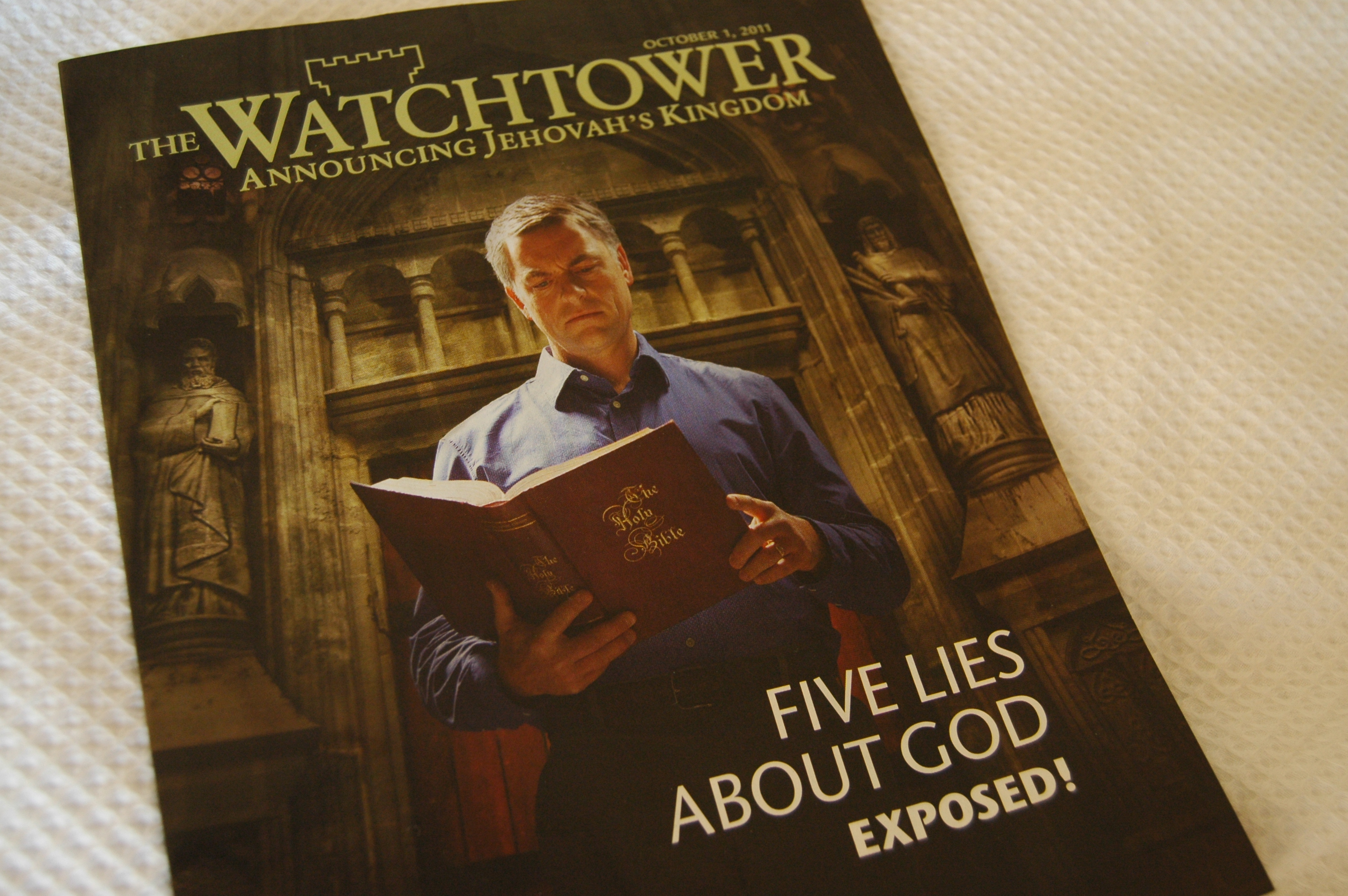
Watchtower

And Thomas answered and said unto him, My Lord and my God (John 20:28)

Almost any Saturday you will find them walking the neighborhoods in pairs smiling and handing out their literature. If you happen to have a face-to-face encounter with the Jehovah’s Witnesses (JWs or Witnesses), you may get the impression that these are really Christians, albeit with a few strange ideas. They quote Scripture, and they seem to be in agreement with some general tenets of Christianity, but do not be fooled, the Jehovah’s Witnesses and the Watchtower Society is a false religion.

As with my last post, False Religion: Mormonism, I will not spend a lot of time reviewing the history of this false religion, although it is very colorful to say the least. For an in-depth study of the Witnesses, I highly recommend The Kingdom of the Cults by Walter Martin (1985) from which I will quote from time to time. While the history of the Jehovah’s Witnesses is a worthwhile study, my main concern is to show how the Witnesses meet the criteria for a false religion: (1) Deny or reject the God of the Bible, (2) Deny or reject the deity of Christ, (3) reject the Bible as the inerrant, infallible Word of God, and (just to add a fourth characteristic of a false religion) (4) they teach salvation through the works or efforts of the believer.

The Witnesses have other problems besides the four “biggies.” JWs reject the doctrine of an eternal hell. They believe that a lost person, one not destined for heaven, i.e., eternal life, is annihilated, that is, they just cease to exist. “To the average Jehovah’s Witness, then, Hell (sheol) is literally ‘the grave,’ the place where mortals wait the resurrection” (Martin, p. 101). The Witnesses contend that the Greek word Gehenna, translated “hell” in English, means “everlasting destruction” (annihilation). “This is indeed a bold-faced misrepresentation of the Greek language and certainly ranks next to the ‘a god’ fallacy [to be discussed later] of John 1:1 as an outstanding example of complete falsehood. There is no evidence that Gehenna ever means annihilation in the New Testament but rather abundant evidence to the contrary” (Martin, p. 102). From the JWs perspective, “The doctrine of a burning hell where the wicked are tortured eternally after death cannot be true, mainly for four reasons: (1) Because it is wholly unscriptural; (2) it is unreasonable; (3) it is contrary to God’s love; and (4) it is repugnant to justice” (Martin, pp. 55-56 quoting Let God Be True, p. 99). By the way, JWs are not the only ones that are repulsed by the doctrine of an eternal hell. Many, both Christians and non-Christians alike, take offense to the doctrine of eternal hell. See my articles “You Don’t Go to Hell Because You’re A Sinner” and “The Book of Life.” While this is a significant problem, it is not the worst problem with this false religion.

Another curious teaching of the Witnesses concerns who will enter “the Kingdom of Heaven.” According to Watchtower literature, “Who and how many are able to enter it [the Kingdom]? The Revelation limits to 144,000 the number that become a part of the Kingdom and stand on heavenly Mount Zion…” (Martin, p. 56 quoting Let God Be True, p. 136). According to http://www.jw.org/en/jehovahs-witnesses/, there are currently 7,965,954 Jehovah’s Witnesses in the world. A little simple math reveals that only about 2% of them will make it into “the Kingdom of Heaven.” So what happens to the other 98%? With those odds, a Jehovah’s Witness is no better off than an atheist who basically believes in annihilationism. At least the atheist does not have to work as hard to achieve that status. The prospect of not making it in is probably the greatest motivator that keeps the JWs on the streets passing out their leaflets. From their perspective, the harder they work and maintain a “holy” life style, the better their chance of being numbered among the 144,000. This fervent work activity is one of the characteristics of false religion (the forth on my list).

Now let us look at why the Jehovah’s Witnesses is a false religion. The Witnesses reject the God of the Bible primarily by their rejection of the Trinity or the triune nature of God – Father, Son, and Holy Spirit. Some astute Witness may point out that the word “Trinity” appears nowhere in the Bible, and they would be correct. Tertullian first used the word in the early part of the third century to describe the triune nature of God. Jehovah’s Witnesses accuse Christians of believing in three gods or “three gods in one,” but Christians “do believe that there are three Persons all of the same Substance, co-equal, co-existent and co-eternal. There is ample ground for this belief in Scriptures, where plurality in the Godhead is very strongly intimated if not expressly declared” (Martin, p. 61). The very first verse of the Bible expresses this. “In the beginning God created the heaven and the earth” (Genesis 1:1, emphasis mine). The Hebrew word translated “God” is ‘ĕlôhı̂ym, a plural, masculine noun. The Hebrew word translated “created” is bârâ’, a singular, masculine verb. Under normal circumstances, the subject and predicate must agree in number and gender, but here they do not indicating that the plural subject acts as a single entity. Just a few verses down we have: “And God said, Let us make man in our image, after our likeness…” (Genesis 1:26, emphasis mine). Again we have the plural ‘ĕlôhı̂ym with the singular verb ‘âmar (“said”). In addition we have the Godhead speaking within Himself, “Let us make man in our image, after our likeness” indicating the plurality of the Godhead. This plurality is also seen in Genesis 11:7 at the Tower of Babel: “let us go down, and there confound their language…” (emphasis mine). In Isaiah’s great vision of God upon His throne we hear the Godhead speak, “Whom shall I send, and who will go for us?” (Isaiah 6:8, emphasis mine) Note how the uni-plurality of the Godhead is demonstrated here. Besides the physical manifestation of the Trinity at Jesus’ baptism (Matthew 3:16-17) there are several examples of the Trinity in the New Testament (See John 14:16; 15:26). More could be said on this, however, it ties into the second reason why the Jehovah’s Witnesses is a false religion.

The JWs deny the deity of Christ. “When Jesus said, ‘My Father is greater than I,” He spoke the truth, for in the form of a servant (Philippians 2:7) and as a man, the Son was subject to the Father willingly; but upon His Resurrection and in the radiance of His glory taken again from whence He veiled it (verses 7, 8), He showed forth His Deity when He declared, “All authority is surrendered to me in heaven and earth” (Matthew 28:18); proof positive of His intrinsic Nature and Unity of Substance. It is evident then that the Lord Jesus Christ was never inferior, speaking of His nature, to His Father during His sojourn on earth” (Martin, p. 63). One of the silly arguments offered by JWs against the deity of Christ concerns His time in the grave. “Who ran the universe the three days Jesus was dead and in the grave?” they say (Martin, p. 62). This reasoning comes from their curious idea that death is the extinction of consciousness. Naturally, if God is unconscious, how can He possibly run the universe? But Scripture clearly affirms the deity of Christ. Consider the following from the Old Testament Scriptures:

Therefore the Lord himself shall give you a sign; Behold, a virgin shall conceive, and bear a son, and shall call his name Immanuel [“God with us”] (Isaiah 7:14, emphasis mine).

For unto us a child is born, unto us a son is given: and the government shall be upon his shoulder: and his name shall be called Wonderful, Counsellor, The mighty God, The everlasting Father, The Prince of Peace (Isaiah 9:6, emphasis mine).

But thou, Bethlehem Ephratah, though thou be little among the thousands of Judah, yet out of thee shall he come forth unto me that is to be ruler in Israel; whose goings forth have been from of old, from everlasting (Micah 5:2).

These descriptions of the coming Messiah clearly show Him to be God: Immanuel (meaning “God with us”), mighty God, everlasting Father, “whose goings forth have been…from everlasting,” i.e., eternity past. Does that sound like any other mortal man? Of course there are many affirmations to Jesus’ deity in the New Testament, but probably none more poignant than Thomas’ confession, “My Lord and my God” (John 20:18). It is remarkable that Jesus did not correct him or reprove him of blasphemy, but rather accepted the worship. “Jesus saith unto him, Thomas, because thou hast seen me, thou hast believed: blessed are they that have not seen, and yet have believed” (John 20:29). Yet, the Jehovah’s Witnesses do not believe and this makes it a false religion.

Jehovah’s Witnesses reject the inerrant and infallible Word of God so much so that they have rewritten it in the form of The New World Translation of Holy Scriptures (NWT) to support their heretical teachings. Most of the changes are designed to deny the Trinity as a whole, but the deity of Christ in particular. One prime example is in their translation of John 1:1. Their translation reads:

In [the] beginning the Word was, and the Word was with God, and the Word was a god. (emphasis mine).

Witnesses have been taught that “a god” is the proper translation because there is no definite article (i.e., “the”) preceding god (theos) in the Greek. I do not want to go into an in-depth study of Greek syntax. Rather, I would simply point out some inconsistencies in their translation were they translate the same Greek construct, i.e., the missing article before “god.”

There arose a man that was sent forth as a representative of God: his name was John (John 1:6 NWT, emphasis mine).

Happy are the peaceable, since they will be called ‘sons of God’ (Matthew 5:9 NWT, emphasis mine).

No one can slave for two masters; for either he will hate the one and love the other, or he will stick to the one and despise the other. You cannot slave for God and for Riches. (Matthew 6:24 NWT, emphasis mine).

And the young child continued growing and getting strong being filled with wisdom and God’s favor continued upon him (Luke 2:40 NWT, emphasis mine).

These are just some examples; there are many more, but in each of the above, the Greek text uses theos alone without the aid of the definite article. If the translators had been consistent in the translation of the NWT, each one of the above examples should have read “a god” not “God.” What this indicates is that they have made a distinction when this Greek construct is referring to Jesus thereby denying His deity. Furthermore, they have ignored Scripture’s stern warning against tampering with the Word of God.

So, to recapitulate, the Jehovah’s Witnesses is a false religion because they deny the God of the Bible when they deny the triune nature of God, they deny the deity of Christ, they deny the inerrant, infallible World of God, and they teach a works based salvation. Again, this was a very brief overview. For an in-depth study, I recommend, The Kingdom of the Cults by Walter Martin.
Comments Off on False Religion: Jehovah’s Witnesses

Filed under Apologetics, Christianity, Evangelism, Gospel, Hell, Religion, Science, Theology

Everyone’s A Slave

No man can serve two masters: for either he will hate the one, and love the other; or else he will hold to the one, and despise the other. Ye cannot serve God and mammon. (Matthew 6:24)

In America, at least for the moment, we consider ourselves to be a free people. After all, we have the Declaration of Independence and the Bill of Rights – the first ten amendments to the United States Constitution. While this may be true in a temporal, earthly sense, it is not so in an eternal, ethereal sense. We are all slaves to something.

Jesus simplifies the slave masters down to two in our verse above. “Ye cannot serve God and mammon.” Mammon was the Aramaic term meaning “riches” or “money,” but the term can be broadened to all the trappings of this world. Anything that demands your time and your devotion is your master. “Know ye not, that to whom ye yield yourselves servants to obey, his servants ye are to whom ye obey; whether of sin unto death, or of obedience unto righteousness?” (Romans 6:16, emphasis added). Many, including Christians, deny that they are slaves to “sin” (i.e., Mammon), but they are self-deceived. This is very easy to prove. It always comes to a choice between the things of God or the things of this world. When confronted with the choice between going to church or Bible study (group or personal) and your favorite diversion, e.g., watching your favorite sports game, watching a favorite TV show or going to a movie, going fishing, boating, or camping, taking the kids to their soccer game, or dance recital, which one comes out on top? None of the things that I listed are necessarily sinful, except when given a superior position to the things of God. Of course, I could have listed really “sinful” choices, but Paul’s exhortation was given to Christians not to “heathen.” If Christians can be enslaved by the things of this world, how much more the non-Christian who is without the power of the Holy Spirit!

The Christian should be guided by a different standard. Paul says that the Christian, “Being then made free from sin, ye became the servants [slaves] of righteousness” (Romans 6:18). Being a “slave of righteousness” (i.e., slaves of God) for the Christian should not be a difficult task. If it is, that one should reevaluate his standing before God. Jesus said, “Take my yoke upon you, and learn of me; for I am meek and lowly in heart: and ye shall find rest unto your souls. For my yoke is easy, and my burden is light” (Matthew 11:29-30). Strange that Jesus should use a yoke as an illustration. Certainly the reader has seen pictures of yoke of oxen pulling a plow or a cart. The yoke that binds the two oxen together for the purpose of pulling a heavy load does not look “easy.” In training oxen to pull a load, a young, inexperienced ox is yoked to an older, experienced ox. The young ox will fight the load, but gradually learns from the older. In the interim, the older ox bears most of the load while the younger is learning. Jesus assures us that “[His] yoke is easy and [His] burden is light” because He “was in all points tempted like as we are, yet without sin” (Hebrews 4:15). He bears the greater load, and as we learn from Him, our load becomes easier to bear; but He must be the Master.

Everyone is a slave to something. You have the choice of who will be master of your life.

2 Comments

Filed under Christianity, Evangelism, Gospel, Religion, Salvation, Theology

Be Ye Holy

Image Credit: Rob Birkbeck

Image Credit: Rob Birkbeck

Sanctify yourselves therefore, and be ye holy: for I am the LORD your God. (Leviticus 20:7)

First of all, I need to emphasize that I believe in salvation by grace alone, through faith alone apart from any works of the flesh (Ephesians 2:8-9; Romans 3:20; 11:6; Galatians 2:16; Titus 3:5). In addition, salvation cannot be maintained through any effort on our part, but it is dependent on the object of our faith, the Lord Jesus Christ, and His ability and faithfulness to keep His promises. Jesus said, “My sheep hear my voice, and I know them, and they follow me: And I give unto them eternal life; and they shall never perish, neither shall any man pluck them out of my hand. My Father, which gave them me, is greater than all; and no man is able to pluck them out of my Father’s hand” (John 10:27-29, emphasis added). Paul asks, “Who shall separate us from the love of Christ?” (Romans 8:3). Then he provides a long list of possibilities before answering, “Nay, in all these things we are more than conquerors through him that loved us. For I am persuaded, that neither death, nor life, nor angels, nor principalities, nor powers, nor things present, nor things to come, Nor height, nor depth, nor any other creature, shall be able to separate us from the love of God, which is in Christ Jesus our Lord” (Romans 8:37-39).

That said, as His children, God still expects us to live “holy” lives. Our opening verse comes from the Old Testament law, and it was directed at the Children of Israel. Many Christians will object: “That’s Old Testament! We are ‘New Testament’ Christians. We are not under the Law; we are under Grace!” Well, what does the New Testament say? Jesus said, “If ye love me, keep my commandmentsHe that hath my commandments, and keepeth them, he it is that loveth me: and he that loveth me shall be loved of my Father, and I will love him, and will manifest myself to him” (John 14:15, 21, emphasis added). Then He makes Himself our example: “If ye keep my commandments, ye shall abide in my love; even as I have kept my Father’s commandments, and abide in his love” (John 15:10). Peter also echoes the words of the Old Testament when he says, “But as he [Jesus] which hath called you is holy, so be ye holy in all manner of conversation [i.e., “manner of life” or “life conduct”]; Because it is written, Be ye holy; for I am holy” (1 Peter 1:15-16). James, the brother of Jesus, puts it very plainly, “faith, if it hath not works, is dead, being alone” (James 2:17). James is not preaching a salvation of works, but rather calls for a practical, visible manifestation of the faith we claim. He explains: “Yea, a man may say, Thou hast faith, and I have works: shew me thy faith without thy works, and I will shew thee my faith by my works” (James 2:18). A very simple illustration of James’ premise is this: To convince my wife to marry me, I told her that I loved her. But once we are married, I never take her out, I never help her at home, I never pay any attention to her or listen to her; I go out and spend time with my friends and leave her at home alone. I stay out late at night and use our home as sort of a “flop house.” Could an outside observer testify that I really love my wife? That is the point James is making. True faith demonstrates some sort evidence to the genuineness of that faith.

So what does it mean to be “holy”? Does it mean living a sinless life? If that were even possible, what purpose would Christ’s death on the cross serve? Of all our godly examples from Scripture, not one lived a sinless life, except for Jesus Christ our Lord. Paul lamented, “O wretched man that I am! who shall deliver me from the body of this death?” (Romans 7:24). So, being “holy” does not equate to being “sinless.”

The word “holy” means to be set apart. When God commanded the Children of Israel to be holy, He intended them to be distinct from the nations that surrounded them. Modern Christians often make light of the Old Testament laws and reject them as not applicable to New Testament saints. But, other than the sacrificial laws which were done away with the sacrifice of Christ, many of those laws were put in place for the sole purpose of distinguishing the people of God from the people of the world. Take for example, the prohibition against piercings and tattoos: “Ye shall not make any cuttings in your flesh for the dead, nor print any marks upon you: I am the LORD” (Leviticus 19:28). Piercings, cuttings of the skin, tattoos, etc. were all common practices of the pagan nations that surrounded Israel. These kinds of markings are still considered “beautiful” with many primitive people today. God wanted His people to be different. I selected this one example because it is one of the most obvious that I see among Christians today – they are hard to hide. To me what this says is “I can make my body more beautiful than the one God made for me.” That aside, the point is that we have a lost generation out there that needs a Savior, and this is what they do. Christians, rather than set themselves “apart,” fall right in line with the rest of the lost world, and yet, God still calls His people to be “holy.”

“Holy” also means to be “sanctified” or “consecrated,” i.e., to be “dedicated” to the service of the Lord. That does not mean that we put on our “holy” garments on Sunday for worship and live the rest of the week serving ourselves – in whatever form that takes. “I beseech you therefore, brethren, by the mercies of God, that ye present your bodies a living sacrifice, holy, acceptable unto God, which is your reasonable service. And be not conformed to this world: but be ye transformed by the renewing of your mind, that ye may prove what is that good, and acceptable, and perfect, will of God” (Romans 12:1-2, emphasis added). A “living sacrifice” is a daily thing. Note that it is “holy” – distinct from the world around us. Our lives should not be conformed to the passing fads of this world, but rather our thinking should be “transformed” according to the pattern of our Savior. Our lifestyle, distinct and set apart from this world, will prove to the world, as James pointed out, “what is that good, and acceptable, and perfect, will of God.” For that Christian who thinks this cannot be done, you are correct. It cannot be done through your own strength, but by the Grace that comes from the indwelling Holy Spirit in our lives. Be ye holy.

1 Comment

Filed under Apologetics, Christianity, Evangelism, Gospel, Religion, Salvation, Theology

What’s Special About Sunday?

In the end of the sabbath, as it began to dawn toward the first day of the week ... (Matthew 28:1)

In the end of the sabbath, as it began to dawn toward the first day of the week … (Matthew 28:1)

And very early in the morning the first day of the week, they came unto the sepulchre at the rising of the sun. (Mark 16:2)

Why should Christians worship on Sunday instead of Saturday as do the Jews and certain other “Christian” denominations? After all, in fourth of the Ten Commandments, God specifically says, “Remember the sabbath day, to keep it holy. Six days shalt thou labour, and do all thy work: But the seventh day is the sabbath of the LORD thy God: in it thou shalt not do any work, thou, nor thy son, nor thy daughter, thy manservant, nor thy maidservant, nor thy cattle, nor thy stranger that is within thy gates: For in six days the LORD made heaven and earth, the sea, and all that in them is, and rested the seventh day: wherefore the LORD blessed the sabbath day, and hallowed it” (Exodus 20:8-11). So, are we in violation of God’s commandment by worshiping on Sunday?

First of all, let me say that setting aside one day of the week for rest and worship is right and proper whether that day be Friday, Saturday, or Sunday or any day of the week for that matter.  “One man esteemeth one day above another: another esteemeth every day alike. Let every man be fully persuaded in his own mind” (Romans 14:5).

Much of the confusion comes with the interpretation of the word “Sabbath” in the Bible.  The word in the Hebrew does not mean “seventh” (shebəiʽi), but rather “rest” or “to rest” (shebbot).  Genesis 2:2 tells us that “on the shebəiʽi day God ended his work which he had made; and he shebbot on the shebəiʽi day from all his work which he had made.”  Translating that seventh day to mean Saturday “assumes” that God began His creative acts on Sunday, and we really have no textual basis for that conclusion other than what has been handed down to us by Jewish tradition – that, however, is not to say that this tradition is in error.  Furthermore, as you study the “Feasts of the Lord” given in Exodus and Leviticus, you find that each of those days is considered a shebbot (Sabbath) regardless of what day of the week it falls on.  So, we need to be careful not to become dogmatic over things on which the Bible is unclear.  However, it is clear that we need to “sanctify” – set aside – one day a week for the Lord.

Today, on Resurrection Day, we celebrate our Lord’s victory over death. (See “Risen Indeed,” where I cover the facts of the Resurrection.) The Resurrection is significant for us who believe because we have the promise that because Christ conquered death, we too can be assured of a resurrection to eternal life. “But if there be no resurrection of the dead, then is Christ not risen: And if Christ be not risen, then is our preaching vain, and your faith is also vain … But now is Christ risen from the dead, and become the firstfruits of them that slept.” (1 Corinthians 15:13-14, 20). Today we rejoice in Christ’s resurrection and look forward to our own resurrection to be with Him eternally.

In the New Testament, the first Jewish Christians went to the temple or synagogue on the Sabbath (Acts 13:14; 17:2; 18:4) for the sake of the Jews, but they also met on the First Day of the week (Acts 20:7; 1 Corinthians 16:2) because this was “the Lord’s Day” and also for the sake of the Gentiles which were not obligated to follow Jewish custom (Colossians 2:16). The reason for this change is because this is when Christ was raised from the dead (Matthew 28:1, Mark 16:2; Luke 24:1; John 20:1).

The First Day of the week was also the day that the Holy Spirit descended upon the disciples gathered in the upper room (Acts 2:1). Scripture does not specify the day of the week, but when you consider that Jesus arose on the first day of the week and count forward 50 days (the Day of Pentecost) you will find that day to be Sunday also. The day that Jesus arose was the “First Omer” (Nisan 16) and the Day of Pentecost was the “50th Omer (Sivan 6). Not only were these days important on the Jewish calendar, but they have even greater significance in the Christian calendar. For this reason, it is proper that Christians should meet on the First Day of the week to celebrate the Risen Lord and the coming of the Holy Spirit.

 So, as you celebrate this Resurrection Lord’s Day, remember why it is so special. He is risen indeed!

Comments Off on What’s Special About Sunday?

Filed under Apologetics, Christianity, Death, Evangelism, Gospel, Heaven, Hell, Religion, Salvation, Theology

Perhaps This Year!

2014

“Watch therefore, for ye know neither the day nor the hour wherein the Son of man cometh.” (Matthew 25:13)

This past weekend my wife and I had dinner with some good friends from church. A little sign above their kitchen clock caught my eye. It read: “Perhaps Today.” It reminded me that Henry M. Morris, founder of the Institute for Creation Research, kept a similar placard on his desk as a constant reminder that Jesus could return any day. Jesus Himself commanded that we should “watch” for His return. That word in the Greek is grēgoreuō, and it means to “keep awake,” to “be vigilant.”

Jesus issued that exhortation in the context of the Parable of the Ten Virgins (Matthew 25:1-13). Five of the virgins were characterized as “wise” and the other five were “foolish.” All ten virgins fell asleep. Perhaps the expected Bride Groom tarried longer than anticipated, and they all grew weary in waiting. The difference is that the wise virgins were prepared with extra oil for their lamps while the foolish virgins used all they had and made no provision for the unexpected. When the herald announced the coming of the Bride Groom, the wise virgins, prepared with extra oil for their lamps, went on in to be with the Bride Groom while the foolish virgins missed the wedding.

Oil is often used to symbolize the Holy Spirit. We who are “born again” have the advantage of the Holy Spirit residing within us, and, like the wise virgins, we have the provision of the Holy Spirit so that no matter when the Lord returns, we will be prepared. However, just like the wise virgins we can become weary of waiting for the Lord’s return, and we lose focus. We fall asleep often distracted by the cares and worries of this world, and we forget to watch. Sometimes we lament, “How long for His return!” While the foolish, distracted and unconcerned, say, “Where is the promise of his coming? for since the fathers fell asleep, all things continue as they were from the beginning of the creation” (2 Peter 3:4). And so, they have no “oil” for their lamps; they are unprepared.

Our dinner conversation quickly turned to the topic of eschatology, the study of end times. All of us at the table are on “watch” and anxiously await our Lord’s return. Someone brought up the fact that there are four “blood moons” (lunar eclipses) and a solar eclipse expected on significant Jewish feast days in 2014 and 2015. The first will occur on Passover (April 15) 2014 followed by the second on the Feast of Tabernacles (October 8) 2014. The third will occur on Passover (April 4) 2015 followed by the fourth on the Feast of Tabernacles (September 28) 2015. This infrequent sequence of lunar eclipses has historically held great significance for the Jewish people.

For example, when it happened in 1493 and 1494 Jews were expelled from Spain. The blood moons in 1949 and 1950 came right after the nation of Israel was assembled, giving the Jews a homeland for the first time in thousands of years. And in 1967 and 1968 it was linked to the Six-Day War.[1]

In addition to this, a solar eclipse is expected on March 20, 2015. This date equates to Nisan 1 on the Jewish calendar which is New Year’s Day on the Jewish religious calendar. When measured against Scripture, these phenomena should make us pay attention.

When God initiated these feasts (there are seven), He said, “these are My feasts.” “Speak unto the children of Israel, and say unto them, Concerning the feasts of the LORD, which ye shall proclaim to be holy convocations, even these are my feasts” (Leviticus 23:2, emphasis added). Besides the seven, modern Jews celebrate Purim and Chanukah, but these are not “feasts of the LORD.” The Feasts of the Lord is a fascinating study, which I cannot cover in this brief article. They hold great significance as they reveal God in the Person of Jesus Christ and demonstrate His plan for the ages.

The fact that this sequence of blood moons, along with the solar eclipse, looms in our immediate future has many who study eschatology excited for the prospect of Christ’s imminent return. “The sun shall be turned into darkness, and the moon into blood, before the great and the terrible day of the LORD come” (Joel 2:31, emphasis added).

How are you fixed for oil in your lamp? “Ye are the light of the world” (Matthew 5:14). Are you prepared for the Lord’s return? Perhaps this year! Perhaps today!

Comments Off on Perhaps This Year!

Filed under Christianity, Current Events, End Times, Evangelism, Gospel, New Year's Day, Religion, Salvation, Second Coming of Christ, Theology