
Tag Archives: Image of God

Top Priority

treasure

For where your treasure is, there will your heart be also. (Matthew 6:21)

But seek ye first the kingdom of God, and his righteousness; and all these things shall be added unto you. (Matthew 6:33)

A “Christian” young man once lamented the exhortation to holy living by exclaiming, “Do you expect me to become a monk!” Sadly, that is not an uncommon sentiment. Such a sentiment coming from an unbeliever is understandable, but too many Christians these days harbor the same sentiments. The call to holiness[1] is prevalent throughout Scripture, yet many Christians try to hide behind “grace” claiming that we are no longer under the Law.[2] Somehow the world has taught Christians that living a life dedicated, in all things, to the service of Christ denies them of the benefits that only the world can give. But is that true?

Our verse above is taken from Jesus’ Sermon on the Mount (Matthew 5-7). In this portion of the sermon, Jesus begins by calling attention to worldly “treasures”: “Lay not up for yourselves treasures upon earth, where moth and rust doth corrupt, and where thieves break through and steal” (Matthew 6:19). Here Jesus points out an undeniable fact that everyone understands: “things” do not last. There exists an unrelenting physical law which dictates that everything degenerates, wears out, or slows down. It is the inescapable Second Law of Thermodynamics.
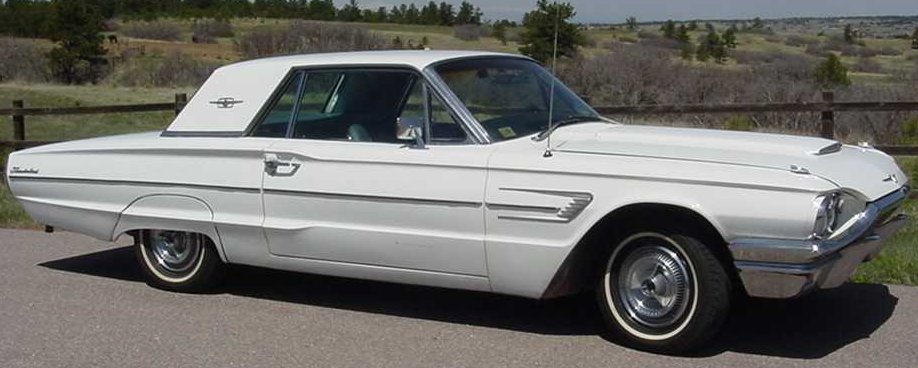
65 T-Bird_SM

1965 Ford Thunderbird

My brother recently tempted me with the opportunity to purchase of a 1965 Ford Thunderbird – a beautiful automobile. For an antique of that type, the price was reasonable, and not outside my ability to purchase it. My brother mentioned that it had “some rust,” a couple of the electric widows were not operating properly, and the paint job was poorly done, but still, it was worth the money. As I battled the temptation, I considered the “little rust” that has the potential to spread like cancer. It would have to be cut out and replaced with “healthy” metal. Then it would need to be repainted. It needs some upholstery work. The windows need new motors. Many “minor” things are needed to make the car “right.” Then, after all that expense, I would end up with an old car that is still wearing out as parts for it become rarer. “Things” just do not last. Jesus says, “Don’t invest in things that will just wear out in the end.” Instead He says, “But lay up for yourselves treasures in heaven, where neither moth nor rust doth corrupt, and where thieves do not break through nor steal: For where your treasure is, there will your heart be also” (Matthew 6:20-21). What do you treasure?

Jesus goes on to talk about real needs: food, clothing, shelter (Matthew 6:25-30), and He emphasizes that “your heavenly Father” knows that you need all these things (v. 32). Just as the Father feeds the birds of the air and clothes the fields with flamboyant colors, He will provide for all your needs. After all, “Are ye not much better than they?” (Matthew 6:26). The birds of the air, and the lilies of the fields were not created in the image of God, but you were (Genesis 1:26). “Therefore take no thought, saying, What shall we eat? or, What shall we drink? or, Wherewithal shall we be clothed? (For after all these things do the Gentiles seek:) for your heavenly Father knoweth that ye have need of all these things” (Matthew 6:31-32). The Greek word translated as “thought” is merimnaō and it means to be “anxious,” and it carries the idea of being overly concerned about these things which are under God’s divine control.

An old hymn that my mother used to sing to us comes to mind. The third verse of that hymn says:

All you may need He will provide,
God will take care of you;
Nothing you ask will be denied,
God will take care of you.[3]

God will take care of you. He has promised to provide for all your needs (not necessarily your desire for a 1965 T-Bird). With your needs met, what should be your priority? “But seek ye first the kingdom of God, and his righteousness; and all these things shall be added unto you” (Matthew 6:33). Top priority is the kingdom of God.

This is the first place this phrase appears in Scripture. If the search for the kingdom of God is to be foremost, we should have an idea of what that is. The next occurrence of this phrase takes place after Jesus has been accused by the Pharisees of casting out demons by the power of Satan. Jesus asserts that He casts out demons by the “Spirit of God” testifying to the presence of the kingdom of God (Matthew 12:28). The “Spirit of God” indwells every believer (Romans 8:9-11; 1 Corinthians 3:16) so that we should strive to “walk not after the flesh [i.e., the desires of this world], but after the Spirit” (Romans 8:1, 4). “So then they that are in the flesh cannot please God” (Romans 8:8). But Christians can suppress the Holy Spirit (the Spirit of God) in their lives (1 Thessalonians 5:19). So, in seeking the kingdom of God, we need to continually turn over control to the Holy Spirit in our lives (Ephesians 5:18) so that through His power we can cast out the demons in our own lives.

The “kingdom of God” is synonymous with the “kingdom of heaven” and both terms seem to be used interchangeably in the New Testament. The kingdom of heaven seems more often to refer to the realm of the elect, i.e., the children of God (Luke 20:34-36, John 1:12), the saved (John 3:17), the church (Acts 2:47), etc. To that end our top priority is to expand the kingdom of God. “For whosoever shall call upon the name of the Lord shall be saved. How then shall they call on him in whom they have not believed? and how shall they believe in him of whom they have not heard? and how shall they hear without a preacher? And how shall they preach, except they be sent? as it is written, How beautiful are the feet of them that preach the gospel of peace, and bring glad tidings of good things!” (Romans 10:13-15). As we draw upon the power of the Holy Spirit, we each in our own way and as the Spirit leads can share the good news of God’s love. “For I am not ashamed of the gospel of Christ: for it is the power of God unto salvation to every one that believeth; to the Jew first, and also to the Greek” (Romans 1:16). The message is simple:

  1. We are all sinners (Romans 3:10, 23)
  2. We are all condemned to “eternal” death (Romans 6:23)
  3. God offers eternal life which we cannot earn (Romans 6:23, Ephesians 2:8-9)
  4. God’s offer is in spite of our sinfulness (Romans 5:8)
  5. Our only requirement is to believe and accept (Romans 10:9-10; John 1:12)

The other priority we should seek, according to our verse, is “His righteousness.” Note that it’s His righteousness, not our own. Because of our sin nature, our righteousness could never measure up to God’s standard of righteousness (Romans 3:23; Isaiah 64:6). It is Jesus’ righteousness we seek, “Whom God hath set forth to be a propitiation through faith in his blood, to declare his righteousness for the remission of sins that are past, through the forbearance of God; To declare, I say, at this time his righteousness: that he might be just, and the justifier of him which believeth in Jesus” (Romans 3:25-26, emphasis mine). The Greek word translated “propitiation” is hilastērion, and it is “an expiatory (place or thing), that is, (concretely) an atoning victim.”[4] In other words, Jesus, the sinless Son of God, offered Himself and His righteousness as the one and only atoning sacrifice worthy of acceptance by God and sufficient to cover (the meaning of “atone”) our sin and make us acceptable to Holy God. Notice that it comes by or “through faith in His blood.” When we receive Jesus as our Savior “through faith in His blood,” i.e. His sacrifice, we are “dressed in His righteousness.” The heavenly scene in Revelation says, “And white robes were given unto every one of them” (Revelation 6:11). Later the source of their whiteness is described: “And he said to me, These are they which came out of great tribulation, and have washed their robes, and made them white in the blood of the Lamb” (Revelation 7:14, emphasis mine). So, our entry into heaven is not gained through our own righteousness, but through His righteousness.

Our top priority then should be to “seek first the kingdom of God and His righteousness,” then all “these things” will be added. In fact, when your first priority is right, the stuff the world offers will seem worthless. It will no longer have same appeal to you. Top priority: God’s Kingdom and His righteousness.

NOTES:


[1] Be Ye Holy

[2] Is the Law Sin?

[3] “God Will Take Care of You” – Civilla D. Martin: http://library.timelesstruths.org/music/God_Will_Take_Care_of_You/

[4] Strong’s G2435

Comments Off on Top Priority

Filed under Christianity, Evangelism, Gospel, Religion, Salvation

How Art Thou Fallen!

Angel of Light

How art thou fallen from heaven, O Lucifer, son of the morning! how art thou cut down to the ground, which didst weaken the nations! (Isaiah 14:12)

God deniers often challenge believers with the question of evil in the world. “If God is so good, why is there so much evil in the world?” Another closely linked question is “Why did God create Satan?” and “When did God create Satan?” My attempt to answer these questions follows.

God created Satan (his name is Lucifer) when He created the other angels. Angels were created early on during the week of creation (Genesis 1) – probably Day One or Day Two of creation. We get this from God’s response to Job’s questioning concerning the calamity that had befallen him. God asks Job:

Where wast thou when I laid the foundations of the earth? … When the morning stars sang together, and all the sons of God shouted for joy? (Job 38:4, 7, emphasis added)

“The morning stars” is used synonymously with “the sons of God” – Hebrew bene Elohim, which is used only in regard to angels in the Old Testament. From this we gather that the angels witnessed creation. Satan is included with “the sons of God.”

Now there was a day when the sons of God came to present themselves before the LORD, and Satan came also among them. (Job 1:6, emphasis added)

Again there was a day when the sons of God came to present themselves before the LORD, and Satan came also among them to present himself before the LORD. (Job 2:1, emphasis added)

Apparently by this time Satan, which means “accuser,” had already fallen, and he was actively attacking man. However, notice Who still has the final say – Satan still needed to get permission from God to attack Job. But when did Satan Fall? The Bible does not provide specific answers to this question, but we can at least conclude that it happened after creation was completed because we have God’s assessment of His finished product:

And God saw every thing that he had made, and, behold, it was very good. (Genesis 1:31, emphasis added).

God’s creation would not have been “very good,” if there were rebellion in the camp, and to suppose that perhaps God was unaware of a rebellion would be to deny God’s omniscience. So, sometime between God’s conclusion of creation and the Fall of man (Genesis 3), Satan rebelled against God. That brings up the question: Why would Satan rebel against God? We are given some hints in the books of Isaiah and Ezekiel.

How art thou fallen from heaven, O Lucifer, son of the morning! how art thou cut down to the ground, which didst weaken the nations! For thou hast said in thine heart, I will ascend into heaven, I will exalt my throne above the stars of God: I will sit also upon the mount of the congregation, in the sides of the north: I will ascend above the heights of the clouds; I will be like the most High. (Isaiah 14:12-14, emphasis added)

Thou [“king of Tyrus,” i.e., Satan] hast been in Eden the garden of God; every precious stone was thy covering, the sardius, topaz, and the diamond, the beryl, the onyx, and the jasper, the sapphire, the emerald, and the carbuncle, and gold: the workmanship of thy tabrets and of thy pipes was prepared in thee in the day that thou wast created. Thou art the anointed cherub that covereth; and I have set thee so: thou wast upon the holy mountain of God; thou hast walked up and down in the midst of the stones of fire. Thou wast perfect in thy ways from the day that thou wast created, till iniquity was found in thee. By the multitude of thy merchandise they have filled the midst of thee with violence, and thou hast sinned: therefore I will cast thee as profane out of the mountain of God: and I will destroy thee, O covering cherub, from the midst of the stones of fire. Thine heart was lifted up because of thy beauty, thou hast corrupted thy wisdom by reason of thy brightness: I will cast thee to the ground, I will lay thee before kings, that they may behold thee. (Ezekiel 28:13-17, emphasis added)

From this, especially from the Ezekiel passage, we can infer that Lucifer (“the king of Tyrus” i.e., Satan) was a high ranking angel – very likely an archangel. He was obviously very beautiful as his “covering” is described as beautiful gem stones. His name, Lucifer, means “shining one” or “day star,” therefore he must have been quite dazzling – very unlike the images of Satan we see depicted today. Notice also that his “sin” was the same sin with which he tempted Eve in the Garden: “ye shall be as gods, knowing good and evil” (Genesis 3:5).

Only three angels are named in the Bible: Lucifer, Michael, and Gabriel. Since these are the only three named, it is quite possible that these are the only archangels that God created. I arrive at this conclusion from what we read of the fall of Satan (the “old dragon”) found in Revelation 12:

And there appeared another wonder in heaven; and behold a great red dragon, having seven heads and ten horns, and seven crowns upon his heads. And his tail drew the third part of the stars of heaven, and did cast them to the earth: and the dragon stood before the woman which was ready to be delivered, for to devour her child as soon as it was born. (Revelation 12:3-4, emphasis added)

As noted in the Job passages above, angels are sometimes referred to as “stars.” That Satan drew “the third part of the stars of heaven” along with him indicates to me that these were the angels that were under his command, leaving the remaining two-thirds under the command of Michael and Gabriel.

It is conjecture on my part, but I believe the reason Satan rebelled was because he became jealous of man who was created in the image of God and given dominion over God’s creation.

And God said, Let us make man in our image, after our likeness: and let them have dominion over the fish of the sea, and over the fowl of the air, and over the cattle, and over all the earth, and over every creeping thing that creepeth upon the earth. So God created man in his own image, in the image of God created he him; male and female created he them. And God blessed them, and God said unto them, Be fruitful, and multiply, and replenish the earth, and subdue it: and have dominion over the fish of the sea, and over the fowl of the air, and over every living thing that moveth upon the earth. (Genesis 1:26-28, emphasis added)

Angels were not created in the image of God, nor were they given charge over God’s creation. That distinction was given to man; therefore Satan became jealous and plotted to cause man to fall. He thought “of himself more highly than he ought to think” (Romans 12:3) as described in the Isaiah and Ezekiel passages above. His sin was not in his thought, but in acting upon his thought and carrying out his plan to cause man to sin. This is probably where Satan fell.

There is evil in the world because of sin – rebellion – which was first birthed in the mind of Satan and brought to full fruition through man’s disobedience. Some may object that God should not have given man occasion to disobey by placing the tree of the knowledge good and evil in the garden, but love is a choice. God also provided another tree on a hill called Calvary. From that tree we are free to partake, “For God so loved the world, that he gave his only begotten Son, that whosoever believeth in him should not perish, but have everlasting life” (John 3:16). Love is a choice.

Comments Off on How Art Thou Fallen!

Filed under Apologetics, Atheism, Christianity, Creation, Evangelism, Gospel, Heaven, Hell, Origins, Religion, Salvation, Satan, Theology

Time for Pride to Grow

“. . . when the morning stars sang together, and all the sons of God shouted for joy?” (Job 38:7)

A common question that arises from time to time is, “When did God make the angels?” A corollary question to that is “Was there enough time for pride to grow in Satan and for the war in Heaven to occur within the first few days?”

In the Job passage quoted above, God is telling Job that the angels were there at the time when He formed the earth. As to whether there was sufficient time for Satan’s pride to grow, we must ask, “How much time does it take for pride to grow?” In our own experience, does it take a long time to develop pride, or does it just seem to flare up unexpectedly? I would say the latter. Pride is one of the most basic sins. Human beings are naturally selfish and self-centered. Recall that very shortly after Creation, Satan was able to tempt Eve with “the pride of life” (1 John 2:16): “ye shall be as gods, knowing good and evil” (Genesis 3:5). It does not take a great amount of time for pride to grow.

The angels probably were created on the first day of the creation week. We cannot be dogmatic about this. The Bible does not specify when the angels were created, but the above passage in Job indicates that they were at least around to see the creation taking place. The angels, therefore, were created before man. Perhaps the reason for not focusing more attention on angels is that the Bible focuses mainly on the relationship between God and man. Angels play a part, but they are not central to God’s redemptive plan. But what does God say about man? “Let us make man in our image, after our likeness: and let them have dominion over the fish of the sea, and over the fowl of the air, and over the cattle, and over all the earth, and over every creeping thing that creepeth upon the earth” (Genesis 1:26, emphasis added). Did God say that about the angels? Did God give dominion over His creation to the angels? Can you see anything there that would give rise to pride and jealousy?

It would not have taken a long time for Satan’s pride to grow. Having been created first and then given lower status than man, Satan said, “I will ascend into heaven, I will exalt my throne above the stars of God: I will sit also upon the mount of the congregation, in the sides of the north: I will ascend above the heights of the clouds; I will be like the most High” (Isaiah 14:13-14, emphasis added). Satan hates man because God has bestowed upon man greater status than the angels. “What is man, that thou art mindful of him? and the son of man, that thou visitest him? For thou hast made him a little lower than the angels, and hast crowned him with glory and honour. Thou madest him to have dominion over the works of thy hands; thou hast put all things under his feet” (Psalm 8:4-6, emphasis added). The English phrase “a little lower than the angels” is not an accurate translation. “Angels” is the Hebrew ‘ĕlôhîym referring to God rather than the normal word for angels mal’âkîm. This is a messianic passage describing the condescension of Christ in taking human form, but this also has a secondary meaning as applied to man. Having been created in the image of his Maker, man holds a higher status than the angels, and this infuriates Satan.

This being the case, Satan most likely rebelled on Day Six of creation or very shortly thereafter. Seeing that man was God’s prized creation, Satan turned his ire toward destroying man. Knowing that man was created in the image of God, he employed that fact to cause man’s demise: “ye shall be as gods” (Genesis 3:5). If one analyses the source of any sin, it all goes back to pride – man wants to be his own god. This has been true from the beginning when Satan witnessed the creation of man, and since the fall of man in the Garden (Genesis 3). It really takes no time for pride to develop. It is nothing that requires any nurturing. On the contrary, it is something must actively be suppressed, and this cannot be done through human strength. It requires the supernatural power that only comes from God through the Holy Spirit. Jesus promised, “ye shall receive power, after that the Holy Ghost is come upon you” (Acts 1:8), and it is in that power alone that pride can be conquered.

1 Comment

Filed under Apologetics, Christianity, Creation, Evolution, Gospel, Origins, Theology

Later, Little Friend

???????????????????????

And in that day will I make a covenant for them with the beasts of the field, and with the fowls of heaven, and with the creeping things of the ground: and I will break the bow and the sword and the battle out of the earth, and will make them to lie down safely. (Hosea 2:18)

About two months ago I wrote about our little dog Tina in my article “Doggie Heaven.” At that time her obvious declining health helped prepare us for the inevitable. I wrote the piece with a heavy heart, and with a rather hopeless feeling that this would be the end forever. Like many people, I believed that only humans are immortal (in essence) because, after all, we have been created in the “image of God” (Genesis 1:26). Animals are God’s creatures, and He cares about them, but they do not bear the Imago Dei. That remains a true statement, but I have come to the conclusion that my former belief that only humans have an eternal soul is false.

Shortly after posting that article, a very good and respected friend gave me a book by Gary Kurz to encourage me as I walked though this “valley of the shadow of death.” In the book, Cold Noses at the Pearly Gates, Kurz walks us though Scripture and demonstrates, through Scripture alone, that animals do indeed have eternal souls, and they do go to heaven when they die. This assurance made my heart glad because it was the conclusion to which I was coming on my own. I cannot possibly cover every aspect in this short post that Kurz takes an entire book to cover, but the concept, when you seriously think about it, is very simple.  When God completed His work of creation, He said it was “very good.” There was no sin in the world, neither was there any death. (This fact should make Christians reject evolution in any way, shape or form. Death is NOT “very good.”) Every creature having the “breath of life” (Hebrew: ruach) was meant to live forever. Death is the enemy (1 Corinthians 15:26); therefore death could not be part of a “very good” creation. But through man’s sin, death entered the world (Romans 5:12) and the whole creation was affected (Romans 8:22). Animals suffer the curse of death even though they are innocent of sin. This is why animals were slain from the very beginning (Genesis 3:21) to atone for the sins of man – innocent blood was required. But the blood of animals cannot atone for the sins of man (Hebrews 9:12), only the sinless blood of the Lamb of God could atone for our sins. Jesus died for the sins of man. He did not die for animals, because they did not sin. In time, He will make all things new (Revelation 21:5). When He does, all those sparrows who escaped not His notice when they fell, will fill the New Heavens and New Earth, and so will all His other creatures as the prophet said (Isaiah 11:6-9; 65:25). All those animals in whom is the “breath of life” will live again.

Last weekend, our little Tina fought for every breath. Early Saturday morning, in the middle of the night we took her to the animal ER thinking that we might have to put her down that night. The vet gave her some injections to help her discomfort and sent us home. Later that morning, Tina was not doing any better, it seemed, so we took her in to our regular vet. He diagnosed her with bloat and prescribed barium to help relieve the gas and Benadryl to help with her breathing. But that did not help either, and she continued to struggle for every breath. Poor baby was so tired, but she had to hold herself up in order to breathe, and could not lay down to sleep or rest. It was such a pitiful sight to watch her sit in the middle of the floor, head drooping down trying to sleep but unable to. That night we propped her up with towels and medicated her so she could rest. The next day, Sunday, was another day of fighting for every breath. Monday morning came and we took our baby to the vet one last time. We came home without her. I held her in my arms as the vet administered the fatal injection, and as I watched her ruach leave her little body, I wept uncontrollably – we both did.

Almost a week has gone by, and there is not a day that goes by that we don’t think about her. She was just a little dog, but she left such a big hole in our lives. The book my friend gave me, Cold Noses at the Pearly Gates, has given me the assurance that even though she is gone for now, she is not gone forever. We will see her again. And she’ll have both eyes!

Later, little friend!


6 Comments

Filed under Christianity, Creation, Dogs, End Times, Gospel, Religion, Salvation, Theology