Tag Archives: Jerusalem

The Land

But now thus saith the LORD that created thee, O Jacob, and he that formed thee, O Israel, Fear not: for I have redeemed thee, I have called thee by thy name; thou art mine. (Isaiah 43:1)

One cannot escape the flood of wars and rumors of wars coming from the Middle East. More than two weeks ago, at the climax of the Feast of Tabernacles in Israel, Hamas terrorists invaded southern Israel. They killed many innocent civilians and took away many captives. They raped women and tortured and killed children and babies. Their atrocities left the world in shock. Not since ISIS have such horrors been on full display for the world to see.

As expected, the “free” world denounced the heinous acts and pledged to stand with Israel. After shaking off the shock, Israel took the offensive against Hamas in the Gaza Strip. Typical of Israel’s approach, the IDF took great measures to warn the civilians in the Gaza Strip to flee to the southern border for their own safety. Then the relentless bombing of Gaza City by the IDF started striking strategic targets of known Hamas strongholds. Unlike Israel and the IDF who value innocent human life, Hamas hunkers down in schools, mosques, hospitals, and civilian housing buildings. They use their own people as human shields knowing that Israel will not attack where innocents may be harmed. However, this time Israel took off the gloves. With sufficient warning to the civilian population, all Hamas targets were attacked.

It did not take long for the “friends” of Israel to start pressuring Israel for restraint in sympathy for the poor Palestinians. Certainly, a (very) small percentage of Palestinians do not agree with the actions of Hamas against innocent Israeli citizens. However, a great majority of them voted for Hamas leadership. In their schools, they teach their children to hate Jews and encourage them from a very young age to kill Jews. When Palestinian terrorists kill Jews in Israel, there are celebrations in the streets of Gaza. So, we should not be so quick to feel sorry for their sufferings; it is not totally undeserved.

It was not long before the US visited Israel to publicly profess solidarity with Israel in this war against terror, while behind the scenes pressuring Israel to allow for “humanitarian” aid for the poor suffering Palestinians. The US threatened to withhold munitions, support parts for Israeli fighters (F-16s and others), and money for the war effort. In the meanwhile, the US continues to send money to Iran which funds its proxies (Hamas, Hezbollah, Islamic Jihad, etc.) to do its dirty work. Money also continues to flow to the Palestinians from the US, which Hamas diverts for its own purposes. They do not care for the Palestinian people.

As Israel continues to prosecute this war, world support for her effort will quickly wane. Even now protests in favor of the poor Palestinians are rising all over the world, including here in the US, Israel’s “friend.” The world has a perverted idea that somehow the Palestinians have some kind of claim to the land of “Palestine.” Without going into great detail, the “Palestinian State” was established in 1965 by the Palestinian Liberation Organization (PLO), and Yasser Arafat, an Egyptian. Before then, there were no “Palestinian” people. The land was called Palestine because the Roman Emperor Hadrian renamed Judea to Syria Palestina and Jerusalem to Aelia Capitolina in order to remove Judah and Jerusalem from the memory of rebellious Jews. Thus, even our Bible maps continue to name the land Palestine. However, the land never belonged to Palestinians, nor did Palestinians ever exist.

The land belongs to God and He says so in so many words. In fact, He begins by asserting ownership of the entire planet. “Now therefore, if ye will obey my voice indeed, and keep my covenant, then ye shall be a peculiar treasure unto me above all people: for all the earth is mine” (Exodus 19:5, emphasis mine). Notice that while making this claim, He also identifies the children of Israel as His “peculiar treasure … above all people,” not Arabs, Palestinians, or any other nation. Furthermore, God claims the land of Israel as His own. “The land shall not be sold for ever: for the land is mine; for ye are strangers and sojourners with me” (Leviticus 25:23, emphasis mine). God “gave” the land to Israel for their stewardship, not to be sold to anyone else, because it belongs to God, not to them. Through the psalmist, David, God names some of the parcels of land. “Gilead is mine; Manasseh is mine; Ephraim also is the strength of mine head; Judah is my lawgiver” (Psalm 108:8). See the following (linked) passages where God makes claim to the land: 2 Chronicles 7:19-20; Isaiah 14:24-25; Jeremiah 2:7; 16:17-18; Ezekiel 38:16; Joel 1:6; 3:2.

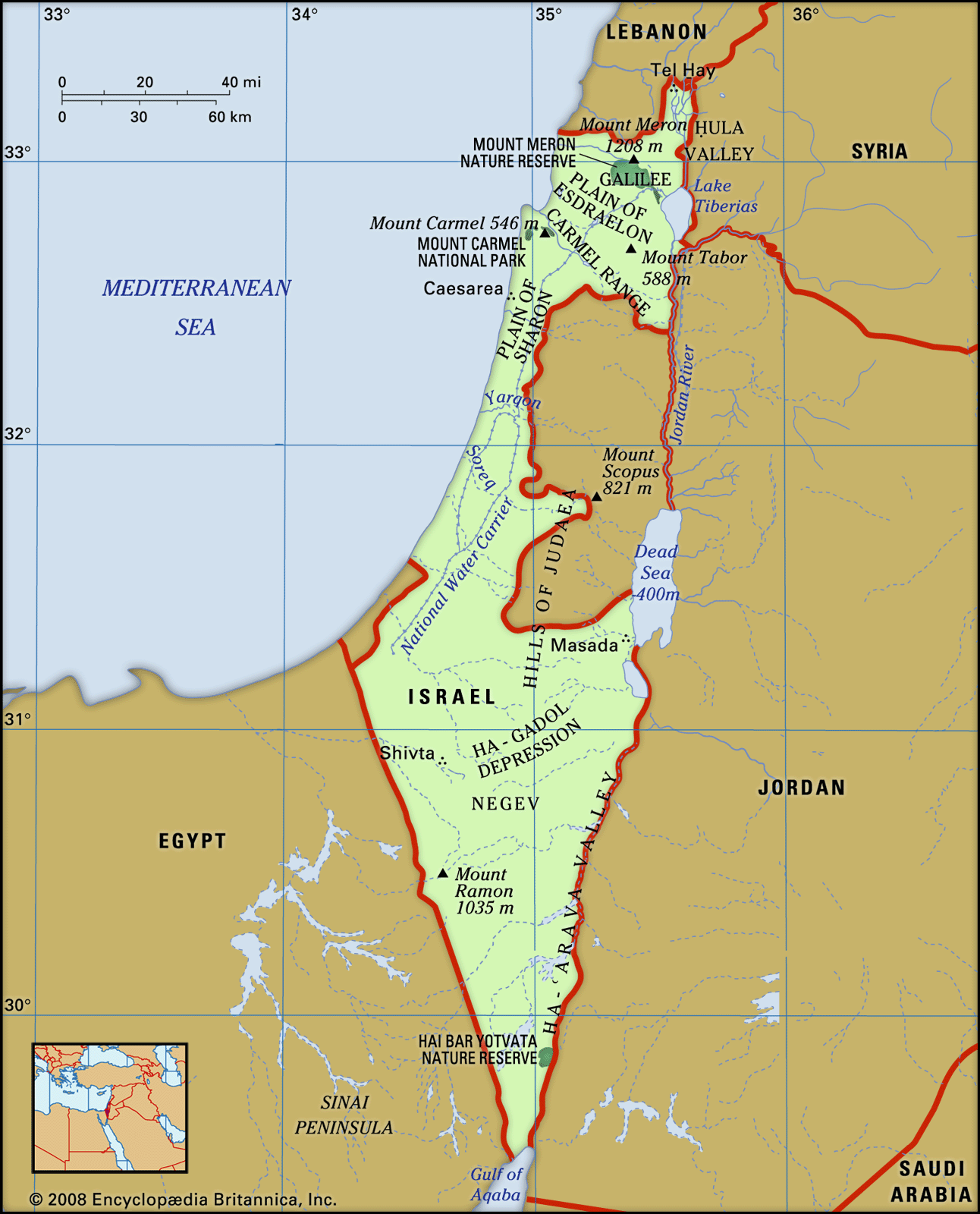
Before the children of Israel inhabited the land, it was possessed by the cursed line of Canaan, son of Noah’s son Ham (Genesis 9:25). For reasons known only to God, He called Abram (Abraham) out of the land of the Chaldees (Genesis 11:28) and promised to give him the land (Genesis 12:7). The land God promised extended beyond the current boundaries of Israel including the Sinai Peninsula, parts of Jordan, all of Syria and Lebanon, to the Euphrates River and up to the southern border of Turkey (Genesis 13:14-15). The land was promised to Abraham and his descendants unconditionally with no strings attached (Genesis 15:7, 9-21). “In the same day the LORD made a covenant with Abram, saying, Unto thy seed have I given this land, from the river of Egypt unto the great river, the river Euphrates” (Genesis 15:18, emphasis mine). The promise has no term limits; it is an eternal promise. “For all the land which thou seest, to thee will I give it, and to thy seed for ever” (Genesis 13:15, emphasis mine).

The promise did not remain with Abraham. It was passed on to his son Isaac (Genesis 26:3, 5) and his grandson, Jacob (later renamed Israel – Genesis 28:3-4, 13-15). Time and again, the promise of the land to the descendants of Abraham, Isaac, and Jacob (Israel) is repeated in Scripture: Genesis 17:8; Exodus 6:8; 12:25; 13:5, 11; 33:1; Deuteronomy 1:8; 8:1; 10:11; 11:9, 21; 19:8; 28:11; 30:20, 21, 23; 34:4; Joshua 1:6; 21:43; Judges 2:1; Nehemiah 9:15, 23. God swore upon Himself to uphold His promise. “For when God made promise to Abraham, because he could swear by no greater, he sware by himself, Saying, Surely blessing I will bless thee, and multiplying I will multiply thee” (Hebrews 6:13-14). God promised the land to the descendants of Abraham, Isaac, and Israel (Jacob), not for a certain timeframe but forever. “Be ye mindful always of his covenant; the word which he commanded to a thousand generations; Even of the covenant which he made with Abraham, and of his oath unto Isaac; And hath confirmed the same to Jacob for a law, and to Israel for an everlasting covenant, Saying, Unto thee will I give the land of Canaan, the lot of your inheritance” (1 Chronicles 16:15-18, emphasis mine). “Everlasting” means that it will never end.

It is God’s land to give to whomever He chooses, and He chose the people of Israel. Abraham had other sons besides Isaac. He had Ishmael through his concubine Hagar (Genesis 16:15). After Sarah died, Abraham remarried and had six other sons by Katura (Genesis 25:1-2). None of these received the promise of the land, only Isaac and later Israel (Jacob). God’s “gift” of the land to Israel is also repeated over and over in Scripture: Leviticus 14:34; 23:10; 25:38; Numbers 27:12; 32:7, 9, 11; 33:53; Deuteronomy 5:31; 6:23; 9:23; 12:1, 10; 16:20; 17:14; 19:14; 21:1; 24:4; 25:15, 19; 27:3; 28:8; 32:52; Joshua 1:2, 11, 15; 5:6; 18:3; 1 Kings 8:34, 40; 9:7; 2 Kings 21:8; Nehemiah 9:36; Jeremiah 25:5; Ezekiel 20:15, 28.

The land belongs to Israel and more land than they currently occupy. The Bible describes the boundaries of the promised land. God showed Abraham the extent of the land promised (Genesis 13:14-15). God repeated the boundaries to Moses (Exodus 23:31) and again to Joshua upon entering the Promised Land (Joshua 1:4). The land on which the Nation of Israel exists today is only a small part of what God has given them, and yet, wrongheaded people want to take away what little they possess now. God will not have it! It is His land, and He will not allow it to be parceled out by outsiders. “Defile not therefore the land which ye shall inhabit, wherein I dwell: for I the LORD dwell among the children of Israel” (Numbers 35:34, emphasis mine). God also has a special affinity for Jerusalem. “Since the day that I brought forth my people out of the land of Egypt I chose no city among all the tribes of Israel to build an house in, that my name might be there; neither chose I any man to be a ruler over my people Israel: But I have chosen Jerusalem, that my name might be there; and have chosen David to be over my people Israel” (2 Chronicles 6:5-6, emphasis mine)

God did drive the Jews out of their land for their rejection of their Messiah, but that was only a temporary measure. God has not permanently disinherited His people. There has always been the promise of restoration in the latter days. “And I will send the sword, the famine, and the pestilence, among them, till they be consumed from off the land that I gave unto them and to their fathers” (Jeremiah 24:10). “For, lo, the days come, saith the LORD, that I will bring again the captivity of my people Israel and Judah, saith the LORD: and I will cause them to return to the land that I gave to their fathers, and they shall possess it … Therefore fear thou not, O my servant Jacob, saith the LORD; neither be dismayed, O Israel: for, lo, I will save thee from afar, and thy seed from the land of their captivity; and Jacob shall return, and shall be in rest, and be quiet, and none shall make him afraid … For I will restore health unto thee, and I will heal thee of thy wounds, saith the LORD; because they called thee an Outcast, saying, This is Zion, whom no man seeketh after.  Thus saith the LORD; Behold, I will bring again the captivity of Jacob’s tents, and have mercy on his dwellingplaces; and the city shall be builded upon her own heap, and the palace shall remain after the manner thereof” (Jeremiah 30:3, 10, 17-18, emphasis mine).

Even though Israel has sinned and remains in sin even now, God in His mercy will restore His people. “Fear thou not, O Jacob my servant, saith the LORD: for I am with thee; for I will make a full end of all the nations whither I have driven thee: but I will not make a full end of thee, but correct thee in measure; yet will I not leave thee wholly unpunished” (Jeremiah 46:28, emphasis mine). The full restoration of Israel will happen when the nation, as a whole, recognizes and turns to their Messiah. “And I will pour upon the house of David, and upon the inhabitants of Jerusalem, the spirit of grace and of supplications: and they shall look upon ME whom they have pierced, and they shall mourn for him, as one mourneth for his only son, and shall be in bitterness for him, as one that is in bitterness for his firstborn” (Zechariah 12:10, emphasis mine).

The land of Israel belongs to God. He has allotted it to the descendants of Abraham, Isaac, and Jacob, i.e., Israel. No one else has any right to that land, and there will be no peace in the Middle East until those who would divide the land, or who would exterminate the Jews from the land acknowledge that the land belongs to them.
5 Comments

Filed under Apologetics, Current Events, End Times, Theology

Jerusalem

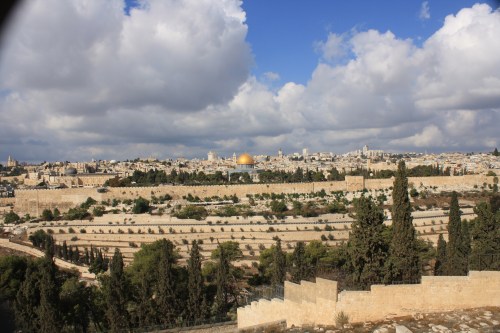
Modern Jerusalem viewed from the Mount of Olives

And unto his son will I give one tribe, that David my servant may have a light alway before me in Jerusalem, the city which I have chosen me to put my name there. (1 Kings 11:36)

Emerging from the tunnel cut through the mountain from Jericho, I caught my first glimpse of the “Eternal City,” Jerusalem. I was completely unprepared for the overwhelming emotional “rush” I would get upon my first view of the city – God’s city. Although Jerusalem is in every way a modern city – nothing like it was in Jesus’ day – building codes imposed on new construction maintain the “old” appearance of the city. That probably contributed to my emotional response.

There are cities in the Middle East more ancient than Jerusalem. Damascus, Syria, for example, is first mentioned in Genesis 14:15.  In this account, a confederation of four kings from the area around Damascus came against the kings of the south, in the area around the Dead Sea. One of those cities was Sodom where Abram’s nephew Lot was living. The invading kings sacked the five cities including Sodom and carried off captives of which Lot was one. Abram mustered up a small army of his own servants, pursued the four kings, rescued Lot, and the other captives, and took back the booty taken by the marauding kings. On his return, he encountered Melchizedek, king of Salem (Genesis 14:17-20). Some have supposed that Salem was the same as Jerusalem, but I disagree for several reasons.[1]

Jerusalem[2] is built on the mountains in the land of Moriah. It was “upon one of the mountains” (Genesis 22:2) there that God instructed Abraham to sacrifice his only son Isaac. It is noteworthy that God did not instruct Abraham to go to Salem, Jerusalem, or Jebus (Judges 19:10-11; 1 Chronicles 11:4-5). Jebus was the “city of the Jebusites” and the Jebusites were in the land when Abram first arrived (Genesis 15:21), and it seems it would have been an excellent landmark if it existed at the time of Abraham. Instead, God instructed Abraham to go the “land of Moriah” and sacrifice Isaac on one of the mountains there. A normal reading of the text leads one to see this place as isolated and uninhabited. However, this would later become the site of Jerusalem, and the particular mountain on which Isaac was offered would become the site of the Temple “in the threshingfloor of Ornan the Jebusite.” (2 Chronicles 3:1). Eventually, God would sacrifice His own Son, on the mountains of Moriah.

This alone makes Jerusalem a special place. Geographically, Jerusalem is located near the center of earth’s total landmass.[3] More than this, God stamped His name on Jerusalem.[4] Jews associate the Hebrew letter “Shin” (ש) with the name of God. They derive this from the “Shama” (meaning “hear”) in Deuteronomy 6:4 – “Hear, O Israel: The LORD our God is one LORD.” Jerusalem – the “Old City” is situated on the mountains of Moriah, which are flanked by two valleys – the Kidron, and Tyropean – with a third, the Hinnom (Gehenna), that runs down the center to join the other two. The topography forms the letter “Shin” the symbol of God’s name. The land of Israel has a similar stamp where the three headwaters of the Jordon River join together to form the letter “Shin.”

The mountains of Moriah are made up of three mountain heads: Ophel, Moriah, and Zion. “Ophel” means “My Fortress” and represents God the Father. “Moriah” means “to see God” or “to be seen of God” and represents God the Son. “Zion” means “the Mark” and represents God the Holy Spirit who is the “seal” or the “mark” of all believers. One mountain range with three heads representing one God in three persons.

Jerusalem, as stated earlier, is the “Eternal City.” When Jesus returns to reign as King of Kings and Lord of Lords, He will come to Jerusalem. “And his feet shall stand in that day upon the mount of Olives, which is before Jerusalem on the east, and the mount of Olives shall cleave in the midst thereof toward the east and toward the west, and there shall be a very great valley; and half of the mountain shall remove toward the north, and half of it toward the south” (Zechariah 14:4, emphasis mine). Jesus will physically reign from His Temple in Jerusalem. A river will flow from his throne here and will run to the east and into the Dead Sea, which will be healed (Ezekiel 47:8-9).

At the end of the 1000-year reign of Christ on earth, God will create a “new heaven and a new earth,” and a “New Jerusalem” will descend from heaven to a recreated earth (Revelation 21:1-2) where those of us who are His children will reign forever with Him. As beautiful as Jerusalem is today, it will not compare to the New Jerusalem where not just God’s name will dwell, but God Himself will dwell with us!

Reader, if you are unsure where you will spend eternity, read my page on Heaven.

Notes:


[1]  “Is Salem Jerusalem?” – https://erniecarrasco.com/2015/08/16/is-salem-jerusalem/

[2]  “Hebrew Word Study – Jerusalem – Part I” – http://livingwordin3d.com/discovery/2016/12/18/hebrew-word-study-jerusalem-part-i/

[3]  “The Center of the Earth” – http://www.icr.org/article/50

[4]  “Jerusalem – I Will Put My Name There – Amazing Revelations” – https://www.youtube.com/watch?v=aZO_eRmR2ho

2 Comments

Filed under Bible, Christianity, End Times, Gospel, Heaven, Religion, Salvation, Second Coming of Christ, Theology

Is Salem Jerusalem?

Melchizedek_Abraham

And Melchizedek king of Salem brought forth bread and wine: and he was the priest of the most high God. (Genesis 14:18)

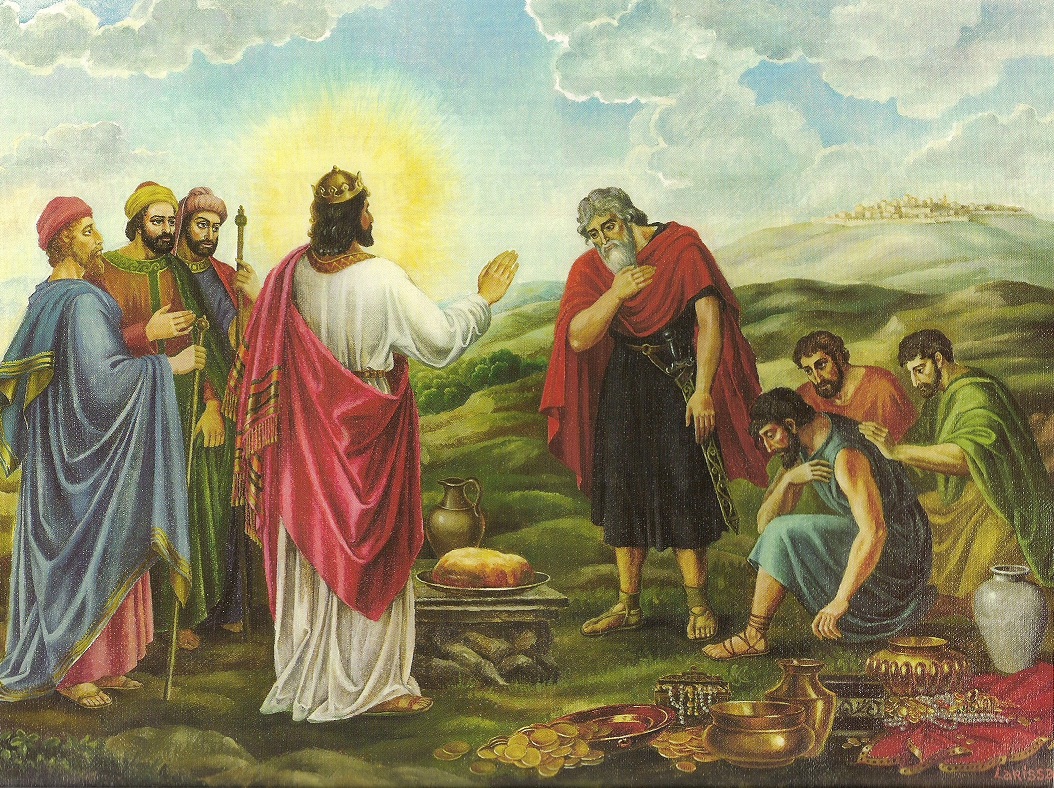
Melchizedek is one of the most mysterious characters recorded in the Bible. He makes his debut in Genesis 14, and the totality of information provided about him is encapsulated within three brief verses (Genesis 14:18-20). It is interesting that the “Book of Beginnings,” which meticulously records all the “begets” of who’s who of important personages of early history, completely ignores the lineage of this apparently most significant person. The New Testament letter to the Hebrews does no better at identifying the parentage of this mysterious figure. Of Melchizedek, the writer of the book of Hebrew writes: “Without father, without mother, without descent, having neither beginning of days, nor end of life; but made like unto the Son of God; abideth a priest continually” (Hebrews 7:3, emphasis mine).

Some believe that Melchizedek was a real person, king of the city-state of Salem. However, Salem is only associated with Melchizedek in the Bible.[1],[2] Nowhere is it listed with the other cities in Canaan, and it is given no significance other than its association with Melchizedek. Some have suggested that Salem was the former name of Jerusalem. They attribute this to clay tablets found at the Tell el Amarna site, dated at 1400 B.C., identifying Urusalim as an early name for Jerusalem. They conclude that “Salem” is just an abbreviated form of Urusalim, and is therefore the same as Jerusalem.

I see several problems with that conclusion. First of all, the date of the Tell el Amarna tablets is about 800 years after Abraham’s encounter with Melchizedek. Israel’s entry into Canaan and the period of the Judges occurred around 1400 B.C. At that time, Jerusalem was known by that name (Jerusalem) and also by the name of Jebus.[3] The Bible identifies Jebus as the city of the Jebusites, and the Jebusites dwelt in the land at the time of Abraham (Genesis 15:18-21). It seems unlikely that the Holy Spirit would refer to the city of Melchizedek as Salem, if He was referring to Jebus (or Jerusalem), and if in fact, Jerusalem existed at that time.

Another problem arises when God commands Abraham to sacrifice Isaac (Genesis 22). God instructed Abraham, “And he said, Take now thy son, thine only son Isaac, whom thou lovest, and get thee into the land of Moriah; and offer him there for a burnt offering upon one of the mountains which I will tell thee of” (Genesis 22:2, emphasis mine). It is widely accepted by Jews, Christians and Muslims, that the place where Abraham offered up his son (Muslims say it was Ishmael) was on Mount Moriah, the place currently occupied by the Dome of the Rock in Jerusalem. If Salem were the same place as Jerusalem, why then did God not clearly say, “Go up to Salem and sacrifice Isaac there”? A close inspection of the text gives the impression that the place to where Abraham was directed was uninhabited.  Note that God directs Abraham to “one of the mountains which I will tell thee.” This was a private matter among God, Abraham and Isaac. It seems unlikely that God would direct Abraham to a population center.

Is Salem Jerusalem? I think not. Jebus, a.k.a. Jerusalem, probably did not exist during Abraham’s lifetime. This would be consistent with the dates of the archaeological finds. So, if Salem is not Jerusalem, then what happened to Melchizedek’s city-state? The validity of the question relies on whether Melchizedek was a flesh-and-blood human being, and whether Salem was a physical place.

I contend that Melchizedek was a Theophany – a preincarnate manifestation of the Lord Jesus Christ. I arrive at this conclusion from the description provided in Genesis 14:18-20 and Hebrews 7:1-4.  As noted earlier, he is described as having no parentage, no beginning, and no end. Only God claims those qualifications. Furthermore, the book of Hebrews notes that he blesses Abraham, and the greater always blesses the lesser. Finally, Abraham offers a tithe (a tenth) of the spoils to Melchizedek. Everywhere else in Scripture, tithes are always associated with service to God, never to men.

His name is more of a title. Melchizedek is a combination of two Hebrew words: melek (king) and tsedeq (righteousness). Combined they render “King of Righteousness” or “Righteous King.” And he is the King of Shalem (peace). His full title could then be rendered as “Righteous King of Peace.” Who does that sound like?

Salem is not Jerusalem. Salem is not a physical place. And Melchizedek is none other than the Lord Jesus Christ, our King of Peace.

Notes:


[1]  See: Genesis 14:18; Hebrews 7:1-2

[2]  Psalm 76:2 associates Salem with Zion – the dwelling place of God.

[3]  See: Judges 19:10-11; 1 Chronicles 11:4-5

2 Comments

Filed under Apologetics, Bible, Religion, Theology

Seeing, They See Not

ConversionStPaul

And the men which journeyed with him stood speechless, hearing a voice, but seeing no man. (Acts 9:7)

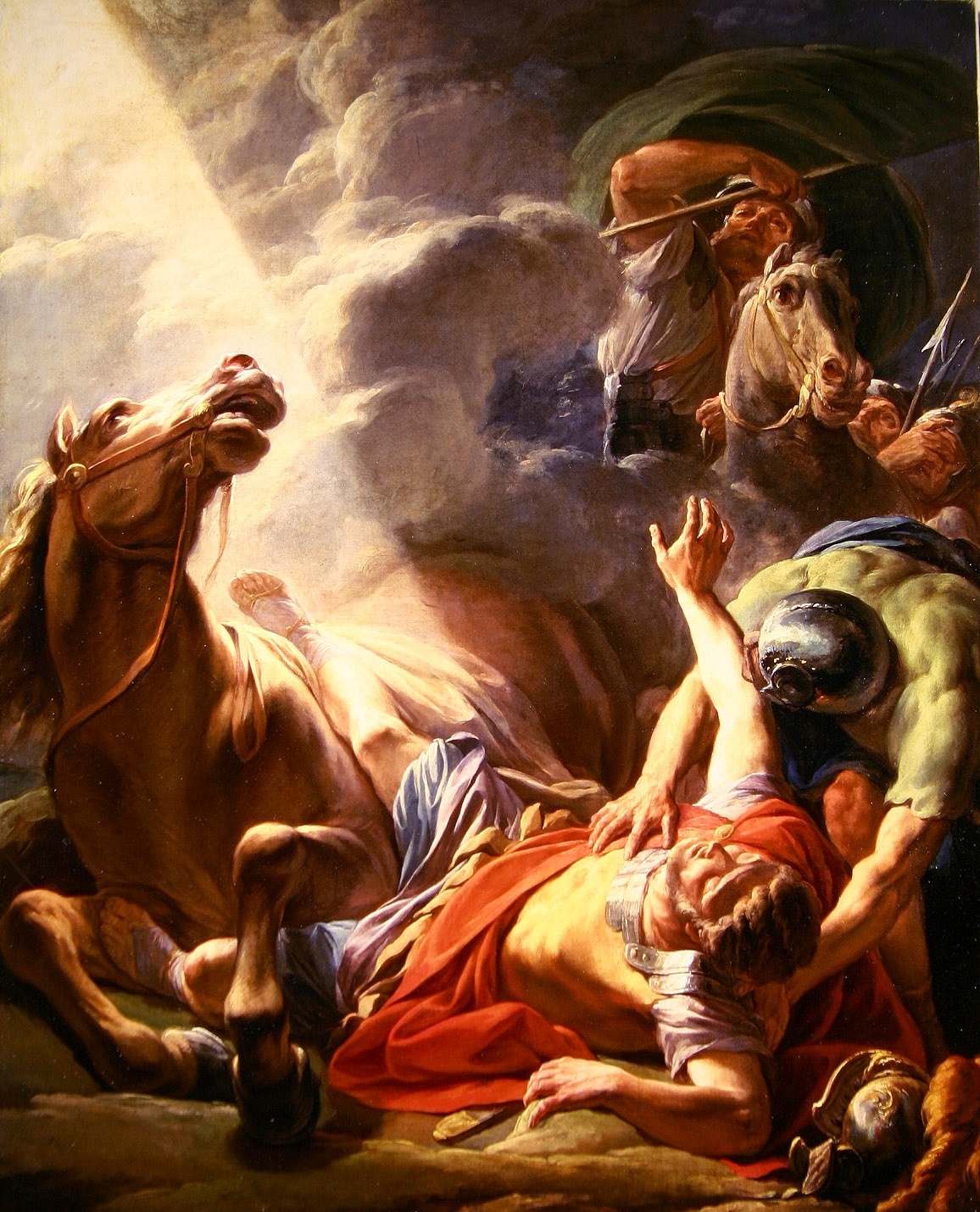
Saul was a religious fanatic. Following his approving support of the stoning of the first recorded Christian martyr, Stephan (Acts 7:58), he “yet breathing out threatenings and slaughter against the disciples of the Lord, went unto the high priest, And desired of him letters to Damascus to the synagogues, that if he found any of this way, whether they were men or women, he might bring them bound unto Jerusalem” (Acts 9:1-2). Saul was ready to bring in the followers of “The Way” either dead or alive, and he would have given his life for the extermination of these infidels – those who had turned away from the religion of their fathers. Such zeal is nothing strange to us these days, unless you are a Christian; Christians do not normally behave in this manner.

But God had something else in mind for Saul, and He would turn Saul’s zeal for his religion into zeal for the Person of Jesus Christ. Saul was a hard-case, and getting his attention would require more than witnessing the death of a faithful martyr. So Jesus met him in person on his mission to exterminate the believers that were in Damascus. “And as he journeyed, he came near Damascus: and suddenly there shined round about him a light from heaven: And he fell to the earth, and heard a voice saying unto him, Saul, Saul, why persecutest thou me?” (Acts 9:3-4). Saul was soon to learn that his mission against The Way was really a mission against God Himself as Jesus directly identified Himself with His church: “I am Jesus whom thou persecutest” (v. 5). The very God whom he thought he was serving and whom he wanted to please struck Saul blind (v. 8), and put him in “time-out” for three days (v. 9) to give him time to reflect on his experience. Saul’s life was dramatically changed following this, so much so that “after … many days were fulfilled, the Jews took counsel to kill him” (v. 23). He was even given a new name, Paul, by which he is most commonly known (Acts 13:9). Everything about Paul changed following this encounter with the risen Christ.

The conversion and transformation of Paul was miraculous indeed, but what about the others who had accompanied Paul on the same mission? They also heard a voice but saw no man. The encounter apparently had some impact on them because they “stood speechless,” but for them, nothing changed. In fact, they may have been the very ones that turned on him, and “took counsel to kill him.” When we think about it, it really should not come as a surprise. Jesus said, concerning the Jewish religious leaders, “Therefore speak I to them in parables: because they seeing see not; and hearing they hear not, neither do they understand. And in them is fulfilled the prophecy of Esaias, which saith, By hearing ye shall hear, and shall not understand; and seeing ye shall see, and shall not perceive” (Matthew 13:13-14).

Today, the Gospel is preached though every possible medium available – even this simple blog – and though it is heard by countless millions, it has no effect on most. Jesus said that “strait [small] is the gate, and narrow is the way, which leadeth unto life, and few there be that find it” (Matthew 7:14). Seeing, they see not, and hearing, they hear not.

Comments Off on Seeing, They See Not

Filed under Apologetics, Christianity, Gospel, Religion, Salvation