Tag Archives: Jesus

Spit In The Eye

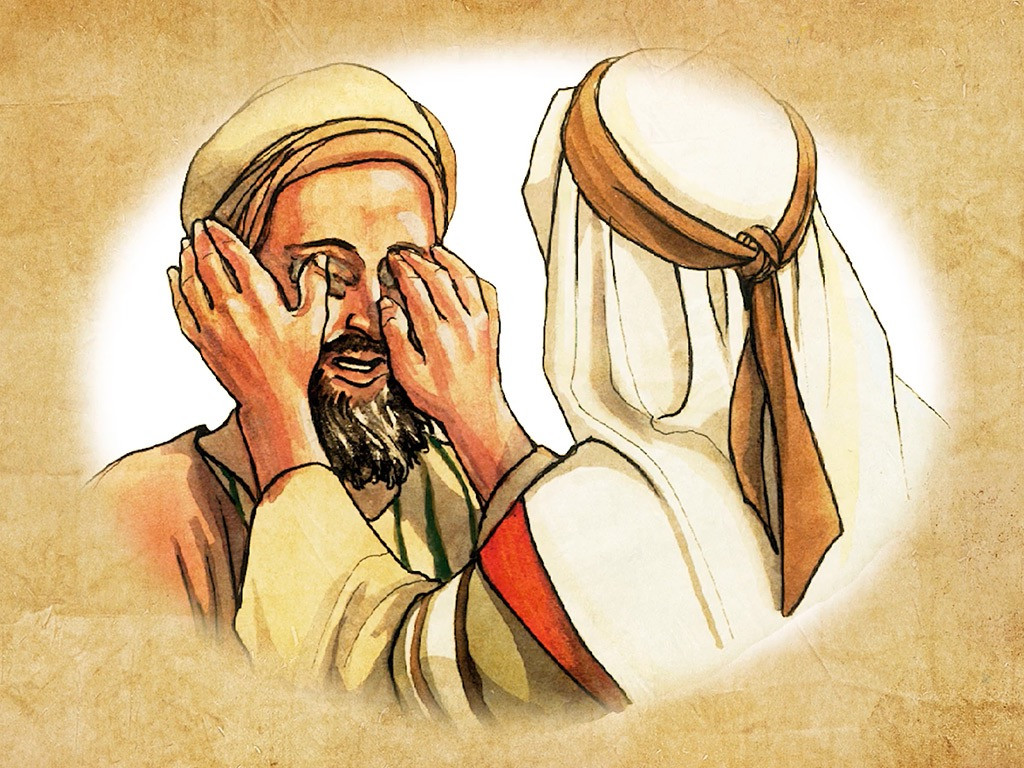
When he had thus spoken, he spat on the ground, and made clay of the spittle, and he anointed the eyes of the blind man with the clay, (John 9:6)

Jesus performed many healing miracles during His time of ministry on earth. The miracles were not only an expression of His compassion for the hurting, but they served as evidence of who He was according to predictive prophecy.

John the Baptist, who baptized Jesus, recognized who He was. “And John bare record, saying, I saw the Spirit descending from heaven like a dove, and it abode upon him. And I knew him not: but he that sent me to baptize with water, the same said unto me, Upon whom thou shalt see the Spirit descending, and remaining on him, the same is he which baptizeth with the Holy Ghost. And I saw, and bare record that this is the Son of God” (John 1:32-34, emphasis mine). Later, John was imprisoned by Herod Antipas, and he started having doubts about the authenticity of Jesus. In order to reassure himself that he had baptized the right man, he sent his disciples to verify that Jesus was indeed the expected Messiah. Responding to their questions, “Jesus answered and said unto them, Go and shew John again those things which ye do hear and see: The blind receive their sight, and the lame walk, the lepers are cleansed, and the deaf hear, the dead are raised up, and the poor have the gospel preached to them” (Matthew 11:4-5, emphasis mine).

Jesus quoted prophecy with which John would be familiar as proof of who He was. “Then the eyes of the blind shall be opened, and the ears of the deaf shall be unstopped. Then shall the lame man leap as an hart, and the tongue of the dumb sing: for in the wilderness shall waters break out, and streams in the desert” (Isaiah 35:5-6, emphasis mine). “Thy dead men shall live, together with my dead body shall they arise. Awake and sing, ye that dwell in dust: for thy dew is as the dew of herbs, and the earth shall cast out the dead” (Isaiah 26:19, emphasis mine). “The Spirit of the Lord GOD is upon me; because the LORD hath anointed me to preach good tidings unto the meek; he hath sent me to bind up the brokenhearted, to proclaim liberty to the captives, and the opening of the prison to them that are bound” (Isaiah 61:1, emphasis mine).

Jesus performed many miracles proving His power and divinity. So many were His miracles that of Him that the Gospel writer, John said, “And there are also many other things which Jesus did, the which, if they should be written every one, I suppose that even the world itself could not contain the books that should be written. Amen” (John 21:25).

Blindness was one of the more common healings Jesus performed. In most cases, Jesus simply spoke the word and the blind were healed. For example, the first restoral of sight recorded by Matthew was of two blind men. “And when Jesus departed thence, two blind men followed him, crying, and saying, Thou Son of David, have mercy on us. And when he was come into the house, the blind men came to him: and Jesus saith unto them, Believe ye that I am able to do this? They said unto him, Yea, Lord. Then touched he their eyes, saying, According to your faith be it unto you. And their eyes were opened; and Jesus straitly charged them, saying, See that no man know it” (Matthew 9:27-30, emphasis mine). On another occasion, Matthew records, “Then was brought unto him one possessed with a devil, blind, and dumb: and he healed him, insomuch that the blind and dumb both spake and saw (Matthew 12:22, emphasis mine). In most cases, the healing required faith on the part of the recipient, but in this case, it was the faith of those who brought the demon possessed man to Jesus.

Many more examples could be cited of Jesus healing the blind simply at His word. However, two cases recorded in the Gospels stand out among the others for the “unorthodox” method Jesus employed in healing the blindness. One is recorded in Mark’s Gospel and the other in John’s.

“And he cometh to Bethsaida; and they bring a blind man unto him, and besought him to touch him. And he took the blind man by the hand, and led him out of the town; and when he had spit on his eyes, and put his hands upon him, he asked him if he saw ought” (Mark 8:22-23, emphasis mine). This was not an instantaneous healing as in other cases where Jesus healed with just His word. At first the man’s vision was unclear. “And he looked up, and said, I see men as trees, walking. After that he put his hands again upon his eyes, and made him look up: and he was restored, and saw every man clearly.” (Mark 8:24, emphasis mine). Could Jesus not have just spoken the word, as He had on other occasions, and healed the man’s blindness instantly? This has puzzled commentators through the years. Adam Clark suggests, “Our Lord could have restored this man to sight in a moment; but he chose to do it in the way mentioned in the text, to show that he is sovereign of his own graces; and to point out that, however insignificant means may appear in themselves, they are divinely efficacious when he chooses to work by them.”[1] That seems like a reasonable conclusion, but why here and not in all cases?

Albert Barnes is equally puzzled. “Why this was done is not known. It was evidently not intended to perform the cure by any natural effect of the spittle. It was to the man a “sign,” an evidence that it was the power of Jesus. The eyes were probably closed. They were perhaps “gummed” or united together by a secretion that had become hard. To apply spittle to them – to wet them – would be a “sign,” a natural expression of removing the obstruction and opening them. The power was not in the spittle, but it attended the application of it.”[2] This too seems a reasonable explanation, but why spit; why not water or olive oil?

Matthew Henry probably offers the best explanation. “That Christ used a sign; he spat on his eyes (spat into them, so some), and put his hand upon him. He could have cured him, as he did others, with a word speaking, but thus he was pleased to assist his faith which was very weak, and to help him against his unbelief. And this spittle signified the eye-salve wherewith Christ anoints the eyes of those that are spiritually blind.”[3] It is true that Jesus, by the faith of the recipients, healed immediately. But here the blind man was brought to Jesus; he did not come of his volition. Furthermore, Jesus took him by the hand and led him out of the city. This act initiated the man’s trust in the Healer. Spitting into his eyes further convinced the man that Jesus was doing something. At first, he is vision was blurred, but it was better than before. This too served to further increase his faith in Jesus’ healing touch. The second time Jesus touched his eyes, his vision was fully restored.

John records the other vision restoration by spittle in John 9. In this account, Jesus was in Jerusalem, possibly on the Feast of Tabernacles.[4] As he walked in the vicinity of the Temple, He saw a man that was blind from birth.[5] The text implies that Jesus knew that the man was blind from birth, but how the disciple knew is not clear for they asked Him, “Master, who did sin, this man, or his parents, that he was born blind?” (John 9:2). They had the common understanding that such tragedies came as a result of sin. Jesus assured them that neither was the case, “but that the works of God should be made manifest in him” (v. 3). With that, Jesus proceeded to restore the man’s vision. “When he had thus spoken, he spat on the ground, and made clay of the spittle, and he anointed the eyes of the blind man with the clay, And said unto him, Go, wash in the pool of Siloam, (which is by interpretation, Sent.) He went his way therefore, and washed, and came seeing” (John 9:6-7, emphasis mine).

This is another sight restoration that puzzles the commentators. Why would Jesus employ such methods? It could not have been to prove anything to His disciples; they had already seen Him heal blindness. If the purpose was merely to show that sin was not the cause of the man’s blindness, He could have healed him as He had done others. Besides applying mud spitballs to the man’s eyes, Jesus encouraged the man’s faith by sending him to wash in the Pool of Siloam.

Without consulting other commentaries, I suspect I know the reason behind Jesus’ method. (I could be wrong, of course, but I think I have good reason for my conclusion.) Jesus is the Creator. “All things were made by him; and without him was not any thing made that was made” (John 1:3). “For by him [Jesus] were all things created, that are in heaven, and that are in earth, visible and invisible, whether they be thrones, or dominions, or principalities, or powers: all things were created by him, and for him: (Colossians 1:16).

With that understanding, we can look back to Genesis. “And the LORD God formed man of the dust of the ground, and breathed into his nostrils the breath of life; and man became a living soul” (Genesis 2:7). God “formed” man out of dirt. The Hebrew word translated “formed” is yâtsar, which Strong’s defines as “to mould into a form; especially as a potter.” By implication, it required God (Jesus) to form and shape the human body out of moist clay.

Coming back to the blind man’s condition, John records that he was “born blind.”[6] That leads me to suspect that the man may have been born with a birth defect where his eyeballs did not develop completely or did not develop at all. The fact that Jesus made clay with His spittle harkens back to the original creation account. Here, Jesus created the missing eyeballs out of the clay. In this, Jesus demonstrated to His disciples and to us in a very clear and visual object lesson that He is the Creator God.

There is physical blindness that impairs the victim from seeing the physical world. There is also a spiritual blindness that impairs the sinner from seeing the spiritual world. Jesus heals both kinds of blindness, but of the two, spiritual blindness is the more severe, for it leads the victim to an eternity separated from the only One that can heal. Reader, if you do not know Jesus, you are spiritually blind. Come to Jesus and be forever healed of that blindness. Read my page on “Securing Eternal Life.”

Notes:


[1]  Adam Clarke, LL.D., F.S.A., (1715-1832), Adam Clarke’s Commentary on the Bible, (Published in 1810-1826; Public Domain).

[2]  Albert Barnes, Albert Barnes’ Notes on the Bible, (Published in 1847-1885; Public Domain).

[3]  Matthew Henry, Matthew Henry’s Commentary on the Whole Bible, (Published in 1708-1714; Public Domain).

[4]  John 7:2

[5]  John 9:1

[6]  John 9:19

Comments Off on Spit In The Eye

Filed under Apologetics, Bible, Christianity, Creation, Gospel, Theology

Did Matthew Goof?

Then was fulfilled that which was spoken by Jeremy the prophet, saying, And they took the thirty pieces of silver, the price of him that was valued, whom they of the children of Israel did value; (Matthew 27:9)

Critics of the Bible constantly look for opportunities to find errors in Scripture. However, whenever they find an error in Scripture, eventually, Scripture proves true and the critics are proven wrong.

Recently, I was reading Matthew’s account of Judas’ betrayal of Jesus, and I encountered what appeared to be an error by Matthew. In his Gospel, Matthew takes great care to point out all the Old Testament prophecies fulfilled by Jesus, and he usually names the specific prophet.

Matthew’s account of Judas’ betrayal begins with the day on which Passover was to start.[1] “Then one of the twelve, called Judas Iscariot, went unto the chief priests, And said unto them, What will ye give me, and I will deliver him unto you? And they covenanted with him for thirty pieces of silver. And from that time he sought opportunity to betray him” (Matthew 26:14-16, emphasis mine). For some reason, known only to Matthew, he made no mention of the prophecy fulfilled here. The prophet Zechariah predicted this more than four hundred years earlier. “And I said unto them, If ye think good, give me my price; and if not, forbear. So they weighed for my price thirty pieces of silver” (Zechariah 11:12, emphasis mine).

Judas regretted his actions as soon as he discovered what the religious leaders planned for Jesus. “Then Judas, which had betrayed him, when he saw that he [Jesus] was condemned, repented himself, and brought again the thirty pieces of silver to the chief priests and elders, Saying, I have sinned in that I have betrayed the innocent blood. And they said, What is that to us? see thou to that. And he cast down the pieces of silver in the temple, and departed, and went and hanged himself” (Matthew 27:3-5, emphasis mine).

The religious leaders were troubled as to what to do with the money that Judas returned. “And the chief priests took the silver pieces, and said, It is not lawful for to put them into the treasury, because it is the price of blood. And they took counsel, and bought with them the potter’s field, to bury strangers in. Wherefore that field was called, The field of blood, unto this day” (Matthew 27:6-8, emphasis mine).

Luke adds a detail that was not revealed until after Christ’s ascension and shortly before the coming of the Holy Spirit at Pentecost. At that time, the Apostles were one short, Judas having committed suicide, and his spot needed to be filled. Luke records, “And in those days Peter stood up in the midst of the disciples, and said, (the number of names together were about an hundred and twenty,) Men and brethren, this scripture must needs have been fulfilled, which the Holy Ghost by the mouth of David spake before concerning Judas, which was guide to them that took Jesus. For he was numbered with us, and had obtained part of this ministry. Now this man purchased a field with the reward of iniquity; and falling headlong, he burst asunder in the midst, and all his bowels gushed out. And it was known unto all the dwellers at Jerusalem; insomuch as that field is called in their proper tongue, Aceldama, that is to say, The field of blood” (Acts 1:15-19, emphasis mine). Granted, Judas did not purchase the field himself, but it was purchased with his ill-gotten money.

Matthew reports that Judas hanged himself, while Peter, as recorded by Luke, said he fell “headlong” and “burst asunder, and all his bowels gushed out.” I will deal with that apparent discrepancy later.

Returning to Matthew’s Gospel, at this point in his narrative, Matthew points to fulfilled prophecy in this act of Judas. “Then was fulfilled that which was spoken by Jeremy [i.e., Jeremiah] the prophet, saying, And they took the thirty pieces of silver, the price of him that was valued, whom they of the children of Israel did value; And gave them for the potter’s field, as the Lord appointed me” (Matthew 27:9-10, emphasis mine). The problem is that Jeremiah never said such a thing. Bible scholars have struggled with this apparent discrepancy over the years without a satisfactory resolution. In fact, my King James Bible gives a cross-reference to Zechariah 11:12, “And I said unto them, If ye think good, give me my price; and if not, forbear. So they weighed for my price thirty pieces of silver.” However, even though he mentions the thirty pieces of silver, Matthew’s focus is on the field that was purchased with the money. The subsequent verse in Zechariah continues, “And the LORD said unto me, Cast it unto the potter: a goodly price that I was prised at of them. And I took the thirty pieces of silver, and cast them to the potter in the house of the LORD” (Zechariah 11:13, emphasis mine). This was Matthew’s focus, but there is one glaring problem. Jeremiah did not prophesy these words.

One of the reference books in my library wrestles with this problem and comes to a resolution, but not to my satisfaction. Their explanation, in part, follows:

The quotation is not entirely a quotation of Zechariah. The majority of the quotation does come from Zechariah 11:13 … there is no field mentioned in Zechariah … Matthew clearly is not quoting Zechariah about the location … Zechariah does not include the phrase “as the Lord commanded me.” Second, Jeremiah is also involved with potters (Jer 17:1-11; 19:1-13 – in this second passage he purchases something from a potter).

When it came to interpreting the Old Testament, it was common to bring passages together based on words they had in common … In this case, it is clear that Jeremiah and Zechariah have several words in common, especially potter and shekel. Probably potter is the key term … the quotation in Matthew is really Zechariah mixed with several phrases taken from Jeremiah.

What we have, then, is Matthew pulling together at least two texts in Jeremiah with one text in Zechariah to show that there was a type of biblically prefiguring of Judas’s [SIC] actions, down to the amount of blood money and the fact that it was given to a potter and was used for the purchase of a field … it was normal for Matthew to cite the more important prophet, Jeremiah, despite the fact that most of his material came from Zechariah.[2]

Their assessment is not altogether unreasonable, and certainly, the authors possess a greater knowledge of these things than I. However, I am not fully convinced that Matthew purposefully lumped two prophecies together and attributed the words to one prophet rather than the other. Personally, I often wonder why Zechariah is numbered among the Minor Prophets. His prophecy is equal to that of Daniel in length (12 chapters). Perhaps it is merely because of its placement in the canon. That aside, his importance, in my estimation, is no greater or lesser than that of Jeremiah. I might even argue that Zechariah contains more Messianic and end-times prophecy than Jeremiah, so, I do not see why Matthew would name Jeremiah rather than Zechariah if indeed he was citing the latter.

I have already established that in these verses, Matthew 27:3-10, Matthew’s focus was on the property purchased with the thirty pieces of silver, and not on the money itself. That had already been established in Matthew 26:14-16. The authors of the book I cited above referred to Jeremiah 19:1-13 where God instructs the Prophet to purchase a clay pot from the potter. God instructs him to go to the Valley of Hinnom by the entry of the east gate of the Temple – the Golden Gate that faces the Mount of Olives. The Temple Mount is surrounded by three valleys: Kidron to the east, Tyropoean to the west, and Hinnom to the south and west. The three valleys come together just to the south of the Temple Mount at a place called Tophet. The Hinnom Valley was of ill-repute due to the child sacrifices as well as other atrocities that took place there in the worship of pagan gods, particularly in the area of Tophet.

Through Jeremiah, God pronounces judgment on the people of Judah for their idolatry, particularly their worship of Baal. “Therefore, behold, the days come, saith the Lord, that this place shall no more be called Tophet, nor The valley of the son of Hinnom, but The valley of slaughter” (Jeremiah 19:6). The “valley of slaughter” could also be interpreted “The Field of Blood.” God decrees a great slaughter in that place and the desolation of Jerusalem.

Then shalt thou break the bottle in the sight of the men that go with thee, And shalt say unto them, Thus saith the LORD of hosts; Even so will I break this people and this city, as one breaketh a potter’s vessel, that cannot be made whole again: and they shall bury them in Tophet, till there be no place to bury. Thus will I do unto this place, saith the LORD, and to the inhabitants thereof, and even make this city as Tophet: And the houses of Jerusalem, and the houses of the kings of Judah, shall be defiled as the place of Tophet, because of all the houses upon whose roofs they have burned incense unto all the host of heaven, and have poured out drink offerings unto other gods. Then came Jeremiah from Tophet, whither the LORD had sent him to prophesy; and he stood in the court of the LORD’S house; and said to all the people, Thus saith the LORD of hosts, the God of Israel; Behold, I will bring upon this city and upon all her towns all the evil that I have pronounced against it, because they have hardened their necks, that they might not hear my words. (Jeremiah 19:10-15, emphasis mine).

“Tophet” means a “place of fire.” This prophecy had a two-fold fulfillment: first when Jerusalem was destroyed by the Babylonians, and the second when it was destroyed by the Romans in 70 A.D. This is the place to which Matthew referred that was bought with the thirty pieces of silver and its complete fulfillment had not yet taken place. When the Romans destroyed Jerusalem, the slaughter of Jews was so great that the Romans could not bury them all, so they tossed them into the Field of Blood that was bought with Judas’ blood money. It is possible that in quoting Jeremiah, Matthew looked ahead at the fulfillment of Jeremiah’s prophecy.

I recently watched a YouTube video on “Israel MyChannel” that provided some insight into the seeming contradictions between Matthew and Luke (in Acts). According to Timothy, the owner of “Israel MyChannel,”[3] who is a Messianic Jew and well-studied in Jewish history, Judas hanged himself as recorded by Matthew, prior to the crucifixion and the Passover sacrifice. According to Jewish practice, the Passover sacrifice could not be performed with a dead body within the walls of the city. So, they took Judas’ corpse and tossed it over the city wall. The impact of the fall burst his body so that “his bowels gushed out.” So, the records of both Matthew and Luke are correct, and Matthew’s citing Jeremiah fits well, even though he did not quote Jeremiah (or Zechariah) verbatim. I encourage you to watch the video; I have provided the link below. Timothy goes into greater detail than I can provide here.

Reader, do you know the Lord Jesus? If not, please read my page on “Securing Eternal Life.” He is coming soon and you need to be ready. You can read more about that on my “Revelation” page.

Notes:


[1]  Passover started at 6 PM in the evening and continued to 6 PM on the following day. Prior to the start of Passover at 6 PM, Judas had already agreed to betray Jesus. The Passover sacrifice was performed at 3 PM on Passover day, at the precise time that Jesus died on the Cross. Jesus was arrested on Passover evening, some time around midnight and was tried throughout the night and into the morning by Caiaphas (the High Priest), Pilate, Herod Antipas, and again by Pilate. Jesus was crucified at 9 AM the morning of Passover. Judas had sufficient time between the time Jesus was arrested and the time He was put on the cross to commit suicide. Tophet was south of the Temple mount. The walls of the city extended south around the City of David, and Tophet was just on the other side of the southern wall of the city.

[2]  Walter C Kaiser Jr., Peter H. Davids, F.F. Bruce, Manfred T. Brauch, Hard Sayings of the Bible, (Inter Varsity Press, Downers Grove, IL, 1996), pp. 339-400.

[3] “Scary Discovery in the Hinnom Valley” – https://www.youtube.com/watch?v=BpuLMHV0_ds For the description of this particular topic, start the video at minute 49:09 to minute 59:39/

1 Comment

Filed under Apologetics, Bible, Christianity

Judge Not

Judge not, that ye be not judged. (Matthew 7:1)

Throughout church history, false teachings and outright heresies have arisen due to the faulty hermeneutic of taking Scripture, especially a single verse, or even a single phrase within a verse, out of context. So it is with the verse above.

The “lost” frequently stymie the witness of Christians by misquoting this Scripture – “Judge not” – and they stop there without reciting the remaining portion of the verse. The well-meaning, albeit unprepared, Christian studders and stammers not knowing how to respond. They think, “That’s true. Jesus said, ‘Judge not, that ye be not judged.’ I don’t want to be a judge or be judged.” Thus, the Christian is defeated and the lost person continues in his lost condition thinking himself in a superior condition to that of the Christian.

Did Jesus really mean that we should suspend all judgment? We need to read beyond that single phrase or the single verse. In the verses that follow in the same seventh chapter of the Gospel of Matthew, Jesus gives several examples where judgment must be employed, but let us first inspect the first verses more closely.

The Greek word translated “judge” in this verse is krinō which means, “to distinguish, that is, decide (mentally or judicially); by implication to try, condemn, punish: – avenge, conclude, condemn, damn, decree, determine, esteem…”[1] Simply put, it means to make a judgment for condemnation. Ultimately, that kind of judgment is reserved for God alone. However, the Christian is free to exercise discernment as to the condition of a lost person, and knowing the consequence of that condition, the Christian is obligated to try and redirect the lost one from the road to perdition to the way of salvation. Scripture is clear on this point. “When I [God] say unto the wicked, O wicked man, thou shalt surely die; if thou dost not speak to warn the wicked from his way, that wicked man shall die in his iniquity; but his blood will I require at thine hand. Nevertheless, if thou warn the wicked of his way to turn from it; if he do not turn from his way, he shall die in his iniquity; but thou hast delivered thy soul” (Ezekiel 33:8-9, emphasis mine). In order to recognize “that wicked man,” one must exercise judgment, not in a condemning way, but by way of discernment.

The verse (7:1) concludes with, “that ye be not judged.” In other words, “Do not condemn, so that you are not condemned.” In the Ezekiel passage above, judgment (discernment) must be exercised to identify the “wicked man” and “to warn the wicked from his way, that wicked man shall die in his iniquity.” The condemnation to the Christian comes for failing to warn the “wicked man” – “his blood will I require at thine hand.” It is not our place to condemn anyone, not even the “wicked man.” In fact, that is exactly what we do when we recognize a lost person, and we fail to witness to them. We have effectively condemned them to an eternity in hell.

Jesus continues: “For with what judgment ye judge, ye shall be judged: and with what measure ye mete, it shall be measured to you again” (Matthew 7:2). Consider an occasion where you judge (discern) that someone is lost and you resist the Spirit’s prompting to share Christ with that person. Now consider Jesus looking at you with the same regard you gave to that lost person. Is that not a frightening thought?

Jesus gives self-examination as the prerequisite for making a judgment. He uses hyperbole in His example of inspecting a mote (speck) in someone’s eye while having a “beam” in one’s own eye. “Thou hypocrite, first cast out the beam out of thine own eye; and then shalt thou see clearly to cast out the mote out of thy brother’s eye” (Matthew 7:5). We need to keep our own sin in check before trying to correct the sin in others.

Jesus does not call us to suspend all judgment. Indeed, the verse that follows cannot be accomplished without a certain degree of judgment and discernment. “Give not that which is holy unto the dogs, neither cast ye your pearls before swine, lest they trample them under their feet, and turn again and rend you” (Matthew 7:6, emphasis mine). Jesus uses the terms “that which is holy” and “your pearls” synonymously to represent the precious Gospel that we have. “‘Dogs’ signify people who spurn, oppose, and abuse that doctrine; people of special sourness and malignity of temper, who meet it like growling and quarrelsome curs, Php_3:2; 2Pe_2:22; Rev_22:15. “Swine” denote those who would trample the precepts underfoot; people of impurity of life; those who are corrupt, polluted, profane, obscene, and sensual; those who would not know the value of the gospel, and who would tread it down as swine would pearls, 2Pe_2:22; Pro_11:22[2] (emphasis mine). Obviously, one needs to make a judgment call to discern who are the “dogs” and the “swine.”

Identifying false prophets requires judgment. Jesus warns against false prophets who disguise themselves “in sheep’s clothing, but inwardly they are ravening wolves” (7:15). They can be known. Jesus says, “Ye shall know them by their fruits” (7:16). Their “fruit” is what they produce. Do they bear the “fruit of the Spirit”?[3] Paul sums up the fruit of the Spirit like this: “For the fruit of the Spirit is in all goodness and righteousness and truth” (Ephesians 5:9). If you suspend judgment when you come under a false teacher, how will you know that the teacher is teaching truth? If you suspend judgment, you will swallow everything a false teacher feeds you because, after all, he/she is a seminary graduate with a Ph.D.! Do not let letter suffixes cloud your judgment.

Do not be intimidated by those who misquote and misuse Scripture. Remember, Satan excels in twisting Scripture. He did it with Eve in the Garden of Eden,[4] and he tried it with Jesus in the wilderness.[5] Those who throw up the “judge not” roadblock are only parroting Satan’s tactics. Don’t fall for it. Stick to your guns. Stick to the Word. Don’t even flinch when you hear “judge not!”

Reader, do you know the Lord Jesus? If not, please read my page on “Securing Eternal Life.” He is coming soon and you need to be ready. You can read more about that on my “Revelation” page.

Notes:


[1]  Strong’s Hebrew and Greek Dictionaries, (Published in 1890; public domain).

[2]  Albert Barnes’ Notes on the Bible, (Published in 1847-85; public domain).

[3]  Galatians 5:22-23

[4]  Genesis 3:1-6

[5]  Matthew 4:1-11; Luke 4:1-13

Comments Off on Judge Not

Filed under Apologetics, Bible, Christianity, Gospel, Salvation, Satan, Theology

Lord

When therefore the Lord knew how the Pharisees had heard that Jesus made and baptized more disciples than John, (John 4:1)

I never cease to be surprised by how often I read a familiar passage in Scripture and see something new that escaped me all the previous times I read that particular passage. So it was this week when I read in John, Chapter Four, in my daily Bible reading. It is the account of Jesus meeting the Samaritan woman at Jacob’s well.[1]

I do not know how many times I have read this account, how many sermons I’ve heard preached on it, or how many times it has been covered in Sunday School lessons. It has become a very familiar passage, which I can almost recite verbatim. However, this time, the first verse struck me like running into a solid brick wall. I had to stop and take a closer look.

The verse reads: “When therefore the Lord knew how the Pharisees had heard that Jesus made and baptized more disciples than John” (John 4:1, emphasis mine). Do you see it? Obviously, the context informs us that “the Lord” refers to Jesus, but why does John use that word? He is obviously referring to Jesus, so why doesn’t he just come out and say so? He could have said, “When therefore Jesus knew how the Pharisees had heard the He made and baptized more disciples than John [the Baptist].” That made me curious.

I looked up the verse in the popular English Standard Version (ESV) which reads like this: “Now when Jesus learned that the Pharisees had heard that Jesus was making and baptizing more disciples than John.” Well, there you go! Of course, this makes it appear as if Jesus obtained this information via rumor or through the grapevine. That is very plausible, but it minimizes Jesus’ attribute of omniscience.

The New English Translation (NET) reads similarly, but removes any guesswork: “Now when Jesus knew that the Pharisees had heard that he was winning and baptizing more disciples than John.” “Knowing” is stronger than “learning.” The New Living Translation (NLT) also uses “knew” instead of “learned:” “Jesus knew the Pharisees had heard that he was baptizing and making more disciples than John.”

However, my question is not about “learned” vs. “knew,” but rather about “Lord” vs. “Jesus.” In context, we already know that John is talking about Jesus, but as the subject of the sentence, he uses “Lord” instead of “Jesus.” Why?

In the Greek text, the subject noun is κύριος (kurios). Strong’s defines it as “supreme in authority, that is, (as noun) controller; by implication Mr. (as a respectful title): – God, Lord, master, Sir.”

John’s main purpose for writing his Gospel was to emphasize the deity of Christ, therefore, the use of “Lord” for Jesus makes sense in that He is God.[2] The NET makes a notation for its use of “Jesus” instead of “Lord” suggesting that “the internal evidence seems to be on the side of ᾿Ιησοῦς. ‘Jesus’ is mentioned two more times in the first two verses of chapter four in a way that is stylistically awkward…”[3] However, the same note admits that “Several early and significant witnesses [i.e, manuscripts], along with the majority of later ones (P66c,75 A B C L Ws Ψ 083 ƒ13 33 M sa), have κύριος (kurios, “Lord”) here instead of ᾿Ιησοῦς (Iēsous, “Jesus”).”[4] So, they make that choice for “stylistic” reasons?

So, what’s the big deal? Well, first of all, John chose to use “Lord” and not “Jesus” because as Lord, i.e., God, Jesus “knew” (He is omniscient) without needing to gather information secondhand, as the ESV suggests by the use of “learned.” He knew what the Pharisees were thinking. He knew what was in their hearts, and He knew they were looking for any opportunity to find guilt in Him. John the Baptist had a large following, and this troubled them. John the Baptist had called the Pharisees a “generation of vipers.”[5] Now here comes Jesus drawing a larger following of disciples than John the Baptist. This really had them worried.

The “Lord” Jesus knew their hearts and their intents because, as God, He knows the hearts of men. He had no need to learn it through any other means. John wanted to make that clear. Jesus is Lord. Jesus is God. He “knows.” He does not “learn.”

Reader, do you know the Lord Jesus? If not, please read my page on “Securing Eternal Life.” He is coming soon and you need to be ready. You can read more about that on my “Revelation” page.

Notes:


[1]  John 4:12

[2]  John 1:1

[3]  https://www.biblegateway.com/passage/?search=John+4%3A1&version=NET

[4]  Ibid.

[5]  Matthew 3:7; Luke 3:7

Comments Off on Lord

Filed under Apologetics, Bible, Christianity, Theology

Maybe This Year

Behold, I shew you a mystery; We shall not all sleep, but we shall all be changed, In a moment, in the twinkling of an eye, at the last trump: for the trumpet shall sound, and the dead shall be raised incorruptible, and we shall be changed. (1 Corinthians 15:51-52)

For many years now, this time of year brings a strong sense of anticipation to me. Next Friday, September 15/16 celebrates the Jewish festival of Yom Teruah, a/k/a Rosh HaShanah, or the Feast of Trumpets. It sounds the beginning of the new civil year 5783.

God gave the Children of Israel seven “feasts of the Lord”[1] that they were required to observe: Passover, Unleavened Bread, First Fruits, Pentecost, Trumpets, Atonement, and Tabernacles. The first four took place in the spring and were fulfilled by Jesus’ crucifixion (Passover), His burial (Unleavened Bread), His resurrection (First Fruits), and His ascension and the coming of the Holy Spirit (Pentecost). The final three, the fall feasts have not yet been fulfilled: Trumpets (His return with the “a great sound of a trumpet”[2]), Atonement (He judges the nations), and Tabernacles (He comes to dwell among His people).

Granted, all of these Feasts of the Lord,[3] apply to Israel and NOT to the Church. However, I cannot restrain my excitement when the day approaches because according to Paul, there is a trumpet associated with the Rapture of the Church (see our starting verse above.) Elsewhere, he says, “For the Lord himself shall descend from heaven with a shout, with the voice of the archangel, and with the trump of God: and the dead in Christ shall rise first: Then we which are alive and remain shall be caught up together with them in the clouds, to meet the Lord in the air: and so shall we ever be with the Lord” (1 Thessalonians 4:16-17, emphasis mine). In the Book of Revelation, John experienced a type of the Rapture when he records, “After this I looked, and, behold, a door was opened in heaven: and the first voice which I heard was as it were of a trumpet talking with me; which said, Come up hither, and I will shew thee things which must be hereafter. And immediately I was in the spirit: and, behold, a throne was set in heaven, and one sat on the throne” (Revelation 4:1-2, emphasis mine). So, why not the Feast of Trumpets for the Rapture event?

Many will argue with Jesus’ words: “But of that day and hour knoweth no man, no, not the angels of heaven, but my Father only” (Matthew 24:36, emphasis mine). The Gospel writer, Mark, includes “the Son” among those who are unknowing. “But of that day and that hour knoweth no man, no, not the angels which are in heaven, neither the Son, but the Father” (Mark 13:32, emphasis mine). Matthew did not miss it, and Mark was not in error. The fact remains that Jesus, in His humanity as “a man,” was not privy to the Father’s plans in that regard. However, He now sits at the right hand of the Father.[4] Surely, He is not presently ignorant of the day or the hour.

We cannot know the day or the hour of the Rapture because it has always been taught as imminent in the New Testament, that is, it could happen at any time. The Apostle Paul certainly thought it could occur during his lifetime. “Now we beseech you, brethren, by the coming of our Lord Jesus Christ, and by our gathering together unto him, That ye be not soon shaken in mind, or be troubled, neither by spirit, nor by word, nor by letter as from us, as that the day of Christ is at hand” (2 Thessalonians 2:1-2, emphasis mine). For some reason, the Thessalonians feared that the Rapture had taken place and they missed it. From Paul’s teaching, they felt that the coming was very near. He did not retract his teaching of imminency, but only reassured them that it had not taken place yet. So, we are left with the same teaching – the Lord could come for us at any time.

We do not know the day or the hour. However, we know that it is nearer now than ever because we see the signs of His Second Coming, as foretold by the prophets and by Jesus Himself, increasing in frequency and intensity. Those prophecies detail the events of the seven-year Tribulation that precedes Christ’s return to earth as King of Kings and Lord of Lords.[5] However, Jesus snatches away (Raptures) His Church sometime prior to the beginning of the Tribulation.

That brings me back to the Feast of Trumpets. Rosh HaShanah is known as the feast where “no man knows the day or the hour.” This is why it is observed over two days. The reason for that is that Yom Teruah (“Day of Trumpets) begins at the first sighting of the new moon on Tishri (the seventh month on the Jewish calendar) 1 or 2. It is the new moon that signals the beginning of the feast and no one knows exactly when that will take place. Could Jesus have been referring to the Feast of Trumpets when He said that “no man knows the day or the hour”?

For this reason and for the fact that the Rapture of the Church seems to be accompanied by the sounding of a trumpet, I get excited when the Feast of Trumpets comes around. For many years now, I have looked forward with anticipation at this time of year, and for many years I have been “disappointed” – not discouraged. I realize that God is not obligated to meet my expectations of events that are fully in His control. Whether Jesus calls us home next Friday/Saturday or not, I know that one day soon, we will hear that trumpet call and go to meet Him in the air. “What a day, glorious day, that will be!”

            Jesus could call His people home anytime soon. Reader, are you prepared for that day? If not, please read my page on “Securing Eternal Life.” You can also find more information on the “last days” on my “Revelation

Notes:


[1]  “Rosh HaShanah” – Rosh HaShanah | Ernie’s Musings (erniecarrasco.com)

[2]  Matthew 24:31

[3]  Leviticus 23

[4]  Matthew 26:64; Mark 14:62; 16:19; Luke 22:69; Acts 7:56; Ephesians 1:19-20; Colossians 3:1; Hebrews 1:3; 12:2; 1 Peter 3:21-22

[5]  Revelation 19:16

Comments Off on Maybe This Year

Filed under Apologetics, Bible, Christianity, Current Events, End Times, Eschatology, Feasts of the Lord, Rapture, Second Coming of Christ, Theology