Tag Archives: Jesus

Shepherd of Shepherds

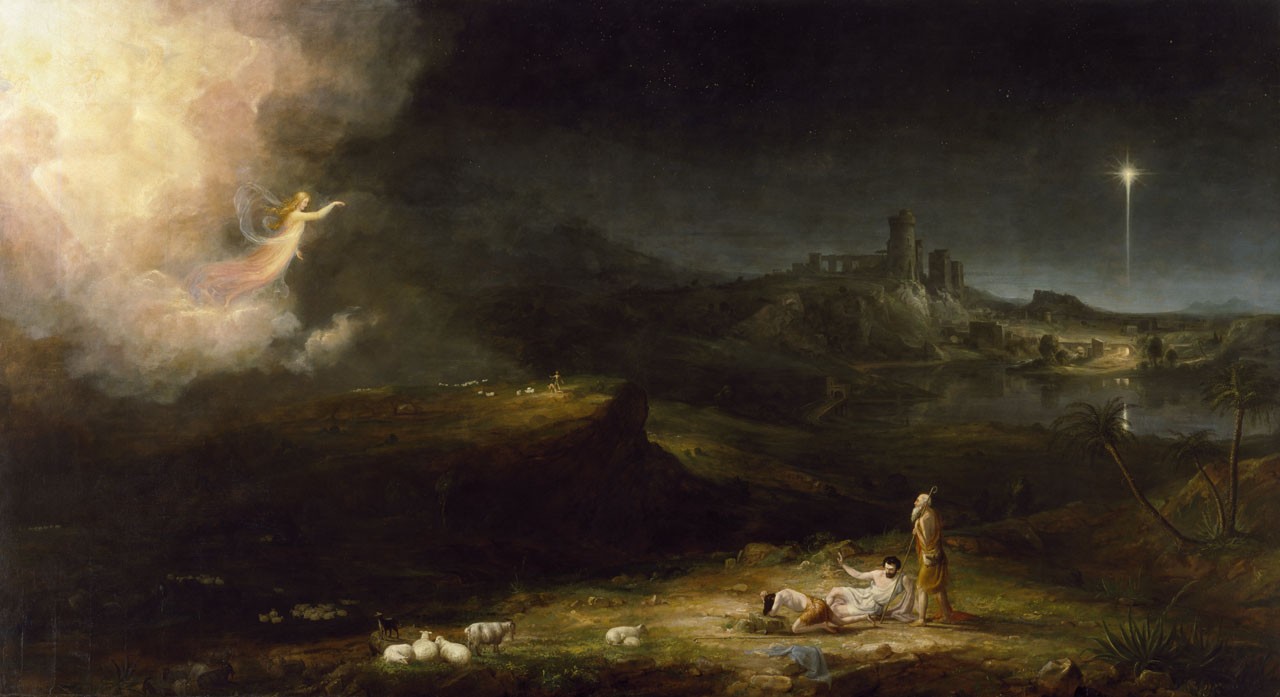
cole-angel-shepherds

“And there were in the same country shepherds abiding in the field, keeping watch over their flock by night.” (Luke 2:8)

One of the best arguments against the birth of Christ having taken place in late December is this fact recorded by Luke in his Gospel. There were shepherds out in the fields watching over their flocks. By late December, there is not sufficient grazing to sustain large flocks of sheep. Jerusalem is near the same latitude as Dallas, Texas where I live. By the middle to the end of November, there is not much left for cattle to graze on, so they need to be fed on hay or “cake.” So it seems very unlikely that shepherds would be out in the fields in the winter time.

The shepherds around Bethlehem generally kept the sheep and goats that were used for sacrifice in the Temple in nearby Jerusalem. Some have suggested that Jesus’ birth was around late September which coincides with the Jewish Fall Feasts: Feast of Trumpets (Rosh Hashanah), Day of Atonement (Yom Kippur) and Feast of Tabernacles (Sukkoths). These were feasts that required all Jewish men to make a pilgrimage to the Temple in Jerusalem. The fact that this requirement happened to coincide with the decree from Caesar Augustus for the census (Luke 2:1) may explain why “there was no room for them in the inn” (Luke 2:7) for the expectant couple. In fact, His birth may have occurred during the Feast of Tabernacles making John’s statement that “the Word was made flesh, and [tabernacled] among us” (John 1:14) even more significant. Interestingly, if one counts back nine months from the end of September, one arrives at a date sometime in late December. It could be that rather than celebrating Christ’s birth on December 25, we are actually celebrating His conception!

Regardless, it was to these simple shepherds that this paramount announcement was delivered. “For unto you is born this day in the city of David a Saviour, which is Christ the Lord” (Luke 2:11). To these shepherds who were known for feeding and protecting their flocks; who sought out the lost sheep, and rescued those that were attacked. It seems appropriate that to these the news of the arrival of the “Shepherd of Israel” should be first delivered. He who would later say, “I am the good shepherd: the good shepherd giveth his life for the sheep” (John 10:11) had come. So without hesitation they said, “Let us now go even unto Bethlehem, and see this thing which is come to pass, which the Lord hath made known unto us” (Luke 2:15). They came “with haste” Luke tells us, “and found Mary, and Joseph, and the [Lamb of God] lying in a manger” (Luke 2:16). His name was Jesus, “for he shall save his people from their sins” (Matthew 1:21). This little Lamb of God, who was to be the Shepherd of shepherds, had finally come to them.


1 Comment

Filed under Apologetics, Christianity, Christmas, Evangelism, Gospel, Religion, Salvation, Theology

Killing Jesus: A Review

V06N25 Killing Jesus Cover

“Study to shew thyself approved unto God, a workman that needeth not to be ashamed, rightly dividing the word of truth.” (2 Timothy 2:15)

Since Bill O’Reilly, commentator and host of the O’Reilly Factor on the Fox News Channel, came out with his latest book, Killing Jesus: A History, Christian “Evangelicals” have turned out to opine on the work. Some, like the pastor of the First Baptist Church of Dallas, Texas have given the book rave reviews and even encouraged Christians to buy and read the book. Others have not been so kind. Since the pastor of the First Baptist Church of Dallas happens to be my pastor, I thought I would take him up on his recommendation. Having done so, I will now attempt to offer my hopefully “fair and balanced” review of the book.

First of all, I will say that Mr. O’Reilly and co-author Martin Dugard make an excellent writing team. I first experienced their work in Killing Lincoln, which I thoroughly enjoyed. Killing Jesus is no exception. The text flows very smoothly, and it entices the reader to continue non-stop. Had I the luxury of uninterrupted time to sit with a book, I might have been tempted, but alas, I had to consume it in short bursts. That gave me the advantage of time to ruminate on the content so that I am less likely to give a knee-jerk assessment of the work.

For what it is, I would recommend it to anyone who enjoys historical or biographical genres. It is not a spiritual book or a book that it is written in a way that honors or glorifies Jesus of Nazareth for Who He is – the Creator, Savior, and King of kings and Lord of lords – nor is it blasphemous in any way. It is just matter-of-fact. The authors present Jesus as an actual historical personage who impacted the world in a significant way. “To say that Jesus of Nazareth was the most influential man who ever lived is almost trite. Nearly two thousand years after he was brutally executed by Roman soldiers, more than 2.2 billion human beings attempt to follow his teachings and believe he is God” (p. 1).[1] The authors admit: “We do not address Jesus as the Messiah, only as a man who galvanized a remote area of the Roman Empire and made very powerful enemies while preaching a philosophy of peace and love” (p. 2). This approach should not come as a surprise since O’Reilly has often expressed and asserted his conviction that Scripture is allegorical and not to be taken literally. That brings into question his use of the Gospels as a historical resource. Indeed, he admits, “Of course we have the Gospels of Matthew, Mark, Luke, and John, but they sometimes appear contradictory and were written from a spiritual point of view rather than as a historical chronicling of Jesus’s [sic] life” (p. 1) If the Gospels are allegorical, as O’Reilly claims, then this book, as a history, is not worth the paper it is written on. Would a true historian rely on allegory to construct a factual account? To be fair, the authors also rely on extra-biblical sources to compose their story. It seems, however, that the Bible is only used to “fill in” where secular historians are silent. But, let us set that aside for the moment.

Evidently, the Gospel account failed to provide sufficient content to accomplish the purpose of this book, so the authors devoted the first third of the book to early Roman history to help set the stage for the main course and perhaps to add a little spice with the depravity of the Roman emperors. I am not a historian, so I will defer to Mr. O’Reilly on the accuracy of these accounts. My strength is in Scripture, and in that regard I can give an honest assessment.

The authors get the Gospel account right for the most part. I was especially surprised by a footnote that informs us that “The Gospels clearly state that Jesus had four brothers: James, Joseph, Judas, and Simon. They also mention that he had sisters, but the number is not specified” (p. 79). O’Reilly and Dugard are both practicing Roman Catholics and for that reason the admission is remarkable. The footnote continues: “The Roman Catholic Church believes Mary remained a virgin throughout her entire life. This doctrine was first put forth four centuries after Jesus lived by an early leader in the Church named Simon. The Church considers the siblings mentioned by the Gospels to be Jesus’s [sic] cousins” (p. 79).

The authors also get it right when they describe two separate temple cleansings by Jesus, one at the beginning of His ministry and one at the end (pp. 126, 192-193). Many Bible scholars miss this point, but sadly, the authors attribute this to error rather than accept it as fact. “Before being written down, the Gospels were oral histories. This might explain some discrepancies among them. The story of Jesus and the money changers is placed at the beginning of Jesus’s [sic] ministry in John (2:14-22), while [the other Gospel writers] all place it at the end. This has led some to speculate (emphasis added) that Jesus performed this cleansing twice, as specific details of the various Gospels account differ” (p. 126). Had the authors taken the time to seek a resolution to the “discrepancy,” as any good historian should do, they may have discovered that John was with Jesus from the very beginning. Matthew came along after the fact, and Mark and Luke were not a part of the original group of disciples. To these men, the last cleansing was most significant because it occurred in Jesus’ final week. All the Gospel writers had differing objectives in relaying their message, and so they tell the story from their individual perspectives. John’s purpose for his Gospel was to present Jesus as God. For him, the first cleansing establishes Christ’s divinity from the very beginning. You will recall John 1:1 “In the beginning was the Word, and the Word was with God, and the Word was God.” There is no discrepancy here, except in the minds of these authors. But they should at least get credit for recording two separate events (pp. 192-193). Since John wrote his Gospel last, surely he had access to those written previously, so his placement of the temple cleansing was not by mistake. John had a point to make as did the other Gospel writers, and all were accurate in their record.

Another point missed by many Bible scholars is in trying to synthesize the different accounts of Jesus’ anointing into one event. O’Reilly and Dugard at least distinguished two different accounts: the anointing at the house of Simon the Pharisee in Galilee before the Transfiguration (Luke 7:36-50, p. 144) and the anointing at the house of Simon the Leper in Bethany following Jesus’ Triumphal Entry into Jerusalem (Matthew 26:6-13, Mark 14:3-9, p 209). It is easy to see how these two separate events could be confused since both hosts are named Simon, but O’Reilly and Dugard correctly identified the two as separate events. However, they failed to include a third anointing which took place in (supposedly) the house of Lazarus, whom Jesus raised from the dead. This account is found in John 12:1-7 and precedes the Triumphal Entry. Martha, as usual, is serving and Mary, her sister, performs the anointing. I cannot be too critical of the oversight, since many Bible scholars make a worse mistake by trying to reconcile the three separate events as one.

The authors accurately record the Gospel accounts for the most part, but given O’Reilly’s presuppositional conviction on the allegorical nature of Scripture, several errors creep into this work. Take for example the baptism of Jesus by John the Baptist (p.103). The Gospel of John 1:29-40 records the baptism, but does not record the interchange between The Baptist and Jesus. As stated earlier, John’s purpose in writing his Gospel was to demonstrate the deity of Christ, and so minor details are unimportant to his account. Instead, John focuses on the Spirit of God descending upon Jesus in the form of a dove. The other Gospel writers also record a voice from heaven saying, “This is my beloved Son, in whom I am well pleased” (Matthew 3:17; Mark 1:11; Luke 3:22). But instead, John focuses on the words of John the Baptist: “And I saw, and bare record that this is the Son of God” (John 1:34, emphasis added). In this passage, we learn that John, the writer of this Gospel, was a firsthand witness from the very beginning. “One of the two which heard John speak, and followed him, was Andrew, Simon Peter’s brother” (John 1:40). The “one” not mentioned is John who never mentions himself by name throughout his Gospel.

Because of their myopia to the literal accuracy of the Gospel text, the writers of Killing Jesus appear somewhat incredulous that a dove coming out of nowhere should light upon Jesus and remain on him. “Suddenly a dove lands on Jesus’s [sic] shoulder. When Jesus makes no move to shoo it away, the bird is quite content to remain there” (p. 103). Looking at it that way, I believe I would be a little incredulous myself. These kinds of errors are systemic throughout the book. 

Another kind of error in this book is that of adding to Scripture. For example, on the account of the baptism of Jesus as He comes out of the water, the writers say, “The believers drop to their knees and press their faces into the earth. Jesus does not react to this sign of worship. He does nothing to discourage it either.” (p. 104). That is nowhere to be found in Scripture, certainly not in any of the Gospels, but the authors cite no references to substantiate that detail. The writers quote John 1:34 (quoted above) and then add, “The crowd remains on its knees as Jesus steps onto the shore and keeps on walking” (p. 105). This must be something the authors learned in catechism, which perhaps explains why no reference is cited, but it has no basis in Scripture.

I understand that the authors are attempting to keep a detached and “objective” perspective, but I found one statement to be rather insulting to our Lord. In telling about the calling of Peter and Andrew (Matthew 4:18-22; Mark 1:16-18; Luke 5:4-10) They recount that Jesus got into Peter’s boat and asked him to push away from the shore so that He could speak to the crowd that had assembled, “Though he [sic] knows next to nothing about fishing” (p. 136). In the first place, Jesus grew up in Nazareth, which is not that far from the Sea of Galilee; I am sure He would have known something about fishing. Furthermore, this is God who created fish and fishermen. That He knows something about fishing is demonstrated in that He gave instructions to lower the nets after the men had fished all night and came up empty, and the catch was more than they could handle. So, I find the assessment that Jesus “knows next to nothing about fishing” a little demeaning. In the same account, the authors claim that Peter was “A fisherman in his early twenties” (p. 137). Most scholars believe that Peter was probably around Jesus’ age or perhaps a little older. Again, the authors cite no references for this claim.

Other errors include the claim that the raising of Lazarus from the dead is a “legend” (p. 199 footnote). They mistake Jesus’ assessment of the Greatest Commandment as a “new” law, but oddly, in the footnote they cite Deuteronomy 6:5 (p. 205). This Greatest Commandment was nothing new; the Deuteronomy reference harkens back to the First and Second Commandments (Exodus 20:3-4). They also confuse Jesus’ agony in the Garden of Gethsemane as “panic” (p. 212). Jesus knew His mission from the very beginning. Luke records: “And it came to pass, when the time was come that he should be received up, he stedfastly set his face to go to Jerusalem” (Luke 9:51, emphasis added) indicating that Jesus was determined to go through with His sacrifice. There was no “panic” in Him. Finally, in the “Afterword,” the writers wrongly attribute the description of “a woman clothed with the sun” in Revelation 12:1 to Mary, the mother of Jesus. This obviously comes from the authors’ Roman Catholic doctrine. More than 1920 years after the time of Christ, “On November 1, 1950 the Roman Catholic Church decreed that [Mary’s] body had been ‘assumed into heaven’” (p. 265). If the authors had bothered to research this in greater depth, they may have learned that the “woman” described in Revelation is Israel, not Mary, and the child she bore is Jesus. The reason nothing more is heard of the woman, is because she, Israel, has not, and will not be destroyed as a nation. However, I would not expect Mr. O’Reilly to accept that explanation.

My final assessment of Killing Jesus: A History is that it is a well written book, easy to read and entertaining. I would not take it seriously as a “history” given that the authors view the Bible as allegory, and allegory is a highly questionable resource when trying to document real history. Admittedly, the authors assert that this is not a spiritual book, and because of that this book has little value from a spiritual perspective. Some supposed Christians claim that the book has strengthened or renewed their faith. That may be true if the “Christian” doubted the historicity of Jesus in the first place. This book might have some value in that regard. I would not recommend this book as a “witnessing” tool as it gives a very poor witness. As I stated at the beginning, the authors are not blasphemous in any way, but at the same time, they do not give Jesus His proper due. He is presented as a mere man on a mission who got on the wrong side of the governing and religious authorities. There is more to Jesus than these authors portray. The book presents Him as a victim ignoring His very words, “I lay down my life for the sheep … No man taketh it from me, but I lay it down of myself” (John 10:15, 18).  Jesus is God, whether “some” believe it or not, and the Bible is not allegory. Killing Jesus might have been a better book, if the authors had taken the Gospel account seriously and literally. That said, I would not discourage anyone from reading it, but I would caution against taking it seriously.


[1] Direct quotes are denoted with the page number on which they are found in the book.

2 Comments

Filed under Apologetics, Book Reviews, Christianity, Religion

Time for Pride to Grow

“. . . when the morning stars sang together, and all the sons of God shouted for joy?” (Job 38:7)

A common question that arises from time to time is, “When did God make the angels?” A corollary question to that is “Was there enough time for pride to grow in Satan and for the war in Heaven to occur within the first few days?”

In the Job passage quoted above, God is telling Job that the angels were there at the time when He formed the earth. As to whether there was sufficient time for Satan’s pride to grow, we must ask, “How much time does it take for pride to grow?” In our own experience, does it take a long time to develop pride, or does it just seem to flare up unexpectedly? I would say the latter. Pride is one of the most basic sins. Human beings are naturally selfish and self-centered. Recall that very shortly after Creation, Satan was able to tempt Eve with “the pride of life” (1 John 2:16): “ye shall be as gods, knowing good and evil” (Genesis 3:5). It does not take a great amount of time for pride to grow.

The angels probably were created on the first day of the creation week. We cannot be dogmatic about this. The Bible does not specify when the angels were created, but the above passage in Job indicates that they were at least around to see the creation taking place. The angels, therefore, were created before man. Perhaps the reason for not focusing more attention on angels is that the Bible focuses mainly on the relationship between God and man. Angels play a part, but they are not central to God’s redemptive plan. But what does God say about man? “Let us make man in our image, after our likeness: and let them have dominion over the fish of the sea, and over the fowl of the air, and over the cattle, and over all the earth, and over every creeping thing that creepeth upon the earth” (Genesis 1:26, emphasis added). Did God say that about the angels? Did God give dominion over His creation to the angels? Can you see anything there that would give rise to pride and jealousy?

It would not have taken a long time for Satan’s pride to grow. Having been created first and then given lower status than man, Satan said, “I will ascend into heaven, I will exalt my throne above the stars of God: I will sit also upon the mount of the congregation, in the sides of the north: I will ascend above the heights of the clouds; I will be like the most High” (Isaiah 14:13-14, emphasis added). Satan hates man because God has bestowed upon man greater status than the angels. “What is man, that thou art mindful of him? and the son of man, that thou visitest him? For thou hast made him a little lower than the angels, and hast crowned him with glory and honour. Thou madest him to have dominion over the works of thy hands; thou hast put all things under his feet” (Psalm 8:4-6, emphasis added). The English phrase “a little lower than the angels” is not an accurate translation. “Angels” is the Hebrew ‘ĕlôhîym referring to God rather than the normal word for angels mal’âkîm. This is a messianic passage describing the condescension of Christ in taking human form, but this also has a secondary meaning as applied to man. Having been created in the image of his Maker, man holds a higher status than the angels, and this infuriates Satan.

This being the case, Satan most likely rebelled on Day Six of creation or very shortly thereafter. Seeing that man was God’s prized creation, Satan turned his ire toward destroying man. Knowing that man was created in the image of God, he employed that fact to cause man’s demise: “ye shall be as gods” (Genesis 3:5). If one analyses the source of any sin, it all goes back to pride – man wants to be his own god. This has been true from the beginning when Satan witnessed the creation of man, and since the fall of man in the Garden (Genesis 3). It really takes no time for pride to develop. It is nothing that requires any nurturing. On the contrary, it is something must actively be suppressed, and this cannot be done through human strength. It requires the supernatural power that only comes from God through the Holy Spirit. Jesus promised, “ye shall receive power, after that the Holy Ghost is come upon you” (Acts 1:8), and it is in that power alone that pride can be conquered.

1 Comment

Filed under Apologetics, Christianity, Creation, Evolution, Gospel, Origins, Theology

Somewhere in the Middle

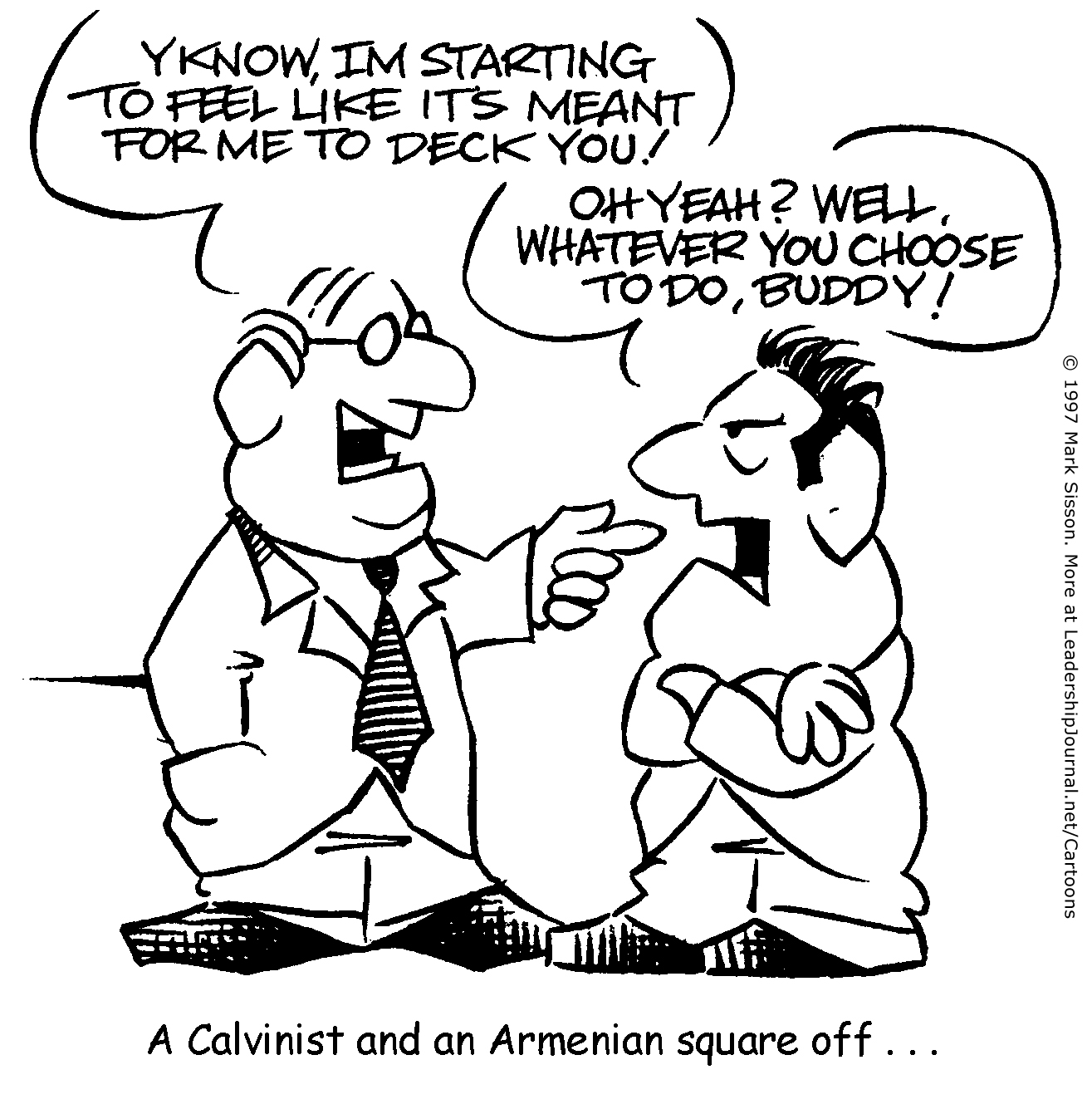
Calvinism-vs.-Arminianism-Cartoon2

For many are called, but few are chosen. (Matthew 22:14)

This past week I’ve had an online conversation with a fellow blogger on the topic of “limited atonement” and “total depravity.” Because of the nature of this topic, these discussions are usually fruitless and typically degenerate into “profane and vain babblings” (2 Timothy 2:16), which we should shun. At issue is the tension between the sovereignty of God and the free will of man. Calvinism (falsely attributed to the reformer, John Calvin) defends five points characterized by the acrostic TULIP: (1) Total Depravity, (2) Unconditional Election, (3) Limited Atonement, (4) Irresistible Grace, and (5) Perseverance of the Saints. Calvinism champions the complete sovereignty of God, and hyper-Calvinists go so far as to assert that God literally picks and chooses who will go to heaven and who will go to hell.

On the other side of the argument is Arminianism, attributed to the Dutch theologian Jacob Arminius. Arminianism counters Calvinism with eight points: (1) Universal Prevenient Grace, (2) Conditional Election, (3) Unlimited (or universal) Atonement, (4) Resistible Grace, (5) Uncertainty of Perseverance, (6) Libertarian Free Will, (7) Equal, Impartial, and Undifferentiated Love, (8) The Universal Call of Salvation.[1]

The conflict comes when one takes one position or the other. Both positions have scriptural support, and both have scriptural weaknesses. Contrast Calvinism’s “Total Depravity” with Arminianism’s “Universal Prevenient Grace.” The former considers individuals dead in sin so that they are incapable of choosing God’s free gift of salvation apart from God’s direct intervention on their behalf. This can be supported from Ephesians 2:8 where the Apostle Paul says in effect that the faith required to accept God’s Grace is in itself a gift of God. The latter acknowledges man’s fallen condition, but suggests that Grace “restores man’s free will which was impaired by the effects of original sin and enables him to choose or refuse the salvation offered by God in Jesus Christ.”[2] This too has scriptural support in “the Lamb slain from the foundation of the world” (Revelation 13:8). Or contrast Calvinism’s “Unconditional Election” with Arminianism’s “Conditional Election.” The former says that God picks who will be saved, the latter basically says that God “elects” or chooses those who choose Him. Both of these concepts find support in Scripture. Jesus said, “Ye have not chosen me, but I have chosen you” (John 15:16), but, of course, it could be argued that Jesus, in context, was speaking to His disciples, and as such it is not a blanket statement covering all believers. The Arminian challenge to this would be: “Then what do you do with all the ‘whosoever’ passages in the New Testament?” The Calvinist would then argue in a circle and say that all the “whosoevers” are the elect, but that also contradicts a lot of Scripture.

In Calvinism, “Unconditional Election” and “Limited Atonement” go hand in hand.  The former specifies God’s sovereignty in “electing” who will be saved and “Limited Atonement” explains that Christ’s sacrifice, while having universal application, is only efficient for those who are elect. They are really two sides of the same coin. Arminianism challenges that with “Unlimited Atonement.” Since Jesus died for all, then all have equal opportunity to respond to the Gospel by the exercise of their free will. Calvinism responds that those who respond to the Gospel do so because Grace, the “call of God,” is irresistible to the elect; they cannot help but respond to the Gospel message. The Arminian would retort that Grace certainly is resistible, as is frequently proven in evangelistic encounters. Anyone who has shared their faith with an unbeliever has experienced the disappointment of bringing someone to the point of conviction and then having them reject the invitation to accept Christ as Lord and Savior. Some say, “I’m not ready now.” Others will say, “Perhaps when I’m older.” Still others may say, “I don’t want to offend my family or my friends.” The offer of God’s grace certainly can be rejected. Of course the Calvinist would counter with, “That’s because they aren’t elect” – again arguing in a circle.

This discussion could go on and on, and countless reams of paper have been spent in defense of both sides. Both sides have good points, and both sides have weak points. The answer to the debate lies somewhere in the middle. Only God knows the real inner workings of His plan. “For my thoughts are not your thoughts, neither are your ways my ways, saith the LORD. For as the heavens are higher than the earth, so are my ways higher than your ways, and my thoughts than your thoughts” (Isaiah 55:8-9). In the end, both Calvinists and Arminians have to come to Christ in the same way: “Believe on the Lord Jesus Christ, and thou shalt be saved” (Acts 16:31). “That if thou shalt confess with thy mouth the Lord Jesus, and shalt believe in thine heart that God hath raised him from the dead, thou shalt be saved” (Romans 10:9).

There is one point where the Calvinists get it right and the Arminians get it wrong, and that is the fifth point of Calvinism: “Perseverance of the Saints” vs. the Arminian “Uncertainty of Perseverance.” “Perseverance of the Saints” is the idea of “once saved always saved.”[3] The Arminians object to this based on observation. They may observe someone who claims to be saved living as a pagan. First of all, I would remind the Arminian that “the LORD seeth not as man seeth; for man looketh on the outward appearance, but the LORD looketh on the heart” (1 Samuel 16:7). Secondly, if salvation is based on man’s own effort, however that may be defined, that “salvation” is not genuine. Ephesians 2:9 tells us that salvation is “Not of works, lest any man should boast.” But when Jesus does the saving He says, “My sheep hear my voice, and I know them, and they follow me: And I give unto them eternal life; and they shall never perish, neither shall any man pluck them out of my hand” (John 10:27-28). Yes, Christians can sin and not lose their salvation. The difference is that the one who is truly saved, cannot continue in willful sin. Either the Christian will readily recognize his sin and immediately repent and ask forgiveness, or the Lord will allow the Christian to continue in his sin until the consequences of his sin bring him to the recognition of his sin that brings about repentance. If the sinner never comes to that point, he has probably never been saved because Jesus says, “My sheep hear my voice.” Either he belongs to Christ or he does not.

So, as I tried to show, the true answer to the Calvinism vs. Arminianism controversy is somewhere in the middle, and only God knows the exact details of His plan. Our task is to present the simple Gospel message, allow the Holy Spirit to do His work, and leave the details of how God accomplishes His plan to God.

Endnotes: 


[3] See my post “Impossible” of September 2, 2012.

5 Comments

Filed under Apologetics, Christianity, Evangelism, Gospel, Religion, Salvation, Theology

Lordship Salvation

Moses and Before the Ten Commandments

Moses and Before the Ten Commandments

Blessed is the man to whom the Lord will not impute sin For whosoever shall call upon the name of the Lord shall be saved. (Romans 4:8; 10:13)

There is always danger in trying to condense deep theological concepts into catchy phrases. Such is the case with the title of this article. “Lordship salvation” is a nebulous term that means different things to different people. Some may consider that it implies a “works” based salvation where the individual has to make Jesus “Lord” by following some undetermined regimen of “good works” in order to earn one’s salvation. Such an idea is ludicrous when measured against Scripture. The Bible is clear that “There is none righteous, no, not one” (Psalm 14:3; 53:3; Romans 3:10). The fact of the matter is that the lost person is incapable of making such a choice of his own volition. As the Psalms suggest, they are fools (Psalm 14:1; 53:1) because “the natural man receiveth not the things of the Spirit of God: for they are foolishness unto him: neither can he know them, because they are spiritually discerned” (1 Corinthians 2:14).

Obviously any recognition of Christ’s deity necessarily implies His Creatorship and Sovereignty over His creation, including individuals at the individual level.  Thus, to “confess” that Jesus is LORD” involves a voluntary acceptance of the reality that He is the Master of all creation, including me. (JJSJ[1])

On the other hand, the Bible does teach that Jesus must be Lord of your life otherwise you cannot be saved. Paul writes in his letter to the Romans, “That if thou shalt confess with thy mouth the Lord Jesus, and shalt believe in thine heart that God hath raised him from the dead, thou shalt be saved” (Romans 10:9). This does not give a long list of things that must be done to earn salvation, but there seems to be no option other than to “confess” (i.e., profess/proclaim/acknowledge) Jesus Christ as Lord. That word “confess” is the compound Greek word homologeō: homo meaning “same,” and logos, meaning “something said.” So in essence, “confess” means to agree with what is said, i.e., that Jesus is Lord.

[A] saving belief/affirmation/acceptance (recognizing Who the Lord Jesus Christ really is, in relation to me, a sinner) is not the same thing as thinking that a “service commitment” (i.e., a promise to serve/surrender) to Him is being exchanged for “salvation” – any such “deal” would be an attempt to gain (or keep) salvation by human efforts/deeds/works/commitments/discipleship/etc., which is a losing formula soteriologically speaking.  Sinners do not qualify themselves for salvation by promising to serve Christ – that would be exchanging salvation for a (promised) life of service/worship, negating the Biblical doctrine of redemption as a divine gift of pure grace. (JJSJ)

Paul in his letter to the Philippians says, “And that every tongue should confess that Jesus Christ is Lord, to the glory of God the Father” (Philippians 2:11). Paul expresses lordship salvation this way: “I am crucified with Christ: nevertheless I live; yet not I, but Christ liveth in me: and the life which I now live in the flesh I live by the faith of the Son of God, who loved me, and gave himself for me” (Galatians 2:20). To the Philippians he writes:

10 That I may know him, and the power of his resurrection, and the fellowship of his sufferings, being made conformable unto his death;

11  If by any means I might attain unto the resurrection of the dead.

12  Not as though I had already attained, either were already perfect: but I follow after, if that I may apprehend that for which also I am apprehended of Christ Jesus.

13  Brethren, I count not myself to have apprehended: but this one thing I do, forgetting those things which are behind, and reaching forth unto those things which are before,

14 I press toward the mark for the prize of the high calling of God in Christ Jesus. (Philippians 3:10-14)

That is Paul’s picture of “lordship salvation” – to die to self and live for Christ. He does not have to live his life that way in order “to be saved,” but rather because he “is saved,” and Jesus has “apprehended” him. He lives this way because “Jesus is Lord,” and Paul recognized that fact and subjected himself to the Lordship of Christ.

Romans 14:8 sums it up pretty well: “For whether we live, we live unto the Lord; and whether we die, we die unto the Lord: whether we live therefore, or die, we are the Lord’s” Jesus Christ is Lord, whether we submit to His Lordship or not. But salvation is by grace alone. There is nothing one can do to earn it (Ephesians 2:8-9), but once we are saved we submit to His Lordship “For we are his workmanship, created in Christ Jesus unto good works, which God hath before ordained that we should walk in them” (Ephesians 2:10).


[1] Dr. James J. S. Johnson is Chief Academic Officer for the Institute for Creation Research School of Biblical Apologetics and my good friend.

Comments Off on Lordship Salvation

Filed under Apologetics, Christianity, Evangelism, Gospel, Religion, Salvation, Theology